
Softgel Tumble Dryer Market Size and Share
Market Overview
| Study Period | 2020 - 2031 |
|---|---|
| Market Size (2026) | USD 177.41 Million |
| Market Size (2031) | USD 254.93 Million |
| Growth Rate (2026 - 2031) | 7.52 % |
| Fastest Growing Market | Asia Pacific |
| Largest Market | Asia Pacific |
| Market Concentration | Medium |
Major Players *Disclaimer: Major Players sorted in no particular order Image © Mordor Intelligence. Reuse requires attribution under CC BY 4.0. | |
Softgel Tumble Dryer Market Analysis by Mordor Intelligence
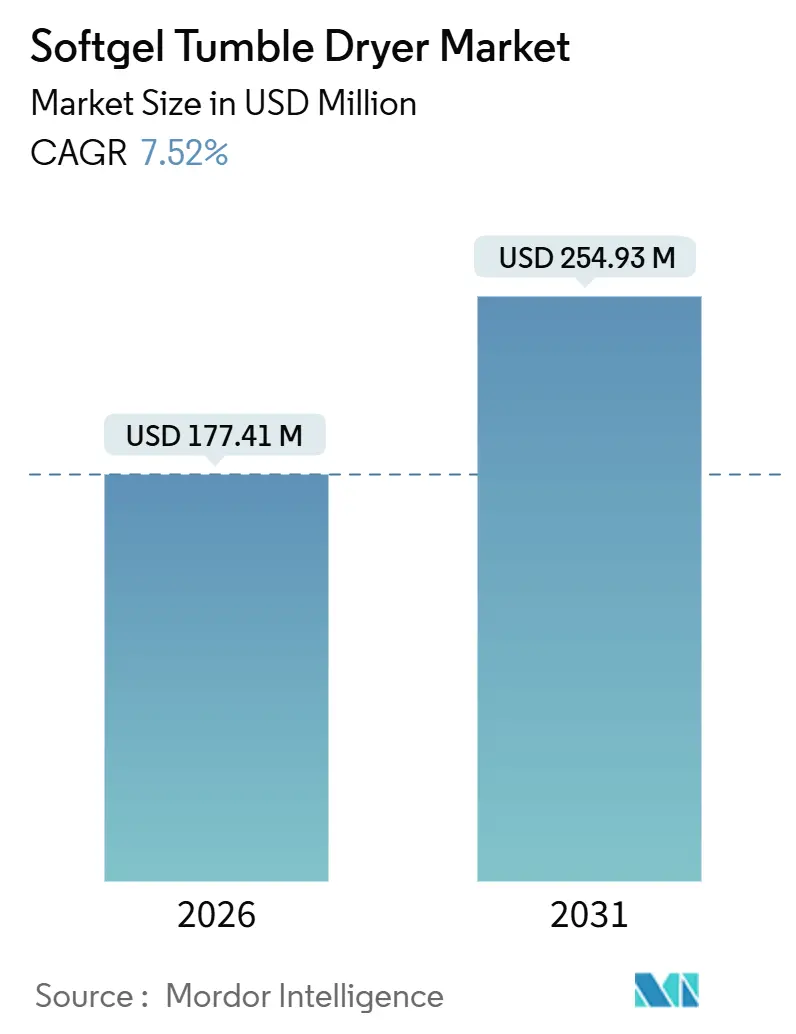
The Softgel Tumble Dryer Market size is estimated at USD 177.41 million in 2026, and is expected to reach USD 254.93 million by 2031, at a CAGR of 7.52% during the forecast period (2026-2031).
The expansion reflects pharmaceutical and nutraceutical manufacturers’ pivot from mere capacity additions toward higher-throughput, energy-compliant drying lines, particularly continuous tumble systems that compress cycle times to fewer than eight hours and trim floor-space needs by up to 40%. Pharmaceutical outsourcing, regulatory carbon pricing, and stricter energy-audit rules are driving procurement decisions as contract manufacturing organizations (CMOs) race to integrate heat-recovery modules and real-time energy monitoring into new installations. Continuous manufacturing directives, codified in ICH Q13, are pushing vendors to embed Process Analytical Technology (PAT) sensors directly inside drum assemblies, cutting residual-moisture variability and shortening validation cycles. Consolidation among equipment users and suppliers, exemplified by Novo Holdings’ USD 16.5 billion takeover of Catalent in late 2024, is intensifying the search for automated dryers that integrate seamlessly with electronic batch-record systems. Meanwhile, price competition from Chinese OEMs is lowering first-cost barriers but raising long-term support concerns, prompting multinationals to weigh total cost of ownership more carefully than initial capex.
Key Report Takeaways
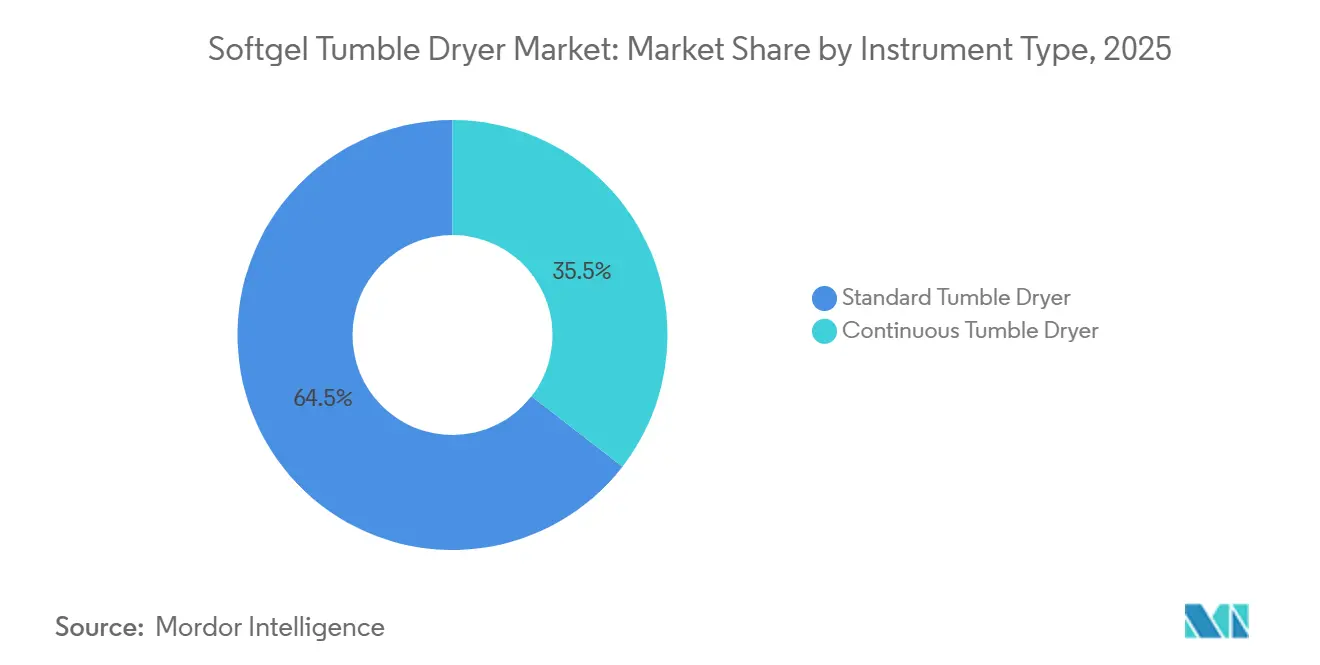
- By instrument type, standard tumble dryers led with 64.55% revenue share in 2025, while continuous tumble dryers are projected to expand at 9.25% CAGR through 2031.
- By capacity, large units captured 62.53% share in 2025, whereas medium units are forecast to rise at 9.85% CAGR to 2031.
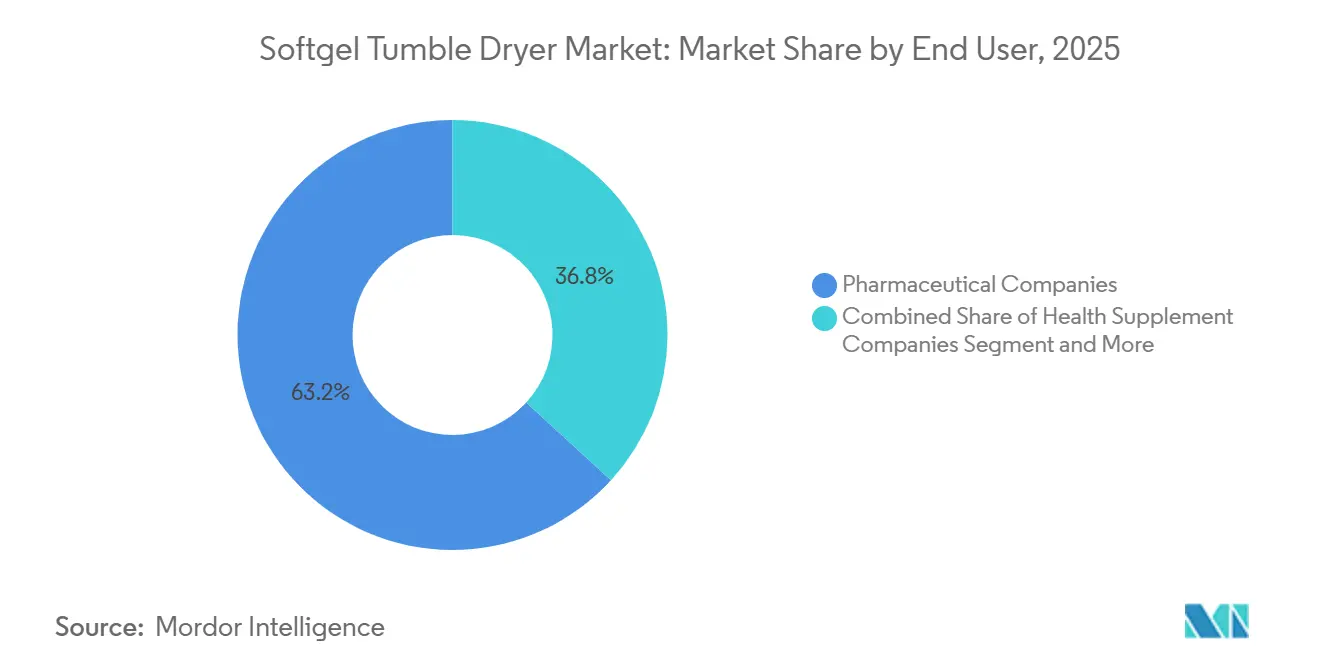
- By end user, pharmaceutical companies accounted for 63.23% of 2025 revenue, yet health supplement companies will advance at 10.55% CAGR through 2031.
- By geography, Asia-Pacific commanded 45.25% revenue share in 2025 and is set to grow at 9.21% CAGR between 2026 and 2031.
Note: Market size and forecast figures in this report are generated using Mordor Intelligence’s proprietary estimation framework, updated with the latest available data and insights as of January 2026.
Global Softgel Tumble Dryer Market Trends and Insights
Drivers Impact Analysis*
| Driver | (~) % Impact on CAGR Forecast | Geographic Relevance | Impact Timeline |
|---|---|---|---|
| Rising softgel demand in pharma & nutraceuticals | +1.8% | Global, with APAC and North America leading | Medium term (2-4 years) |
| Expansion of contract manufacturing organizations (CMOs) | +2.1% | Global, concentrated in APAC, North America, Europe | Short term (≤ 2 years) |
| Shift toward continuous manufacturing for higher throughput | +1.5% | North America & EU early adopters; APAC following | Medium term (2-4 years) |
| Growing adoption of automation & PAT in drying equipment | +1.2% | North America, EU, advanced APAC facilities | Medium term (2-4 years) |
| Energy-efficiency mandates & carbon-pricing pressures | +0.7% | EU primary; North America and APAC emerging | Long term (≥ 4 years) |
| AI-driven predictive maintenance reducing downtime | +0.9% | Global, led by large CMOs and pharma companies | Medium term (2-4 years) |
| Source: Mordor Intelligence | |||
Rising Softgel Demand in Pharma & Nutraceuticals
Softgel encapsulation is increasingly favored for lipophilic active ingredients because it masks taste, improves bioavailability, and allows precise dosing of oils and suspensions. Robinson Pharma lifted annual capacity to 23 billion units in 2024, reflecting a shift toward omega-3, cannabidiol, and fat-soluble-vitamin formulations that command superior margins. Pharmaceutical producers are also adopting softgels in oncology and immunology pipelines to protect moisture-sensitive actives, a trend amplified in Asia-Pacific where ACG’s Thailand plant is designed for 20 billion capsules per year. Consumer preference for plant-based gelatin alternatives such as HPMC and pullulan is creating new dryer-specification requirements that emphasize lower temperatures and gentler airflow. Dietary-supplement standards like NSF/ANSI 455-2 have narrowed allowable residual-moisture ranges, replacing end-batch testing with inline sensors that keep moisture below 1%. Collectively, these factors are boosting replacement demand for legacy batch dryers and propelling the softgel tumble dryer market.
Expansion of Contract Manufacturing Organizations (CMOs)
CMO capacity additions now outpace in-house pharmaceutical investments by a factor of three as brand owners channel capital toward biologics R&D. Lonza’s USD 93 million expansion featuring D90 capsule technology underscores the sector’s quest for debottlenecking solutions within existing cleanrooms. Delpharm Boucherville’s CAD 200 million program to hit 65 million softgel units per year illustrates how near-shore CMOs are courting North American clients eager to de-risk supply chains. Continuous tumble dryers, which reduce cycle times to six hours, let CMOs push asset-utilization rates above the 75% threshold needed for healthy margins. Vertical integration by instrumentation giants—Agilent’s USD 925 million acquisition of BIOVECTRA in 2024 and Thermo Fisher’s USD 4.1 billion deal for Solventum’s filtration division in 2025—signals strategic interest in CDMO infrastructure that relies on audit-ready, data-rich dryers compatible with 21 CFR Part 11.
Shift Toward Continuous Manufacturing for Higher Throughput
Continuous manufacturing, formalized under ICH Q13 and championed by the FDA’s 2024 roadmap, eliminates batch boundaries by maintaining softgels in constant motion under controlled airflow. Peer-reviewed work by Ramachandran et al. showed vacuum tumble drying achieving <1% final moisture in eight hours—half the time of tray systems—while reducing variability to below 5% coefficient of variation. Modular drum additions allow phased investment, an advantage for mid-scale Asian CMOs scaling from pilot to commercial volumes. In Europe, the Energy Efficiency Directive incentivizes dryers with air-to-air heat exchangers that recover 20-30% of thermal energy, a feature lowering annual gas bills by up to USD 25,000 per unit. Although PAT integration adds USD 50,000-100,000 to capex, rising labor and energy costs shorten payback periods to under two years, accelerating adoption of continuous dryers across the softgel tumble dryer market.
Growing Adoption of Automation & PAT in Drying Equipment
Regulators now expect real-time data streams instead of retrospective batch reports. An FDA 2024 poster introduced an AI-based controller that adjusts airflow and temperature every 30 seconds, trimming residual-moisture variability from ±0.8% to ±0.2%[1]FDA, “AI-Based Closed-Loop Control for Tumble Dryers,” fda.gov. Equipment suppliers have standardized Siemens PLCs and Mitsubishi inverters, enabling remote diagnostics that cut unplanned downtime. OpenText’s predictive-maintenance suite, using vibration and thermal sensors, forecasts bearing failures weeks in advance and schedules service during planned shutdowns. Automation eases skilled-labor shortages—in India, an estimated 300,000 additional technicians are needed by 2025—by shifting control logic from operator intuition to software algorithms viewed via touchscreens. China’s provincial standard T/ZZB 1207-2019 now mandates adaptive PID temperature control within ±0.1 °C for dosing heads, making intelligent automation a baseline for domestic sales. ISO 50001 certification, which requires energy-per-batch logging, is becoming a key differentiator for procurement teams.
Restraints Impact Analysis*
| Restraint | (~) % Impact on CAGR Forecast | Geographic Relevance | Impact Timeline |
|---|---|---|---|
| High CAPEX for advanced continuous tumble dryers | -1.4% | Global, most acute in emerging APAC markets | Short term (≤ 2 years) |
| Stringent GMP validation & documentation burden | -0.9% | Global, particularly North America & EU | Medium term (2-4 years) |
| Volatile gelatin/alt-gelatin prices affecting specs | -0.6% | Global, with APAC gelatin supply concentration | Short term (≤ 2 years) |
| Shortage of skilled PLC technicians in emerging markets | -0.8% | Emerging APAC, Latin America, MEA | Medium term (2-4 years) |
| Source: Mordor Intelligence | |||
High CAPEX for Advanced Continuous Tumble Dryers
Continuous systems cost USD 500,000-1.2 million versus USD 150,000-300,000 for standard units, a three-fold premium that presses the budgets of CMOs operating on sub-20% EBITDA. Auxiliary HEPA filters, explosion-proof panels, and 21 CFR Part 11 software add another 15-20% to the invoice, while GMP qualification can consume nine months and USD 100,000 in third-party services. Currency volatility further inflates costs in emerging markets; a 10% depreciation can erase thin project margins. Vendor financing remains scarce because lenders view tumble dryers as specialized assets with limited secondary markets. Consequently, smaller firms prolong the life of batch dryers, slowing the conversion rate toward continuous technology in the softgel tumble dryer market.
Stringent GMP Validation & Documentation Burden
Validation packs for a continuous dryer can exceed 3,000 pages and entail 150 test runs, each with hundreds of data points requiring cross-reference to acceptance criteria. The EMA’s 2024 revision of Annex 15 raised process-capability thresholds to Cpk ≥ 1.33 for critical attributes, often adding months of engineering runs before commercial release. Continuous systems, which lack discrete batch boundaries, must use PAT data to establish “virtual batches,” a concept not uniformly accepted across global regulators. Smaller CMOs frequently retain consultants at USD 1,500-2,500 per day to navigate multi-jurisdictional requirements, inflating total project cost. The documentation load delays capital upgrades and tempers the softgel tumble dryer market’s near-term growth.
*Our forecasts treat driver/restraint impacts as directional, not additive. The impact forecasts reflect baseline growth, mix effects, and variable interactions.
Segment Analysis
By Instrument Type: Continuous Systems Gain Despite Premium Pricing
Standard tumble dryers held 64.55% of 2025 revenue because most installed lines follow batch-processing layouts, and their USD 150,000-300,000 ticket makes them viable for firms producing 5-10 SKUs at 100-500 kg per batch. Operators manually tweak temperature and rotation speed based on periodic sampling, accepting 10-16 hour cycles in return for scheduling flexibility. Nevertheless, continuous tumble dryers are projected to grow at 9.25% CAGR, the quickest among all equipment categories, as CMOs chase higher asset utilization and lower labor costs. These systems pair with encapsulation machines running up to 200,000 capsules per hour, erasing drying bottlenecks and sustaining 24/7 production.
Continuous technology also aligns with corporate sustainability goals by reclaiming exhaust heat and cutting annual CO₂ emissions by 15-20 tons per unit. Regulatory clarity from ICH Q13 reduces compliance uncertainty, while energy savings and labor efficiencies cut the payback period to fewer than 24 months despite the higher sticker price. As a result, multinational CMOs in the United States, Germany, and Japan are locking in framework contracts that bundle encapsulators and dryers, further entrenching continuous systems in the softgel tumble dryer market.


By Capacity: Mid-Scale Dryers Capture CMO Scale-Up Demand
Large industrial dryers, rated 500-1,500 kg per cycle, commanded 62.53% revenue in 2025 because centralized plants rely on volume to achieve cost efficiencies. These units, priced up to USD 1.5 million, require dedicated suites, extensive utilities, and multi-year customer contracts to achieve acceptable utilization. Mid-scale dryers handling 200-500 kg per cycle are expected to advance at 9.85% CAGR, the fastest rate by capacity.
They satisfy regional CMOs in India, Southeast Asia, and Latin America that must scale beyond pilot runs yet lack the footprint or capex for giant lines. Modular mid-scale units support eight to twelve product changeovers monthly versus two to four for industrial machines, suiting nutraceutical clients with seasonal SKUs. Manufacturers such as Beijing Hanlin supply complete mid-scale lines that expand via plug-in drum modules, letting customers defer capex until orders materialize[2]Beijing Hanlin Aerospace Technology Development Co. Ltd., “CFM Series Product Catalog,” bjhanlin.com. ISO 14644 cleanroom compatibility and recipe-management software have made mid-scale offerings audit friendly, increasing their penetration across the softgel tumble dryer market.
By End User: Nutraceutical Surge Reshapes Dryer Specifications
Pharmaceutical companies generated 63.23% of 2025 revenue by requiring hermetically sealed OTC and prescription softgels. Buyers specify 316L stainless-steel construction, validated CIP systems, and fully documented 21 CFR Part 11 data logging to satisfy FDA and EMA auditors. Meanwhile, health-supplement companies are projected to expand at 10.55% CAGR to 2031, outpacing all other user groups. Demand for omega-3, vitamin D, curcumin, and cannabidiol softgels calls for gentler airflow and lower temperatures to preserve delicate botanicals, steering specifications toward vacuum tumble dryers and rapid changeover designs.
Contract manufacturers serving both sectors invest in dryers with recipe-management modules that store dozens of validated parameter sets, minimizing cross-contamination risk. Robinson Pharma’s rollout of inline weight-check capabilities illustrates how quality-assurance features once reserved for pharmaceuticals are migrating to the supplement space. Cosmetics and veterinary sub-segments remain niche yet are growing as premium pet-health and skincare brands adopt softgel formats. Collectively, shifting end-user needs are increasing demand for flexible, automation-ready equipment across the softgel tumble dryer market.

Geography Analysis
Asia-Pacific held 45.25% revenue share in 2025 and is forecast to grow at 9.21% CAGR through 2031, reflecting its dominance in gelatin production and its role as the world’s leading exporter of empty capsules. China’s equipment ecosystem now delivers containment-ready softgel lines validated by Bureau Veritas, reducing reliance on European imports and shortening lead times for domestic CMOs. ACG’s Thailand complex, spanning 175,000 m² and engineered for 20 billion capsules annually, demonstrates the massive scale at which Asian facilities are being built to capture global outsourcing contracts. Further, the region’s labor-cost advantage is narrowing as automation reduces dependency on operators; continuous dryers with adaptive PID control help mitigate the shortage of PLC technicians forecast by India’s workforce councils. Consolidation moves such as Sansho Miyako’s absorption of Kamata in March 2025 show Japanese firms shoring up business-continuity capabilities to secure multinational orders[3]Sansho Miyako Pharmaceutical Co. Ltd., “Press Release on Kamata Integration,” sunsho.co.jp.
North America maintains a sizeable share, bolstered by near-shoring strategies and premium-ingredient capsules that command 2-3× higher ex-factory prices than commodity fish-oil gels. Canadian investments—Delpharm’s CAD 200 million expansion in Quebec, for instance—promise quicker lead times for U.S. customers wary of trans-Pacific disruptions. The FDA’s public endorsement of AI-driven closed-loop drying in its 2024 poster has accelerated procurement of PAT-enabled dryers nationwide. Simultaneously, U.S. sustainability targets and rising utility costs elevate interest in heat-recovery modules, making energy efficiency a primary evaluation criterion.
Europe is reshaping procurement around carbon compliance. The EU Emissions Trading System priced CO₂ at EUR 65-85 per ton in 2024, nudging manufacturers toward dryers that reclaim up to 30% thermal energy and log consumption for ISO 50001 audits. Germany and the United Kingdom lead on adoption of continuous lines equipped with air-to-air heat exchangers and predictive-maintenance analytics. South America and the Middle East & Africa are early in the adoption curve; national incentives in Brazil and Saudi Arabia aim to localize softgel production, but volumes remain modest, and much of the installed base still relies on refurbished batch dryers. Nonetheless, as regulatory frameworks tighten globally, demand for automated, energy-efficient systems is expected to expand the softgel tumble dryer market worldwide.


Competitive Landscape
The softgel tumble dryer market is moderately fragmented, comprising more than twenty active suppliers that range from long-standing European and Japanese OEMs to cost-focused Chinese entrants. European and Japanese brands command 30-35% price premiums due to precision machining and extensive validation dossiers, yet they face share erosion in Asia-Pacific and Latin America where Chinese OEMs offer 12- to 18-month payment plans and local-language technical support. Vertical integration is a rising theme; ACG bundles encapsulators, dryers, and auxiliary systems under multi-year service agreements, locking customers into proprietary ecosystems. Chinese players such as Zhejiang Tianrui and Joysun now embed Siemens PLCs and PAT interfaces to address multinational audit requirements, narrowing historical technology gaps and putting pricing pressure on Western rivals.
Technology differentiation centers on automation, energy efficiency, and PAT readiness. Vendors capable of delivering ISO 50001-certified energy-logging, inline near-infrared moisture probes, and remote diagnostics gain preference among CMOs serving regulated markets. Containment solutions for high-potency APIs are another battleground; Truking’s Bureau-Veritas-validated systems address operator-safety mandates and are drawing interest from oncology drug makers. Modular and hybrid dryer designs, able to toggle between batch and continuous modes, are emerging as an attractive compromise for facilities balancing high-volume commodity runs with low-volume clinical batches. Suppliers investing in IoT-based predictive maintenance stand to capture after-sales revenue while boosting customers’ equipment uptime—an increasingly important buying criterion.
M&A and alliances continue to reshape the field. Sansho Miyako’s merger with Kamata expanded its footprint and machine-development talent pool, signaling a push to shorten lead times and secure Japanese supply chains against geopolitical risks. Instrumentation majors are also making inroads: Agilent’s and Thermo Fisher’s recent acquisitions position them to layer analytics and filtration technologies onto CDMO platforms that rely on modern tumble dryers. Competitive intensity is expected to increase as OEMs race to embed intelligence, validate energy savings, and harmonize documentation packages across jurisdictions, all while keeping entry-level price points attractive to emerging-market buyers.
Softgel Tumble Dryer Industry Leaders
Changsung Softgel System Ltd.
Long March Tianmin
SKY Softgel & Pack Co., Ltd.
Pharmagel Technology
Technophar
- *Disclaimer: Major Players sorted in no particular order


Recent Industry Developments
- December 2025: Robinson Pharma expanded its U.S. site to 13 softgel lines, up from nine, adding state-of-the-art encapsulation and tumble-drying capacity.
- September 2025: Althera Laboratories obtained GMP approval for a new commercial-scale facility capable of complex tablets and capsules, including softgels.


Global Softgel Tumble Dryer Market Report Scope
As per the scope of the report, a softgel tumble dryer is specialized equipment used to dry softgel capsules after manufacturing. Softgel capsules are gelatin-based shells filled with liquids, oils, or semi-solids. During production, these capsules often contain excess moisture that needs to be removed to ensure stability, quality, and shelf life.
The softgel tumble dryer market is segmented by instrument type into standard tumble dryers and continuous tumble dryers. By capacity, the market is categorized into small (laboratory/pilot), medium (mid-scale), and large (industrial). Based on end users, the market is divided into pharmaceutical companies, health supplement companies, contract manufacturing organizations, and others (cosmetics, veterinary). Geographically, the market is analyzed across North America, Europe, Asia-Pacific, the Middle East and Africa, and South America. The Market Forecasts are Provided in Terms of Value (USD).
| Standard Tumble Dryer |
| Continuous Tumble Dryer |
| Small (Laboratory / Pilot) |
| Medium (Mid-scale) |
| Large (Industrial) |
| Pharmaceutical Companies |
| Health Supplement Companies |
| Contract Manufacturing Organisations |
| Others (Cosmetics, Veterinary) |
| North America | United States |
| Canada | |
| Mexico | |
| Europe | Germany |
| United Kingdom | |
| France | |
| Italy | |
| Spain | |
| Rest of Europe | |
| Asia-Pacific | China |
| India | |
| Japan | |
| Australia | |
| South Korea | |
| Rest of Asia-Pacific | |
| Middle East and Africa | GCC |
| South Africa | |
| Rest of Middle East and Africa | |
| South America | Brazil |
| Argentina | |
| Rest of South America |
| By Instrument Type | Standard Tumble Dryer | |
| Continuous Tumble Dryer | ||
| By Capacity | Small (Laboratory / Pilot) | |
| Medium (Mid-scale) | ||
| Large (Industrial) | ||
| By End User | Pharmaceutical Companies | |
| Health Supplement Companies | ||
| Contract Manufacturing Organisations | ||
| Others (Cosmetics, Veterinary) | ||
| By Geography | North America | United States |
| Canada | ||
| Mexico | ||
| Europe | Germany | |
| United Kingdom | ||
| France | ||
| Italy | ||
| Spain | ||
| Rest of Europe | ||
| Asia-Pacific | China | |
| India | ||
| Japan | ||
| Australia | ||
| South Korea | ||
| Rest of Asia-Pacific | ||
| Middle East and Africa | GCC | |
| South Africa | ||
| Rest of Middle East and Africa | ||
| South America | Brazil | |
| Argentina | ||
| Rest of South America | ||


Key Questions Answered in the Report
What growth rate is projected for softgel tumble dryer demand between 2026 and 2031?
The market is forecast to expand at a 7.52% CAGR, climbing from USD 177.41 million in 2026 to USD 254.93 million by 2031.
Which equipment type is set to grow fastest?
Continuous tumble dryers, which shorten drying cycles to six-eight hours, are projected to register a 9.25% CAGR through 2031.
Why are CMOs investing heavily in new tumble dryers?
Outsourcing demand is rising, and continuous dryers improve asset utilization, reduce labor, and meet energy-audit requirements, making them key to competitive CMO economics.
How are energy regulations influencing purchase decisions?
EU carbon pricing and ISO 50001 audits favor dryers with heat-recovery modules and batch-level energy logging, driving upgrades in Europe and beyond.
What challenges limit wider adoption of continuous dryers?
High capex - USD 500,000-1.2 million per unit - and extensive GMP validation requirements delay purchases for smaller manufacturers.
Which region holds the largest share of installed tumble dryers?
Asia-Pacific commands the largest installed base, accounting for 45.25% of 2025 revenue and leading global capacity additions.
Page last updated on:





