
Sodium Tripolyphosphate Market Size and Share
Market Overview
| Study Period | 2021 - 2031 |
|---|---|
| Market Size (2026) | USD 1.31 Billion |
| Market Size (2031) | USD 1.64 Billion |
| Growth Rate (2026 - 2031) | 4.64 % |
| Fastest Growing Market | Asia-Pacific |
| Largest Market | Asia-Pacific |
| Market Concentration | Medium |
Major Players
*Disclaimer: Major Players sorted in no particular order Image © Mordor Intelligence. Reuse requires attribution under CC BY 4.0. |
|
Sodium Tripolyphosphate Market Analysis by Mordor Intelligence
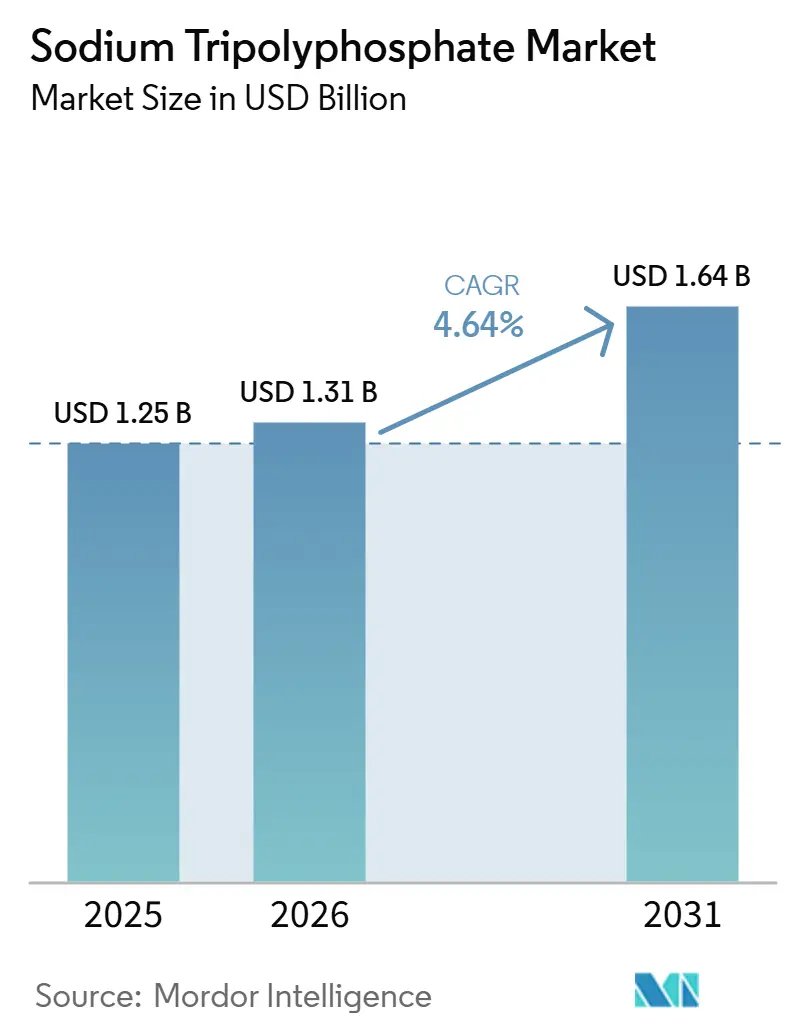
The Sodium Tripolyphosphate Market size is expected to grow from USD 1.25 billion in 2025 to USD 1.31 billion in 2026 and is forecast to reach USD 1.64 billion by 2031 at 4.64% CAGR over 2026-2031. The sodium tripolyphosphate market continues to maintain a stable position, as the material performs multiple functions across detergents, food processing, ceramics, and water systems. This multifunctionality slows replacement decisions, even as regulations tighten in some regions. Broad-use cleaning formulations continue to anchor demand, while faster growth in processed foods and industrial water treatment is expanding the revenue base and reducing reliance on a single application stream. The sodium tripolyphosphate market also shows a clear regional divide. Asia-Pacific benefits from production scale, lower input costs, and rising local consumption, while Europe and North America remain more affected by detergent-related phosphorus controls and compliance costs. Competitive dynamics increasingly reflect the contrast between commodity pressure in standard grades and stronger margins in food-grade or specialty-certified materials. This trend is encouraging established producers to upgrade their product mix and strengthen customer support. Over the next five years, growth is likely to remain steady rather than abrupt, as substitution pressure persists in regulated regions but continues to face slower adoption cycles, certification barriers, and performance trade-offs across several end-use applications.
Key Report Takeaways
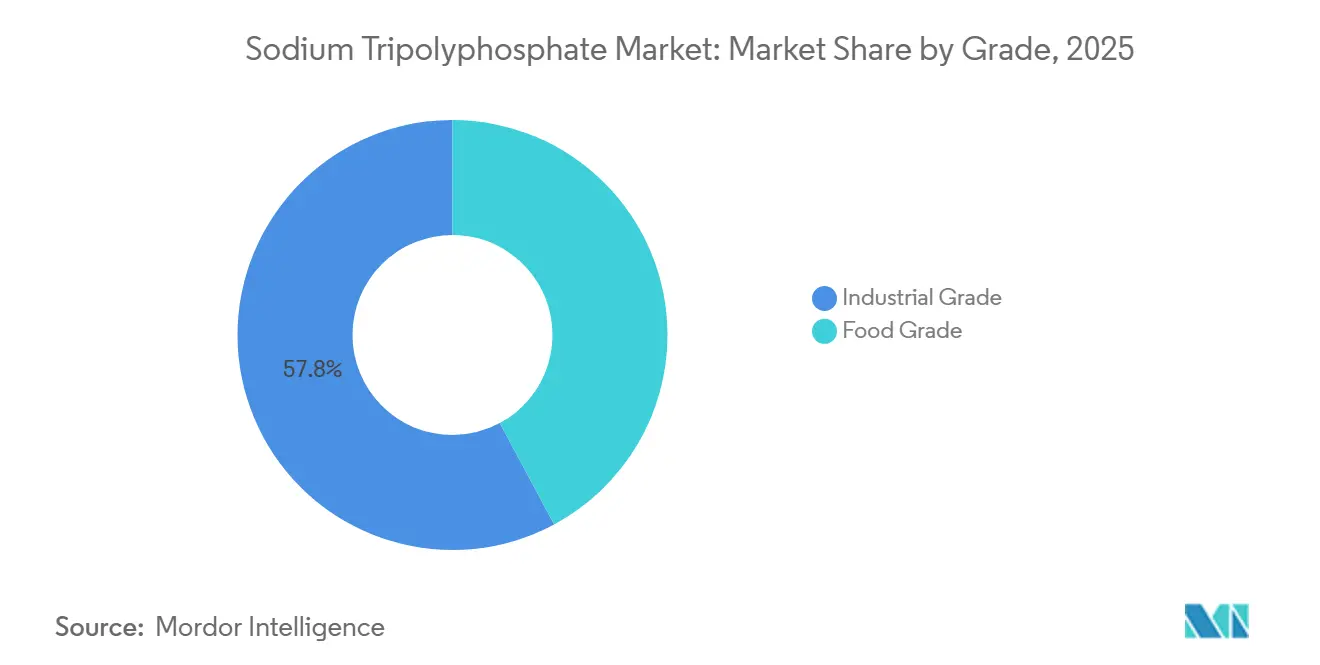
- By grade, industrial grade held 57.84% of the sodium tripolyphosphate market size in 2025, while food grade is projected to expand at a 5.32% CAGR through 2031.
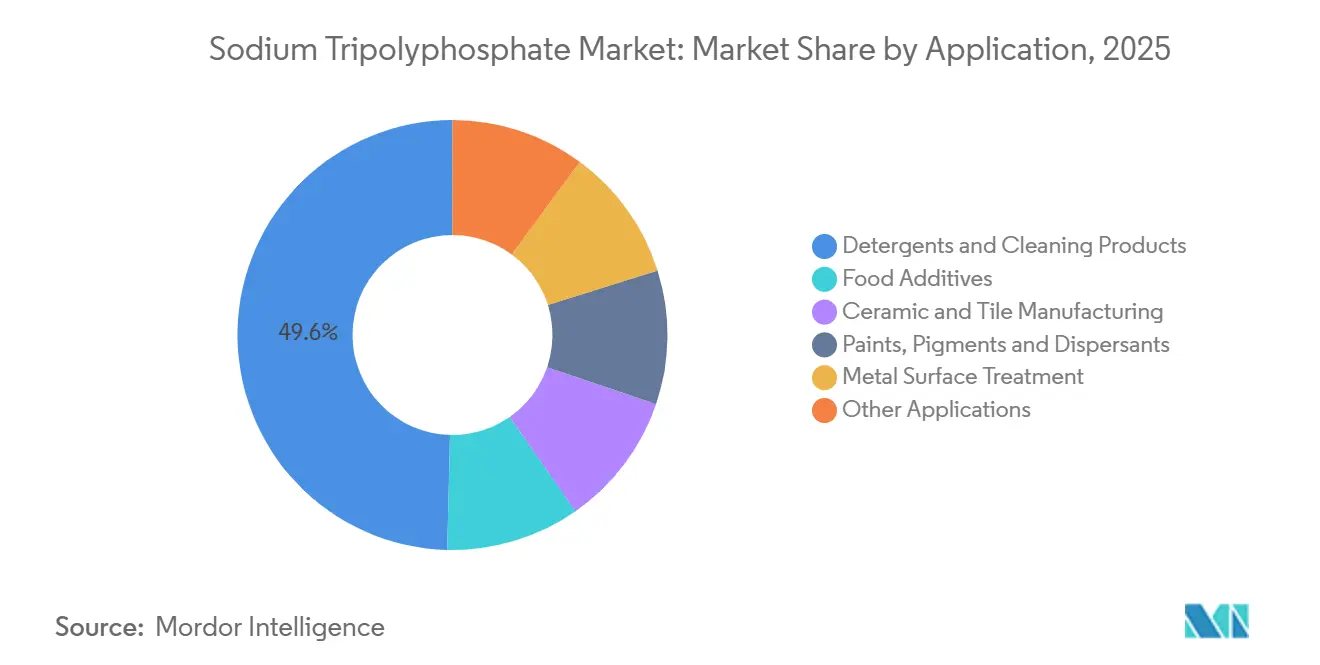
- By application, detergents and cleaning products accounted for 49.62% of the sodium tripolyphosphate market size in 2025, while food additives is forecast to grow at a 5.38% CAGR through 2031.
- By form, powder captured 63.11% share in 2025, while granular is expected to record the highest CAGR at 5.11% through 2031.
- By end-use industry, detergent manufacturers held 47.39% share of consumption in 2025, while water treatment is projected to expand at a 5.44% CAGR through 2031.
- By geography, Asia-Pacific held 52.82% of global sodium tripolyphosphate market share in 2025 and is also forecast to post the fastest regional CAGR at 5.12% through 2031.
Note: Market size and forecast figures in this report are generated using Mordor Intelligence’s proprietary estimation framework, updated with the latest available data and insights as of January 2026.
Market Trends and Insights
Drivers Impact Analysis of Sodium Tripolyphosphate Market*
| Driver | (~) % Impact on CAGR Forecast | Geographic Relevance | Impact Timeline |
|---|---|---|---|
| Rising Demand For STPP In Household And Industrial Detergent Formulations | +1.3% | Global, concentrated in APAC and MEA | Short term (≤ 2 years) |
| Growing Use Of STPP In Water Treatment For Scale Inhibition And Metal Ion Sequestration | +0.7% | Global, APAC core with spill-over to MEA | Medium term (2-4 years) |
| Increasing Demand For Processed Foods Driving The Use Of Food-Grade Phosphate Additives | +0.6% | APAC and North America | Medium term (2-4 years) |
| Growing Demand For High-Purity STPP In Specialty Industrial Applications | +0.4% | Global, concentrated in Europe and APAC | Long term (≥ 4 years) |
| Rising Industrialization And Urbanization Supporting Demand For Cleaning And Water Treatment Chemicals | +0.7% | APAC core, spill-over to MEA and South America | Medium term (2-4 years) |
| Source: Mordor Intelligence | |||
Rising Demand for STPP in Household and Industrial Detergent Formulations
Detergent and cleaning product manufacturers are expected to remain the largest end-use base in the sodium tripolyphosphate market in 2025, accounting for 47.39% of total consumption and maintaining STPP’s role as a core builder in powdered cleaning systems. This dependence remains particularly strong in hard-water markets across South Asia, Southeast Asia, and parts of Africa, where STPP continues to offer a practical balance of cleaning efficiency, formulation stability, and cost control that many phosphate-free systems do not fully match at scale[1]Eco-Friendly STPP in Detergents: Innovations & Sustainable Alternatives." Accessed 2024. https://sodiumtripolyphosphate.com/eco-friendly-stpp-in-detergents-innovations-sustainable-alternatives. The institutional and industrial cleaning channel further strengthens demand, as food-service sanitation, automatic dishwashing, and automotive cleaning products often use higher STPP loading rates than household detergents and face a different pace of regulatory scrutiny compared with retail consumer brands. Product standards in China are also increasing purity requirements in cleaning formulations, supporting integrated producers that control raw material supply and can deliver consistent quality to large-volume detergent accounts. As a result, the sodium tripolyphosphate market continues to benefit from volume support and selective premiumization within cleaning applications, rather than a simple shift toward the lowest commodity price.
Growing Use of STPP in Water Treatment for Scale Inhibition and Metal Ion Sequestration
Water treatment is the fastest-growing end-use channel in the sodium tripolyphosphate market and is forecast to grow at a CAGR of 5.44% through 2031. STPP remains useful in this application because it interferes with early crystal formation and keeps scale-forming ions dispersed, preventing them from settling on heat-transfer surfaces. Technical review literature on sequestration and anti-scaling practices discusses this mechanism. Industrial capacity additions across Southeast Asia, the Gulf region, and South Asia are reinforcing demand, as power plants, process industries, commercial facilities, and data centers require dependable treatment programs for cooling towers and boiler circuits. Buyers are also showing greater interest in higher-purity grades with more predictable chelating performance, shifting supplier evaluation away from price alone and toward batch consistency, documentation, and application support. Public investment in municipal water systems across India and ASEAN economies adds another source of demand, as institutional procurement is beginning to complement the historic dominance of private industrial buyers. This pattern gives the sodium tripolyphosphate market a firmer medium-term growth layer that is less dependent on household detergent cycles.
Increasing Demand for Processed Foods Driving the Use of Food-Grade Phosphate Additives
Food additives represent the fastest-growing application in the sodium tripolyphosphate market and are projected to expand at a CAGR of 5.38% through 2031. In the United States, 21 CFR 173.370 recognizes sodium tripolyphosphate for specific food uses, including ready-to-eat cooked sausages at levels not exceeding 0.5% by weight, supporting its continued use in regulated processed food systems [2]U.S. Food and Drug Administration, “21 CFR 173.370, Sodium Tripolyphosphate,” Electronic Code of Federal Regulations, ecfr.gov . Its commercial appeal stems from processing economics, as STPP helps stabilize proteins and retain water, improving yield and saleable output in meat and seafood operations that face pressure from raw material costs and throughput efficiency. As a result, food processors show less sensitivity to small input price changes than buyers in purely commodity applications, particularly when product performance and audit readiness deliver direct operational value. Documentation requirements linked to food safety systems, halal certification, and national compliance standards also favor established suppliers that can maintain traceability, heavy-metal control, and customer audit support. Consequently, the sodium tripolyphosphate market is witnessing rising food-grade demand, driven not only by volume growth but also by higher standards that limit easy entry.
Rising Industrialization and Urbanization Supporting Demand for Cleaning and Water Treatment Chemicals
Urbanization and industrial expansion continue to support the sodium tripolyphosphate market across multiple applications rather than through a single demand channel. As populations move to cities, detergent usage, packaged food purchases, formal retail distribution, and reliance on municipal water systems tend to increase simultaneously, broadening STPP consumption in a way that a single substitute strategy cannot easily replicate. India clearly reflects this trend, as its demand trajectory connects the formalization of fast-moving consumer goods, rising packaged protein consumption, and investment in industrial water infrastructure into one expanding consumption base. Vietnam and India also recorded stronger ceramic manufacturing activity, with demand for STPP-based ceramic deflocculants rising by 7% as construction-linked tile output increased and slurry performance remained critical to production economics. Powder detergent formats continue to hold strong positions across many parts of Asia and Africa, keeping STPP usage elevated compared to markets that have shifted more substantially toward phosphate-free liquid formats. This broad urban and industrial base gives the sodium tripolyphosphate market a more diversified demand profile, even as regulatory pressure increases in Western economies.
Restraints Impact Analysis of Sodium Tripolyphosphate Market*
| Restraint | (~) % Impact on CAGR Forecast | Geographic Relevance | Impact Timeline |
|---|---|---|---|
| Stringent Regulations On Phosphate Content In Detergents And Cleaning Products | -1.0% | North America and EU | Short term (≤ 2 years) |
| Environmental Concerns Related To Eutrophication From Phosphate Discharge | -0.8% | Global, most acute in Europe and East Asia | Medium term (2-4 years) |
| Increasing Adoption Of Phosphate-Free Builders And Alternative Chelating Agents | -0.9% | Europe and North America, with spill-over to APAC | Medium term (2-4 years) |
| Source: Mordor Intelligence | |||
Stringent Regulations on Phosphate Content in Detergents and Cleaning Products
The regulatory climate for phosphate use in detergents is expected to tighten further in 2025 and 2026, remaining one of the clearest restraints on the sodium tripolyphosphate market. In June 2025, the Council of the European Union and the European Parliament are expected to reach a provisional agreement requiring the European Commission to assess, within two years, the feasibility and environmental effects of further phosphorus reductions across most detergent categories. This development matters because it may not create an immediate global demand shock, but it will increase the planning burden for suppliers serving Europe. These suppliers will need to align formulation strategies, product documentation, and portfolio design with potentially tighter future phosphorus limits. In the United States, nutrient-focused discharge controls under the EPA permit framework continue to reinforce reformulation pressure in industrial and institutional cleaning channels by increasing scrutiny of downstream phosphorus loads in wastewater. As a result, the regulatory landscape is becoming more uneven, with Europe and North America moving toward tighter phosphate accountability while high-growth Asia-Pacific markets remain more open to continued STPP use. This gap forces multinational suppliers in the sodium tripolyphosphate market to manage parallel product lines and compliance systems, raising operating complexity even where end-use demand remains stable.
Environmental Concerns Related to Eutrophication from Phosphate Discharge
Environmental concerns related to eutrophication continue to pressure the sodium tripolyphosphate market, as phosphate discharges from wastewater and industrial effluent directly contribute to algal blooms, oxygen depletion, and declining freshwater ecosystem quality. Research published in Environmental Research Letters in 2026 showed that current EU policies would reduce nutrient concentrations only modestly through 2050 and that major river basins would still require additional phosphorus reductions of 10% to 20% to achieve good ecological status. The United Kingdom has also established a clear policy direction through its wastewater target delivery framework, which aims to reduce total phosphorus discharge to freshwater by 80% by December 2038, compared with a 2020 baseline. These developments extend the debate beyond detergent bans and encourage industrial users, utilities, and procurement teams to assess phosphate use more carefully across the full operating chain. They also increase pressure on producers to provide technical documentation, handling guidance, and compliance support to customers facing greater scrutiny from regulators and local communities. Even where authorities have not yet imposed strict restrictions, this environmental pressure strengthens the commercial case for phosphate-free builders and other alternative chelating systems in selected applications.
*Our forecasts treat driver/restraint impacts as directional, not additive. The impact forecasts reflect baseline growth, mix effects, and variable interactions.
Sodium Tripolyphosphate Market Segment Analysis
By Grade:
Industrial Grade Anchors Volume, Food Grade Accelerates on Processed Protein GrowthIndustrial grade is expected to hold a 57.84% share in 2025 and remain the largest grade in the sodium tripolyphosphate market, as detergent, ceramic tile, and industrial water treatment applications continue to account for the largest tonnage base. However, food grade is forecast to register a CAGR of 5.32% through 2031, making it the faster-growing segment of the sodium tripolyphosphate market as processed meat, seafood, and convenience food production expands across Asia-Pacific and North America. This split indicates that high-volume industrial applications continue to lead current demand, while future value creation is shifting toward stricter, specification-driven food applications. Food-grade procurement has higher entry barriers, as customers require consistent documentation, lower contaminant risk, and a stronger audit trail than standard industrial sales typically demand.
The grade structure also influences competition across the sodium tripolyphosphate industry. Industrial grade functions more as a scale-driven business, where low-cost production, raw material integration, and broad application reach matter more than brand positioning alone. Producers serving this segment benefit from exposure to multiple end-use channels, which helps protect volumes when demand slows in one application. At the same time, buyers are placing greater emphasis on phase-controlled and application-tuned industrial grades, especially where detergency or deflocculant performance requires greater consistency than a standard commodity product can provide. Food grade remains a more selective segment, as certification breadth, traceability, and technical support often determine supplier approval before price becomes the deciding factor. As a result, the sodium tripolyphosphate market is not only split between large and small grades but also between a commodity lane and a premium, compliance-led lane, each with distinct barriers and margin structures.
Food processors also tend to retain approved vendors for longer periods once validation is complete, which can make food-grade revenue more stable than spot-driven industrial sales. This dynamic encourages established producers to shift capacity and commercial focus toward higher-specification output, even though industrial grade continues to dominate total volume.



By Application:
Detergent Leadership Intact, Food Additives Momentum BuildsDetergents and cleaning products are projected to hold a 49.62% application share in 2025, maintaining their position as the largest application base in the sodium tripolyphosphate market. This dominance is supported by STPP’s established role in water softening, dispersing, and cleaning performance across powdered formulations. Food additives represent the fastest-growing application and are projected to expand at a CAGR of 5.38% through 2031, indicating that the sodium tripolyphosphate market is gaining stronger support from regulated food processing applications rather than relying solely on legacy cleaning uses. This combination keeps the application mix balanced between a mature anchor segment and a faster-growing, specification-sensitive segment. It also reduces the risk that a single regulatory change in detergents will fully determine the direction of total market demand.
Within cleaning applications, the institutional segment remains important because automatic dishwashing, food-service sanitation, and industrial surface cleaning often require stronger formulations and involve different customer priorities than mass retail laundry products. These buyers typically prioritize performance consistency, cleaning efficiency, and compatibility with operating systems, which helps preserve STPP demand even as consumer detergent brands move more slowly or face reformulation pressure. Food additives are advancing because processors require moisture retention, protein stabilization, and yield support across meat, seafood, dairy, and bakery lines. These functions align directly with commercial production economics. Ceramic and tile manufacturing remains a steady technical application in the sodium tripolyphosphate market because STPP supports slurry deflocculation without damaging plaster molds. This keeps it relevant in high-end porcelain and sanitaryware production, where process stability is critical. Paints, pigments, dispersants, and metal surface treatment remain more mature applications, with growth tracking industrial output rather than significant product innovation. As a result, producers that can offer food-grade or application-engineered products are likely to capture more value than suppliers focused only on bulk detergent-oriented demand.
The application mix, therefore, indicates a gradual improvement in revenue quality, with faster growth coming from applications that require stronger documentation and closer technical engagement. This trend does not weaken the role of cleaning products in the sodium tripolyphosphate market, but it shifts part of future competition toward specialized formulation support.
By Form:
Powder Retains Broad Industrial Utility, Granular Gains Momentum in Precision DosingPowder is expected to hold a 63.11% share in 2025 and remain the leading form in the sodium tripolyphosphate market, as it dissolves reliably across temperature ranges and integrates well with detergent spray-drying, dry blending, and various food-processing workflows. The granular form is forecast to grow at a CAGR of 5.11% through 2031, making it the faster-growing form as automated dosing systems gain wider adoption in utilities and industrial production lines. This indicates that the form mix is shifting not because powder is losing relevance, but because customers are adding process requirements that granular material can address more effectively in selected settings. Therefore, the sodium tripolyphosphate market continues to rely on powder for scale, while granular products gain ground where handling control and dosing precision are more important.
Powder remains the preferred form in many applications because its dispersion profile helps manufacturers maintain uniform batches, which is important in detergents and food systems where consistency affects both process performance and finished-product quality. Granular material is becoming more attractive in water treatment and some food operations because its controlled particle size can reduce dust, improve flow behavior, and perform better with volumetric or gravimetric equipment that requires steady feed characteristics. This gives granular products a commercial advantage in accounts that have already invested in automation and aim to reduce handling losses or dosing errors. In the sodium tripolyphosphate industry, this trend also creates room for modest price premiums where producers have the required calcination and granulation capabilities. European utility specifications and the expansion of automated lines in China and India both support this shift, although for different reasons: Europe’s transition is tied more to system design, while the shift in China and India is driven more by production modernization. As a result, powder retains the broadest utility base, while granular products take on a larger role in newer, more controlled operating environments.
Form selection is also becoming a subtle differentiator in supplier relationships because it affects storage, transfer, dosing, and worker handling conditions beyond pure chemistry. As a result, the sodium tripolyphosphate market is seeing value shift toward suppliers that can align product form with customer process design, rather than treating all end uses as interchangeable bulk demand.
By End-Use Industry:
Detergent Manufacturers Drive Baseline Demand, Water Treatment Leads Forward GrowthDetergent manufacturers are projected to account for 47.39% of end-use consumption in 2025, remaining the primary demand base in the sodium tripolyphosphate market. This share reflects the continued importance of powdered household and industrial cleaning products across many regions. Water treatment is expected to record the fastest growth, at a CAGR of 5.44% through 2031, strengthening the sodium tripolyphosphate market’s link to industrial infrastructure and municipal utility investment. This end-use balance indicates that current volume demand continues to depend on cleaning applications, while the next phase of expansion is likely to come from systems that manage scaling, hardness, and metal-ion control. It also shows that demand drivers are becoming more diverse across customer types, purchase criteria, and selling cycles.
Household and industrial cleaning remain key applications because manufacturers continue to value STPP as a builder in markets where powder detergents dominate and where institutional products require stronger performance in demanding operating environments, such as food service, healthcare, and vehicle care. The water treatment channel is expanding due to several factors, including new industrial plant construction in Southeast Asia and the Gulf, rehabilitation of older systems in developed markets, and greater focus on operating efficiency in cooling and boiler circuits. Food and beverage users are also increasing their role in the sodium tripolyphosphate market, as meat, seafood, and ready-meal processors expand procurement to support yield, texture, and moisture control. Ceramics demand remains linked to construction and real estate cycles in Asia, while paints, coatings, and metal processing are more mature applications that primarily compete on cost and process fit. Over time, this pattern is expected to reduce the relative share of detergent manufacturers in total demand, although they are likely to remain the single largest end-use group.
The end-use structure also influences how suppliers organize sales and technical service. Detergent accounts are typically large and volume-driven, while water and food customers often require more process-specific support. As a result, portfolio balance is becoming increasingly important for producers seeking stable volume exposure alongside higher-value growth opportunities.
Geography Analysis
APAC Sodium Tripolyphosphate Market
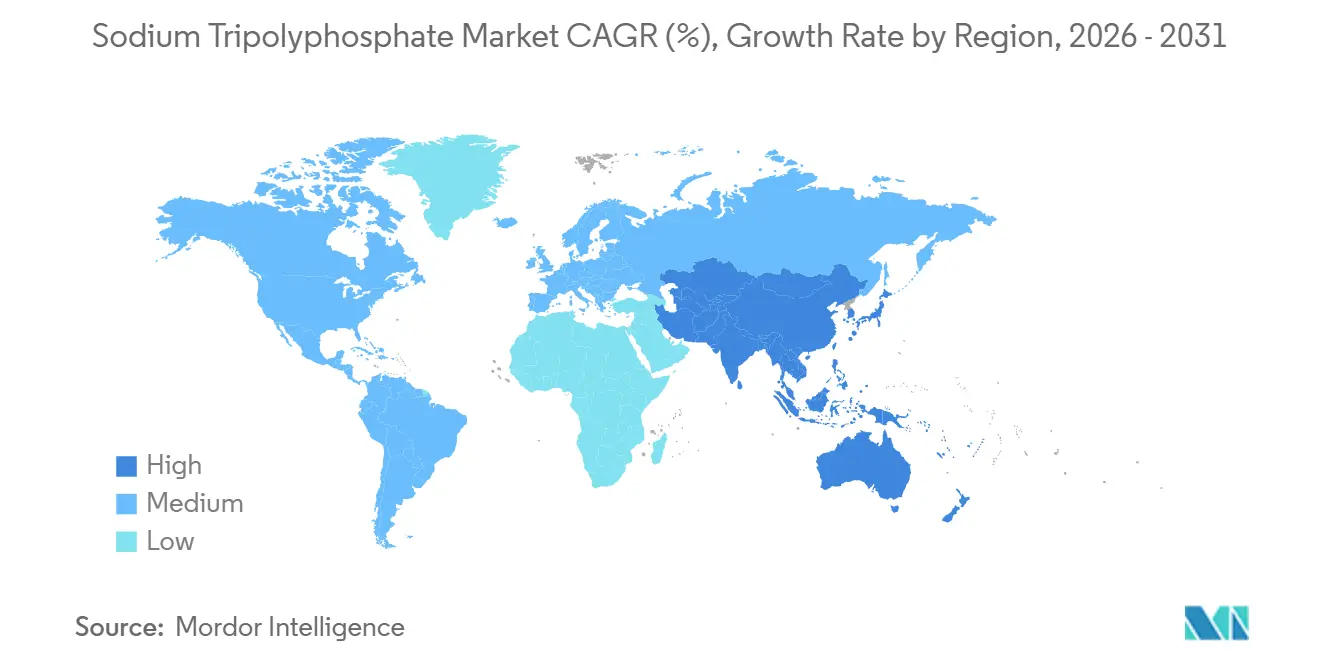
Asia-Pacific is expected to hold 52.82% of the global share in 2025 and record the fastest regional CAGR, at 5.12%, through 2031. This position keeps the region at the center of the sodium tripolyphosphate market in terms of both supply and demand. China remains the production backbone, as its domestic phosphate rock availability and integrated refining capacity give producers lower structural costs than many Western counterparts can achieve. This cost advantage shapes export pricing and regional competition. It also strengthens China’s influence in standard-grade materials, where scale and raw material control carry more weight than specialty branding. India remains the most important growth engine outside China, supported by urbanization, packaged food demand, the formalization of fast-moving consumer goods, and investment in industrial water infrastructure. These factors support broader STPP consumption across multiple applications. Vietnam and Indonesia add further volume through detergents and ceramics, while Japan and South Korea focus more on higher-purity food-grade and specialty industrial uses.
North America and Europe Sodium Tripolyphosphate Market
North America and Europe present a different operating environment for the sodium tripolyphosphate market, as regulation plays a larger role in shaping demand and product strategy. In Europe, industrial-grade consumption remains steady in water treatment, ceramics, and specialty cleaning applications. However, the expected 2025 agreement on detergent regulation is likely to make future phosphorus policy a more active planning issue for suppliers and buyers. The United States remains more dependent on food processing, institutional cleaning, and industrial water treatment, as many household laundry products had already shifted toward phosphate-free formulations before the current forecast period. As a result, food processing provides a relatively stable demand floor in the region, supported by regulated usage pathways and a large installed base in meat, poultry, and seafood manufacturing. Russia remains a notable consumer due to its industrial base, although supply security concerns and shifts in trade flows complicate its position within the broader European geography.
MEA and South America Sodium Tripolyphosphate Market
South America, the Middle East, and Africa remain smaller in absolute size, but they continue to offer meaningful expansion opportunities for the sodium tripolyphosphate market. Brazil and Argentina support demand through food processing, poultry and seafood exports, and domestic detergent manufacturing linked to broader consumer goods growth. In the Middle East and Africa, Saudi Arabia and South Africa remain key markets. Water treatment plays a larger role in these markets, as industrial water management, desalination, and cooling infrastructure remain operational priorities in arid environments. Sub-Saharan Africa also offers gradual volume upside as detergent adoption rises with urban growth and imports from Asia continue to address local supply gaps where domestic production remains limited.

Competitive Landscape
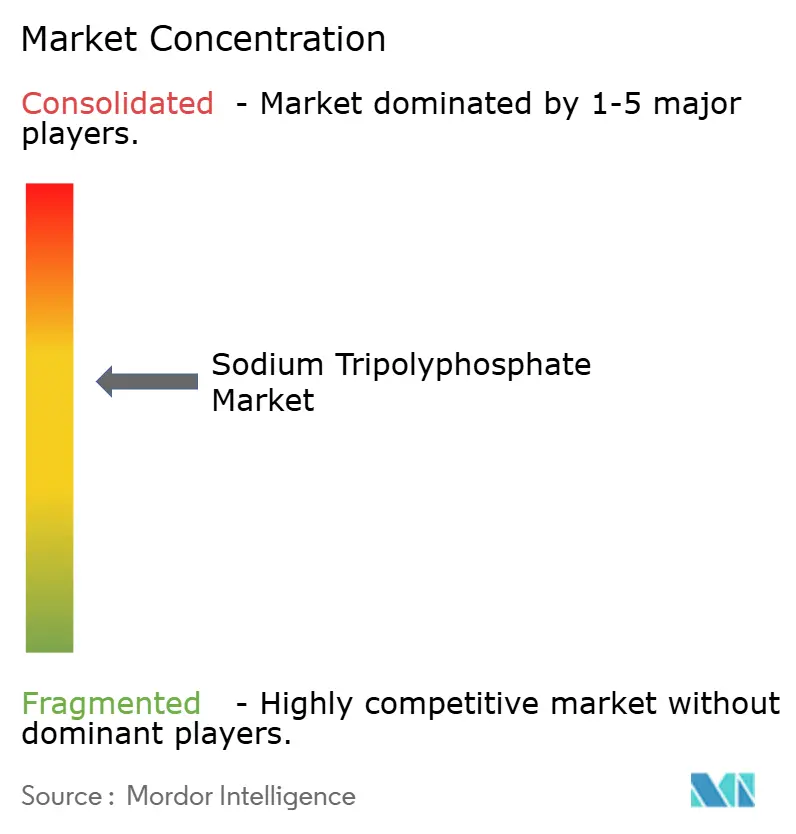
The sodium tripolyphosphate market shows moderate concentration among top-tier players and broader fragmentation across the remaining competitive landscape. Large integrated Chinese producers, such as Hubei Xingfa Chemicals Group, Wengfu Group, and Yuntianhua Group, benefit from captive phosphate rock access, integrated processing chains, and manufacturing scale. These advantages help them defend their cost positions more effectively than many peers in Europe or North America. This advantage is most significant in commodity-oriented grades, where raw material control and energy efficiency influence pricing power more directly than downstream branding. Western suppliers compete on different terms, with specialty quality, regulatory support, application development, and supply reliability playing a larger role than pure cost leadership. As a result, the sodium tripolyphosphate market remains divided between scale-led competition in standard grades and specification-led competition in food-grade or higher-purity products.
ICL Group reflects this specialty-oriented strategy. The company reported FY 2025 revenue of more than USD 7.2 billion and phosphate solutions sales of USD 2.33 billion, highlighting the scale of its phosphate platform even as it competes outside the lowest-cost commodity segment. The same filing also noted ICL’s acquisition of a 49.9% stake in Bartek Ingredients, a move that strengthens its specialty food solutions position and supports broader exposure to higher-value phosphate-adjacent demand. Innophos also signaled continued interest in value-added food ingredient categories when it launched VersaCal Bright in July 2025, following U.S. FDA approval related to calcium phosphate use in specific food categories. These developments do not change the bulk supply structure immediately, but they show how phosphate-related companies are seeking margin resilience through closer alignment with food, specialty, and formulation-sensitive applications. In the sodium tripolyphosphate market, this approach is important because the most attractive growth pockets increasingly reward certification depth, customer support, and technical fit rather than low price alone.
Regulation and the gradual rise of phosphate-free alternatives in Europe and North America are also shaping the competitive landscape. These trends do not immediately remove STPP from most end-use systems, but they increase the value of reformulation expertise, portfolio flexibility, and the ability to serve different regional regulatory requirements. Producers with upstream integration remain better protected against raw material and sulfur cost volatility, while specialty-focused suppliers are better positioned to defend margins in audit-heavy or application-specific business. Therefore, the sodium tripolyphosphate market is likely to remain neither tightly concentrated nor fully commoditized, as cost leadership and specification leadership continue to coexist as distinct competitive routes.
Sodium Tripolyphosphate Industry Leaders
-
Hubei Xingfa Chemicals Group Co. Ltd.
-
Yibin Tianyuan Group
-
Wengfu (Group) Co., Ltd.
-
Aditya Birla Chemicals (Thailand) Pvt. Ltd.
-
Innophos
- *Disclaimer: Major Players sorted in no particular order
Sodium Tripolyphosphate Market Companies Covered in this Report
- Aditya Birla Chemicals (Thailand) Pvt. Ltd.
- Advansix
- Chengxing Group
- Fosfa a.s.
- Guizhou Zhongshen Phosphates Chemical
- Hubei Lomon Phosphorus Chemical
- Hubei Xingfa Chemicals Group Co. Ltd.
- ICL Group Ltd.
- Innophos
- Kazphosphate LLC
- Prayon S.A.
- SDIC
- Sichuan Shengda Group
- Yibin Tianyuan Group
- Wengfu (Group) Co., Ltd.
- Yuntianhua Group

Recent Industry Developments in Sodium Tripolyphosphate Market
- June 2025: The EU Council and the European Parliament reached a provisional agreement on the revised Detergents Regulation, requiring the Commission to assess the potential reduction of phosphorus levels across most detergent categories. The agreement does not set new immediate limits but establishes a review mechanism that could lead to legislative proposals during 2028–2030.
- June 2025: Innophos launched VersaCal Bright, a calcium phosphate-based clean-label whitening ingredient, after the US FDA approved the company’s petition to use calcium phosphate as a safe color additive in specific food categories. The launch marks Innophos’ expansion into functional food ingredient categories adjacent to its core phosphate salt portfolio.


Global Sodium Tripolyphosphate Market Report Scope
Sodium tripolyphosphate (STPP), with the chemical formula Na₅P₃O₁₀, is an inorganic salt widely used in industrial and domestic detergents and food processing. It serves as a heavy-duty water softener, pH buffer, and emulsifier, helping improve cleaning performance and retain moisture.
The sodium tripolyphosphate market is segmented by grade, application, form, end-use industry, and geography. By grade, the market is segmented into food grade and industrial grade. By application, the market is segmented into detergents & cleaning products, food additives, ceramic & tile manufacturing, paints, pigments & dispersants, metal surface treatment, and other applications. By form, the market is segmented into powder and granular. By end-use industry, the market is segmented into household & industrial cleaning, food & beverage, water treatment, ceramics, paints & coatings, metal processing, and other end-use industries. The report also covers the sodium tripolyphosphate market size and forecasts for the sodium tripolyphosphate market in 16 countries across major regions. For each segment, the market sizing and forecasts have been done on the basis of value (USD).
| Food Grade |
| Industrial Grade |
| Detergents & Cleaning Products |
| Food Additives |
| Ceramic & Tile Manufacturing |
| Paints, Pigments & Dispersants |
| Metal Surface Treatment |
| Other Applications |
| Powder |
| Granular |
| Household & Industrial Cleaning |
| Food & Beverage |
| Water Treatment |
| Ceramics |
| Paints & Coatings |
| Metal Processing |
| Other End-Use Industries |
| Asia-Pacific | China |
| India | |
| Japan | |
| South Korea | |
| Rest of Asia-Pacific | |
| North America | United States |
| Canada | |
| Mexico | |
| Europe | Germany |
| United Kingdom | |
| France | |
| Italy | |
| Russia | |
| Rest of Europe | |
| South America | Brazil |
| Argentina | |
| Rest of South America | |
| Middle-East and Africa | Saudi Arabia |
| South Africa | |
| Rest of Middle-East and Africa |
| By Grade | Food Grade | |
| Industrial Grade | ||
| By Application | Detergents & Cleaning Products | |
| Food Additives | ||
| Ceramic & Tile Manufacturing | ||
| Paints, Pigments & Dispersants | ||
| Metal Surface Treatment | ||
| Other Applications | ||
| By Form | Powder | |
| Granular | ||
| By End Use Industry | Household & Industrial Cleaning | |
| Food & Beverage | ||
| Water Treatment | ||
| Ceramics | ||
| Paints & Coatings | ||
| Metal Processing | ||
| Other End-Use Industries | ||
| By Geography | Asia-Pacific | China |
| India | ||
| Japan | ||
| South Korea | ||
| Rest of Asia-Pacific | ||
| North America | United States | |
| Canada | ||
| Mexico | ||
| Europe | Germany | |
| United Kingdom | ||
| France | ||
| Italy | ||
| Russia | ||
| Rest of Europe | ||
| South America | Brazil | |
| Argentina | ||
| Rest of South America | ||
| Middle-East and Africa | Saudi Arabia | |
| South Africa | ||
| Rest of Middle-East and Africa | ||


Key Questions Answered in the Report
What is the 2031 value forecast for the sodium tripolyphosphate market?
The Sodium Tripolyphosphate Market size is expected to grow from USD 1.25 billion in 2025 to USD 1.31 billion in 2026 and is forecast to reach USD 1.64 billion by 2031 at 4.64% CAGR over 2026-2031.
Why is water treatment becoming a more important use case for sodium tripolyphosphate?
Water treatment is the fastest-growing end-use segment at 5.44% CAGR because industrial plants and utilities need scale control, hardness management, and consistent chemical performance in cooling and boiler systems.
Which region leads global sodium tripolyphosphate consumption?
Asia Pacific led with 52.82% share in 2025 and is also expected to grow the fastest at 5.12% CAGR through 2031, supported by China’s supply base and India’s rising downstream demand.
What is the main regulatory risk for producers and buyers?
The main risk comes from phosphorus-related controls in detergents and wastewater management, especially in Europe and North America, where policy direction is pushing closer review of phosphate content and downstream discharge impact.
Page last updated on:





