
Sodium Hypochlorite Market Size and Share
Market Overview
| Study Period | 2021 - 2031 |
|---|---|
| Market Size (2026) | USD 368.43 Million |
| Market Size (2031) | USD 471.72 Million |
| Growth Rate (2026 - 2031) | 5.07 % |
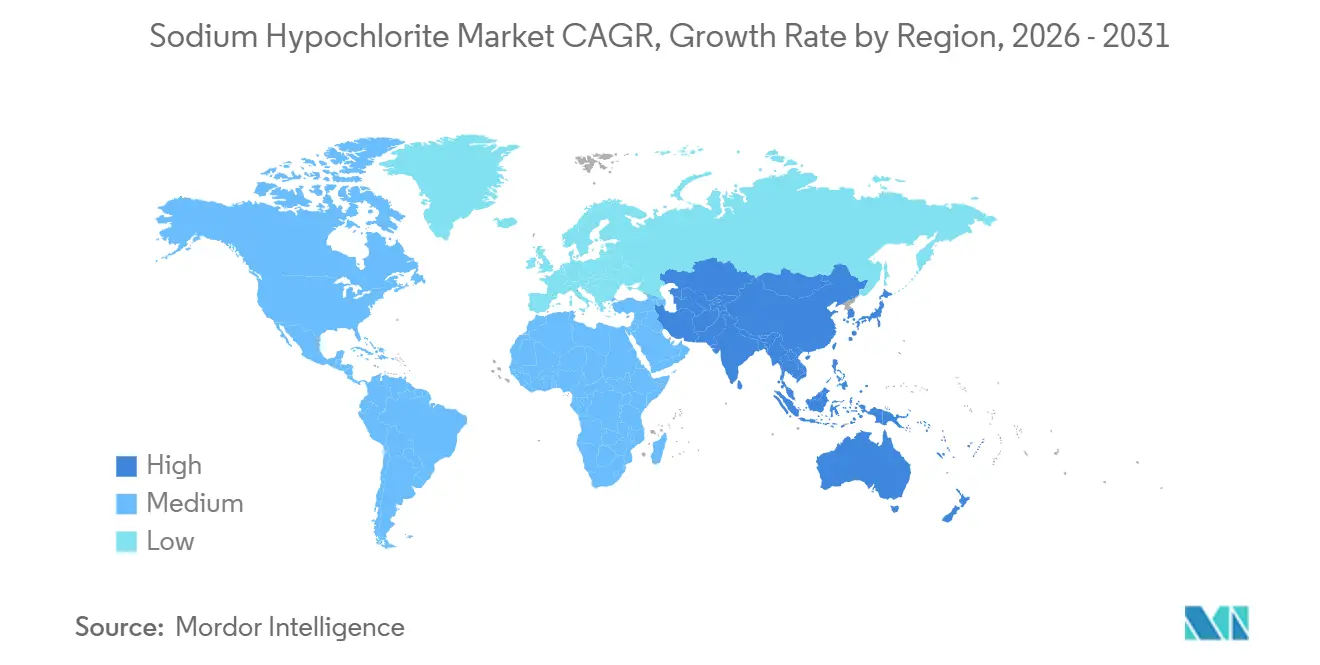
| Fastest Growing Market | Asia-Pacific |
| Largest Market | Asia-Pacific |
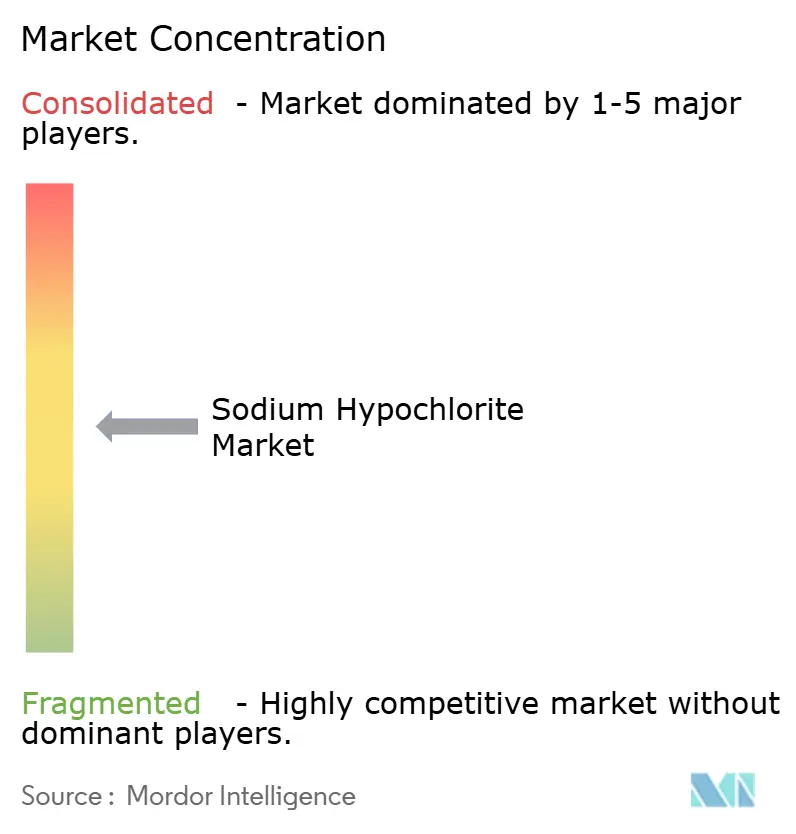
| Market Concentration | Medium |
Major Players *Disclaimer: Major Players sorted in no particular order Image © Mordor Intelligence. Reuse requires attribution under CC BY 4.0. | |
Sodium Hypochlorite Market Analysis by Mordor Intelligence
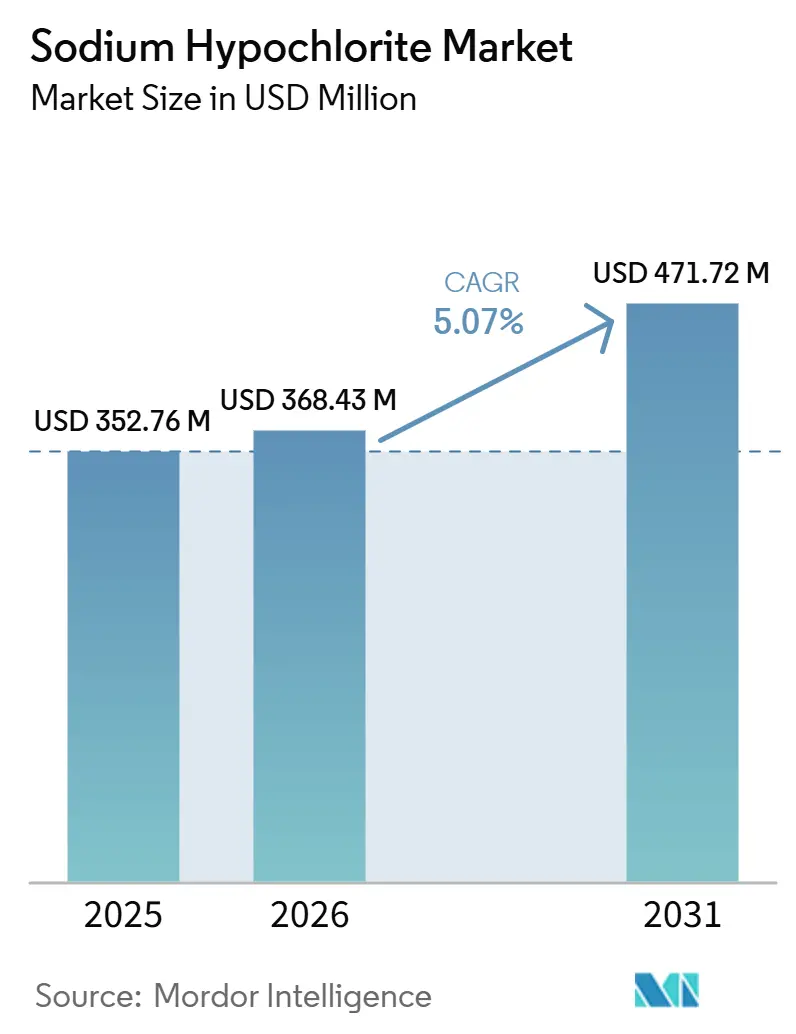
The Sodium Hypochlorite Market size was valued at USD 352.76 million in 2025 and is estimated to grow from USD 368.43 million in 2026 to reach USD 471.72 million by 2031, at a CAGR of 5.07% during the forecast period (2026-2031). The sodium hypochlorite market is supported by steady demand from municipal water treatment, household cleaning, healthcare sanitation, and industrial processing, where buyers continue to prefer a disinfectant with broad antimicrobial performance and low cost. Public water infrastructure upgrades, especially those tied to safer chlorination systems, are reinforcing the sodium hypochlorite market as utilities replace chlorine gas systems with liquid or on-site generated alternatives. Competitive activity is also becoming more important, as ownership changes and regional consolidation are altering chlor-alkali capacity control and supply relationships in the sodium hypochlorite market. Even with pressure from energy costs and product stability limits, the sodium hypochlorite market retains a durable base because most end uses are essential and tied to public health, sanitation, and regulated industrial operations.
Key Report Takeaways
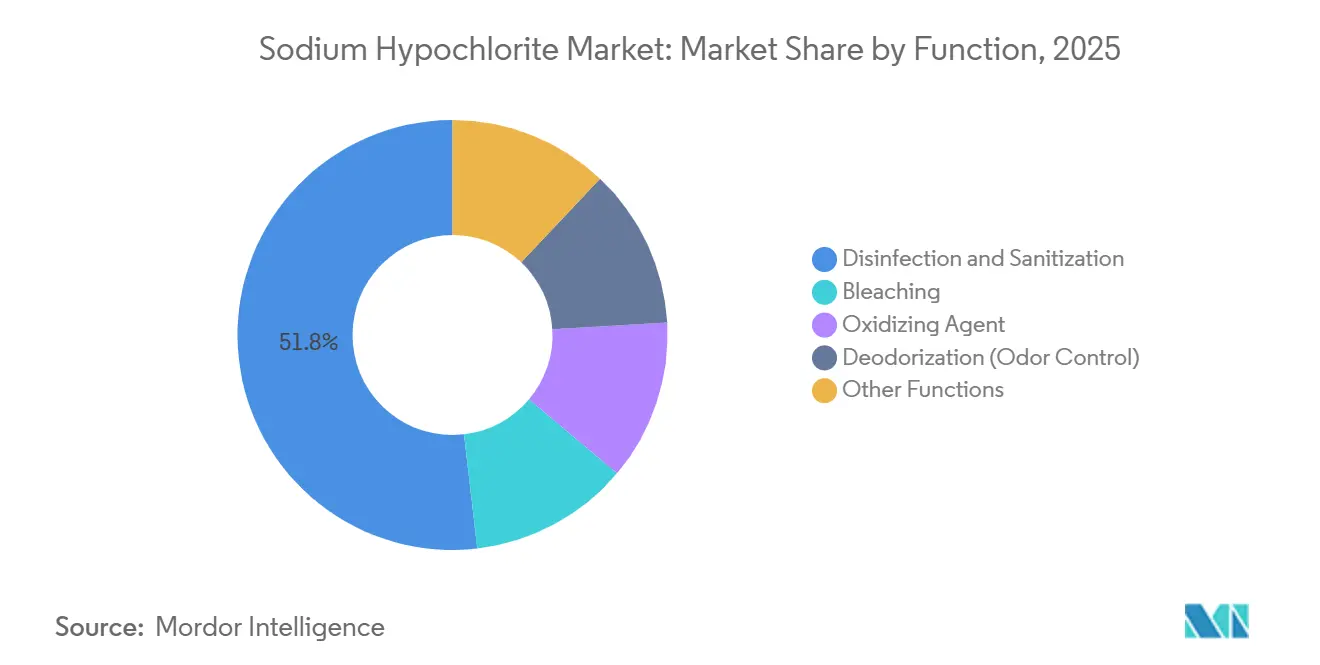
- By function, disinfection & sanitization held 51.83% of the sodium hypochlorite market share in 2025, while deodorization (odor control) is projected to grow at a 5.72% CAGR through 2031.
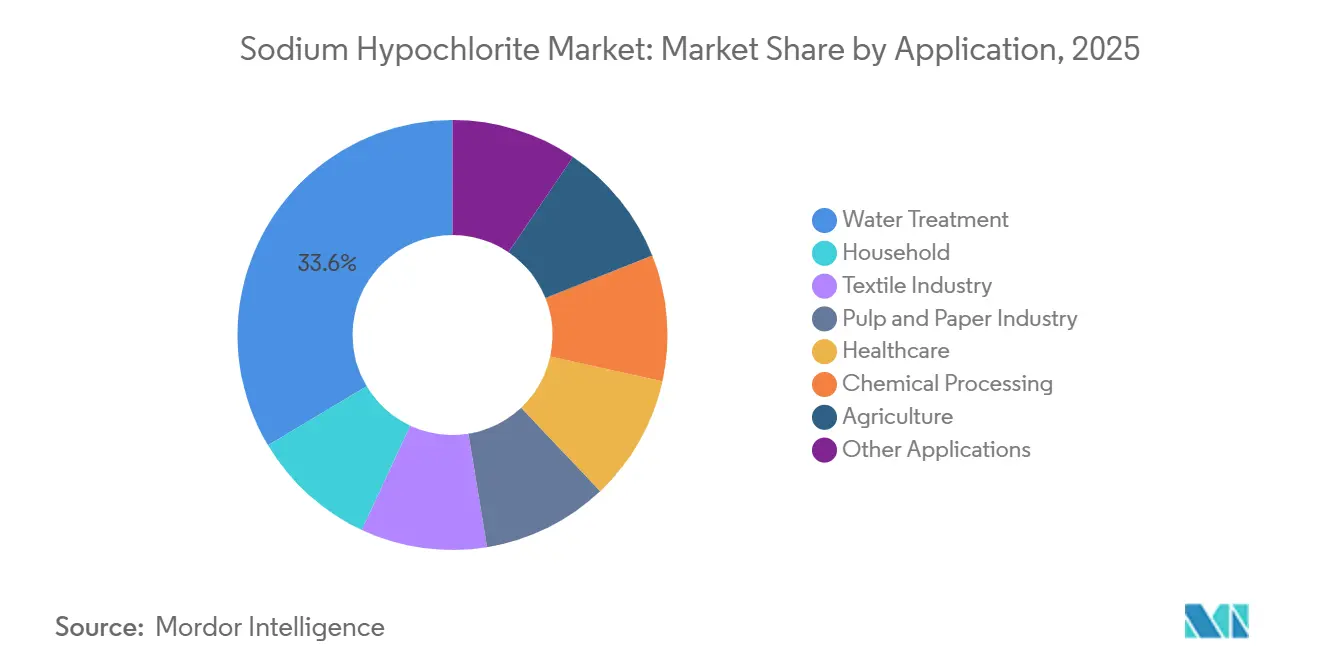
- By application, water treatment accounted for 33.58% of the sodium hypochlorite market share in 2025, while healthcare is forecast to advance at a 6.37% CAGR through 2031.
- By geography, Asia-Pacific held 41.63% of the sodium hypochlorite market share in 2025 and is forecast to advance at a 5.87% CAGR through 2031.
Note: Market size and forecast figures in this report are generated using Mordor Intelligence’s proprietary estimation framework, updated with the latest available data and insights as of January 2026.
Market Trends and Insights
Drivers Impact Analysis of Sodium Hypochlorite Market*
| Driver | (~) % Impact on CAGR Forecast | Geographic Relevance | Impact Timeline |
|---|---|---|---|
| Increasing adoption of sodium hypochlorite for municipal water treatment | +1.5% | Global, with peak impact in Asia-Pacific, North America, and MEA | Short term (≤ 2 years) |
| Expanding use in healthcare and food processing sanitization | +1.1% | Global; fastest uptake in Asia-Pacific and North America | Medium term (2–4 years) |
| Increasing preference for on-site sodium hypochlorite generation | +0.9% | North America, APAC core, spill-over to Europe | Medium term (2–4 years) |
| Growing demand for household cleaning and surface disinfection | +0.7% | Global, led by Asia-Pacific and South America | Short term (≤ 2 years) |
| Rising utilization in textile, pulp & paper, and chemical processing | +0.6% | APAC core (China, India), South America (Brazil) | Long term (≥ 4 years) |
| Source: Mordor Intelligence | |||
Increasing Adoption of Sodium Hypochlorite for Municipal Water Treatment
The shift toward sodium hypochlorite for municipal water treatment remains the largest demand support in the sodium hypochlorite market. Utilities are moving away from chlorine gas, where treatment sites need safer storage, simpler handling, and lower public risk exposure. In the United States, FY2026 project funding for a sodium hypochlorite chlorination system upgrade shows that this transition is being backed by direct public spending rather than only operating preference. In India, the extended Jal Jeevan Mission requires chlorination systems for rural piped water supply schemes, which gives the sodium hypochlorite market a visible multi-year demand stream linked to basic water service expansion[1]Government of India, “Water Quality Handbook for Piped Water Schemes,” Jal Jeevan Mission, jaljeevanmission.gov.in. On-site generation also reduces dependence on long-haul chemical deliveries, which makes municipal operations less exposed to supply interruptions and storage loss. This combination of safety, policy support, and operating resilience gives the sodium hypochlorite market a steady public-utility demand base through the forecast period.
Expanding Use in Healthcare and Food Processing Sanitization
Healthcare remains the fastest-growing application in the sodium hypochlorite market, with a projected 6.4% CAGR through 2031. Demand is rising because hospitals, clinics, and diagnostic settings need dependable surface disinfection that fits routine sanitation protocols and large facility workflows. This trend is especially relevant in Asia-Pacific and the Middle East, where healthcare infrastructure expansion is adding new facilities and increasing daily cleaning volumes. Food processing is also supporting the sodium hypochlorite market because sanitation spending in this channel is tied to compliance, plant uptime, and contamination prevention rather than discretionary purchasing. Buyers in these end uses tend to prefer validated formulations with more reliable quality control, which supports stronger demand for higher-specification products. That shift matters because it helps the sodium hypochlorite market move part of its growth toward applications that are less exposed to pure commodity pricing.
Increasing Preference for On-Site Sodium Hypochlorite Generation
On-site generation is moving from a specialized option to a more common procurement choice in the sodium hypochlorite market. Utilities in North America and Europe are drawn to these systems because they reduce chlorine gas storage requirements and support local production at the point of use. Engineering case evidence also shows that operators value the ability to use off-peak electricity and improve daily operating flexibility. Peer-reviewed work published in 2025 reported progress in electrochemical synthesis that improves current efficiency and solution strength control, which lowers barriers for broader use beyond the largest utilities. For bulk suppliers, this changes the account structure because some large customers stop buying delivered bleach and instead buy salt, power, equipment, and service support. The sodium hypochlorite market still benefits from the underlying demand, but value capture gradually shifts toward more distributed customers and service-linked models.
Growing Demand for Household Cleaning and Surface Disinfection
Household cleaning creates a meaningful demand for the sodium hypochlorite market. Consumer awareness around routine disinfection is keeping liquid bleach and surface sanitizers relevant across both mature and emerging retail channels. The opportunity is stronger in South America and Southeast Asia, where organized retail expansion is widening access to packaged household cleaning products. This part of the sodium hypochlorite market is less defined by technical product differences and more defined by shelf presence, local distribution reach, and refill frequency. That makes transport efficiency and local delivery density especially important for household-grade supply, since the product is often sold at lower concentrations.
Restraints Impact Analysis of Sodium Hypochlorite Market*
| Restraint | (~) % Impact on CAGR Forecast | Geographic Relevance | Impact Timeline |
|---|---|---|---|
| Limited product stability due to degradation during storage and transportation | -0.9% | Global; most acute in tropical and high-temperature regions (Southeast Asia, Middle-East and Africa, South America) | Short term (≤ 2 years) |
| Stringent safety, handling, and corrosion management requirements | -0.5% | Global, particularly Europe and North America | Medium term (2–4 years) |
| Volatility in chlor-alkali raw material and energy costs | -0.7% | Europe, North America; spill-over to global traded markets | Short term (≤ 2 years) |
| Source: Mordor Intelligence | |||
Limited Product Stability Due to Degradation During Storage and Transportation
Product instability remains the most persistent operational limit in the sodium hypochlorite market. Olin stated in its 2025 product stewardship manual that decomposition can accelerate by a factor of 2 to 4 for every 10 °C rise in storage temperature. That means active chlorine can decline materially during storage and transport, especially when a 12.5% solution is shipped over longer distances in hot climates. The sodium hypochlorite market, therefore, favors local producers and on-site generation in regions where high ambient temperature shortens practical shelf life. The constraint is especially relevant in Southeast Asia, the Middle East, and parts of South America, where transport radius and storage conditions directly affect delivered quality. Europe is also tightening compliance expectations because EN 901:2024 updated purity and storage guidance for sodium hypochlorite used in drinking water treatment.
Volatility in Chlor-Alkali Raw Material and Energy Costs
The sodium hypochlorite market is exposed to chlor-alkali economics because chlorine and caustic soda production conditions shape its cost base. The International Energy Agency reported that electricity accounts for 40% to 60% of chlor-alkali production costs, which keeps power pricing central to supplier margins. Europe faces the sharpest cost pressure because industrial electricity prices in 2025 remained more than twice U.S. levels and nearly 50% above China’s levels. Those conditions reduce operating flexibility for European producers and can tighten supply when municipal and industrial demand rise at the same time. The sodium hypochlorite market also carries a co-production risk because chlorine and caustic soda output move together, so weakness in parallel caustic soda end markets can still curb hypochlorite availability. This leaves suppliers managing a cost structure that is only partly under their control, especially when contracts do not fully allow price pass-through.
*Our forecasts treat driver/restraint impacts as directional, not additive. The impact forecasts reflect baseline growth, mix effects, and variable interactions.
Sodium Hypochlorite Market Segment Analysis
By Function:
Disinfection Dominance Masking Emergent Odor-Control GrowthDisinfection & sanitization held 51.83% of the sodium hypochlorite market share in 2025, which confirms that the largest part of demand still comes from core sanitation use cases. This position is rooted in water treatment, healthcare, food processing, and household cleaning, where sodium hypochlorite remains widely accepted and simple to deploy. The segment also benefits from regulatory familiarity in drinking water treatment, where compliance frameworks continue to favor established disinfection chemistries. Bleaching usage of the sodium hypochlorite market is supported by textile, pulp and paper demand across industrial centers in Asia-Pacific. Oxidizing agents and other functions add stability to the sodium hypochlorite market because they keep demand present in chemical synthesis and agricultural sanitation, even when headline growth comes from other uses.
Deodorization (odor control) is projected to grow at a 5.72% CAGR through 2031, making it the fastest-growing function in the sodium hypochlorite market. Growth is tied to wastewater treatment, livestock facility management, and municipal waste handling, where odor suppression and microbial control often need to happen together. Aging sewer networks in North America and Europe are also creating recurring demand for in-line odor management programs as utilities upgrade older systems. At the same time, sustainability pressure in pulp bleaching is limiting the long-run appeal of chlorine-based bleaching, which improves the relative position of disinfection and deodorization in the sodium hypochlorite market.



By Application:
Water Treatment Anchors Demand While Healthcare Drives Premium GrowthWater treatment accounted for 33.58% share of the sodium hypochlorite market size in 2025, which made it the largest application segment by value. Its scale comes from non-discretionary water safety needs and from regulatory frameworks that require reliable disinfection performance in municipal systems. New treatment plant buildouts, upgrades of existing systems, and continued replacement of chlorine gas infrastructure are supporting growth in this application. A key shift inside the sodium hypochlorite market is that on-site generation changes how utilities procure disinfectant, but it does not remove the underlying need for hypochlorite chemistry in treatment operations. This means the segment continues to anchor total demand even as the supplier mix and service model evolve.
Healthcare is forecast to expand at a 6.37% CAGR through 2031, making it the fastest-growing application in the sodium hypochlorite market. Growth is being supported by infection control requirements, broader surgical activity, and new healthcare capacity in China, India, Saudi Arabia, and South Africa. The household segment shows a steadier profile in developed economies, but it still has room to grow in South America and Southeast Asia as retail distribution improves. Textile industry and pulp and paper industry demand continue to add cyclical value to the sodium hypochlorite industry, though environmental pressure is limiting how far chlorine-based bleaching can expand over time. Chemical processing and agriculture remain smaller applications, but both support diversification in the sodium hypochlorite market because they broaden end-use exposure beyond core sanitation channels.
Geography Analysis
APAC Sodium Hypochlorite Market
Asia-Pacific held 41.63% of the sodium hypochlorite market share in 2025 and is projected to grow at a 5.87% CAGR through 2031, which makes it both the largest and fastest-growing regional block. The region benefits from urban water infrastructure expansion, strong industrial activity, and broad sanitation demand across municipal and commercial settings. India is a major support point for the sodium hypochlorite market because the Jal Jeevan Mission has expanded rural tap-water coverage from 16.7% to over 80% of households since 2019 and continues to require chlorination systems under its extended phase. Japan and South Korea contribute a steadier quality-driven layer of demand through healthcare sanitation, food processing hygiene, and industrial cleaning applications.
North America Sodium Hypochlorite Market
North America’s demand is supported by ongoing water safety spending and a mature industrial cleaning base. The United States continues to move municipal systems away from chlorine gas, and the FY2026 Association of California Water Administrators (ACWA) funding example shows that sodium hypochlorite system upgrades remain an active part of that transition[2]Association of California Water Administrators, “Sweetwater Authority Secures USD 1,000,000 for the Sodium Hypochlorite Chlorination System Project in Federal Appropriations Bill,” ACWA. Berkshire Hathaway's acquisition of OxyChem in January 2026 strengthens capacity concentration in the regional chlor-alkali base and may influence future supply negotiations for large buyers. Canada and Mexico add incremental growth to the sodium hypochlorite market through water infrastructure programs and food and beverage processing, while Mexico also benefits from geographic proximity to the U.S. supply.
EMEA and South America Sodium Hypochlorite Market
Europe remains important in the sodium hypochlorite market, but its outlook is more constrained by regulatory stringency and high-power costs. EN 901:2024 raised purity and labeling expectations for sodium hypochlorite used in drinking water treatment, which favors suppliers with stronger quality systems and tighter supply-chain control. The International Energy Agency reported that EU industrial electricity prices in 2025 stayed more than twice U.S. levels, which continues to pressure European chlor-alkali margins. South America presents a useful growth pocket for the sodium hypochlorite market, especially in Brazil, where urban expansion and pulp-related chemical demand support broader chlorine value-chain investment. Middle-East and Africa remains an emerging zone in the sodium hypochlorite market, where desalination, water reuse, and municipal water treatment keep demand linked to essential infrastructure.

Competitive Landscape
The sodium hypochlorite market is moderately concentrated, with the top five players including Olin Corporation, Occidental Chemical Corporation (OxyChem), HASA, Inc., PCC Group, and Ercros S.A. Olin Corporation, OxyChem under Berkshire Hathaway, Westlake Corporation, AGC Inc., Tosoh Corporation, and Vynova Group benefit from vertical integration that starts at chlor-alkali electrolysis and extends into sodium hypochlorite production and distribution. Olin's 2025 product stewardship manual reinforces its lead position in North America and points to the importance of terminal and delivery infrastructure in the sodium hypochlorite market. Competition becomes more fragmented at the regional and local distribution level, where players such as HASA, Ennore India Chemical, Gujarat Alkalies and Chemicals Limited (GACL), and PCC Group serve customers that are sensitive to transport distance and solution stability.
Strategic differentiation in the sodium hypochlorite market is shifting toward quality assurance, compliance, and supply reliability rather than only price. EN 901:2024-compliant grades and well-managed handling practices matter more for municipal buyers because water utilities cannot absorb quality failures. Berkshire Hathaway's January 2026 purchase of OxyChem stands out as the most visible consolidation move in the sodium hypochlorite market during the current period. AGC's JPY 15 billion, or USD 100 million, investment in a new fluorinated ion-exchange membrane facility at Kitakyushu is another clear example, because it supports more efficient chlor-alkali operations that also matter for sodium hypochlorite output.
Bondalti's takeover of Ercros adds a second important example, because regulators required supply commitments after identifying local sodium hypochlorite overlaps above 50% within a 400 km radius. That case shows the sodium hypochlorite market can look concentrated near production clusters even when the global market remains only moderately consolidated. Another competitive opening is forming around on-site generation, where suppliers can bundle electrolyzer systems, maintenance, and monitoring instead of only selling bulk liquid product. Smaller producers in India and Southeast Asia are also widening their chlorine-derivative portfolios, which helps reduce exposure to pure commodity cycles and supports local account retention.
Sodium Hypochlorite Industry Leaders
Olin Corporation
Occidental Chemical Corporation (OxyChem)
PCC Group
HASA, Inc.
Ercros S.A.
- *Disclaimer: Major Players sorted in no particular order
Sodium Hypochlorite Market Companies Covered in this Report
- Aditya Birla Chemicals (India) Limited
- AGC Inc.
- BONDALTI
- Ennore India Chemical
- Ercros S.A.
- Gujarat Alkalies and Chemicals Ltd.
- HASA, Inc.
- Nouryon
- Occidental Chemical Corporation (OxyChem)
- Olin Corporation
- PCC Group
- Tokuyama Corporation
- Tosoh Corporation
- Vynova Group
- Westlake Corporation

Recent Industry Developments in Sodium Hypochlorite Market
- March 2026: BONDALTI Ibérica completed its takeover of Ercros S.A., acquiring a 77.2% stake following confirmation of the final results by Spain's Comisión Nacional del Mercado de Valores (CNMV). The transaction created one of Europe's largest integrated producers of chlor-alkali and sodium hypochlorite, with operations primarily across Spain and Portugal.
- January 2026: Berkshire Hathaway Inc. completed the acquisition of Occidental Chemical Corporation (OxyChem) from Occidental Petroleum for USD 9.7 billion. OxyChem manufactures chlor-alkali, PVC, and chlorinated organics, including sodium hypochlorite for water treatment and industrial applications and is expected to improve OxyChem's access to capital for capacity and distribution investments.


Global Sodium Hypochlorite Market Report Scope
Sodium hypochlorite is a strong, corrosive oxidizing compound, commonly known as household bleach (typically a 3–6% dilute aqueous solution). It is widely used as a disinfectant, stain remover, and water treatment agent, and requires careful handling to prevent toxic gas exposure.
The Sodium Hypochlorite Market is segmented by function, application, and geography. By function, the market is segmented into disinfection & sanitization, bleaching, oxidizing agent, deodorization (odor control), and other functions. By application, the market is segmented into water treatment, household, textile industry, pulp & paper industry, healthcare, chemical processing, agriculture, and other applications. The report also covers the market size and forecasts for sodium hypochlorite in 16 countries across major regions. For each segment, the market sizing and forecasts have been done on the basis of value (USD).
| Disinfection & Sanitization |
| Bleaching |
| Oxidizing Agent |
| Deodorization (Odor Control) |
| Other Functions |
| Water Treatment |
| Household |
| Textile Industry |
| Pulp & Paper Industry |
| Healthcare |
| Chemical Processing |
| Agriculture |
| Other Applications |
| Asia-Pacific | China |
| India | |
| Japan | |
| South Korea | |
| Rest of Asia-Pacific | |
| North America | United States |
| Canada | |
| Mexico | |
| Europe | Germany |
| United Kingdom | |
| France | |
| Italy | |
| Russia | |
| Rest of Europe | |
| South America | Brazil |
| Argentina | |
| Rest of South America | |
| Middle-East and Africa | Saudi Arabia |
| South Africa | |
| Rest of Middle-East and Africa |
| By Function | Disinfection & Sanitization | |
| Bleaching | ||
| Oxidizing Agent | ||
| Deodorization (Odor Control) | ||
| Other Functions | ||
| By Application | Water Treatment | |
| Household | ||
| Textile Industry | ||
| Pulp & Paper Industry | ||
| Healthcare | ||
| Chemical Processing | ||
| Agriculture | ||
| Other Applications | ||
| By Geography | Asia-Pacific | China |
| India | ||
| Japan | ||
| South Korea | ||
| Rest of Asia-Pacific | ||
| North America | United States | |
| Canada | ||
| Mexico | ||
| Europe | Germany | |
| United Kingdom | ||
| France | ||
| Italy | ||
| Russia | ||
| Rest of Europe | ||
| South America | Brazil | |
| Argentina | ||
| Rest of South America | ||
| Middle-East and Africa | Saudi Arabia | |
| South Africa | ||
| Rest of Middle-East and Africa | ||


Key Questions Answered in the Report
What is the size of the sodium hypochlorite market?
The sodium hypochlorite market stands at USD 368.43 million in 2026 and is projected to reach USD 471.72 million by 2031.
Which application led the market demand in 2025?
Water Treatment led with 33.58% share in 2025 because municipal and regulated water disinfection remains a non-discretionary use.
Which region is expected to grow fastest through 2031?
Asia-Pacific is the fastest-growing region, with a projected 5.87% CAGR through 2031.
Why are utilities shifting from chlorine gas to sodium hypochlorite?
Utilities are prioritizing safer handling, lower site risk, and more flexible treatment operations, especially where on-site generation is feasible.
Page last updated on:





