
Sodium Hydrosulfide Market Size and Share
Market Overview
| Study Period | 2022 - 2032 |
|---|---|
| Market Size (2027) | USD 733.90 Billion |
| Market Size (2032) | USD 915.45 Billion |
| Growth Rate (2027 - 2032) | 4.52 % |
| Fastest Growing Market | Asia-Pacific |
| Largest Market | Asia-Pacific |
| Market Concentration | Medium |
Major Players *Disclaimer: Major Players sorted in no particular order Image © Mordor Intelligence. Reuse requires attribution under CC BY 4.0. | |
Sodium Hydrosulfide Market Analysis by Mordor Intelligence
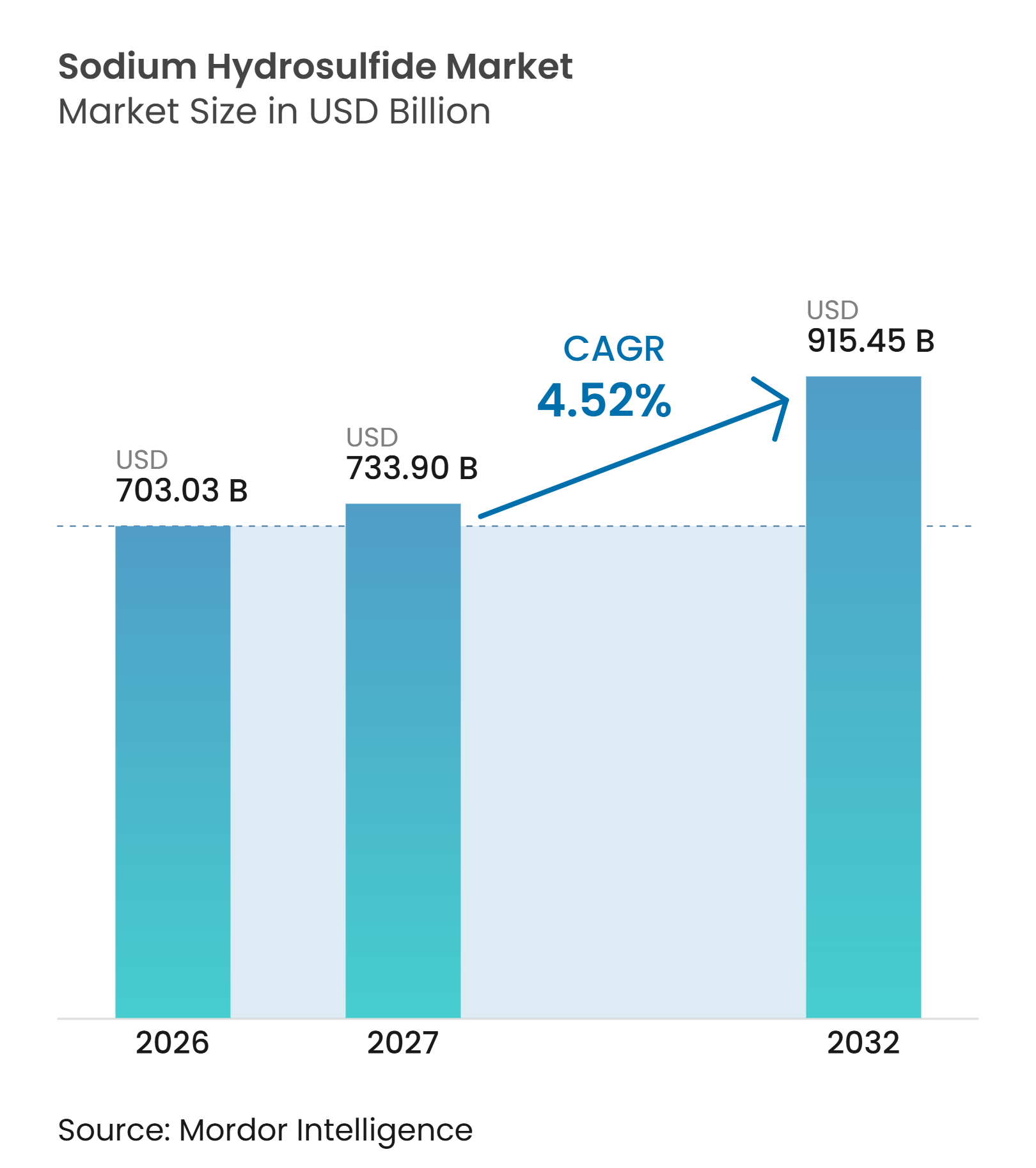
The sodium hydrosulfide market size was valued at USD 703.03 billion in 2026 and is estimated to grow from USD 733.90 billion in 2027 to USD 915.45 billion by 2032, at a CAGR of 4.52% during the forecast period (2027-2032). The sodium hydrosulfide industry is supported by established use in mineral processing, Kraft pulp production, and industrial effluent treatment. Its demand is linked to industrial activity across these end uses rather than to a single commodity cycle. Heavier, sulfur-rich crude processing increases the hydrogen sulfide available for sodium hydrosulfide production, while demand for metals used in electrification supports reagent consumption in mining. This connection gives suppliers an opportunity to monetize by-product hydrogen sulfide and expand availability without relying solely on new production plants. The application base is also broadening toward wastewater treatment and advanced chemical synthesis, reducing dependence on a single end market while increasing the importance of product purity and form.
Key Report Takeaways
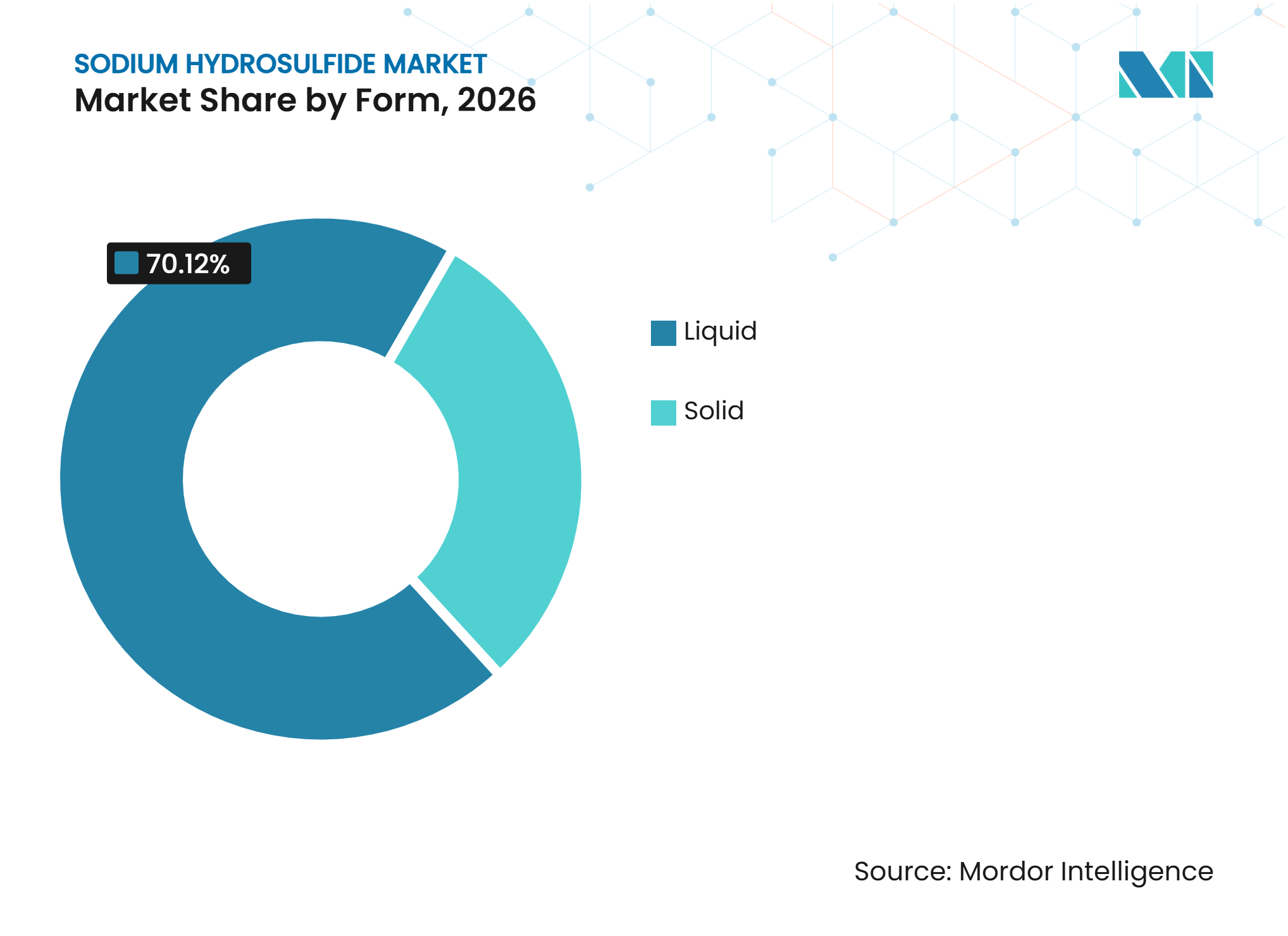
- By form, liquid sodium hydrosulfide held 70.12% of the Sodium Hydrosulfide market share in 2026, while solid sodium hydrosulfide is forecast to grow at a 5.12% CAGR through 2032.
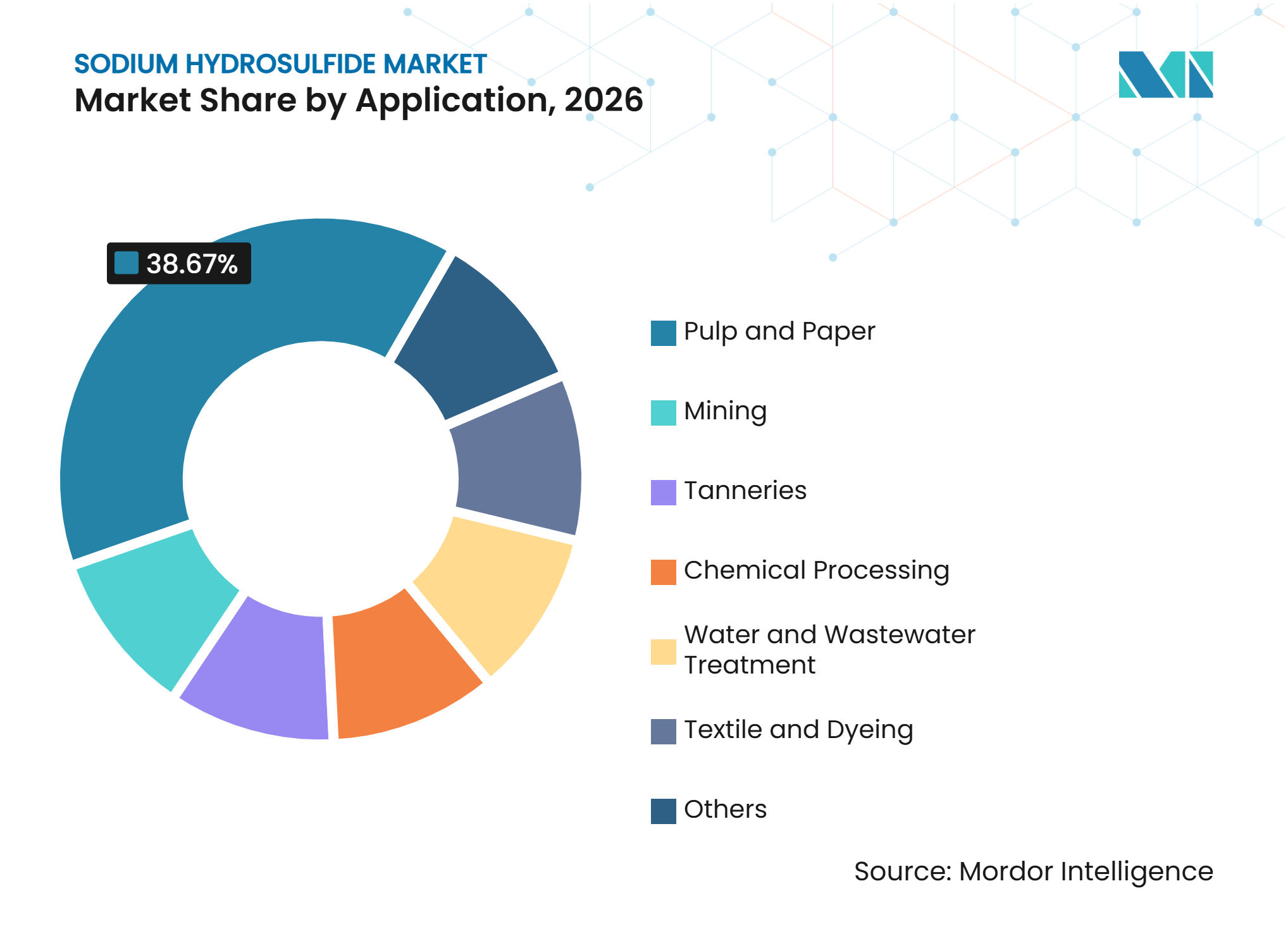
- By application, pulp and paper accounted for 38.67% of the Sodium Hydrosulfide market share in 2026, while water and wastewater treatment is projected to grow at a 5.45% CAGR through 2032.
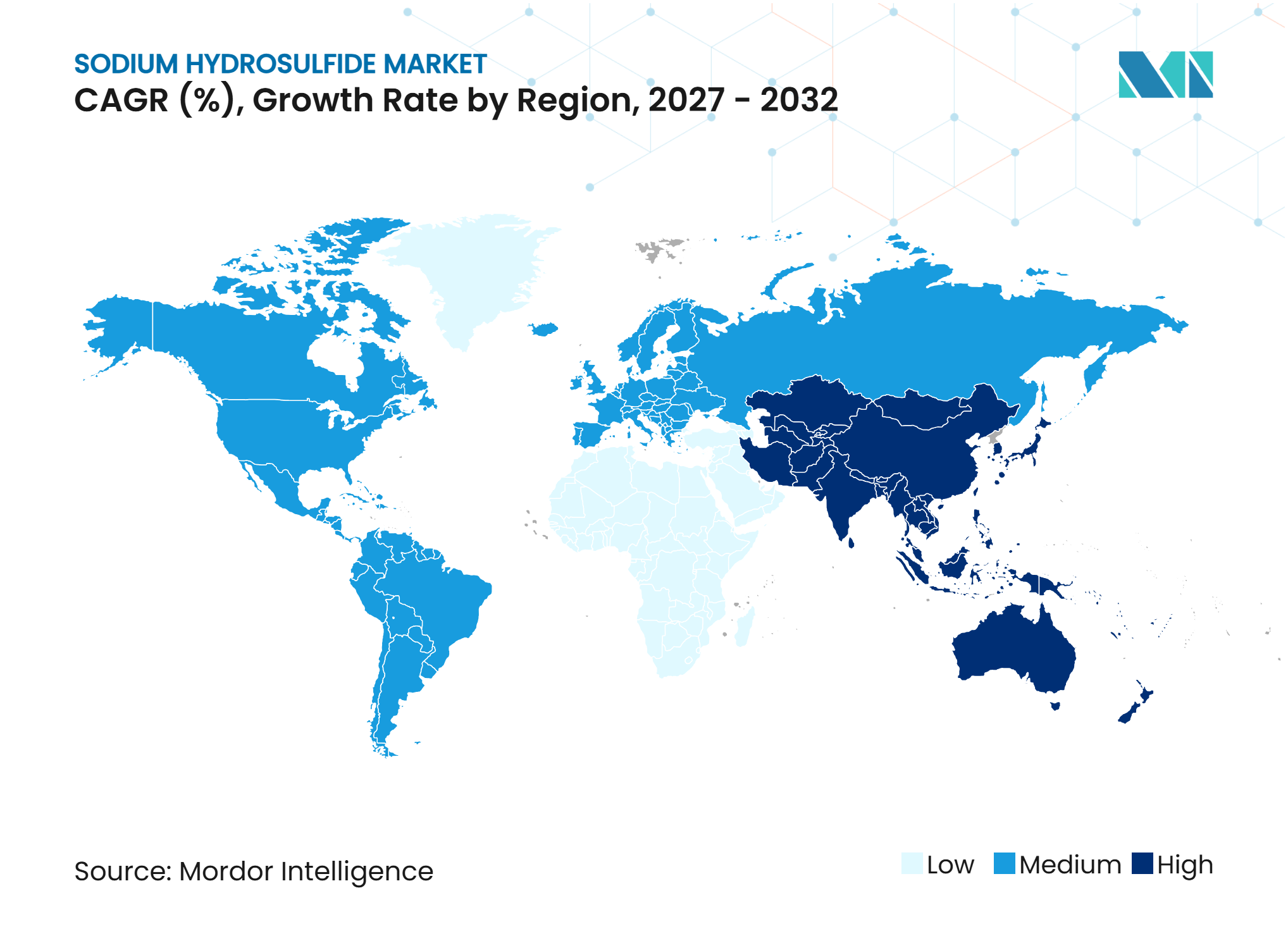
- By geography, Asia-Pacific captured 37.91% of the sodium hydrosulfide market size in 2026 and is forecast to record a 5.33% CAGR through 2032.
Note: Market numbers in this report are based on Mordor Intelligence's proprietary estimation framework, which combines nine months of actuals with Q4 projections for base year 2026.
Market Trends and Insights
Drivers Impact Analysis of Sodium Hydrosulfide Market*
| Drivers | (~) % Impact on CAGR Forecast | Geographic Relevance | Impact Timeline |
|---|---|---|---|
| Copper Electrification and Complex-Ore Flotation Demand | +1.0% | Global, concentrated in Asia-Pacific and South America | Medium term (2-4 years) |
| Kraft Pulp Sulfidity and Chemical-Recovery Requirements | +1.5% | Global, strongest in North America, Europe, and Asia-Pacific | Long term (≥ 4 years) |
| Industrial Wastewater Heavy-Metal Precipitation | +0.8% | Asia-Pacific core, with spillover to Middle East & Africa and South America | Medium term (2-4 years) |
| By-Product Hydrogen Sulfide Monetization | +0.5% | North America, Europe, and Asia-Pacific industrial corridors | Short term (≤ 2 years) |
| Expansion of Leather Processing in Asia-Pacific | +0.5% | Asia-Pacific core, with spillover to Middle East & Africa | Medium term (2-4 years) |
| Source: Mordor Intelligence | |||
Copper Electrification and Complex-Ore Flotation Demand
Electrification of transport and grid infrastructure is reshaping investment in copper mining and supporting reagent demand in the sodium hydrosulfide market. Producers are moving into lower-grade porphyry deposits, increasing the need for selectivity in copper-molybdenum flotation circuits. Sodium hydrosulfide remains a depressant used in molybdenum recovery stages, with stated dosages of 0.15 to 0.45 kilograms per ton of ore. China Copper International Trading Group tendered for 3,685 tons of sodium hydrosulfide in September 2025 for delivery to five copper operations in Yunnan and Sichuan[1]. Lower ore grades increase reagent requirements per ton of metal produced, which can cause demand for sodium hydrosulfide to rise faster than copper output. Chile produced 5.3 million metric tons of copper in 2025, reinforcing its role as a major center of mining-related demand in the sodium hydrosulfide market.
Kraft Pulp Sulfidity and Chemical-Recovery Requirements
Kraft pulp production provides a continuing demand base, as sodium hydrosulfide supports sulfidity management in the chemical recovery loop. The active sulfur species, HS-, works with sodium hydroxide in lignin removal, making stable liquor chemistry important for mill operation. The 2025 International Chemical Recovery Conference highlighted dynamic mass-balance modeling for managing sulfidity changes during shifts between hardwood and softwood feedstocks. Elemental sulfur pellets can replace sodium hydrosulfide in certain makeup applications, offering a cost-effective alternative for mills that adapt their causticizing systems. This alternative is limited in mills with established liquid supply arrangements, in remote locations, or with tight liquor specifications. Global Kraft pulp output exceeds 130 million tons annually, while chemical recovery efficiency can approach 97%, sustaining a stable demand pool in the sodium hydrosulfide industry.
Industrial Wastewater Heavy-Metal Precipitation
The sodium hydrosulfide market benefits as sulfide precipitation gains use in industrial wastewater treatment, given its ability to selectively remove metals at low pH. This approach is relevant to the treatment of copper, cadmium, lead, and arsenic, where hydroxide precipitation may be less selective. A 2025 study reported that machine-learning-optimized sulfidation reduced sodium hydrosulfide overdosing by 15% to 30% while maintaining precipitation efficiency above 95%. Lower chemical use per facility can reduce operating costs and make treatment accessible to more facilities. Eisenmann Environmental Technology documented a sodium hydrosulfide process for copper-smelter wash water that produces copper sulfide sludge with a 40% copper content for return to the smelting process. U.S. Environmental Protection Agency (EPA) and European Chemicals Agency requirements around sodium hydrosulfide use and discharge increase the value of controlled treatment systems, supporting water-treatment expansion in the sodium hydrosulfide market.
By-Product Hydrogen Sulfide Monetization
In the sodium hydrosulfide market, capturing refinery sour gas hydrogen sulfide and neutralizing it with caustic soda can produce saleable sodium hydrosulfide, rather than directing the gas solely to destruction or sulfur recovery. This route can add supply without building a greenfield sodium hydrosulfide facility. Genesis Energy operated sulfur-removal services at 11 refining or petrochemical facilities in the United States and marketed the resulting sodium hydrosulfide to more than 100 customers in fiscal 2025. NAGAO established a 1,000-kiloliter liquid sodium hydrosulfide stockpoint in Ichikawa, Chiba, in 2025 to strengthen its marine distribution network. This route is most valuable where hydrogen sulfide is concentrated and free of organic contaminants. These projects strengthen supply resilience in the sodium hydrosulfide market and enable producers to link refinery services to specialty chemical sales.
Restraints Impact Analysis of Sodium Hydrosulfide Market*
| Restraints | (~) % Impact on CAGR Forecast | Geographic Relevance | Impact Timeline |
|---|---|---|---|
| Toxic Hydrogen Sulfide Release and Safety Compliance Costs | -0.4% | Global, heightened in Europe and North America under REACH, OSHA, and EPA frameworks | Long term (≥ 4 years) |
| Leather-Sector Shift Toward Enzymatic Dehairing | -0.3% | Asia-Pacific core, with spillover to South America | Medium term (2-4 years) |
| Chinese Chemical-Park Environmental Shutdowns | -0.3% | China, including Shandong, Jiangsu, and Zhejiang industrial hubs | Short term (≤ 2 years) |
| Source: Mordor Intelligence | |||
Toxic Hydrogen Sulfide Release and Safety Compliance Costs
The primary handling challenge associated with sodium hydrosulfide is the release of hydrogen sulfide upon contact with moisture or acids. Storage, transfer, and emergency response systems add capital and operating requirements for both producers and users. In the United States, OSHA requires Safety Data Sheet maintenance and hazard communication for sodium hydrosulfide users under 29 CFR 1910.1200. U.S. EPA listing requirements under 40 CFR 302.4 and Clean Water Act Section 311 also create reporting and compliance obligations. The European Chemicals Agency (ECHA) registration imposes additional documentation and exposure control requirements on European operators[2]. Solvay markets AERO NR-7361 as a copper-circuit alternative that uses lower stated dosage ranges than sodium hydrosulfide, although its higher unit cost can limit adoption at mines with tight operating margins.
Leather-Sector Shift Toward Enzymatic Dehairing
Enzymatic dehairing is progressing from laboratory research to commercial testing, creating a substitution risk for sodium hydrosulfide in leather processing. The Central Leather Research Institute–Leather and Leather Products Industry Research Complex (CLRI-LLPIRC) Green Tannery Initiative completed an industrial-scale sulfide-free unhairing trial at the LLPIRC pilot tannery in Addis Ababa in June 2025. A 2025 peer-reviewed study reported that soybean enzyme alternatives can reduce chemical oxygen demand by up to 70% compared with conventional processing. The enzyme route preserves hair fiber for recovery, whereas sulfide treatment converts hair into effluent-contaminating material. This added value strengthens the case for enzyme use in export-oriented markets facing stricter wastewater standards. However, a neutral protease, lime, and sodium hydrosulfide hybrid process indicates that co-use may remain more common than full replacement in the near term.
*Our forecasts treat driver/restraint impacts as directional, not additive. The impact forecasts reflect baseline growth, mix effects, and variable interactions.
Sodium Hydrosulfide Market Segment Analysis
By Form:
Liquid Grade Anchors Share While Solid Grade Supports New ChemistryLiquid sodium hydrosulfide held a 70.12% market share in the sodium hydrosulfide market in 2026, supported by its use in continuous-feed systems for copper flotation, Kraft pulp production, and industrial wastewater treatment. These applications are built around liquid chemical dosing, which gives the aqueous grade a practical advantage at large sites. Liquid products are typically shipped as 35-45% solutions, making transport distance and proximity to customers key factors in producers' competitiveness. Solid sodium hydrosulfide is the faster-growing form, with a forecast CAGR of 5.12% through 2032. Remote mining sites tend to favor solid grades because higher active content reduces freight weight per unit of chemical value.
Solid grades also serve applications that require anhydrous or high-purity material, including battery material synthesis and pharmaceutical intermediates. NAGAO began mass production of anhydrous sodium hydrosulfide in April 2025 and positions the material for reactions where water inhibits performance. Long-haul exports to mining customers in Africa and Latin America are more practical with 70% flake than with liquid material. China's GB/T 23937-2026 industrial sodium hydrosulfide standard adds total organic carbon specifications, potentially favoring higher-purity grades in the sodium hydrosulfide industry. The form split therefore reflects both processing requirements and regional trade logistics.



By Application:
Pulp and Paper Leads While Water Treatment Expands FasterPulp and paper accounted for 38.67% of the sodium hydrosulfide market size in 2026, as sodium hydrosulfide supports sulfidity in the Kraft process. Global chemical pulp output of more than 130 million tons per year provides a substantial base for this application. Process analytical research at an Austrian Kraft mill demonstrated the use of real-time Raman spectroscopy to monitor liquor chemistry, reflecting continued investment in recovery optimization. Mining is the second-largest application, led by copper flotation, with additional use in bauxite refining and nickel-gold processing. Genesis Energy identifies bauxite recovery as one of the end markets served by its caustic and sodium hydrosulfide operations.
Water and wastewater treatment is forecast to grow at a 5.45% CAGR through 2032, making it the fastest-growing application in the sodium hydrosulfide market. Tighter limits on heavy-metal discharge can drive new treatment capacity, while resource-recovery goals encourage existing plants to recover copper-bearing sludge rather than landfill it. Eisenmann's two-stage treatment approach combines sodium hydrosulfide precipitation with arsenic removal, yielding reusable copper sulfide sludge and clean sulfuric acid. Tanneries remain a mature application, although enzyme alternatives are influencing future demand. Chemical processing, textile and dyeing, and other uses provide smaller, stable demand pools.

Geography Analysis
Asia-Pacific
Asia-Pacific accounted for 37.91% of the sodium hydrosulfide market in 2026 and is forecast to grow at a CAGR of 5.33% through 2032. This position reflects the region's activity in copper mining, Kraft pulp production, leather processing, and industrial chemicals. China Copper's 2025 tender for 3,685 tons across five copper operations in Yunnan and Sichuan illustrates the scale of mining-related demand. China's GB/T 23937-2026 standard and the Ministry of Industry and Information Technology (MIIT) chemical-park policy are compliance factors that encourage larger and cleaner production sites. NAGAO's 2025 stockpoint in Ichikawa reflects a distribution-focused response to regional demand and marine transport requirements.
North America
North America has a distinct supply structure, as both refinery hydrogen sulfide monetization and mining demand are present in the region. Genesis Energy processed sour-gas streams at 11 refining facilities and marketed sodium hydrosulfide to more than 100 customers, including those in mining, pulp and paper, and specialty chemicals. Genesis Energy's February 2025 sale of its soda ash business for USD 1.01 billion sharpened its focus on sulfur services and sodium hydrosulfide marketing. Pulp operations in British Columbia and mineral processing in western North America contribute to stable consumption. Safety oversight under OSHA and EPA frameworks makes compliant storage, transfer, and emergency response capabilities important to regional competitiveness.
Europe, South America, and Middle East & Africa
Europe is a mature sodium hydrosulfide market shaped by Registration, Evaluation, Authorization and Restriction of Chemicals (REACH) requirements, which tend to favor large producers with established documentation and exposure-control systems. In South America, Chile and Peru support regional demand through large copper operations, with Chile producing 5.3 million metric tons of copper in 2025. Fosfoquim operates a sodium hydrosulfide facility in Talcahuano and produces its product through direct synthesis from hydrogen, sulfur, and caustic soda. Gansu Winshine supplies mining-related customers and export markets, reflecting the logistics link between Chinese production and distant mining operations.
Competitive Landscape
Market Concentration
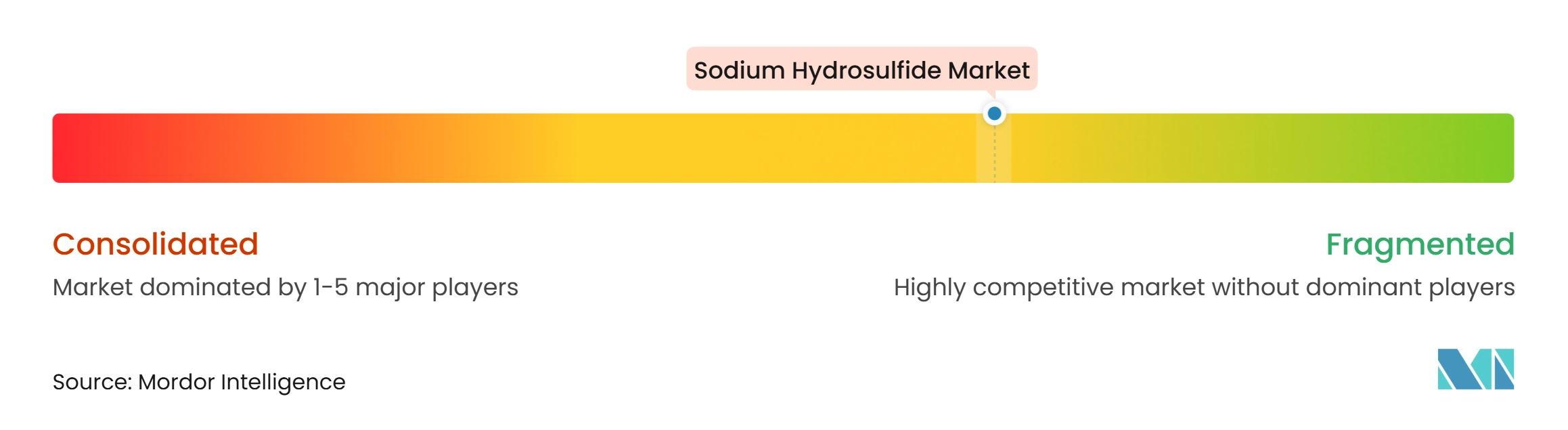
The sodium hydrosulfide market is moderately fragmented. Western specialty chemical suppliers, including Nouryon, Solvay, and Genesis Energy through TDC, compete on grade quality, supply reliability, logistics, and regulatory capability. Genesis Energy identifies owned logistics assets and leased storage as cost and service advantages in its sulfur services operations. Nouryon offers sodium hydrosulfide within its sulfur-products range, supporting its position with customers requiring a documented specialty chemical supply.
Product differentiation in the sodium hydrosulfide market is particularly visible in high-purity and anhydrous grades. NAGAO states that it produces industrial-grade anhydrous sodium hydrosulfide for reactions that are water-inhibited. Tessenderlo Kerley's moleko business rebranded its high-purity sodium hydrosulfide product as ekoSURE in July 2025. It also introduced TKI-330 as a partial replacement for sodium hydrosulfide in copper-molybdenum depression, positioning the business on both the supply and substitution sides of the market.
Chinese suppliers compete on price, export availability, and output capacity. Luxi Chemical reported 50,000 tons per year of 32-34% sodium hydrosulfide solution capacity in its 2025 annual report. Efirm identifies liquid capacity of 70,000 metric tons per year and solid capacity of 30,000 metric tons per year. GB/T 23937-2026 and tighter chemical-park requirements may reduce the number of compliant producers while raising quality expectations. Tangshan Fengshi reported recognition from Luoyang Molybdenum and cited mining-sector partnerships, indicating a shift toward closer customer relationships. Competition in the market therefore depends on regulatory compliance, supply security, specialized grades, and export pricing.
Sodium Hydrosulfide Industry Leaders
-
Genesis Energy, L.P.
-
Tessenderlo Kerley
-
Nouryon
-
Solvay
-
Fosfoquim SA
- *Disclaimer: Major Players sorted in no particular order
Sodium Hydrosulfide Market Companies Covered in this Report
- Chaitanya Chemicals
- Chemical Products Corporation
- Fosfoquim SA
- Gansu Winshine Metallurgy Chemicals Co., Ltd.
- Genesis Energy, L.P.
- Luxi Chemical Group Co., Ltd.
- NAGAO co., ltd
- Nouryon
- Sankyo Kasei Co., Ltd.
- Shandong Efirm Biochemistry Co., Ltd.
- Shandong Linyi Minyu Chemical Co., Ltd.
- Solvay
- Tangshan Fengshi Chemical Co., Ltd.
- Tessenderlo Kerley
- Tianjin RUISITE International Co., Ltd.
Recent Industry Developments in Sodium Hydrosulfide Market
- November 2026: China's specialty sulfide market is expected to experience short-term supply tightness as periodic production audits in Shandong, Jiangsu, and Zhejiang target high-sulfur-emission facilities under updated local environmental regulations. Approximately 15% of small-scale sodium hydrosulfide production lines are expected to enter short-term maintenance, temporarily lifting export quotation benchmarks, according to industry monitoring data reported by Ditai Chemicals.
- July 2025: Tessenderlo Kerley's moleko unit rebranded its high-purity sodium hydrosulfide product as ekoSURE, launched in Phoenix, Arizona. The rebrand also introduced ekoFITE and ekoFEND, reflecting a strategic shift of the moleko sulfide business toward application-specific, branded chemical solutions rather than commodity sodium hydrosulfide supply.
Global Sodium Hydrosulfide Market Report Scope
Sodium hydrosulfide is an inorganic salt produced by the half-neutralization of hydrogen sulfide with sodium hydroxide. It is also commonly known as sodium bisulfide, sodium sulfhydrate, or sodium hydrogen sulfide. The compound is available in both liquid and solid forms, with the solid form typically appearing as yellow flakes or chunks. It is soluble in water and alcohol, and it releases hydrogen sulfide gas when exposed to moisture or acidic conditions.
The sodium hydrosulfide market is segmented by form, application, and geography. By form, the market is segmented into liquid and solid. By application, the market is segmented into mining, pulp and paper, tanneries, chemical processing, water and wastewater treatment, textile and dyeing, and others. The report also covers market sizes and forecasts for sodium hydrosulfide across 15 countries in major regions. The market sizes and forecasts are provided in terms of value (USD).
Segmentation Overview
| Liquid |
| Solid |
| Mining |
| Pulp and Paper |
| Tanneries |
| Chemical Processing |
| Water and Wastewater Treatment |
| Textile and Dyeing |
| Others |
| Asia-Pacific | China |
| India | |
| Japan | |
| South Korea | |
| ASEAN Countries | |
| Rest of Asia-Pacific | |
| North America | United States |
| Canada | |
| Mexico | |
| Europe | Germany |
| United Kingdom | |
| France | |
| Italy | |
| NORDIC Countries | |
| Rest of Europe | |
| South America | Brazil |
| Argentina | |
| Rest of South America | |
| Middle East and Africa | Saudi Arabia |
| South Africa | |
| Rest of Middle East and Africa |
| By Form | Liquid | |
| Solid | ||
| By Application | Mining | |
| Pulp and Paper | ||
| Tanneries | ||
| Chemical Processing | ||
| Water and Wastewater Treatment | ||
| Textile and Dyeing | ||
| Others | ||
| By Geography | Asia-Pacific | China |
| India | ||
| Japan | ||
| South Korea | ||
| ASEAN Countries | ||
| Rest of Asia-Pacific | ||
| North America | United States | |
| Canada | ||
| Mexico | ||
| Europe | Germany | |
| United Kingdom | ||
| France | ||
| Italy | ||
| NORDIC Countries | ||
| Rest of Europe | ||
| South America | Brazil | |
| Argentina | ||
| Rest of South America | ||
| Middle East and Africa | Saudi Arabia | |
| South Africa | ||
| Rest of Middle East and Africa | ||
Key Questions Answered in the Report
What is current market size of Sodium Hydrosulfide Market?
The Sodium Hydrosulfide market size was valued at USD 703.03 billion in 2026 and is estimated to grow from USD 733.90 billion in 2027 to USD 915.45 billion by 2032, at a CAGR of 4.52% during the forecast period (2027-2032).
Which form of sodium hydrosulfide has the largest share?
Liquid grade held a 70.12% share in 2026 because large mining, pulp, and treatment sites commonly use continuous liquid-feed systems.
Which application is growing fastest for sodium hydrosulfide?
Water and wastewater treatment is forecast to expand at a 5.45% CAGR through 2032, driven by demand for heavy-metal removal and resource recovery.
Which region leads sodium hydrosulfide consumption?
Asia-Pacific held a 37.91% share in 2026 and is projected to grow at a 5.33% CAGR through 2032.