
Sodium Amide Market Size and Share
Market Overview
| Study Period | 2022 - 2032 |
|---|---|
| Market Size (2027) | USD 418.44 Million |
| Market Size (2032) | USD 548.44 Million |
| Growth Rate (2027 - 2032) | 5.56 % |
| Fastest Growing Market | Asia-Pacific |
| Largest Market | Asia-Pacific |
| Market Concentration | Medium |
Major Players *Disclaimer: Major Players sorted in no particular order Image © Mordor Intelligence. Reuse requires attribution under CC BY 4.0. | |
Sodium Amide Market Analysis by Mordor Intelligence
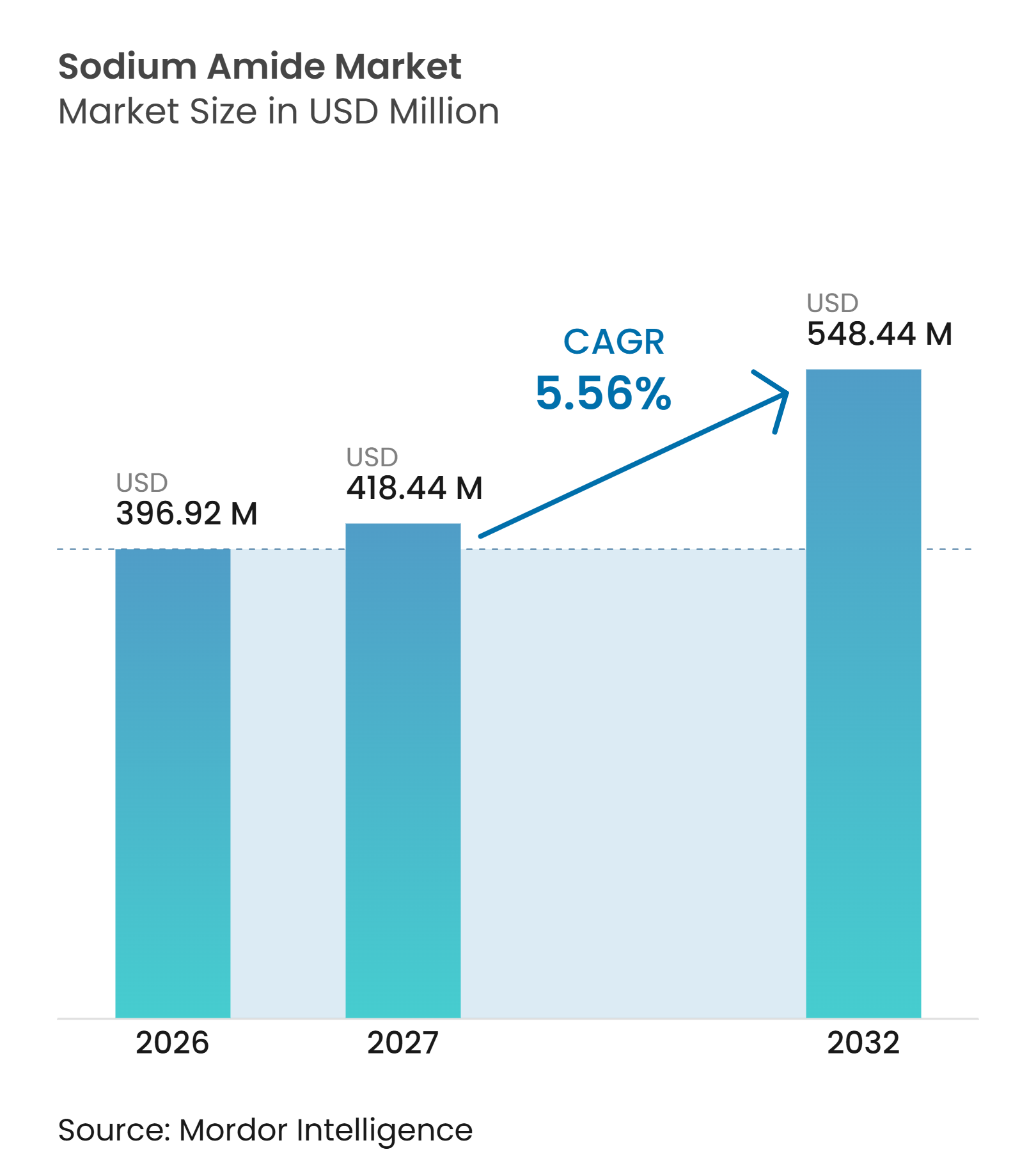
The Sodium Amide Market size was valued at USD 396.92 million in 2026 and is estimated to grow from USD 418.44 million in 2027 to reach USD 548.44 million by 2032, at a CAGR of 5.56% during the forecast period (2027-2032). Sodium amide is used as a strong inorganic base in organic synthesis, agrochemical intermediates, and active pharmaceutical ingredient production, and it is registered under the United States Toxic Substances Control Act and EU Registration, Evaluation, Authorisation and Restriction of Chemicals (REACH). Pharmaceutical manufacturing is moving toward Asia, while policy measures in the United States are encouraging more resilient domestic active pharmaceutical ingredient supply chains. This creates demand for qualified sodium amide supply across both established Asian manufacturing centers and North American pharmaceutical customers. The sodium amide market also faces higher handling, storage, and transport requirements because the substance is classified as dangerous when wet under UN 1390.
Key Report Takeaways
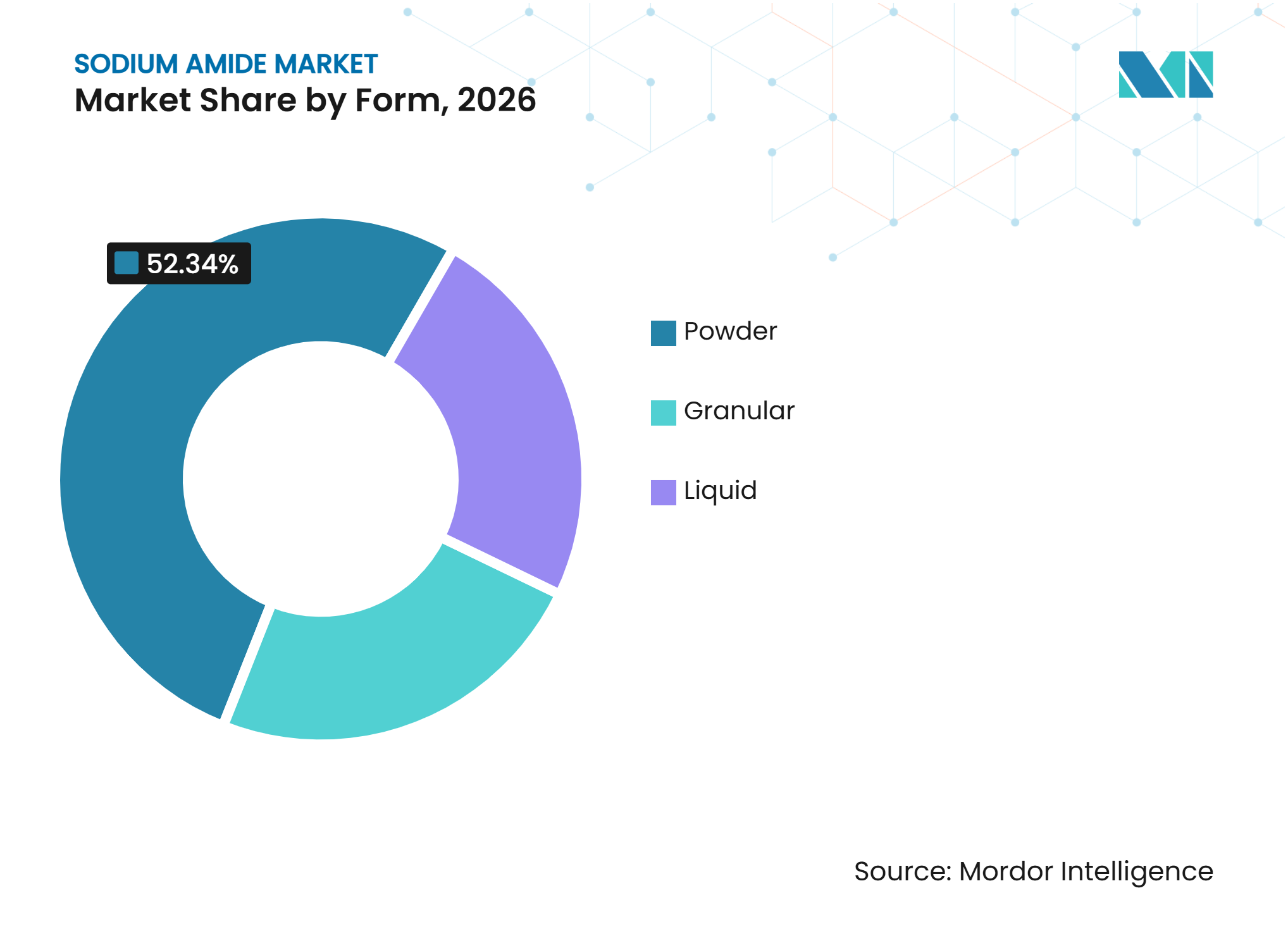
- By form, powder held 52.34% of the sodium amide market share in 2026, while liquid is projected to advance at a 6.13% CAGR through 2032.
- By grade, technical grade held 50.12% of the sodium amide market share in 2026, while high-purity grade is projected to advance at a 6.26% CAGR through 2032.
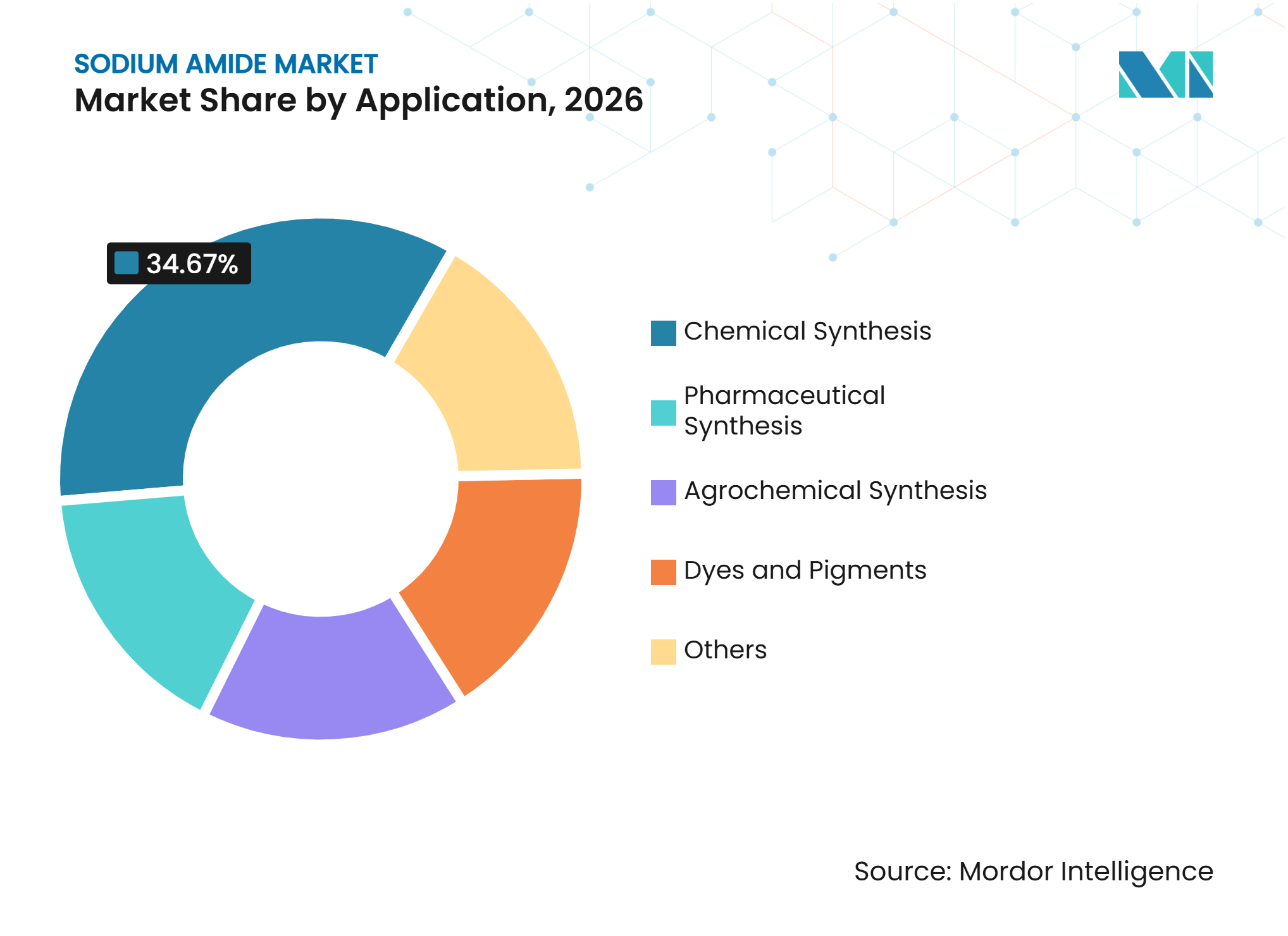
- By application, chemical synthesis held 34.67% of the sodium amide market share in 2026, while pharmaceutical synthesis is projected to advance at a 6.89% CAGR through 2032.
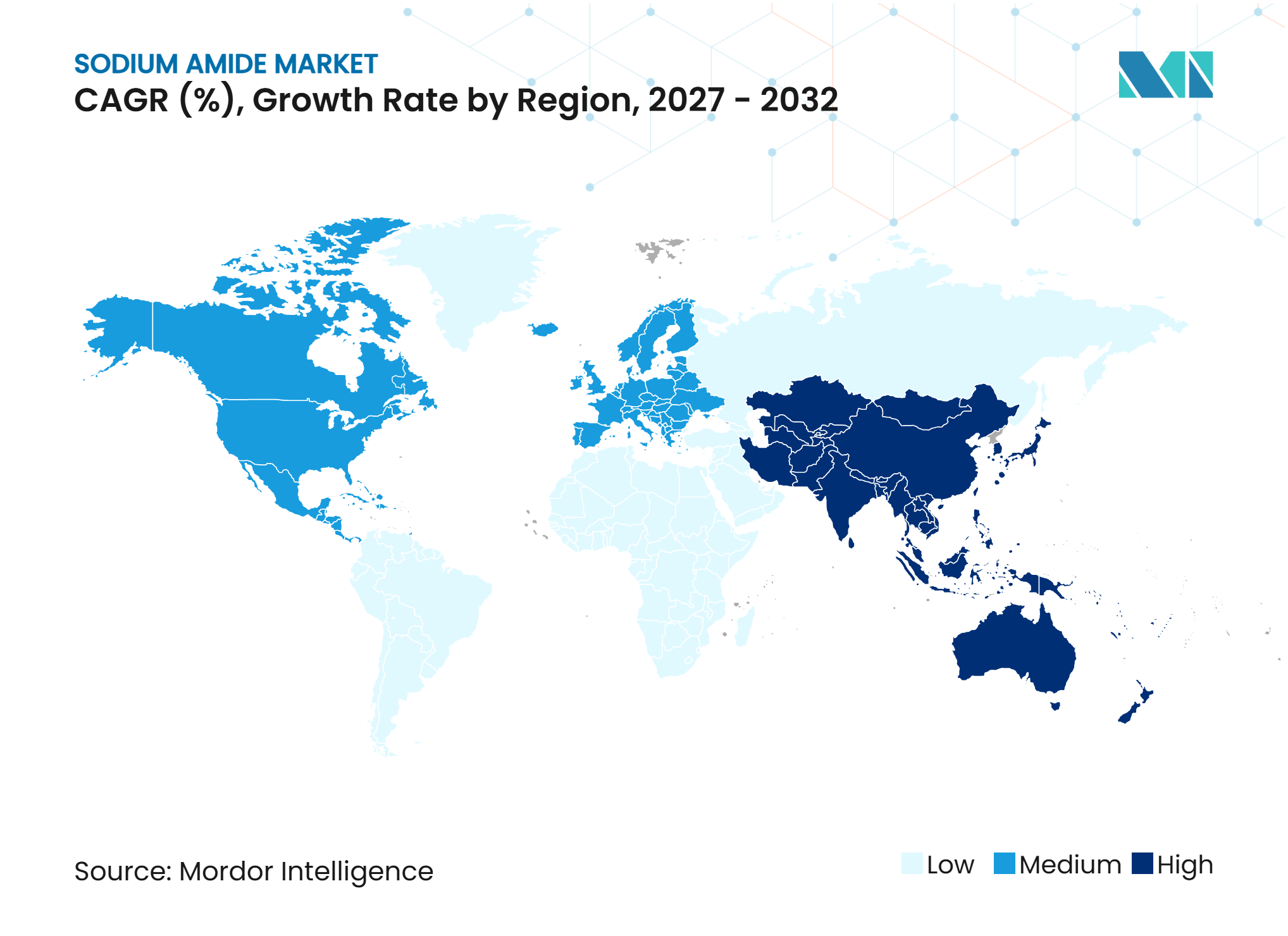
- By geography, Asia-Pacific held 38.41% of the sodium amide market share in 2026 and is projected to advance at a 6.77% CAGR through 2032.
Note: Market numbers in this report are based on Mordor Intelligence's proprietary estimation framework, which combines nine months of actuals with Q4 projections for base year 2026.
Market Trends and Insights
Drivers Impact Analysis of Sodium Amide Market*
| Driver | (~) % Impact on CAGR Forecast | Geographic Relevance | Impact Timeline |
|---|---|---|---|
| Pharmaceutical and API Synthesis Demand | +1.6% | Global, with intensity in Asia-Pacific (India, China) and North America | Medium term (2-4 years) |
| Agrochemical and Specialty Chemical Production | +1.2% | APAC core, spillover to South America and MEA | Medium term (2-4 years) |
| Safer Flake and Low-Dust Product Formats | +0.9% | Global, led by Europe and North America regulatory environments | Short term (≤ 2 years) |
| Integrated Ammonia Recovery and Energy Efficiency | +0.7% | Asia-Pacific and Europe (energy transition economies) | Long term (≥ 4 years) |
| Demand for High-Purity Reagents in Advanced Synthesis | +0.6% | North America, Europe, Japan, South Korea | Medium term (2-4 years) |
| Source: Mordor Intelligence | |||
Pharmaceutical and API Synthesis Demand
Sodium amide supports deprotonation and cyclization steps used in complex pharmaceutical synthesis. The Food and Drug Administration reported that India’s share of active pharmaceutical ingredient manufacturing locations increased by 3.3 percentage points from 2020 through Fiscal Year 2025 (FY2025), while the shares for the United States and Europe declined. This production pattern concentrates a significant part of reagent demand in Asian manufacturing locations. Researchers at the University of Cambridge and the University of Strathclyde reported a continuous-flow method for sodium amide-mediated ester amidation and carbon-fluorine bond amination in deep eutectic solvents. The process operated at room temperature and tolerated air and moisture, which may broaden the use of sodium amide chemistry in drug-intermediate production.
Agrochemical and Specialty Chemical Production
Sodium amide is used as a condensing and aminating reagent in chemical routes for agrochemical intermediates. It also supports the preparation of azide derivatives that are used in routes toward triazole fungicide intermediates. BASF stated that Asia-Pacific represented nearly 70% of the global chemicals market and that more than 80% of chemical-industry growth is expected in the region through 2035. This production base supports continued demand for reactive reagents in China and India. BASF’s Zhanjiang Verbund project adds downstream chemical capacity in China, strengthening the regional manufacturing environment for specialty chemical synthesis. Sodium amide also remains relevant to industrial indigo production, where it supports cyclization of N-phenylglycine in established textile chemical routes.
Safer Flake and Low-Dust Product Formats
Powder sodium amide can create inhalation and reactive-dust risks during storage and transfer. Buyers operating under strict chemical-safety systems can favor flake or lower-dust forms because these formats reduce airborne material during handling. Sodium amide is subject to EU registration and classification requirements under REACH and the Classification, Labelling and Packaging framework[1]. Alkali Metals Ltd. identifies sodium amide flakes as a product format in its portfolio, and the company’s product information describes controlled packaging for hazardous material handling. The United States Hazard Communication Standard and European classification rules increase the value of product formats that support controlled handling.
Integrated Ammonia Recovery and Energy Efficiency
The sodium amide production route uses metallic sodium and liquid ammonia, creating an economic reason to recover valuable process materials. Recovery of ammonia and hydrogen can improve plant efficiency when producers have suitable process equipment. Alkali Metals Ltd. describes integrated operations for sodium-based products and identifies sodium amide as part of its operating portfolio. Process integration can reduce exposure to input-cost volatility and can support supply contracts that place greater emphasis on production reliability. Hokkaido University has also described sodium amide as a low-temperature nitridation flux for nitride synthesis below 300 °C. This research indicates a possible use case in advanced materials where controlled nitrogen delivery is valuable.
Restraints Impact Analysis of Sodium Amide Market*
| Restraint | (~) % Impact on CAGR Forecast | Geographic Relevance | Impact Timeline |
|---|---|---|---|
| Water Reactivity and Hazardous Material Handling Costs | -1.2% | Global - highest compliance overhead in North America and Europe | Short term (≤ 2 years) |
| Feedstock and Energy Cost Volatility | -0.9% | Asia-Pacific, Europe (energy-intensive sodium metal production) | Medium term (2-4 years) |
| Oxidation, Peroxide Formation, and Inventory-Age Risk | -0.6% | Global, with severity in tropical climates (South/Southeast Asia, MEA) | Long term (≥ 4 years) |
| Source: Mordor Intelligence | |||
Water Reactivity and Hazardous Material Handling Costs
Sodium amide reacts with water to form ammonia and sodium hydroxide. The substance is classified as UN 1390, dangerous when wet, which requires controlled storage and transport arrangements[2]. The National Oceanic and Atmospheric Administration (NOAA) identifies incompatibilities with water, halogenated hydrocarbons, alcohols, and oxidizing agents. These conditions require segregated storage and increase operating costs for facilities that use or distribute the material. Smaller buyers can face a higher barrier because they may not have inert-gas storage, specialized packaging, or suitable hazardous-material logistics. The restraint is most relevant where chemical-safe warehousing and emergency-response capacity are limited.
Feedstock and Energy Cost Volatility
Sodium amide production depends on metallic sodium and liquid ammonia, both of which have energy-intensive supply chains. Metallic sodium is produced from sodium chloride through electrochemical methods, making its cost sensitive to electricity prices. The sodium amide market can face margin pressure when higher energy costs cannot be passed through to downstream customers. Buyers may assess alternative strong bases when sodium amide pricing rises sharply, particularly in cost-sensitive synthesis routes.
*Our forecasts treat driver/restraint impacts as directional, not additive. The impact forecasts reflect baseline growth, mix effects, and variable interactions.
Sodium Amide Market Segment Analysis
By Form:
Powder Retains Broad Use, While Liquid Gains MomentumPowder accounted for 52.34% of the sodium amide market share in 2026 because it remains suited to established batch chemical synthesis operations. The format is widely used in agrochemical, dye, and basic organic synthesis where plants already have established material-handling procedures. Powder is generally appropriate for high-volume operations that prioritize simple procurement and direct reagent charging. Its handling requirements remain significant because sodium amide reacts with water and can create reactive dust. Granular material provides a lower-dust alternative for users who want to retain a solid form. This format can support mid-scale pharmaceutical and specialty chemical facilities that require improved handling control. The form mix reflects the different operating environments of large-volume industrial synthesis and higher-control specialty production. Product selection therefore depends on reaction design, worker-safety procedures, and the capability of each production site.
Liquid is projected to advance at a 6.13% CAGR through 2032, making it the fastest-growing form in the sodium amide market. Liquid suspensions can reduce certain manual handling steps and can support measured dosing in continuous-flow operations. Merck KGaA lists sodium amide in toluene suspension as part of its reagent offering. Continuous-flow methods can give manufacturers better control over reaction stoichiometry and residence time. The 2025 study from the University of Cambridge and the University of Strathclyde demonstrated sodium amide reactions in continuous flow under air- and moisture-tolerant conditions. The reported method may make liquid-phase use more practical for selected pharmaceutical and fine chemical routes. Liquid products still require hazardous-material controls, especially where the suspension uses an organic solvent. Demand will therefore depend on whether facilities can justify the added process equipment and compliance requirements.



By Grade:
Technical Grade Supports Revenue While High-Purity Grade Builds ValueTechnical grade held 50.12% of the sodium amide market share in 2026, supported by bulk chemical synthesis, dye production, and agrochemical intermediate manufacturing. These uses often require effective base performance but do not always need the most stringent reagent specifications. Technical grade therefore remains relevant to large-volume routes that operate under established quality systems. Industrial grade serves related applications with lower or different purity requirements. The segment benefits from the scale of chemical production in Asia, where sodium-based intermediates are part of broader manufacturing networks. BASF identifies the Asia-Pacific region as a major center for global chemical production and future chemical growth. Technical grade demand remains closely tied to the output of downstream chemical plants. Its commercial position depends on reliable volume supply, consistent specifications, and compliant delivery of a hazardous material.
High-purity grade is projected to advance at a 6.26% CAGR through 2032 as customers increase controls over reagent consistency. Pharmaceutical and advanced-material producers need materials that can support traceability and reproducible process outcomes. Merck KGaA lists crystalline sodium amide with an assay of at least 95%, while Alkali Metals Ltd. identifies a 99.3% purity flake product. The sodium amide market size for high-purity products is shaped by buyers that place greater weight on specification control than on minimum purchase cost. Lonza Group AG’s 2025 advanced-synthesis performance reflects continued activity in small-molecule drug substance manufacturing. Suppliers that document purity, packaging integrity, and hazardous-goods compliance can be better positioned for these applications. Research and catalyst-preparation uses also require dependable reagent quality, though their purchase volumes are generally smaller.
By Application:
Chemical Synthesis Leads, While Pharmaceutical Synthesis Expands FasterChemical synthesis held 34.67% of the sodium amide market share in 2026 because sodium amide is used in deprotonation, condensation, and amination reactions. It is relevant to a range of organic synthesis routes, including alkyne chemistry, indigo production, and hydrazine intermediate preparation. This broad technical role gives the application a stable position across several downstream chemical chains. Agrochemical synthesis also uses sodium amide as an aminating agent for selected crop-protection intermediates. Dyes and pigments represent an established use, especially for indigo-related chemistry. The continuation of chemical production capacity in Asia supports demand for these uses. Applications outside core synthesis include specialty polymer initiation and emerging advanced-material routes. Each application must still address the same handling and storage controls required for a water-reactive material.
Pharmaceutical synthesis is projected to advance at a 6.89% CAGR through 2032. Small-molecule drug production can require bases that support complex multi-step reaction sequences. The Food and Drug Administration’s FY2025 quality report shows the continuing importance of India in the global active pharmaceutical ingredient manufacturing footprint. The United States has also established policy measures to strengthen reserves of critical active pharmaceutical ingredients and encourage domestic production. These factors support demand from both Asian production centers and North American customers building qualified supply chains. Lonza Group AG’s multi-year small-molecule supply agreement provides a company example of sustained contracted activity in advanced drug-substance manufacturing. Pharmaceutical customers can place higher value on quality documentation, supply reliability, and controlled packaging. This strengthens the role of premium reagents within the sodium amide market.

Geography Analysis
Asia-Pacific
Asia-Pacific held 38.41% of the sodium amide market share in 2026 and is projected to advance at a 6.77% CAGR through 2032. The region combines large-scale chemical production with a substantial active pharmaceutical ingredient manufacturing base. Alkali Metals Ltd. operates in Hyderabad, India, and identifies sodium amide among its product offerings. China supports demand through agrochemical intermediate, dye, and specialty chemical production. BASF reported that Asia-Pacific contributes nearly 70% of the global chemicals market and is expected to account for most chemicals-industry growth through 2035. Japan adds high-specification demand through research, pharmaceutical, and specialty chemical applications. Nippon Soda Co., Ltd. reports activities across chemical materials, including fine and specialty chemicals, while Tokyo Chemical Industry Co., Ltd. (TCI) serves laboratory reagent customers. The region’s growth is supported by local production networks, but safe handling practices remain essential because sodium amide is water-reactive.
Europe
Europe’s sodium amide market is supported by pharmaceutical and fine chemical production that values product quality and compliance documentation. The region is shaped by REACH registration and the Classification, Labelling and Packaging framework for hazardous chemicals. These compliance factors encourage buyers to evaluate lower-dust product formats and reliable inert packaging. Germany remains important because it hosts major chemical and reagent operations, including BASF and Merck KGaA. BASF has announced investment in a new alcoholates plant at Ludwigshafen for a planned 2027 startup, which indicates continued investment in sodium-based specialty chemistry infrastructure. Merck KGaA provides crystalline and suspension sodium amide products for synthesis applications. Pharmaceutical and research customers in Germany, France, Italy, and Nordic markets can favor high-purity materials. Product formats that reduce dust exposure can be especially relevant under European workplace safety expectations. The region’s demand profile is therefore more closely linked to quality-led synthesis than to basic bulk use.
North America, South America, and Middle East and Africa
North America is supported by policy measures aimed at improving resilience in domestic pharmaceutical supply chains. The United States Executive Order on the Strategic Active Pharmaceutical Ingredients Reserve directs action to secure supplies of critical active pharmaceutical ingredients with a preference for domestic manufacturing. The Food and Drug Administration’s PreCheck program also supports domestic manufacturing readiness. Thermo Fisher Scientific Inc. and Spectrum Chemical Mfg. Corp. support laboratory and pharmaceutical accounts through reagent distribution, while qualified imports remain important for industrial demand. South American demand is linked to agrochemical and generic-drug activity, particularly in Brazil and Argentina. Middle East and Africa demand is more limited and is generally concentrated among specialist importers serving pharmaceutical and industrial synthesis customers. UN 1390 transport restrictions can make logistics more difficult in locations with less developed hazardous-material infrastructure. Saudi Arabia’s efforts to move from petrochemicals toward higher-value chemicals may support future specialty chemical demand. Across these mixed regions, qualified distribution, storage capability, and compliance procedures will determine how quickly demand develops.
Competitive Landscape
Market Concentration
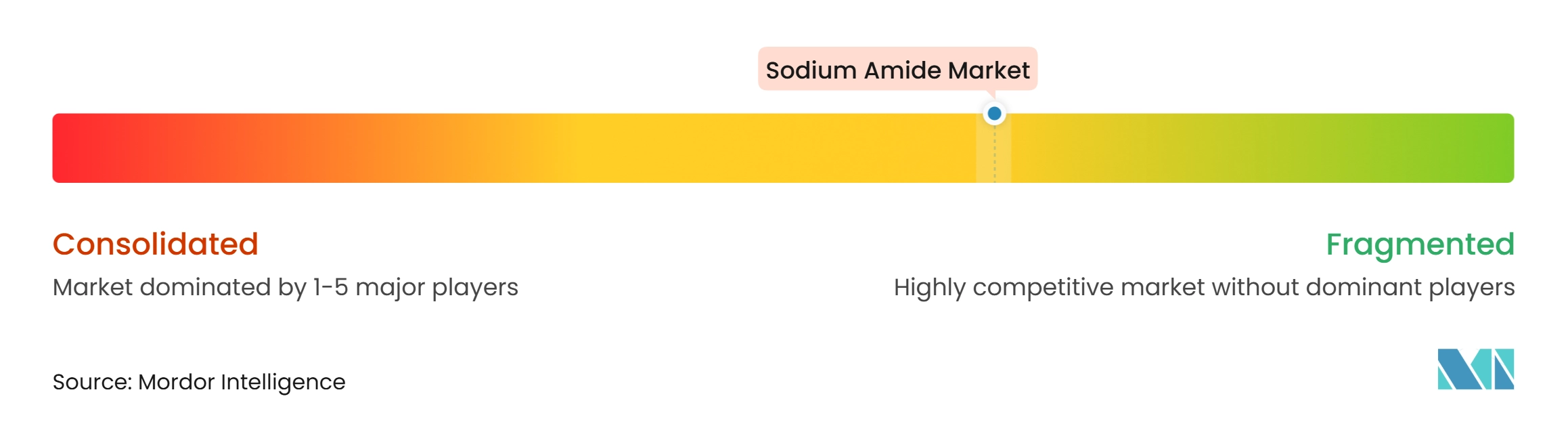
The sodium amide market is moderately concentrated, with top players including BASF, Merck KGaA, Albemarle Corporation, Thermo Fisher Scientific Inc., and Tokyo Chemical Industry Co., Ltd. (TCI). BASF and Solvay have broader specialty chemical portfolios and operate in markets where sodium chemistry supports other product lines. Merck KGaA, Thermo Fisher Scientific Inc., and Tokyo Chemical Industry Co., Ltd. (TCI) distribute reagents to research, pharmaceutical, and industrial customers. This separation means that producers need qualified distribution partnerships, while distributors need dependable supply arrangements. Companies that can meet quality and hazardous-goods documentation requirements are better placed to serve pharmaceutical and advanced-synthesis customers.
Cost and compliance are central competitive factors. Producers that recover ammonia and hydrogen from their operations can improve resource efficiency and potentially reduce unit costs. Alkali Metals Ltd. identifies sodium amide within its sodium derivative portfolio and maintains product information for hazardous materials. Suppliers that provide high-purity grades can address customers that require documented specifications and controlled packaging. Merck KGaA offers crystalline sodium amide for synthesis, while Thermo Fisher Scientific Inc. maintains safety documentation for its sodium amide product line. BASF’s continued capacity development at Zhanjiang is an example of a major supplier strengthening its Asia-Pacific manufacturing presence. Solvay doubled high-purity electronic-grade hydrogen peroxide capacity at Zhenjiang in 2025, showing continued investment in Asian high-purity specialty chemical supply. These moves do not confirm sodium amide capacity, but they show the strategic importance of regional specialty chemical operations.
Lonza Group AG competes differently because it uses advanced chemistry within contracted drug-substance manufacturing rather than selling sodium amide as a general reagent. The company reported a large multi-year commercial supply agreement for small-molecule drug substance work in 2025. This approach captures value from process development, manufacturing, and client supply arrangements. The 2025 continuous-flow study from Cambridge and Strathclyde may also lower some process barriers for sodium amide chemistry if it is translated into commercial methods. Natrizen Chemical Pvt. Ltd. and Loba Chemie Pvt. Ltd. participate in the Indian supply environment, while Spectrum Chemical Mfg. Corp. supports distribution in the United States. The competitive structure therefore favors verified producers with safe production operations and distributors that can serve regulated customers.
Sodium Amide Industry Leaders
-
BASF
-
Merck KGaA
-
Albemarle Corporation
-
Thermo Fisher Scientific Inc.
-
Tokyo Chemical Industry Co., Ltd. (TCI)
- *Disclaimer: Major Players sorted in no particular order
Sodium Amide Market Companies Covered in this Report
- Albemarle Corporation
- Alkali Metals Ltd.
- BASF
- Loba Chemie Pvt. Ltd.
- Lonza Group AG
- Merck KGaA
- Mitsubishi Gas Chemical Company, Inc.
- Natrizen Chemical Pvt. Ltd.
- Nippon Soda Co., Ltd.
- Solvay
- Spectrum Chemical Mfg. Corp.
- Sreepathi Pharmaceuticals Limited
- Thermo Fisher Scientific Inc.
- Tokyo Chemical Industry Co., Ltd. (TCI)
Recent Industry Developments in Sodium Amide Market
- February 2026: Researchers used a deep-learning generative model to investigate crystal structures of sodium amide and their potential applications in solid-state hydrogen storage systems. The study broadened research into sodium amide-based materials for hydrogen storage applications.
- October 2025: A study published in ACS Sustainable Chemistry & Engineering evaluated sodium amide reagents in deep eutectic solvents (DES) for ester amidation processes. The research expanded the potential use of sodium amide in synthetic chemistry and amidation applications.
Global Sodium Amide Market Report Scope
Sodium amide (NaNH₂) is an inorganic chemical compound widely used as a strong base and reducing agent in organic and industrial chemical reactions. It facilitates deprotonation, condensation, and other chemical transformations, making it useful in the synthesis of specialty chemicals and complex organic compounds. Its applications extend across chemical manufacturing, pharmaceutical intermediates, agrochemicals, dyes, and pigments.
The Sodium Amide Market is segmented by form, grade, application, and geography. By form, the market is segmented into powder, granular, and liquid. By grade, the market is segmented into industrial grade, technical grade, high-purity grade, and others. By application, the market is segmented into chemical synthesis, pharmaceutical synthesis, agrochemical synthesis, dyes and pigments, and others. The report also covers the market size and forecasts for sodium amide in 15 countries across major regions. For each segment, the market sizing and forecasts have been done on the basis of value (USD).
Segmentation Overview
| Powder |
| Granular |
| Liquid |
| Industrial Grade |
| Technical Grade |
| High-Purity Grade |
| Others |
| Chemical Synthesis |
| Pharmaceutical Synthesis |
| Agrochemical Synthesis |
| Dyes and Pigments |
| Others |
| Asia-Pacific | China |
| India | |
| Japan | |
| South Korea | |
| ASEAN Countries | |
| Rest of Asia-Pacific | |
| North America | United States |
| Canada | |
| Mexico | |
| Europe | Germany |
| United Kingdom | |
| France | |
| Italy | |
| NORDIC Countries | |
| Rest of Europe | |
| South America | Brazil |
| Argentina | |
| Rest of South America | |
| Middle East and Africa | Saudi Arabia |
| South Africa | |
| Rest of Middle East and Africa |
| By Form | Powder | |
| Granular | ||
| Liquid | ||
| By Grade | Industrial Grade | |
| Technical Grade | ||
| High-Purity Grade | ||
| Others | ||
| By Application | Chemical Synthesis | |
| Pharmaceutical Synthesis | ||
| Agrochemical Synthesis | ||
| Dyes and Pigments | ||
| Others | ||
| By Geography | Asia-Pacific | China |
| India | ||
| Japan | ||
| South Korea | ||
| ASEAN Countries | ||
| Rest of Asia-Pacific | ||
| North America | United States | |
| Canada | ||
| Mexico | ||
| Europe | Germany | |
| United Kingdom | ||
| France | ||
| Italy | ||
| NORDIC Countries | ||
| Rest of Europe | ||
| South America | Brazil | |
| Argentina | ||
| Rest of South America | ||
| Middle East and Africa | Saudi Arabia | |
| South Africa | ||
| Rest of Middle East and Africa | ||
Key Questions Answered in the Report
What is the size of the sodium amide market?
The sodium amide market size was valued at USD 396.92 million in 2026 and is estimated to grow from USD 418.44 million in 2027 to reach USD 548.44 million by 2032, at a CAGR of 5.56% during the forecast period (2027-2032).
What is driving demand for sodium amide?
Active pharmaceutical ingredient synthesis, agrochemical intermediates, and specialty chemical production support demand.
Which form is projected to advance fastest through 2032?
Liquid is projected to advance at a 6.13% CAGR through 2032, supported by controlled dosing and continuous-flow chemistry.
Which grade is projected to advance fastest through 2032?
High-purity grade is projected to advance at a 6.26% CAGR through 2032 as pharmaceutical and advanced-synthesis customers require stronger quality controls.