
Social Media Marketing Services Market Size and Share
Market Overview
| Study Period | 2020 - 2031 |
|---|---|
| Market Size (2026) | USD 42.31 Billion |
| Market Size (2031) | USD 64.48 Billion |
| Growth Rate (2026 - 2031) | 8.79 % |
| Fastest Growing Market | Asia-Pacific |
| Largest Market | North America |
| Market Concentration | Medium |
Major Players *Disclaimer: Major Players sorted in no particular order Image © Mordor Intelligence. Reuse requires attribution under CC BY 4.0. | |
Social Media Marketing Services Market Analysis by Mordor Intelligence
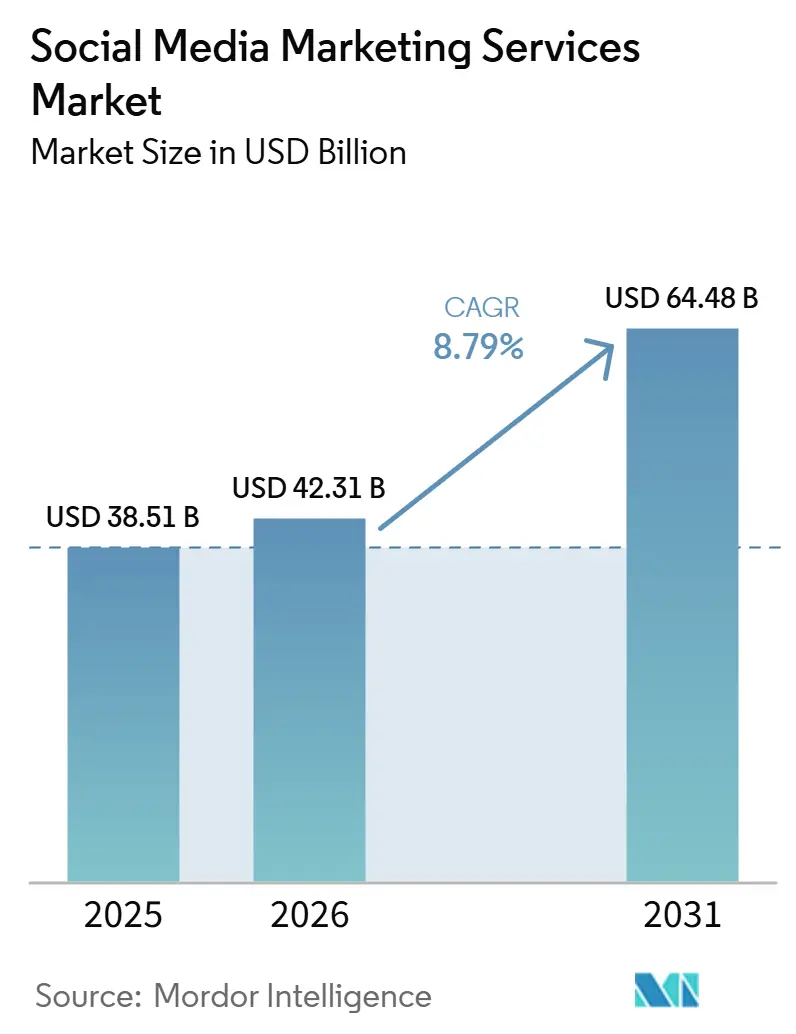
The Social Media Marketing Services Market size was valued at USD 38.51 billion in 2025 and is estimated to grow from USD 42.31 billion in 2026 to reach USD 64.48 billion by 2031, at a CAGR of 8.79% during the forecast period (2026-2031). Generative AI is lowering the time and cost required to produce and test social content, while making strategy, review, and measurement more important service functions. Social commerce is bringing discovery and purchase closer together, which is making revenue attribution a central client requirement. Creator programs are moving into recurring media budgets as brands seek stronger links between creator activity and commercial results. Enterprise demand remains important because multinational publishing, approvals, crisis response, customer care, paid campaigns, and product launches require governance that is hard to manage through separate tools. At the same time, privacy restrictions, weaker attribution signals, and unsuitable content environments are raising demand for independent measurement and brand-safety support, including verification of placements, interactions, and content context before results are presented to clients.
Key Report Takeaways
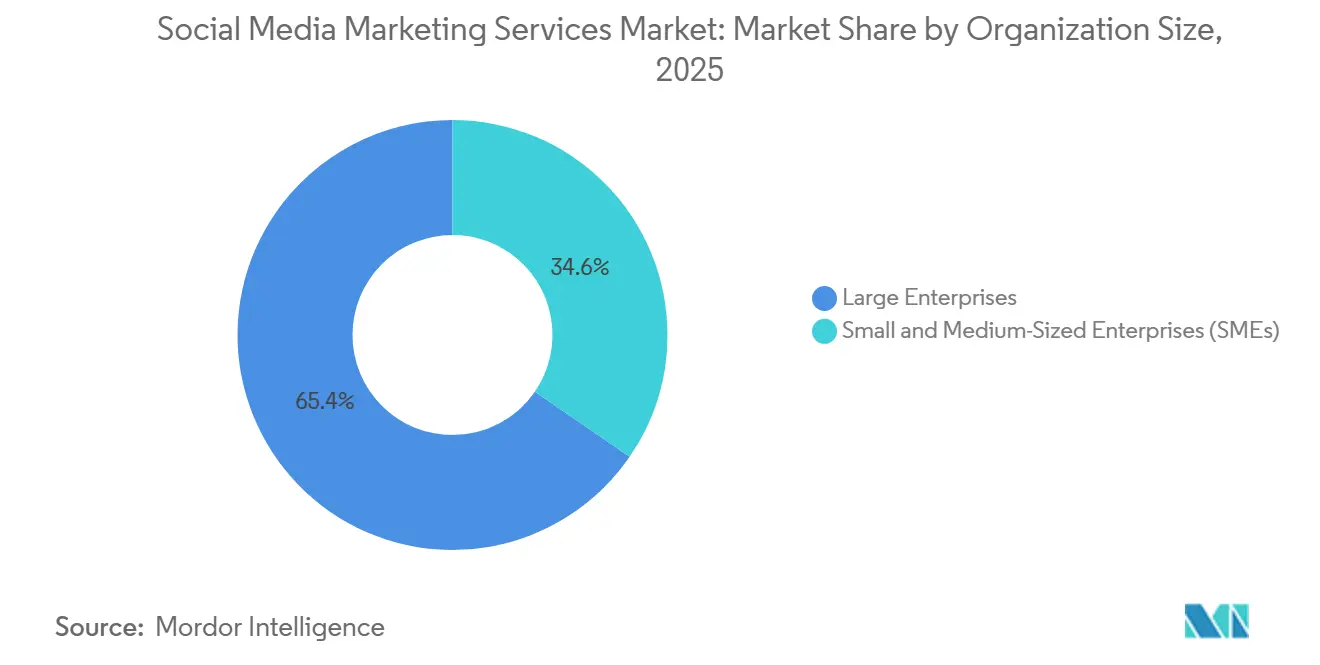
- By organization size, large enterprises accounted for 65.41% of market revenue in the Social Media Marketing Services Market 2025, while small and medium-sized enterprises are projected to expand at a 12.12% CAGR through 2031.
- By application, sales and marketing management accounted for 31.11% of revenue in the Social Media Marketing Services Market 2025, while customer experience management is expected to expand at a 13.54% CAGR through 2031.
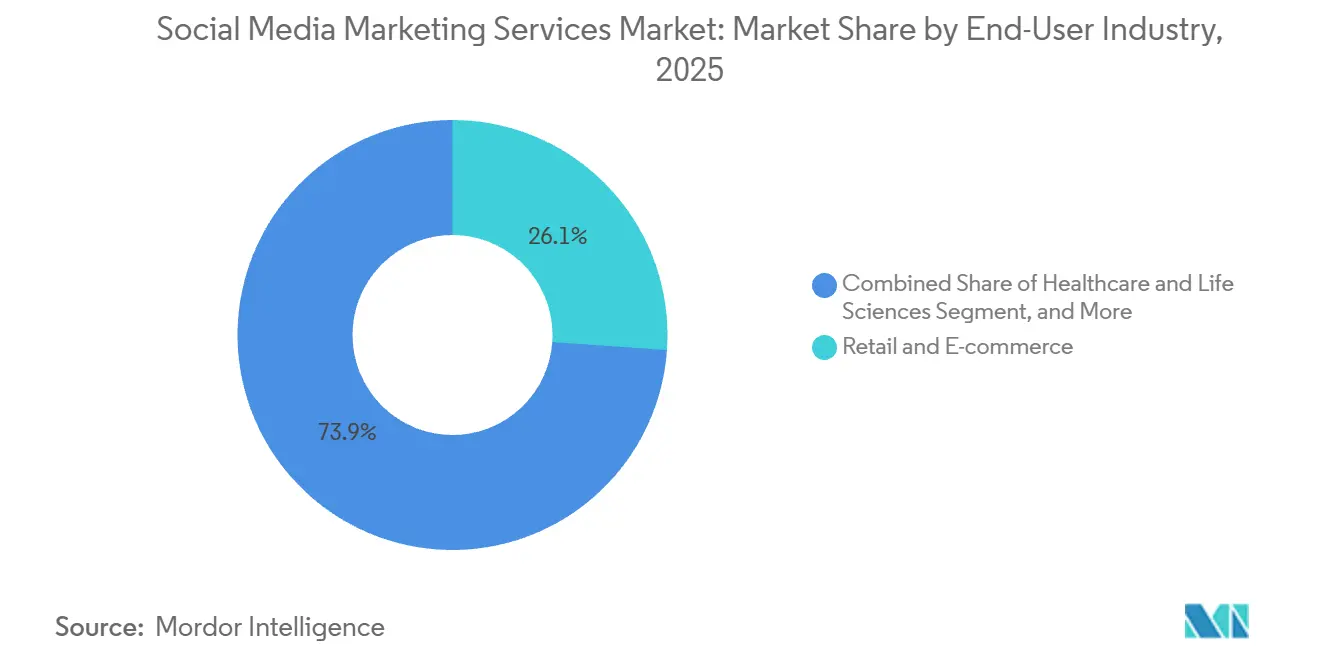
- By end-user industry, retail and e-commerce accounted for 26.12% of revenue in the Social Media Marketing Services Market 2025, while healthcare and life sciences are projected to grow at a 13.42% CAGR through 2031.
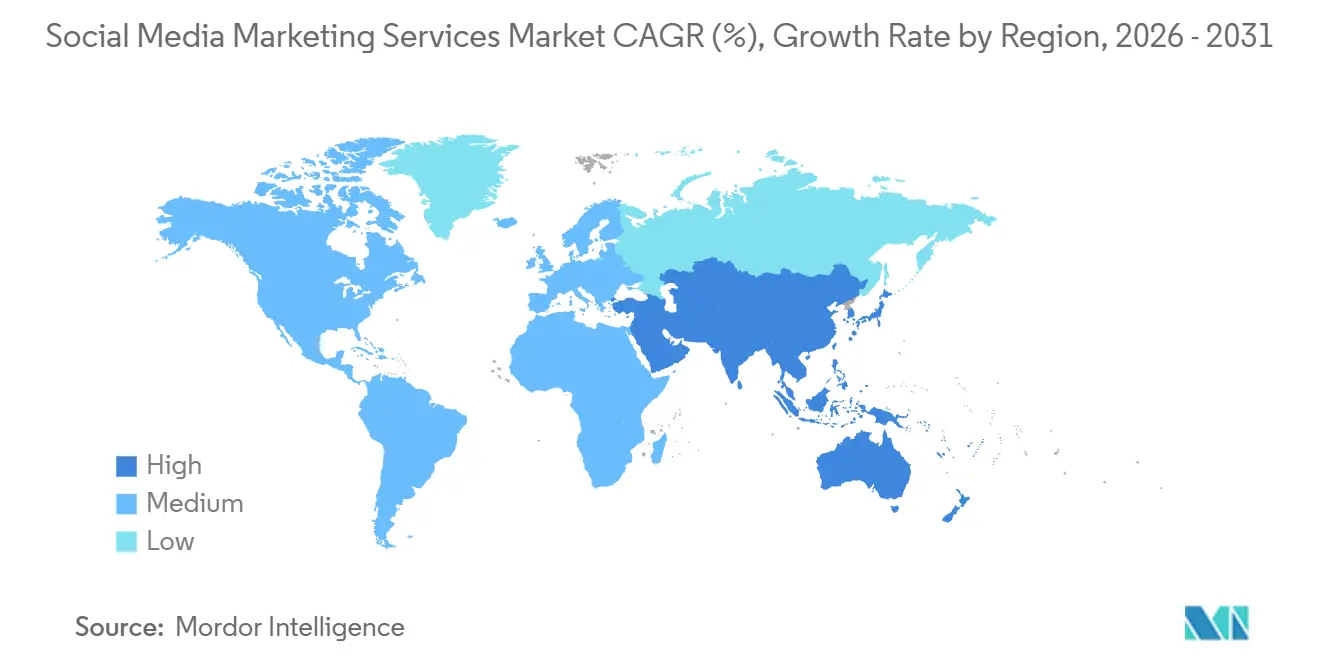
- By geography, North America accounted for 34.51% of revenue in 2025, while Asia-Pacific is expected to expand at a 14.12% CAGR through 2031.
Note: Market size and forecast figures in this report are generated using Mordor Intelligence’s proprietary estimation framework, updated with the latest available data and insights as of January 2026.
Market Trends and Insights
Drivers Impact Analysis of Social Media Marketing Services Market*
| Driver | (~) % Impact on CAGR Forecast | Geographic Relevance | Impact Timeline |
|---|---|---|---|
| Generative AI Lowers Content Production and Optimization Costs | +2.0% | Global | Short term (≤ 2 years) |
| Social Commerce and Shoppable Formats Bring Budgets Closer to Conversion | +1.8% | Global, Asia-Pacific core and North America leading | Short term (≤ 2 years) |
| Creator Partnerships Become a Core Media Line Item | +1.4% | North America and Europe, spill-over to Asia-Pacific | Short term (≤ 2 years) |
| Community Management Becomes a Revenue Protection Function | +1.0% | Global | Medium term (2-4 years) |
| Social Search and Generative Discovery Expand Organic Brand Discovery | +0.8% | Global | Medium term (2-4 years) |
| Multi-Location and Franchise Marketing Automation Scales Local Social Execution | +0.6% | North America and Europe | Medium term (2-4 years) |
| Source: Mordor Intelligence | |||
Generative AI Lowers Content Production And Optimization Costs
Generative AI is changing the cost structure behind the Social Media Marketing Services Market. Companies can now create more creative versions within the same campaign budget. Adobe integrated Firefly across the Experience Cloud in October 2025, reducing creative timelines by up to 50% in early implementations. HubSpot reported in 2026 that 73% of marketers had integrated AI into content workflows.[1]HubSpot, “The Future of Social Media [Research]: What Marketers Need to Know in 2026,” HubSpot, hubspot.com This adoption shifts client demand from simple post-production toward content review, brand consistency, compliance checks, and performance analysis. Teams must decide which ideas deserve investment, which versions meet brand standards, and which content can be approved for regulated audiences. More assets also create a greater need for common approval rules across internal teams, agencies, and creators. The Social Media Marketing Services Market, therefore, has an opportunity to serve teams that need human oversight across much larger volumes of content.
Social Commerce And Shoppable Formats Bring Budgets Closer To Conversion
Social commerce is shifting social activity from a promotional channel toward a direct sales channel. TikTok livestreams drove 84% year-over-year sales growth for participating brands during Black Friday and Cyber Monday 2025. The format requires creators, live production, merchandise planning, and careful performance tracking.[2]Talkwalker, “Social Media Community Management: Your 2025 Playbook,” Talkwalker, talkwalker.com Clients are increasingly asking service providers to demonstrate revenue results rather than just reach or engagement. This need favors platforms and agencies that can connect creator activity, product-level reporting, checkout data, paid distribution, affiliate links, and customer interactions across the purchase journey. Product availability, returns, promotional rules, and customer responses also affect whether a social commerce program performs as intended. Teams must coordinate these factors without losing the speed that makes live and short-form formats useful. Social Media Marketing Services Market providers can also benefit as brands redesign customer acquisition models around affiliate commissions and shoppable content. The move toward transaction-linked campaigns makes measurement capability a more material part of each service engagement.
Creator Partnerships Become A Core Media Line Item
Creator marketing has moved beyond short-term experiments for many brand teams. In 2026, micro and nano influencers accounted for 45.5% of influencer marketing spending, reflecting a deliberate approach to targeted audience matching. Smaller creators can offer more specialized communities, but they create more contracts and reporting work. This raises the need for services that manage briefing, compliance, content approval, affiliate arrangements, and attribution. Brand teams must also ensure creator messages align with product claims and paid-media guidelines. This work becomes more complex when several creators promote the same products across different markets and platforms. The Social Media Marketing Services Market is also being shaped by a shift from flat fees toward performance-based creator compensation. Brands that use performance models need reliable sales evidence before they can scale these programs. Creator management is thus becoming closer to paid-media operations than to a separate brand activity.
Community Management Becomes A Revenue Protection Function
Community management is gaining relevance as social channels become a common channel for service questions and product concerns. Active communities can give companies a direct setting to respond before complaints spread across broader channels. Talkwalker reported that brands with active online communities achieved a 53% higher customer retention rate. These programs can also provide feedback that supports product, service, and communication decisions. The work is operationally demanding because response quality, escalation routes, and brand standards must remain consistent. Teams need defined ownership for urgent cases, product questions, and complaints that may carry legal or reputational risk. They also need a reliable way to share lessons from conversations with service and product teams. For the Social Media Marketing Services Market, this supports longer client relationships than campaign-only work. Providers that combine social publishing with listening and customer care can show value across acquisition and retention objectives.
Restraints Impact Analysis of Social Media Marketing Services Market*
| Restraint | (~) % Impact on CAGR Forecast | Geographic Relevance | Impact Timeline |
|---|---|---|---|
| Privacy-Driven Signal Loss Weakens Attribution Precision | -1.2% | Global, most acute in North America and Europe | Short term (≤ 2 years) |
| Platform Algorithm Volatility Raises Planning Risk | -0.9% | Global | Short term (≤ 2 years) |
| Artificial Intelligence Opacity Reduces Media Transparency and Spend Defensibility | -0.7% | North America and Europe | Medium term (2-4 years) |
| Synthetic Traffic, Deepfakes, and Brand Safety Risks Distort Performance | -0.5% | Global, most acute in North America | Medium term (2-4 years) |
| Source: Mordor Intelligence | |||
Privacy-Driven Signal Loss Weakens Attribution Precision
Privacy changes are making it harder for clients to connect social spending with a verified business outcome. Browser restrictions and consent rules reduce the data that can flow from social touchpoints into standard tracking systems. The European Union’s General Data Protection Regulation requires a lawful basis for processing personal data, which continues to shape digital measurement practices.[3]European Parliament and Council, “General Data Protection Regulation,” EUR-Lex, eur-lex.europa.eu This creates a sharper challenge for mid-sized brands that lack dedicated measurement teams and server-side data infrastructure. Enterprise clients are better positioned to use methods such as marketing mix modeling and conversion APIs. They can also compare platform results with internal sales records and other independent data. Mid-sized clients may have to rely more heavily on platform-reported outcomes when those alternatives are unavailable. The Social Media Marketing Services Market must therefore provide clearer reporting methods and stronger data governance support. Without credible attribution, performance-focused clients may question the value of continued social investment.
Platform Algorithm Volatility Raises Planning Risk
Platform recommendation systems are making organic reach less predictable. Content increasingly competes with material chosen through interest-based recommendations rather than only with posts from followed accounts. The European Commission states that the Digital Services Act gives users options relating to recommendation systems on very large online platforms.[4]European Commission, “Digital Services Act Package,” European Commission, digital-strategy.ec.europa.eu This can change the level and composition of organic exposure available to brands. Instagram, Facebook, and TikTok also update content-ranking practices at different times and for different objectives. A method that performs well on one platform may not translate to another platform or remain effective after an update. Teams must preserve consistent brand messages while testing formats, topics, and posting patterns more often. Service teams must respond with repeated testing, clearer topics, and distribution across multiple platforms. These additional planning needs can increase delivery costs in the Social Media Marketing Services Market without a matching increase in service margins.
*Our forecasts treat driver/restraint impacts as directional, not additive. The impact forecasts reflect baseline growth, mix effects, and variable interactions.
Social Media Marketing Services Market Segment Analysis
By Organization Size:
Large Enterprises Anchor Revenue While SMEs AccelerateLarge enterprises held 65.41% of the Social Media Marketing Services Market share in 2025. Their scale creates a need for coordinated publishing across markets, languages, business units, and social accounts. Approval processes and crisis escalation rules also make centralized governance more valuable. Large clients often require social listening, customer care, campaign reporting, and compliance controls within a single operating model. Sprinklr reported fiscal 2026 revenue of USD 857.2 million, up 8% year over year, and cited its largest software agreement with a global consumer electronics company. This pattern supports premium contracts for providers that can manage complex global programs. Financial services, healthcare, and pharmaceutical organizations also create additional demand, as each social communication may entail regulatory obligations. The leading enterprise providers are extending social capabilities into broader customer experience and marketing systems. Their clients also require clear responsibilities when service teams manage public conversations across several brands. These requirements make integrated service relationships more practical than a collection of separate point solutions.
Small and medium-sized enterprises are projected to grow at a 12.12% CAGR from 2026 to 2031. The Social Media Marketing Services Market size for this group is benefiting from lower content production costs and simpler access to AI-supported tools. Constant Contact found that 68% of surveyed small business owners expected social media to provide the most value among marketing channels in 2026. The same share planned to increase marketing budgets. These businesses still need help with strategy, reporting, community engagement, and interpreting campaign results. Simple scheduling and publishing services face greater price pressure as AI tools handle an increasing share of routine work. Providers can differentiate through outcome-based retainers that focus on business goals rather than production volume. This creates a broad opportunity for social media marketing services that remain practical for smaller teams. Flexible services are important because smaller companies often lack specialists for analytics, creative review, and customer response. Providers that simplify these tasks can support sustained client engagement as social activity expands.


By Application:
Sales And Marketing Management Leads While Customer Experience Management AcceleratesSales and marketing management held 31.11% of application revenue in 2025. This application is central to lead generation, campaign planning, paid social activity, content calendars, reporting, and commerce attribution. It has clear links to the revenue measures used in marketing budget approvals. HubSpot introduced an integration in April 2026 that lets marketers manage TikTok advertisements and organic content inside Marketing Hub. The integration connects TikTok activity with CRM records, contacts, deals, and closed revenue. Competitive intelligence, risk management, and fraud detection are also becoming more relevant as brand-safety requirements grow. Content scheduling and publishing remain important, but they are increasingly bundled with broader subscriptions. The Social Media Marketing Services Market is responding by integrating campaign management more closely with business reporting. This allows teams to connect campaign choices with leads, customer records, and commercial results. It also raises expectations for service providers to explain performance in terms that commercial leaders can use.
Customer experience management is projected to grow at a 13.54% CAGR from 2026 to 2031. Social platforms are often the first channel where customers report product issues, ask for support, or share feedback. This creates a need for timely responses, clear routing, and access to current customer information. Sprout Social introduced Trellis in May 2026 as an agentic AI capability across Publishing, Listening, Smart Inbox, and Reporting. The release shows how social data is moving into wider customer experience workflows. Unified systems can help organizations view sentiment and service needs alongside campaign performance. The share of customer experience work should benefit as companies move away from disconnected tools. Providers need to combine automation with human review because sensitive service issues still require appropriate judgment. Teams also need reliable escalation paths when a public inquiry requires specialist support. This gives customer experience management a more continuous role than campaign work alone.
By End-User Industry:
Retail And E-commerce Leads While Healthcare And Life Sciences ExpandsRetail and e-commerce accounted for 26.12% of market revenue in 2025. Social commerce gives retailers a closer link between content, product discovery, and completed purchases. Short-form video, live shopping, creator content, and native checkout formats can provide fast feedback on product demand. Retailers need services that coordinate creative assets, creator activity, paid distribution, customer support, and product-level reporting. Media and entertainment also benefit from short-form video, as social engagement can be linked to ticket sales and subscriptions. Travel and hospitality use visual discovery and creator-led destination promotion to reach high-intent travelers. Consumer goods companies are increasingly focusing on shoppable short-form video because it provides frequent feedback. BFSI, education, automotive, and IT and telecom remain relevant verticals with distinct social communication needs. Retail programs also require close coordination between marketing teams and the teams responsible for inventory and fulfillment. This makes timely reporting especially important when social content drives a sudden increase in product demand.
The healthcare and life sciences industry is projected to expand at a 13.42% CAGR from 2026 to 2031. The Social Media Marketing Services Market size for this vertical is supported by patient digital behavior and strict promotional requirements. The U.S. Food and Drug Administration requires prescription drug advertisements to present risk information in a truthful and non-misleading way. These requirements raise the cost of content review and campaign approval. Healthcare organizations must also consider privacy responsibilities when using tracking tools and advertising platforms. Specialized providers can support workflows that account for Food and Drug Administration requirements and Health Insurance Portability and Accountability Act expectations. The complexity favors managed services over generalist support for regulated pharmaceutical programs. It also creates a durable need for careful review of social video, copy, targeting, and measurement practices. Providers must maintain consistent records of approvals when content changes across formats and channels. These responsibilities increase the value of specialists with established healthcare review processes.

Geography Analysis
North America Social Media Marketing Services Market
North America accounted for 34.51% of the Social Media Marketing Services Market share in 2025. The United States remains the largest contributor because it combines sophisticated advertisers with major platform headquarters. New advertising products, creator programs, social commerce features, and AI-supported bidding tools often appear in the U.S. before wider release. Meta reported USD 42.3 billion in advertising revenue for the first quarter of 2026. This level of platform activity supports a large demand base for management, analytics, customer care, and campaign services.
APAC Social Media Marketing Services Market
Asia-Pacific is expected to grow at a 14.12% CAGR from 2026 to 2031. India has a large mobile-first internet base and public digital infrastructure that supports continuous digital engagement. Dentsu forecasts that India’s advertising market will grow 8.6% in 2026. China has major commerce platforms such as Douyin and WeChat, while Japan and South Korea have mature creator and branded content ecosystems. Southeast Asia’s expanding base of digital-native retailers is increasing demand for managed social selling and community support. These factors give the Social Media Marketing Services Market a larger demand pipeline than mature regions with slower user growth.
EMEA and South America Social Media Marketing Services Market
Europe is the third-largest geography in the Social Media Marketing Services Market. Spain’s digital advertising sector reached EUR 6.211 billion (USD 6.73 billion) in 2025, with social networks accounting for EUR 1.832 billion (USD 1.99 billion). South America is also advancing, with Brazil expected to grow advertising spending by 9.1% in 2026. The Middle East and Africa remain earlier in their service development, although the United Arab Emirates and Saudi Arabia are increasing investment in creator programs and managed social campaigns tied to tourism and retail.

Competitive Landscape
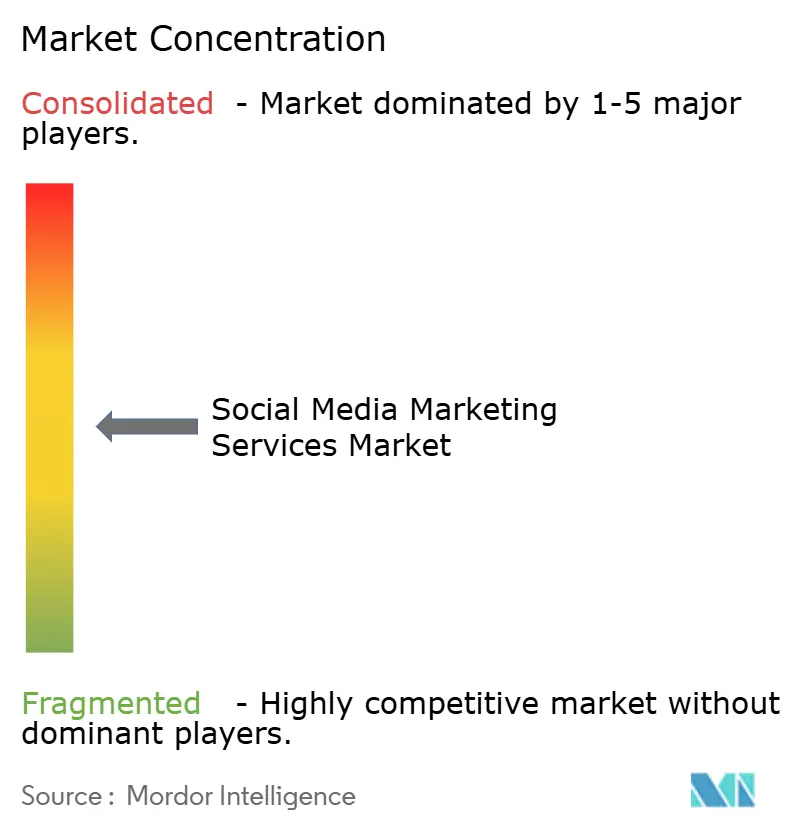
The Social Media Marketing Services Market is moderately fragmented among mid-sized and smaller providers, while enterprise demand is consolidating around integrated platforms. Large clients need customer experience management, listening, publishing, analytics, and attribution to work together. Sprinklr’s fiscal 2026 performance included USD 857.2 million in revenue and 50% annual recurring revenue growth for generative AI-native Service SKUs. Hootsuite launched Wisdom and Social OS in June 2026, bringing publishing, customer care, employee advocacy, and social intelligence into a unified AI-focused structure. These moves show how established providers are broadening beyond publishing tools.
Customer relationship management providers are extending social functions into larger marketing environments. HubSpot’s April 2026 TikTok integration linked social activity with lifecycle stage, deal history, purchase behavior, and revenue records. Sprout Social expanded Trellis across its core social workflows in May 2026. Healthcare-focused services remain a high-value opening because compliance requirements limit the suitability of generalist providers. Multi-location marketing and creator-commerce reporting are also less developed than general campaign reporting.
New AI connectors could change how enterprises access social intelligence. Hootsuite’s Model Context Protocol connectors allow approved external AI tools to access insights directly. This may reduce dependence on traditional platform interfaces for some intelligence tasks. Pure-play analytics providers may find opportunities to bring social data into existing enterprise workflows. The Social Media Marketing Services Market continues to reward providers that combine data, governance, customer care, and content operations.
Social Media Marketing Services Industry Leaders
Hootsuite Inc.
Sprout Social, Inc.
Combin
Oktopost Technologies Inc.
Spredfast
- *Disclaimer: Major Players sorted in no particular order
Social Media Marketing Services Market Companies Covered in this Report
- Hootsuite Inc.
- Sprout Social, Inc.
- Sprinklr, Inc.
- HubSpot, Inc.
- Zoho Corporation Pvt. Ltd.
- Meltwater N.V.
- Cision Ltd.
- Khoros, LLC
- Oktopost Technologies Inc.
- Adobe Inc.
- Oracle Corporation
- Combin
- Buffer, Inc.
- Sendible Ltd.
- Later, LLC
- Emplifi Inc.
- Agorapulse SAS
- Semrush Holdings, Inc.
- Spredfast
- Salesforce Inc.

Recent Industry Developments in Social Media Marketing Services Market
- July 2026: HubSpot launched Agent Hub and Agent Builder in public beta for all Professional and Enterprise customers. The tools give go-to-market teams a single place to build, monitor, and manage AI agents that share customer context across contacts, deals, call transcripts, and buying signals. The launch was accompanied by the rebrand of Commerce Hub to Revenue Hub and the expansion of the Prospecting Agent to all Sales Hub users.
- June 2026: Hootsuite launched Wisdom, a social-first AI agent powered by 15+ years of proprietary social data and 150 million-plus monitored sources, and simultaneously unveiled Social OS, an AI-first operating system unifying publishing (Perch), customer care (Nest), employee advocacy (Parliament), and social intelligence (Lumen by Talkwalker). Model Context Protocol connectors allow external AI tools to access Hootsuite insights directly.
- May 2026: Sprout Social unveiled its AI-powered social intelligence platform and expanded Trellis, its proprietary agentic AI engine, to integrate across Publishing, Listening, Smart Inbox, and Reporting. Trellis Studio, a dedicated environment for building bespoke AI workflows tailored to specific KPIs, was also introduced for general availability in July 2026.
- April 2026: HubSpot announced the first integration enabling marketers to sync, manage, and measure both TikTok ads and organic content inside HubSpot Marketing Hub. The integration connects TikTok campaigns to HubSpot's Smart CRM, enabling targeting based on lifecycle stage, deal history, and purchase behavior, with unified attribution that links TikTok ad interactions to contacts, deals, and closed revenue.


Global Social Media Marketing Services Market Report Scope
The social media marketing services market comprises the ecosystem of professional and outsourced services that help businesses create, manage, execute, and optimize their marketing strategies across various social media platforms. This market encompasses a wide range of applications, including sales and marketing management, customer experience management, competitive intelligence, risk management and fraud detection, and content scheduling and publishing. These services cater to organizations of all sizes, from large enterprises to small and medium-sized enterprises, across diverse industry verticals such as retail, media, healthcare, and consumer goods. By leveraging platform-specific expertise, data analytics, community management, and creative content strategies, social media marketing service providers enable businesses to build brand awareness, engage with target audiences, drive website traffic and conversions, manage online reputation, and ultimately achieve measurable business growth in an increasingly digital and connected consumer landscape.
The Social Media Marketing Services Market Report is Segmented by Organization Size (Large Enterprises and Small and Medium-Sized Enterprises), Application (Sales and Marketing Management, Customer Experience Management, Competitive Intelligence, Risk Management and Fraud Detection, and Content Scheduling and Publishing), End-User Industry (Retail and E-commerce, Media and Entertainment, Healthcare and Life Sciences, Travel and Hospitality, Consumer Goods, and Other End-User Industries (BFSI, Education, Automotive, IT and Telecom amongst Others)), and Geography (North America, South America, Europe, Asia-Pacific, Middle East, and Africa). The Market Forecasts are Provided in Terms of Value (USD).
| Large Enterprises |
| Small and Medium-Sized Enterprises |
| Sales and Marketing Management |
| Customer Experience Management |
| Competitive Intelligence |
| Risk Management and Fraud Detection |
| Content Scheduling and Publishing |
| Retail and E-commerce |
| Media and Entertainment |
| Healthcare and Life Sciences |
| Travel and Hospitality |
| Consumer Goods |
| Other End-User Industries (BFSI, Education, Automotive, IT and Telecom amongst Others) |
| North America | United States |
| Canada | |
| Mexico | |
| South America | Brazil |
| Argentina | |
| Chile | |
| Rest of South America | |
| Europe | Germany |
| United Kingdom | |
| France | |
| Italy | |
| Spain | |
| Rest of Europe | |
| Asia-Pacific | China |
| Japan | |
| India | |
| South Korea | |
| Australia | |
| Rest of Asia-Pacific | |
| Middle East | United Arab Emirates |
| Saudi Arabia | |
| Qatar | |
| Rest of Middle East | |
| Africa | South Africa |
| Egypt | |
| Nigeria | |
| Rest of Africa |
| By Organization Size | Large Enterprises | |
| Small and Medium-Sized Enterprises | ||
| By Application | Sales and Marketing Management | |
| Customer Experience Management | ||
| Competitive Intelligence | ||
| Risk Management and Fraud Detection | ||
| Content Scheduling and Publishing | ||
| By End-User Industry | Retail and E-commerce | |
| Media and Entertainment | ||
| Healthcare and Life Sciences | ||
| Travel and Hospitality | ||
| Consumer Goods | ||
| Other End-User Industries (BFSI, Education, Automotive, IT and Telecom amongst Others) | ||
| By Geography | North America | United States |
| Canada | ||
| Mexico | ||
| South America | Brazil | |
| Argentina | ||
| Chile | ||
| Rest of South America | ||
| Europe | Germany | |
| United Kingdom | ||
| France | ||
| Italy | ||
| Spain | ||
| Rest of Europe | ||
| Asia-Pacific | China | |
| Japan | ||
| India | ||
| South Korea | ||
| Australia | ||
| Rest of Asia-Pacific | ||
| Middle East | United Arab Emirates | |
| Saudi Arabia | ||
| Qatar | ||
| Rest of Middle East | ||
| Africa | South Africa | |
| Egypt | ||
| Nigeria | ||
| Rest of Africa | ||


Key Questions Answered in the Report
What is the Social Media Marketing Services Market size?
The Social Media Marketing Services Market is estimated at USD 42.31 billion in 2026 and is projected to reach USD 64.48 billion by 2031, growing at an 8.79% CAGR. The outlook reflects demand for managed content, commerce, measurement, creator, and customer care services.
Which organization size segment leads spending?
Large enterprises led spending with a 65.41% share in 2025 because global publishing, approvals, compliance, and crisis management require coordinated service support. In the Social Media Marketing Services Market, their requirements favor integrated platforms, consistent controls, and managed operating models that support several teams and markets.
Which application is growing the fastest?
Customer experience management is projected to expand at a 13.54% CAGR through 2031 as social channels become a common first point of contact for customer service. Providers need to join automation with clear escalation and human review.
Which vertical is expected to grow the fastest?
Healthcare and life sciences is forecast to grow at a 13.42% CAGR through 2031, supported by digital patient behavior and complex promotional compliance requirements. The Social Media Marketing Services Market needs specialist services that can support review, targeting, measurement, record keeping, and responsible management of regulated communications.
Which region is projected to grow the fastest?
Asia-Pacific is expected to record a 14.12% CAGR through 2031, supported by mobile-first commerce, Indian digital base, and Southeast Asian digital retail growth. China, Japan, and South Korea add distinct platform and creator ecosystems.
What is changing competition among service providers?
Competition is shifting toward platforms that combine publishing, listening, customer care, AI automation, analytics, and revenue-focused attribution in one workflow. The Social Media Marketing Services Market also presents opportunities in healthcare, multi-location marketing, and creator-commerce measurement, where general campaign reporting may not meet client needs.
Page last updated on:





