
Social Media Management Software Market Size and Share
Market Overview
| Study Period | 2020 - 2031 |
|---|---|
| Market Size (2026) | USD 21.98 Billion |
| Market Size (2031) | USD 42.76 Billion |
| Growth Rate (2026 - 2031) | 14.20% CAGR |
| Fastest Growing Market | Asia-Pacific |
| Largest Market | North America |
| Market Concentration | Medium |
Major Players *Disclaimer: Major Players sorted in no particular order Image © Mordor Intelligence. Reuse requires attribution under CC BY 4.0. | |
Social Media Management Software Market Analysis by Mordor Intelligence
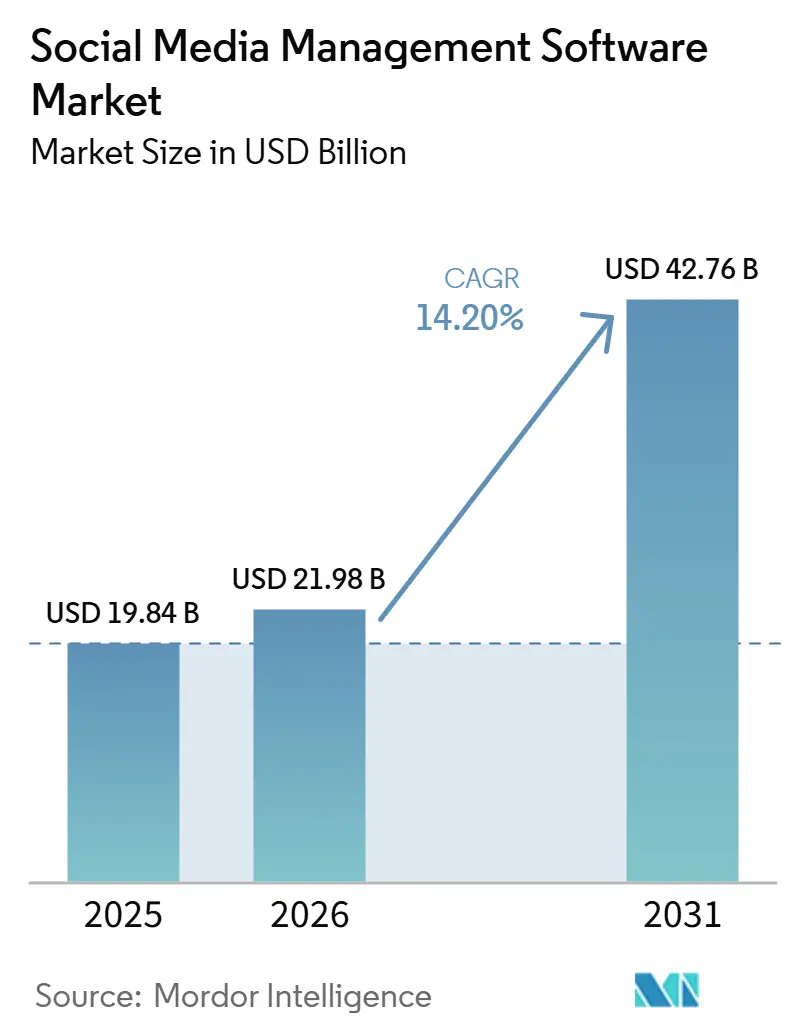
The social media management software market size was valued at USD 19.84 billion in 2025 and is estimated to grow from USD 21.98 billion in 2026 to reach USD 42.76 billion by 2031, at a CAGR of 14.20% during the forecast period (2026-2031). The social media management software market is expanding as generative AI moves deeper into content planning, publishing, and analytics, while enterprise buyers also continue shifting their marketing systems onto cloud-native platforms. The social media management software market is also benefiting from social commerce becoming a revenue-focused channel, which has pushed brands to connect creator activity, content workflows, and performance measurement into a single operating layer. The social media management software market is seeing stronger demand because fragmented platform-by-platform social operations can weaken customer response times, message consistency, and measurable revenue capture. The social media management software market is also changing as agentic AI tools that can monitor, create, schedule, and report across channels are moving buyer attention away from feature lists and toward intelligence-led platform selection. The social media management software market still faces pressure from tighter platform API rules and rising privacy requirements, but those same factors are creating room for vendors with stronger direct integrations, better governance controls, and more resilient data access models.
Key Report Takeaways
- By component, solutions held 70.89% revenue share in 2025, while services are projected to expand at a 17.25% CAGR through 2031 in the social media management software market.
- By deployment mode, cloud held 61.23% of the social media management software market share in 2025 and is projected to expand at a 16.77% CAGR through 2031.
- By organization size, large enterprises held 72.15% of the social media management software market share in 2025, while SMEs are projected to record the highest CAGR at 16.92% through 2031.
- By application, social publishing and campaign management accounted for 59.11% of the social media management software market share in 2025, while social listening and competitive intelligence are projected to expand at a 16.34% CAGR through 2031.
- By industry vertical, retail and e-commerce held 22.45% share in 2025, while healthcare and life sciences are projected to grow at a 15.67% CAGR through 2031.
- By geography, North America held 37.16% of the social media management software market share in 2025, while Asia-Pacific is projected to expand at a 15.98% CAGR through 2031.
Note: Market size and forecast figures in this report are generated using Mordor Intelligence’s proprietary estimation framework, updated with the latest available data and insights as of January 2026.
Global Social Media Management Software Market Trends and Insights
Drivers Impact Analysis*
| Driver | (~) % Impact on CAGR Forecast | Geographic Relevance | Impact Timeline |
|---|---|---|---|
| Rising Demand for AI-Assisted Content Planning and Publishing Workflows | +3.2% | Global | Short term (≤ 2 years) |
| Growing Need for Cross-Channel Social Listening and Sentiment Analytics | +2.8% | Global | Medium term (2-4 years) |
| Increasing Shift to Cloud-Native MarTech Stacks | +2.1% | North America and Europe | Medium term (2-4 years) |
| Expansion of Performance-Driven Social Commerce and Creator Marketing | +1.9% | Asia-Pacific, North America | Short term (≤ 2 years) |
| Rising Demand for Privacy-Safe First-Party Engagement Workflows | +1.5% | Europe, North America | Medium term (2-4 years) |
| Growth in Governance Requirements for Regulated Social Customer Engagement | +1.1% | North America, Europe, APAC core, spill-over to MEA | Long term (≥ 4 years) |
| Source: Mordor Intelligence | |||
Rising Demand for AI-Assisted Content Planning and Publishing Workflows
The social media management software market is moving into a stage where AI-assisted publishing is no longer seen as a premium add-on, because enterprise buyers now expect help with planning, drafting, timing, and optimization inside the core platform. What matters more now is not only the model itself, but the historical signal base behind it, because a stronger proprietary data layer can improve relevance, speed, and decision quality across publishing and reporting. Hootsuite’s June 2026 launch of Wisdom made this shift visible by introducing a social-first AI agent built on more than 15 years of proprietary social data and 150 million monitored data sources, which shows how scale in owned social data is becoming a product advantage in the social media management software market. Sprout Social’s 2026 Social Intelligence Report also found that 71% of marketing directors expect social data to surpass traditional market research in shaping enterprise strategy by 2029, underscoring why AI publishing workflows are increasingly tied to broader intelligence use cases. As these tools begin handling trend detection, content creation, scheduling, and reporting within a single loop, the social media management software market is giving smaller teams access to an operating scale that used to be mostly the domain of large social media departments.
Growing Need for Cross-Channel Social Listening and Sentiment Analytics
The social media management software market is placing greater emphasis on listening functions, as brands now use social media, reviews, and AI-generated responses as real-time sources of customer, competitor, and reputation signals. That shift is changing how platforms compete, since channel breadth, data speed, and classification quality matter more when listening becomes a business intelligence task rather than a simple monitoring feature. Meltwater’s 2026 mid-year release added enhanced GenAI Lens reporting, enabling organizations to monitor and shape brand presence in AI-generated search results, extending listening into an area that had previously received limited product attention.[1]Meltwater, “2026 Mid-Year Release,” Meltwater Press Releases, meltwater.com. Sprout Social also expanded its Trellis agentic AI engine across Publishing, Listening, Smart Inbox, and Reporting in May 2026, reflecting the market's move toward unified signal pipelines rather than disconnected listening and execution tools. As this pattern deepens, the social media management software market is treating social intelligence less like an adjacent module and more like the operating center for brand, care, and campaign decisions.
Increasing Shift to Cloud-Native MarTech Stacks
The social media management software market is benefiting from a broader enterprise shift toward cloud-native marketing systems, as buyers want social data, customer data, and commerce activity to flow through connected workflows rather than through separate tools. Integration has become a major buying factor in this environment, since marketing, service, and IT teams increasingly review social software as part of wider platform decisions rather than as a stand-alone purchase. Sprout Social’s expanded Salesforce collaboration in August 2025 made Sprout the first social media management platform to integrate with Salesforce Digital Engagement through Bring Your Own Channel architecture, which moved social channels directly into service workflows and strengthened the case for deeper platform connectivity. Salesforce’s Summer 2026 release then introduced multi-agent orchestration and AI-powered customer engagement features, which increased the integration surface between CRM systems and the social media management software market. Vendors that cannot fit smoothly into these core enterprise environments are likely to face longer procurement cycles, as buyers now expect connected architecture as a basic product requirement.
Expansion of Performance-Driven Social Commerce and Creator Marketing
The social media management software market is benefiting from the shift in social commerce from awareness spending to measurable revenue activity, as brands now need closer control over creator sourcing, shoppable content, and campaign attribution. That change is also widening the product boundary, as platforms are being asked to support more of the creator workflow rather than stopping at scheduling and reporting. Sprout Social’s February 2026 launch of Recruit, an AI-powered creator-matching and management tool, showed how vendors are moving deeper into brand alignment, creator discovery, and campaign setup within the social media management software market. This move also suggests that functions once handled by separate influencer tools are being absorbed into broader social operating platforms, simplifying execution for retail and e-commerce buyers. As brands demand clearer links between creator-led content and downstream sales outcomes, the social media management software market is creating more room for vendors that can connect social activity with conversion tracking and revenue accountability.
Restraints Impact Analysis*
| Restraint | (~) % Impact on CAGR Forecast | Geographic Relevance | Impact Timeline |
|---|---|---|---|
| Fragmented Platform APIs and Frequent Social Network Policy Changes | -2.8% | Global | Short term (≤ 2 years) |
| Data Privacy Constraints on Tracking, Targeting, and Attribution | -2.3% | Europe, North America, APAC core, spill-over to MEA | Medium term (2-4 years) |
| Tool Overlap with Broader Marketing Suites and CRM Platforms | -1.8% | North America and Europe | Long term (≥ 4 years) |
| Limited Process Maturity in Small Businesses for Advanced Social Operations | -1.5% | APAC core, South America, spill-over to MEA | Long term (≥ 4 years) |
| Source: Mordor Intelligence | |||
Fragmented Platform APIs and Frequent Social Network Policy Changes
The social media management software market still relies on access to multiple social networks that operate with different authentication rules, publishing permissions, rate limits, and revision cycles, which creates ongoing engineering work for platform vendors. This burden grows as buyers expect broader channel coverage, because maintaining compatibility across a changing set of network policies can slow product delivery and raise operating costs. Hootsuite’s June 2026 Social OS launch included Model Context Protocol connectors across Perch, Nest, and Lumen, demonstrating one way vendors are trying to reduce the burden of maintaining multiple, separate integration paths. Meltwater also expanded access to Meltwater MCP in July 2026, enabling organizations to connect its intelligence tools to existing AI agent workflows, which points to a similar effort to make data access more resilient in the social media management software market. Vendors with smaller engineering teams are at a disadvantage under these conditions, because each policy or API change can take resources away from roadmap development and force more defensive product work.
Data Privacy Constraints on Tracking, Targeting, And Attribution
The social media management software market is also facing tighter privacy expectations, which are limiting the amount of behavioral data that platforms can use for targeting, tracking, and attribution across channels. When visibility into audience actions falls, marketing teams can struggle to prove return on software spending, which tends to slow purchase decisions in closely watched budget environments. The European Data Protection Board’s 2025 guidance on the interplay between the Digital Services Act and the General Data Protection Regulation clarified that DSA-related data processing still requires a valid GDPR legal basis and must comply with the data minimization and purpose limitation principles. That raises the value of first-party engagement workflows, consent controls, and audit documentation, because vendors are increasingly being judged on their ability to support compliant social operations rather than just campaign performance. As a result, the social media management software market is seeing a shift toward privacy-safe design, from a supporting feature to a core sales requirement, in regulated and risk-sensitive accounts.
*Our forecasts treat driver/restraint impacts as directional, not additive. The impact forecasts reflect baseline growth, mix effects, and variable interactions.
Segment Analysis
By Component: Managed Services Scale as Enterprises Outsource Intelligence Operations
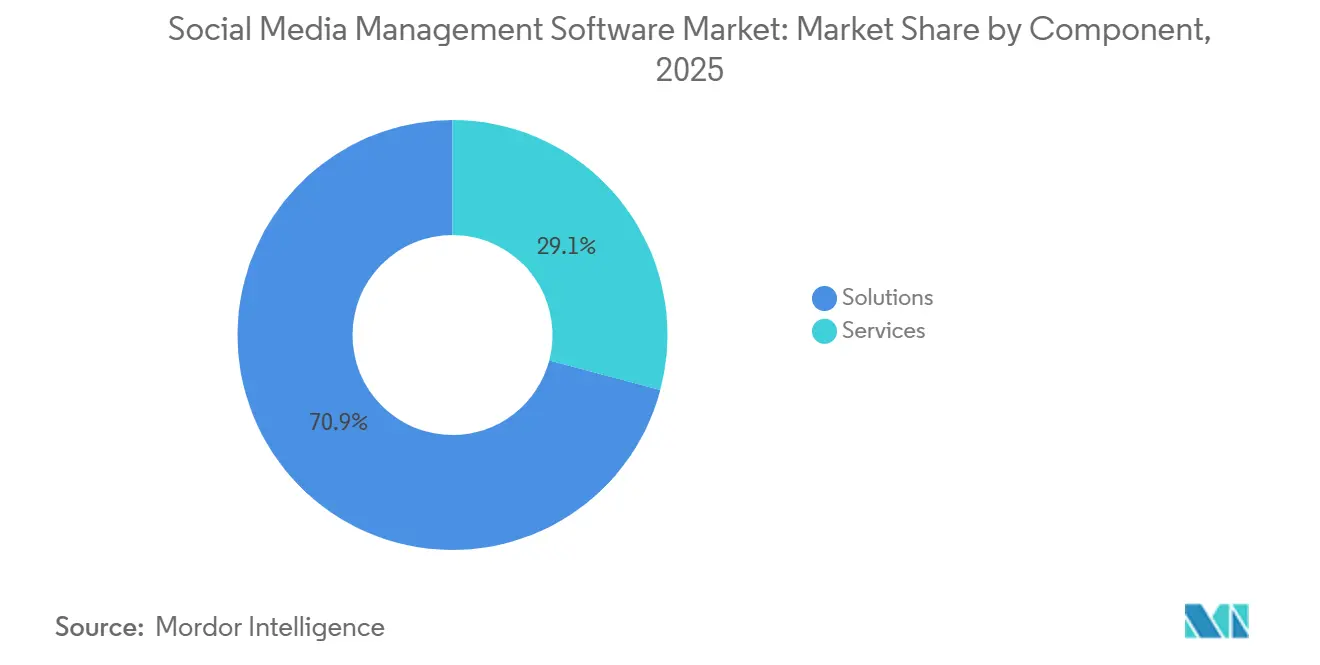
Solutions led the segment with 70.89% of the social media management software market share in 2025, indicating that recurring software subscriptions remain the core revenue driver for the category. Services, however, are projected to grow at a 17.25% CAGR through 2031, indicating faster expansion in provider-led support than in stand-alone software access. This pattern suggests that many buyers can purchase tools, but still need outside help to configure listening programs, tune AI models, and convert large volumes of social signals into decisions that matter to business teams. It also shows that the social media management software market is moving beyond basic platform access, because the value of the product increasingly depends on whether buyers can operationalize intelligence at scale.
That divide is creating a more visible split between self-serve digital-native customers and larger organizations that prefer bundled support with implementation, managed monitoring, and strategic review built into the contract. In the social media management software industry, this matters because enterprise and regulated accounts often need more than software licenses, especially when governance, documentation, and internal coordination requirements are high. Service-heavy offers can therefore support stronger retention when the vendor becomes part of the buyer’s ongoing operating process rather than a tool that sits beside it. The same pattern also helps explain why premium pricing can hold in some accounts even as lower-cost automation tools improve, because managed support still solves organizational gaps that software alone does not fully address.


By Deployment Mode: Cloud Consolidates its Infrastructure Lead
Cloud held 61.23% of the social media management software market share in 2025 and is projected to expand at a 16.77% CAGR through 2031, making it both the leading and fastest-growing deployment model. That position reflects a product structure in which real-time collaboration, rapid feature updates, and continuous integration with social, CRM, and analytics systems are closely tied to the platform's core customer value. Hootsuite’s June 2026 Social OS architecture, built on a shared agentic cloud layer that connects publishing, care, advocacy, and intelligence products through a single real-time feed, showed how deeply cloud design is now built into platform strategy.[2]Hootsuite, “Hootsuite Rebuilds for the AI Era, Introducing Wisdom,” Hootsuite Newsroom, hootsuite.com. As a result, the social media management software market is now treating cloud deployment less as a delivery preference and more as the default for advanced product capabilities.
Hybrid and on-premises environments still retain a role in which data sovereignty, security controls, or local infrastructure rules narrow cloud adoption choices for the buyer. This is particularly relevant for public entities, tightly controlled institutions, and audited operating environments where data location and access oversight matter as much as workflow speed. Even so, on-premises models are losing ground because update cycles are slower and the cost of keeping pace with platform changes is harder to justify over time. That leaves the social media management software market tilted toward vendors that can combine cloud speed with governance controls, since buyers increasingly want both real-time execution and stronger oversight in the same system.
By Organization Size: SMEs Narrow the Enterprise Adoption Gap
Large enterprises held a 72.15% share in 2025, reflecting the heavier workload created by multi-brand portfolios, international channel operations, employee advocacy programs, and more advanced analytics expectations. SMEs, however, are projected to grow at a 16.92% CAGR through 2031, making them the fastest-growing segment of the social media management software market, even though they start from a smaller base. This shows that lower-priced AI-native tools are lowering the minimum capability threshold for adopting social management software in a meaningful way. Sprout Social’s February 2026 expansion of AI-powered solutions reflected the broader market direction, where vendors are trying to shorten time to value and make more sophisticated features easier to access across company sizes.
The most important shift is not that SMEs are catching large enterprises in absolute spending, but that they are gaining access to functions that used to require far more internal staff and larger budgets. In the social media management software industry, it closes the gap between entry-level and enterprise-grade capabilities, especially in scheduling, listening, and basic competitor tracking. It also puts pressure on vendors that focus only on large accounts, because a growing share of the lower end of the market can now access acceptable functionality at a fraction of historical prices. Vendors that defend their enterprise position through deeper integration, stronger governance, and advanced AI logic are therefore in a better position than those that respond mainly with price cuts.
By Application: Social Listening Intelligence Gains Strategic Primacy
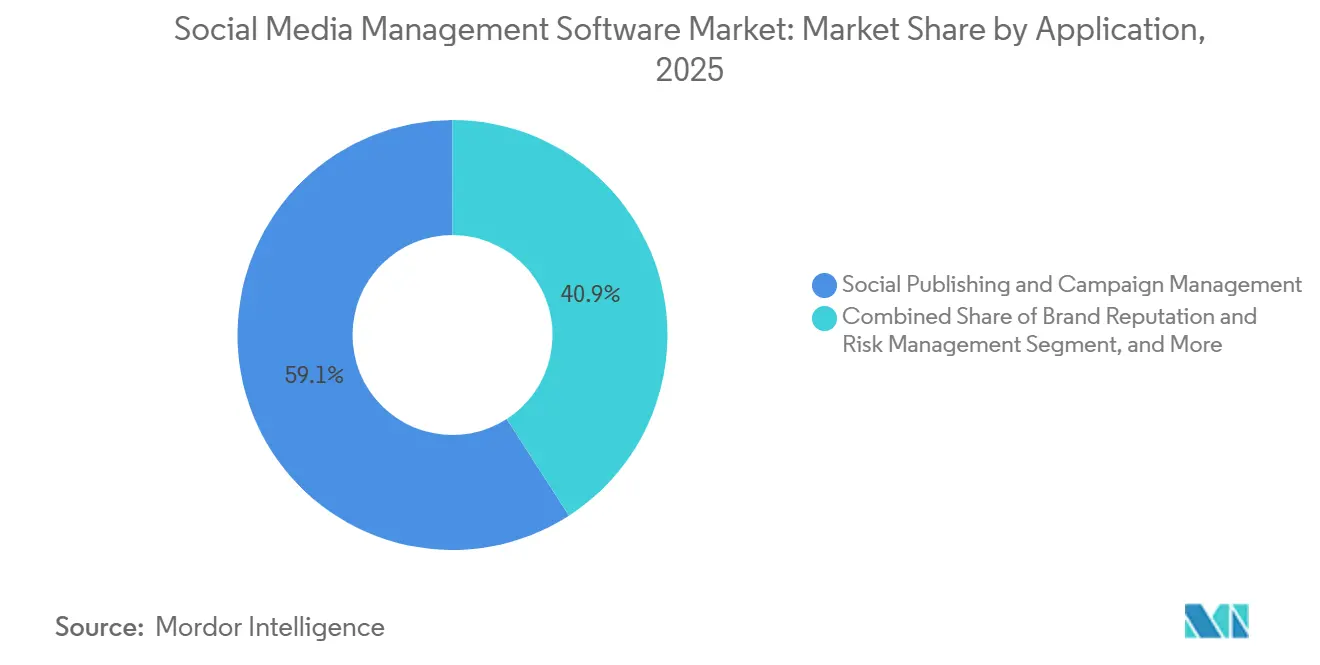
Social publishing and campaign management accounted for 59.11% of the social media management software market in 2025, underscoring that publishing remains the primary entry point for buyers. Social listening and competitive intelligence are projected to expand at a 16.34% CAGR through 2031, making it the fastest-growing application within the social media management software market. This signals a broader change in buyer priorities, because firms increasingly want platforms to surface customer intent, competitor moves, and reputation risks rather than only manage post calendars. Sprout Social’s May 2026 expansion of Trellis across publishing, listening, smart inbox, and reporting demonstrated how the market is aligning product design around shared intelligence flows rather than isolated feature modules.
Customer engagement and community management are also becoming increasingly important as social channels handle more first-contact service interactions, especially in consumer-facing categories with high message volume. Sprout Social’s Salesforce collaboration brought channels such as Instagram, LinkedIn, X, Facebook Messenger, and WhatsApp into service workflows, demonstrating how social management and customer care are increasingly linked within a single operating environment. Brand reputation, compliance, and risk management are also becoming stronger use cases, as regulated industries need approval chains, content archives, and clear records that go beyond campaign scheduling. Together, these patterns show that the social media management software market is shifting from a publishing-centered toolset toward a broader intelligence and operations layer with multiple business roles.

By Industry Vertical: Healthcare Compliance Reshapes Social Engagement Priorities
Retail and e-commerce held a 22.45% share in 2025, keeping this vertical as the largest revenue contributor in the social media management software market, as social commerce, creator coordination, and shoppable content execution remain active budget priorities. Healthcare and life sciences are projected to grow at a 15.67% CAGR through 2031, making it the fastest-growing vertical, though its growth is driven more by governance needs than by promotional volume. This difference matters because it shows that scale and growth are coming from different demand patterns: retail seeks conversion support, while healthcare needs structure, documentation, and safer communication processes. The social media management software market, therefore, serves both expansion-led and compliance-led use cases simultaneously, broadening the basis of demand across the vertical mix.
Healthcare providers, pharmaceutical companies, and life sciences firms are adopting these platforms as a governance layer for patient communication, approval control, and documented social activity across sensitive interactions. BFSI also remains a structurally demanding part of the social media management software industry, and a 2025 analysis in the Journal of Financial Compliance found that 55% of financial services compliance executives considered social media an emerging compliance risk. That environment supports demand for audit trails, archival capability, approval routing, and policy control rather than only campaign execution. IT and telecommunications, government and public administration, media and entertainment, industrial manufacturing, and travel and hospitality also represent distinct demand pools, with platform needs varying from employer branding and crisis messaging to customer support and reputation monitoring.
Geography Analysis
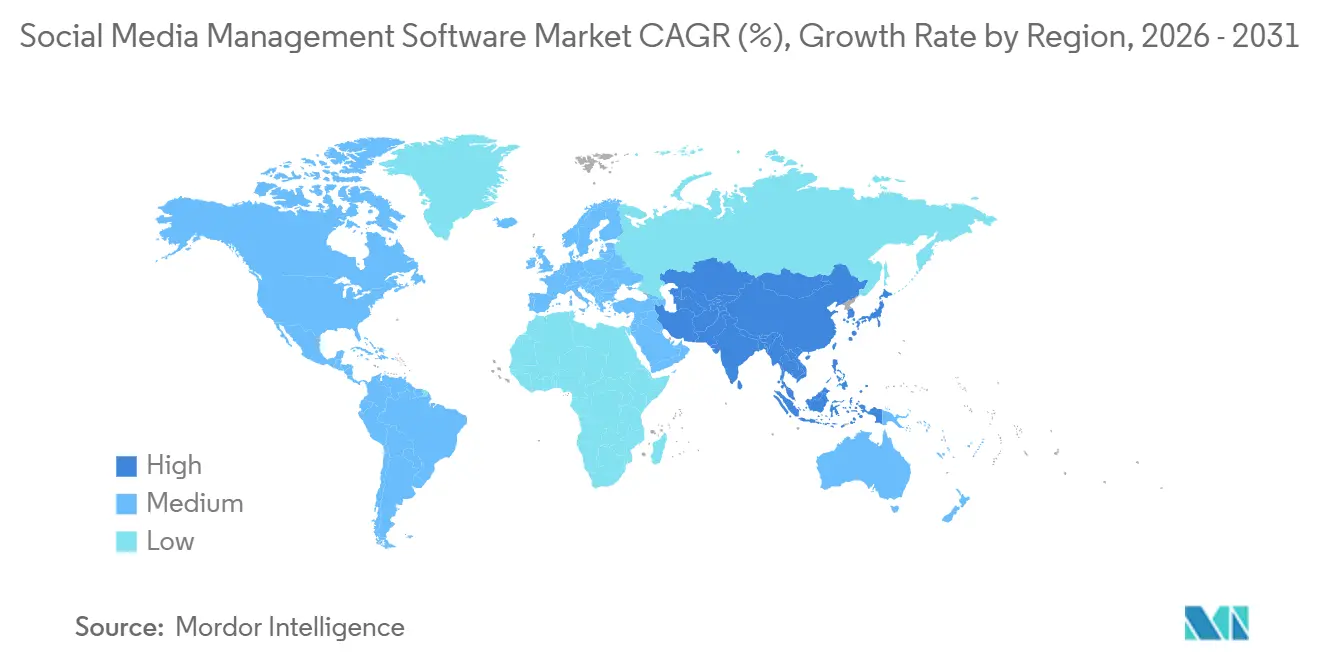
North America accounted for 37.16% of the social media management software market in 2025, making it the largest regional base, as enterprise budgets, platform integrations, and mature digital operating models are more concentrated there. The region benefits from a dense base of large corporate accounts that are willing to connect social tools with CRM, commerce, analytics, and service platforms rather than manage social operations as a separate function. Salesforce’s Summer 2026 product release added multi-agent orchestration and AI-powered customer engagement capabilities, which reinforced the region’s role as the main proving ground for deeper integration between customer systems and the social media management software market.[3]Salesforce, “Salesforce Announces Summer 2026 Product Release,” Salesforce News, salesforce.com. Europe remained the second-largest regional market, and the European Data Protection Board’s 2025 guidance is pushing vendors to strengthen consent handling, data minimization, and audit-ready workflow controls across the region.
Asia-Pacific is projected to grow at a 15.98% CAGR through 2031, making it the fastest-expanding geography in the social media management software market, even though demand drivers vary widely across countries. Some markets are driven by enterprise AI adoption, while others are being shaped more by expanding digital business activity, mobile-first consumer behavior, and rising SME use of social channels. Japan is moving more visibly toward AI-native social operating tools, and ADK Marketing Solutions launched the SOCIAI AI agent for corporate SNS automation in July 2026. Dentsu Digital also upgraded its platform in August 2025 with AI-assisted content-generation capabilities, demonstrating that regional value creation is increasingly flowing through local AI service layers as well as through global software providers. In more mature markets such as South Korea, Australia, and New Zealand, product differentiation is narrowing, which means AI depth and integration quality are becoming more important than basic feature coverage.
South America remains an emerging opportunity in the social media management software market, with Brazil driving demand across retail and consumer-facing brands, though adoption still leans toward accessible SME-tier tools rather than full enterprise platforms. This makes the region important for scaled adoption over time, even if average contract size remains below that of North America and parts of Europe today. The Middle East and Africa are smaller in current revenue terms, but public-sector digital programs in Saudi Arabia and the UAE are driving demand for governance-capable platforms with stronger language support and archival discipline. Nigeria and South Africa lead adoption across Africa, and rising mobile internet penetration is likely to support continued demand for lower-cost, easier-to-deploy social management solutions across a broader set of local operating environments.

Competitive Landscape
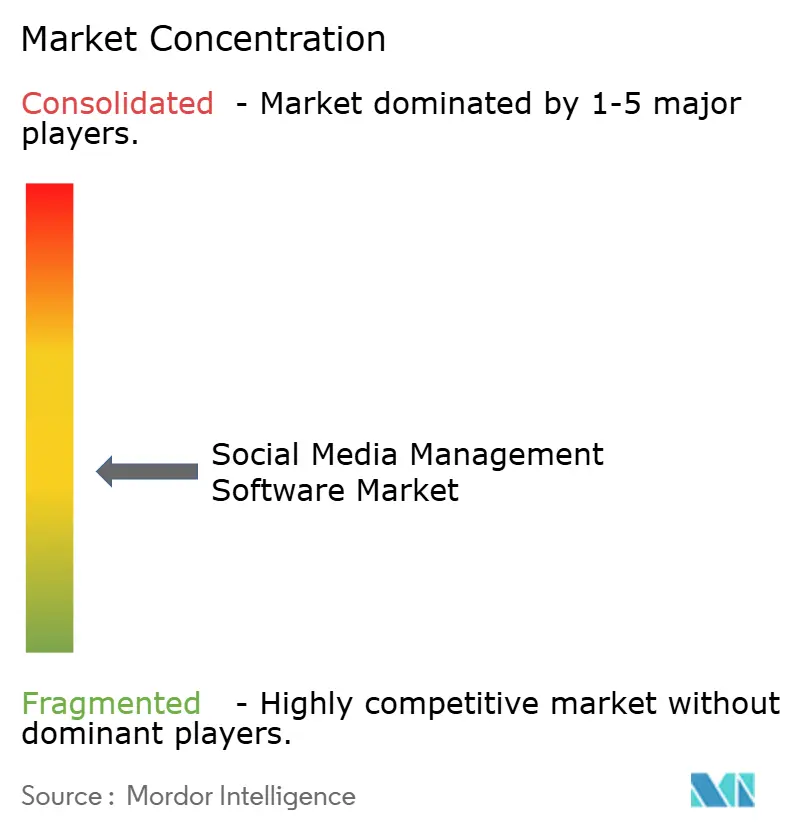
The social media management software market shows moderate concentration, with Sprinklr, Hootsuite, Sprout Social, and Meltwater holding strong positions in enterprise accounts while larger software suites such as Salesforce, Adobe, HubSpot, Oracle, and Zoho compete through broader ecosystem ties. That creates a market structure where some vendors win through social depth, while others win through the strength of adjacent customer systems already in place. Sprinklr’s July 2026 announcement that it had been named a Leader in the 2026 Gartner Magic Quadrant for Social Media Management and Listening reinforced its standing in enterprise buying cycles and supported its visibility at the top end of the social media management software market. Hootsuite’s June 2026 launch of Wisdom and Social OS also showed how leading vendors are trying to make agentic AI and unified workflow design central to their competitive positioning.
A clear strategy pattern across the social media management software market is the push toward AI agents, shared intelligence layers, and easier integration into the rest of the enterprise stack. Meltwater’s July 2026 expansion of MCP access widened the ways organizations could connect their social and media intelligence into existing AI agent workflows, which strengthened its relevance beyond a stand-alone dashboard model. Sprout Social’s May 2026 expansion of Trellis across publishing, listening, smart inbox, and reporting demonstrated a parallel effort to unify execution and analysis within a single intelligence framework.[4]Sprout Social, “Sprout Social Unveils Its AI-Powered Social Intelligence Platform and the Expansion of Its Proprietary AI Agent, Trellis,” Sprout Social Press, sproutsocial.com. Sprout’s earlier expansion of its Salesforce collaboration also demonstrated how leading providers are seeking to secure a stronger role within customer service workflows, not just within marketing teams. These moves matter because buyers now compare social platforms not only on channel management features but also on how well they fit within the wider decision and response system of the organization.
Smaller vendors continue to shape the social media management software market through simpler user experience, lower pricing, and sharper specialization around the needs of creators, smaller brands, and selected verticals. White space still exists in mid-market accounts and non-English-language environments where vernacular analysis, local platform connections, and region-specific compliance features remain less developed. At the same time, pure-play platforms face pressure from low-cost AI-native tools at one end and from CRM or MarTech suites that can absorb social management functions into broader contracts at the other. This means long-term pricing power in the social media management software market is likely to depend on proprietary data depth, integration breadth, and governance strength more than on basic publishing or scheduling capability alone.
Social Media Management Software Industry Leaders
Adobe Inc.
Oracle Corporation
Salesforce, Inc.
HubSpot, Inc.
Zoho Corporation Pvt. Ltd.
- *Disclaimer: Major Players sorted in no particular order

Recent Industry Developments
- June 2026: Hootsuite launches Wisdom, a social-first AI agent powered by 150 million monitored data sources, alongside Social OS, a unified social operating system integrating publishing, customer care, employee advocacy, and intelligence via Model Context Protocol connectors that enable AI agents to access access to HootsuiteHootsuite data.
- May 2026: Sprout Social unveils its AI-powered social intelligence platform and expands its proprietary Trellis agentic AI engine across Publishing, Listening, Smart Inbox, and Reporting modules, alongside the launch of Trellis Studio for building bespoke AI workflows tailored to organization-specific KPIs.
- May 2026: Meltwater unveils its 2026 Mid-Year Product Release, including enhanced GenAI Lens reporting to help organizations monitor and shape brand presence in AI-generated search results, and a Meltwater Agent for Slack that enables in-channel intelligence access.
- February 2026: Sprout Social launches AI-powered solutions including an expanded Reddit partnership for discovery-era brand reach, the Recruit AI-powered creator management tool enabling brands to source and vet creators using qualitative brand alignment data, and the Trellis Monitoring Agent for NewsWhip, for signal-driven content intelligence.


Global Social Media Management Software Market Report Scope
The Social Media Management Software Market comprises software solutions that help organizations plan, publish, monitor, manage, and analyze content and interactions across multiple social media platforms through a unified interface. These solutions support content scheduling, social listening, audience engagement, performance analytics, brand monitoring, and campaign management. Increasing social media adoption, growing investments in digital marketing, and the need for real-time customer engagement and brand management drive the market. These solutions help businesses improve marketing efficiency, strengthen customer relationships, and optimize social media performance.
The Social Media Management Software Market Report is Segmented by Component (Solutions, and Services), Deployment Mode (Cloud, On-Premises, and Hybrid), Organization Size (Small and Medium Enterprises, and Large Enterprises), Application (Social Publishing and Campaign Management, Customer Engagement and Community Management, Social Listening and Competitive Intelligence, and Brand Reputation, Compliance and Risk Management), Industry Vertical (Banking, Financial Services, and Insurance [BFSI], Retail and E-Commerce, Government and Public Administration, Healthcare and Life Sciences, IT and Telecommunication, Media and Entertainment, Industrial Manufacturing, Travel and Hospitality, and Other Industry Verticals), and Geography (North America, South America, Europe, Asia-Pacific, Middle East, and Africa). The Market Forecasts are Provided in Terms of Value (USD).
| Solutions |
| Services |
| Cloud |
| On-Premises |
| Hybrid |
| Small and Medium Enterprises |
| Large Enterprises |
| Social Publishing and Campaign Management |
| Customer Engagement and Community Management |
| Social Listening and Competitive Intelligence |
| Brand Reputation, Compliance and Risk Management |
| Banking, Financial Services, and Insurance (BFSI) |
| Retail and E-Commerce |
| Government and Public Administration |
| Healthcare and Life Sciences |
| IT and Telecommunication |
| Media and Entertainment |
| Industrial Manufacturing |
| Travel and Hospitality |
| Other Industry Verticals |
| North America | United States |
| Canada | |
| Mexico | |
| South America | Brazil |
| Argentina | |
| Rest of South America | |
| Europe | Germany |
| United Kingdom | |
| France | |
| Italy | |
| Spain | |
| Russia | |
| Rest of Europe | |
| Asia-Pacific | China |
| Japan | |
| India | |
| South Korea | |
| Australia and New Zealand | |
| Rest of Asia-Pacific | |
| Middle East | Saudi Arabia |
| United Arab Emirates | |
| Turkey | |
| Rest of Middle East | |
| Africa | South Africa |
| Nigeria | |
| Rest of Africa |
| By Component | Solutions | |
| Services | ||
| By Deployment Mode | Cloud | |
| On-Premises | ||
| Hybrid | ||
| By Organization Size | Small and Medium Enterprises | |
| Large Enterprises | ||
| By Application | Social Publishing and Campaign Management | |
| Customer Engagement and Community Management | ||
| Social Listening and Competitive Intelligence | ||
| Brand Reputation, Compliance and Risk Management | ||
| By Industry Vertical | Banking, Financial Services, and Insurance (BFSI) | |
| Retail and E-Commerce | ||
| Government and Public Administration | ||
| Healthcare and Life Sciences | ||
| IT and Telecommunication | ||
| Media and Entertainment | ||
| Industrial Manufacturing | ||
| Travel and Hospitality | ||
| Other Industry Verticals | ||
| By Geography | North America | United States |
| Canada | ||
| Mexico | ||
| South America | Brazil | |
| Argentina | ||
| Rest of South America | ||
| Europe | Germany | |
| United Kingdom | ||
| France | ||
| Italy | ||
| Spain | ||
| Russia | ||
| Rest of Europe | ||
| Asia-Pacific | China | |
| Japan | ||
| India | ||
| South Korea | ||
| Australia and New Zealand | ||
| Rest of Asia-Pacific | ||
| Middle East | Saudi Arabia | |
| United Arab Emirates | ||
| Turkey | ||
| Rest of Middle East | ||
| Africa | South Africa | |
| Nigeria | ||
| Rest of Africa | ||


Key Questions Answered in the Report
What is the current size and future outlook of the social media management software market?
The social media management software market was valued at USD 19.84 billion in 2025, stands at USD 21.98 billion in 2026, and is forecast to reach USD 42.76 billion by 2031 at a 14.20% CAGR.
What is driving demand for social media management software right now?
Demand is being supported by AI-assisted content workflows, stronger use of social listening, cloud-native integration with CRM systems, and the rise of performance-led social commerce.
Which application area is growing the fastest?
Social listening and competitive intelligence is the fastest-growing application, with a projected 16.34% CAGR through 2031, while social publishing and campaign management remained the largest revenue contributor in 2025.
Which deployment model leads adoption?
Cloud leads adoption, with a 61.23% share in 2025 and a projected 16.77% CAGR through 2031, because buyers want faster updates, easier collaboration, and tighter data integration.
Why is Asia-Pacific important for future expansion?
Asia-Pacific is projected to grow at a 15.98% CAGR through 2031, supported by varied demand across Japan, China, India, South Korea, and Southeast Asia, with local AI-enabled offerings gaining relevance.
Which buyer group is expanding the fastest?
SMEs are the fastest-growing buyer group, with a projected 16.92% CAGR through 2031, as AI-native tools lower the cost and skill barriers for adoption.
Page last updated on:






