
SMS Marketing Services Market Size and Share
Market Overview
| Study Period | 2020 - 2031 |
|---|---|
| Market Size (2026) | USD 15.62 Billion |
| Market Size (2031) | USD 26.05 Billion |
| Growth Rate (2026 - 2031) | 10.77 % |
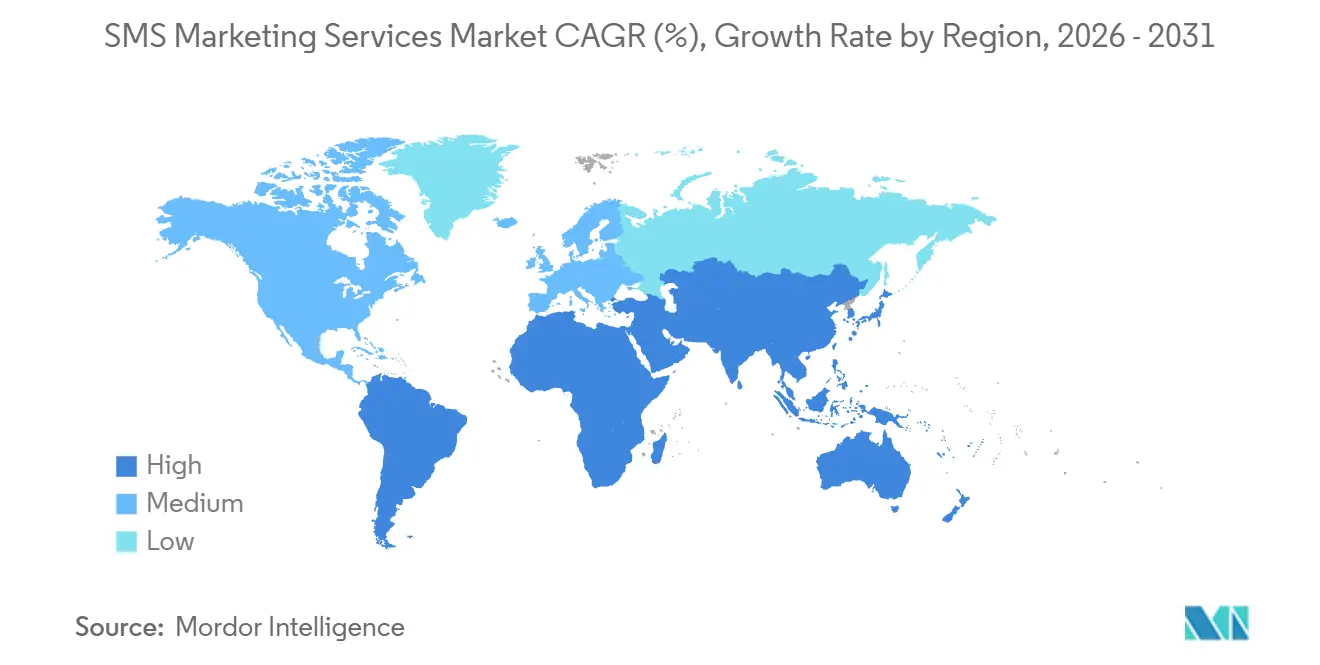
| Fastest Growing Market | Africa |
| Largest Market | North America |
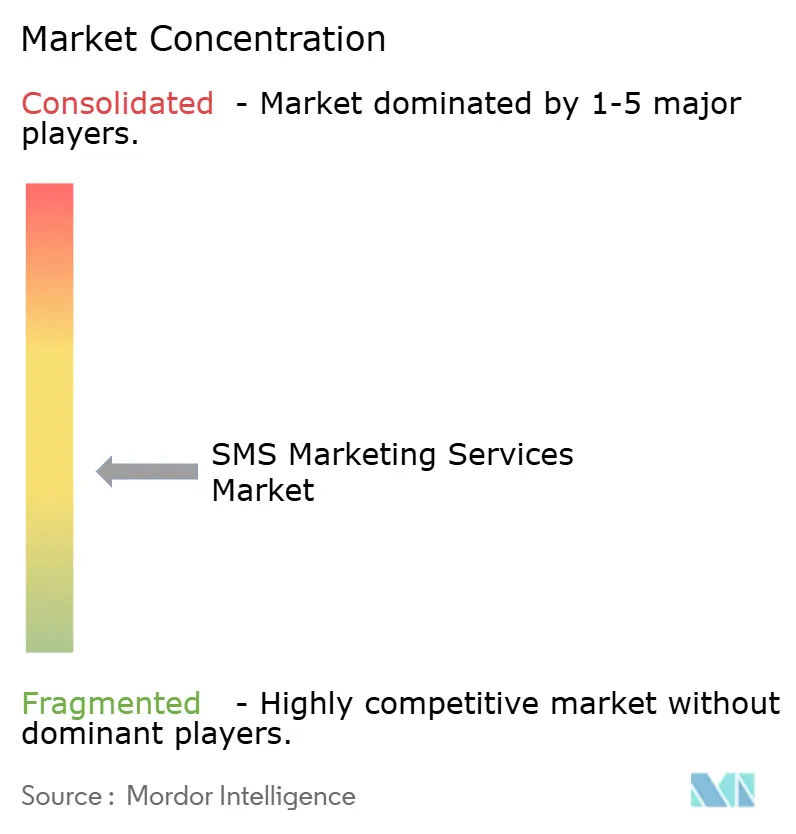
| Market Concentration | Medium |
Major Players *Disclaimer: Major Players sorted in no particular order Image © Mordor Intelligence. Reuse requires attribution under CC BY 4.0. | |
SMS Marketing Services Market Analysis by Mordor Intelligence
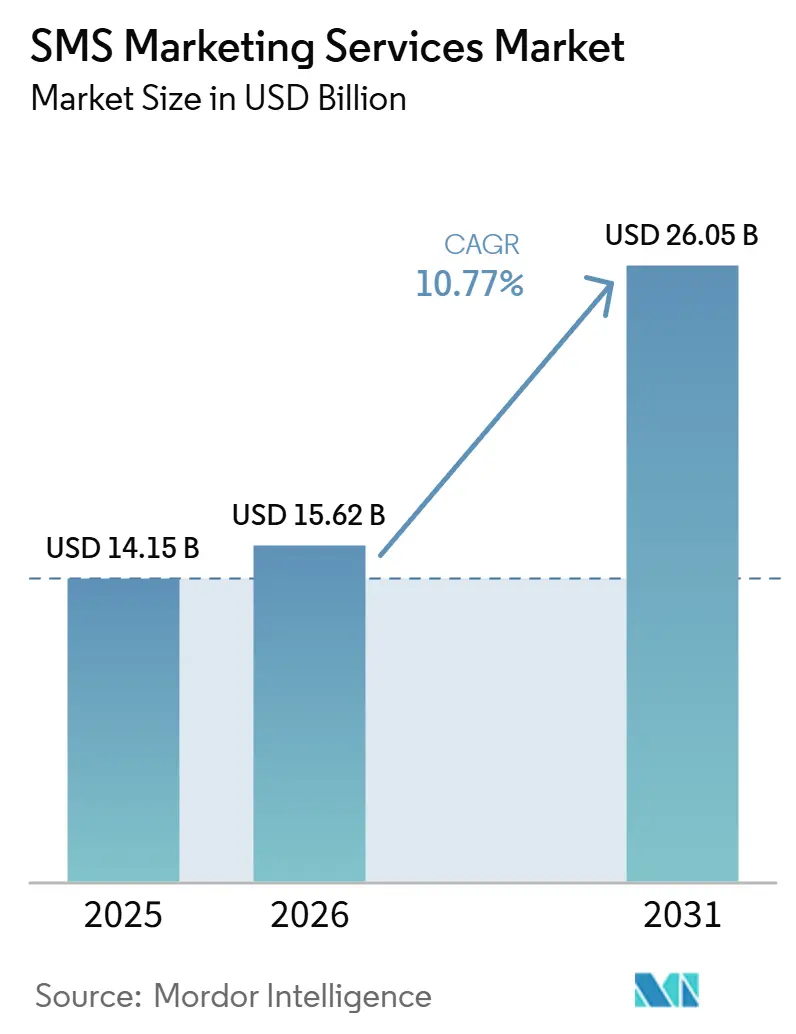
The SMS Marketing Services Market size was valued at USD 14.15 billion in 2025, USD 15.62 billion in 2026, and is forecast to reach USD 26.05 billion by 2031, registering a CAGR of 10.77% during 2026-2031. The SMS Marketing Services Market continues to benefit from direct reach, fast delivery, and integration with customer engagement systems. AI-based campaign tools and connections to customer data platforms are making messages more relevant to defined customer groups. Sender registration and consent rules are also increasing the value of platforms that can manage compliant communication at scale. RCS adoption supports this position because businesses still need SMS fallback when richer messages cannot reach a device or network. Competition centers on API coverage, compliance functions, AI capabilities, and reliable local delivery routes.
Key Report Takeaways
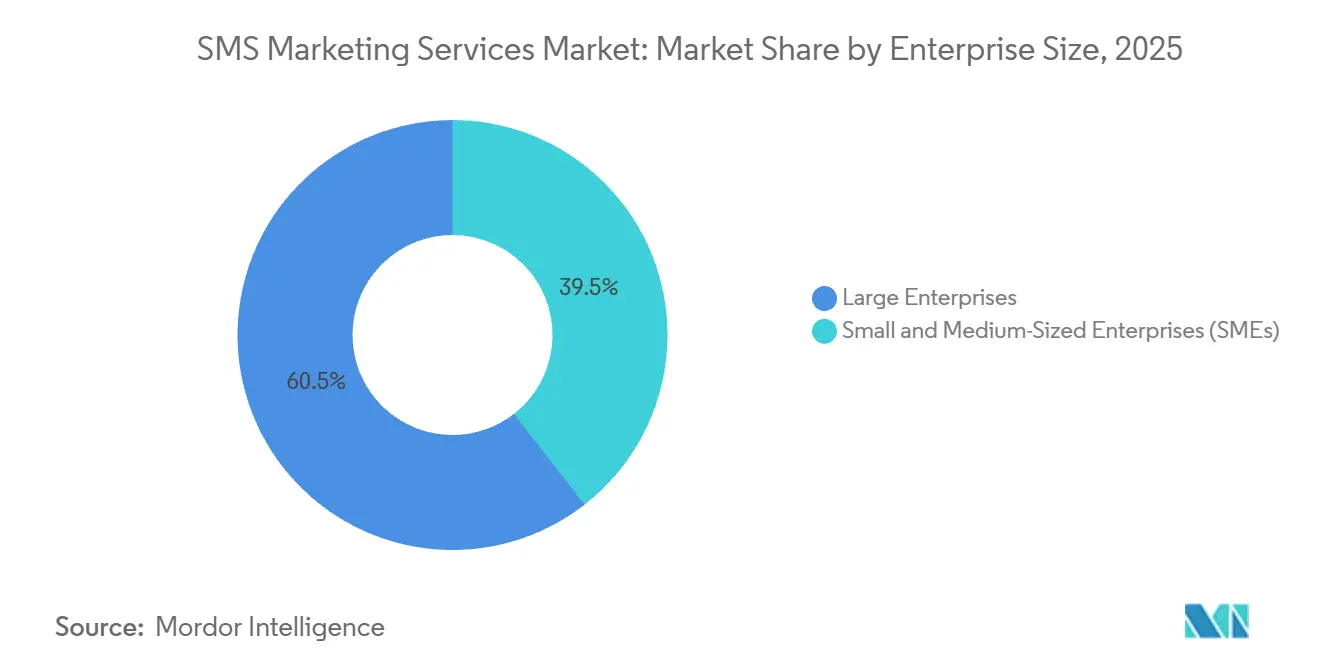
- By enterprise size, large enterprises held 60.53% of the SMS Marketing Services Market share in 2025, while small and medium-sized enterprises are projected to expand at a 14.51% CAGR through 2031.
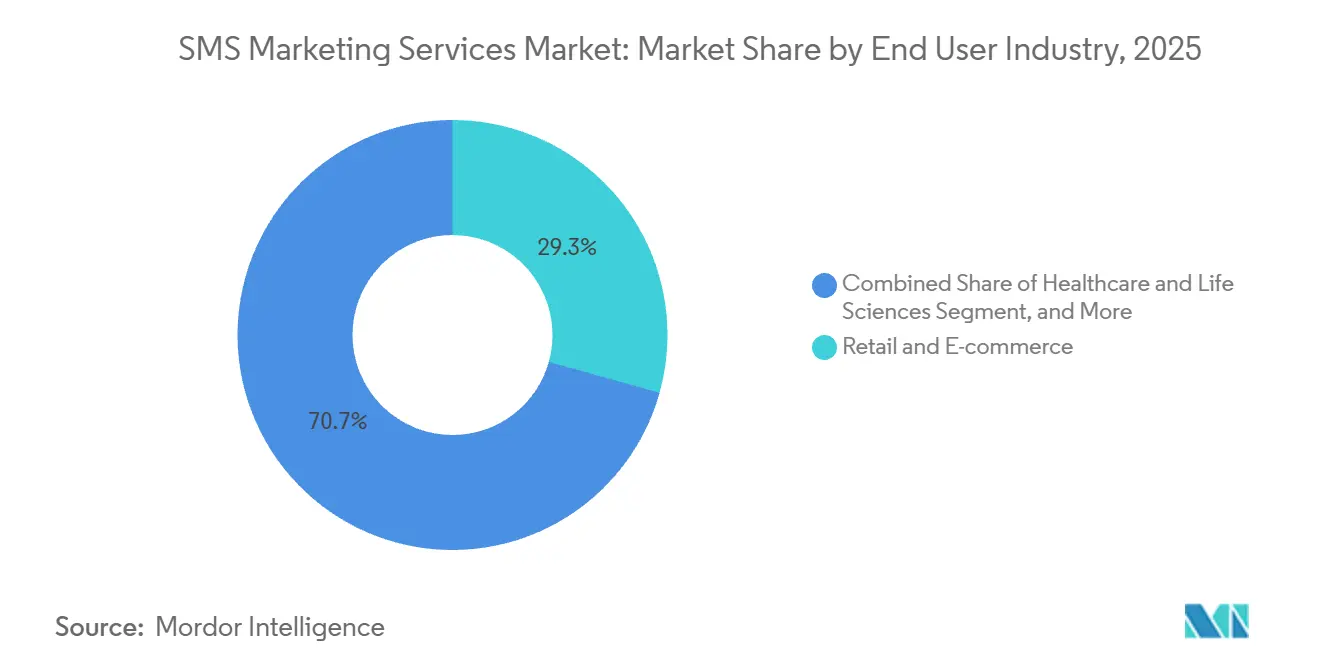
- By end-user industry, retail and e-commerce accounted for 29.33% of the SMS Marketing Services Market share in 2025, while healthcare and life sciences are expected to grow at a 14.12% CAGR through 2031.
- By geography, North America held 32.31% of the SMS Marketing Services Market share in 2025, while Africa is projected to grow at a 15.12% CAGR through 2031.
Note: Market size and forecast figures in this report are generated using Mordor Intelligence’s proprietary estimation framework, updated with the latest available data and insights as of January 2026.
Global SMS Marketing Services Market Trends and Insights
Drivers Impact Analysis*
| Driver | (~) % Impact on CAGR Forecast | Geographic Relevance | Impact Timeline |
|---|---|---|---|
| High Open Rates and Immediate Conversion Windows | +1.5% | Global | Short term (≤ 2 years) |
| Small Business Adoption of Self-Serve Text Platforms | +1.3% | Global, concentrated in North America and Asia-Pacific | Short term (≤ 2 years) |
| Commerce and Customer Data Platform Integrations Improve Campaign Precision | +1.0% | North America and Europe | Medium term (2-4 years) |
| Rich Messaging Rollouts Increase Demand for Text Fallback at Scale | +0.8% | Global, led by North America and Asia-Pacific | Medium term (2-4 years) |
| Registered Sender Frameworks Improve Deliverability for Compliant Brands | +0.5% | North America and Europe | Short term (≤ 2 years) |
| Network API Number Intelligence Improves Targeting and Fraud Control | +0.4% | Global | Medium term (2-4 years) |
| Source: Mordor Intelligence | |||
High Open Rates and Immediate Conversion Windows
The SMS Marketing Services Market benefits from a channel that places time-sensitive offers and service messages directly on a consumer device, without requiring a person to open a separate application. Subtext reported a 98% open rate and stated that 95% of messages were opened within 3 minutes in its 2026 benchmark report, based on messages sent during 2025.[1]Subtext, “2026 SMS Marketing Benchmarks Report: CTR, Engagement Rates and Industry Data,” Subtext, joinsubtext.com Omnisend found that automated campaigns converted at 0.77%, compared with 0.12% for scheduled broadcast campaigns, showing the value of messages triggered by customer behavior. Its data covered cart abandonment, post-purchase follow-up, and other actions that can be addressed while purchase intent is still active. Immediate delivery also allows a business to link a message to a specific customer action rather than relying on a general promotional calendar, making campaign results easier to compare. This gives campaign teams a clearer basis for testing timing, audience selection, message content, and the route from a response to a purchase, while respecting the opt-in choices that determine whether the message can be sent.[2]Omnisend, “SMS Marketing Benchmarks 2026: Campaigns vs. Automations,” Omnisend, omnisend.com
Small Business Adoption of Self-Serve Text Platforms
Self-serve products are broadening access to the SMS Marketing Services Market for businesses without dedicated development teams or large technology budgets. TXTImpact reported that 66% of U.S. businesses used SMS marketing in 2025, and the same share increased their budgets for the channel. Listrak recorded a 93% increase in retailer SMS volume in 2025, alongside a 16.7% increase in client revenue and a 21% increase in Black Friday and Cyber Monday SMS revenue. HubSpot made native SMS available as a paid Marketing Hub add-on in May 2026, placing message creation within established marketing workflows for its users.[3]HubSpot, “Create and Send SMS Messages in HubSpot,” HubSpot Knowledge Base, hubspot.com These products reduce setup time through templates, guided workflows, direct links to commerce and CRM applications, and settings that allow teams to start with modest campaign volumes. They also allow small teams to manage opt-ins, message cadence, and basic results without shifting work among several disconnected systems or relying on an external development project for routine changes.
Commerce and Customer Data Platform Integrations Improve Campaign Precision
The SMS Marketing Services Market is moving from isolated campaigns to messaging that leverages customer records and real-time behavioral signals across connected marketing systems. Omnisend stated in its 2025 analysis that automated messages generated 5 times as much revenue per send as broadcast campaigns. Such systems can use purchase history, membership in segments, abandoned carts, post-purchase events, and customer preferences to determine when to send a message. Solutions by Text integrated its FinText platform with Salesforce Marketing Cloud Journey Builder in March 2026, allowing financial services and retail users to send SMS, MMS, and RCS messages through automated customer journeys.[4]Solutions by Text, “SBT Integrates FinText with Salesforce Marketing Cloud,” Solutions by Text, solutionsbytext.com Klaviyo found that 64.4% of SMS flow revenue came from first-purchase conversions, compared with 20% for broadcast campaigns. The FCC's one-to-one consent rule has added weight to these integrations because each brand must maintain clear evidence of its customers' consent and be able to trace that permission to the relevant communication program.
Rich Messaging Rollouts Increase Demand for Text Fallback at Scale
RCS adoption adds interactive features, but it does not eliminate the need for reliable SMS delivery in the SMS Marketing Services Market when a recipient lacks a compatible service. Twilio made RCS generally available in August 2025 to more than 349,000 active accounts via its messaging products, including automatic SMS fallback for devices that cannot receive RCS. Infobip reported 169.3% global RCS traffic growth in the first half of 2026 and 1,298.8% growth in the United States. Listrak found that eligible-device RCS campaigns generated up to 58% higher visit rates, 52% more orders, and 74% more revenue per message than standard SMS campaigns in 2025. LINK Mobility reported 105% year-over-year RCS volume growth in the first quarter of 2026, while SMS remained a core delivery layer across its network. Providers can therefore serve a wider mix of communication formats without asking customers to build separate campaign systems, preserve a different customer database, or accept gaps in message reach.
Restraints Impact Analysis*
| Restraint | (~) % Impact on CAGR Forecast | Geographic Relevance | Impact Timeline |
|---|---|---|---|
| Growing Shift to WhatsApp and Rich Communication Services | -1.2% | Global, especially Europe and Asia-Pacific | Medium term (2-4 years) |
| Stricter Consent and Content Compliance Requirements | -0.7% | North America and Europe | Short term (≤ 2 years) |
| Passkey Adoption Weakens Authentication-Led Messaging Volumes | -0.4% | Global, concentrated in North America, Europe, and Asia-Pacific | Long term (≥ 4 years) |
| Termination Fee Inflation and Grey-Route Normalization Pressure Margins | -0.3% | Africa, Middle East, and South America | Medium term (2-4 years) |
| Source: Mordor Intelligence | |||
Growing Shift to WhatsApp and Rich Communication Services
WhatsApp and RCS create competitive pressure for the SMS Marketing Services Market, particularly where consumers already use app-based messaging extensively and expect rich media functions. Infobip stated that WhatsApp had more than 3 billion active users and carried 140 billion messages each day, making it a major enterprise messaging option outside North America. The company also reported that RCS passed 1.5 billion users globally after broader handset support. This does not mean that SMS will be replaced in every use case, since customer access and channel availability vary by geography, device, carrier, and application use. SMS still reaches customers without a separate application, an active data session, or a compatible RCS connection. Operators are responding with routing systems that select RCS or WhatsApp when available and use SMS when universal delivery is necessary, rather than treating channel choice as a permanent replacement decision.
Stricter Consent and Content Compliance Requirements
Consent rules can increase costs and slow campaign execution for participants in the SMS Marketing Services Market, especially when a business has outdated customer lists or multiple acquisition channels. The FCC's one-to-one consent rule, effective in January 2026, requires brands to collect and document consent individually rather than transfer consent gathered through comparison-shopping or lead-generation sites. The Telephone Consumer Protection Act allows statutory damages of USD 500 to USD 1,500 for each noncompliant message. GDPR Article 7 also requires that consent be freely given, specific, informed, and evidenced by clear affirmative action. These requirements favor platforms that build consent capture, record retention, and campaign controls into the regular user workflow, rather than leaving customers to manage records in separate files. They also put smaller aggregators under pressure when they cannot fund comparable compliance processes or provide customers with clear audit records during reviews, disputes, or internal checks.
*Our forecasts treat driver/restraint impacts as directional, not additive. The impact forecasts reflect baseline growth, mix effects, and variable interactions.
Segment Analysis
By Enterprise Size: Large-Enterprise Infrastructure Leads, While Self-Serve SME Adoption Expands
Large enterprises held 60.53% of the SMS Marketing Services Market share in 2025. Their programs typically require high message throughput, dedicated API teams, customer segmentation, and integration with internal data systems. Financial services, retail, healthcare, and logistics users also need robust controls for consent and sender registration. Large organizations can spread these compliance and operating costs across higher message volumes. They are more likely to combine text messaging with customer data platform records to create targeted nationwide campaigns.
Small and medium-sized enterprises are projected to grow at a 14.51% CAGR from 2026 to 2031, the highest rate within this segmentation. Subscription pricing, self-serve setup, and prebuilt links to HubSpot, Salesforce, and Shopify reduce the development effort once needed to start a program. Klaviyo reported that nearly two-thirds of SMS flow revenue among its customers came from new buyers, underscoring how smaller e-commerce businesses can use automated flows for acquisition as well as retention. HubSpot's May 2026 SMS add-on similarly placed campaign tools inside Marketing Hub workflows. The SMS Marketing Services industry can gain a broader, more balanced customer base when platforms make registration, consent, and campaign creation easier for smaller businesses.


By End User Industry: Retail Provides Scale, While Healthcare and Life Sciences Leads Growth
Retail and e-commerce accounted for 29.33% of the SMS Marketing Services Market size in 2025. The segment relies on messages for cart recovery, product availability, delivery updates, limited-time offers, and seasonal promotions. Listrak reported that retailer SMS volume increased by 93% in 2025, with client revenue rising by 16.7% and Black Friday and Cyber Monday SMS revenue rising by 21%. These patterns make message timing, permission management, and coordination with promotions central to retailer campaign planning. Media and entertainment, travel and hospitality, and consumer goods also use text messaging when speed matters for ticket alerts, check-in reminders, and short-duration offers.
Healthcare and life sciences are expected to record a 14.12% CAGR between 2026 and 2031. Sinch found that 84% of 1,000 surveyed U.S. patients were more likely to attend an appointment when their provider sent an SMS reminder. This supports uses such as appointment reminders, prescription adherence prompts, post-discharge follow-up, and chronic disease engagement. The Telecom Regulatory Authority of India requires registered templates for commercial messaging under its distributed ledger framework, thereby strengthening the role of compliant providers in health-related communication. Government programs that support digital health records and patient access can increase demand for secure, documented messaging workflows, while banking, financial services and insurance, education, automotive, and IT and telecom continue to send high volumes of notification and verification messages.

Geography Analysis
North America held 32.31% of the SMS Marketing Services Market share in 2025. The region has established enterprise messaging infrastructure, high smartphone use, and extensive adoption of communication platforms. A2P 10DLC registration has improved the operating conditions for registered senders and limited grey-route traffic. Twilio reported USD 1.41 billion in first-quarter 2026 revenue, a 20% year-over-year increase, and raised its 2026 reported revenue growth guidance to 14%-15%.
Europe remains a major regional base for the SMS Marketing Services Market, where GDPR compliance affects vendor selection and customer processes. Germany, the United Kingdom, France, Italy, and Spain support demand from retail, financial services, and logistics organizations. LINK Mobility serves more than 66,000 customers across Europe and reported that its 2025 annual results reflected stronger adoption of AI and RCS. Asia-Pacific combines diverse market conditions, from mature RCS and AI use in China, Japan, South Korea, and Australia to compliance-led A2P messaging in India. India's DLT framework requires organizations to register commercial communication templates, making compliance capability an important factor in provider selection.
Africa is projected to grow at a 15.12% CAGR from 2026 to 2031, the highest regional rate. Mobile technologies contributed USD 240 billion to Africa's economy in 2025, equal to 7.8% of regional GDP, and the GSMA expects this contribution to reach USD 290 billion by 2030. In markets with uneven internet access, text messaging remains a practical business channel that does not require continuous data connectivity. LINK Mobility completed its acquisition of South Africa-based SMSPortal in November 2025, gaining a business that served more than 5,400 customers and processed 16 billion messages annually. The Middle East has sophisticated enterprise demand from retail, banking, and hospitality users, while South America benefits from e-commerce growth and providers such as Zenvia that focus on regional customer experience infrastructure.

Competitive Landscape
The SMS Marketing Services Market is moderately fragmented at the platform level. Twilio, Sinch, and Infobip compete in the global communications platform space, combining SMS with APIs, RCS, compliance functions, and AI-supported engagement tools. Regional providers and wholesale aggregators compete through route quality, local regulation knowledge, and specialized workflows. Twilio reported USD 1.41 billion in first-quarter 2026 revenue and a 114% dollar-based net expansion rate, reflecting continued demand for its multi-channel platform.
Product strategies increasingly combine engagement messaging with identity, consent, and message routing. Twilio completed its acquisition of Stytch in November 2025 to add an identity platform for AI agents to its product roadmap. In May 2026, Twilio introduced generally available next-generation platform capabilities that included conversational AI infrastructure tools and a public beta for SMS EU data residency. Solutions by Text connected FinText to Salesforce Marketing Cloud Journey Builder in March 2026, expanding compliant messaging options inside enterprise CRM workflows. These actions show why product integration and regulatory readiness have become central buying criteria.
The SMS Marketing Services Market still contains open opportunities in healthcare compliance, African SME adoption, and intelligent routing across SMS, RCS, WhatsApp, and voice. Healthcare users need templates, consent records, and controls that fit their patient communication requirements. LINK Mobility's acquisition of SMSPortal gave it a direct presence in South Africa, where mobile-first businesses can use low-cost messaging services. Sinch partnered with Lovable in February 2026 to bring SMS, RCS, and WhatsApp tools to AI-native application developers. The competitive position of each vendor will depend on reliable delivery, transparent consent controls, and the ability to manage multiple communication channels within a single workflow.
SMS Marketing Services Industry Leaders
Twilio Inc.
Sinch AB
Infobip Ltd.
Vonage Holdings Corp.
Route Mobile Ltd.
- *Disclaimer: Major Players sorted in no particular order

Recent Industry Developments
- July 2026: Infobip reported 169.3% global RCS traffic growth in H1 2026, with the United States posting 1298.8% growth over the same period. The development signals that RCS-SMS hybrid messaging architectures are becoming mainstream for enterprise campaigns, expanding the total addressable market for platforms supporting both channels through a unified API.
- May 2026: Twilio launched its next-generation platform capabilities in general availability, including conversational AI infrastructure tools and Data Residency for SMS EU in public beta. The platform is designed to serve as a foundational infrastructure layer for AI-driven customer engagement, expanding beyond messaging into identity, data, and orchestration for enterprise accounts.
- May 2026: Twilio reported Q1 2026 revenue of USD 1.41 billion, up 20% year over year, and raised its full-year 2026 reported revenue growth guidance to 14%-15% from the prior guidance of 11.5%-12.5%. The company cited milestone-level performance in revenue and gross profit growth ra
- March 2026: Solutions by Text integrated its FinText platform with Salesforce Marketing Cloud's Journey Builder, enabling financial services and retail brands to send compliant SMS, MMS, and RCS messaging within unified omnichannel automated journeys. The integration bridges compliance-first mobile messaging with enterprise CRM automation infrastructure for Salesforce's customer base.


Global SMS Marketing Services Market Report Scope
The SMS marketing services market refers to professional services that assist businesses in strategizing, executing, and managing text message marketing campaigns. This includes campaign design, audience segmentation, compliance management (including adherence to telecom regulations and privacy laws), platform integration, and performance analytics. These services enable organizations across industries such as retail, healthcare, and BFSI to directly engage with customers, deliver time-sensitive promotions and alerts, and drive high-conversion interactions through one of the most immediate and widely adopted communication channels.
The SMS Marketing Services Market Report is Segmented by Enterprise Size (Large Enterprises, and Small and Medium-Sized Enterprises), End User Industry (Retail and E-commerce, Media and Entertainment, Healthcare and Life Sciences, Travel and Hospitality, Consumer Goods, and Other End User Industries (BFSI, Education, Automotive and IT and Telecom amongst Others)), and Geography (North America, South America, Europe, Asia-Pacific, Middle East, and Africa). The Market Forecasts are Provided in Terms of Value (USD).
| Large Enterprises |
| Small and Medium-Sized Enterprises |
| Retail and E-commerce |
| Media and Entertainment |
| Healthcare and Life Sciences |
| Travel and Hospitality |
| Consumer Goods |
| Other End User Industries (BFSI, Education, Automotive, and IT and Telecom amongst Others) |
| North America | United States |
| Canada | |
| Mexico | |
| South America | Brazil |
| Argentina | |
| Chile | |
| Rest of South America | |
| Europe | Germany |
| United Kingdom | |
| France | |
| Italy | |
| Spain | |
| Rest of Europe | |
| Asia-Pacific | China |
| Japan | |
| India | |
| South Korea | |
| Australia | |
| Rest of Asia-Pacific | |
| Middle East | United Arab Emirates |
| Saudi Arabia | |
| Qatar | |
| Rest of Middle East | |
| Africa | South Africa |
| Egypt | |
| Nigeria | |
| Rest of Africa |
| By Enterprise Size | Large Enterprises | |
| Small and Medium-Sized Enterprises | ||
| By End User Industry | Retail and E-commerce | |
| Media and Entertainment | ||
| Healthcare and Life Sciences | ||
| Travel and Hospitality | ||
| Consumer Goods | ||
| Other End User Industries (BFSI, Education, Automotive, and IT and Telecom amongst Others) | ||
| By Geography | North America | United States |
| Canada | ||
| Mexico | ||
| South America | Brazil | |
| Argentina | ||
| Chile | ||
| Rest of South America | ||
| Europe | Germany | |
| United Kingdom | ||
| France | ||
| Italy | ||
| Spain | ||
| Rest of Europe | ||
| Asia-Pacific | China | |
| Japan | ||
| India | ||
| South Korea | ||
| Australia | ||
| Rest of Asia-Pacific | ||
| Middle East | United Arab Emirates | |
| Saudi Arabia | ||
| Qatar | ||
| Rest of Middle East | ||
| Africa | South Africa | |
| Egypt | ||
| Nigeria | ||
| Rest of Africa | ||


Key Questions Answered in the Report
What is the current size of the SMS Marketing Services Market?
The SMS Marketing Services Market was valued at USD 14.15 billion in 2025 and is forecast to reach USD 26.05 billion by 2031 at a 10.77% CAGR.
What is driving SMS marketing service adoption?
The channel benefits from behavioral automation, CRM and customer data platform integration, self-serve tools, and SMS fallback for RCS deployments. These capabilities help organizations connect messaging activity with customer records, consent requirements, and campaign measurement.
Which enterprise group is growing fastest in SMS marketing services?
Within the SMS Marketing Services Market, small and medium-sized enterprises are projected to grow at a 14.51% CAGR from 2026 to 2031 as self-serve platforms reduce setup requirements.
Which end user sector has the highest growth outlook?
In the SMS Marketing Services Market, healthcare and life sciences is expected to grow at a 14.12% CAGR through 2031, supported by appointment reminders and patient engagement workflows.
Which region is expected to grow fastest through 2031?
Africa is projected to expand at a 15.12% CAGR, supported by mobile-first communication patterns and uneven internet access in several markets.
How are RCS and WhatsApp affecting SMS service providers?
They increase the need for multi-channel routing, but SMS remains important as the universal fallback when app, device, or carrier support is unavailable across different customer settings.
Page last updated on:





