
SME Marketing-as-a-Service Market Size and Share
Market Overview
| Study Period | 2020 - 2031 |
|---|---|
| Market Size (2026) | USD 9.21 Billion |
| Market Size (2031) | USD 18.07 Billion |
| Growth Rate (2026 - 2031) | 14.43 % |
| Fastest Growing Market | Asia-Pacific |
| Largest Market | North America |
| Market Concentration | Low |
Major Players *Disclaimer: Major Players sorted in no particular order Image © Mordor Intelligence. Reuse requires attribution under CC BY 4.0. | |
SME Marketing-as-a-Service Market Analysis by Mordor Intelligence
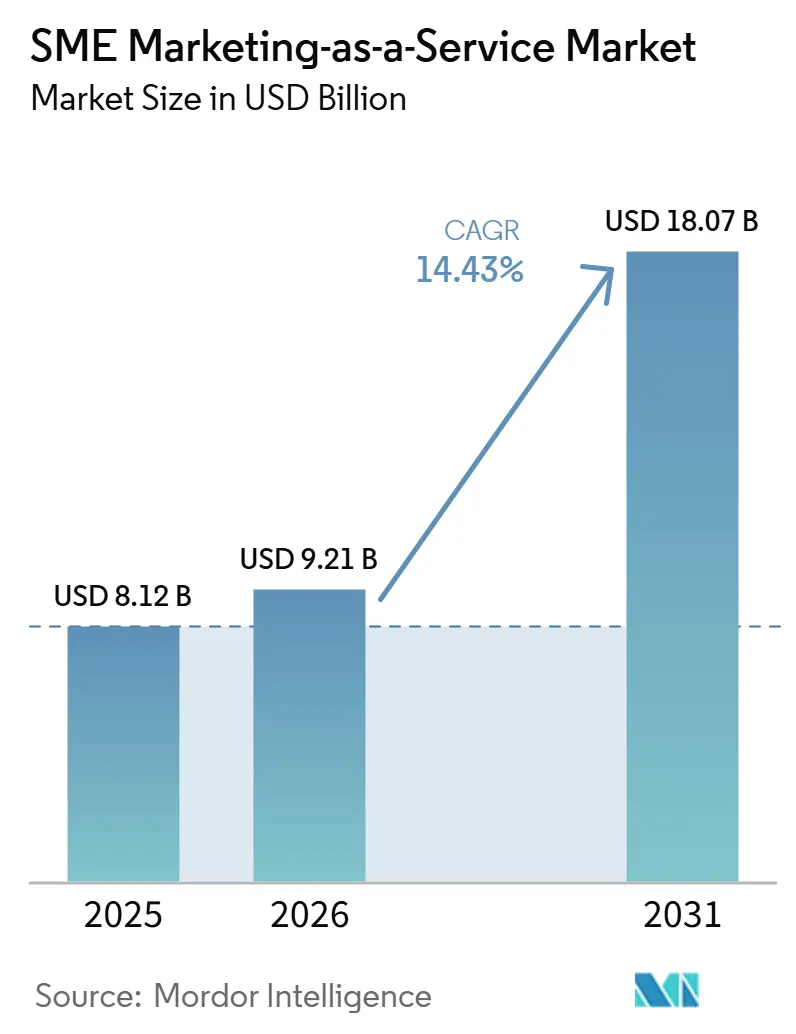
The SME Marketing-as-a-Service market size was valued at USD 8.12 billion in 2025 and is estimated to grow from USD 9.21 billion in 2026 to reach USD 18.07 billion by 2031, at a CAGR of 14.43% during the forecast period 2026-2031. The SME Marketing-as-a-Service market is shifting from project work toward subscription services with clearer accountability for execution and results. AI is reducing the cost of routine work while raising the importance of data, workflow automation, and senior marketing oversight. Fixed monthly retainers can appeal to SMEs that need several skills but cannot build a broad in-house team. Providers are responding by combining software, managed delivery, and performance reporting into a single offering. The SME Marketing-as-a-Service market, therefore, creates opportunities for platforms and specialist firms that can manage complex campaigns with reliable governance.
Key Report Takeaways
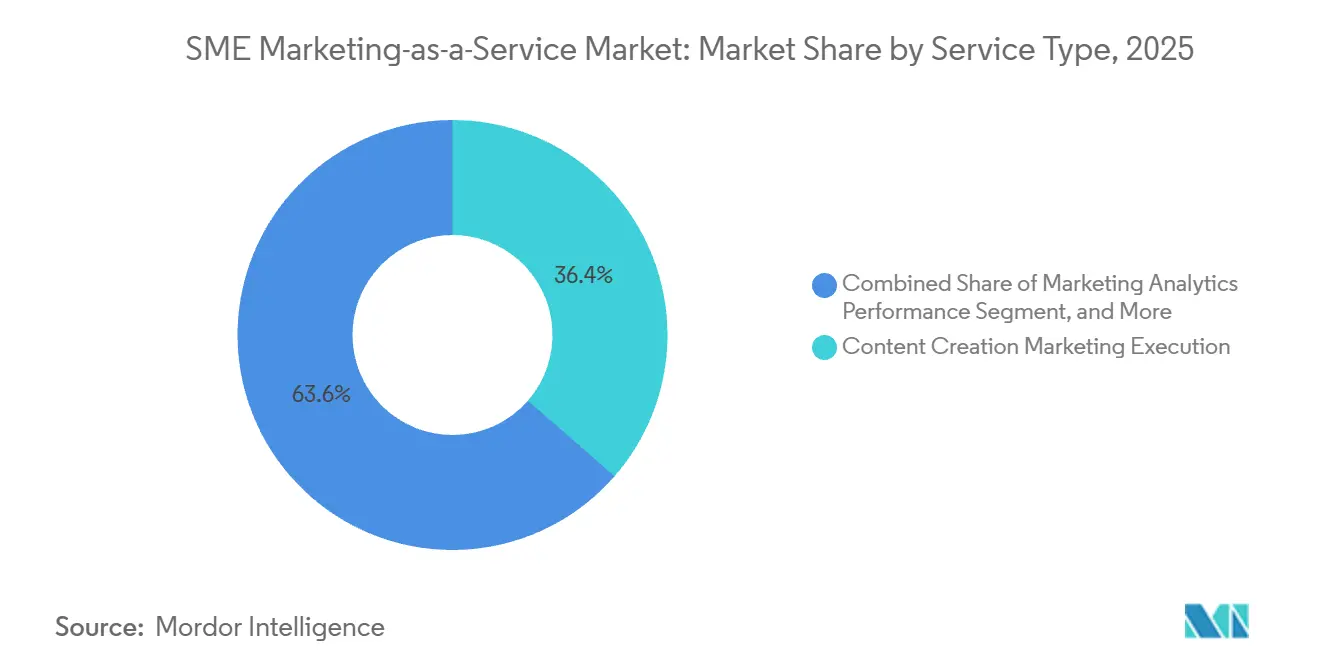
- By service type, Demand Generation and Customer Acquisition held 36.41% of the SME Marketing-as-a-Service market share in 2025, while Marketing Automation and CRM Management are projected to expand at a 15.29% CAGR through 2031.
- By subscription model, Fully Managed Marketing Services held 68.72% of the SME Marketing-as-a-Service market share in 2025, while Project-Based Retainer Services is projected to expand at a 15.06% CAGR through 2031.
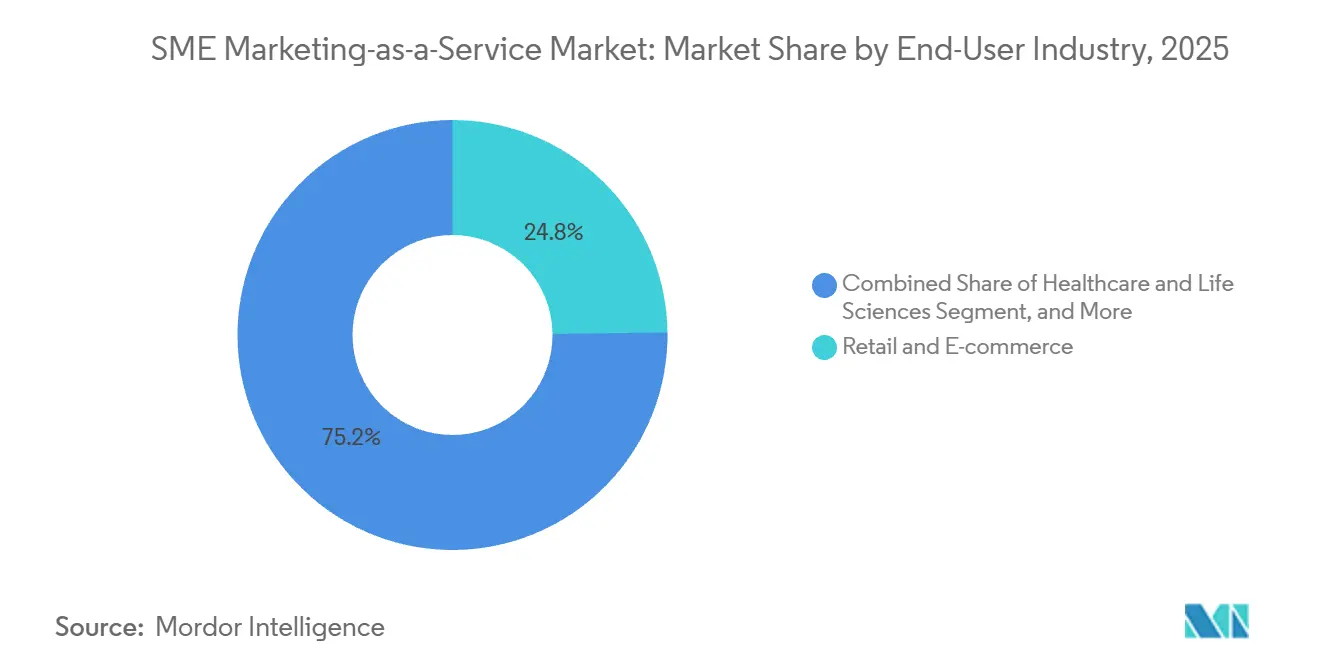
- By end user industry, Retail and E-commerce accounted for 24.81% of the SME Marketing-as-a-Service market share in 2025, while Healthcare and Life Sciences is projected to expand at a 14.91% CAGR through 2031.
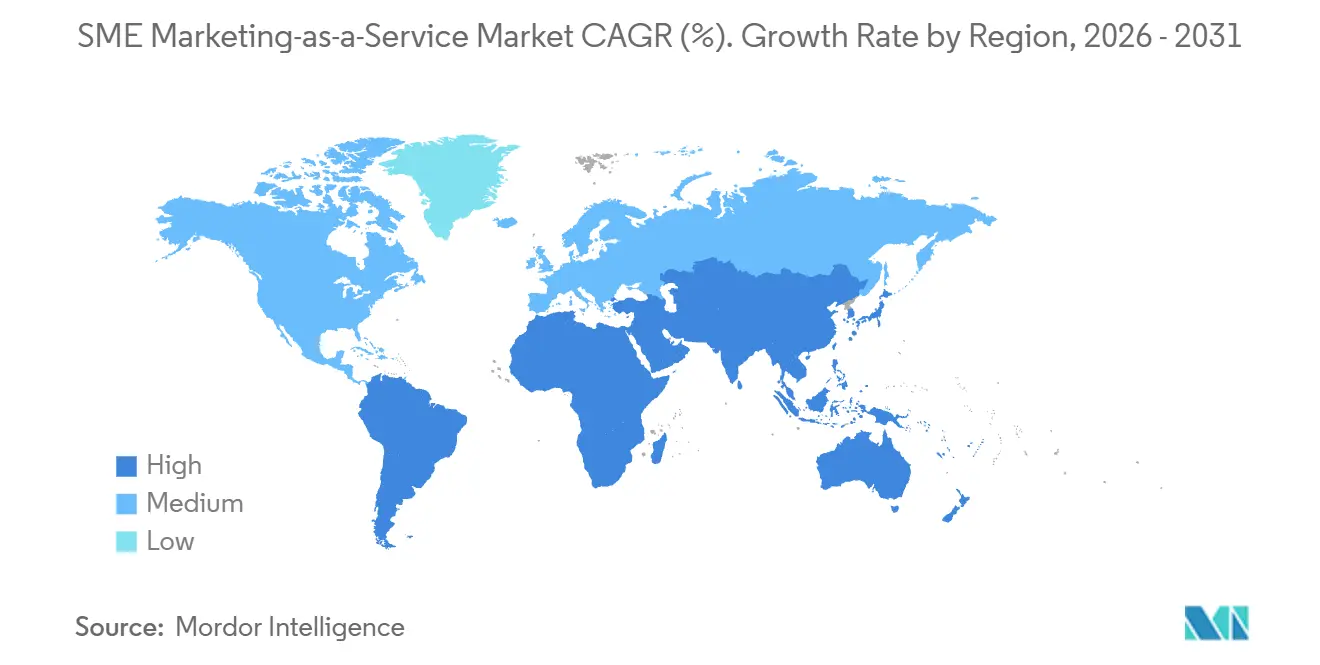
- By geography, North America held 39.21% of the SME Marketing-as-a-Service market in 2025, while Asia-Pacific is projected to expand at a 14.84% CAGR through 2031.
Note: Market size and forecast figures in this report are generated using Mordor Intelligence’s proprietary estimation framework, updated with the latest available data and insights as of January 2026.
Market Trends and Insights
Drivers Impact Analysis of SME Marketing-as-a-Service Market*
| Driver | (~) % Impact on CAGR Forecast | Geographic Relevance | Impact Timeline |
|---|---|---|---|
| Need for Senior Marketing Expertise Without Full-Time Headcount | +3.5% | Global | Short term (≤ 2 years) |
| Multi-Channel Customer Acquisition Pressure Favoring Outsourced Execution | +3.0% | North America and Europe core, spill-over to Asia-Pacific | Short term (≤ 2 years) |
| Strong Shift Toward Social, Search, and Content-Led Demand Generation | +2.5% | Global, highest concentration in North America and Europe | Short term (≤ 2 years) |
| Affordable AI and Automation Expanding Service Scope for SMEs | +2.0% | North America, Europe, Asia-Pacific | Medium term (2-4 years) |
| First-Party Data and AI Search Readiness Creating New Managed-Service Demand | +1.5% | North America and EU core, spill-over to Asia-Pacific | Medium term (2-4 years) |
| Fragmented MarTech Stacks Driving Subscription-Led Optimization Outsourcing | +1.0% | North America core, global markets | Long term (≥ 4 years) |
| Source: Mordor Intelligence | |||
Rising SME Need for Senior Marketing Expertise Without Full-Time Headcount
The shortage of experienced marketing talent is increasing interest in managed services. Budget limits add pressure because many firms cannot staff every required specialty internally. Deloitte reported that B2B services companies allocated 12.2% of revenue to marketing in February 2025. The SME Marketing-as-a-Service market provides smaller firms with access to senior-level guidance without a permanent executive hire. Sagefrog found that 22% of outsourcing decisions reflected limited internal bandwidth, and another 22% reflected cost-effectiveness relative to a full internal team, although this survey result is not relied on as an independent market indicator. AI-supported workflows also enable senior specialists to support multiple clients simultaneously. This expands the practical supply of fractional marketing leadership for smaller businesses.
Multi-Channel Customer Acquisition Pressure Favoring Outsourced Execution
SMEs increasingly need coordinated activity across paid social, search, email, and content. A single internal generalist may struggle to maintain current expertise across those channels. The SME Marketing-as-a-Service market, therefore, supports hybrid models in which internal teams retain strategy and external specialists run channel programs. Browser privacy restrictions have also made conversion tracking and consent management more demanding. Infrequently managed accounts can lose the quality signals that platform algorithms use to optimize delivery. Vendasta received TikTok Channel Sales Partner status in July 2026, allowing campaigns to be launched and managed through its MatchCraft workflow. This development reflects the growing role of integrated channel tools in local business advertising.[1]Vendasta Technologies, “Vendasta Badged as a TikTok Channel Sales Partner,” Vendasta Technologies, vendasta.com
Strong Shift Toward Social, Search, and Content-Led Demand Generation
Business discovery is extending beyond conventional keyword search toward AI-assisted search and answer tools. These services favor structured, credible, and regularly updated content. The SME Marketing-as-a-Service market benefits because managed programs can maintain content cadence and topical coverage more consistently than irregular internal publishing. Vendasta stated that 22% of consumers begin their product research using AI tools, and 62% use AI to find local businesses. This raises the importance of content for firms with a digital customer base. It also increases demand for providers that can connect content planning, paid promotion, and measurement.
Affordable AI and Automation Expanding Service Scope for SMEs
AI tools are allowing providers to deliver more research, campaign support, and routine marketing work at accessible price points. Salesforce reported that 75% of SMBs were experimenting with AI in 2024, while 91% of users reported revenue growth.[2]Salesforce, “New Research Reveals SMBs with AI Adoption See Revenue Boost,” Salesforce, salesforce.com The SME Marketing-as-a-Service market is adapting as clients expect AI capabilities from service partners. The U.S. Chamber of Commerce reported that 58% of U.S. small businesses used generative AI in 2025, compared with 23% in 2023. Serviceplan Group opened its Sokosumi AI agent platform to small and medium-sized enterprises in March 2026. As execution becomes easier to automate, provider differentiation shifts toward data infrastructure, attribution, and commercial accountability.[3]Serviceplan Group, “Serviceplan Makes AI Agents Accessible to Small and Medium-Sized Enterprises,” Serviceplan Group, markt-kom.com
Restraints Impact Analysis of SME Marketing-as-a-Service Market*
| Restraint | (~) % Impact on CAGR Forecast | Geographic Relevance | Impact Timeline |
|---|---|---|---|
| SME Budget Volatility and Short Contract Cycles | -1.2% | Global | Short term (≤ 2 years) |
| Data Privacy, Copyright, and AI Governance Risk | -1.0% | EU, North America, Asia-Pacific | Medium term (2-4 years) |
| Owner-Led Marketing Decision Bottlenecks | -0.8% | Global, elevated in Asia-Pacific and Middle East | Long term (≥ 4 years) |
| Channel Fragmentation and Attribution Complexity | -0.6% | Global | Medium term (2-4 years) |
| Source: Mordor Intelligence | |||
SME Budget Volatility and Short Contract Cycles
Revenue volatility can make SME contracts less predictable than enterprise outsourcing agreements. Budget or scope misalignment can lead clients to pause work before campaign results become visible. The SME Marketing-as-a-Service market consequently faces a higher need to demonstrate value early in each engagement. Many providers concentrate reporting and early milestones within the first 60 to 90 days. Shorter contract cycles can limit revenue visibility and increase customer acquisition pressure. Modular pricing tied to leads, pipeline value, or revenue attribution can reduce concern about recurring retainers.
Data Privacy, Copyright, and AI Governance Risk
AI-generated content and third-party data introduce compliance obligations for providers and clients. Regulation (EU) 2024/1689 establishes requirements for AI systems in the European Union.[4]European Parliament and Council of the European Union, “Regulation (EU) 2024/1689 Artificial Intelligence Act,” EUR-Lex, eur-lex.europa.eu GDPR also requires careful data processing, consent records, and appropriate safeguards. The SME Marketing-as-a-Service market must address content ownership, data use, and human oversight in its delivery processes. Smaller providers may lack the legal and operational resources needed to document these controls. Scaled platforms can use established governance processes as a competitive advantage.
*Our forecasts treat driver/restraint impacts as directional, not additive. The impact forecasts reflect baseline growth, mix effects, and variable interactions.
SME Marketing-as-a-Service Market Segment Analysis
By Service Type:
Demand Generation Leads, Automation and CRM AcceleratesDemand Generation and Customer Acquisition held 36.41% of the SME Marketing-as-a-Service market share in 2025. It is the largest service type because coordinated paid search, paid social, and SEO programs have become a central outsourcing need for many SMEs. Meta Advantage+, Google Performance Max, and TikTok reward well-managed accounts with consistent activity and quality signals. This can widen the gap between an always-on program and an intermittently managed campaign. Providers can address the gap through coordinated channel planning, budget management, and tracking. Content and Brand Management is the second-largest service category. It is moving from a focus on publishing volume toward topical authority and content formats suited to AI-supported search. Marketing Analytics and Reporting is also becoming increasingly important because clients expect real-time visibility into performance within their retainers.
Marketing Automation and CRM Management is the fastest-growing service type, with the SME Marketing-as-a-Service market size for this segment projected to expand at a 15.29% CAGR from 2026 to 2031. HubSpot, Salesforce, and Zoho make connected campaign workflows more accessible, but licenses still require skilled implementation. Managed providers can connect customer records, campaign activity, and follow-up processes in a practical workflow. Fractional Marketing Leadership is a separate niche that offers senior strategic direction without a full-time executive role. AI-supported execution enables experienced professionals to serve 4 to 6 SME clients simultaneously. Specialized SEO, paid media, and video production services also remain relevant. These services can be added to a broader program when clients seek fewer vendor relationships. The SME Marketing-as-a-Service market is therefore supporting both broad managed programs and more specialized service engagements.



By Subscription Model:
Fully Managed Services Dominate, Project-Based Retainers Gain ShareFully Managed Marketing Services accounted for 68.72% of the SME Marketing-as-a-Service market share in 2025. Lean teams often prefer end-to-end accountability because selective projects require internal coordination across several suppliers. A business with 1 to 3 generalist marketers may find a fully managed program easier to oversee. Such programs can include campaign execution, reporting, content, and platform administration. Thryv's Marketing Center bundles marketing work with its subscription platform. Thryv reported that Marketing Center revenue more than doubled in 2025. This supports the appeal of integrated services for SME buyers. Fully managed delivery is especially relevant where clients have limited internal marketing capacity.
Project-Based Retainer Services is projected to expand at a 15.06% CAGR from 2026 to 2031. This model can suit SMEs that have developed an internal team but need external expertise for paid media, CRM implementation, or AI search optimization. The SME Marketing-as-a-Service market is therefore serving a buyer group with more varied operating models. Some clients need a provider to run the whole function, while others need defined technical or channel capabilities. Providers may need modular services that allow scopes to expand or contract without a full contract reset. Rigid engagement models can create attrition risk as clients mature. One-off work, including website redesigns, identity programs, and campaign launches, can also introduce first-time clients to managed services. Proven results from an initial project can pave the way for a recurring retainer.
By End User Industry:
Retail and E-commerce Anchors Volume, Healthcare and Life Sciences AcceleratesRetail and E-commerce held 24.81% of the SME Marketing-as-a-Service market share in 2025. Small retailers often sell on Amazon, Google Shopping, Instagram, and TikTok Shop simultaneously. Managing product feeds, paid placements, social commerce, and CRM records across these channels can exceed the capacity of a small in-house team. The SME Marketing-as-a-Service market helps providers organize these activities around a common acquisition plan. Media and Entertainment is the second-largest end-user category because it requires ongoing content and regular channel decisions. Travel and Hospitality also has strong outsourcing demand because independent operators use direct marketing to reduce OTA commissions of 15% to 25% per booking. Consumer Goods, BFSI, Education, Automotive, IT, and Telecom are also increasing their use of digital-first customer acquisition. This reduces reliance on trade shows, distributors, and conventional sales channels.
Healthcare and Life Sciences are projected to grow at a 14.91% CAGR from 2026 to 2031. Telehealth, specialist medical practices, and life-science companies are increasing their use of digital patient and customer acquisition. Advertising rules for prescription products, mental health services, and telehealth make this a compliance-focused service area. Providers with documented platform-compliant content processes can have an advantage over generalist agencies. Digital health apps, direct-to-patient diagnostics, and wellness technology also need precise audience targeting and compliant messages. This supports specialized delivery rather than undifferentiated marketing work. The sector has lower risk of simple price competition because content and campaign approvals require deeper knowledge. It also gives the SME Marketing-as-a-Service market a high-growth vertical with measurable compliance needs.
Geography Analysis
North America SME Marketing-as-a-Service Market
North America held 39.21% of the SME Marketing-as-a-Service market in 2025. The region has a high concentration of MaaS platforms and widespread use of technology among smaller businesses. U.S. small businesses' use of generative AI reached 58% in 2025, according to the U.S. Chamber of Commerce. Thryv reported USD 461 million in SaaS revenue for 2025, a 34.2% year-over-year increase. Canada requires English and French content, while Mexico supports Spanish-language programs connected to North American trade.
Europe SME Marketing-as-a-Service Market
SME skill gaps and tighter requirements around personal data influence Europe. Weitkamp Marketing launched a Marketing-as-a-Service subscription model for industrial mid-market companies in March 2026. The IPA reported a net budget balance of +7.3% for United Kingdom companies in the first quarter of 2026. GDPR and the EU AI Act favor providers with documented practices for data processing and AI oversight.
APAC and MEA SME Marketing-as-a-Service Market
Asia-Pacific is the fastest-growing region, with the SME Marketing-as-a-Service market projected to expand at a 14.84% CAGR from 2026 to 2031. China, India, South Korea, and Southeast Asia support growth through e-commerce, social commerce, and SME digital-transformation programs. Businesses in the region need services that address local platforms, languages, and data rules. The Middle East also retains growth potential as Saudi Arabia develops SME-intensive activity in entertainment, sports, and tourism. Africa remains in the early stages overall, while South Africa, Nigeria, and Egypt show initial adoption in urban fintech, consumer goods, and retail clusters.

Competitive Landscape
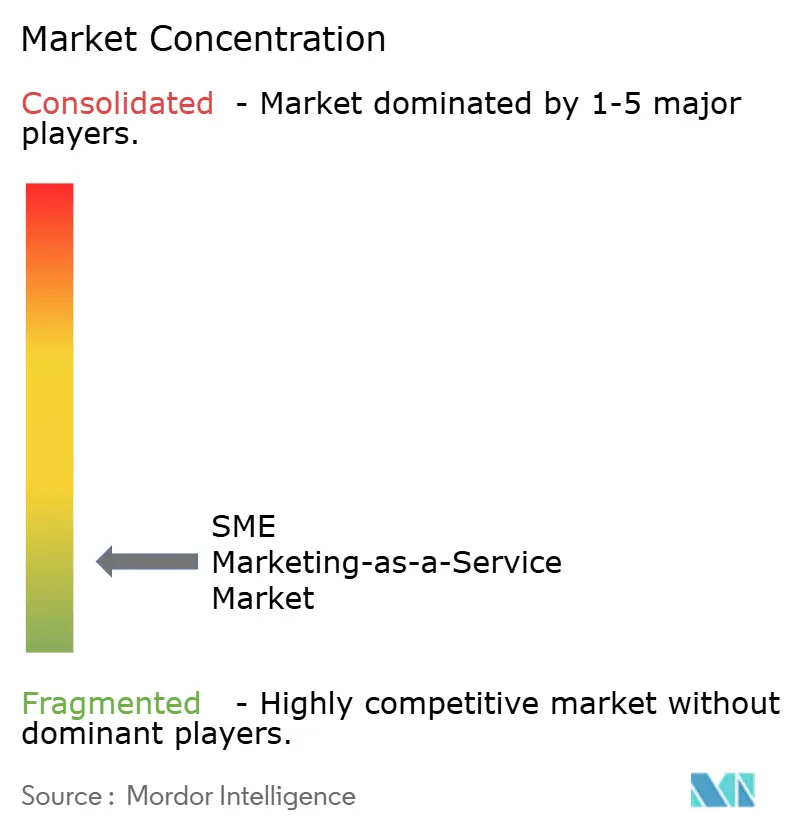
The SME Marketing-as-a-Service market is fragmented. It includes platform consolidators with proprietary software and specialist boutiques providing fractional CMO, inbound, and demand-generation services. Platform firms use acquisitions and partner channels to increase their customer reach. Thryv acquired Keap for USD 80 million in October 2024. The transaction added CRM and marketing automation capabilities to its SMB-focused offering. Thryv stated that its SaaS revenue reached USD 116.7 million in the first quarter of 2026, representing 70% of consolidated revenue. These moves show the importance of subscription software in the SME Marketing-as-a-Service market.
Vendasta serves more than 66,000 channel partners, including agencies, franchisors, and software vendors. The July 2026 release of AI Social Media Manager and AI Blogger reached more than 500 production deployments in its first 24 hours. The product automates the creation, scheduling, publication, and analysis of location-specific content. This illustrates how platform companies use AI product development to widen their service capacity. Specialist boutiques compete through vertical knowledge and access to senior talent. SmartBug Media launched Point Success Media in January 2026 as a separate digital advertising business. The unit manages advertising for more than 500 service-based businesses and supports more than 10 franchise networks.
Healthcare, legal, and financial services offer opportunities for specialized providers because compliance can raise switching barriers. AI-native fractional agencies are also using content generation, analytics, and automated bidding to serve smaller clients. These models can reduce prices for firms with revenue below USD 1 million. WebFX uses its RevenueCloudFX platform to link marketing work with revenue outcomes. It earned Reddit Gold Certified Sales Partner status in June 2026. It's April 2026, USD 10.7 million expansion in Harrisburg included a training and headquarters facility. The SME Marketing-as-a-Service market remains open to both scaled platforms and focused firms, but governance, measurable attribution, and vertical expertise will shape competitive positions.
SME Marketing-as-a-Service Industry Leaders
Thryv Holdings, Inc.
Hibu Inc.
Vendasta Technologies Inc.
WebFX, Inc.
LYFE Marketing, LLC
- *Disclaimer: Major Players sorted in no particular order
SME Marketing-as-a-Service Market Companies Covered in this Report
- Thryv Holdings, Inc.
- Hibu Inc.
- Vendasta Technologies Inc.
- WebFX, Inc.
- LYFE Marketing, LLC
- Ignite Visibility LLC
- Straight North, LLC
- Chief Outsiders, LLC
- yorCMO LLC
- Marketri, LLC
- CMOx, LLC
- SmartSites LLC
- KlientBoost, LLC
- SmartBug Media, LLC
- Ironpaper, Inc.
- Heinz Marketing Inc.
- Red Branch Media, LLC
- Authentic Brand LLC
- Impact Plus, LLC
- Kuno Creative, LLC

Recent Industry Developments in SME Marketing-as-a-Service Market
- July 2026: Vendasta Technologies launched two autonomous AI Employees, AI Social Media Manager and AI Blogger, on July 29, 2026, reaching 500+ production deployments within the first 24 hours. The agents automatically generate, schedule, publish, and analyze location-specific content across social platforms and WordPress blogs, converting a labor-intensive fulfillment model into a scalable, high-margin SaaS revenue stream for channel partners serving SMBs.
- July 2026: Vendasta Technologies earned a Marketing Technology badge as a TikTok Channel Sales Partner on July 16, 2026, enabling TikTok ad campaigns to be launched and managed directly within its MatchCraft workflow. The partnership positions Vendasta to capture a share of U.S. digital video advertising, with TikTok offering qualifying local business advertisers up to USD 10,000 in ad spend credits.
- June 2026: WebFX earned Reddit's Gold Certified Sales Partner badge on June 4, 2026, demonstrating deep platform expertise and expanding its certified SME advertising capabilities to Reddit's audience. WebFX has generated over USD 10 billion in client revenue and more than 24 million leads over the past 5 years, reinforcing its scale credentials in the SME digital marketing segment.
- April 2026: WebFX announced a USD 10.7 million expansion investment in Harrisburg, Pennsylvania, including acquisition and renovation of the historic Tracy Mansion as a training and headquarters facility, with state support of USD 900,000. The project is expected to create 100 new tech jobs over 3 years and retain 407 existing positions, signaling continued physical scaling of a major SME-focused digital marketing agency.


Global SME Marketing-as-a-Service Market Report Scope
The SME marketing-as-a-service market refers to outsourced marketing solutions specifically designed for small and medium-sized enterprises that lack the resources, time, or expertise to build extensive in-house marketing teams. This market encompasses professional services such as demand generation, content and brand management, marketing automation, CRM management, and performance analytics. Delivered typically on a subscription, retainer, or project basis, these services enable SMEs across various industries to access enterprise-level marketing capabilities, scale their customer acquisition efforts efficiently, and drive business growth without the overhead costs of full-time internal staff.
The SME Marketing-as-a-Service Market Report is Segmented by Service Type (Demand Generation and Customer Acquisition, Content and Brand Management, Marketing Automation and CRM Management, Marketing Analytics and Reporting, Fractional Marketing Leadership, and Others), Engagement Model (Fully Managed Marketing Services, Project-Based Retainer Services, and Others), End User Industry (Retail and E-commerce, Media and Entertainment, Healthcare and Life Sciences, Travel and Hospitality, Consumer Goods, and Other End User Industries (BFSI, Education, Automotive, and IT and Telecom amongst Others)), and Geography (North America, South America, Europe, Asia-Pacific, Middle East, and Africa). The Market Forecasts are Provided in Terms of Value (USD).
| Demand Generation and Customer Acquisition |
| Content and Brand Management |
| Marketing Automation and CRM Management |
| Marketing Analytics and Reporting |
| Fractional Marketing Leadership |
| Others |
| Fully Managed Marketing Services |
| Project-Based Retainer Services |
| Others |
| Retail and E-commerce |
| Media and Entertainment |
| Healthcare and Life Sciences |
| Travel and Hospitality |
| Consumer Goods |
| Other End User Industries (BFSI, Education, Automotive, and IT and Telecom amongst Others) |
| North America | United States |
| Canada | |
| Mexico | |
| South America | Brazil |
| Argentina | |
| Chile | |
| Rest of South America | |
| Europe | Germany |
| United Kingdom | |
| France | |
| Italy | |
| Spain | |
| Rest of Europe | |
| Asia-Pacific | China |
| Japan | |
| India | |
| South Korea | |
| Australia | |
| Rest of Asia-Pacific | |
| Middle East | United Arab Emirates |
| Saudi Arabia | |
| Qatar | |
| Rest of Middle East | |
| Africa | South Africa |
| Egypt | |
| Nigeria | |
| Rest of Africa |
| By Service Type | Demand Generation and Customer Acquisition | |
| Content and Brand Management | ||
| Marketing Automation and CRM Management | ||
| Marketing Analytics and Reporting | ||
| Fractional Marketing Leadership | ||
| Others | ||
| Fully Managed Marketing Services | ||
| Project-Based Retainer Services | ||
| Others | ||
| By End User Industry | Retail and E-commerce | |
| Media and Entertainment | ||
| Healthcare and Life Sciences | ||
| Travel and Hospitality | ||
| Consumer Goods | ||
| Other End User Industries (BFSI, Education, Automotive, and IT and Telecom amongst Others) | ||
| By Geography | North America | United States |
| Canada | ||
| Mexico | ||
| South America | Brazil | |
| Argentina | ||
| Chile | ||
| Rest of South America | ||
| Europe | Germany | |
| United Kingdom | ||
| France | ||
| Italy | ||
| Spain | ||
| Rest of Europe | ||
| Asia-Pacific | China | |
| Japan | ||
| India | ||
| South Korea | ||
| Australia | ||
| Rest of Asia-Pacific | ||
| Middle East | United Arab Emirates | |
| Saudi Arabia | ||
| Qatar | ||
| Rest of Middle East | ||
| Africa | South Africa | |
| Egypt | ||
| Nigeria | ||
| Rest of Africa | ||


Key Questions Answered in the Report
What is the size of the SME Marketing-as-a-Service market?
The SME Marketing-as-a-Service market was valued at USD 8.12 billion in 2025 and is estimated at USD 9.21 billion in 2026. It is forecast to reach USD 18.07 billion by 2031 at a 14.43% CAGR.
Which service type leads SME Marketing-as-a-Service?
Demand Generation and Customer Acquisition led with 36.41% share in 2025. Marketing Automation and CRM Management is projected to grow fastest at a 15.29% CAGR through 2031.
What subscription model is most common for smaller businesses?
Fully Managed Marketing Services held 68.72% share in 2025, reflecting demand for end-to-end execution and reporting from lean internal teams.
Which end-user sector has the largest demand?
Retail and E-commerce accounted for 24.81% in 2025 because sellers must coordinate marketplaces, shopping platforms, social commerce, and customer records.
Which region is growing fastest for SME marketing services?
Asia-Pacific is projected to expand at a 14.84% CAGR from 2026 to 2031, supported by digital commerce, social commerce, and SME technology adoption.
How is AI changing managed marketing for SMEs?
AI is increasing capacity for content, research, campaign execution, and reporting. It also increases the need for data controls, content ownership practices, and reliable attribution.
Page last updated on:





