
Smart Shoes Market Size and Share
Market Overview
| Study Period | 2021 - 2031 |
|---|---|
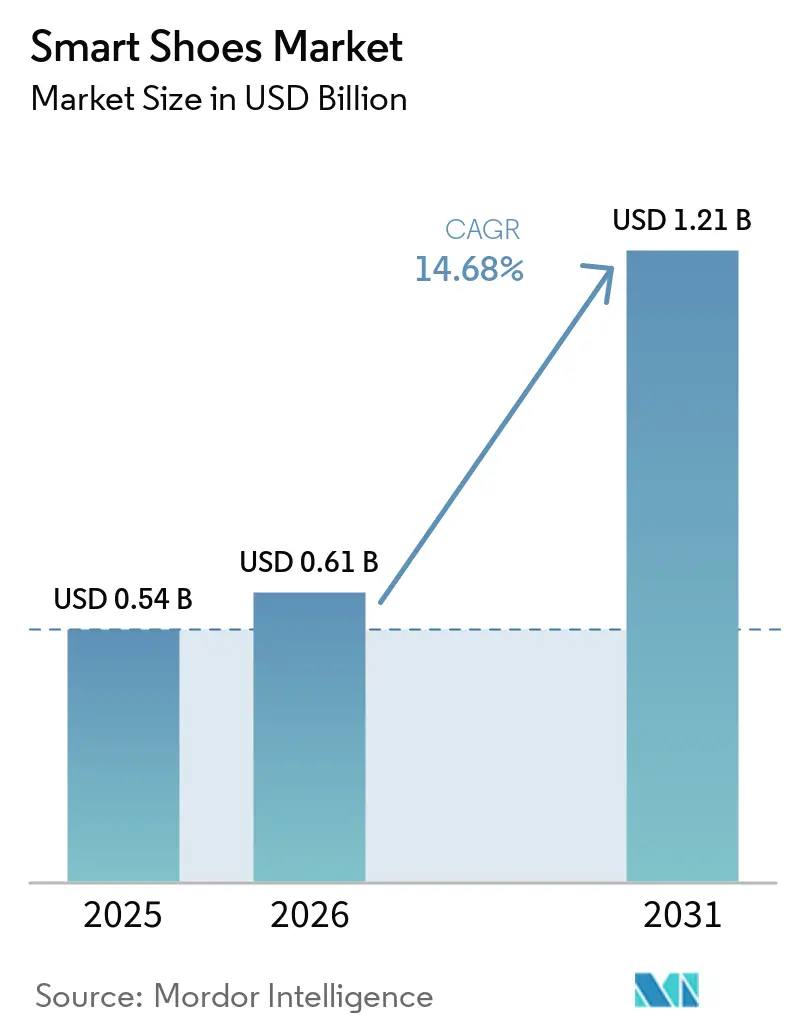
| Market Size (2026) | USD 0.61 Billion |
| Market Size (2031) | USD 1.21 Billion |
| Growth Rate (2026 - 2031) | 14.68 % |
| Fastest Growing Market | Asia-Pacific |
| Largest Market | North America |
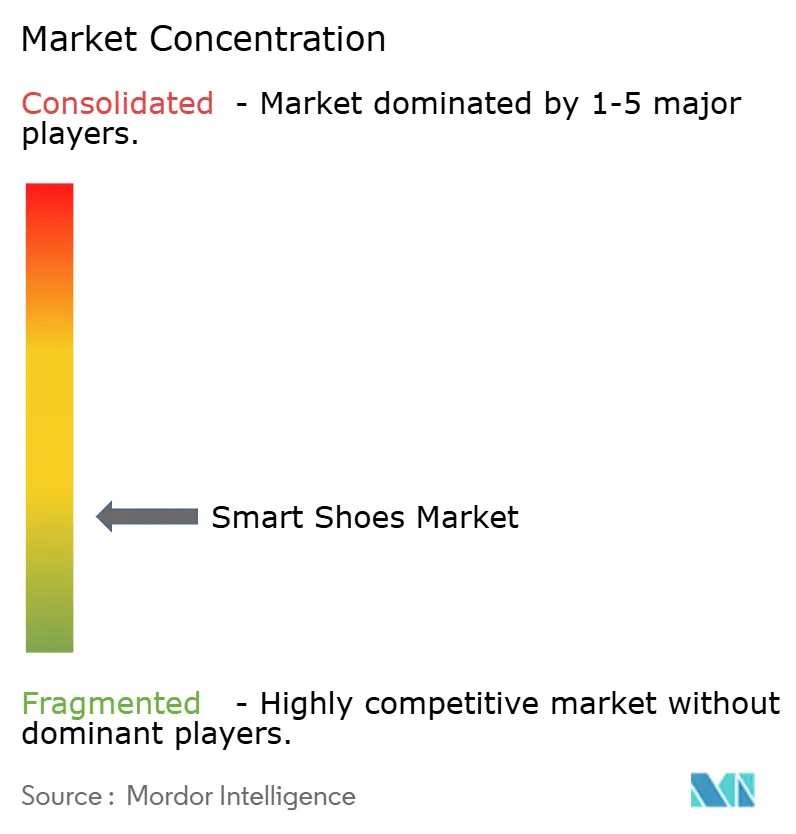
| Market Concentration | Low |
Major Players *Disclaimer: Major Players sorted in no particular order Image © Mordor Intelligence. Reuse requires attribution under CC BY 4.0. | |
Smart Shoes Market Analysis by Mordor Intelligence
The smart shoes market size is expected to grow from USD 0.54 billion in 2025 to USD 0.61 billion in 2026 and is forecast to reach USD 1.21 billion by 2031 at 14.68% CAGR over 2026-2031. The market is gaining momentum as consumers increasingly seek connected footwear solutions that combine comfort, performance tracking, and health monitoring capabilities. Advances in sensor technology, artificial intelligence, Bluetooth connectivity, and wearable electronics are enabling manufacturers to introduce innovative smart footwear for sports, fitness, healthcare, and lifestyle applications. Growing awareness of personal health, rising adoption of fitness-tracking devices, and increasing demand for real-time activity monitoring are further supporting market expansion. Additionally, the integration of smart features such as gait analysis, posture correction, navigation assistance, and pressure sensing is enhancing the value proposition of smart shoes across diverse user groups. As technology continues to evolve and product accessibility improves, the market is expected to witness sustained growth worldwide.
Key Report Takeaways
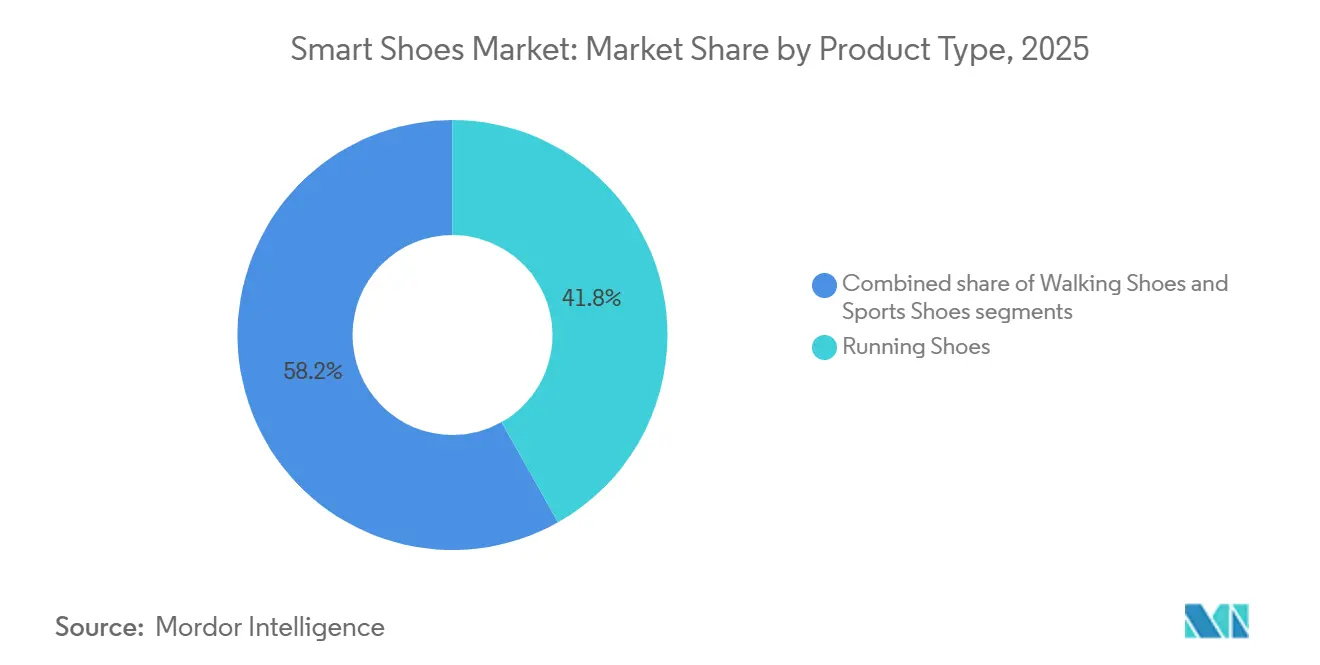
- By product type, running shoes held 41.83% share of the smart shoes market size in 2025, and this segment is projected to grow at 15.54% CAGR through 2031.
- By end user, men held 55.47% of the smart shoes market share in 2025, while women recorded the highest projected CAGR at 15.63% through 2031.
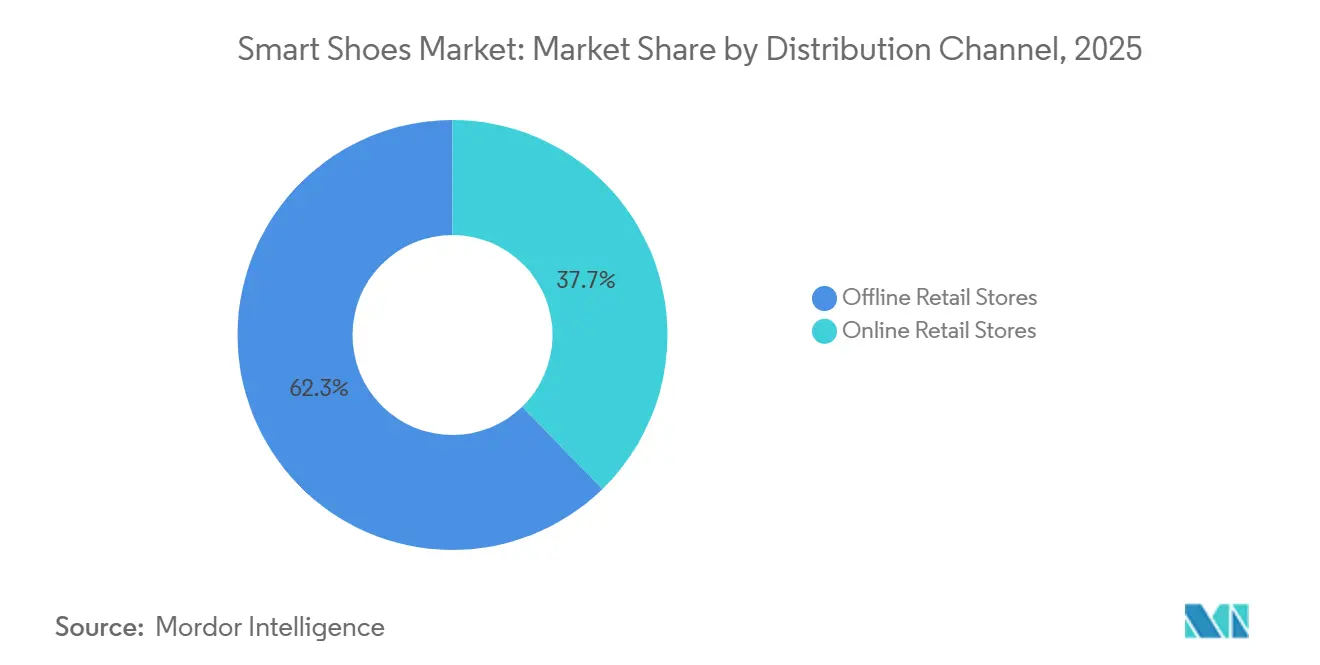
- By distribution channel, offline retail stores held 62.29% share in 2025, while online retail stores are forecast to expand at 16.76% CAGR through 2031.
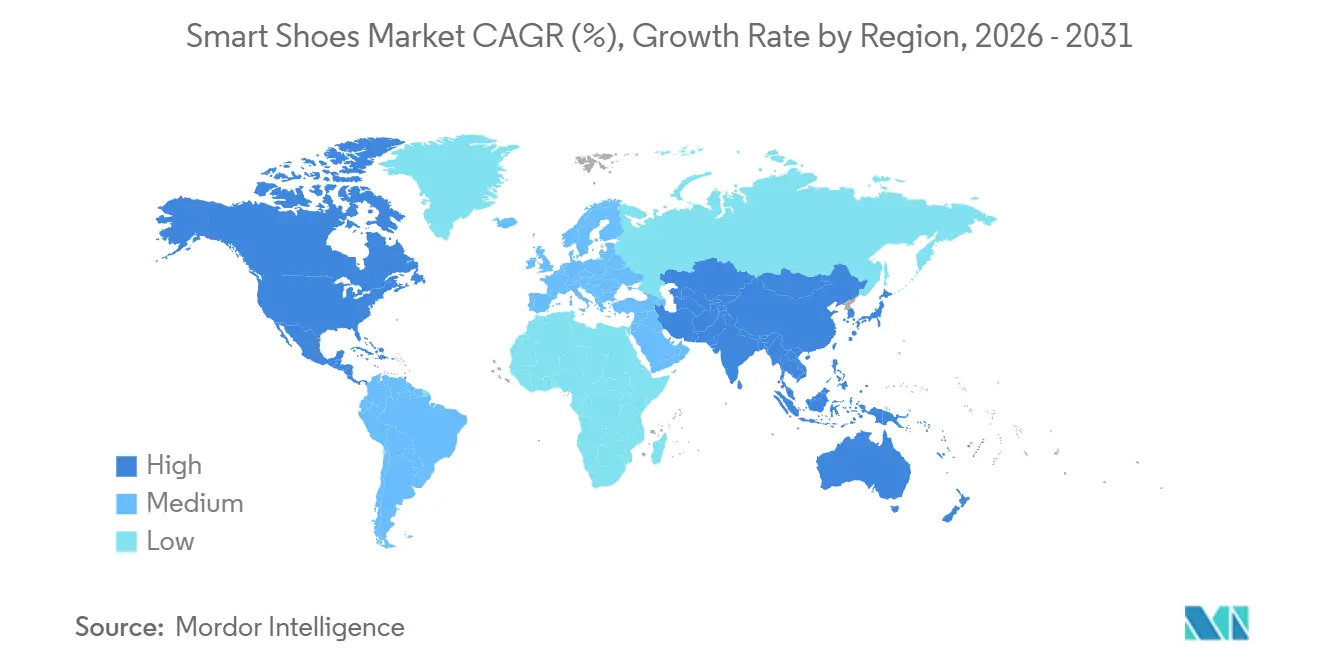
- By geography, North America accounted for 35.27% share in 2025, while Asia-Pacific is projected to advance at 16.14% CAGR through 2031.
Note: Market size and forecast figures in this report are generated using Mordor Intelligence’s proprietary estimation framework, updated with the latest available data and insights as of January 2026.
Market Trends and Insights
Drivers Impact Analysis of Smart Shoes Market*
| Driver | (~) % Impact on CAGR Forecast | Geographic Relevance | Impact Timeline |
|---|---|---|---|
| Growing adoption of wearable fitness and health-tracking technologies | +3.2% | Global | Short term (≤ 2 years) |
| Increasing consumer focus on health, wellness, and activity monitoring | +2.8% | Global | Medium term (2-4 years) |
| Advancements in sensor, Bluetooth, and embedded electronics technologies | +2.5% | Global, with early gains in China, United States, and Germany | Short term (≤ 2 years) |
| Growing popularity of smart sports and athletic performance tracking | +2.0% | North America and Europe | Medium term (2-4 years) |
| Growing consumer interest in personalized and data-driven fitness solutions | +1.8% | North America and Asia-Pacific | Medium term (2-4 years) |
| Increasing investments and product innovations by footwear technology companies | +1.5% | Global | Long term (≥ 4 years) |
| Source: Mordor Intelligence | |||
Growing adoption of wearable fitness and health-tracking technologies
The growing adoption of wearable fitness and health-tracking technologies is significantly supporting the expansion of the smart shoes market. Wearable devices have evolved from niche gadgets into essential tools for monitoring daily health, fitness, and physical activity, increasing consumer acceptance of connected products. While smartwatches, fitness bands, and rings effectively track heart rate and overall activity levels, they cannot capture detailed foot-specific metrics such as plantar pressure distribution, stride mechanics, gait patterns, and ground reaction forces. Smart shoes address this gap by providing real-time biomechanical insights directly from the point of foot contact, enabling more accurate performance analysis and injury prevention. The increasing focus on personalized fitness monitoring is encouraging manufacturers to integrate advanced sensors, connectivity features, and data analytics capabilities into footwear. Furthermore, regulatory frameworks such as the GDPR and the EU AI Act are prompting companies to strengthen consent management, data privacy, and biometric data handling systems within smart footwear platforms[1]. As compliance and transparency become integral to product development, consumer confidence in connected footwear solutions continues to grow, supporting wider adoption across fitness, sports, and healthcare applications.
Increasing consumer focus on health, wellness, and activity monitoring
The increasing consumer focus on health, wellness, and activity monitoring is contributing significantly to the growth of the smart shoes market. Consumers are becoming more proactive about tracking physical activity, mobility, posture, and overall health, creating strong demand for connected footwear capable of delivering real-time performance and wellness insights. Smart shoes equipped with sensors can monitor metrics such as walking patterns, gait analysis, step count, balance, and pressure distribution, helping users improve fitness outcomes and detect potential health issues early. The healthcare segment is also creating substantial opportunities for adoption. According to a 2024 survey conducted by the National Institutes of Health (NIH), approximately 422 million people worldwide were living with diabetes, with a 15%–25% lifetime risk of developing diabetic foot ulcers[2]. This large at-risk population is showing an increasing interest in smart footwear solutions that can monitor foot health, detect abnormal pressure points, and support preventive care. As awareness of preventive healthcare and digital health monitoring continues to rise, smart shoes are gaining traction across both fitness and medical applications.
Advancements in sensor, Bluetooth, and embedded electronics technologies
Advancements in sensor, Bluetooth, and embedded electronics technologies are playing a crucial role in the expansion of the smart shoes market. Continuous improvements in miniaturized sensors, low-power microprocessors, and wireless communication modules have enabled manufacturers to integrate sophisticated tracking capabilities into footwear without compromising comfort or design. Modern smart shoes can accurately monitor metrics such as step count, gait patterns, stride length, foot pressure distribution, and calorie expenditure in real time. Enhanced Bluetooth connectivity allows seamless synchronization with smartphones, fitness applications, and cloud-based health platforms, improving the overall user experience. At the same time, advancements in embedded electronics have increased battery efficiency, processing power, and data accuracy while reducing device size and weight.
Growing popularity of smart sports and athletic performance tracking
The growing popularity of smart sports and athletic performance tracking is creating strong growth opportunities for the smart shoes market. Athletes, fitness enthusiasts, and sports professionals are increasingly seeking advanced technologies that provide detailed insights into movement efficiency, running performance, and training effectiveness. Smart shoes equipped with embedded sensors can track metrics such as stride length, cadence, foot strike patterns, speed, distance, and balance in real time, enabling users to optimize performance and reduce injury risks. Unlike conventional wearables, smart footwear captures data directly from the point of contact with the ground, offering more precise biomechanical analysis. The increasing adoption of data-driven training programs in professional and amateur sports is further accelerating demand for intelligent footwear solutions. Integration with mobile applications and sports analytics platforms allows users to monitor progress and receive personalized recommendations.
Restraints Impact Analysis of Smart Shoes Market*
| Restraint | (~) % Impact on CAGR Forecast | Geographic Relevance | Impact Timeline |
|---|---|---|---|
| High cost of smart shoes compared to conventional footwear | -3.5% | Global, acute in South America, Middle East and Africa, and developing Asia-Pacific | Short term (≤ 2 years) |
| Limited battery life and charging requirements | -2.8% | Global | Medium term (2-4 years) |
| Durability challenges of embedded electronic components | -2.0% | Global | Medium term (2-4 years) |
| Limited consumer awareness in developing markets | -1.5% | South America, Middle East and Africa, and Rest of Asia-Pacific | Long term (≥ 4 years) |
| Source: Mordor Intelligence | |||
High cost of smart shoes compared to conventional footwear
The high cost of smart shoes compared to conventional footwear remains a significant challenge for market growth. Smart shoes incorporate advanced components such as sensors, microprocessors, Bluetooth modules, batteries, and embedded software, which substantially increase manufacturing and development costs. As a result, these products are often priced considerably higher than traditional athletic or casual footwear, limiting their affordability for a large segment of consumers. Price-sensitive customers, particularly in developing economies, may perceive smart shoes as non-essential or luxury products rather than everyday footwear. In addition, concerns about battery life, maintenance requirements, and potential technology obsolescence can further discourage purchasing decisions. The premium pricing also creates challenges for widespread adoption among casual users who may not require advanced tracking features.
Limited battery life and charging requirements
Limited battery life and charging requirements remain key challenges for the smart shoes market. Smart footwear relies on embedded sensors, wireless connectivity modules, and data-processing components that require a continuous power supply to function effectively. Frequent charging can reduce user convenience, particularly for consumers who expect footwear to operate without additional maintenance. Battery performance often varies significantly depending on the features and sensing intensity of the product. According to a 2024 survey conducted by the National Institutes of Health (NIH), commercial smart footwear autonomy ranges from less than one hour in continuous pressure-sensing applications to more than 100 hours in basic step-counting modes[3]. This wide variation in battery life makes it difficult for manufacturers to establish clear consumer expectations and creates challenges in educating users about product capabilities.
*Our forecasts treat driver/restraint impacts as directional, not additive. The impact forecasts reflect baseline growth, mix effects, and variable interactions.
Smart Shoes Market Segment Analysis
By Product Type:
Running Consolidates Both Share and Growth LeadershipRunning shoes accounted for the largest share of the smart shoes market, representing 41.83% of total revenue in 2025. The segment's leadership is driven by the strong adoption of smart footwear among runners, fitness enthusiasts, and professional athletes seeking real-time performance insights. Smart running shoes are increasingly equipped with advanced sensors that track metrics such as distance covered, pace, cadence, stride length, foot pressure, and calorie expenditure. The growing popularity of running as a fitness activity, coupled with rising participation in marathons and recreational races, continues to support demand for connected running footwear. This segment is also projected to grow at a 15.54% CAGR from 2026 to 2031.
Smart walking shoes are gaining popularity among individuals seeking daily activity monitoring, posture correction, and health-tracking capabilities during routine movements. The increasing focus on preventive healthcare and active lifestyles is encouraging consumers to adopt connected walking footwear that provides real-time feedback and wellness insights. At the same time, smart sports shoes are witnessing strong demand from athletes and sports participants who require advanced performance tracking and movement analysis across various sporting activities.

By End User:
Male Dominance Narrows as Women Lead GrowthMen represented the largest end-user segment in the smart shoes market, accounting for 55.47% of total revenue in 2025. The segment’s dominance is primarily driven by higher participation rates in sports, fitness activities, running, and outdoor recreation, where performance-tracking footwear is increasingly valued. Male consumers have shown strong interest in wearable technologies that provide real-time data on movement, training efficiency, and physical activity. In addition, the availability of a wide range of smart athletic and performance-oriented footwear products has supported adoption within this consumer group. Leading brands continue to target male users with advanced features such as gait analysis, fitness monitoring, adaptive fit systems, and integrated mobile connectivity.
Women are projected to be the fastest-growing end-user segment in the smart shoes market, registering a CAGR of 15.63% through 2031. Rising health awareness, increasing participation in fitness and wellness activities, and growing adoption of wearable technologies are driving demand among female consumers. Smart shoes are gaining popularity among women for applications ranging from fitness tracking and daily activity monitoring to personalized health insights and lifestyle management. Manufacturers are responding by introducing products specifically designed to address women's preferences for comfort, functionality, design, and digital connectivity.
By Distribution Channel:
Physical Retail Leads, but Digital Accelerates FastestOffline retail stores accounted for the largest share of the smart shoes market, contributing 62.29% of total revenue in 2025. The dominance of this channel is largely attributed to consumers’ preference for physically evaluating footwear before purchase, particularly for products that combine advanced technology with comfort and fit requirements. Customers often prefer visiting specialty sports stores, brand outlets, and multi-brand retail locations to assess shoe sizing, functionality, and overall user experience. In-store demonstrations of smart features such as activity tracking, pressure sensing, and mobile connectivity also help increase consumer confidence in purchasing decisions. Furthermore, the strong presence of established footwear retail networks and personalized customer assistance continues to support offline sales.
Online retail stores are projected to be the fastest-growing distribution channel in the smart shoes market, expanding at a CAGR of 16.76% through 2031. The rapid growth of e-commerce platforms, increasing internet penetration, and rising consumer preference for convenient shopping experiences are driving demand through online channels. Consumers are increasingly attracted to the wide product selection, competitive pricing, product comparisons, and customer reviews available on digital platforms. Manufacturers are also strengthening their direct-to-consumer online strategies to improve brand engagement and reach broader customer bases.
Geography Analysis
North America Smart Shoes Market
North America accounted for 35.27% of the global smart shoes market revenue in 2025, making it the largest regional market. The region benefits from high consumer adoption of wearable technologies, strong purchasing power, and widespread awareness of fitness and health monitoring solutions. The presence of major athletic footwear companies, technology innovators, and well-established retail networks further supports market leadership. Consumers in the United States and Canada are increasingly seeking connected footwear that offers performance tracking, activity monitoring, and personalized insights. Growing participation in sports, fitness activities, and outdoor recreation continues to drive demand for technologically advanced footwear products.
APAC Smart Shoes Market
Asia-Pacific is projected to register the fastest growth in the smart shoes market, expanding at a CAGR of 16.14% through 2031. Rising disposable incomes, increasing urbanization, and growing health consciousness are encouraging consumers to adopt wearable and connected fitness products. Countries such as China, Japan, South Korea, and India are emerging as key growth markets due to their large consumer bases and expanding technology ecosystems. The region is also benefiting from the presence of major electronics manufacturers and footwear production hubs, which facilitate product innovation and cost-effective manufacturing. Increasing smartphone penetration and digital connectivity are making smart footwear more accessible to a wider population.
EMEA and South America Smart Shoes Market
Europe, South America, and the Middle East and Africa collectively represent important growth opportunities for the smart shoes market. In Europe, strong interest in fitness, sports technology, and sustainable innovation is supporting the adoption of connected footwear solutions. Consumers across countries such as Germany, the United Kingdom, and France are increasingly embracing smart wearable products that enhance health and performance monitoring. South America is witnessing gradual market development, supported by growing sports participation, expanding e-commerce channels, and rising awareness of fitness technologies. Meanwhile, the Middle East and Africa region is benefiting from increasing investments in digital transformation, sports infrastructure, and health-focused consumer products.
Competitive Landscape
The smart shoes market remains largely fragmented, with large athletic brands setting the pace while specialists and regional players keep the field open across narrow use cases. Nike benefits from vertical control across footwear design, embedded functionality, and app-linked user data, which strengthens retention when buyers stay inside the brand’s digital ecosystem. The company’s patent activity around footwear that can adjust fit through processor commands and stored user profiles shows that competition is moving beyond passive tracking and toward active personalization.
Adidas is leveraging its strong research and development capabilities and manufacturing expertise to develop technologically advanced footwear solutions that enhance comfort, performance, and connectivity. Meanwhile, Under Armour continues to strengthen its market position through athlete-backed product validation and a focus on performance-oriented smart footwear. These strategies are keeping competition centered on innovation, user engagement, and data-driven functionality rather than solely on pricing.
Competition in the smart shoes market is increasingly influenced by advancements in sensor integration, artificial intelligence, and mobile application ecosystems. Leading companies are investing in connected platforms that allow users to track fitness metrics, analyze movement patterns, and receive personalized recommendations through companion applications. The ability to provide seamless synchronization between footwear and digital devices has become a key differentiator among manufacturers. Established brands benefit from extensive distribution networks, strong brand recognition, and loyal customer bases, enabling them to commercialize new technologies more effectively.
Smart Shoes Industry Leaders
-
Nike, Inc.
-
Adidas AG
-
Under Armour, Inc.
-
PUMA SE
-
ASICS Corporation
- *Disclaimer: Major Players sorted in no particular order
Smart Shoes Market Companies Covered in this Report
- Nike, Inc.
- Adidas AG
- Under Armour, Inc.
- PUMA SE
- Xiaomi Corporation
- ASICS Corporation
- Li-Ning Company Limited
- Anta Sports Products Limited
- Lenovo Group Limited
- Digitsole
- Sensoria Inc.
- Salted Venture Inc.
- Vivobarefoot Ltd.
- FeetMe
- SolePower LLC
- Boltt Sports Technologies Private Limited
- Zhor-Tech
- E-vone
- ReTiSense Inc.
- Powerlace Technology, Inc.
Recent Industry Developments in Smart Shoes Market
- June 2026: ASICS, in collaboration with HumanFab, established the ASICS Institute of Sport Science Europe (ISS Europe) in Aix-en-Provence, France. This new R&D hub developed next-gen performance footwear and tested a smart tennis shoe prototype, underscoring ASICS' dedication to data-centric athletic footwear in Europe.
- February 2026: Under Armour launched the UA ROGUE 6, which featured CHARGED+ smart cushioning technology through ABC-Mart. This innovative midsole adapts in real-time to the wearer's weight, speed, and impact, marking a pivotal shift from traditional static cushioning to a dynamic response in athletic footwear.
- October 2025: Nike, in partnership with robotics firm Dephy, unveiled Project Amplify, touted as the globe's inaugural powered footwear system tailored for running and walking. This innovation integrated a lightweight motor, drive belt, and rechargeable battery with a carbon fiber-plated running shoe, optimizing natural movements of the lower leg and ankle. With algorithms honed at the Nike Sport Research Lab, the system empowered everyday athletes to walk or run longer and faster, all with diminished effort.
Global Smart Shoes Market Report Scope
Smart shoes are technologically advanced footwear embedded with electronic components such as sensors, microprocessors, Bluetooth modules, and connectivity features that enable the collection, analysis, and transmission of user activity and biometric data. The smart shoes market is segmented by product type, end user, distribution channel and geography. By product type, the market is segmented into walking shoes, running shoes and sports shoes. Based on end user, the market is segmented into men, women and children. Based on distribution channel, the market is segmented into offline and online retail stores. By geography, the market is segmented into North America, Europe, Asia-Pacific, South America, and Middle-East and Africa. For each segment, the market sizing and forecasting have been done in value terms (USD million).
Segmentation Overview
| Waking Shoes |
| Running Shoes |
| Sports Shoes |
| Men |
| Women |
| Children |
| Offline Retail Stores |
| Online Retail Stores |
| North America | United States |
| Canada | |
| Mexico | |
| Rest of North America | |
| Europe | United Kingdom |
| Germany | |
| Spain | |
| France | |
| Italy | |
| Sweden | |
| Ireland | |
| Austria | |
| Rest of Europe | |
| Asia-Pacific | China |
| Japan | |
| India | |
| South Korea | |
| New Zealand | |
| Australia | |
| Rest of Asia-Pacific | |
| South America | Brazil |
| Argentina | |
| Rest of South America | |
| Middle East and Africa | United Arab Emirates |
| Saudi Arabia | |
| South Africa | |
| Rest of Middle East and Africa |
| By Product Type | Waking Shoes | |
| Running Shoes | ||
| Sports Shoes | ||
| By End User | Men | |
| Women | ||
| Children | ||
| By Distribution Channel | Offline Retail Stores | |
| Online Retail Stores | ||
| By Geography | North America | United States |
| Canada | ||
| Mexico | ||
| Rest of North America | ||
| Europe | United Kingdom | |
| Germany | ||
| Spain | ||
| France | ||
| Italy | ||
| Sweden | ||
| Ireland | ||
| Austria | ||
| Rest of Europe | ||
| Asia-Pacific | China | |
| Japan | ||
| India | ||
| South Korea | ||
| New Zealand | ||
| Australia | ||
| Rest of Asia-Pacific | ||
| South America | Brazil | |
| Argentina | ||
| Rest of South America | ||
| Middle East and Africa | United Arab Emirates | |
| Saudi Arabia | ||
| South Africa | ||
| Rest of Middle East and Africa | ||
Key Questions Answered in the Report
What is the 2026 value of smart shoes worldwide?
The smart shoes market is valued at USD 0.61 billion in 2026 and is forecast to reach USD 1.21 billion by 2031 at a 14.68% CAGR.
Which product type leads connected footwear demand?
Running shoes lead both scale and growth, holding 41.83% of 2025 revenue and expanding at 15.54% CAGR through 2031.
Why does North America lead while Asia-Pacific grows faster?
North America led with 35.27% share in 2025 because of strong brand presence and faster launches, while Asia-Pacific is growing fastest at 16.14% CAGR because of manufacturing scale, rising incomes, and broader fitness adoption.
What is slowing wider adoption of connected footwear?
The main barriers are high prices versus conventional shoes and uneven battery life, especially when consumers must add footwear to their regular charging routine.
Which sales channel is gaining ground fastest?
Online retail is the fastest-growing channel with a projected 16.76% CAGR through 2031 as direct-to-consumer tools improve trust and convenience.