
Smart City Data Exchange Platforms Market Size and Share
Market Overview
| Study Period | 2020 - 2031 |
|---|---|
| Market Size (2026) | USD 3.68 Billion |
| Market Size (2031) | USD 7.81 Billion |
| Growth Rate (2026 - 2031) | 16.24 % |
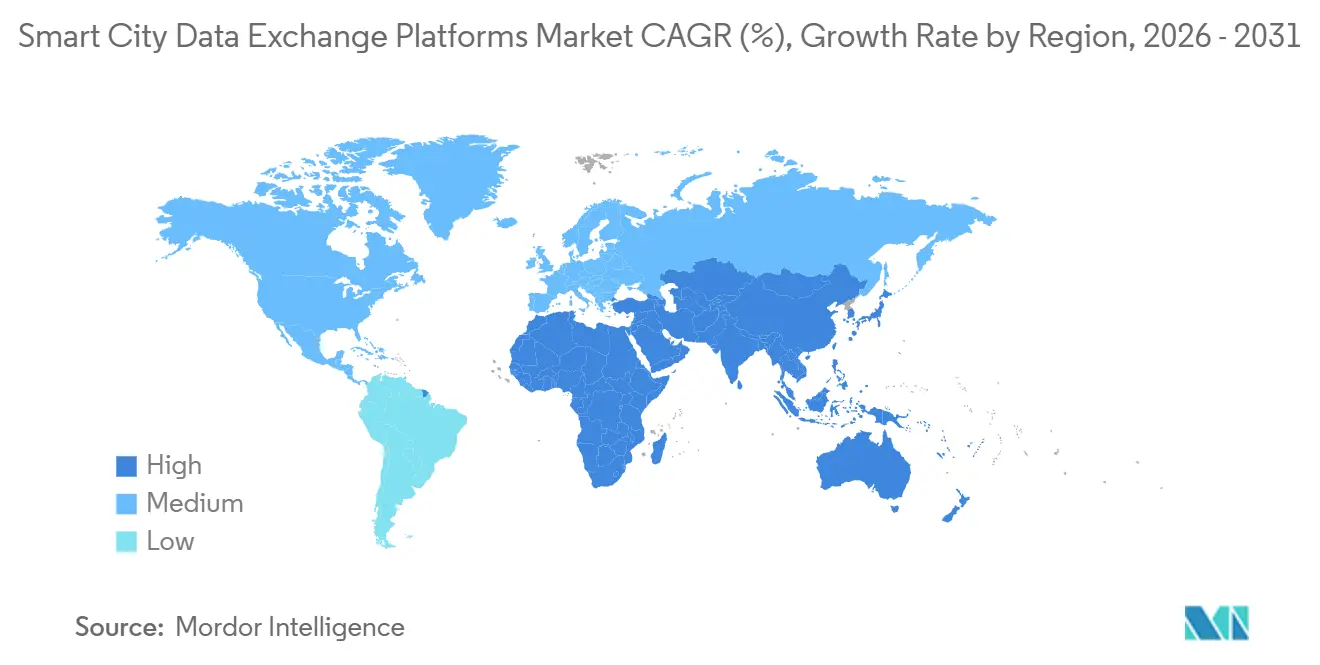
| Fastest Growing Market | Middle East |
| Largest Market | Asia-Pacific |
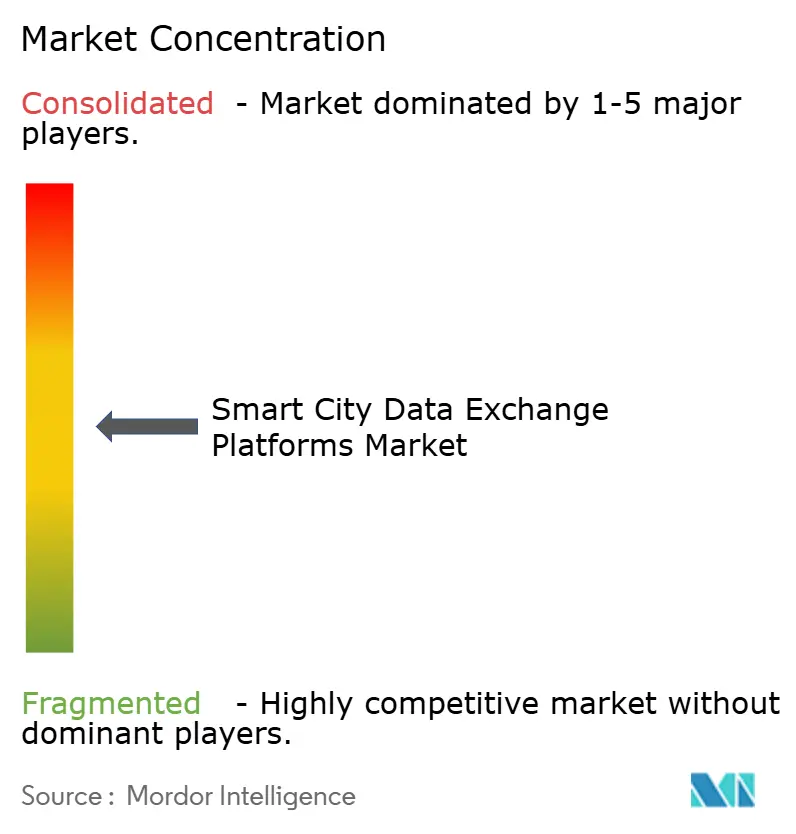
| Market Concentration | Medium |
Major Players *Disclaimer: Major Players sorted in no particular order Image © Mordor Intelligence. Reuse requires attribution under CC BY 4.0. | |
Smart City Data Exchange Platforms Market Analysis by Mordor Intelligence
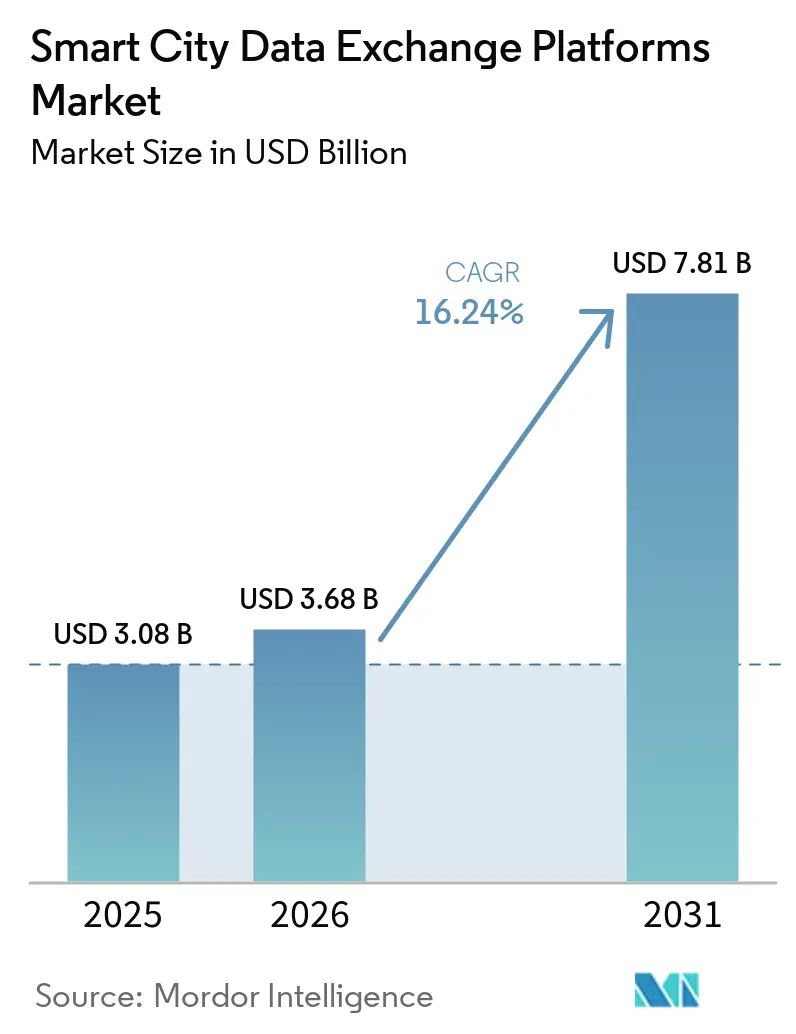
The Smart City Data Exchange Platforms Market size is projected to be USD 3.08 billion in 2025, USD 3.68 billion in 2026, and reach USD 7.81 billion by 2031, growing at a CAGR of 16.24% from 2026 to 2031. Municipal agencies are replacing isolated departmental systems with connected environments that support real-time operations and controlled data sharing. ISO 37187:2026 gives procurement teams a common reference for city information modeling platforms across transport, energy, buildings, and public administration. This common baseline can reduce technical uncertainty in tenders and favor suppliers that meet interoperability and data governance requirements. National data rules are also affecting deployment choices, particularly where sensitive city data must remain under local control. The Smart City Data Exchange Platforms Market, therefore, combines demand for software with demand for implementation, governance, and long-term operational support.
Key Report Takeaways
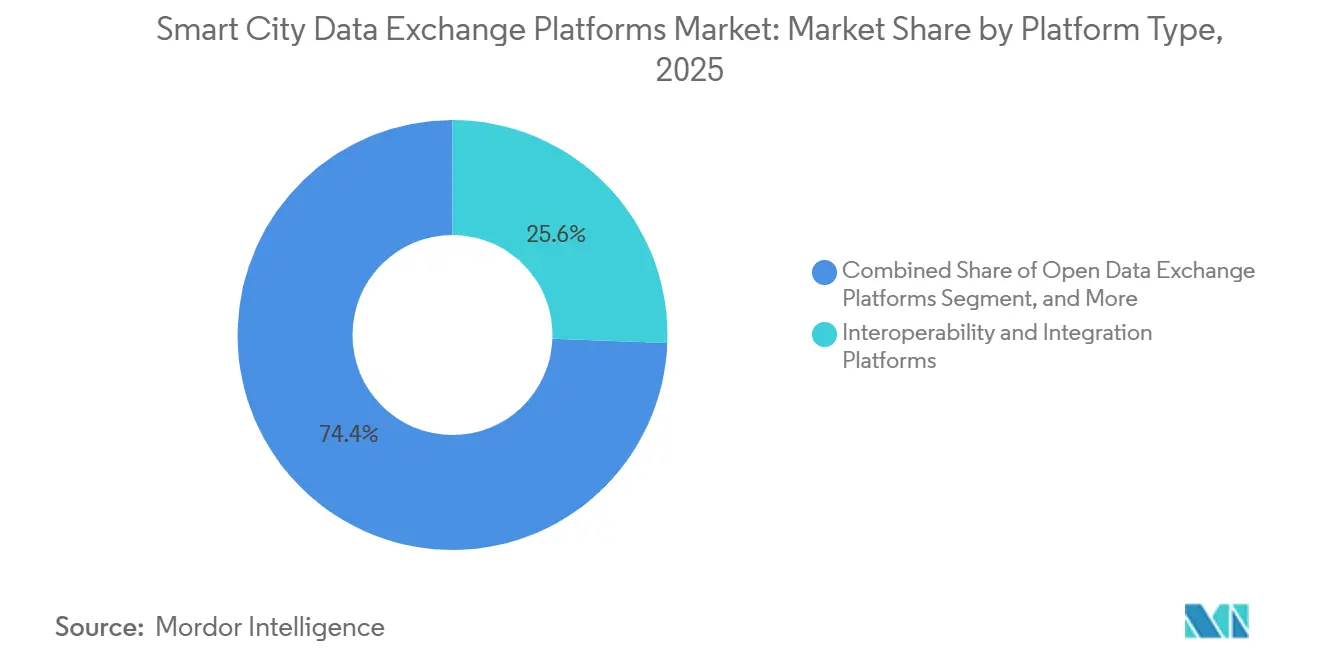
- By platform type, Interoperability and Integration Platforms held 25.59% of smart city data exchange platforms market share in 2025, while Digital Twin-Enabled Data Exchange Platforms are projected to expand at an 18.71% CAGR through 2031.
- By deployment model, cloud accounted for 46.72% of the smart city data exchange platforms market size in 2025 and is projected to expand at a 19.22% CAGR through 2031.
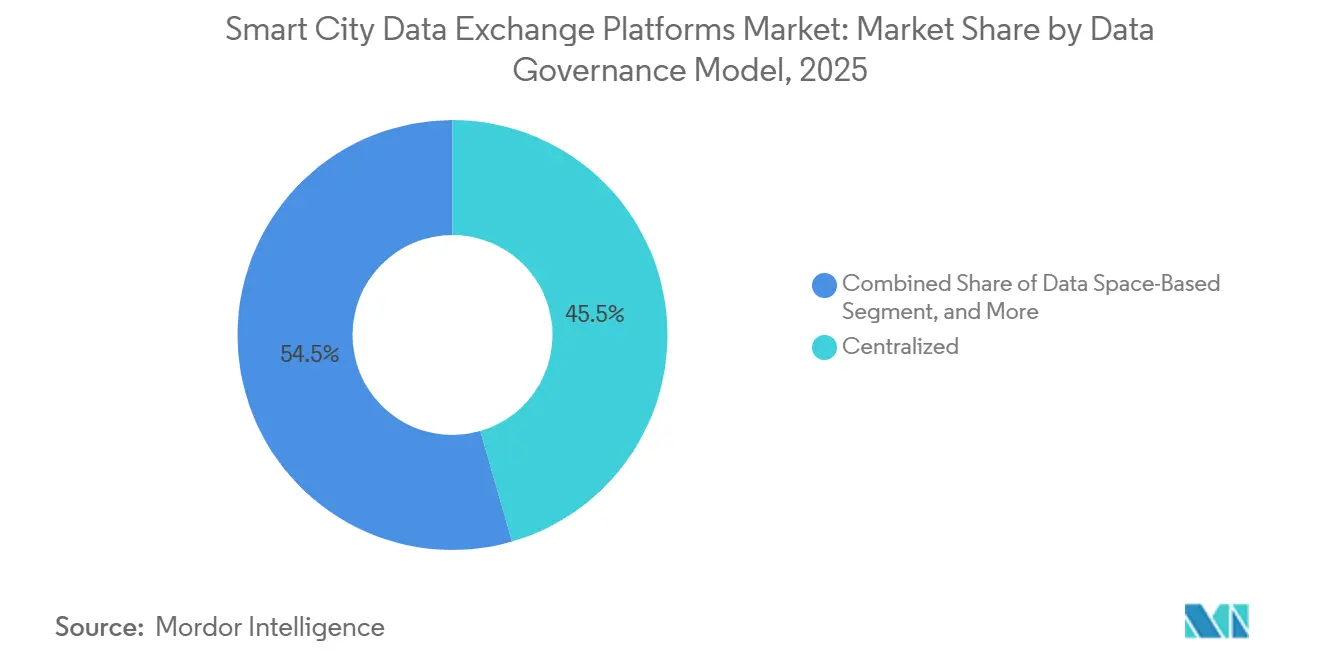
- By data governance model, centralized governance held 45.54% share in 2025, while Data Space-Based governance is projected to expand at an 18.31% CAGR through 2031.
- By end user, municipal governments held 40.27% share in 2025, while Urban Developers and System Integrators are projected to expand at a 17.34% CAGR through 2031 in the smart city data exchange platforms market.
- By geography, Asia-Pacific held 33.29% share in 2025, while the Middle East is projected to expand at a 19.11% CAGR through 2031 in the smart city data exchange platforms market.
Note: Market size and forecast figures in this report are generated using Mordor Intelligence’s proprietary estimation framework, updated with the latest available data and insights as of January 2026.
Market Trends and Insights
Drivers Impact Analysis of Smart City Data Exchange Platforms Market*
| DRIVER | (~) % IMPACT ON CAGR FORECAST | GEOGRAPHIC RELEVANCE | IMPACT TIMELINE |
|---|---|---|---|
| Rising Interoperability Demand Across Municipal Data Silos | +3.8% | Global, concentrated in Europe, North America, and East Asia | Medium term (2-4 years) |
| Expansion of Cross-Sector City Data Sharing Programs | +2.9% | Global, high in Asia-Pacific and Europe, with spillover to the Middle East and Africa | Medium term (2-4 years) |
| Increasing Open API and Open Standards Adoption | +2.4% | Europe, North America, and the Asia-Pacific | Short term (≤ 2 years) |
| Scaling Real-Time Urban Operations and Command Centers | +2.1% | Middle East, South and Southeast Asia, and North America | Short term (≤ 2 years) |
| Privacy-First Data Collaboration Models Gaining Traction | +1.6% | Europe, Canada, Japan, and South Korea | Long term (≥ 4 years) |
| Growing Demand for Federated Data Spaces and Sovereign Data Exchange | +1.4% | Europe, the Middle East, and India, with spillover to Africa | Long term (≥ 4 years) |
| Source: Mordor Intelligence | |||
Rising Interoperability Demand Across Municipal Data Silos
Municipal agencies in transport, utilities, public safety, and planning still use systems that cannot readily exchange data. This fragmentation creates a direct need for platforms that establish shared data formats, access rules, and operating processes. A 2026 European study on the DS4SSCC initiative identified modular architecture, common governance, semantic alignment, procurement clauses, and capacity building as core conditions for interoperability by design. ETSI updated the NGSI-LD API specification in July 2025 to support distributed environments and digital twin integration.[1]European Telecommunications Standards Institute, “GS CIM 009 V1.9.1 Context Information Management NGSI-LD API,” European Telecommunications Standards Institute, etsi.org. The smart city data exchange platforms market benefits because a city adopting a standards-based exchange layer also needs governance design, semantic alignment, and continuing operational support. These needs can extend supplier relationships beyond the initial platform deployment.
Expansion of Cross-Sector City Data Sharing Programs
Data sharing among public agencies, utilities, and mobility operators is moving beyond limited pilots into larger operating programs. India’s Intelligent Universal Data Exchange, or IUDX, was deployed in 55 smart cities by April 2026 and supported real-time data flows for mobility, utilities, environmental monitoring, and public services. The platform uses a governed design intended to preserve ownership and privacy through confidential computing and secure enclaves. In April 2026, ONESTRUCTION and DataKaveri signed an agreement to integrate IFC-compliant openBIM construction data with IUDX for urban planning and digital twin work.[2]Centre of Data for Public Good, “Strategic India-Japan Partnership to Accelerate AI-Readiness and Construction Urban Data Exchange for Smart Cities,” Centre of Data for Public Good, dataforpublicgood.org.in. Representatives from Japanese and Indian ministries attended the signing, showing public support for the collaboration. The smart city data exchange platforms market can benefit when city platforms connect to broader cross-border public data programs.
Increasing Open API and Open Standards Adoption
Open APIs and recognized standards can reduce integration effort and lower switching barriers for cities evaluating vendors. The Data Space Business Alliance recommends NGSI-LD as a data exchange API for European data spaces, and the FIWARE Data Space Connector aligns with this recommendation.[3]European Telecommunications Standards Institute ISG CIM, “ETSI AI Conference 2025 NGSI-LD as Data Exchange API for Data Spaces,” European Telecommunications Standards Institute, etsi.org. The European Commission issued a standardization request for trusted data transactions in July 2025, paving the way for common certification requirements.[4]Dawex, “Technology and Innovation Standardization,” Dawex, dawex.com. These developments make proprietary integration complexity less valuable as a supplier advantage. They shift competition toward governance tools, analytics, managed data-space services, and dependable implementation. The smart city data exchange platforms market may therefore offer more room for specialists who provide policy controls, lineage, and operational support around open connectors.
Scaling Real-Time Urban Operations and Command Centers
Cities are investing in connected operations environments to manage dense events, weather risks, traffic, and public services. In May 2026, Arcadis and the City of Atlanta opened an upgraded Integrated Command Center linking ATLDOT, GDOT, MARTA, and other city operations teams. The center supports shared situational awareness for traffic management, incident response, and event coordination. Singapore’s SMRT opened an AI-powered Mobility Command and Control Center in August 2026 that combined fleet, vehicle, battery, and road-alert data. Such deployments create a shared real-time layer that can support later additions such as predictive maintenance and digital twins. This makes command centers an important entry point to the smart city data exchange platforms market for platform providers and integrators.
Restraints Impact Analysis of Smart City Data Exchange Platforms Market*
| RESTRAINT | (~) % IMPACT ON CAGR FORECAST | GEOGRAPHIC RELEVANCE | IMPACT TIMELINE |
|---|---|---|---|
| Fragmented Municipal Procurement and Long Sales Cycles | -1.8% | Global, most acute in North America, Western Europe, and South America | Medium term (2-4 years) |
| Legacy IT and OT Integration Complexity | -1.5% | Global, concentrated in older city infrastructure in Europe and the Asia-Pacific | Long term (≥ 4 years) |
| Limited Data Governance Maturity in Smaller Cities | -1.0% | Africa, South America, and South and Southeast Asia | Long term (≥ 4 years) |
| Cybersecurity and Liability Concerns in Multi-Stakeholder Data Sharing | -0.8% | Global, elevated in cross-border deployments and critical infrastructure | Medium term (2-4 years) |
| Source: Mordor Intelligence | |||
Fragmented Municipal Procurement and Long Sales Cycles
Municipal procurement remains a significant barrier even when a city has the technical case for a data exchange platform. Annual budgets are commonly held by separate departments, making it difficult to structure integrated multiyear contracts. Cross-agency programs also require executive backing and formal agreements on roles, spending, and access rights. The issue becomes more complex when cities move from centralized management to federated governance. Vendors may need to negotiate separate liability and indemnity terms for each participating organization. These lengthy negotiations consume pre-sale technical resources and delay revenue from the smart city data exchange platforms market.
Legacy IT and OT Integration Complexity
Legacy operational technology can make deployment costly and slow, especially in water, power, transport, and building systems. SCADA installations, telecommunications networks, and proprietary sensor systems often use real-time protocols that predate modern APIs. Connecting them requires specialized middleware, integration engineering, and careful testing to avoid disruption to essential services. The challenge is larger than a conventional information technology upgrade because public infrastructure cannot be taken offline casually. Older city estates can therefore direct a substantial share of project budgets toward services rather than software licenses. This limits the addressable software revenue within the smart city data exchange platforms market, where legacy infrastructure is extensive.
*Our forecasts treat driver/restraint impacts as directional, not additive. The impact forecasts reflect baseline growth, mix effects, and variable interactions.
Smart City Data Exchange Platforms Market Segment Analysis
By Platform Type:
Integration Layers Hold the Largest Share While Digital Twins Draw InvestmentInteroperability and Integration Platforms accounted for 25.59% of the smart city data exchange platforms market share in 2025. The segment addresses the fundamental need to connect traffic management, utility SCADA, emergency dispatch, and building systems through a shared semantic and governance framework. European procurement requirements increasingly reference interoperability principles and the NGSI-LD API. These requirements support adoption among cities that need common exchange layers before deploying more advanced applications.
Digital Twin-Enabled Data Exchange Platforms are projected to grow at a CAGR of 18.71% from 2026 to 2031. European public programs and sovereign infrastructure investments in the Middle East support their adoption. The TWINVERSE project includes 26 partners across seven European countries and works with five EU Mission Cities, including Milan and Cork. The project generates demand for exchange infrastructure that enables local digital twins to operate across organizational boundaries. ISO 37187:2026 guides data exchange through City Information Modeling platforms. It covers integration across GIS, BIM, IoT, and business data. This guidance strengthens the case for Digital Twin-Enabled platforms in tenders that reference international standards. The segment also benefits when city developers require simulation tools before constructing or operating assets.



By Deployment Model:
Cloud Leads Adoption While Local Processing Remains ImportantCloud deployment accounted for 46.72% of the smart city data exchange platforms market size in 2025 and is projected to grow at a CAGR of 19.22% from 2026 to 2031. Cloud-native platforms provide cities with flexible capacity, regular security updates, and vendor-managed compliance capabilities. These features are particularly important for smaller municipalities with limited internal technology teams. IBM Consulting introduced its GICA solution in November 2025 using AWS, FIWARE’s Garnet Framework, and NGSI-LD context management. The offering demonstrates how managed services can package smart city standards into a ready-to-use platform. This approach benefits the Smart City Data Exchange Platforms Market by reducing the technical burden of connecting multiple municipal systems. It can also support consistent maintenance across a distributed user base.
On-premise deployment remains relevant in jurisdictions where regulations require the processing of sensitive information within national borders. Local hosting gives public authorities more direct control over security, access, and data location. Hybrid models combine this local control with cloud capacity for analytics and artificial intelligence workloads. This approach allows sensitive operational data to remain local while using centralized resources for less sensitive processing. Sovereign data requirements can influence platform architecture before a city evaluates platform features. They can also increase the value of implementation projects, as suppliers must design and operate both local and cloud components. The smart city data exchange platforms market must support these varied requirements rather than treat cloud adoption as a single replacement path. Platforms that provide clear control over data movement can be better positioned in jurisdictions with stringent public-sector requirements.
By Data Governance Model:
Centralized Systems Lead While Data Spaces AdvanceCentralized governance accounted for 45.54% of the smart city data exchange platforms market share in 2025. It remains the default model for early-stage smart city programs because a single municipal body can manage permissions, access, and data flows. This model provides a direct accountability structure and can simplify initial deployment. However, its limitations become more apparent when utilities, transit operators, and private mobility service providers need to exchange data under different legal obligations.
Data Space-Based governance is projected to grow at a CAGR of 18.31% from 2026 to 2031. Its progress reflects European support for interoperable tools and structured trust frameworks. Gaia-X released Trust Framework 3.0, called Danube, in November 2025, with domain and geographic extensions for federated trust. The framework supports automated compliance checks across different regulatory environments. A 2025 IEEE paper tested an NGSI-LD context broker architecture in a Heraklion pilot, guided by data-space principles. The findings provided operational evidence of federated identity and semantic interoperability at the city scale. The smart city data exchange platforms market may experience increased procurement for this model as public bodies require governed data sharing across institutional boundaries. Data-space tools are especially relevant where manual compliance reviews slow multi-party project operations.
By End User:
Municipal Governments Provide Volume While Developers Add MomentumMunicipal governments accounted for 40.27% of the smart city data exchange platforms market share in 2025. Their purchasing decisions establish technical expectations that nearby agencies and service providers may subsequently adopt. However, city procurement often entails the most demanding compliance reviews, the longest sales cycles, and the most stakeholders. Transport authorities use interoperability and command platforms for traffic management, multimodal coordination, and emergency response. The Atlanta and Singapore projects demonstrate the role of these systems in integrating agency and fleet data. Utilities most commonly participate in energy and water data exchanges, in which sector regulations govern access rules. Public safety agencies require restrictive permissions, detailed audit trails, and extensive liability safeguards. These requirements slow decision-making, but successful deployments can create strong references from suppliers.
Urban Developers and System Integrators are projected to grow at a CAGR of 17.34% from 2026 to 2031. Their role is expanding in master-planned projects across the Gulf, South and Southeast Asia, and parts of Africa. These organizations often develop data infrastructure for government clients that specify data sovereignty and delivery requirements. Their projects can provide an entry route for providers that may not initially sell directly to city governments. They also require platforms that can connect mobility, utilities, building systems, and public services as projects progress. Developers generally have greater flexibility to select specialized architectures during the design phase. However, their platforms must still meet public-sector operational and governance requirements before services can be launched. The Smart City Data Exchange Platforms Market can benefit from this channel as new urban projects transition from construction to long-term operations.
Geography Analysis
APAC Smart City Data Exchange Platforms Market
Asia-Pacific is projected to account for 33.29% of the smart city data exchange platforms market in 2025. The region benefits from national exchange programs that span connected urban networks rather than from isolated city-level pilots. Shenzhen Data Exchange is expected to operate a national-level data trading platform and enter into an agreement with Zetrix AI in May 2026 to support ASEAN-China cross-border data activities. This initiative highlights the scale achievable when public institutions support data exchange infrastructure. India’s IUDX is expected to be deployed across 55 smart cities by April 2026. Its India-Japan agreement is expected to incorporate construction data and urban artificial intelligence workflows. South Korea and Japan also maintain mature smart city programs supported by domestic technology suppliers. Singapore’s planned command center, expected in August 2026, indicates continued regional investment in integrated urban operations.
Europe Smart City Data Exchange Platforms Market
Europe is expected to rank as the second-largest region in the smart city data exchange platforms market. Its regulatory environment increasingly directs public procurement toward interoperable platform architectures. The Interoperable Europe Board is scheduled to adopt the 2026 Interoperable Europe Agenda on February 3, 2026. The agenda identifies priorities, including semantic registries, API standardization, reusable vocabularies, and DCAT-AP solutions. The Interoperable Europe Act also establishes requirements for interoperability assessments in relevant digital public services. GDPR requirements support governance models that manage cross-border data sharing through clear controls. Germany’s municipal Gaia-X initiatives connect cities such as Hamburg, Darmstadt, and Wolfsburg through a cloud-based data platform.
The Americas and MEA Smart City Data Exchange Platforms Market
The Middle East is projected to expand at a CAGR of 19.11% from 2026 to 2031. Large-scale infrastructure programs, sovereign data requirements, and public investment in artificial intelligence capabilities support regional growth. These factors create demand for platforms that connect government services, urban operations, and infrastructure operators under defined data-sharing rules. Local data-hosting requirements may favor hybrid or locally controlled deployments. City-scale developments also require integrated mobility, energy, water, and building data from their earliest stages. North America remains active in command center and interoperability projects, as demonstrated by the Atlanta deployment. South America and Africa remain at earlier stages of development, although established command center models are emerging as regional reference points. Rio de Janeiro’s COR center manages 1,200 urban incidents each month through integrated sensor, camera, and agency data, illustrating an operating model that other cities can evaluate.

Competitive Landscape
The smart city data exchange platforms market is moderately concentrated, particularly in large municipal contracts. Siemens, IBM, Hitachi, and Cisco compete by offering capabilities across sensor connectivity, data ingestion, governance, analytics, and operational visualization. Their established operational technology relationships strengthen their position among municipal buyers. Their international delivery capabilities also support public agencies that require consistent implementation and support across complex programs. Smaller suppliers may struggle to match the compliance certifications of larger competitors within a short timeframe. Consequently, large integrators hold an advantage in tier-1 projects with broad delivery requirements. Municipal governments often value proven execution as highly as platform functionality. Competition becomes more open when projects focus on specific software capabilities rather than end-to-end city programs.
Specialist competition remains more fragmented across data exchanges, data spaces, and digital twin tools. Dawex focuses on data exchange and data space enablement, while FIWARE supports open-standard context management through NGSI-LD-compliant brokers. Bentley Systems and Cityzenith provide digital twin visualization solutions for infrastructure and urban environments. In June 2026, Nemetschek Group is expected to acquire a strategic equity stake in Dawex to support trusted, AI-ready data exchange ecosystems. Dawex’s co-founders are expected to retain operational control following the transaction. The investment also reflects growing interest in data marketplace capabilities for architecture, engineering, construction, and operations. These specialists can compete effectively when cities require governance or exchange capabilities without engaging a single integrator to manage the full technology stack. The smart city data exchange platforms market supports this narrower positioning because data-sharing requirements often evolve in stages.
The most significant opportunity lies in automated governance and compliance tools for multi-jurisdictional data spaces. Few providers have fully operationalized automated compliance checks across multiple regulatory frameworks. Gaia-X Trust Framework 3.0 provides technical support for federated trust across diverse environments. The Data Space Business Alliance has also identified NGSI-LD as the data exchange API for European data spaces. Suppliers that combine access controls, verifiable credentials, audit-ready data lineage, and NGSI-LD architecture may be well-positioned to serve public-sector programs. IBM Consulting’s GICA offering demonstrates another competitive approach through context-aware analysis of municipal data. Market emphasis is shifting toward systems that understand relationships among city data streams rather than merely storing data. This trend could shape supplier differentiation after 2027.
Smart City Data Exchange Platforms Industry Leaders
Siemens AG
Cisco Systems, Inc.
Schneider Electric SE
Hitachi, Ltd.
Amazon Web Services, Inc.
- *Disclaimer: Major Players sorted in no particular order
Smart City Data Exchange Platforms Market Companies Covered in this Report
- Siemens AG
- International Business Machines Corporation
- Cisco Systems, Inc.
- Microsoft Corporation
- Oracle Corporation
- Amazon Web Services, Inc.
- Schneider Electric SE
- SAP SE
- Nokia Corporation
- Huawei Technologies Co., Ltd.
- Ericsson AB
- Hitachi, Ltd.
- Bentley Systems, Incorporated
- ESRI, Inc.
- FIWARE Foundation e.V.
- Dawex Systems
- Monotch B.V.
- Cityzenith, Inc.
- Pangea Data Limited
- NEC Corporation
- Tata Communications Limited
- Advantech Co., Ltd.

Recent Industry Developments in Smart City Data Exchange Platforms Market
- August 2026: HUMAIN, a Public Investment Fund company, and DataVolt announced an expanded partnership to develop 100MW of a planned 360MW AI-ready data center at Oxagon, NEOM, Saudi Arabia. Construction is underway, with the first 100MW anticipated to be available in 2028 to support large-scale AI and urban operations workloads for the region’s smart city programs.
- August 2026: Singapore’s SMRT opened an SGD 6 million (USD 4.5 million) AI-powered Mobility Command and Control Center at Gali Batu Bus Depot, consolidating fleet deployment data, real-time bus movements, vehicle health, electric-bus battery telemetry, road traffic, and safe-driving alerts into a single platform interface. The system monitors 80 electric buses and will cover the full fleet of 217 by the end of October 2026.
- June 2026: Nemetschek Group, reporting revenue of EUR 1.19 billion (USD 1.31 billion) in 2025, acquired a strategic equity stake in Dawex Systems to accelerate the development of trusted, AI-ready data exchange ecosystems across architecture, engineering, construction, and operations. Dawex co-founders retained full operational control, and the deal targets European expansion within the CEN trusted data transactions standardization initiative.
- May 2026: Arcadis and the City of Atlanta opened an upgraded Integrated Command Center that connects the Atlanta Department of Transportation, GDOT, MARTA, and joint city operations agencies ahead of the FIFA World Cup 2026. The six-month project integrated video management systems, upgraded operator workstations, and upgraded broadband communications for shared situational awareness among city transport stakeholders.


Global Smart City Data Exchange Platforms Market Report Scope
The Smart City Data Exchange Platforms Report is Segmented by Platform Type (Open Data Exchange Platforms, Interoperability and Integration Platforms, Data Marketplace and Monetization Platforms, Command, Control, and Urban Operations Platforms, and Digital Twin-Enabled Data Exchange Platforms), Deployment (Cloud, On-Premise, and Hybrid), Data Governance (Centralized, Federated, and Data Space-Based), End User (Municipal Governments, Transport Authorities, Utilities, Public Safety Agencies, and Urban Developers and System Integrators), and Geography (North America, South America, Europe, Asia-Pacific, the Middle East and Africa). The Market Forecasts are Provided in Terms of Value (USD).
| Open Data Exchange Platforms |
| Interoperability and Integration Platforms |
| Data Marketplace and Monetization Platforms |
| Command, Control, and Urban Operations Platforms |
| Digital Twin-Enabled Data Exchange Platforms |
| Cloud |
| On-Premise |
| Hybrid |
| Centralized |
| Federated |
| Data Space-Based |
| Municipal Governments |
| Transport Authorities |
| Utilities |
| Public Safety Agencies |
| Urban Developers and System Integrators |
| North America | United States |
| Canada | |
| Mexico | |
| South America | Brazil |
| Argentina | |
| Rest of South America | |
| Europe | Germany |
| United Kingdom | |
| France | |
| Rest of Europe | |
| Asia-Pacific | China |
| Japan | |
| India | |
| South Korea | |
| Rest of Asia-Pacific | |
| Middle East | Saudi Arabia |
| United Arab Emirates | |
| Rest of the Middle East | |
| Africa | South Africa |
| Nigeria | |
| Rest of Africa |
| By Platform Type | Open Data Exchange Platforms | |
| Interoperability and Integration Platforms | ||
| Data Marketplace and Monetization Platforms | ||
| Command, Control, and Urban Operations Platforms | ||
| Digital Twin-Enabled Data Exchange Platforms | ||
| By Deployment Model | Cloud | |
| On-Premise | ||
| Hybrid | ||
| By Data Governance Model | Centralized | |
| Federated | ||
| Data Space-Based | ||
| By End User | Municipal Governments | |
| Transport Authorities | ||
| Utilities | ||
| Public Safety Agencies | ||
| Urban Developers and System Integrators | ||
| By Geography | North America | United States |
| Canada | ||
| Mexico | ||
| South America | Brazil | |
| Argentina | ||
| Rest of South America | ||
| Europe | Germany | |
| United Kingdom | ||
| France | ||
| Rest of Europe | ||
| Asia-Pacific | China | |
| Japan | ||
| India | ||
| South Korea | ||
| Rest of Asia-Pacific | ||
| Middle East | Saudi Arabia | |
| United Arab Emirates | ||
| Rest of the Middle East | ||
| Africa | South Africa | |
| Nigeria | ||
| Rest of Africa | ||


Key Questions Answered in the Report
What is the Smart City Data Exchange Platforms Market size?
The Smart City Data Exchange Platforms Market size is projected to be USD 3.68 billion in 2026 and USD 7.81 billion by 2031, at a 16.24% CAGR.
What is driving the adoption of smart city data exchange platforms?
Cities need to connect fragmented data systems across transport, utilities, public safety, planning, and other public services.
Which platform type leads city data exchange spending?
Interoperability and Integration Platforms held the largest share at 25.59% in 2025.
Which deployment model is expanding fastest?
Cloud deployment held 46.72% in 2025 and is projected to expand at a 19.22% CAGR through 2031.
Which region leads the adoption of city data exchanges?
Asia-Pacific held the largest regional share at 33.29% in 2025, supported by large national programs and urban networks.
Why are data governance models important for city platforms?
Governance models define who can access data, how it is protected, and how separate agencies can share information under clear rules.
Page last updated on:





