
Smart Bulbs Market Size and Share
Market Overview
| Study Period | 2020 - 2031 |
|---|---|
| Market Size (2026) | USD 4.86 Billion |
| Market Size (2031) | USD 9.37 Billion |
| Growth Rate (2026 - 2031) | 14.04 % |
| Fastest Growing Market | Asia-Pacific |
| Largest Market | North America |
| Market Concentration | Medium |
Major Players *Disclaimer: Major Players sorted in no particular order Image © Mordor Intelligence. Reuse requires attribution under CC BY 4.0. | |
Smart Bulbs Market Analysis by Mordor Intelligence
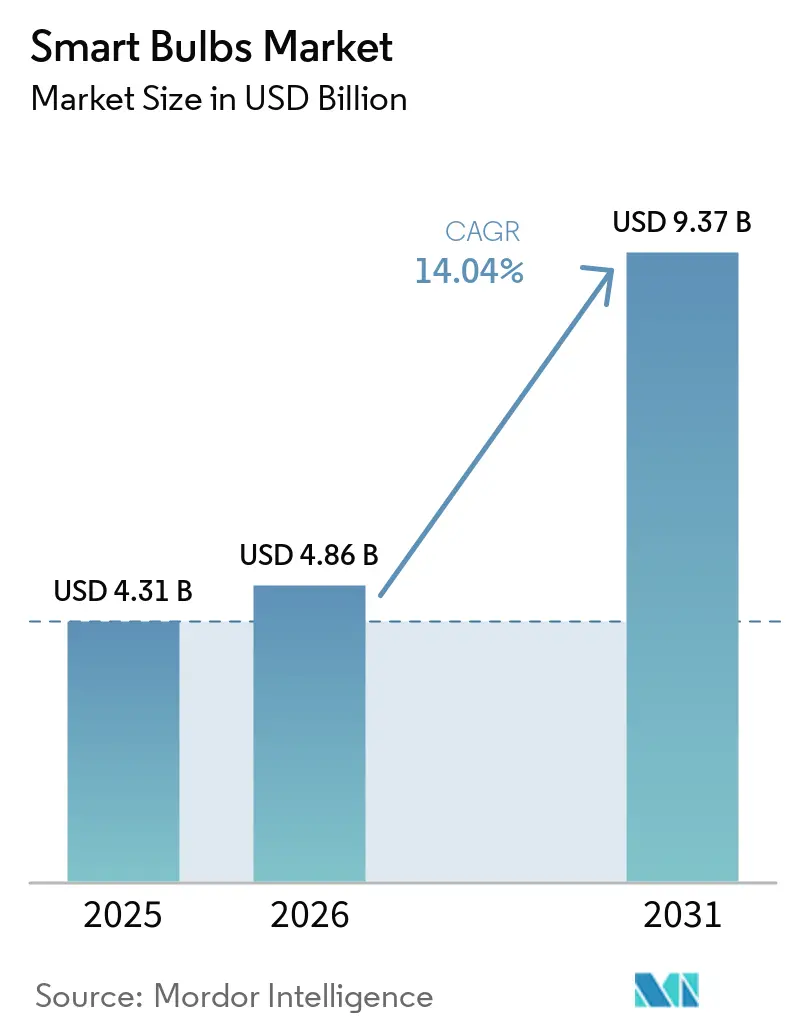
The smart bulbs market size was valued at USD 4.31 billion in 2025 and is estimated to expand from USD 4.86 billion in 2026 to reach USD 9.37 billion by 2031, at a CAGR of 14.04% during the forecast period 2026-2031. The smart bulbs market is moving from a product focused on lower power use to a practical starting point for connected home systems. Energy rules, mature smart home platforms, and wider Matter support are encouraging household and business buyers to choose connected LED products. Buyers increasingly value lighting automation, voice control, and compatibility with other devices, rather than viewing smart bulbs as a stand-alone replacement. The smart bulbs market also benefits when property owners and retailers make connected lighting easier to buy, install, and manage. Competition is likely to center on certification, reliable local control, simple setup, and pricing across retail and online channels.
Key Report Takeaways
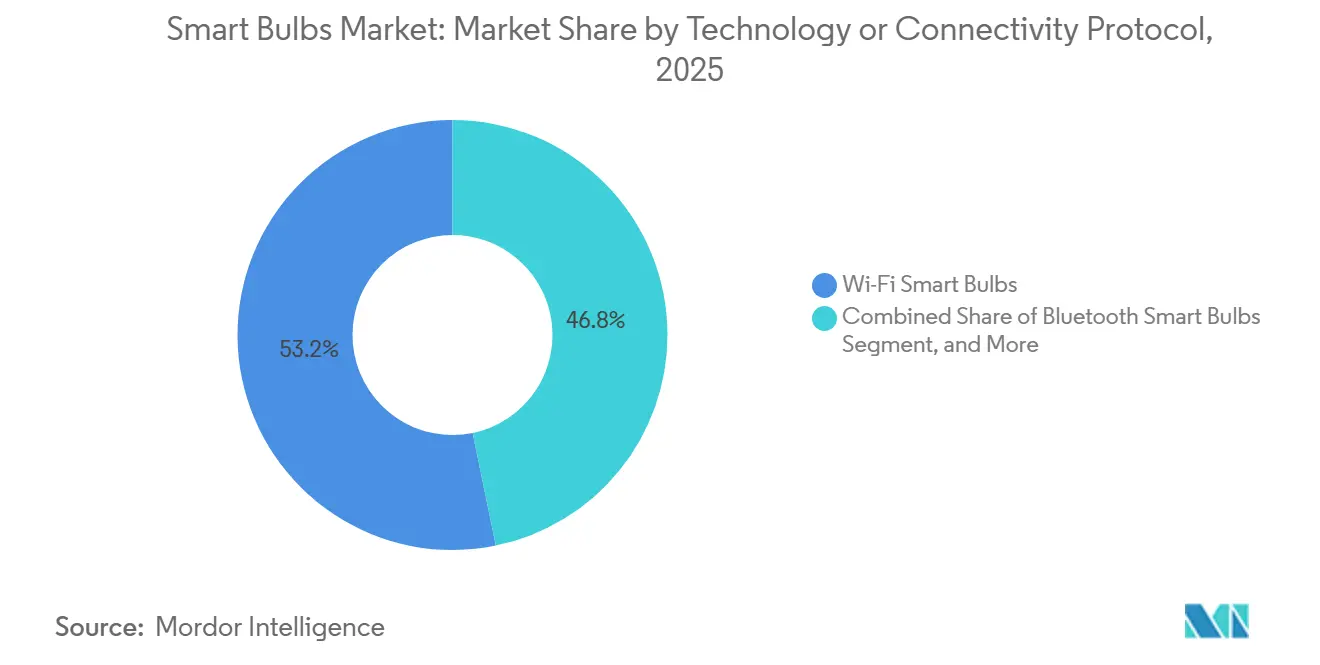
- By technology/connectivity protocol, Wi-Fi smart bulbs held 53.23% share of the smart bulbs market in 2025, while other connectivity protocols (thread-native/matter-over-thread, proprietary mesh) products are projected to expand at a 16.45% CAGR through 2031.
- By light source type, LED smart bulbs accounted for 97.57% share of the smart bulbs market in 2025 and are projected to expand at a 16.32% CAGR through 2031.
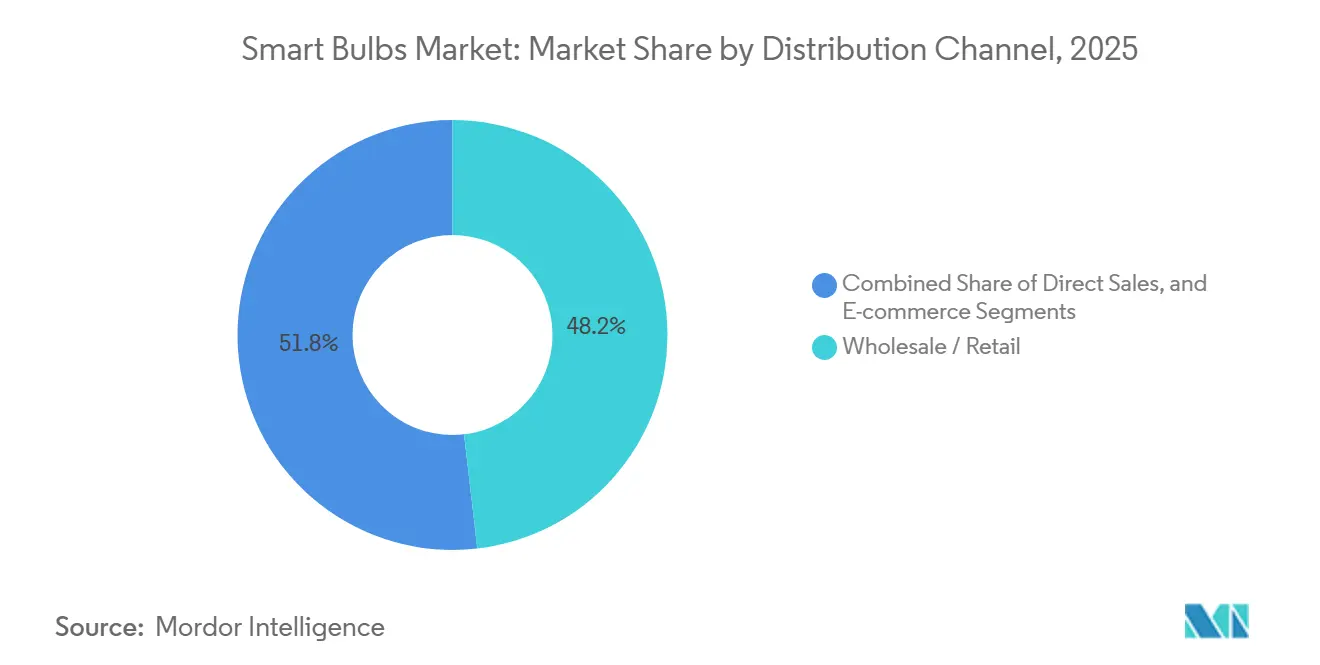
- By distribution channel, wholesale and retail accounted for 48.16% of the smart bulbs market in 2025, while e-commerce is projected to expand at a 17.73% CAGR through 2031.
- By end-user industry, residential users held 79.85% share of the smart bulbs market in 2025, while commercial users are projected to expand at a 16.93% CAGR through 2031.
- By geography, North America held 35.21% share of the smart bulbs market in 2025, while Asia-Pacific is projected to expand at a 17.46% CAGR through 2031.
Note: Market size and forecast figures in this report are generated using Mordor Intelligence’s proprietary estimation framework, updated with the latest available data and insights as of January 2026.
Market Trends and Insights
Drivers Impact Analysis of Smart Bulbs Market*
| Driver | (~) % Impact on CAGR Forecast | Geographic Relevance | Impact Timeline |
|---|---|---|---|
| Rising Smart-Home Penetration | +3.5% | Global, concentrated in North America and Europe | Medium term (2-4 years) |
| Energy-Efficiency Regulation and LED Replacement | +2.8% | North America and Europe, spillover to the Middle East and Africa | Medium term (2-4 years) |
| Matter-Based Interoperability Expansion | +2.1% | Global | Medium term (2-4 years) |
| Connected Lighting Demand in Rental and Multifamily Housing | +1.8% | North America and Asia-Pacific, spillover to Europe | Medium term (2-4 years) |
| App-Visible Lighting as a Gateway to Home Automation | +1.2% | Global, concentrated in North America | Medium term (2-4 years) |
| Retailer-Led Bundling With Home Internet and Security Services | +0.8% | North America and Europe | Short term (≤ 2 years) |
| Source: Mordor Intelligence | |||
Rising Smart-Home Penetration
Smart home technology adoption reached 59% among surveyed households in the United States and Canada in 2025, compared with 49% in 2024. Affordable Matter-compatible devices and simpler automation are making connected products more accessible to households. Smart bulbs fit standard E26 and E27 sockets, need no rewiring, and can be controlled through existing smartphone applications. Each installed bulb can establish an application habit that lowers the barrier to purchasing thermostats, cameras, and sensors later. The smart bulbs market, therefore, gains from the larger installed base of voice assistant platforms and connected home devices. As these platforms spread, lighting is becoming a routine entry product for home automation rather than an optional efficiency upgrade.
Energy-Efficiency Regulation and LED Replacement
The U.S. Department of Energy finalized general service lamp standards that require more than 120 lm/W for newly manufactured or imported bulbs from July 2028. The Department expects the standards to save 4 quadrillion British thermal units over 30 years of shipments. DesignLights Consortium SSL V6.0 and LUNA V2.0 requirements took effect on January 5, 2026, with tighter efficacy, controllability documentation, and lifecycle reporting requirements for nonresidential LED lighting.[1] Europe also applies the Ecodesign Regulation for light sources, while EN 15193-1:2026 supports system-level assessment of building energy performance. These rules encourage the replacement of legacy lamps with LED products that meet higher-efficacy requirements. The smart bulbs market can benefit because connected LED products meet efficiency needs while adding controllability in retrofit and new-build settings.
Matter-Based Interoperability Expansion
The Connectivity Standards Alliance released Matter 1.6. The release added Joint Fabric, which permits authorized controllers to co-manage a shared Matter network through a central datastore. It also introduced NFC-based commissioning to configure devices before power-on. These functions can reduce setup complexity for bulbs installed in fixed fixtures and shared homes. Matter certification gives buyers a clearer signal of compatibility when comparing product listings. The smart bulbs market is likely to see greater interest in open protocols, as consumers want devices that work across their preferred home platforms.
Connected Lighting Demand in Rental and Multifamily Housing
13% of U.S. apartment residents lived in units with smart amenity packages in 2025, including connected lighting, thermostats, and access control. More than half of multifamily renters said they would pay a premium for a smart-equipped apartment. Smart bulbs install quickly in existing sockets and do not require an electrician or extensive building changes. This feature suits property operators who need to deploy and manage lighting across many units. Bulk commissioning and property IoT platforms shift the purchase decision toward management capability and total ownership cost. The smart bulbs market can gain as operators package connected amenities into recurring resident fees and larger portfolio deployments.
Restraints Impact Analysis of Smart Bulbs Market*
| Restraint | (~) % Impact on CAGR Forecast | Geographic Relevance | Impact Timeline |
|---|---|---|---|
| Cybersecurity and Privacy Exposure | -1.5% | Global | Short term (≤ 2 years) and Medium term (2-4 years) |
| Interoperability Fragmentation Across Ecosystems | -1.2% | Global | Medium term (2-4 years) |
| Shorter Product Replacement Cycles From Integrated Electronics | -0.9% | Asia-Pacific core, spillover to North America | Long term (≥ 4 years) |
| Low Consumer Willingness to Pay for Advanced Features | -0.6% | Global | Medium term (2-4 years) |
| Source: Mordor Intelligence | |||
Cybersecurity and Privacy Exposure
CISA issued advisory ICSA-25-177-02 in June 2025 on 2 high-severity vulnerabilities in the TrendMakers Sight Bulb Pro.[2] The advisory identified clear-text transmission of AES encryption keys during setup and a command injection vulnerability that could allow adjacent-network attackers to execute arbitrary commands. NIST documented CVE-2024-9991, which involved Philips lighting devices storing Wi-Fi credentials in plain text in device firmware. Research presented at SSTIC 2026 showed remote and wireless root access to a Philips Hue Bridge through Zigbee attack surfaces. These cases can make hotels, enterprises, and consumers more cautious when assessing cloud-connected bulbs. The EU Cyber Resilience Act will introduce security-by-design obligations through 2027, increasing certification and compliance demands for manufacturers.
Interoperability Fragmentation Across Ecosystems
Matter promises cross-platform compatibility, but implementation differences can still affect consumer experiences. The Connectivity Standards Alliance has continued to update Matter through version 1.6, including functions intended to support shared ecosystems and simpler setup. Product certification alone does not remove the need for reliable hub, application, and platform integration. The Alliance operates interoperability testing to improve product quality and consistency across connected device ecosystems. Buyers may postpone upgrades when products do not connect smoothly with their preferred platforms. This restraint underscores the continued importance of thorough testing, firmware maintenance, and clear compatibility information in the smart bulbs market.
*Our forecasts treat driver/restraint impacts as directional, not additive. The impact forecasts reflect baseline growth, mix effects, and variable interactions.
Smart Bulbs Market Segment Analysis
By Technology / Connectivity Protocol:
Wi-Fi Leads While Thread Gains ImportanceWi-Fi smart bulbs held 53.23% of revenue in 2025, supported by near-universal router availability and a setup process that does not require a dedicated hub. This position in the smart bulb market gives Wi-Fi products a broad consumer base among households seeking simple app-based control. Bluetooth smart bulbs offer local control, low latency, and less reliance on cloud infrastructure. These features appeal to buyers who prefer basic control within a defined room or home. Zigbee and Z-Wave remain relevant in professional installations where mesh reliability and integration with building control systems matter.
Other connectivity protocols, mainly Thread-native and Matter-over-Thread products, are projected to expand at a 16.45% CAGR from 2026 to 2031. This outlook reflects manufacturer interest in open standards and architectures that can reduce dependence on a proprietary hub. Aqara's LED Bulb T2 supports both Zigbee and Thread, giving buyers the option to switch protocols without replacing the bulb.[3] Matter 1.6 provides shared-network and commissioning functions that can make multi-platform installations easier to manage. The smart bulbs market is likely to reward products that combine simple setup with reliable local and cross-platform operation.

By Light Source Type:
LED Maintains a Clear LeadLED smart bulbs accounted for 97.57% of the smart bulb market in 2025 and are projected to grow at a 16.32% CAGR through 2031. The combination makes LED the central technology in the smart bulbs market at consumer price points. Signify reported 171 million connected light points globally in Q1 2026, compared with 167 million at the end of 2025. This installed base reflects continuing demand for LED-based connected lighting. Higher lamp-efficiency standards further support LED technology because it meets both performance requirements and consumer cost expectations.
OLED smart bulbs remain limited to premium applications where diffuse and low-glare illumination is valued in hospitality and retail spaces. Their cost per lumen remains higher than that of LED arrays, limiting wider adoption in common retrofit bulb formats. Other light source types remain marginal as efficiency requirements favor LED performance at comparable prices. Within the LED category, product differentiation now depends more on color tuning, color rendering index, dimming behavior, and color temperature options. The smart bulbs industry, therefore, has more scope to compete on lighting quality and control functions than on changes in light-source technology.
By Distribution Channel:
Wholesale and Retail Retain Reach While E-Commerce ExpandsWholesale and retail channels captured 48.16% of revenue in 2025, as home improvement stores serve both installers and do-it-yourself buyers. Direct sales remain important for hospitality and commercial real estate projects that use specified vendor relationships or energy performance contracts. E-commerce is projected to expand at a 17.73% CAGR from 2026 to 2031. Online product pages allow brands to highlight voice-assistant support, Matter certification, and bundle offers. These functions help the smart bulbs market serve buyers who start their product search within a digital platform.
Search visibility, user reviews, and compatibility badges can influence a buyer before the product is physically examined. Tuya reported USD 321.8 million in full-year 2025 revenue, and its platform model supports connected product development for a wide base of customers. This type of platform can lower the technology barrier for OEMs that need cloud services, firmware tools, and application integration. Signify stated that online channels played an important role in connected lighting performance across most regions in 2025. The smart bulbs market is consequently placing more value on transparent online product information and recognized ecosystem credentials.
By End-User Industry:
Residential Demand Sets Volume While Commercial Use BroadensResidential users accounted for 79.85% of revenue in 2025, reflecting the widespread availability of smart bulbs at accessible consumer prices. Some households use lighting throughout the home, while others use products in selected rooms for ambiance or energy management. Multifamily properties add a business purchasing layer because owners can introduce connected lighting across many units. In 2025, 13% of U.S. apartment residents lived in smart-equipped units, while more than half of multifamily renters said they would pay a premium for those capabilities. Property managers in the smart bulbs market, therefore, consider ownership cost, management application compatibility, and bulk provisioning alongside retail price.
Commercial users are projected to grow at the highest end-user CAGR, 16.93%, from 2026 to 2031. The group includes hospitality venues, offices, commercial real estate, and retail spaces that require lighting integration with management and energy systems. ABB introduced GuestFlow in March 2026, integrating smart lighting, HVAC, and shading controls for hotel rooms. Industrial and institutional users also need occupancy-responsive lighting within energy management and facility systems. These buyers place greater weight on data reporting, integration, and long-term operational control.
Geography Analysis
North America Smart Bulbs Market
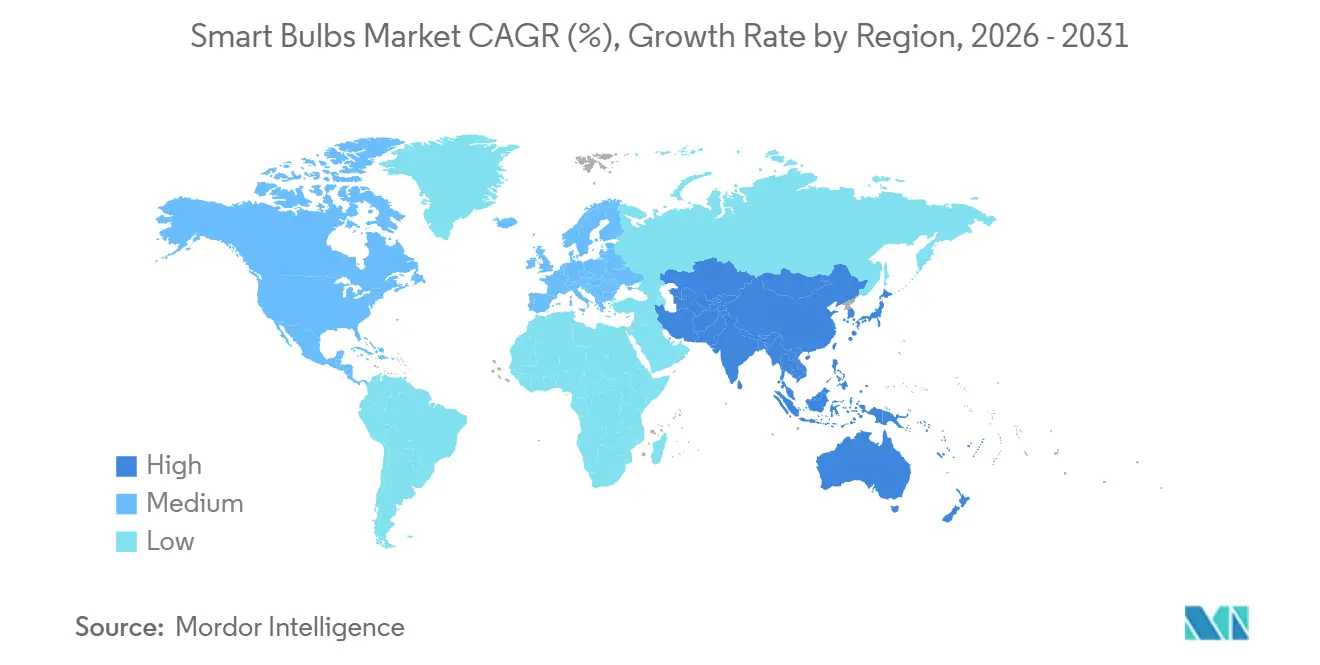
North America held 35.21% of revenue in 2025, supported by a mature base of broadband-connected households, voice assistants, and energy rules. Smart home technology adoption reached 59% among surveyed households in the United States and Canada in 2025. Signify reported double-digit revenue expansion in its U.S. consumer business during 2025, with strong connected home performance during peak periods. AT&T launched Connected Life in December 2025, combining Google Home devices and Abode monitoring with wireless and broadband subscriptions.[4] Canada contributes through utility-backed LED retrofit programs, while Mexico expands the regional smart-bulb market amid urbanization.
APAC Smart Bulbs Market
Asia-Pacific is projected to expand at a 17.46% CAGR from 2026 to 2031, the fastest rate among the geographic segments. China combines a major manufacturing base with a large consumer base for the smart bulbs market, which is served through platform-based retail channels. India benefits from urbanization, smart city activity, and a growing consumer base for connected home products. South Korea adds a quality-focused consumer base, high broadband density, and close links between consumer electronics and home platforms.
EMEA and South America Smart Bulbs Market
Europe, the Middle East and Africa, and South America show different stages of adoption because their policy, infrastructure, and income conditions vary. Saudi Arabia is a major Middle Eastern market because large infrastructure projects include connected lighting in their specifications, while the UAE has smart city districts that support hospitality and commercial demand. South America remains earlier in adoption, with Brazil and Argentina as major consumer markets and import costs and local-language ecosystem support limiting near-term penetration. Regional demand will depend on how regulatory replacement cycles, urbanization, and broadband availability develop.
Competitive Landscape
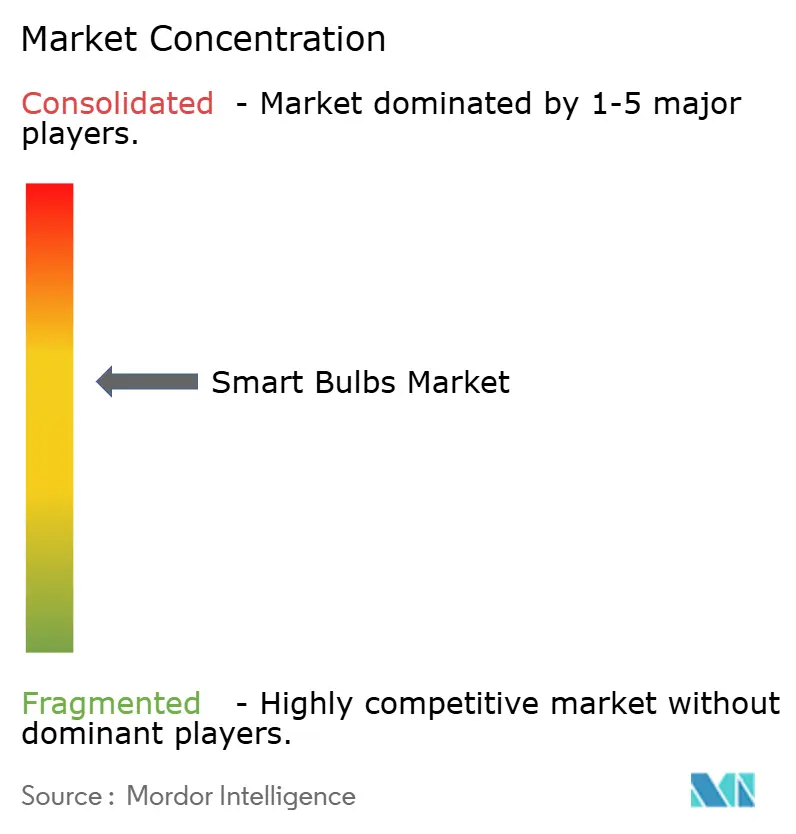
The smart bulbs market is moderately concentrated, with Signify holding a significant position through Philips Hue and WiZ. Signify reported 2025 sales of EUR 5,765 million (USD 6.28 billion) and a connected light points installed base of 171 million in Q1 2026. The company operates in a premium tier, while Govee, Yeelight, Leedarson, OPPLE, and Aqara form a broad mid-market group. These suppliers compete through certification, online availability, product range, and price. Tuya supports many OEMs with cloud infrastructure, firmware management, and multi-platform application interfaces.
Signify introduced next-generation candle bulbs in June 2026 with native Matter support and 40% higher energy efficiency than the prior generation.[5] Tuya showcased AI-based smart lighting and building integrations with ecosystem partners at Light+Building 2026. These moves show that leading firms are extending competition from bulb hardware into applications, building controls, and ecosystem support. The smart bulbs market favors suppliers that can demonstrate reliable compatibility and ongoing software support.
White-space demand remains in security-sensitive sites that prefer local operation without dependence on cloud services. Multifamily building owners need bulk-management application interfaces for deep-retrofit projects. Commercial facilities need connected lighting data to support ISO 50001 energy management. Signify launched next-generation Interact Building solutions in March 2026 for centralized monitoring, automation, and optimization in professional indoor spaces. The category is therefore competitive across consumer bulbs, integrated building systems, and platform services in the smart bulbs market.
Smart Bulbs Industry Leaders
-
Nanoleaf Inc.
-
Govee Home Appliance Co., Ltd.
-
Shenzhen Yeelight Technology Co., Ltd.
-
Signify N.V.
-
Feit Electric Company, Inc.
- *Disclaimer: Major Players sorted in no particular order
Smart Bulbs Market Companies Covered in this Report
- Nanoleaf Inc.
- Govee Home Appliance Co., Ltd.
- Shenzhen Yeelight Technology Co., Ltd.
- Signify N.V.
- Feit Electric Company, Inc.
- Sengled Co., Ltd.
- LEDVANCE GmbH
- Leedarson IoT Technology Inc.
- TP-Link Systems Inc.
- SATCO Products, Inc.
- Lutron Electronics Co., Inc.
- Xiaomi Communications Co., Ltd.
- Lumi United Technology Co., Ltd. (Aqara)
- IKEA Supply AG
- Shenzhen Opple Lighting Co., Ltd. (OPPLE Lighting)
- Tuya Smart Inc.
- Miboxer (FUTLIGHT OPTOELECTRONICS CO., LTD.)
- AiDot Inc. (Linkind)
- Shenzhen Homa Technology Co., Ltd.
Recent Industry Developments in Smart Bulbs Market
- June 2026: Signify expanded the Philips Hue portfolio with the Play Table Lamp, Play Floor Lamp Large, and next-generation E14 candle bulbs featuring full-spectrum daylight technology (a broad color temperature range for natural daylight mimicry), Matter compatibility, and 40% greater energy efficiency than the prior generation. Products became available globally from June 2026 via philips-hue.com and selected retailers.
- June 2026: The Connectivity Standards Alliance released Matter 1.6, introducing the Joint Fabric feature that enables multiple smart home platforms to co-administer a shared device fabric, and NFC-based commissioning for pre-powered-on device configuration, a specification advance with material implications for smart bulb installation in fixed fixtures.
- March 2026: Tuya Smart exhibited at Light+Building 2026 in Frankfurt under the theme "Hey Tuya, Hey Brighter Life," showcasing AI-driven smart lighting and building technology integrations with ecosystem partners, including Whale Vision, MoreSense Technology, and XiongYuan Lighting.
- November 2025: IKEA announced a full strategic pivot to Matter-over-Thread smart home products, including more than 20 new lights, sensors, and remotes. The DIRIGERA hub was simultaneously updated to the Matter 1.4 controller with Thread border router capabilities, opening the ecosystem to third-party Matter devices.
Global Smart Bulbs Market Report Scope
The smart bulbs market comprises internet-connected smart light bulbs that enable remote control, scheduling, dimming, color tuning, and integration with smart home platforms using Wi-Fi, Bluetooth, Zigbee, Z-Wave, Thread, and other wireless protocols. The market includes LED, OLED, and other smart bulb technologies sold through direct, retail, and e-commerce channels for residential, commercial, industrial, and institutional applications, as well as bundled starter kits sold at the point of purchase.
The Smart Bulbs Market Report is Segmented by Technology / Connectivity Protocol (Wi-Fi Smart Bulbs, Bluetooth Smart Bulbs, Zigbee Smart Bulbs, Z-Wave Smart Bulbs, and Other Connectivity Protocols (Thread-native/Matter-over-Thread, and Proprietary Mesh)), Light Source Type (LED Smart Bulbs, OLED Smart Bulbs, and Other Light Source Types), Distribution Channel (Direct Sales, Wholesale / Retail, and E-commerce), End-User Industry (Residential, Commercial (Hospitality, Offices and Commercial Real Estate, and Retail Spaces), and Industrial & Institutional), and Geography (North America, South America, Europe, Asia-Pacific, and Middle East and Africa). The Market Forecasts are Provided in Terms of Value (USD).
Segmentation Overview
| Wi-Fi Smart Bulbs |
| Bluetooth Smart Bulbs |
| Zigbee Smart Bulbs |
| Z-Wave Smart Bulbs |
| Other Connectivity Protocols (Thread-native/Matter-over-Thread, Proprietary Mesh) |
| LED Smart Bulbs |
| OLED Smart Bulbs |
| Other Light Source Types |
| Direct Sales |
| Wholesale / Retail |
| E-commerce |
| Residential | |
| Commercial | Hospitality |
| Offices and Commercial Real Estate | |
| Retail Spaces | |
| Industrial and Institutional |
| North America | United States | |
| Canada | ||
| Mexico | ||
| South America | Brazil | |
| Argentina | ||
| Rest of South America | ||
| Europe | Germany | |
| United Kingdom | ||
| France | ||
| Italy | ||
| Spain | ||
| Rest of Europe | ||
| Asia-Pacific | China | |
| Japan | ||
| India | ||
| South Korea | ||
| Rest of Asia-Pacific | ||
| Middle East and Africa | Middle East | Saudi Arabia |
| United Arab Emirates | ||
| Turkey | ||
| Rest of the Middle East | ||
| Africa | South Africa | |
| Nigeria | ||
| Rest of Africa | ||
| By Technology / Connectivity Protocol | Wi-Fi Smart Bulbs | ||
| Bluetooth Smart Bulbs | |||
| Zigbee Smart Bulbs | |||
| Z-Wave Smart Bulbs | |||
| Other Connectivity Protocols (Thread-native/Matter-over-Thread, Proprietary Mesh) | |||
| By Light Source Type | LED Smart Bulbs | ||
| OLED Smart Bulbs | |||
| Other Light Source Types | |||
| By Distribution Channel | Direct Sales | ||
| Wholesale / Retail | |||
| E-commerce | |||
| By End-user Industry | Residential | ||
| Commercial | Hospitality | ||
| Offices and Commercial Real Estate | |||
| Retail Spaces | |||
| Industrial and Institutional | |||
| By Geography | North America | United States | |
| Canada | |||
| Mexico | |||
| South America | Brazil | ||
| Argentina | |||
| Rest of South America | |||
| Europe | Germany | ||
| United Kingdom | |||
| France | |||
| Italy | |||
| Spain | |||
| Rest of Europe | |||
| Asia-Pacific | China | ||
| Japan | |||
| India | |||
| South Korea | |||
| Rest of Asia-Pacific | |||
| Middle East and Africa | Middle East | Saudi Arabia | |
| United Arab Emirates | |||
| Turkey | |||
| Rest of the Middle East | |||
| Africa | South Africa | ||
| Nigeria | |||
| Rest of Africa | |||
Key Questions Answered in the Report
What is the smart bulbs market value?
It is estimated at USD 4.86 billion in 2026 and is forecast to reach USD 9.37 billion by 2031, at a 14.04% CAGR.
What is driving demand for smart bulbs?
Smart home adoption, LED efficiency rules, Matter support, and demand from multifamily properties are supporting adoption.
Which connectivity protocol leads smart bulb sales?
Wi-Fi led with 53.23% of revenue in 2025 because it works with common household routers and does not require a dedicated hub.
Why are Matter and Thread important for connected lighting?
They are intended to simplify compatibility and setup across home platforms. Thread-native and Matter-over-Thread products are projected to expand at a 16.45% CAGR through 2031.
Which end user accounts for the greatest demand?
Residential users held 79.85% of revenue in 2025, while commercial users are projected to expand at the fastest 16.93% CAGR through 2031.
Which region has the fastest projected expansion?
Asia-Pacific is projected to expand at a 17.46% CAGR from 2026 to 2031, supported by manufacturing capacity and connected home demand.