
Small Language Models (SLMs) Market Size and Share
Market Overview
| Study Period | 2020 - 2031 |
|---|---|
| Market Size (2026) | USD 1.37 Billion |
| Market Size (2031) | USD 4.84 Billion |
| Growth Rate (2026 - 2031) | 28.71 % |
| Fastest Growing Market | Asia-Pacific |
| Largest Market | North America |
| Market Concentration | Medium |
Major Players *Disclaimer: Major Players sorted in no particular order Image © Mordor Intelligence. Reuse requires attribution under CC BY 4.0. | |
Small Language Models (SLMs) Market Analysis by Mordor Intelligence
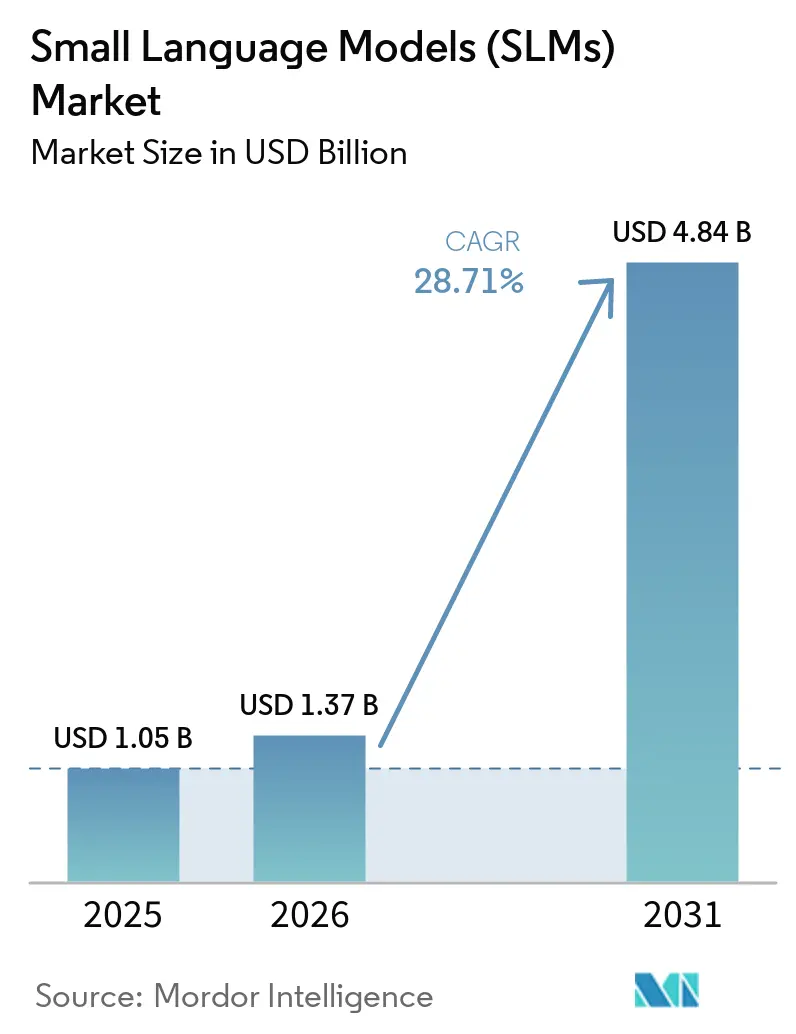
The Small Language Models (SLMs) Market size is projected to expand from USD 1.05 billion in 2025 and USD 1.37 billion in 2026 to USD 4.84 billion by 2031, registering a CAGR of 28.71% from 2026 to 2031. The market is expanding as enterprises shift AI spending toward task-specific models that can run at the edge, on-premises, or in private cloud environments, enabling tighter control over costs and performance. Rising inference costs for large model APIs, stronger data-handling rules across major economies, and improved neural processing unit performance are pushing buyers toward architectures that are easier to deploy at scale. The small language models market is also benefiting from broader changes in enterprise buying behavior, where organizations now prefer durable model infrastructure and repeatable deployment stacks rather than one-off experiments with general-purpose systems. Competition is moving away from a simple scale race toward licensing flexibility, hardware optimization, and deeper enterprise integration, which are the factors shaping production adoption. Pricing pressure from open-weight releases and bundling by large cloud providers is likely to intensify consolidation, while still leaving room for vendors that can deliver efficient deployment, support, and domain adaptation across the small language models market.
Key Report Takeaways
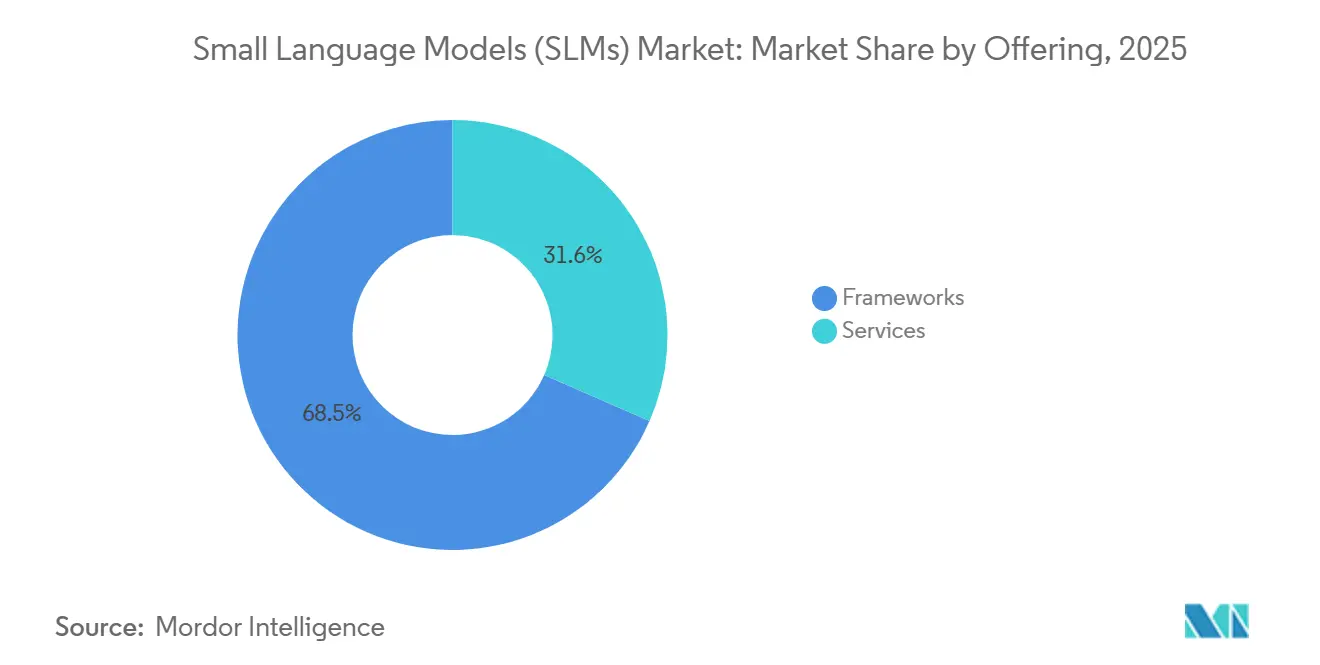
- By offering, frameworks held 68.45% of revenue share in the small language models (SLMs) market in 2025, while services are projected to expand at a 26.34% CAGR through 2031.
- By deployment mode, cloud held 57.38% of revenue share in the small language models (SLMs) market in 2025, while edge devices are projected to expand at a 28.98% CAGR through 2031.
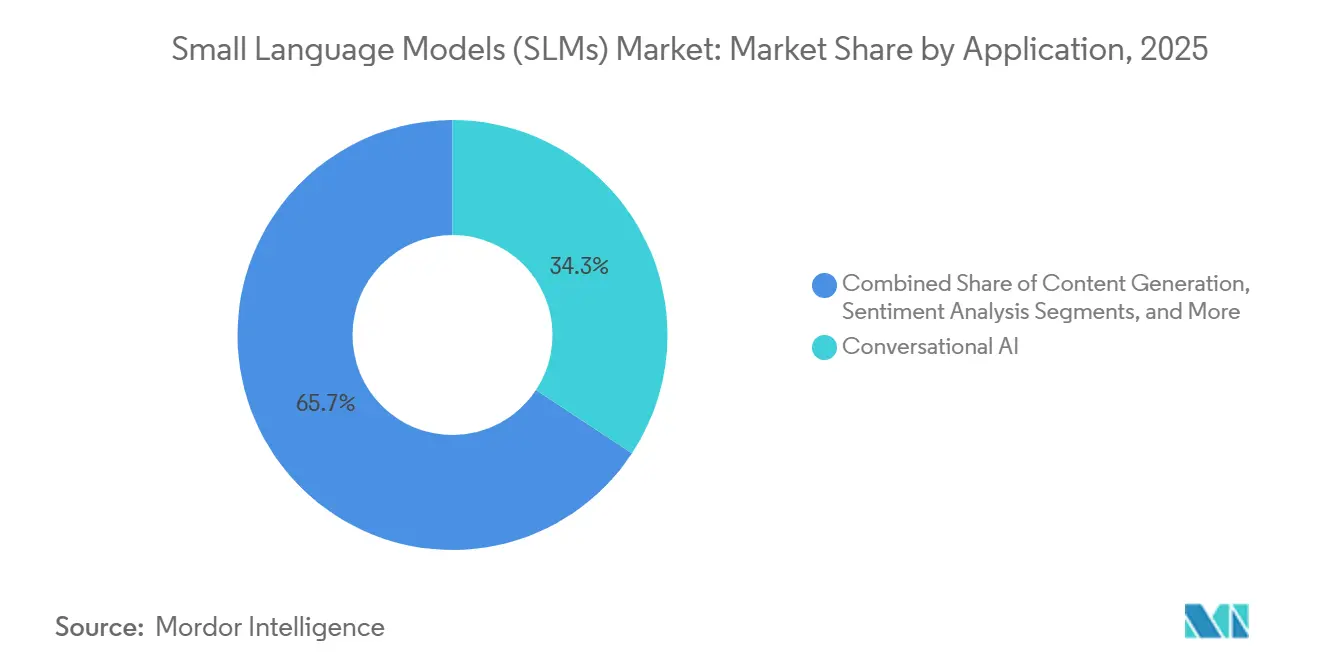
- By application, conversational AI accounted for 34.26% of revenue share in the small language models (SLMs) market in 2025, while semantic search and information retrieval are expected to expand at a 27.65% CAGR through 2031.
- By end user, technology and software providers held 27.84% of revenue share in the small language models (SLMs) market in 2025, while healthcare and life sciences are projected to expand at a 28.12% CAGR through 2031.
- By geography, North America captured 37.89% of revenue share in the small language models (SLMs) market in 2025, while Asia-Pacific is projected to expand at a 29.76% CAGR through 2031.
Note: Market size and forecast figures in this report are generated using Mordor Intelligence’s proprietary estimation framework, updated with the latest available data and insights as of January 2026.
Market Trends and Insights
Drivers Impact Analysis of Small Language Models (SLMs) Market*
| Driver | (~) % Impact on CAGR Forecast | Geographic Relevance | Impact Timeline |
|---|---|---|---|
| Rising Demand For Low-Latency On-Device AI | +6.2% | Global, with concentrated momentum in North America, Asia-Pacific, and Western Europe | Short term (≤ 2 years) |
| Cost Pressure Versus Frontier Model Inference Economics | +5.8% | Global, most acute in North America and Europe where cloud AI spending is highest | Short term (≤ 2 years) |
| Data Privacy, Residency, and Sovereign AI Requirements | +4.5% | European Union, Middle East, India, and South Korea | Medium term (2-4 years) |
| Edge-Optimized Enterprise Automation Use Cases | +4.0% | Asia-Pacific industrial corridor, and North America manufacturing | Medium term (2-4 years) |
| Open-Source Model Ecosystems and Fast Fine-Tuning Cycles | +3.2% | Global, with dense developer ecosystems in North America, Europe, and Asia-Pacific | Medium term (2-4 years) |
| Hardware Efficiency Gains in NPUs, GPUs, and AI Accelerators | +2.8% | Global, with strongest concentration in Asia-Pacific manufacturing hubs | Long term (≥ 4 years) |
| Source: Mordor Intelligence | |||
Rising Demand For Low-Latency On-Device AI
Low-latency inference has moved from a technical preference to a commercial requirement across the small-language-models market. Enterprises now expect AI functions to deliver faster response times, lower power consumption, and fewer network dependencies when embedded in software and devices. Microsoft made Phi-4-mini-reasoning available on Snapdragon-powered Copilot+ PCs in May 2025, demonstrating that reasoning workloads could run with NPU offload rather than relying on CPU-heavy execution.[1] Apple also released an on-device foundation model at WWDC 2025 that reduced KV cache memory use by 37.5% while maintaining multilingual performance across 15 languages, reinforcing the practicality of fully offline inference.[2] Google extended that direction in April 2026 with Gemma 4 on Google Cloud, which supported more than 140 languages and included edge-oriented variants built for mobile and device deployment.[3] As a result, the small language models market is being pulled forward by hardware and software categories that now treat local AI capability as a baseline feature rather than an optional enhancement.
Cost Pressure Versus Frontier Model Inference Economics
Inference cost has become one of the clearest adoption drivers in the small language models market because it changes how enterprises compare production architectures. Buyers are no longer choosing models only on capability benchmarks, because recurring API costs can quickly outweigh any performance advantage in high-volume workflows. The small language models market is therefore gaining traction not only because compact models are cheaper today, but also because their economics are pushing even frontier model providers to release smaller, more efficient alternatives.
Data Privacy, Residency, and Sovereign AI Requirements
Data-handling rules are shaping deployment decisions earlier in the buying cycle across the small language models market. Regulatory compliance is no longer a secondary filter, as many organizations now need an architecture that already meets local storage, audit, and disclosure requirements before they select a vendor. The EU AI Act transparency obligations under Article 50 were set to take effect on August 2, 2026, and they require AI systems that interact with individuals to disclose their AI nature and label AI-generated content in machine-readable form.[4] The same framework carries penalties of up to EUR 15 million (USD 16.93 million) or 3% of global turnover for non-compliance, using the 2025 IRS yearly average exchange rate for euro conversion, as the 2026 yearly average rates were not yet available. These rules favor on-premises and tightly governed deployments, where enterprises can control data flows and documentation more directly. The small language models market is therefore gaining support from sovereign AI programs and privacy-sensitive industries that need compact, auditable, and region-specific deployment models.
Edge-Optimized Enterprise Automation Use Cases
Industrial automation is providing the small language models market a steady source of practical demand. Many factory, logistics, and field workflows generate narrow, repetitive inference tasks that do not require a frontier model but do require low latency and reliable output formatting. Mitsubishi Electric announced in June 2025 that it had developed a manufacturing-focused language model for edge device deployment using its Maisart AI technology, with a target for product application in industrial equipment and robots within FY2026. China’s Ministry of Industry and Information Technology issued its "AI + Manufacturing" specialized action plan in January 2026, targeting 1,000 high-level industrial AI agents and 100 high-quality industrial datasets, thereby creating a clear policy framework for local industrial deployment. Cathay Financial Holdings also showed in June 2026 that open-source compact models fine-tuned for customer intent classification could replace cloud API calls in structured financial workflows, which reflected the same push toward local inference and tighter governance in a different operating setting. As these narrow enterprise workflows expand, the small language models market is benefiting from a model improvement cycle in which each deployed interaction can become training data for later fine-tuning.
Restraints Impact Analysis of Small Language Models (SLMs) Market*
| Restraint | (~) % Impact on CAGR Forecast | Geographic Relevance | Impact Timeline |
|---|---|---|---|
| Limited Context Depth Versus Larger Foundation Models | -2.8% | Global, most constraining in North America and Europe where complex enterprise use cases are concentrated | Short term (≤ 2 years) |
| Benchmark Fragmentation and Weak Cross-Model Comparability | -1.5% | Global | Medium term (2-4 years) |
| Integration Complexity Across Legacy Enterprise Stacks | -1.2% | North America and Europe, where legacy ERP and middleware infrastructure is most entrenched | Medium term (2-4 years) |
| Hardware Supply Chain Constraints and Accelerator Cost Sensitivity | -0.9% | Asia-Pacific for manufacturing and sourcing, and North America for enterprise hardware procurement | Long term (≥ 4 years) |
| Source: Mordor Intelligence | |||
Limited Context Depth Versus Larger Foundation Models
Context depth remains the clearest technical limit on how far the small language model market can go in complex analytical tasks. Many compact models perform well in bounded workflows, but long-document review, extended agent memory, and layered reasoning still expose the gap with larger systems. Apple stated that its on-device foundation model supports a 4,000-token context window, while its Private Cloud Compute pathway supports 32,000 tokens, highlighting the trade-off between privacy-first deployment and broader contextual capacity. Mistral addressed part of that gap in July 2026 with Magistral Small 2507, which supported a 128,000-token context window under an Apache 2.0 license while remaining deployable on-premises. Even with that progress, the small-language-models market still faces a design trade-off between edge efficiency and the broader contextual memory needed for the most demanding enterprise use cases.
Benchmark Fragmentation and Weak Cross-Model Comparability
The small language models market also faces friction because buyers still lack clear and comparable evaluation standards. Procurement teams often need evidence that reflects real deployment conditions, yet benchmark results remain fragmented across tasks, hardware configurations, and runtime choices. A systematic review published by Springer Nature in June 2026 identified missing standardized benchmarks and the absence of NPU-isolated power measurement as major gaps in AI hardware efficiency evaluation. The same review stated that software stack optimization alone can create a 15% to 30% efficiency difference even when hardware stays the same. That variability makes it harder for regulated sectors to defend vendor choices with repeatable internal evidence. It also favors larger providers in the small language models market because they are better positioned to fund independent validation, optimized runtimes, and broader deployment documentation.
*Our forecasts treat driver/restraint impacts as directional, not additive. The impact forecasts reflect baseline growth, mix effects, and variable interactions.
Small Language Models (SLMs) Market Segment Analysis
By Offering:
Frameworks Anchor the Stack, Services Expand the Revenue BaseFrameworks captured 68.45% of revenue in 2025, placing them at the center of the small language models market during a period when enterprises were still standardizing their deployment approach. That position reflected the need for inference runtimes, orchestration layers, fine-tuning pipelines, and hardware-aware backends before a business application could move into production. Enterprises generally treated this layer as a long-term infrastructure choice because once a framework is embedded in internal workflows, it tends to support many subsequent model releases. The small language models market, therefore, showed stronger early spending on reusable model plumbing than on narrow point solutions. This pattern also suggested that buyers were building environments that could host successive proprietary and open-weight models rather than committing to one fixed algorithm.
Microsoft’s ONNX-based Phi optimizations for Snapdragon-powered NPUs, available from May 2025, and Apple’s Core AI framework introduced at WWDC26 both showed how platform vendors are trying to own the model-to-hardware path from compilation to runtime management. That strategy matters because open-weight model releases are lowering the scarcity value of access to basic frameworks across the small language model market. Mistral Small 3 in January 2025 and Mistral Small 4 in March 2026 were both released under the Apache 2.0 license, which increased pressure on vendors that rely solely on proprietary framework differentiation. Services are projected to grow at a 26.34% CAGR through 2031, and that shift points to a later monetization layer where enterprises want managed fine-tuning, domain adaptation, and monitoring after the base stack is in place. In that sense, the small language models industry is moving from framework selection toward operational support, where service depth becomes a more durable source of revenue than access to the framework itself.
By Deployment Mode:
Cloud Leads Today, Edge Devices Shape the Next PhaseCloud held 57.38% of revenue in 2025, giving it the largest share of the small language models market at the start of enterprise adoption. Many organizations chose cloud-first because it reduced upfront hardware commitments, integrated with existing identity systems, and enabled usage-based testing before larger infrastructure decisions were made. That early dominance did not mean cloud was the long-term answer for every workload, because regulated sectors still needed stronger control over where data moved and how inference was handled. On-premises deployments continued to serve healthcare, BFSI, and other governance-heavy users that could not easily route sensitive tasks through third-party cloud environments. The small language models market has therefore kept a multi-path deployment structure, with each mode matching a different combination of cost, speed, and compliance needs.
Edge devices are projected to expand at a 28.98% CAGR through 2031, which makes them the fastest-growing deployment mode in the small language models market. That growth reflects hardware pull more than software supply, because enterprises are now seeing local inference as a practical production option rather than a lab exercise. Microsoft’s Phi releases for Snapdragon-powered Copilot+ PCs and Apple’s developer tooling around on-device inference both helped turn compact local execution into a more standardized path. Springer Nature reported in June 2026 that NPUs can deliver 40 to 60 times the energy efficiency of GPUs for edge inference within their operating range, thereby changing the economics of distributed AI deployment. Shenzhen’s "AI + Advanced Manufacturing 2026-2027" action plan also backed pruning, quantization, and distillation for production-line deployment, indicating that public policy was reinforcing device-side demand in the small language models market.
By Application:
Conversational AI Holds Share, Retrieval Use Cases Gain GroundConversational AI captured 34.26% of revenue in 2025, giving it the largest market share among application segments in the small language models market. That lead reflected the practical strength of narrow and auditable interactions where latency is visible, outputs can be checked, and return on investment is easier to measure. Customer support, internal helpdesk functions, and enterprise language interfaces had already built a demand base before the current wave of compact models accelerated. The small language models market benefited from that installed demand because buyers could replace older chatbot architectures with more capable systems without redesigning the business case. This made conversational AI the clearest near-term entry point for organizations that wanted to deploy to production without taking on the full risk of open-ended generative workflows.
Semantic search and information retrieval are projected to expand at a 27.65% CAGR through 2031, underscoring how the small language models market is moving deeper into knowledge access and document-heavy workflows. Enterprises increasingly want contextual search across repositories, policies, contracts, and internal knowledge bases, because tasks that reward consistency and low-latency performance outweigh broad creative output. Cathay Financial Holdings presented production findings in June 2026 showing that open-source compact models fine-tuned for customer intent classification could replace cloud API calls in structured workflows, which supports the case for domain-specific deployment in information-heavy environments. Translation, localization, data extraction, document analysis, and sentiment monitoring are also expanding, even when the workflow scope is narrow, and output formatting must remain predictable. The small language models industry is therefore seeing application demand shift toward systems that can turn enterprise content into repeatable downstream actions, not just human-like text.

By End User:
Technology Providers Lead, Healthcare Builds MomentumTechnology and software providers accounted for 27.84% of revenue in 2025, giving them the largest market share among end-user groups in the small language models market. Their lead role came from a dual role: they both develop model stacks and consume them within broader software products. These firms usually absorb frameworks earlier, integrate faster, and test more deployment options than other industries, which keeps them ahead during early market formation. The small language models market also aligns with their product strategy, as compact models can be embedded into software-as-a-service offerings without the same recurring inference burden as frontier APIs. That makes this group both the largest direct buyer and an indirect channel through which compact models reach enterprise users.
Healthcare and life sciences are projected to expand at a 28.12% CAGR through 2031, making them the fastest-growing end-user segment in the small language models market. Growth is being supported by clinical workflow automation, strong privacy requirements, and the value of fine-tuning on curated biomedical data. Innovaccer’s Sara family, built on Google’s Gemma 3 and Gemma 4 model families, covered 12 clinical workflow tasks and demonstrated sub-500-millisecond on-premises response times in early 2026. Within the small language models market, that combination of compliance fit and domain tuning is helping healthcare close the gap with technology providers faster than other end-user groups.
Geography Analysis
North America Small Language Models (SLMs) Market
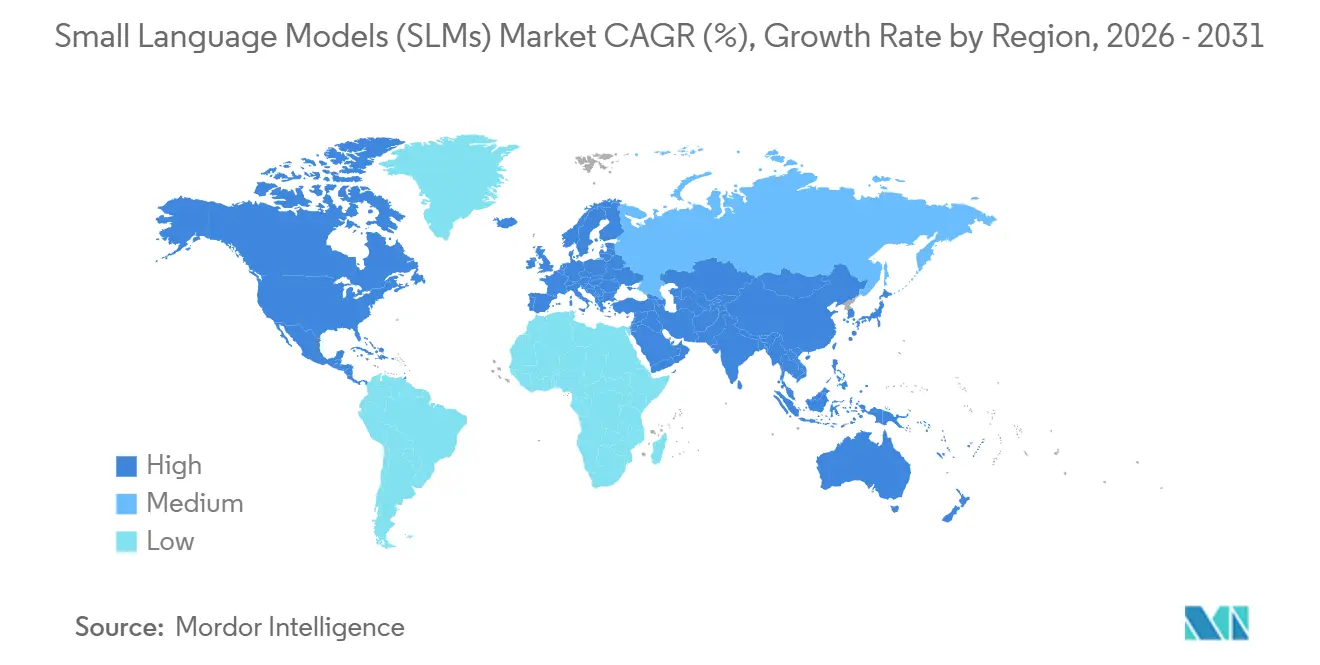
North America accounted for 37.89% of global revenue in 2025, making it the largest region in the small language models market. The region’s lead rested on the concentration of early-adopting enterprises, mature cloud infrastructure, and the presence of major platform companies such as Microsoft, Google LLC, Amazon Web Services, and Apple. It also remained the clearest center for framework consolidation, because regulated enterprises tended to narrow procurement around a smaller set of production-validated platforms. New York’s 2026 financial sector guidance on AI-related cybersecurity risk added to that pattern by reinforcing the need for auditable and locally governed deployments in compliance-sensitive environments. As a result, the small language models market in North America continued to face strong demand amid tighter enterprise scrutiny of deployment architecture.
APAC Small Language Models (SLMs) Market
Asia-Pacific is projected to expand at a 29.76% CAGR through 2031, making it the fastest-growing regional market for small language models. Growth is being driven by manufacturing-edge AI demand in Japan and South Korea, a highly active domestic model ecosystem in China, and cost-sensitive deployment demand across India. Mitsubishi Electric announced a manufacturing-domain language model for edge deployment in June 2025, and the company targeted product application in industrial equipment and robots within FY2026. Tokyo Electron Device launched its "Try it! SLM on Edge" support program in June 2026 to help manufacturers evaluate and productize compact models in edge environments. These developments showed that the small language models market in Asia-Pacific was moving from experimentation toward production integration, especially in industrial settings where local inference aligns with operational needs.
EMEA and South America Small Language Models (SLMs) Market
Europe remained the third-largest regional market, and its adoption pattern was defined by regulatory-first deployment choices in the small language models market. The EU AI Act transparency obligations under Article 50 were set to apply from August 2, 2026, which increased the importance of disclosure, labeling, and documentation in customer-facing AI systems. Germany and the United Kingdom led enterprise procurement in the region, while the Nordics were gaining relevance as design centers for sovereign AI architectures. South America was still in an early growth phase with banking, e-commerce, and media localization supporting initial adoption, while Middle East markets and parts of Africa were developing around sovereign AI infrastructure and local-language service demand.
Competitive Landscape
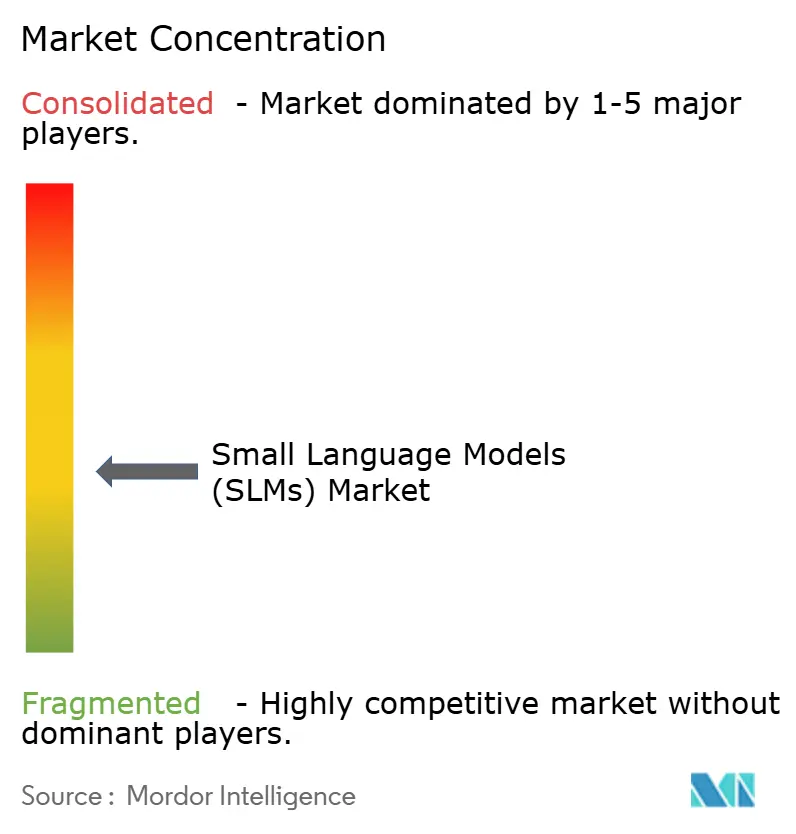
The small language models market remained moderately fragmented because competition stretched across model developers, framework providers, and managed service specialists rather than being concentrated in a single dominant vendor. Microsoft, Google LLC, Meta Platforms, and Apple anchored the framework layer through model families such as Phi, Gemma, Llama, and Apple Foundation Models. Their competition was no longer defined only by parameter scale, because enterprise buyers were paying closer attention to licensing posture, runtime efficiency, and compatibility with existing infrastructure. That shift favored vendors that could connect model releases with actual deployment tooling, security controls, and hardware support. The small language models market, therefore, continued to reward providers that combined technical performance with a production-ready operating environment.
Licensing strategy became one of the most visible competitive tools in the small language models market. Mistral AI released Mistral Small 3 in January 2025 under Apache 2.0, followed by Mistral Small 4 in March 2026 under the same license, demonstrating a deliberate effort to use open-source access as a customer acquisition path. That approach shifted monetization toward enterprise support, private deployment, and fine-tuning services instead of charging for access to the base model alone. NVIDIA also deepened its role in 2026 with TensorRT Edge-LLM for Jetson and DRIVE AGX Thor, which gave enterprises a way to optimize compiled inference with support for FP16, INT8, and INT4 precision. In parallel, Apple extended its on-device framework path at WWDC26, while Microsoft continued to align Phi releases with ONNX and Snapdragon optimization, demonstrating how platform-level control was becoming a key differentiator.
Specialized providers such as Cohere Inc., Liquid AI, and AI21 Labs continued to compete by focusing on enterprise integration quality, governed outputs, and domain relevance rather than raw model scale. White-space opportunities remained strongest in vertical applications such as clinical workflow automation, industrial fault diagnosis, and legal document review, where general-purpose models often struggle with structured output requirements. Cohere’s emphasis on enterprise retrieval and citation grounding illustrated how governance features can support positioning in regulated procurement cycles. Across the small language model market, the competitive balance is likely to remain broad as long as open-weight releases, hardware diversity, and industry-specific deployment needs continue to limit full concentration on a small set of vendors.
Small Language Models (SLMs) Industry Leaders
-
Microsoft Corporation
-
Google LLC
-
Meta Platforms, Inc.
-
Nomic AI, Inc.
-
NVIDIA Corporation
- *Disclaimer: Major Players sorted in no particular order
Small Language Models (SLMs) Market Companies Covered in this Report
- Microsoft Corporation
- Google LLC
- Meta Platforms, Inc.
- Nomic AI, Inc.
- NVIDIA Corporation
- Amazon Web Services, Inc.
- IBM Corporation
- Liquid AI, Inc.
- Cohere Inc.
- Mistral AI SAS
- AI21 Labs Ltd.
- 01.AI
- Hugging Face, Inc.
- Databricks, Inc.
- Salesforce, Inc.
- DeepSeek Artificial Intelligence Co., Ltd.
- Qualcomm Incorporated
- Apple Inc.
- Ollama, Inc.
- Alibaba Cloud (Alibaba Group Holding Limited)
- Cerebras Systems, Inc.
- Groq, Inc.
- H2O.ai, Inc.
- Upstage AI, Inc.
Recent Industry Developments in Small Language Models (SLMs) Market
- June 2026: Apple introduced Siri AI at WWDC26, rebuilt on the next generation of Apple Foundation Models with on-device inference supporting image input, improved instruction following, tool calling, and a 4,000-token context window, all processing user data locally without transmission to Apple servers. The launch expanded Apple's on-device SLM ecosystem to iPhone, iPad, and Mac and extended the Foundation Models framework to third-party developer applications.
- June 2026: Google released Gemma 4 12B, a multimodal dense model with a unified, encoder-free architecture running locally on consumer laptops with 16 GB of RAM under the Apache 2.0 license, with native audio input support and agentic workflow capabilities. The release extended edge-capable multimodal AI to standard consumer hardware without requiring datacenter-class GPU resources.
- May 2026: Cohere Inc. released Command A+, a 218-billion-parameter sparse Mixture of Experts model with 25 billion active parameters per token, under the Apache 2.0 license. The model featured native citation generation, a 128,000-token context window, and API pricing of USD 2.50 per million input tokens, targeting enterprise use cases that require traceable AI-generated outputs.
Global Small Language Models (SLMs) Market Report Scope
The Small Language Models (SLMs) Market comprises the development, deployment, and commercialization of compact, computationally efficient language models, along with associated frameworks and services that enable AI inference and natural language processing across cloud, on-premises, and edge environments. Market revenue is generated through the licensing and subscription of SLM frameworks, API and inference usage fees, cloud and edge deployments, model customization and optimization services, managed AI services, and enterprise support for applications such as content generation, conversational AI, semantic search, sentiment analysis, translation, and document intelligence across industries, including BFSI, healthcare, retail, telecommunications, media, and technology.
The Small Language Models (SLMs) Market Report is Segmented by Offering (Frameworks and Services), Deployment Mode (Cloud, On-Premises, and Edge Devices), Application (Content Generation, Sentiment Analysis, Semantic Search and Information Retrieval, Conversational AI, and Other Applications (Translation and Localization, Data Extraction and Document Analysis, etc.)), End User (BFSI, Healthcare and Life Sciences, Retail and E-Commerce, Technology and Software Providers, Media and Entertainment, Telecommunications, and Other End-Users), and Geography (North America, South America, Europe, Asia-Pacific, Middle East, and Africa). The Market Forecasts are Provided in Terms of Value (USD).
Segmentation Overview
| Frameworks |
| Services |
| Cloud |
| On-Premises |
| Edge Devices |
| Content Generation |
| Sentiment Analysis |
| Semantic Search and Information Retrieval |
| Conversational AI |
| Other Applications (Translation and Localization, Data Extraction and Document Analysis, etc.) |
| BFSI |
| Healthcare and Life Sciences |
| Retail and E-Commerce |
| Technology and Software Providers |
| Media and Entertainment |
| Telecommunications |
| Other End-Users |
| North America | United States |
| Canada | |
| South America | Brazil |
| Rest of South America | |
| Europe | Germany |
| United Kingdom | |
| France | |
| Italy | |
| Spain | |
| Nordics | |
| Rest of Europe | |
| Asia-Pacific | China |
| India | |
| Japan | |
| South Korea | |
| Australia | |
| Southeast Asia | |
| Rest of Asia-Pacific | |
| Middle East | Turkey |
| Saudi Arabia | |
| United Arab Emirates | |
| Rest of Middle East | |
| Africa | South Africa |
| Rest of Africa |
| By Offering | Frameworks | |
| Services | ||
| By Deployment Mode | Cloud | |
| On-Premises | ||
| Edge Devices | ||
| By Application | Content Generation | |
| Sentiment Analysis | ||
| Semantic Search and Information Retrieval | ||
| Conversational AI | ||
| Other Applications (Translation and Localization, Data Extraction and Document Analysis, etc.) | ||
| By End-User | BFSI | |
| Healthcare and Life Sciences | ||
| Retail and E-Commerce | ||
| Technology and Software Providers | ||
| Media and Entertainment | ||
| Telecommunications | ||
| Other End-Users | ||
| By Geography | North America | United States |
| Canada | ||
| South America | Brazil | |
| Rest of South America | ||
| Europe | Germany | |
| United Kingdom | ||
| France | ||
| Italy | ||
| Spain | ||
| Nordics | ||
| Rest of Europe | ||
| Asia-Pacific | China | |
| India | ||
| Japan | ||
| South Korea | ||
| Australia | ||
| Southeast Asia | ||
| Rest of Asia-Pacific | ||
| Middle East | Turkey | |
| Saudi Arabia | ||
| United Arab Emirates | ||
| Rest of Middle East | ||
| Africa | South Africa | |
| Rest of Africa | ||
Key Questions Answered in the Report
What is the current and forecast size of the small language models space?
The small language models market was valued at USD 1.05 billion in 2025, stood at USD 1.37 billion in 2026, and is forecast to reach USD 4.84 billion by 2031 at a 28.71% CAGR.
Which deployment model is growing the fastest?
Edge devices are projected to expand at a 28.98% CAGR through 2031, supported by better NPUs, lower latency needs, and wider industrial deployment.
Which application currently leads demand?
Conversational AI led with 34.26% of revenue in 2025 because it offers a clear return on investment in structured and auditable interactions.
Which end-user group is adopting these models the fastest?
Healthcare and life sciences are projected to grow at a 28.12% CAGR through 2031 due to privacy needs, on-premises deployment, and domain-specific model tuning.
Why are enterprises choosing compact models over frontier APIs?
Cost pressure, lower latency, better control of data handling, and easier on-premises or edge deployment are pushing enterprises toward compact models.
Which region offers the strongest growth outlook through 2031?
Asia-Pacific is projected to grow at a 29.76% CAGR, driven by manufacturing automation, strong local ecosystems, and government-backed AI deployment programs.