
Small Animal Metabolic Monitoring System Market Size and Share
Market Overview
| Study Period | 2019 - 2030 |
|---|---|
| Market Size (2025) | USD 151 Million |
| Market Size (2030) | USD 213.27 Million |
| Growth Rate (2025 - 2030) | 7.15 % |
| Fastest Growing Market | Asia Pacific |
| Largest Market | North America |
| Market Concentration | Medium |
Major Players *Disclaimer: Major Players sorted in no particular order Image © Mordor Intelligence. Reuse requires attribution under CC BY 4.0. | |
Small Animal Metabolic Monitoring System Market Analysis by Mordor Intelligence
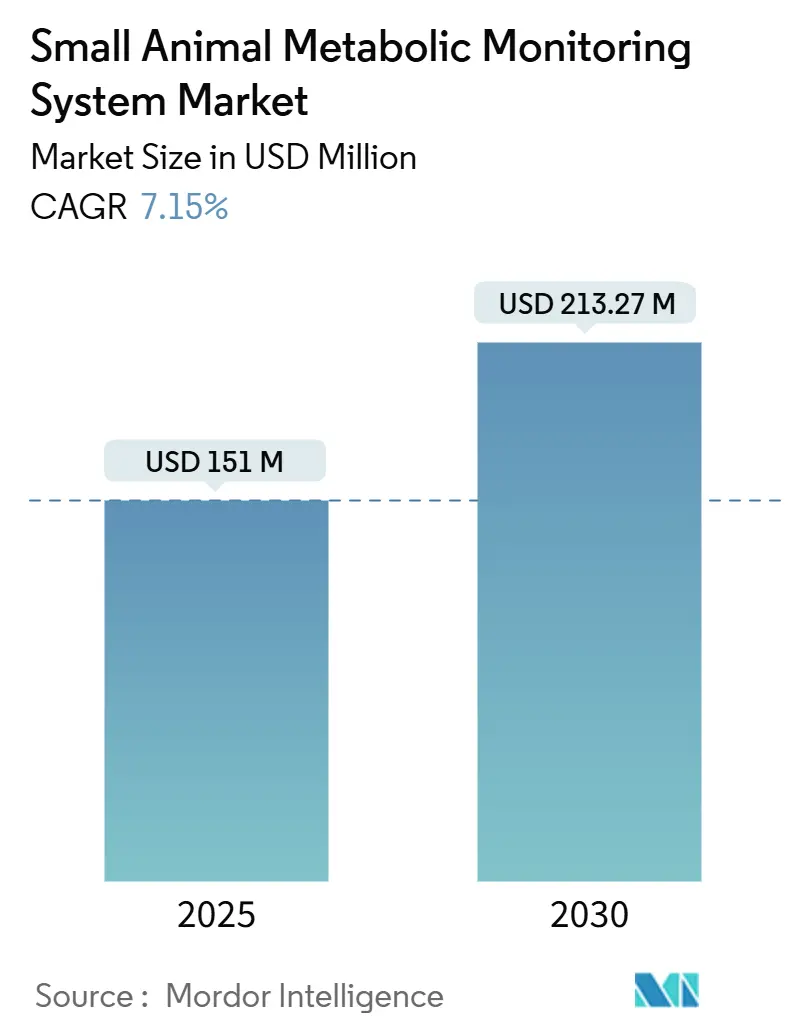
The Small Animal Metabolic Monitoring System Market size is estimated at USD 151 million in 2025, and is expected to reach USD 213.27 million by 2030, at a CAGR of 7.15% during the forecast period (2025-2030).
Momentum in the small animal metabolic monitoring system market stems from three mutually reinforcing dynamics outsourced pre-clinical studies, regulations that reward welfare-compliant home-cage platforms, and miniaturized sensors that capture 24-hour gas-exchange without restraining the animal. As contract research organizations (CROs) take on a larger slice of pharmaceutical pipelines, their purchasing power is steering vendors toward integrated service-plus-hardware offerings that simplify study start-up and data reporting. Funding commitments, notably the National Institutes of Health’s USD 49.1 billion request for fiscal 2025, maintain a reliable revenue stream for suppliers of indirect calorimetry and telemetry-ready cages used in obesity and diabetes models [1]NIH Staff, “FY 2025 Congressional Justification,” National Institutes of Health. At the same time, stable-isotope calorimetry and AI-driven behavior analytics are turning metabolic phenotyping into a data-rich decision tool for drug developers that want earlier insight into substrate utilization, energy balance, and welfare compliance.
Key Report Takeaways
- By product type, indirect calorimetry systems held 45.23% of the small animal metabolic monitoring system market share in 2024, while home-cage metabolic platforms are on track for the fastest 11.8% CAGR through 2030.
- By technology, open-circuit systems commanded 48.21% of the small animal metabolic monitoring system market size in 2024, whereas stable-isotope CO₂ calorimetry is forecast to expand at 14.1% CAGR to 2030.
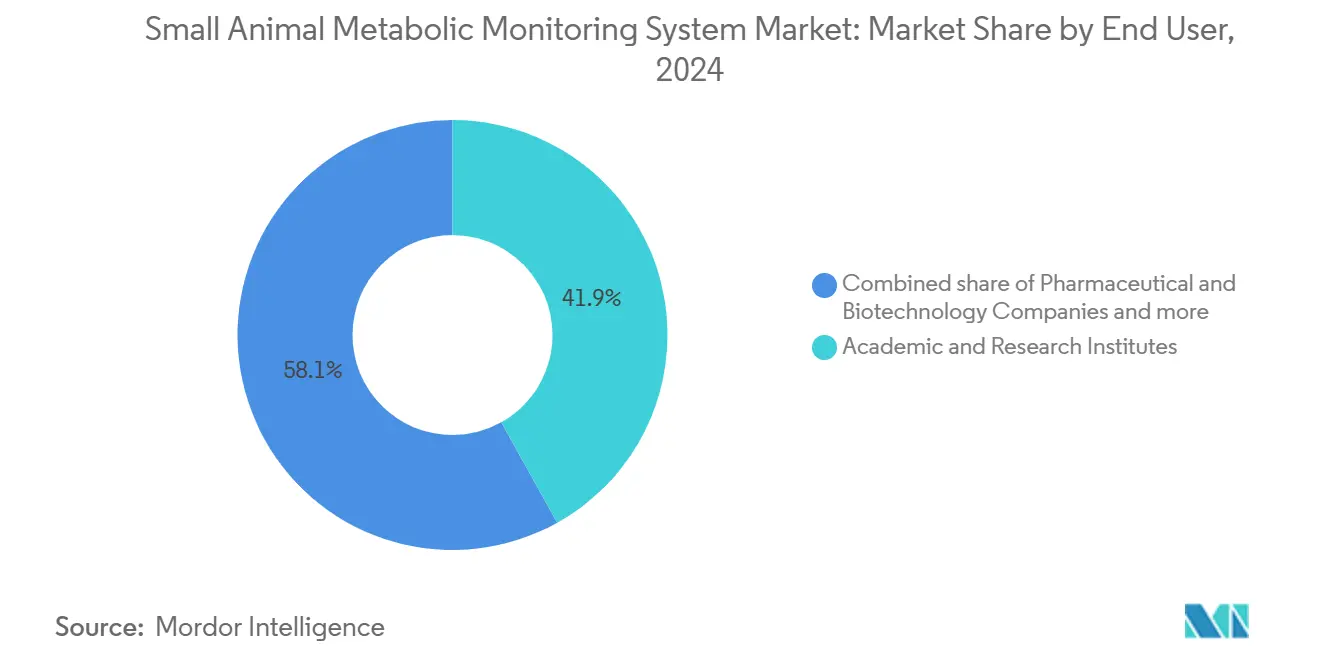
- By end user, academic and research institutes captured 41.90% of demand in 2024, while CRO facilities are advancing at a 10.20% CAGR on rising pharma outsourcing.
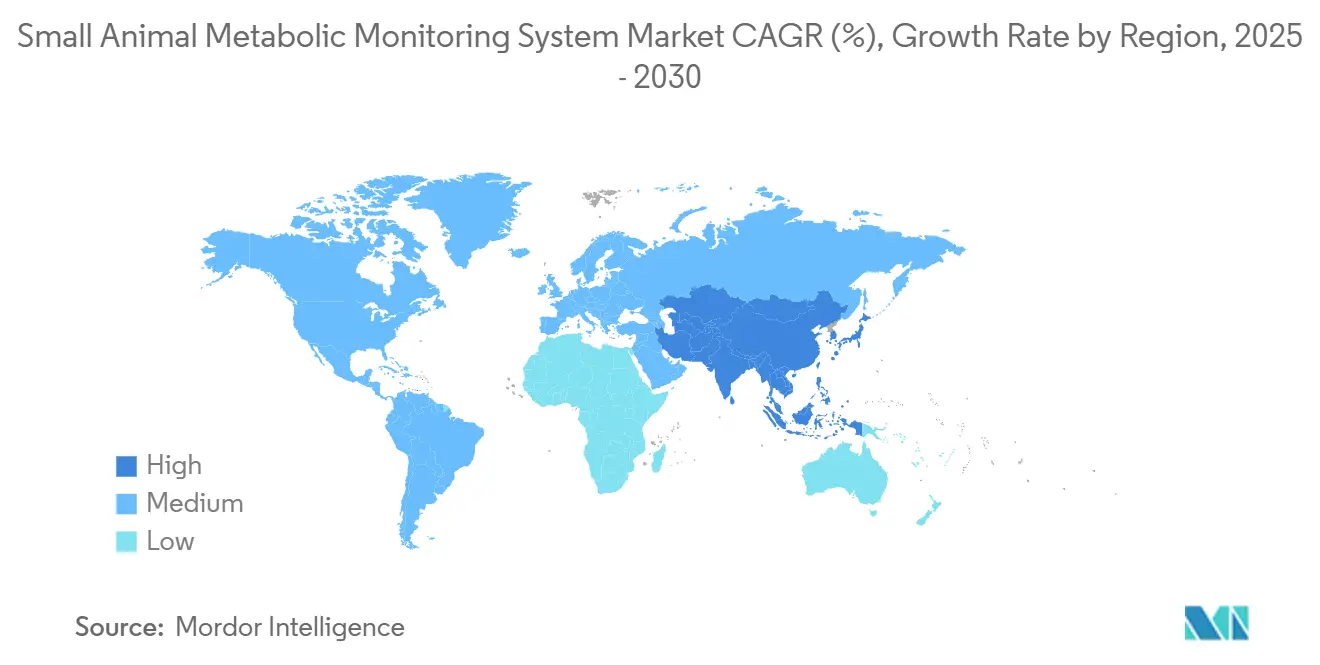
- By geography, North America led with 37.22% revenue in 2024; Asia-Pacific is projected to grow the fastest at 9.67% CAGR through 2030.
Note: Market size and forecast figures in this report are generated using Mordor Intelligence’s proprietary estimation framework, updated with the latest available data and insights as of January 2026.
Market Trends and Insights
Drivers Impact Analysis of Small Animal Metabolic Monitoring System Market*
| Driver | (~) % Impact on CAGR Forecast | Geographic Relevance | Impact Timeline |
|---|---|---|---|
| Mainstream R&D demand for rodent phenotyping platforms | +1.8% | Global, heavy in North America and Europe | Long term (≥ 4 years) |
| Pharma & biotech outsourcing to CRO vivaria | +2.1% | North America, Europe, Asia-Pacific | Medium term (2-4 years) |
| Sensor and automation advances in indirect calorimetry | +1.3% | Global | Medium term (2-4 years) |
| Stable-isotope calorimetry adoption for substrate-oxidation studies | +0.9% | North America, Europe | Long term (≥ 4 years) |
| Welfare-friendly smart home-cage systems cutting labor and energy | +1.5% | Europe, North America, spillover to Asia-Pacific | Short term (≤ 2 years) |
| ESG-driven demand-controlled ventilation cages | +0.7% | Europe, North America | Short term (≤ 2 years) |
| Source: Mordor Intelligence | |||
Mainstream R&D Demand for Rodent Phenotyping Platforms
The Mouse Metabolic Phenotyping Centers network gives federally funded investigators subsidized access to indirect calorimetry, body composition, and glucose assays, lowering entry barriers yet validating the utility of high-precision metabolic cages. NIH’s 2025 budget request prioritizes obesity and diabetes initiatives, firming up demand for open-circuit calorimetry and telemetry-ready platforms. Institutions competing for these grants pursue AAALAC accreditation, which favors automated home-cage monitoring over manual single-housing protocols [2]AAALAC International, “Guide for the Care and Use of Laboratory Animals,” . Gene-edited mouse lines covering rare mitochondrial and lysosomal disorders are increasing throughput needs, compelling facilities to invest in multi-chamber systems capable of terabyte-scale data capture. Together, these dynamics lengthen equipment refresh cycles and anchor the small animal metabolic monitoring system market to a stable, grant-backed customer base.
Pharma & Biotech Outsourcing to CRO Vivaria
Large drug sponsors have trimmed internal vivarium footprints, channeling pre-clinical metabolism studies to CROs that bill per project and maintain high-end calorimetry suites. Charles River Laboratories, Labcorp Drug Development, and Inotiv (via Envigo) each operate AAALAC-accredited rooms fitted with indirect calorimetry, telemetry, and behavior analytics, giving sponsors turn-key compliance without capital lock-up. PharmaLegacy’s 2024 acquisition of BTS Research and partnership with Catawba Research exemplify the scale play: more cages, broader geographies, and bundled regulatory expertise. As CROs consolidate, they negotiate fleet discounts and multi-year service contracts with vendors, shifting the small animal metabolic monitoring system market toward recurring revenue rather than one-off instrument sales. Emerging Asian clusters, notably Suzhou, compress supply chains by co-locating cage builders, sensor suppliers, and service providers, cutting lead times and fueling Asia-Pacific growth.
Sensor & Automation Advances in Indirect Calorimetry
Pull-mode respirometry, ppm-level gas resolution, and wireless telemetry are reshaping how researchers collect metabolic endpoints. TSE Systems’ PhenoMaster links respiration, feeding, and activity in one dashboard, while Sable Systems’ Promethion pushes sub-ppm CO₂ detection for fine-grained substrate studies. Columbus Instruments’ multiplexed Oxymax-CLAMS lowers per-cage sensor cost, bringing continuous monitoring into mid-sized budgets. Core body temperature, ECG, and blood pressure now flow into the same database via Data Sciences International implants, eliminating tethering stress. AI-enhanced video analytics further cut labor by automating behavior scoring, transforming metabolic studies from episodic snapshots into uninterrupted digital narratives.
Welfare-Friendly Smart Home-Cage Systems Cutting Labor/Energy
IntelliCage and similar RFID-enabled platforms let group-housed mice self-initiate cognitive or metabolic tasks, eliminating daily handling and reducing stress-linked variability. Tecniplast’s demand-controlled ventilation racks modulate airflow via ammonia sensors, cutting vivarium power bills by around half and qualifying for campus ESG funds. Europe’s 3Rs Working Party endorsed automated home-cage monitoring in March 2025, explicitly linking it to animal reduction and refinement goals. U.K. and Canadian regulators increasingly ask principal investigators to justify any single-housing longer than the absolute minimum, nudging facilities toward RFID-equipped group housing. Immediate cost savings and compliance benefits have accelerated purchase decisions slated for the next two budget cycles.
Restraints Impact Analysis of Small Animal Metabolic Monitoring System Market*
| Restraint | (~) % Impact on CAGR Forecast | Geographic Relevance | Impact Timeline |
|---|---|---|---|
| High capital and maintenance costs | -1.2% | Global, acute in emerging markets and small academic labs | Long term (≥ 4 years) |
| Strict welfare limits on prolonged single housing | -0.6% | Europe, North America | Medium term (2-4 years) |
| Data-management and analytics bottlenecks | -0.8% | Global | Short term (≤ 2 years) |
| Tariff volatility and localized sensor supply risk | -0.5% | Asia-Pacific, Latin America, spillover to North America | Short term (≤ 2 years) |
| Source: Mordor Intelligence | |||
High Capital & Maintenance Costs
A 32-cage indirect calorimetry suite with telemetry and video analytics can exceed USD 300,000, while annual service contracts add another 10–15% of purchase price. Smaller laboratories and emerging-market institutes often defer upgrades, relying on labor-intensive manual weighing that carries zero upfront cost but higher long-run variability. Import duties on precision gas sensors raise prices further in Latin America and parts of Southeast Asia, and limited local technicians force facilities to pay premium travel fees for calibration visits. Leasing and shared-core models soften the blow but impose scheduling constraints that conflict with multi-week studies. Without a disruptive price shift, capital intensity will keep the small animal metabolic monitoring system market segmented between high-resource institutions and cost-sensitive buyers.
Strict Welfare Limits on Prolonged Single Housing
European and North American regulators now classify extended single housing as a refinement requiring explicit justification, adding weeks to study approvals and constraining classic metabolic cage protocols. RFID-based group-housing systems alleviate the issue but cost USD 20,000–50,000 more per cage row and demand staff training to interpret social-interaction artifacts. The European Commission’s 2024 workshop on phasing out animal tests for chemical safety signals a gradual tightening of standards, making legacy single-housing equipment a depreciating asset. Academic investigators increasingly run power analyses to demonstrate that any single-housing duration is indispensable, adding administrative friction that discourages exploratory projects and slows replacement cycles in the small animal metabolic monitoring system market.
*Our forecasts treat driver/restraint impacts as directional, not additive. The impact forecasts reflect baseline growth, mix effects, and variable interactions.
Small Animal Metabolic Monitoring System Market Segment Analysis
By Product Type:
Home-Cage Platforms Extend Welfare ComplianceHome-cage platforms generated 11.8% annual growth through 2030, surpassing the overall small animal metabolic monitoring system market. Indirect calorimetry chambers still supplied 45.23% revenue in 2024, underscoring a large installed base, yet procurement committees now favor integrated home-cage systems that pair gas-exchange data with RFID tracking to satisfy welfare audits. Modular metabolic cages remain a niche for thermoneutrality or hypoxia studies, but commoditization limits differentiation. Telemetry-integrated rigs command premium invoices because cardiovascular readouts enrich safety pharmacology datasets, a feature CRO sponsors value. Software ecosystems are the new battleground as facilities demand automated quality checks, circadian analytics, and cloud dashboards that slash technician time. Commercial suites such as TSE LabMaster offer turnkey analysis, while open-source alternatives like CalR help academic users avoid proprietary lock-in. Over the depreciation horizon, facilities replacing end-of-life units overwhelmingly choose home-cage-compatible models even at a 25% higher tag, swelling the small animal metabolic monitoring system market.
A rising share of procurement RFPs stipulate energy-saving ventilation and AI behavior modules, reflecting both ESG targets and reduced staffing budgets. Vendors package these add-ons into tiered subscription models, aligning cost with grant cycles rather than capital budgets. Smaller Asian manufacturers exploit local sensor supply to undercut incumbents on entry-level cages, prompting global brands to introduce stripped-down variants aimed at price-sensitive buyers. The resulting product ladder widens access yet preserves high-margin tiers loaded with advanced analytics—a balance that keeps value growth in line with volume expansion inside the small animal metabolic monitoring system market.




By Technology:
Isotope Methods Expand Mechanistic ResolutionOpen-circuit indirect calorimetry retained 48.21% revenue in 2024, reflecting decades of protocol validation, but stable-isotope calorimetry’s 14.1% CAGR highlights escalating mechanistic demands in drug development. Direct and combined calorimetry chambers hold specialized appeal for thermogenesis studies yet carry higher complexity and cost. Non-invasive IR sensors support large-scale screens, but lack GLP acceptance.
Hybrid instrument lines integrating isotope sampling ports into conventional respirometry cages cut study time and animal use, speeding sponsor timelines. Academic labs gravitate to shared isotope cores to offset mass-spectrometry expenses, broadening the user base beyond pharma. Equipment makers bundle SOP libraries and statistical templates with hardware, flattening the learning curve that once hindered isotope adoption. As guidance documents crystallize, the small animal metabolic monitoring system market will likely see further convergence between indirect gas exchange and isotope workflows.
By End User:
CROs Accelerate Outsourcing ShiftAcademic institutes consumed 41.90% of 2024 demand, but a 10.20% CAGR for CROs through 2030 puts fee-for-service providers on a steeper trajectory. CROs monetize equipment across multiple clients, justifying rapid adoption of home-cage and isotope technologies that a single pharma site may not amortize efficiently. Large sponsors also pivot toward asset-light models, redirecting vivarium budgets to discovery or clinical projects. The small animal metabolic monitoring system market size tied to CROs is set to outpace overall growth as master service agreements lock in recurring revenue.
Academic cores remain method-development hubs, leveraging grant funding to beta-test new sensor modules and open-source analytics. Yet age-critical equipment replacement often lags because capital budgets face competing priorities. Pharmaceutical firms maintain selective in-house rigs for proprietary models but increasingly outsource confirmatory studies to CROs with global AAALAC accreditation. Vendor account managers now dedicate separate playbooks for CRO versus academic segments, each with tailored financing and support packages.
Geography Analysis
North America Small Animal Metabolic Monitoring System Market
North America contained 37.22% of 2024 revenues, supported by NIH grant structures that reward AAALAC-accredited facilities and sustain indirect calorimetry cores. U.S. CRO density delivers rapid study start-up, while proximity to Sable Systems and Columbus Instruments ensures swift technical fixes. Canada’s welfare guidelines further elevate demand for group-housing-ready cages, even at a higher price point. Mexico’s expanding CRO corridor absorbs entry-level units, though tariff unpredictability tempers near-term acceleration.
APAC Small Animal Metabolic Monitoring System Market
Asia-Pacific is forecast for a 9.67% CAGR as China’s USD 3 billion biotech spend and roughly 20 million annual rodent usage translate into modern vivarium buildouts. Suzhou’s cluster merges equipment vendors, CROs, and model breeders into a localized ecosystem that compresses lead times. Singapore’s Project RESET, a four-year tie-up between Agilent and the National University of Singapore, positions the city-state as a translational metabolism hub, driving demand for isotope and mass-spec compatible cages. Japan’s rigorous animal-welfare codes stimulate home-cage purchases, whereas India’s growth remains gradual amid fragmented oversight.
EMEA and LATAM Small Animal Metabolic Monitoring System Market
Europe balances academic funding strength against Directive 2010/63/EU’s push toward non-animal methods, creating mixed signals for the small animal metabolic monitoring system market. Germany, the United Kingdom, and France account for most spending, yet updated EMA guidance endorses automated home-cage monitoring as a welfare refinement, adding near-term tailwinds. Long-run uncertainty arises from the European Commission’s phase-out roadmap, which could shrink toxicology applications after 2028. Middle East and Africa markets stay nascent but are buoyed by Saudi and UAE biomedical initiatives. Latin America’s gradual progress is hindered by currency risks; leasing models, not outright purchases, dominate tender requests.

Competitive Landscape
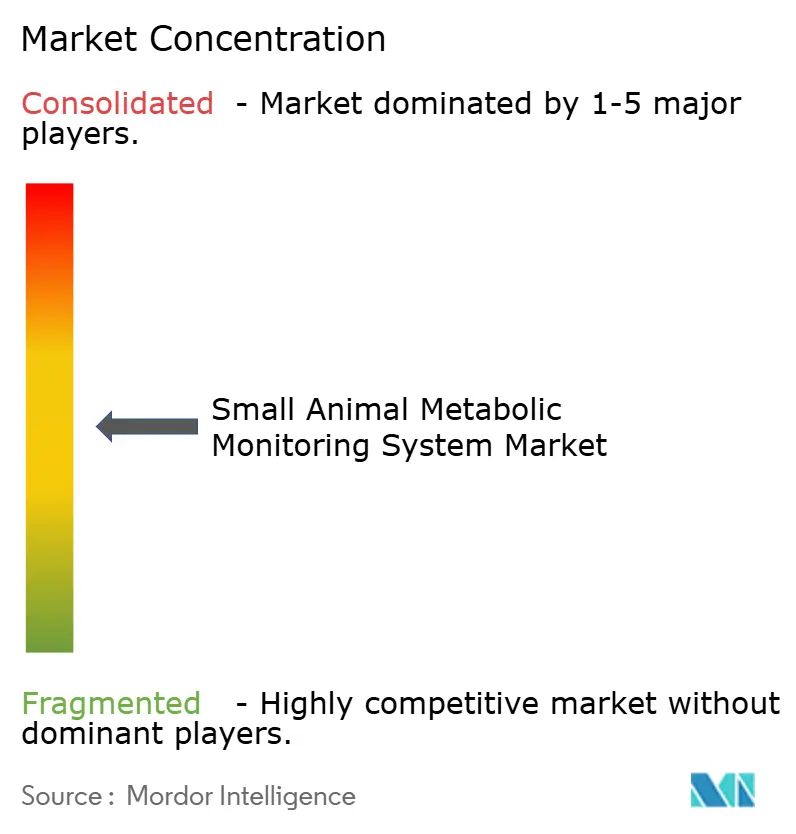
The small animal metabolic monitoring system market is moderately fragmented, with the four leading brands capturing majority of global revenue. TSE Systems, Tecniplast, Sable Systems International, and Columbus Instruments differentiate on modularity, integrated telemetry, and welfare-centric ventilation that halves energy use. New entrants from China, such as Shanghai TOW Intelligent Technology, leverage domestic sensor supply and lower labor costs to under-price established offerings, especially in entry-level academia.
Software innovation drives the latest bidding wars. Vendors embed AI algorithms that flag outlier breath data, automate circadian analysis, and push real-time dashboards to investigators’ phones, reducing technician oversight hours by up to 40%. Integrated service contracts bundle hardware, calibration gases, sensor replacements, and analytics subscriptions, smoothing revenue and locking customers into multiyear terms aligned with CRO study calendars.
Small Animal Metabolic Monitoring System Industry Leaders
TSE Systems GmbH
Columbus Instruments, LLC.
Sable Systems International
Shanghai TOW Intelligent Technology Co., Ltd
TECNIPLAST S.p.A
- *Disclaimer: Major Players sorted in no particular order
Small Animal Metabolic Monitoring System Market Companies Covered in this Report
- Bruker
- Columbus Instruments, LLC.
- Harvard Bioscience
- Lab Products, llc.
- Orchid Scientific & Innovative India Private Limited.
- PhenoSys GmbH
- PLEXX B.V.
- Sable Systems International
- Shanghai TOW Intelligent Technology Co., Ltd
- TECNIPLAST S.p.A
- TSE Systems GmbH
- UGO BASILE SRL
- UNO Life Science Solutions
- Zoonlab GmbH

Recent Industry Developments in Small Animal Metabolic Monitoring System Market
- January 2025: The European Parliament implemented live telemetry requirements for all inter-facility rodent transports, raising demand for DVC-equipped carrier cages
- October 2024: Agilent Technologies and the National University of Singapore launched a four-year Center of Excellence in Cell Metabolism, integrating isotope-ratio mass spectrometry with high-throughput calorimetry.
- October 2024: PharmaLegacy Laboratories partnered with Catawba Research to streamline global pre-clinical development workflows


Global Small Animal Metabolic Monitoring System Market Report Scope
According to the report's scope, small animal metabolic monitoring systems are utilized in biomedical and preclinical research to measure metabolic parameters in small laboratory animals. These systems help researchers understand energy balance, metabolic diseases, drug effects, and physiological responses under controlled conditions.
The small animal metabolic monitoring systems market is segmented by product type, technology, end user, and geography. By product type, the market is segmented into indirect calorimetry systems, home-cage metabolic monitoring platforms, modular metabolic cages & accessories, telemetry-integrated systems, and software & analytics suites. By technology, it is segmented into open-circuit indirect calorimetry, direct & combined calorimetry, stable-isotope co₂ calorimetry, and non-invasive sensor-based monitoring. By end user, the segmentation includes academic & research institutes, pharmaceutical & biotechnology companies, and contract research organizations (CROs). Geographically, the market is segmented across North America, Europe, the Asia-Pacific region, the Middle East & Africa, and South America. The market report also covers the estimated market sizes and trends for 17 countries across major regions globally. For each segment, the market size and forecast are provided in terms of value (USD).
| Indirect Calorimetry Systems |
| Home-Cage Metabolic Monitoring Platforms |
| Modular Metabolic Cages & Accessories |
| Telemetry-Integrated Systems |
| Software & Analytics Suites |
| Open-Circuit Indirect Calorimetry |
| Direct & Combined Calorimetry |
| Stable-Isotope CO₂ Calorimetry |
| Non-Invasive Sensor-Based Monitoring |
| Academic & Research Institutes |
| Pharmaceutical & Biotechnology Companies |
| Contract Research Organizations (CROs) |
| North America | United States |
| Canada | |
| Mexico | |
| Europe | Germany |
| United Kingdom | |
| France | |
| Italy | |
| Spain | |
| Rest of Europe | |
| Asia-Pacific | China |
| Japan | |
| India | |
| Australia | |
| South Korea | |
| Rest of Asia-Pacific | |
| Middle East and Africa | GCC |
| South Africa | |
| Rest of Middle East and Africa | |
| South America | Brazil |
| Argentina | |
| Rest of South America |
| By Product Type | Indirect Calorimetry Systems | |
| Home-Cage Metabolic Monitoring Platforms | ||
| Modular Metabolic Cages & Accessories | ||
| Telemetry-Integrated Systems | ||
| Software & Analytics Suites | ||
| By Technology | Open-Circuit Indirect Calorimetry | |
| Direct & Combined Calorimetry | ||
| Stable-Isotope CO₂ Calorimetry | ||
| Non-Invasive Sensor-Based Monitoring | ||
| By End User | Academic & Research Institutes | |
| Pharmaceutical & Biotechnology Companies | ||
| Contract Research Organizations (CROs) | ||
| By Geography | North America | United States |
| Canada | ||
| Mexico | ||
| Europe | Germany | |
| United Kingdom | ||
| France | ||
| Italy | ||
| Spain | ||
| Rest of Europe | ||
| Asia-Pacific | China | |
| Japan | ||
| India | ||
| Australia | ||
| South Korea | ||
| Rest of Asia-Pacific | ||
| Middle East and Africa | GCC | |
| South Africa | ||
| Rest of Middle East and Africa | ||
| South America | Brazil | |
| Argentina | ||
| Rest of South America | ||


Key Questions Answered in the Report
What is the current value of the small animal metabolic monitoring system market?
The market stands at USD 151 million in 2025 and is on course to reach USD 213.27 million by 2030.
Which product category is growing the fastest?
Home-cage metabolic platforms are expanding at 11.8% CAGR because they satisfy new welfare and ESG requirements.
Why are CROs important to future demand?
CROs are scaling vivarium capacity and buying integrated calorimetry suites to support pharma’s outsourcing drive, growing at 10.20% CAGR through 2030.
Which region offers the highest growth potential?
Asia-Pacific shows the strongest trajectory with a 9.67% CAGR, propelled by China’s biotech investment and clustered supply chains.
Page last updated on:





