
Skin Biopsy Devices Market Size and Share
Market Overview
| Study Period | 2020 - 2031 |
|---|---|
| Market Size (2026) | USD 2.99 Billion |
| Market Size (2031) | USD 4.10 Billion |
| Growth Rate (2026 - 2031) | 6.52 % |
| Fastest Growing Market | Asia-Pacific |
| Largest Market | North America |
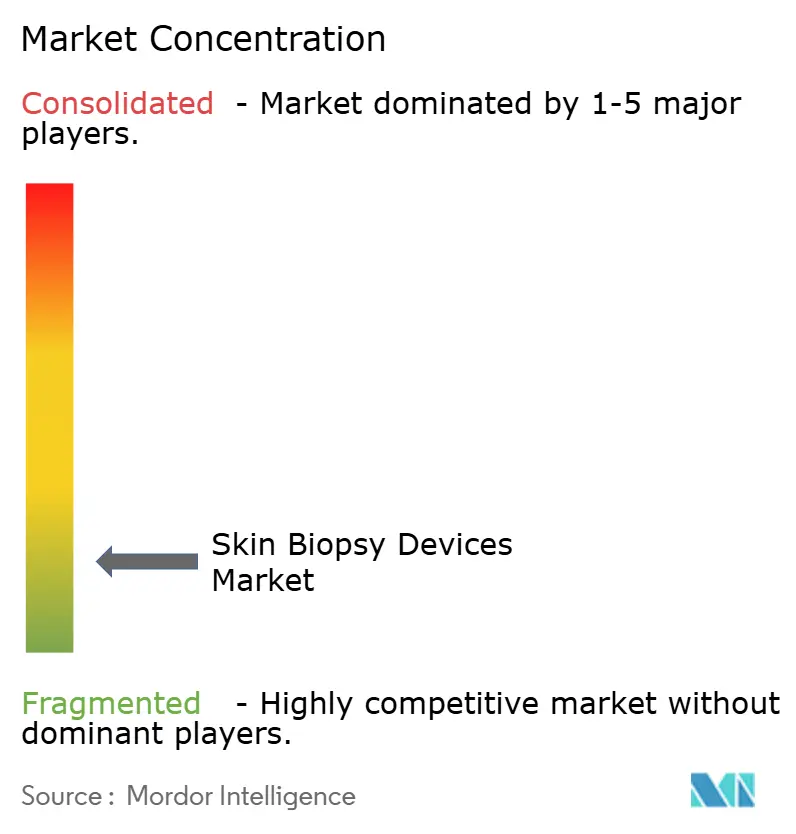
| Market Concentration | Low |
Major Players *Disclaimer: Major Players sorted in no particular order Image © Mordor Intelligence. Reuse requires attribution under CC BY 4.0. | |
Skin Biopsy Devices Market Analysis by Mordor Intelligence
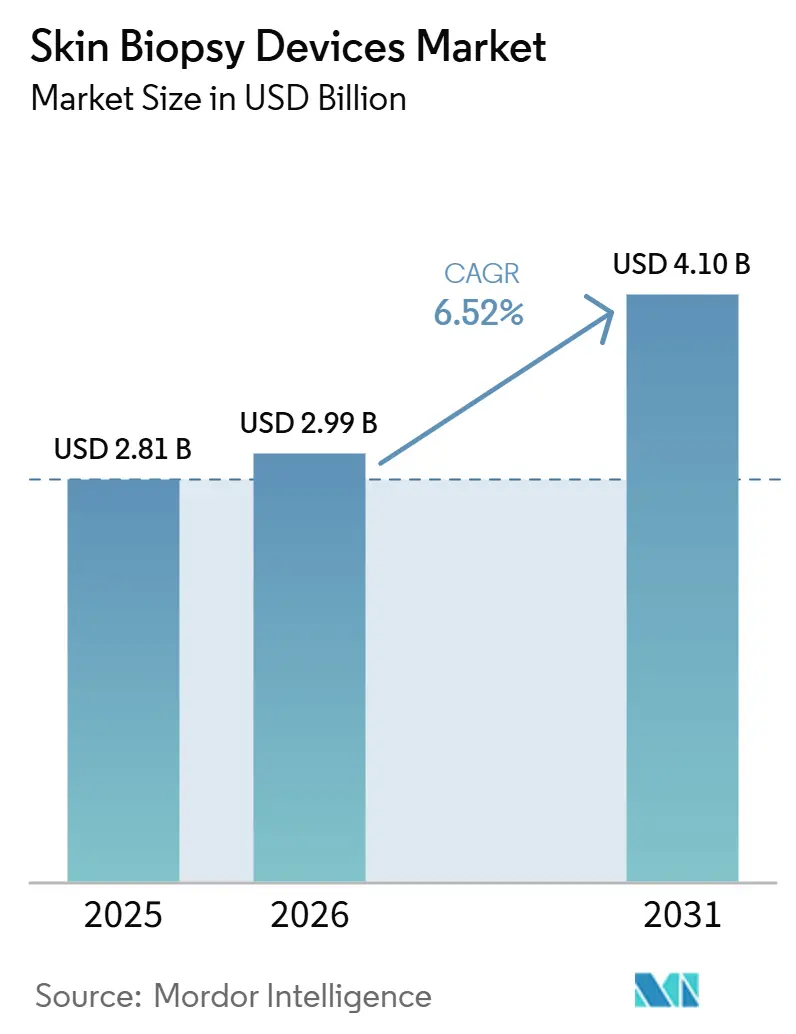
The Skin Biopsy Devices Market size is expected to increase from USD 2.81 billion in 2025 to USD 2.99 billion in 2026 and reach USD 4.10 billion by 2031, growing at a CAGR of 6.52% over 2026-2031.
The current pace of expansion reflects a clear move in dermatology practice, where clinicians are using tissue confirmation earlier instead of delaying decisions through watchful observation. AI-assisted dermatopathology is improving specimen throughput, which lowers the operational drag from pathology backlogs and supports more consistent ordering behavior in the skin biopsy devices market. Outpatient-first care delivery is also changing where procedures are performed, as ambulatory and clinic settings gain importance and shift buying power away from large hospital procurement channels toward smaller and more fragmented buyers in the skin biopsy devices market. The competitive picture remains split between relatively open device manufacturing and increasingly consolidated downstream pathology infrastructure, which gives digital workflow owners more leverage over specimen routing and ecosystem lock-in.
Key Report Takeaways
- By type, punch biopsy held 34.31% share in 2025, while needle biopsy is projected to expand at a 10.38% CAGR through 2031.
- By device, biopsy punches and curettes accounted for 33.44% share in 2025, while guidance systems are forecast to grow at a 9.52% CAGR through 2031.
- By indication, skin cancer represented 42.24% share in 2025 and is expected to record the fastest growth at a 10.52% CAGR through 2031.
- By end user, hospitals held 46.26% share in 2025, while diagnostic laboratories are projected to advance at a 9.95% CAGR through 2031.
- By geography, North America accounted for 38.61% share in 2025, while Asia-Pacific is forecast to expand at a 10.65% CAGR through 2031.
Note: Market size and forecast figures in this report are generated using Mordor Intelligence’s proprietary estimation framework, updated with the latest available data and insights as of January 2026.
Market Trends and Insights
Drivers Impact Analysis of Skin Biopsy Devices Market*
| Driver | (~) % Impact on CAGR Forecast | Geographic Relevance | Impact Timeline |
|---|---|---|---|
| Rising Skin Cancer And Melanoma Burden | +2.1% | Global, with peak concentration in North America and Europe | Long term (≥ 4 years) |
| Shift Toward Minimally Invasive Dermatology Diagnostics | +1.5% | North America, Western Europe, APAC core | Medium term (2-4 years) |
| AI-Assisted Pathology And Digital Slide Review Adoption | +1.0% | North America, Germany, South Korea, Australia | Medium term (2-4 years) |
| Rising Ambulatory Dermatology And Outpatient Biopsy Volumes | +0.8% | North America, Western Europe, Urban APAC | Short term (≤ 2 years) |
| Teledermatology-Enabled Biopsy Triage And Referral Capture | +0.6% | UK, Ireland, Nordic, Rural North America, spill-over to GCC | Medium term (2-4 years) |
| Source: Mordor Intelligence | |||
Rising Skin Cancer And Melanoma Burden
Escalating melanoma incidence remains the most durable structural support for the skin biopsy devices market. GLOBOCAN 2024 estimated 337,969 new melanoma cases worldwide and 58,398 deaths, with Europe alone accounting for 150,781 cases, or 44.6% of global incidence. IARC also reported in May 2025 that more than 80% of global melanoma cases were attributable to ultraviolet radiation exposure, which makes future case generation more predictable across aging and outdoor-exposed populations. The WHO Global Status Report on Cancer 2026 said rising case volumes are outpacing diagnostic capacity in many health systems, which strengthens the role of biopsy-based confirmation when imaging alone cannot close the diagnostic gap. This keeps biopsy tools positioned as core clinical instruments rather than optional upgrades within the skin biopsy devices market. It also means that demand is being supported by disease burden itself, not only by technology adoption or procurement cycles.
Shift Toward Minimally Invasive Dermatology Diagnostics
Patient preference and clinic economics are both moving procedures toward smaller-footprint biopsy techniques in the skin biopsy devices market. A 2025 review in Frontiers in Medicine noted that punch and needle methods reduce anesthesia needs, limit wound area, and allow multi-site sampling during a single outpatient visit, which supports higher per-encounter device use. A 2025 study in the Egyptian Journal of Medicine found that 2.5 mm punch biopsies still produced diagnostically sufficient tissue while reducing patient discomfort compared with larger punches. The April 2026 launch of the Harpera microbiopsy punch showed how the design frontier is moving toward sub-millimeter sampling that avoids sutures and shortens recovery time. Smaller instruments also create a recurring demand stream for accessories and consumables, which adds another layer of support to the skin biopsy devices market. A relatively accessible 510(k) pathway for biopsy instruments further helps companies bring iterative design improvements to market faster than they could through a more novel regulatory route.
AI-Assisted Pathology And Digital Slide Review Adoption
AI-assisted pathology is reducing one of the main throughput limits in the skin biopsy devices market, which is the speed at which biopsy specimens can be reviewed and reported. PathAI presented research at USCAP 2025 showing that U.S. skin biopsy volume is increasing at 6% annually while the active dermatopathologist workforce is only around 1,100 practitioners. The company also launched PathAssist Derm in 2025 on the AISight system, and the tool can predict the presence of 17 skin entities that together cover more than 95% of standard dermatopathology specimen volumes. Helmholtz Munich reported in 2025 that HistoGPT was trained on 15,129 whole-slide images from 6,705 dermatology patients and can generate pathology reports from full-resolution histology images[1]Helmholtz Munich, “HistoGPT, Advancing AI-Powered Pathology Reporting In Dermatopathology,” Helmholtz Munich, helmholtz-munich.de. As slide triage, orientation, lesion detection, and report generation improve, clinicians have less reason to delay procedures because of downstream backlog risk in the skin biopsy devices market. This creates a reinforcing loop where faster pathology review supports more biopsy ordering and more specimen flow.
Rising Ambulatory Dermatology And Outpatient Biopsy Volumes
The migration of dermatology procedures into outpatient and ambulatory settings is changing both demand channels and buying behavior in the skin biopsy devices market. CMS approved 537 total procedures for the ambulatory surgical center setting for calendar year 2026, and the CY 2026 Medicare payment rate for ASC procedures stands at USD 750.50. MedPAC also reported that ambulatory surgical center activity continues to expand, which supports stable procedural economics outside the hospital campus. As more biopsies are collected in clinics and ASCs, procurement decisions move away from hospital group purchasing systems and into smaller practice-level budgets across the skin biopsy devices market. That fragmentation opens room for specialty manufacturers that can compete on speed, product focus, and service rather than only on scale. It also explains why diagnostic laboratories are gaining momentum, because a higher share of outpatient specimens is being routed to independent and regional pathology operators rather than hospital departments.
Restraints Impact Analysis of Skin Biopsy Devices Market*
| Restraint | (~) % Impact on CAGR Forecast | Geographic Relevance | Impact Timeline |
|---|---|---|---|
| High Procedure And Post-Procedure Cost Burden | -1.3% | United States, South America, Rest of APAC (out-of-pocket markets) | Medium term (2-4 years) |
| Limited Specialist Capacity For Biopsy And Histopathology | -0.8% | Nonmetropolitan North America, Rural APAC, MEA | Long term (≥ 4 years) |
| Variable Reimbursement And Device Procurement Friction | -0.6% | Global, with acute impact in South America, Rest of APAC, and MEA | Medium term (2-4 years) |
| Source: Mordor Intelligence | |||
High Procedure And Post-Procedure Cost Burden
Procedure affordability remains a meaningful constraint on procedure conversion in the skin biopsy devices market. The cost of a single biopsy encounter often exceeds USD 400 once pathology charges are added, and pathology under CPT 88305 averaged USD 182, which means multi-lesion visits can quickly produce several separate charges. A 2024 Journal of the American Academy of Dermatology analysis found reimbursement pressure on pathology costs while patient out-of-pocket burden moved in the opposite direction, which reinforces the strain on cost-sensitive settings. In South America and parts of Southeast Asia, out-of-pocket payment still acts as a direct access barrier, which suppresses actual utilization even when clinical need is present. Capital spending friction adds another layer, because health systems under budget pressure often favor consumable restocking over higher-cost guidance systems or digital pathology platforms. This makes the skin biopsy devices market more volume-sensitive in lower-income settings and more exposed to payer policy changes in developed ones.
Limited Specialist Capacity For Biopsy And Histopathology
Workforce shortages place a structural ceiling on procedural growth in the skin biopsy devices market. The ASCP said in September 2025 that the United States will need 3,000 additional pathologists by 2037, while HRSA projected a shortage of 4,230 pathology full-time equivalents by the same year[2]American Society of Clinical Pathology, “ASCP Deepens Commitment To Pathologist Workforce Development,” American Society of Clinical Pathology, ascp.org. A 2025 Journal of the American Academy of Dermatology cross-sectional study also found that dermatologist density remained below the recommended threshold and that nonmetropolitan areas face especially uneven access. Even where devices are available, the number of procedures that can be ordered, performed, and interpreted still depends on the availability of trained staff. AI tools can ease some of the downstream reading burden, but they do not fully solve the front-end shortage of clinicians who collect samples. This leaves the skin biopsy devices market with a clear execution gap between visible epidemiological demand and the number of billable procedures that systems can actually absorb.
*Our forecasts treat driver/restraint impacts as directional, not additive. The impact forecasts reflect baseline growth, mix effects, and variable interactions.
Skin Biopsy Devices Market Segment Analysis
By Type, Minimally Invasive Techniques Reshape Procedure Mix
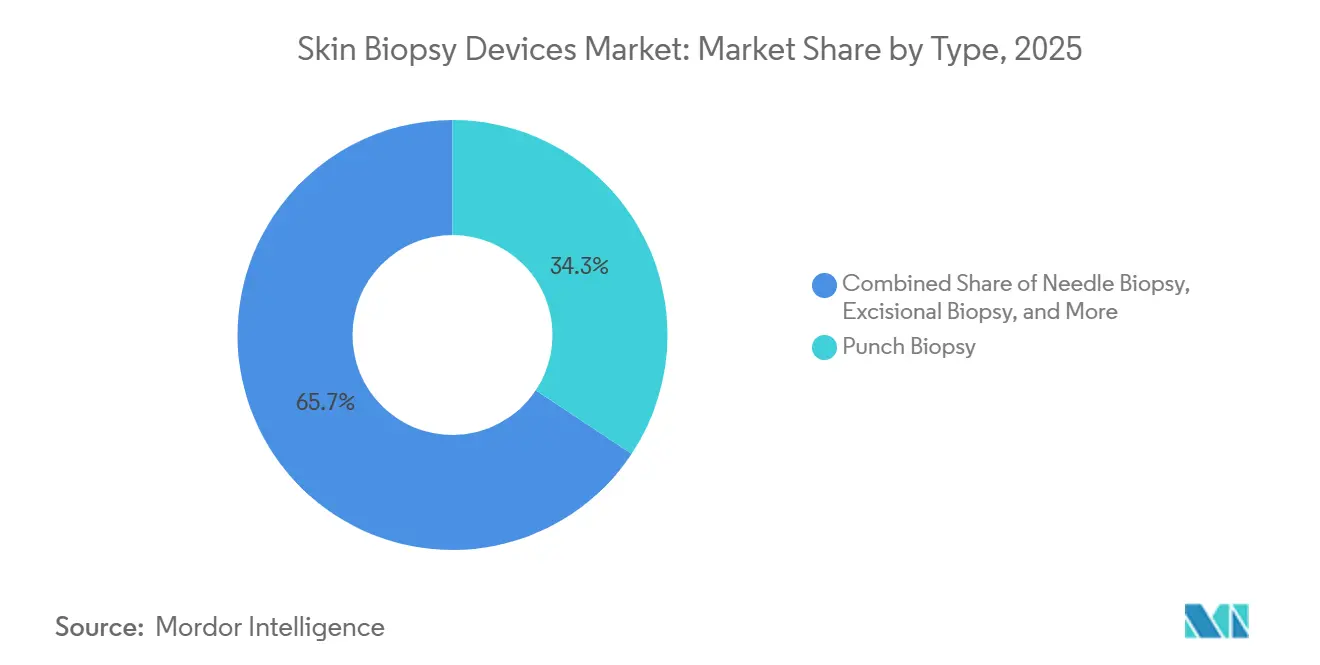
Punch biopsy accounted for 34.31% of the skin biopsy devices market size in 2025, which made it the leading procedure type in the skin biopsy devices market. Its position reflects broad clinical use across inflammatory dermatoses, non-melanoma skin cancers, and uncertain lesions that require full-thickness sampling. The technique captures epidermis, dermis, and superficial subcutis in a single pass, which keeps it clinically useful when lesion architecture matters to diagnosis. That practical versatility supports repeat use across both routine dermatology visits and more suspicious lesion workups.
Needle biopsy is the fastest-growing type, with skin biopsy devices market size for this category projected to expand at a 10.38% CAGR through 2031. Growth is tied to maturing ultrasound guidance that helps clinicians reach deeper skin and subcutaneous lesions without relying on hospital-grade imaging infrastructure. The 2025 IEEE EMBC publication on an automatic punch biopsy device with simultaneous wound closure also showed that procedure automation is moving forward within the skin biopsy devices industry, especially in areas where ease of use and faster turnover matter[3]IEEE Engineering in Medicine and Biology Conference, “A Device For Automatic Punch Biopsy And Simultaneous Wound Closure,” IEEE EMBC 2025, doi.org. Shave biopsy remains useful for superficial lesions, but it faces pressure as clinicians increasingly favor full-thickness sampling for more definitive histopathology. Excisional and incisional biopsy will continue to serve specific roles for small suspicious lesions and larger lesions, and their mix will remain closely linked to melanoma staging and procedural reimbursement.



By Device, Guidance Systems Lead The Next Growth Wave
Biopsy punches and curettes represented 33.44% of 2025 value, which kept them at the core of the skin biopsy devices market because they are familiar, low-cost, and used in large disposable volumes. Their demand base remains durable because they fit routine clinic workflows and do not depend on capital budgets or specialized training in the same way as advanced platforms. This part of the skin biopsy devices market also benefits from regular replenishment cycles, which gives distributors and manufacturers a steady revenue stream. As a result, even when attention shifts to innovation, the underlying unit demand for simple instruments remains firm.
Guidance systems are the fastest-growing device category at a 9.52% CAGR through 2031, reflecting the move toward image-confirmed and operator-supportive procedures in the skin biopsy devices market. High-frequency ultrasound above 20 MHz is increasingly used for skin evaluation, and published work in 2025 reinforced its value in dermatologic surgery and lesion characterization. A 2026 Ultrasonography study described the HUMaN handheld ultrasound system with magnetic needle navigation and sub-millimeter mean accuracy, which points to more point-of-care guidance options as the skin biopsy devices market evolves. Better guidance reduces operator variability and improves specimen adequacy, which matters when clinics want more reliable sampling without adding major workflow complexity. Accessories and consumables linked to specimen handling also remain attractive, because traceability and workflow documentation are becoming more important across the skin biopsy devices industry.
By Indication, Skin Cancer Anchors Demand Across Procedure Types
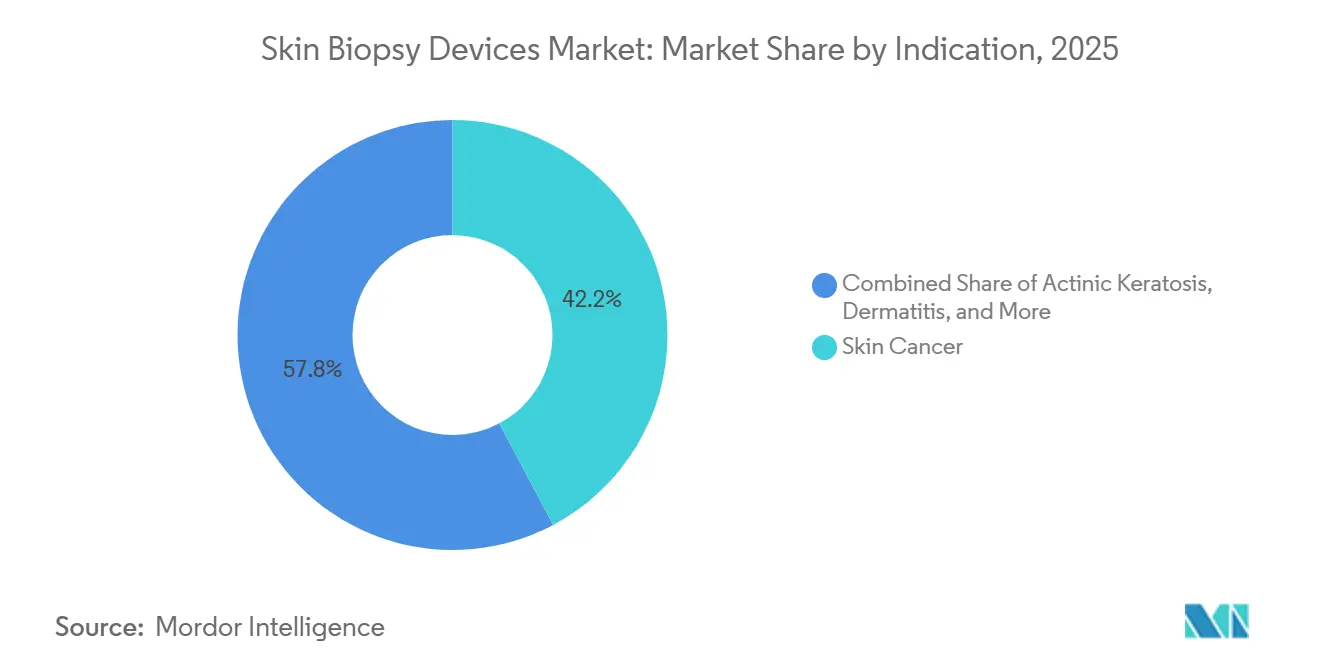
Skin cancer accounted for 42.24% of the skin biopsy devices market size in 2025, and it is also the fastest-growing indication in the skin biopsy devices market at a 10.52% CAGR through 2031. That rare overlap between largest share and fastest growth shows how much demand is centered on malignancy workups rather than on lower-acuity lesion categories. GLOBOCAN 2024 reported 337,969 new melanoma cases globally, and IARC said in 2025 that ultraviolet radiation drives more than 80% of melanoma cases, which supports sustained diagnostic need in exposed and aging populations. In the skin biopsy devices market, this makes cancer-related sampling less discretionary than many other dermatology procedures. It also means product development is more likely to prioritize sampling precision, lesion depth control, and diagnostic confidence.
Actinic keratosis and dermatitis form an important secondary demand pool in the skin biopsy devices market because both conditions still require tissue confirmation in selected cases. Actinic keratosis remains especially relevant in UV-exposed populations, where surveillance for malignant transformation supports recurring procedural need. Psoriasis biopsies play a narrower role and are used more often when the clinical picture is atypical or uncertain. Skin infection biopsies are usually simpler and lower cost, which keeps demand concentrated in single-use instruments rather than advanced platforms. The overall result is a layered indication mix where oncology-led growth shapes innovation priorities while inflammatory and infectious conditions preserve baseline procedural volume.
By End User, Diagnostic Laboratories Are Emerging As Structural Disruptors
Hospitals held 46.26% of the skin biopsy devices market share in 2025, which kept them as the largest end-user group in the skin biopsy devices market. Their lead reflects concentration of complex cases, higher-acuity dermatology, and procurement contracts that favor established suppliers. Hospitals also remain the main setting for excisional and incisional procedures that need greater surgical support. This gives them continuing importance even as outpatient care expands.
Diagnostic laboratories are the fastest-growing end-user segment, with a 9.95% CAGR through 2031 in the skin biopsy devices market. As more samples are collected in dermatology clinics and ambulatory centers, histopathology work is increasingly routed to independent and regional laboratories rather than to hospital pathology departments. That shift raises the strategic weight of workflow capacity, specimen logistics, and digital pathology integration in the skin biopsy devices market. Dermatology clinics are growing as an ordering channel, but their share is still limited by lower per-site procedure volumes and tighter purchasing budgets. Ambulatory surgical centers are also gaining ground as CMS continues to support ASC procedure coverage, which pushes specimen flow outward from hospital campuses and strengthens the role of labs that can scale efficiently.
Geography Analysis
North America Skin Biopsy Devices Market
North America held 38.61% of the skin biopsy devices market share in 2025, which made it the largest regional contributor to the skin biopsy devices market. The region benefits from established reimbursement structures, a dense ambulatory surgical center network, and a very high burden of skin cancer diagnosis. CMS set the 2026 payment rate for ambulatory surgical center procedures at USD 750.50, which supports continued procedural economics and device procurement in outpatient settings. The U.S. FDA also reclassified optical diagnostic devices for melanoma from Class III to Class II under special controls in April 2026, which opens a more practical 510(k) pathway for adjunctive tools that will still rely on confirmatory biopsy. Canada adds stability through coverage for medically necessary biopsy procedures, while Mexico is expanding the role of private dermatology channels.
Europe Skin Biopsy Devices Market
Europe remains the second-largest regional block in the skin biopsy devices market and carries the highest share of global melanoma incidence. GLOBOCAN 2024 showed that Europe accounted for 150,781 new melanoma cases, equal to 44.6% of global incidence. This high disease burden supports demand across Germany, the United Kingdom, France, Italy, and Spain, while teledermatology policy support in markets such as Ireland can improve how cases move into biopsy pathways. At the same time, tighter medical device compliance processes favor larger firms with stronger regulatory capacity and make market access harder for smaller specialists.
APAC, MEA and South America Skin Biopsy Devices Market
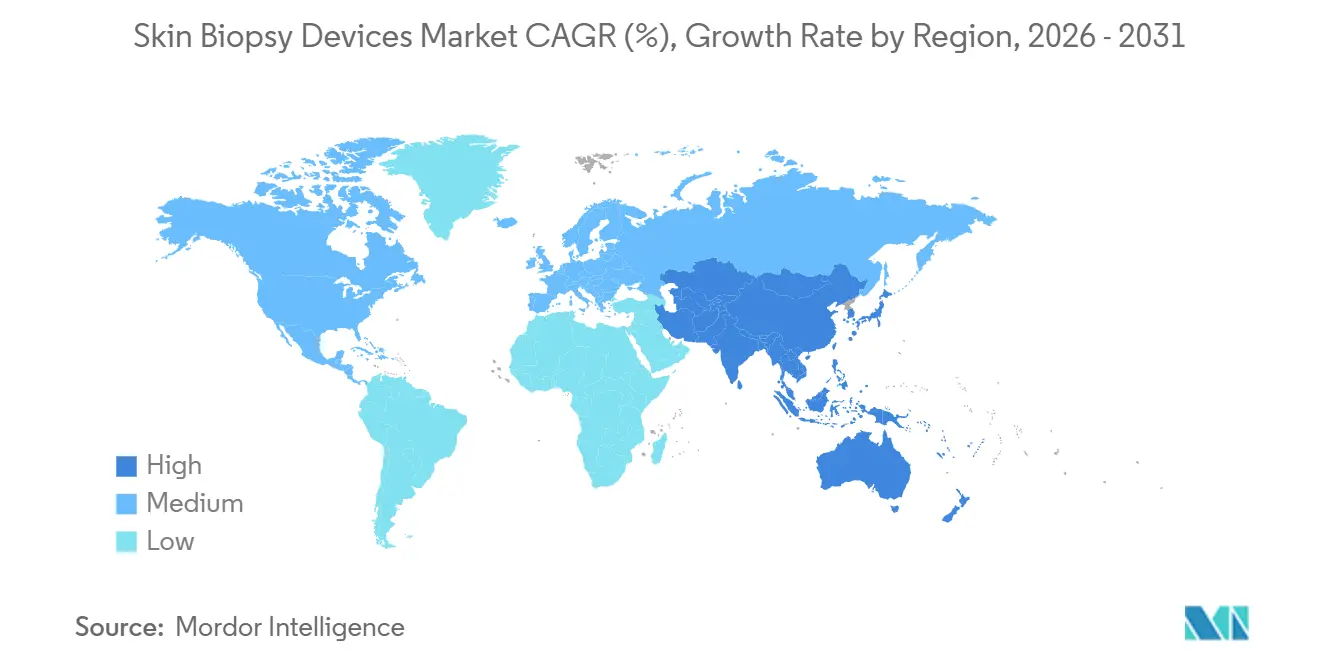
Asia-Pacific is the fastest-growing regional cluster, with skin biopsy devices market size projected to expand at a 10.65% CAGR through 2031. The region is being driven by China, India, Australia, Japan, and South Korea, although each country is scaling dermatology capacity through a different mix of public hospitals, private care, and specialty services. Australia’s high melanoma exposure profile supports consistent biopsy demand, while China is seeing a broader set of specimen collection points beyond traditional public hospitals. The Middle East and Africa remain smaller in absolute size, but GCC healthcare expansion is steadily adding outpatient dermatology capacity. South America is being led by Brazil and Argentina, where delayed diagnosis still leaves room for stronger early detection and tissue confirmation pathways.

Competitive Landscape
The skin biopsy devices market remains fragmented, with large diversified companies competing alongside specialized instrument makers. Becton, Dickinson and Company, Danaher through Leica Biosystems, Cardinal Health, and Merit Medical sit beside focused manufacturers such as AccuTec, DTR Medical, KAI Group, Innovia Medical, and Sklar Instruments. This creates a two-layer structure in the skin biopsy devices market, where large firms benefit from distribution scale and regulatory reach, while smaller firms compete through niche engineering and pricing flexibility. Commodity instrument categories face greater pricing pressure, while guidance-linked and pathology-linked systems are more defensible. The competitive center of gravity is moving toward workflow ownership rather than only toward the physical collection device.
Leica Biosystems announced in July 2026 that it would acquire StatLab Medical Products, which broadens its position across the anatomic pathology workflow used downstream of biopsy collection. Agilent also completed its acquisition of Biocare Medical in 2026, which deepens its capabilities in pathology solutions that connect with specimen analysis after collection. These moves show that competition in the skin biopsy devices market is no longer limited to punches, needles, or curettes alone. Companies are increasingly trying to control the full specimen-to-report pathway because that is where integration and switching costs are stronger.
Another visible shift is the faster regulatory progress of newer entrants in the skin biopsy devices market. Promisemed Hangzhou Meditech’s VeriEcto Automatic Biopsy Needles received FDA clearance in May 2026, which showed that Chinese manufacturers are becoming more capable in regulated market entry. This narrows the gap between established Western suppliers and emerging exporters in higher-value procurement channels. At the same time, non-invasive alternatives such as genomic sampling and multispectral imaging are beginning to compete for selected use cases, although histopathology remains the diagnostic standard in current clinical practice. That means substitutes may influence triage behavior, but they are unlikely to displace conventional tissue confirmation in a major way during the forecast period.
Skin Biopsy Devices Industry Leaders
Becton, Dickinson and Company
Cardinal Health, Inc.
Boston Scientific Corporation
Cook Medical LLC
Integra LifeSciences Holdings Corporation
- *Disclaimer: Major Players sorted in no particular order
Skin Biopsy Devices Market Companies Covered in this Report
- AccuTec, Inc.
- Beckton Dickinson
- Boston Scientific
- Cardinal Health
- Conmed
- Cook Group
- Danaher
- DTR Medical Ltd
- Gallini Srl
- Innovia Medical
- Integra LifeSciences
- KAI Group
- Danaher
- Medline Industries
- Merit Medical Systems
- Olympus
- Sklar Instruments

Recent Industry Developments in Skin Biopsy Devices Market
- July 2026: Leica Biosystems (a Danaher operating company) announced a definitive agreement to acquire StatLab Medical Products from Linden Capital Partners and Audax Private Equity. StatLab is a global developer and manufacturer of anatomical pathology products with a broad portfolio serving pathology laboratories worldwide. The transaction, expected to close by end-2026 pending regulatory clearance, strengthens Leica's position across the full anatomic pathology workflow including specimen processing products used downstream of skin biopsy.
- December 2025: Sanguine Biosciences announced the expansion of its clinical sample portfolio with the launch of two new offerings: Synovial Fluid and Skin Punch Biopsy collections.


Global Skin Biopsy Devices Market Report Scope
As per the scope of the report, skin biopsy devices are specialized instruments used to obtain a sample of skin tissue for diagnostic purposes. These devices enable clinicians to remove a small section of skin from a patient for examination under a microscope, aiding in the diagnosis of skin conditions, infections, and cancers.
The skin biopsy devices market is segmented by type into shave biopsy, punch biopsy, excisional biopsy, incisional biopsy, and needle biopsy; by device into biopsy punches and curettes, biopsy needles, biopsy forceps, guidance systems, needle-based biopsy guns, and biopsy accessories and consumables; by indication into skin cancer, actinic keratosis, dermatitis, psoriasis, skin infection, and other indications; by end user into hospitals, dermatology clinics, diagnostic laboratories, ambulatory surgical centers, and other end users; and by geography into North America, Europe, Asia-Pacific, Middle East and Africa, and South America. The market report also covers the estimated market sizes and trends for 17 countries across major regions globally. For each segment, the market size and forecast are provided in terms of value (USD).
| Shave Biopsy |
| Punch Biopsy |
| Excisional Biopsy |
| Incisional Biopsy |
| Needle Biopsy |
| Biopsy Punches and Curettes |
| Biopsy Needles |
| Biopsy Forceps |
| Guidance Systems |
| Needle-Based Biopsy Guns |
| Biopsy Accessories and Consumables |
| Skin Cancer |
| Actinic Keratosis |
| Dermatitis |
| Psoriasis |
| Skin Infection |
| Other Indications |
| Hospitals |
| Dermatology Clinics |
| Diagnostic Laboratories |
| Ambulatory Surgical Centers |
| Other End Users |
| North America | United States |
| Canada | |
| Mexico | |
| Europe | Germany |
| United Kingdom | |
| France | |
| Italy | |
| Spain | |
| Rest of Europe | |
| Asia-Pacific | China |
| Japan | |
| India | |
| Australia | |
| South Korea | |
| Rest of Asia-Pacific | |
| Middle East and Africa | GCC |
| South Africa | |
| Rest of Middle East and Africa | |
| South America | Brazil |
| Argentina | |
| Rest of South America |
| By Type | Shave Biopsy | |
| Punch Biopsy | ||
| Excisional Biopsy | ||
| Incisional Biopsy | ||
| Needle Biopsy | ||
| By Device | Biopsy Punches and Curettes | |
| Biopsy Needles | ||
| Biopsy Forceps | ||
| Guidance Systems | ||
| Needle-Based Biopsy Guns | ||
| Biopsy Accessories and Consumables | ||
| By Indication | Skin Cancer | |
| Actinic Keratosis | ||
| Dermatitis | ||
| Psoriasis | ||
| Skin Infection | ||
| Other Indications | ||
| By End User | Hospitals | |
| Dermatology Clinics | ||
| Diagnostic Laboratories | ||
| Ambulatory Surgical Centers | ||
| Other End Users | ||
| By Geography | North America | United States |
| Canada | ||
| Mexico | ||
| Europe | Germany | |
| United Kingdom | ||
| France | ||
| Italy | ||
| Spain | ||
| Rest of Europe | ||
| Asia-Pacific | China | |
| Japan | ||
| India | ||
| Australia | ||
| South Korea | ||
| Rest of Asia-Pacific | ||
| Middle East and Africa | GCC | |
| South Africa | ||
| Rest of Middle East and Africa | ||
| South America | Brazil | |
| Argentina | ||
| Rest of South America | ||


Key Questions Answered in the Report
What is the current value of the skin biopsy devices space in 2026?
The skin biopsy devices market is valued at USD 2.99 billion in 2026 and is forecast to reach USD 4.10 billion by 2031 at a 6.52% CAGR.
Which region leads global revenue for skin biopsy devices?
North America leads with 38.61% share in 2025, supported by strong reimbursement systems, dense outpatient care networks, and high skin cancer incidence.
Which region is growing the fastest through 2031?
Asia-Pacific is the fastest-growing region, with a 10.65% CAGR through 2031, driven by expanding dermatology infrastructure and broader access points for specimen collection.
Which procedure type holds the largest share?
Punch biopsy is the leading type, with 34.31% share, because it is widely used for full-thickness sampling across inflammatory and neoplastic skin conditions.
Which indication is driving the strongest demand?
Skin cancer is the largest and fastest-growing indication, with 42.24% share in 2025 and a 10.52% CAGR through 2031, supported by rising melanoma burden and the need for tissue confirmation.
Why are diagnostic laboratories gaining importance?
Diagnostic laboratories are the fastest-growing end user at a 9.95% CAGR through 2031 because more outpatient and clinic-based biopsies are being routed to independent and regional pathology networks.
Page last updated on:





