
Skills-Based Organization Technology Market Size and Share
Market Overview
| Study Period | 2020 - 2031 |
|---|---|
| Market Size (2026) | USD 9.46 Billion |
| Market Size (2031) | USD 22.85 Billion |
| Growth Rate (2026 - 2031) | 19.29% CAGR |
| Fastest Growing Market | Asia-Pacific |
| Largest Market | North America |
| Market Concentration | Medium |
Major Players *Disclaimer: Major Players sorted in no particular order Image © Mordor Intelligence. Reuse requires attribution under CC BY 4.0. | |
Skills-Based Organization Technology Market Analysis by Mordor Intelligence
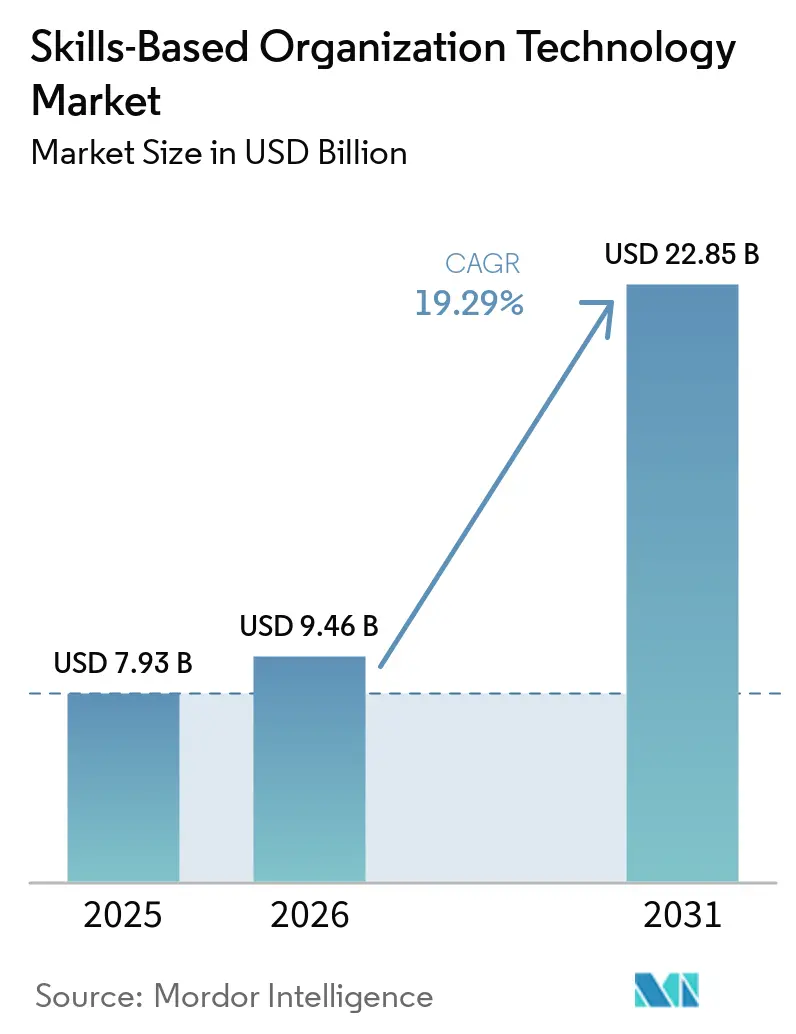
The skills-based organization technology market size was valued at USD 7.93 billion in 2025 and estimated to grow from USD 9.46 billion in 2026 to reach USD 22.85 billion by 2031, at a CAGR of 19.29% during the forecast period (2026-2031). The skills-based organization technology market is moving from isolated HR experimentation to a core system for workforce planning, internal mobility, and enterprise AI. Adoption is being supported by the fact that many organizations now see job descriptions as too static for fast-changing roles, especially in digital, engineering, and AI-linked functions. The category is also benefiting from the growing need for explainable, auditable workforce data, which is pushing buyers toward platforms with stronger governance, ontology management, and deeper integration. Competition is intensifying between broad HCM suite vendors and focused specialists, but switching costs rise once skills data is embedded across hiring, learning, and workforce planning workflows. That dynamic keeps the skills-based organization technology market resilient, even as enterprise software budgets are reviewed more closely.
Key Report Takeaways
- By component, platform software held 72.41% of the skills-based organization technology market share in 2025, while services are projected to expand at a CAGR of 22.67% through 2031.
- By deployment model, cloud accounted for 68.92% share of the skills-based organization technology market size in 2025, while cloud is also projected to record the fastest CAGR of 23.83% through 2031.
- By enterprise size, large enterprises captured 74.13% of the market in 2025, while SMEs are expected to expand at a CAGR of 24.77% through 2031.
- By application, talent management and internal mobility represented 29.34% of the market in 2025, while strategic workforce planning and scenario intelligence is projected to grow at a CAGR of 25.43% through 2031.
- By end-user industry vertical, IT and telecommunications held 24.82% of the skills-based organization technology market in 2025, while healthcare and life sciences is expected to advance at a CAGR of 26.19% through 2031.
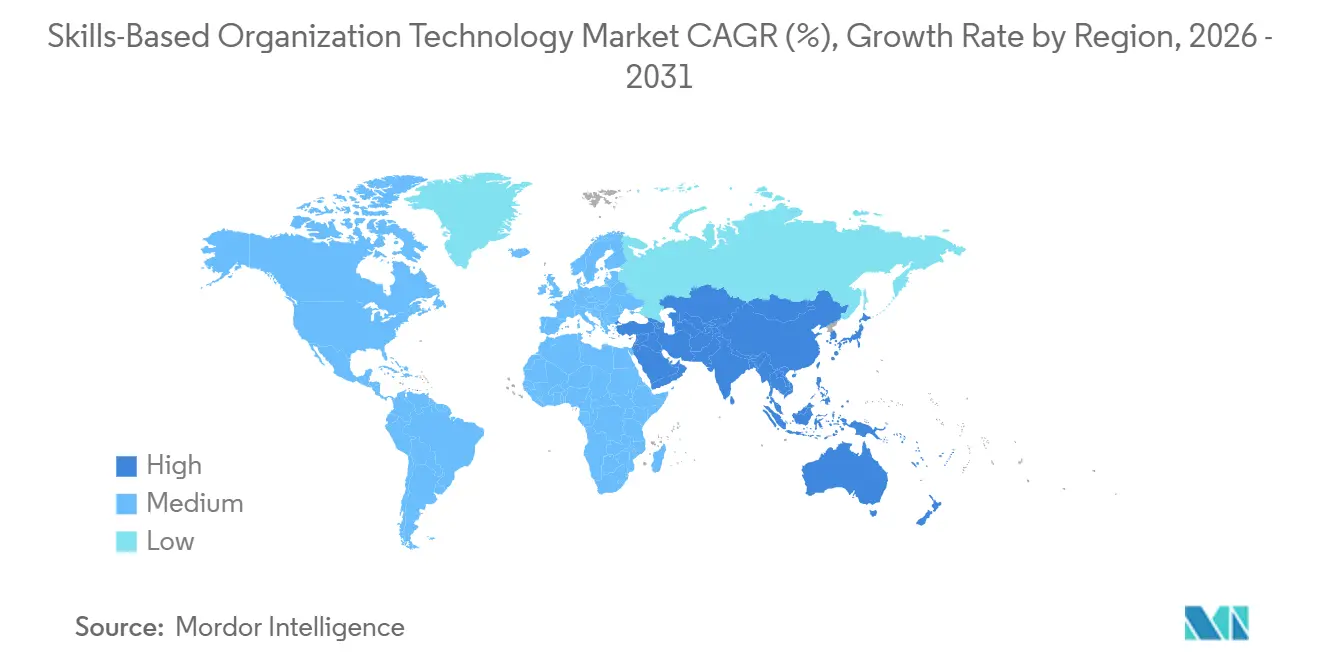
- By geography, North America held 41.64% of the market in 2025, while Asia-Pacific is projected to expand at a CAGR of 27.17% through 2031.
Note: Market size and forecast figures in this report are generated using Mordor Intelligence’s proprietary estimation framework, updated with the latest available data and insights as of January 2026.
Global Skills-Based Organization Technology Market Trends and Insights
Drivers Impact Analysis*
| DRIVER | (~) % IMPACT ON CAGR FORECAST | GEOGRAPHIC RELEVANCE | IMPACT TIMELINE |
|---|---|---|---|
| Shift From Job-Based to Skills-Based Operating Models | +5.8% | Global | Medium term (2-4 years) |
| AI-Enabled Skills Inference and Matching at Scale | +4.6% | North America, Europe, Asia-Pacific | Medium term (2-4 years) |
| Internal Mobility and Retention Prioritization | +3.2% | Global, concentration in North America and Europe | Short term (≤ 2 years) |
| Agentic Workflow Demand for Machine-Readable Skills Graphs | +2.4% | North America and Europe | Medium term (2-4 years) |
| Regulatory Pressure for Auditable Workforce Data | +1.8% | Europe, North America | Short term (≤ 2 years) |
| Verifiable Credentials and Skills Portability | +1.2% | Europe, Global | Long term (≥ 4 years) |
| Source: Mordor Intelligence | |||
Shift from Job-Based to Skills-Based Operating Models
The move away from job-title-based workforce design remains the strongest driver for the skills-based organization technology market. Workday reported in April 2025 that only 32% of business leaders strongly believed their current workforce skills matched future needs, which keeps pressure on organizations to adopt systems that update capability data continuously.[1]Workday, “The Global State Of Skills,” Workday, workday.comThe same study found that 55% of organizations had already started the shift to a skills-based operating model, and another 23% planned to do so within 12 months, which shows how quickly this model is becoming standard practice. As companies begin to inventory skills rather than headcount alone, workforce planning becomes more continuous and less dependent on fixed requisition cycles. This changes procurement behavior because buyers increasingly want platforms that can support redeployment, learning, and planning from one skills layer. The skills-based organization technology market is therefore being shaped by a structural change in how enterprises define work itself.
AI-Enabled Skills Inference and Matching at Scale
AI-based inference has eased a longstanding data problem in the skills-based organization technology market, because self-reported and manager-reported skills data often lack depth and go stale quickly. Modern systems can infer capabilities from signals such as authored content, completed learning, and collaboration patterns, thereby improving coverage and update frequency. Gloat stated in March 2026 that its Loomra engine operates on a skills graph with 2.4 million skill nodes and 18.7 million skill relationships, showing how vendors are building large-scale inference infrastructure for real-time workforce use. Workday has also highlighted the engineering challenge of inferring relevant skills from minimal structured inputs, such as job titles, indicating that low-latency inference is becoming a core product capability rather than an add-on. Better inference matters commercially because it reveals skills that formal taxonomies had missed and makes internal mobility and planning more credible. This strengthens platform value over time, since each new employee action improves the data layer used across the business.
Internal Mobility and Retention Prioritization
With the growing adoption of skills-first approaches in hiring and career development, internal mobility is emerging as a critical channel for workforce supply, driving the expansion of the skills-based organization technology market. Skills frameworks, previously confined to pilot programs, are now becoming integral to routine talent processes. By integrating recruitment, career paths, and learning into a unified skills layer, organizations gain more comprehensive insights into employee interests and readiness, surpassing the limitations of traditional annual assessments. This improved visibility enhances retention by enabling employees to identify adjacent roles, stretch assignments, and mentoring opportunities. At the same time, employers benefit from faster and more cost-efficient talent redeployment. As a result, the demand for skills-based platforms is increasing, driven not only by strategy teams but also by operating managers seeking practical alternatives to external hiring.
Agentic Workflow Demand for Machine-Readable Skills Graphs
The rise of agentic AI is creating a new infrastructure role for the skills-based organization technology market. AI agents cannot reliably allocate tasks, recommend learning, or model workforce scenarios from unstructured role descriptions, so they depend on machine-readable skills graphs with explicit relationships and proficiency logic. Gloat's March 2026 platform launch and Workday's March 2026 Sana release both assumed that a structured skills layer would sit underneath agent-based HR workflows. SAP reinforced this direction in May 2026, when it introduced a Workforce Upskilling Assistant that linked personalized learning to broader workforce planning efforts. This makes skills platforms more central to enterprise architecture, because they become context layers for AI execution rather than standalone HR applications. Companies that delay this investment risk weaker governance, weaker task matching, and weaker scenario planning as agentic workflows scale.
Restraints Impact Analysis*
| RESTRAINT | (~) % IMPACT ON CAGR FORECAST | GEOGRAPHIC RELEVANCE | IMPACT TIMELINE |
|---|---|---|---|
| Employee Data Privacy and AI Governance Burden | -2.8% | Global, acute in Europe and California | Short term (≤ 2 years) |
| Integration Complexity Across HCM and Learning Systems | -2.2% | Global | Medium term (2-4 years) |
| Taxonomy Drift From Rapidly Evolving Hybrid Roles | -1.6% | Global | Medium term (2-4 years) |
| Suite Vendor Bundling Compressing Standalone Pricing Power | -1.4% | North America and Europe | Long term (≥ 4 years) |
| Source: Mordor Intelligence | |||
Employee Data Privacy and AI Governance Burden
Privacy and governance remain the most immediate restraints on the skills-based organization technology market. Skills inference systems often analyze passive work signals, such as authored content, project history, and collaboration activity, raising consent and transparency questions when those signals are reused for employment decisions. California's Civil Rights Council finalized automated decision-making system regulations in June 2025, effective October 2025, that require anti-bias testing, record retention, and broad oversight for covered tools.[2]California Civil Rights Council, “Automated Decision-System Regulations,” California Civil Rights Department, calcivilrights.ca.gov The EU AI Act has also raised scrutiny of employment-related AI systems, increasing documentation, review, and oversight requirements during procurement and deployment. These obligations tend to favor larger vendors that already have legal, engineering, and audit resources in place. They also slow spending recognition because buyers take longer to approve deployments and often widen project scope to include governance controls from the start.
Integration Complexity Across HCM and Learning Systems
Integration complexity is the second major brake on the skills-based organization technology market, because platforms deliver the most value only when data flows across recruiting, performance, learning, and workforce planning systems. Many enterprises still operate with layered HCM estates that were not designed for continuous bidirectional skills data exchange. That pushes implementation work into long connector programs, taxonomy mapping, and change management, which raises service intensity and delays software value capture. The effect is visible in segment performance, where services are growing faster than the overall market because buyers are paying for the work needed to connect fragmented environments. Vendors that offer open APIs, pre-built connectors, and strong middleware support are therefore gaining an edge in large accounts. Even so, integration remains a meaningful barrier, especially in multinational organizations with legacy systems, local data rules, and uneven data quality.
*Our forecasts treat driver/restraint impacts as directional, not additive. The impact forecasts reflect baseline growth, mix effects, and variable interactions.
Segment Analysis
By Component: Platform Software Anchors the Core, Services Fuel Expansion
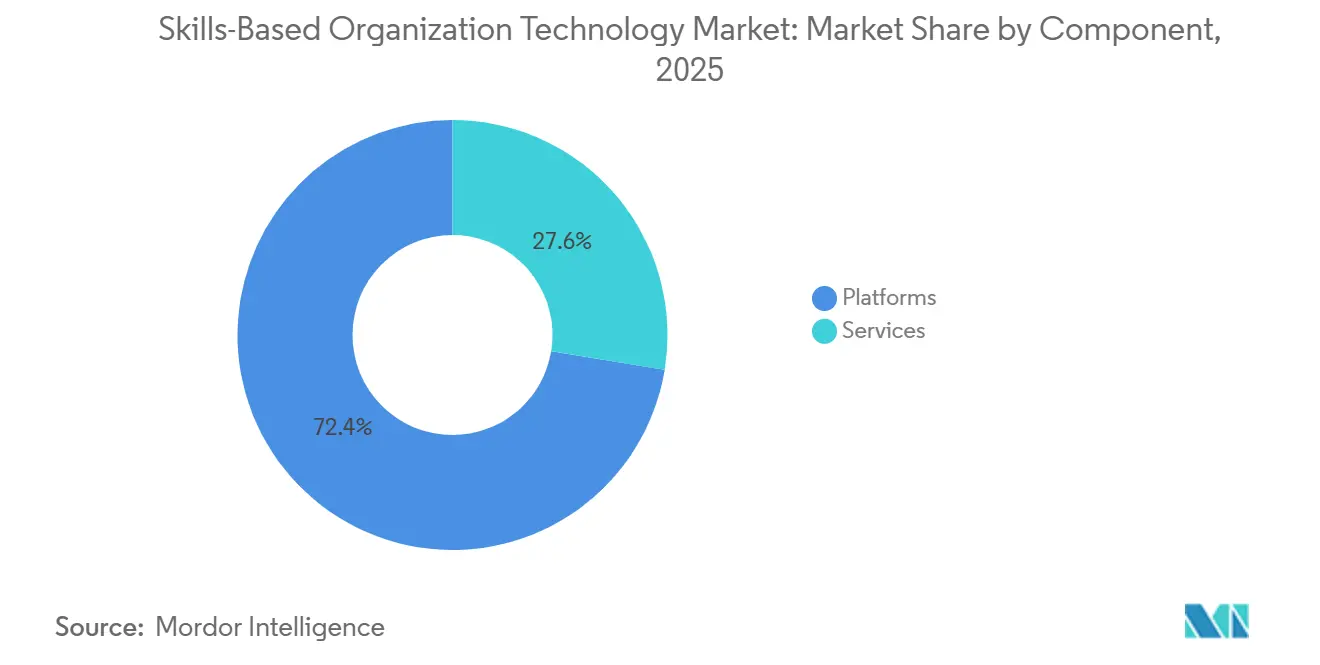
Platform software held 72.41% of the 2025 skills-based organization technology market share, which confirms that buyers still place the highest value on the core ontology, inference, and decisioning layer. That lead should remain intact because most downstream use cases, including mobility, learning, and planning, depend on a persistent skills graph that can be updated continuously. Within platform software, skills intelligence and ontology platforms form the base layer, while talent intelligence, internal mobility, and workforce planning modules build on top of that foundation. This sequencing matters because many enterprises enter the skills-based organization technology market with a core ontology project and then widen spend after the data layer starts to deliver usable signals.
Services are projected to expand at a CAGR of 22.67% from 2026 to 2031, which reflects the implementation effort required to deploy skills infrastructure across large and distributed workforces. Buyers need support with taxonomy design, change management, governance, and integration, and those needs do not end once the software goes live. Docebo's January 2026 acquisition of 365Talents showed that vendors increasingly want to connect skills identification directly to development actions inside broader learning systems.[3]Docebo, “Docebo Acquires 365Talents,” Docebo, docebo.com That move also suggests that services in the skills-based organization technology market will extend beyond setup work and into ongoing operating support. As agent-based capabilities spread, enterprises are also likely to spend more on managed governance, policy configuration, and workflow monitoring. This keeps services structurally important even though platform software remains the main revenue anchor.


By Deployment Model: Cloud Consolidates Scale, Hybrid Serves Data Control Needs
Cloud accounted for 68.92% share of the skills-based organization technology market size in 2025, and it is also projected to be the fastest-growing deployment model at a CAGR of 23.83% through 2031. That combination is unusual in enterprise software and shows how strongly real-time inference, ontology updates, and multi-system integration favor cloud architecture. On-premises deployments still matter in regulated settings, but they are harder to maintain when skills data must be refreshed continuously and shared across multiple workflows. For many buyers, the skills-based organization technology market now looks less like a traditional HR software purchase and more like a data-layer decision that requires scale, speed, and update frequency.
Hybrid deployment remains strategically important because some large organizations still need tighter control over where employee data is processed and stored. This is especially relevant in Europe, where sovereign cloud preferences and local compliance obligations can shape platform design and vendor selection. Deutsche Telekom's rollout of its AI-powered Growth Hub across 2025 and 2026 illustrates how large enterprises are pairing global platform ambition with domestic governance requirements. That pattern suggests hybrid will not overtake cloud on volume, but it will hold a durable role in large regulated accounts. Vendors that can support both operational flexibility and local control are better positioned to win multinational programs. This also means deployment choice in the skills-based organization technology market is increasingly tied to governance maturity, not just IT preference.
By Enterprise Size: Large Enterprises Hold the Base, SMEs Raise the Growth Rate
Large enterprises held 74.13% of the market in 2025, reflecting the fact that workforce instrumentation becomes more urgent as organizations scale across geographies, systems, and business units. Large employers also have stronger reasons to invest because internal redeployment, planning, and learning become harder to manage when skills are not mapped consistently. Skills Base reported in 2026 that the median share of the targeted workforce formally assessed among active Fortune 500 users reached 71.8%, which indicates that mature deployments are producing real coverage rather than sitting as symbolic software rollouts. That operational maturity helps explain why large organizations still dominate current revenue in the skills-based organization technology market.
SMEs are projected to grow at a CAGR of 24.77% from 2026 to 2031, and that reflects changing product economics more than a sudden change in need. SaaS pricing, lighter integrations, and pre-built ontologies have reduced the upfront burden that previously kept smaller firms out of the category. SMEs in professional services, fintech, and healthtech appear especially well placed to adopt because they depend heavily on skills visibility as teams scale. In these firms, informal knowledge of who can do what breaks down quickly once headcount expands across functions and locations. That makes skills systems valuable earlier in the growth curve than many buyers expected. The skills-based organization technology market is therefore broadening from a large-enterprise category into a more accessible operating layer for mid-sized and smaller knowledge-intensive firms.
By Application: Mobility Leads Current Spend, Planning Drives the Next Wave
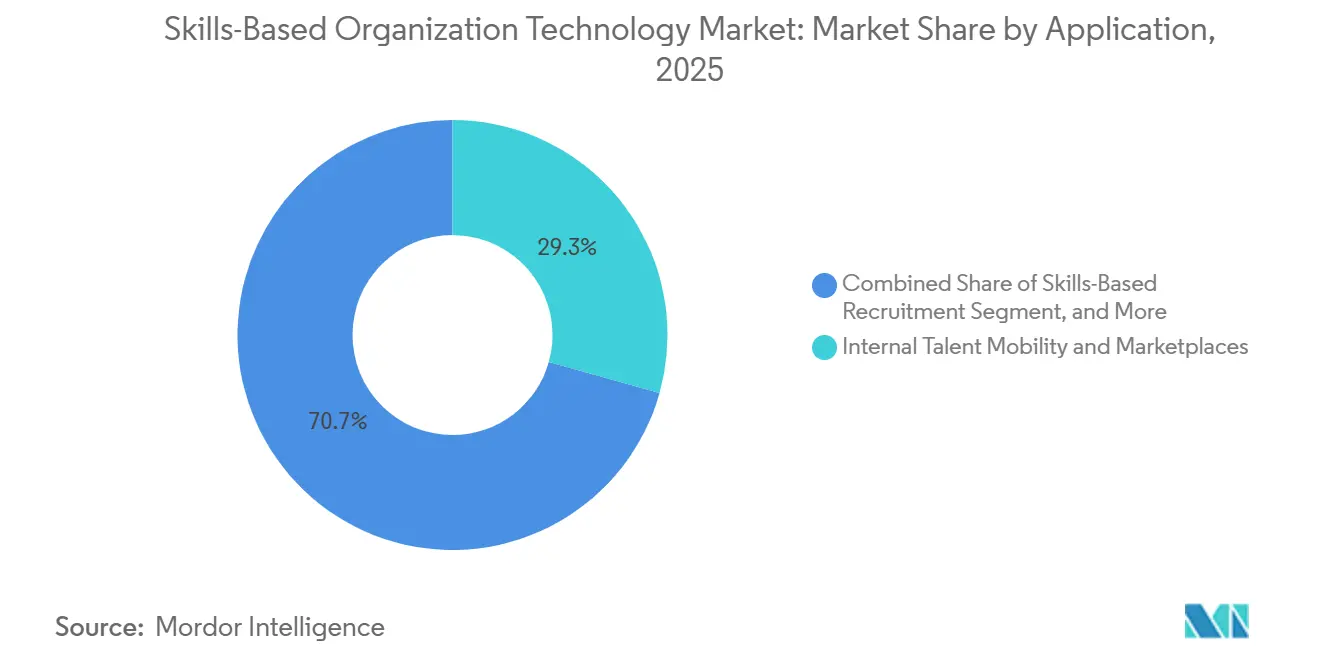
Talent management and internal mobility accounted for 29.34% of the 2025 skills-based organization technology market size, which reflects the immediate operational value of reducing external hiring and redeploying available talent faster. This application area often produces the clearest early return because it links visible employee demand with open roles, gigs, mentoring, and development paths. Phenom reported in April 2026 that its work with Alight Solutions mapped skills across 1,200 job titles automatically and helped drive a 97% increase in internal careers profile creation within 8 months after launch. That example shows why many organizations first enter the skills-based organization technology market through mobility-focused use cases rather than through long-range planning programs.
Strategic workforce planning and scenario intelligence is projected to expand at a CAGR of 25.43% from 2026 to 2031, which makes it the fastest-growing application. This shift suggests that buyers are moving from tactical matching toward broader questions about capability gaps, future demand, and workforce mix. SAP reported in May 2026 that 62% of C-suite executives were dissatisfied with how people data connects to business performance, and it launched new planning functionality to close that gap. Recruitment-only skills projects now look less complete because they do not connect hiring decisions with internal supply, development pathways, or scenario modeling. Learning, capability development, performance, and succession mapping are therefore becoming the connective applications that extend value after the first deployment. Over time, that should deepen platform stickiness because more workforce decisions are routed through the same skills layer.

By End-User Industry Vertical: IT and Telecom Leads Adoption, Healthcare Builds Momentum
IT and telecommunications accounted for 24.82% of the 2025 market, reflecting how quickly skills become outdated in roles tied to software, cloud, cybersecurity, and AI. This sector moved early because job descriptions were no longer sufficient to capture evolving capability needs within engineering and digital teams. The result is a more mature use of the skills-based organization technology market, where organizations rely on inference engines to detect emerging sub-skills before those changes are visible in formal roles. That early-mover status also means IT and telecommunications remain a reference point for other verticals that are now building similar systems.
Healthcare and life sciences are projected to grow at a CAGR of 26.19% from 2026 to 2031, which makes it the fastest-growing vertical in the skills-based organization technology market. The American Hospital Association's 2026 Healthcare Workforce Scan described how health systems are systematically upskilling existing staff for digital and AI-integrated roles, which raises the need for structured workforce capability data. BFSI continues to attract spend because documented competencies support audit, compliance, and risk management needs. Manufacturing and industrial operations are also gaining momentum as automation, Industry 4.0, and reshoring programs create new combinations of shop-floor and digital skills. Government, public sector, and education remain more measured because procurement cycles are slower and legacy HR systems are harder to modernize. Even so, the vertical mix is widening, and that supports a broader demand base for the category.
Geography Analysis
North America held 41.64% of the skills-based organization technology market share in 2025, making it the largest regional revenue base. The United States remains the core demand center because it combines a dense population of digitally mature enterprises with a long history of investment in HCM and talent software. California's automated decision-making rules, effective from October 2025, have also increased the need for auditable, explainable workforce data in AI-supported employment decisions. Canada and Mexico remain smaller in scale, but Canada follows a similar enterprise adoption path while Mexico is showing demand in manufacturing and shared-services settings.
Europe is a high-opportunity but more compliance-heavy region for the skills-based organization technology market. The EU AI Act has pushed employment-related AI into a stricter governance framework, extending procurement cycles and favoring vendors that can clearly document controls. France and Germany remain the largest enterprise demand pools, supported by large telecom and industrial employers that are formalizing skills data at scale. The UK is also maintaining strong adoption momentum, and Skills England's Annual Skills Report 2026 underscored the importance of structured skills data for closing major competency gaps across the economy.[4]GOV.UK, “Skills England Annual Skills Report 2026,” GOV.UK, gov.uk
Asia-Pacific is projected to grow at a CAGR of 27.17% through 2031, making it the fastest-growing region and the strongest growth area for the skills-based organization technology market. Singapore, India, and South Korea are the main demand engines because digital-skills frameworks, maturing HR technology ecosystems, and industrial upgrading are creating stronger use cases for auditable competency data. South America is emerging more gradually, but employer interest is shifting from hiring automation toward skills-led capability development. The Middle East is still earlier in adoption, though capital-backed programs in Saudi Arabia and the United Arab Emirates are creating meaningful enterprise demand tied to national workforce modernization agendas. Africa remains nascent, with South Africa and Kenya as the clearest centers of activity in financial services and telecommunications.

Competitive Landscape
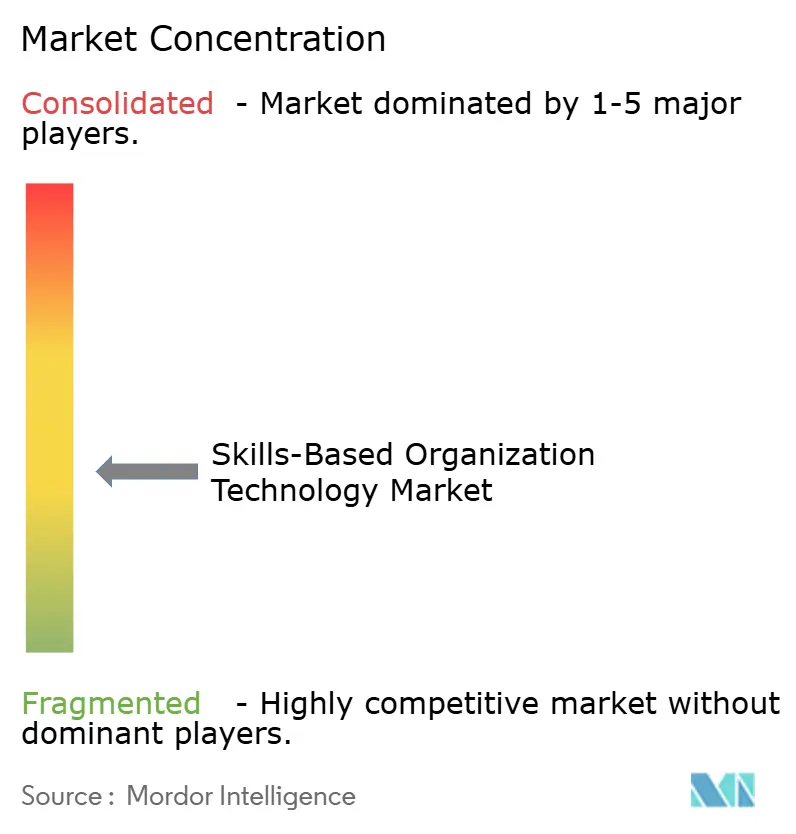
The skills-based organization technology market remains moderately fragmented, with competition split between broad suite vendors and focused specialists. Workday, SAP SE, and Oracle Corporation use installed-base depth and existing HCM relationships to extend skills functionality across larger product portfolios. Specialists such as TechWolf BV, Eightfold AI Inc., and Gloat Ltd. compete more directly on ontology depth, inference quality, and workflow flexibility. This keeps pricing and product design in motion because buyers can compare all-in-one suite convenience with best-of-breed capability.
Large vendors accelerated product development in 2026, which narrowed some of the functional distance with specialists. Workday launched Sana in March 2026 with more than 300 built-in skills, while SAP expanded SuccessFactors and the Talent Intelligence Hub through its 1H 2026 release and later announced autonomous HCM updates at Sapphire. Oracle also introduced Fusion Agentic Applications for HR in April 2026, which brought reusable AI agent patterns and measurement tools into its cloud HCM environment.[5]Oracle, “Fusion Agentic Applications For HR,” Oracle, oracle.com These moves show that the skills-based organization technology market is shifting toward platform breadth, governance depth, and AI orchestration rather than simple feature addition. At the same time, specialists still hold white space in persistent skills graph infrastructure, which remains difficult for generalist suites to reproduce quickly.
Skills-Based Organization Technology Industry Leaders
Eightfold AI Inc.
Workday, Inc.
SAP SE
Oracle Corporation
Cornerstone OnDemand, Inc.
- *Disclaimer: Major Players sorted in no particular order

Recent Industry Developments
- May 2026: SAP announced Autonomous HCM innovations at SAP Sapphire in Orlando, including a Workforce Upskilling Assistant that delivers personalized, AI-driven learning through Joule Agents and a Workforce Planning capability within SAP Enterprise Planning that links headcount decisions to financial and business performance data in real time, addressing reported C-suite dissatisfaction with disconnected people analytics.
- May 2026: Eightfold AI launched TalentForge at Cultivate 2026, repositioning the company as an HR application development platform that allows enterprises to build custom HR workflows on top of Eightfold's Talent Intelligence layer. The launch also introduced a 360 Interview for AI Interviewer capability, SOC 2 and ISO 42001 certified, with full audit logs, and a Workforce Readiness product providing CHROs with real-time visibility into organizational AI adoption.
- April 2026: Gloat integrated its Agentic HR capabilities with Microsoft 365 Copilot and Microsoft Teams, with the Gloat Copilot Agent published in the Microsoft Agent Store and Microsoft Marketplace. This extension brings skills-based career development and workforce redeployment capabilities directly into Microsoft productivity environments without requiring employees to navigate a separate HR platform.
- April 2026: SAP SuccessFactors delivered its 1H 2026 release with over 400 innovations, including a significantly upgraded Talent Intelligence Hub with enhanced skills governance providing centralized skills management and Joule AI assistant integration across talent acquisition and career development workflows.


Global Skills-Based Organization Technology Market Report Scope
Skills-based organization technology refers to digital solutions designed to enable businesses to adopt a skills-first approach instead of traditional job-based structures. These technologies facilitate the identification, evaluation, and management of workforce skills, ensuring alignment between talent and business objectives while addressing capability gaps. By leveraging AI, analytics, and integrated HR tools, they enhance internal mobility, workforce planning, and learning development, making organizations more adaptable and resilient in a dynamic market environment.
The Skills-Based Organization Technology Market Report is Segmented by Component (Platforms [Skills Intelligence and Ontology Platforms, Talent Intelligence and Internal Mobility Platforms, and Workforce Planning and Analytics Platforms], and Services), Deployment Model (Cloud, On-Premises, and Hybrid), Enterprise Size (Large Enterprises, Small and Medium-Sized Enterprises), Application (Internal Talent Mobility and Marketplaces, Skills-Based Recruitment and Talent Acquisition, Skills-Driven Learning and Capability Development, Workforce Planning and Scenario Intelligence, and Performance, Succession and Skills Mapping), End-User Industry Vertical (IT and Telecommunications, Healthcare and Life Sciences, BFSI, Manufacturing and Industrial Operations, Retail and E-Commerce, Education, Government and Public Sector, Energy and Utilities, Media and Entertainment, and Other End-User Industry Verticals), and Geography (North America, South America, Europe, Asia-Pacific, Middle East, and Africa). The Market Forecasts are Provided in Terms of Value (USD).
| Platforms | Skills Intelligence and Ontology Platforms |
| Talent Intelligence and Internal Mobility Platforms | |
| Workforce Planning and Analytics Platforms | |
| Services |
| Cloud |
| On-Premises |
| Hybrid |
| Large Enterprises |
| Small and Medium-Sized Enterprises |
| Internal Talent Mobility and Marketplaces |
| Skills-Based Recruitment and Talent Acquisition |
| Skills-Driven Learning and Capability Development |
| Workforce Planning and Scenario Intelligence |
| Performance, Succession and Skills Mapping |
| IT and Telecommunications |
| Healthcare and Life Sciences |
| BFSI |
| Manufacturing and Industrial Operations |
| Retail and E-Commerce |
| Education |
| Government and Public Sector |
| Energy and Utilities |
| Media and Entertainment |
| Other End-User Industry Verticals |
| North America | United States |
| Canada | |
| Mexico | |
| South America | Brazil |
| Argentina | |
| Chile | |
| Rest of South America | |
| Europe | Germany |
| United Kingdom | |
| France | |
| Italy | |
| Spain | |
| Rest of Europe | |
| Asia-pacific | China |
| Japan | |
| India | |
| Australia | |
| South Korea | |
| Singapore | |
| Rest of Asia-pacific | |
| Middle East | Saudi Arabia |
| United Arab Emirates | |
| Turkey | |
| Rest of Middle East | |
| Africa | South Africa |
| Egypt | |
| Nigeria | |
| Kenya | |
| Rest of Africa |
| By Component | Platforms | Skills Intelligence and Ontology Platforms |
| Talent Intelligence and Internal Mobility Platforms | ||
| Workforce Planning and Analytics Platforms | ||
| Services | ||
| By Deployment Model | Cloud | |
| On-Premises | ||
| Hybrid | ||
| By Enterprise Size | Large Enterprises | |
| Small and Medium-Sized Enterprises | ||
| By Application | Internal Talent Mobility and Marketplaces | |
| Skills-Based Recruitment and Talent Acquisition | ||
| Skills-Driven Learning and Capability Development | ||
| Workforce Planning and Scenario Intelligence | ||
| Performance, Succession and Skills Mapping | ||
| By End-User Industry Vertical | IT and Telecommunications | |
| Healthcare and Life Sciences | ||
| BFSI | ||
| Manufacturing and Industrial Operations | ||
| Retail and E-Commerce | ||
| Education | ||
| Government and Public Sector | ||
| Energy and Utilities | ||
| Media and Entertainment | ||
| Other End-User Industry Verticals | ||
| By Geography | North America | United States |
| Canada | ||
| Mexico | ||
| South America | Brazil | |
| Argentina | ||
| Chile | ||
| Rest of South America | ||
| Europe | Germany | |
| United Kingdom | ||
| France | ||
| Italy | ||
| Spain | ||
| Rest of Europe | ||
| Asia-pacific | China | |
| Japan | ||
| India | ||
| Australia | ||
| South Korea | ||
| Singapore | ||
| Rest of Asia-pacific | ||
| Middle East | Saudi Arabia | |
| United Arab Emirates | ||
| Turkey | ||
| Rest of Middle East | ||
| Africa | South Africa | |
| Egypt | ||
| Nigeria | ||
| Kenya | ||
| Rest of Africa | ||


Key Questions Answered in the Report
What is the current and forecast size of the skills-based organization technology market?
The skills-based organization technology market was valued at USD 7.93 billion in 2025, stands at USD 9.46 billion in 2026, and is forecast to reach USD 22.85 billion by 2031 at a CAGR of 19.29%.
Which component leads revenue generation in this space?
Platform software led with 72.41% share in 2025, showing that buyers still prioritize the core ontology, inference, and decisioning layer.
Why is Asia-Pacific growing faster than other regions?
Asia-Pacific is projected to grow at a CAGR of 27.17% through 2031, supported by digital-skills frameworks, enterprise formalization, and stronger workforce modernization programs in markets such as Singapore, India, and South Korea.
Which application area is expanding the fastest?
Strategic workforce planning and scenario intelligence is projected to grow at a CAGR of 25.43% through 2031 as enterprises connect skills data more closely with business and financial planning.
Which end-user vertical is creating the strongest growth opportunity?
Healthcare and life sciences is expected to grow at a CAGR of 26.19% through 2031 because digital and AI-linked roles are increasing faster than traditional competency models can capture.
What is holding adoption back despite strong demand?
Privacy compliance and integration complexity are the main near-term barriers, because enterprises need explainable AI controls and seamless data flow across recruiting, learning, performance, and planning systems.
Page last updated on:





