
Market Overview
| Study Period | 2021 - 2031 |
|---|---|
| Market Size (2026) | USD 37.98 Billion |
| Market Size (2031) | USD 96.31 Billion |
| Growth Rate (2026 - 2031) | 20.45 % |
| Fastest Growing Market | Asia Pacific |
| Largest Market | North America |
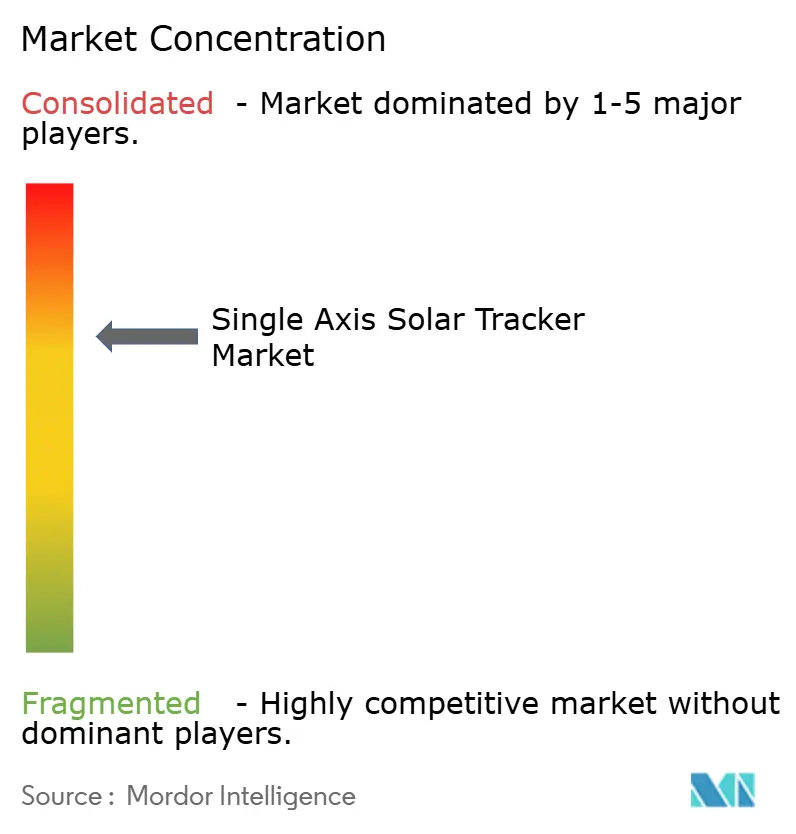
| Market Concentration | Medium |
Major Players *Disclaimer: Major Players sorted in no particular order Image © Mordor Intelligence. Reuse requires attribution under CC BY 4.0. | |
Single Axis Solar Tracker Market Analysis by Mordor Intelligence
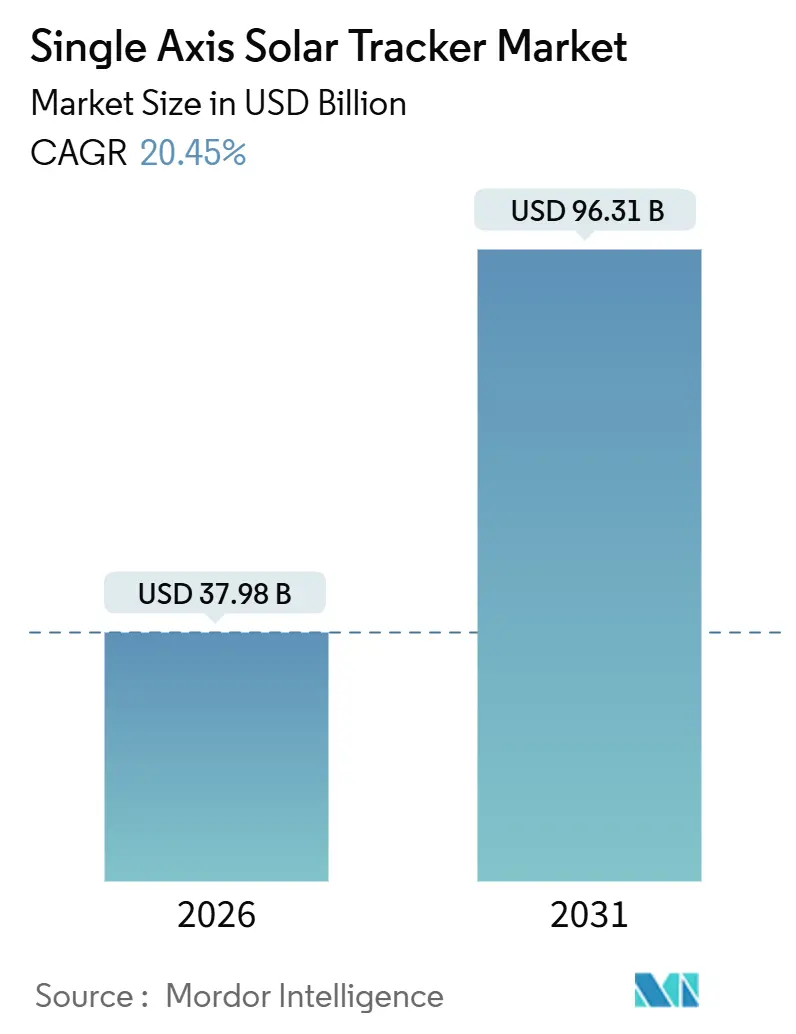
The Single Axis Solar Tracker Market size is estimated at USD 37.98 billion in 2026, and is expected to reach USD 96.31 billion by 2031, at a CAGR of 20.45% during the forecast period (2026-2031).
Policy stimulus from the United States Inflation Reduction Act, rapid bifacial-module cost declines, and software-enabled O&M efficiencies are catalyzing adoption across utility and commercial projects. Domestic-content incentives have already shifted torque-tube and fastener production from Mexico to Texas and Ohio, trimming logistics costs and unlocking an additional 10-percentage-point investment tax credit for compliant projects. Simultaneously, 35% yield gains recorded in Chile’s Atacama Desert and Australia’s outback when pairing bifacial modules with horizontal single-axis trackers (HSAT) have pushed the levelized cost of energy (LCOE) below USD 20 per megawatt-hour in extreme-irradiance zones. These cost wins, coupled with confirmation that 96% of U.S. utility-scale solar commissioned in 2023 deployed trackers, underscore the technology’s evolution from premium option to baseline standard. Geographic diversification adds further lift: North America captured 55.3% of 2025 revenue, yet Asia-Pacific is poised to outpace every region, propelled by China’s west-to-north build-out and India’s 500-gigawatt 2030 target.
Key Report Takeaways
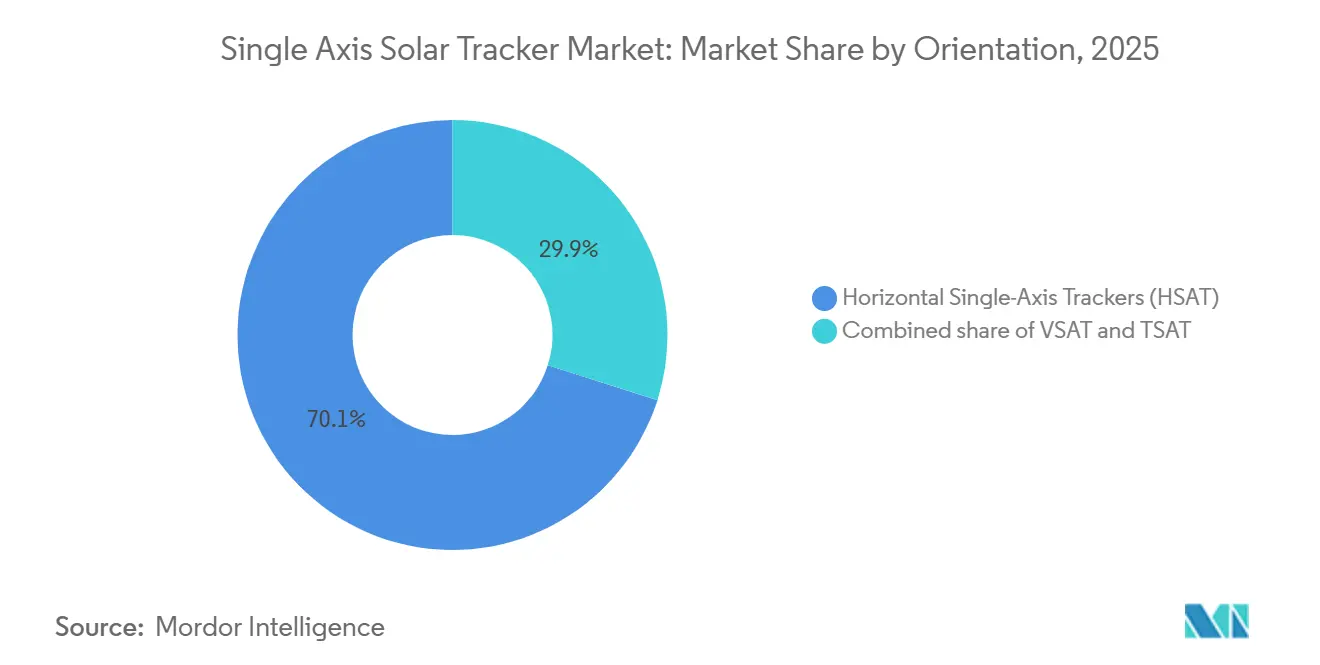
- By orientation, horizontal single-axis trackers led with 70.1% of single-axis solar tracker market share in 2025; vertical configurations are forecast to expand at a 21.5% CAGR to 2031.
- By drive type, active systems accounted for 84.9% of the single-axis solar tracker market size in 2025, while passive systems are advancing at a 22.4% CAGR through 2031.
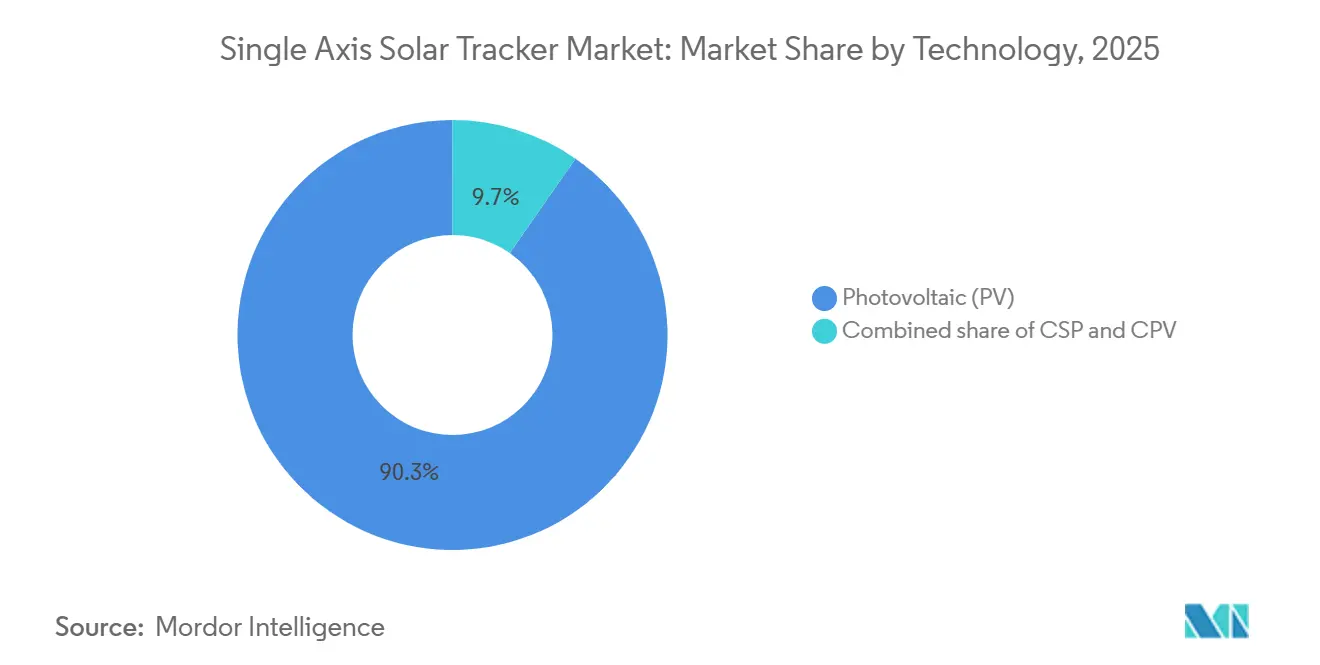
- By technology, photovoltaic platforms captured 90.3% share of the single-axis solar tracker market size in 2025, and concentrator photovoltaic solutions are growing at a 24.2% CAGR to 2031.
- By application, utility-scale installations held 84.8% of the single-axis solar tracker market size in 2025; commercial and industrial projects are registering the fastest growth at a 23.1% CAGR to 2031
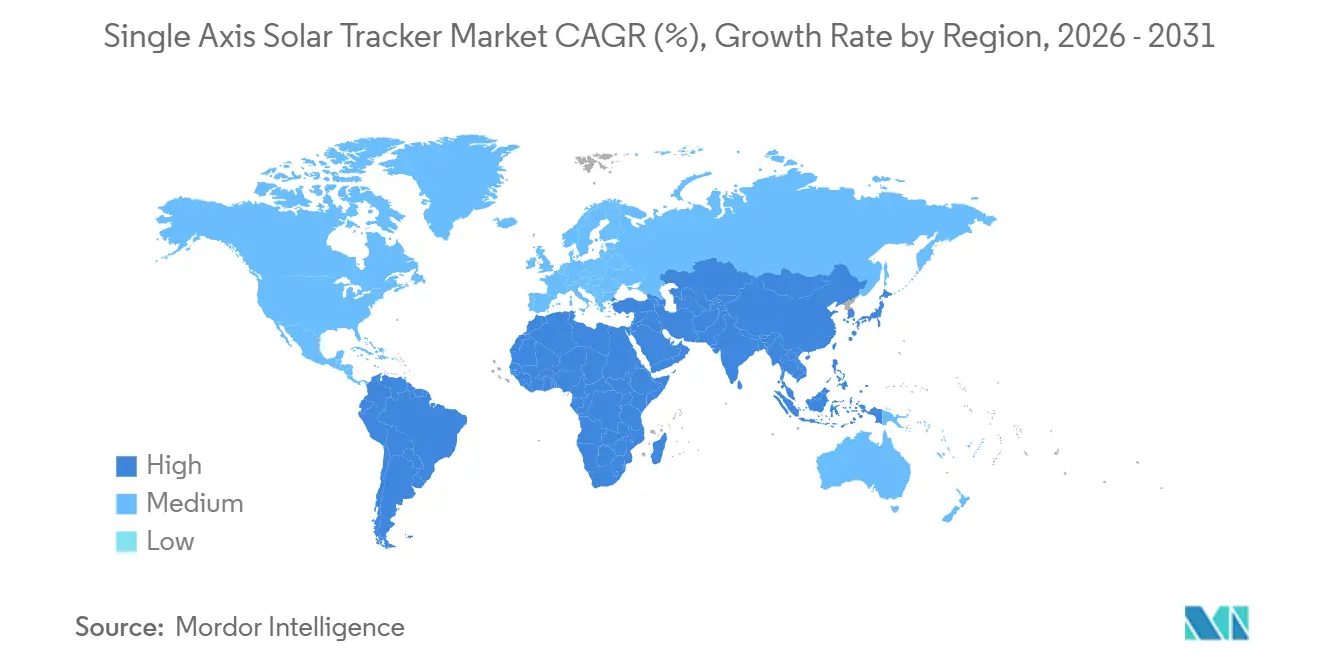
- By geography, North America dominated with 55.3% of 2025 revenue, while Asia-Pacific is projected to mark the quickest regional expansion at a 22.8% CAGR through 2031.
Note: Market size and forecast figures in this report are generated using Mordor Intelligence’s proprietary estimation framework, updated with the latest available data and insights as of January 2026.
Market Trends and Insights
Drivers Impact Analysis of Single Axis Solar Tracker Market*
| Driver | ( ~ ) % Impact on CAGR Forecast | Geographic Relevance | Impact Timeline |
|---|---|---|---|
| Aggressive utility-scale procurement mandates in U.S. & Spain favoring single-axis trackers | 4.2% | North America, Spain | Medium term (2-4 years) |
| Rapid LCOE reduction for bifacial modules paired with horizontal trackers in Chile & Australia deserts | 3.8% | South America (Chile), Australia | Short term (≤ 2 years) |
| Inflation Reduction Act 10% domestic-content bonus spurring North American industrial projects | 3.5% | United States, Canada, Mexico | Medium term (2-4 years) |
| Corporate PPA boom in Brazil's Northeast requiring low-cost tracking for capacity-factor guarantees | 2.9% | Brazil, expanding to Argentina | Short term (≤ 2 years) |
| AI-enabled predictive O&M lowering downtime of trackers in Middle East dust zones | 2.1% | Middle East & North Africa | Long term (≥ 4 years) |
| Vertical single-axis adoption in land-constrained high-latitude EU markets | 1.8% | Germany, Netherlands, France | Long term (≥ 4 years) |
| Source: Mordor Intelligence | |||
Aggressive Utility-Scale Procurement Mandates in U.S. & Spain Favoring Single-Axis Trackers
Renewable portfolio standards in California and 20-year PPAs in Texas stipulate capacity factors above 28%, benchmarks that fixed-tilt arrays cannot consistently deliver.[1]California Energy Commission, “SB 100 Progress Report,” cec.ca.gov Spain’s auction design similarly rewards the lowest LCOE bids, effectively disqualifying non-tracking proposals in Andalusia and Castilla-La Mancha. The U.S. Treasury’s May 2024 clarification that domestically melted torque tubes qualify for a 10% bonus further tilts economics toward on-shore-made tracker assemblies, accelerating supply-chain reshoring. Developers have responded by locking in multi-gigawatt frame contracts with NEXTracker and Array Technologies to de-risk PPA penalties. As a result, the single-axis solar tracker market has become the default route to achieving state and federal compliance rather than an optional performance upgrade.
Rapid LCOE Reduction for Bifacial Modules Paired with Horizontal Trackers in Chile & Australia Deserts
Field trials in the Atacama Desert show 35% energy-yield gains when bifacial modules ride HSAT platforms, pushing LCOE below USD 18 per megawatt-hour and undercutting gas peakers by a wide margin.[2]International Energy Agency, “Bifacial Performance in High-Albedo Sites,” iea-pvps.org Australia’s Clean Energy Regulator confirmed that 68% of 2024 project approvals specified bifacial-plus-tracker configurations, driven by financial models evidencing 12-15% higher net present value across 25-year asset lives. EPC contractors in Queensland and New South Wales now mandate tracker compatibility in module tenders, and similar procurement clauses are migrating to South Africa’s Northern Cape and Jordan’s Ma’an corridor. This virtuous loop of higher yield and lower cost is locking trackers into bankability matrices worldwide, sustaining momentum for the single-axis solar tracker market during the forecast window.
Inflation Reduction Act 10% Domestic-Content Bonus Spurring North American Industrial Projects
Section 45X manufacturing credits and a 10-percentage-point investment tax credit adder have redirected torque-tube, bearing, and fastener supply chains into U.S. steel corridors in Pennsylvania and Ohio. NEXTracker declared full domestic-content compliance for its NX Horizon platform in November 2024, while Array Technologies doubled New Mexico capacity to 12 GW to defend its share. Treasury guidance confirming melt-and-pour thresholds solidified the value proposition, adding an estimated 3.5 percentage points to the U.S. single-axis solar tracker market CAGR through 2028. Developers are prioritizing tax-credit maximization over marginal hardware savings from offshore sourcing, effectively baking tracker premiums into baseline budgets.
Corporate PPA Boom in Brazil’s Northeast Requiring Low-Cost Tracking for Capacity-Factor Guarantees
Brazil’s liberalized free-energy market lets mining, steel, and data-center operators contract directly with generators, but only if plants guarantee 32-35% capacity factors over fifteen-year PPAs. Single-axis configurations meet these thresholds with 15-20% fewer modules than fixed-tilt setups, compressing land and balance-of-system costs. Tracker penetration in Brazilian utility and commercial projects climbed from 52% in 2023 to 64% by late 2025. Comparable demand is surfacing in Argentina’s lithium-rich San Juan and Mendoza provinces, underscoring the structural tailwind trackers enjoy wherever corporate buyers require reliable daytime output.
Restraints Impact Analysis of Single Axis Solar Tracker Market*
| Restraint | ( ~ ) % Impact on CAGR Forecast | Geographic Relevance | Impact Timeline |
|---|---|---|---|
| Wind-load certification delays in typhoon-prone APAC raising CAPEX | -2.3% | Philippines, Vietnam, Taiwan, Japan | Short term (≤ 2 years) |
| Steel-price volatility inflating tracker structure costs (EU & India) | -1.9% | European Union, India | Medium term (2-4 years) |
| Tracker stow-mode failure incidents tightening bankability criteria | -1.4% | Global, acute in APAC coastal zones | Short term (≤ 2 years) |
| High soiling-loss O&M burden in arid regions compared with fixed-tilt | -1.1% | Middle East, North Africa, Australia | Long term (≥ 4 years) |
| Source: Mordor Intelligence | |||
Wind-Load Certification Delays in Typhoon-Prone APAC Raising CAPEX
The Philippines, Vietnam, and Taiwan now mandate site-specific structural tests that prove tracker stability under gusts exceeding 200 km/h, pushing engineering costs up by USD 0.04-0.06 per watt and extending approval cycles 6-9 months.[3]International Electrotechnical Commission, “IEC 61215 Wind-Load Amendments,” iec.ch A 2024 typhoon damaged 120 MW of unstowed arrays in Luzon, prompting insurers to hike premiums 12-18%. Japan’s 2025 guidelines require third-party validation of stow algorithms, lengthening commissioning schedules and squeezing internal rates of return.
Steel-Price Volatility Inflating Tracker Structure Costs (EU & India)
Hot-rolled-coil prices surged 20% in Europe during 2024 as energy shocks and sanctions reduced Russian imports.[4]European Steel Association, “Steel Market Report 2024,” eurofer.eu Indian mills raised ex-factory tags 8-12% in early 2025 after coking-coal disruptions, squeezing tracker margins, which rely on steel for 35-40% of bill-of-materials cost. Developers have pivoted to fixed-price contracts and partial aluminum substitution, but long lead times and 25% cost premiums limit relief. Euro depreciation against the dollar compounded pain by boosting the landed price of U.S. components.
*Our forecasts treat driver/restraint impacts as directional, not additive. The impact forecasts reflect baseline growth, mix effects, and variable interactions.
Single Axis Solar Tracker Market Segment Analysis
By Orientation:
Bifacial Synergy Anchors HSAT DominanceHorizontal single-axis trackers controlled 70.1% of 2025 revenue, underscoring their role as the performance backbone of the single-axis solar tracker market share. HSAT premiums have narrowed to USD 0.10 per watt, yet they raise yield 25-30% in 20°–40° latitude belts, a trade-off developers now view as mandatory rather than optional. In desert settings where land prices remain below USD 5,000 per acre, maximized energy density outweighs mechanical complexity, ensuring HSAT supremacy for gigawatt-scale procurement.
Vertical single-axis trackers are scaling a 21.5% CAGR, carving out agrivoltaic and peri-urban niches where dual land use or winter production is critical. Denmark’s pilot projects tallied 15-18% winter-season gains, strengthening VSAT’s value proposition above 50° N. Meanwhile, inclined single-axis units retain relevance in 45° N+ zones but remain a sub-5% slice due to elevated maintenance. Combined, these trends confirm that HSAT will anchor bulk growth, with VSAT supplying specialized momentum that sustains overall single-axis solar tracker market expansion.



By Drive Type:
Passive Systems Gain Traction in Off-Grid NichesActive motorized drives held 84.9% of the global single-axis solar tracker market size in 2025, favored for sub-degree accuracy and full integration with AI-enabled control suites. Hydraulic variants continue in cyclone-exposed regions, where high torque secures stow stability, albeit at a 10-15% capex premium.
Passive systems, though only 15.1% of shipments, are pacing a 22.4% CAGR, targeting mini-grid and telecom applications in sub-Saharan Africa and rural India. Eliminating motors trims USD 0.04 per watt and simplifies maintenance in hard-to-reach sites. Kenya’s 2025 gravity-tracker trials boosted harvest 20% over fixed-tilt arrays without drawing grid power, making them ideal diesel-offset replacements. The dichotomy suggests passive systems will not displace motorized solutions but will broaden the total addressable market, reinforcing overarching demand for the single-axis solar tracker market.
By Technology:
CPV Emerges as High-DNI SpecialistPhotovoltaic arrays represented 90.3% of tracker deployments in 2025, supported by crystalline-silicon learning curves and bifacial uptake. Commodity electric drives already meet the ±2° accuracy PV requires, allowing cost focus to shift toward software-led O&M efficiency.
Concentrator photovoltaic platforms, demanding ±0.1° precision, are scaling a 24.2% CAGR thanks to 29% module conversion efficiencies validated in Spanish field trials. Their economics hinge on DNI above 2,000 kWh /m²-year, making Andalusia and Saudi Tabuk natural proving grounds. Dual-axis or feedback-enhanced single-axis architectures double control-system budgets but also deliver LCOE below USD 25 per megawatt-hour in extreme-irradiance deserts. PV will remain mainstream, yet CPV’s specialty edge will further diversify revenue streams inside the single-axis solar tracker market.
By Application:
C&I Segment Accelerates on Corporate PPA MomentumUtility-scale sites commanded 84.8% of 2025 installations, driven by Texas, California, and Spain’s large-volume PPAs mandating capacity factors unreachable by fixed-tilt layouts. Gigawatt-level contracts now bundle trackers as the default scope, reinforcing the volume backbone of the single-axis solar tracker market.
Commercial and industrial (C&I) demand is rising at 23.1% CAGR on the back of direct corporate PPAs in Brazil, India, and Mexico. Capacity-factor floors of 32-35% make single-axis hardware indispensable, reducing module count 15-20% versus fixed-tilt plans and easing rooftop congestion at data centers and processing plants. FTC Solar and GameChange Solar have introduced modular 5-20 MW platforms that compress engineering cycles by 40-50%, filling a product void between rooftop kits and utility behemoths. Residential uptake remains negligible due to space constraints, and no shift is expected through 2031.
Geography Analysis
North America Single Axis Solar Tracker Market
North America captured 55.3% of 2025 revenue, consolidated by the Inflation Reduction Act’s 10% domestic-content bonus and state mandates such as California’s SB-100, which compels 100% clean electricity by 2045. Texas alone locked in 8.3 GW of tracker-specific PPAs in 2024, evidencing ERCOT’s preference for capacity factors above 28%. The region’s dominance is fortified by supply-chain onshoring, NEXTracker now fabricates torque tubes in Ohio and bearings in Pennsylvania, and by C&I demand from Mexican auto clusters leveraging near-shoring supply chains in Nuevo León and Guanajuato.
APAC Single Axis Solar Tracker Market
Asia-Pacific is the fastest-growing arena, riding a 22.8% CAGR on the strength of China’s westward expansion into Qinghai and Inner Mongolia, where tracker penetration already tops 75% in new builds. India’s Rajasthan and Gujarat tenders specify 30-32% capacity-factor floors, steering developers to single-axis configurations. ASEAN auctions in Vietnam and Thailand now reward the lowest LCOE rather than fixed tariffs, further institutionalizing trackers. Typhoon-driven certification delays in Japan, Taiwan, and the Philippines squeeze near-term margins but are expected to normalize post-2027 as stronger stow algorithms receive validation, cementing long-term bankability.
EMEA and South America Single Axis Solar Tracker Market
Europe holds a mid-teens share, with Spain’s 47 GW 2030 target anchoring demand across Andalusia and Extremadura. Germany’s agrivoltaic regulations are stimulating VSAT demand, while Italy contends with steel-cost spikes that inflated tracker bills 15-20% during 2024. South America’s acceleration stems from Brazil’s corporate PPA window and Chile’s sub-USD 20 LCOE in the Atacama. Middle East and Africa momentum centers on Saudi and UAE mega-projects that harness DNI above 2,200 kWh /m²-year despite high soiling-loss O&M overheads mitigated by AI-driven cleaning schedules. Collectively, these cross-currents illustrate how regional specifics shape the adoption curve yet uniformly channel capital toward the single-axis solar tracker market.

Competitive Landscape
Five incumbents, NEXTracker, Array Technologies, Soltec, Arctech Solar, and PVH, controlled roughly 60-65% of 2025 shipments, granting the single-axis solar tracker market a moderate concentration profile. Incumbent leverage flows from multi-gigawatt manufacturing footprints, long-run bankability records, and software ecosystems that turn hardware sales into sticky service revenue. NEXTracker’s TrueCapture and Soltec’s SFOne exploit machine learning to raise energy harvest 2-6%, providing differentiation beyond commodity steel.
Software-centric value is also a defense against steel and transport cost swings because clients weigh lifecycle gains over upfront metal pricing. Array’s 2.4 GW Texas contract, embedding SmarTrack analytics, exemplifies the shift toward recurrent revenue streams for predictive stow and cleaning algorithms. New entrants such as GameChange Solar and FTC Solar are addressing the 5-20 MW C&I sweet spot with pre-engineered, fast-install kits that reduce engineering cycles by half.
Vertically integrated module producers like TrinaTracker and SunPower are bundling panels with trackers to capture margin stack and simplify procurement for developers seeking one-stop sourcing. Regional cost disruptors such as Arctech’s Vietnam plant unlock 15-20% landed-cost advantages in ASEAN. Patent filings from Valmont Industries hint at gravity-assisted actuators that could cut motor energy 35%, signaling that the R&D contest remains vibrant. Insurance-driven performance warranties are tightening entry barriers, favoring established names, but also elevating technical standards market-wide.
Single Axis Solar Tracker Industry Leaders
NEXTracker Inc.
Array Technologies Inc.
Arctech Solar Holding Co. Ltd.
PV Hardware Solutions S.L.U.
Soltec Power Holdings S.A.
- *Disclaimer: Major Players sorted in no particular order
Single Axis Solar Tracker Market Companies Covered in this Report
- NEXTracker Inc.
- Array Technologies Inc.
- PV Hardware Solutions S.L.U. (PVH)
- Arctech Solar Holding Co. Ltd.
- Soltec Power Holdings S.A.
- Valmont Industries Inc. (Valmont Solar)
- Nclave Renewable S.L.
- STi Norland S.L.
- GameChange Solar
- FTC Solar Inc.
- Solar FlexRack (Northern States Metals)
- Ideematec Deutschland GmbH
- Convert Italia S.p.A.
- TrinaTracker (Trina Solar Co. Ltd.)
- SunPower Corporation
- AllEarth Renewables Inc.
- Sun Action Trackers
- Alion Energy Inc.
- Clenergy Co. Ltd.
- Exosun SAS

Recent Industry Developments in Single Axis Solar Tracker Market
- April 2025: Soltec launched a dual-row single-axis tracker that improves installation speed and energy capture for utility-scale projects.
- May 2025: Antaisolar signed a 120 MW European supply deal with Sunliberty, enhancing its market access through local distribution.
- April 2025: Soltec launched a dual-row single-axis tracker that improves installation speed and energy capture for utility-scale projects.
- December 2024: NEXTracker shipped the first fully U.S.-manufactured trackers, enabling projects to qualify for the Inflation Reduction Act bonus credit.
- June 2024: GameChange Solar deployed 158 mph-rated tracker systems in Florida, addressing hurricane resilience needs.


Global Single Axis Solar Tracker Market Report Scope
Solar panels equipped with single-axis solar trackers can follow the sun's east-to-west trajectory, optimizing energy capture throughout the day. By adopting these trackers, energy production can surge by about 25-30% compared to traditional fixed-position panels. Moreover, these systems are not only cost-effective but also boast straightforward installation.
The global single-axis solar tracker market is segmented by orientation, drive type, technology, application, and geography. By orientation, the market is segmented into horizontal single-axis trackers, vertical single-axis trackers, and others. By drive type, the market is segmented into active and passive. By technology, the market is segmented into photovoltaic, concentrated solar power, and concentrator photovoltaic. By application, the market is segmented into utility-scale, commercial and industrial, and residential. The report also covers the market sizes and forecasts for the global single-axis solar tracker market in 23 countries across major regions. For each segment, the market sizing and forecasts have been done on the basis of value (USD).
By Orientation
| Horizontal Single-Axis Trackers (HSAT) |
| Vertical Single-Axis Trackers (VSAT) |
| Tilted/Inclined Single-Axis Trackers (TSAT) |
By Drive Type
| Active (Electric/Hydraulic) |
| Passive (Thermal/Gravity) |
By Technology
| Photovoltaic (PV) |
| Concentrated Solar Power (CSP) |
| Concentrator Photovoltaic (CPV) |
By Application
| Utility-Scale |
| Commercial and Industrial |
| Residential |
By Geography
| North America | United States |
| Canada | |
| Mexico | |
| Europe | Germany |
| United Kingdom | |
| Italy | |
| Spain | |
| France | |
| Rest of Europe | |
| Asia-Pacific | China |
| India | |
| Japan | |
| South Korea | |
| ASEAN Countries | |
| Rest of Asia-Pacific | |
| South America | Brazil |
| Argentina | |
| Chile | |
| Rest of South America | |
| Middle East and Africa | Saudi Arabia |
| United Arab Emirates | |
| South Africa | |
| Rest of Middle East and Africa |
| By Orientation | Horizontal Single-Axis Trackers (HSAT) | |
| Vertical Single-Axis Trackers (VSAT) | ||
| Tilted/Inclined Single-Axis Trackers (TSAT) | ||
| By Drive Type | Active (Electric/Hydraulic) | |
| Passive (Thermal/Gravity) | ||
| By Technology | Photovoltaic (PV) | |
| Concentrated Solar Power (CSP) | ||
| Concentrator Photovoltaic (CPV) | ||
| By Application | Utility-Scale | |
| Commercial and Industrial | ||
| Residential | ||
| By Geography | North America | United States |
| Canada | ||
| Mexico | ||
| Europe | Germany | |
| United Kingdom | ||
| Italy | ||
| Spain | ||
| France | ||
| Rest of Europe | ||
| Asia-Pacific | China | |
| India | ||
| Japan | ||
| South Korea | ||
| ASEAN Countries | ||
| Rest of Asia-Pacific | ||
| South America | Brazil | |
| Argentina | ||
| Chile | ||
| Rest of South America | ||
| Middle East and Africa | Saudi Arabia | |
| United Arab Emirates | ||
| South Africa | ||
| Rest of Middle East and Africa | ||


Key Questions Answered in the Report
How large is the global single axis solar tracker market in 2026?
The single axis solar tracker market size is USD 37.98 billion in 2026, expanding at a 20.45% CAGR toward 2031.
Which orientation type holds the dominant share?
Horizontal single-axis trackers account for 70.1% of 2025 revenue, driven by bifacial-module synergy and proven bankability.
Why is Asia-Pacific growing the fastest?
China’s west-to-north solar build-out and India’s aggressive 2030 target push Asia-Pacific to a 22.8% CAGR, the quickest regional pace.
What role do AI platforms play in trackers?
Machine-learning suites like TrueCapture and SFOne cut cleaning frequency 30-40% and lower O&M cost up to 22% over the asset life.
How are steel price spikes affecting project costs?
European and Indian steel increases of 15-20% in 2024-2025 inflated tracker bills of materials, trimming about 1.9 percentage points off expected CAGR.
Which companies lead the market?
NEXTracker, Array Technologies, Soltec, Arctech Solar, and PVH together held approximately 60-65% share in 2025.
Page last updated on:





