
Singapore Secure Logistics Market Size and Share
Market Overview
| Study Period | 2020 - 2031 |
|---|---|
| Forecast Data Period | 2026 - 2031 |
| Base Year Market Size (2025) | USD 311.53 Million |
| Market Size (2026) | USD 331.47 Million |
| Market Size (2031) | USD 482.39 Million |
| Growth Rate (2026 - 2031) | 7.79 % |
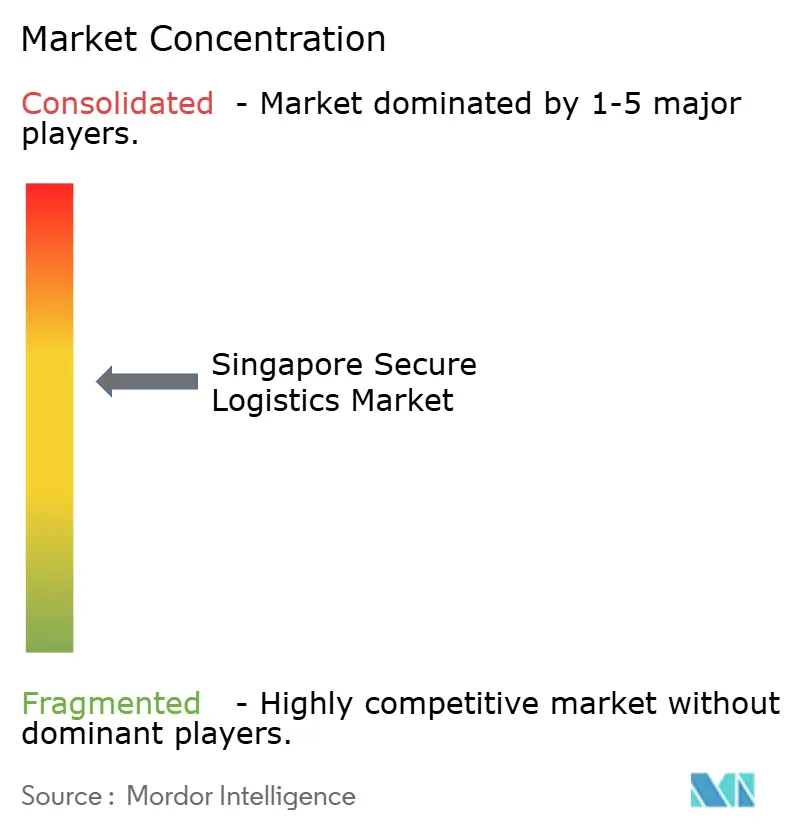
| Market Concentration | Medium |
Major Players
*Disclaimer: Major Players sorted in no particular order Image © Mordor Intelligence. Reuse requires attribution under CC BY 4.0. |
|
Singapore Secure Logistics Market Analysis by Mordor Intelligence
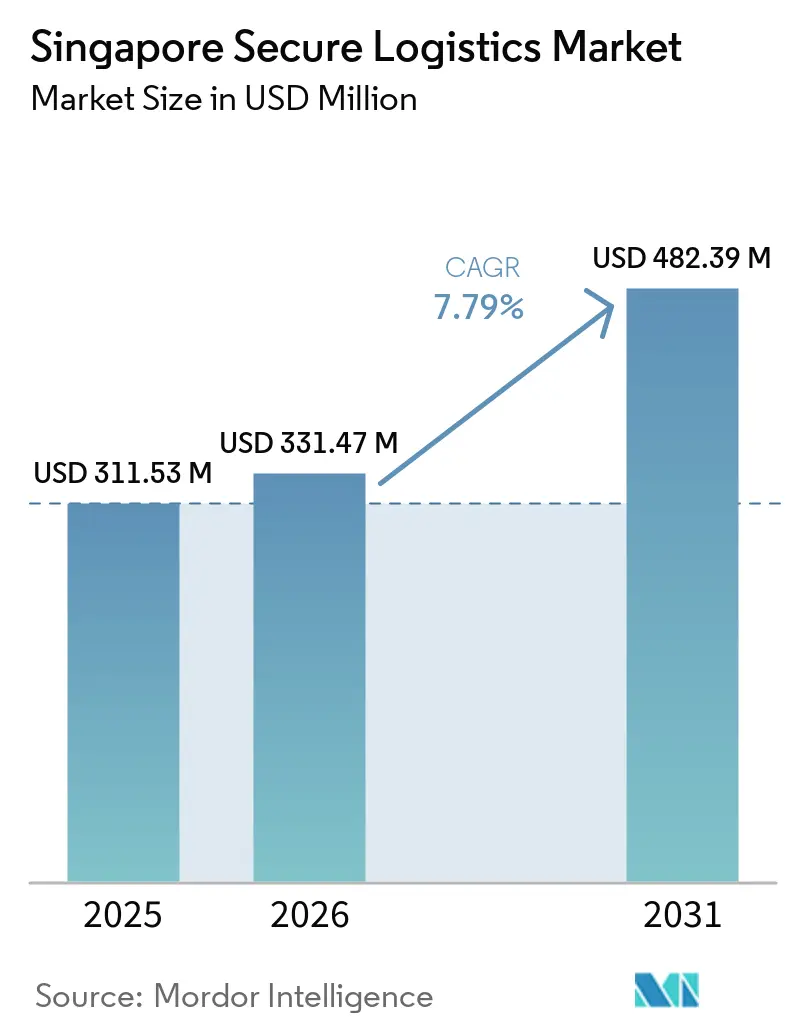
The Singapore secure logistics market size was valued at USD 311.53 million in 2025 and is estimated to grow from USD 331.47 million in 2026 to reach USD 482.39 million by 2031, at a CAGR of 7.79% during the forecast period (2026-2031).
Singapore remains a financial, trade, and transshipment center where the movement and storage of high-value assets require documented custody, armored transport, and secure vaulting. Its location on major east-west shipping routes supports shipments that require controlled handling before they move to other markets. The concentration of private wealth, institutional assets, and precious metals activity also supports demand for specialized providers. Regulations for cash, precious metals, and sensitive cargo increase the importance of traceable handling and secure storage. These conditions favor operators that can combine physical protection, audited processes, insurance support, and digital visibility across a client’s custody chain, rather than offering only a guarded vehicle or a storage location, with customers handling bullion, jewelry, cash, diamonds, fine art, or sensitive manufactured items need service continuity from collection through transport, handover, vaulting, monitoring, audit activity, and eventual release, and providers that can make those controls clear to insurers and institutional clients are better positioned to compete for recurring contracts.
Key Report Takeaways
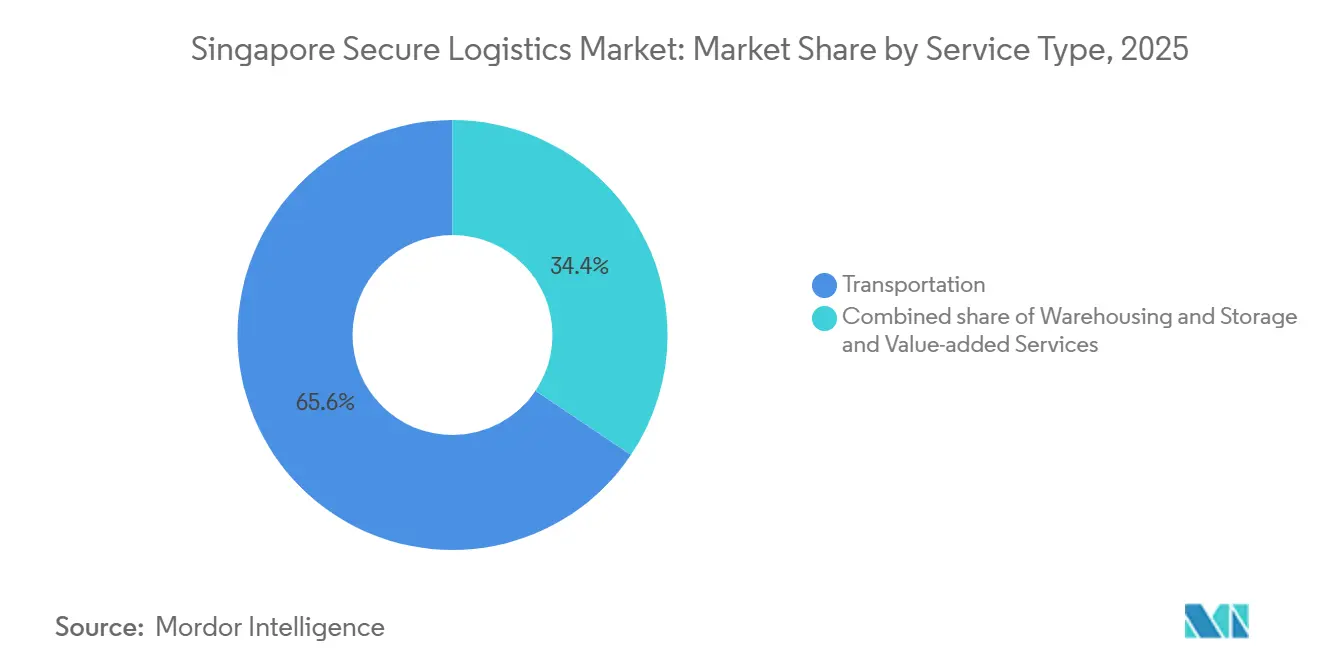
- By service type, transportation held 65.55% of the Singapore secure logistics market share in 2025, while the value-added services segment is forecast to grow at a 10.10% CAGR through 2031.
- By application, cash management held 52.50% of the Singapore secure logistics market size in 2025, while the jewelry and precious metals segment is forecast to grow at a 9.70% CAGR through 2031.
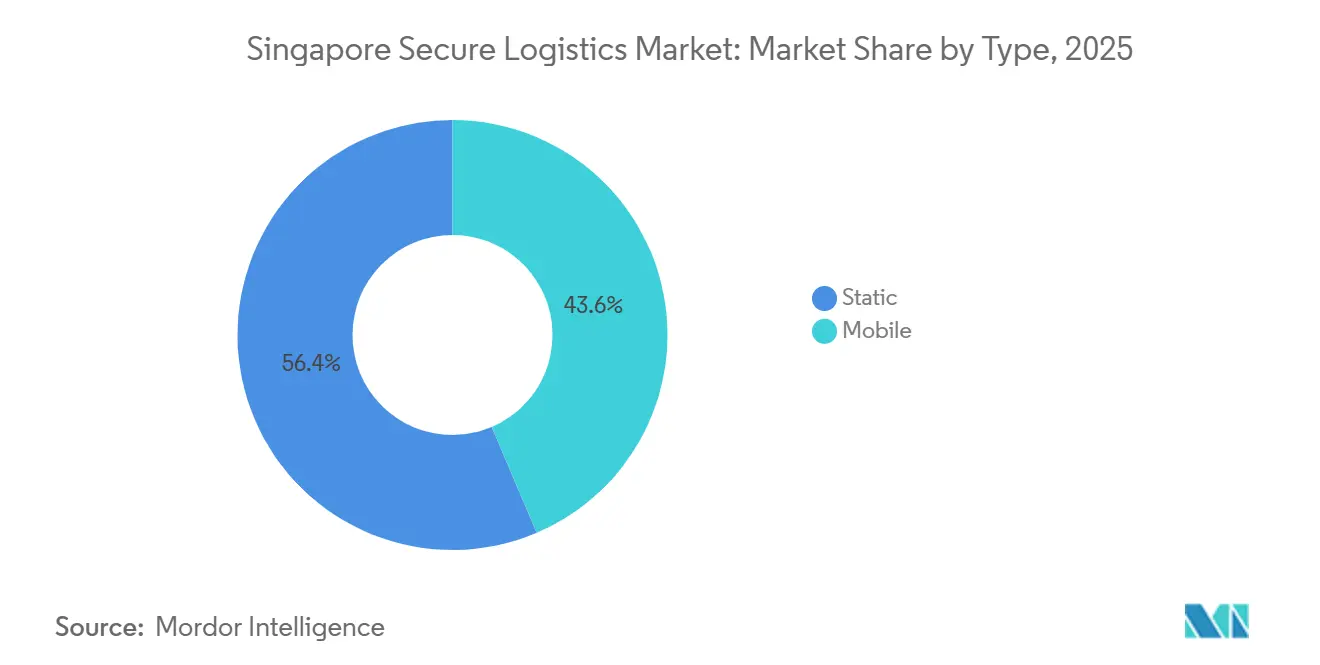
- By type, static secure logistics held 56.35% of the Singapore secure logistics market share in 2025, while mobile secure logistics is forecast to grow at an 8.50% CAGR through 2031.
- By end user, financial institutions held 55.00% of the Singapore secure logistics market size in 2025, while the retailers segment is forecast to grow at a 9.10% CAGR through 2031.
Note: Market size and forecast figures in this report are generated using Mordor Intelligence’s proprietary estimation framework, updated with the latest available data and insights as of January 2026.
Singapore Secure Logistics Market Trends and Insights
Drivers Impact Analysis*
| Driver | (~) % Impact on CAGR Forecast | Geographic Relevance | Impact Timeline |
|---|---|---|---|
| Rising High-Value Trade Through Singapore Free Trade And Transshipment Hubs | +1.8% | Global, with primary impact on Singapore’s Changi Airport and Tuas Port corridors | Medium term (2-4 years) |
| Rising Demand For Chain-Of-Custody Visibility In Bullion And Jewelry Movements | +1.3% | Singapore and ASEAN cross-border flows, including bullion transit to London, Dubai, and Hong Kong | Medium term (2-4 years) |
| Hybrid Physical-Digital Security Adoption Across Logistics Hubs | +0.9% | Singapore-wide, with spillover to Malaysia and Indonesia | Medium term (2-4 years) |
| Growth In Secure Vaulting And Secured Transit For Cash And Valuables | +0.9% | Singapore, Hong Kong, and Asia-Pacific sovereign and institutional channels | Long term (≥ 4 years) |
| Cross-Border Compliance Needs For High-Sensitivity Cargo Movements | +0.8% | Singapore as a regional hub, covering ASEAN transshipment and re-export corridors | Short term (≤ 2 years) |
| Rising Outsourcing Of Security-Intensive Logistics Operations | +0.8% | National, with early traction in the financial district and Changi Airport industrial zone | Medium term (2-4 years) |
| Source: Mordor Intelligence | |||
Rising High-Value Trade Through Singapore Free Trade and Transshipment Hubs
Singapore’s position as a transshipment hub concentrates high-value cargo movements within a compact and tightly managed jurisdiction. Cargo moving between air, sea, and bonded storage facilities requires protected transfers and clear custody records. This setting supports demand in the Singapore secure logistics market for guarded transport, bonded warehousing, and specialized handling. Expansion of storage and handling capacity around Singapore’s major logistics corridors can increase the need for secure services beyond conventional container operations. Operators that establish warehousing and guarded transport relationships before new capacity is commissioned can secure customer commitments before competition becomes more intense. This activity shifts part of the addressable demand beyond the established Changi and Le Freeport corridor and toward facilities that support controlled complex cross-border high-value cargo flows.
Rising Demand for Chain-Of-Custody Visibility in Bullion and Jewelry Movements
The Monetary Authority of Singapore and the Singapore Bullion Market Association announced plans in March 2026 to develop Singapore as an Asia-Pacific gold trading and clearing center. The plan includes over-the-counter gold clearing infrastructure by the end of 2026 and central bank gold vaulting services by October 2026. Bullion entering this system must be moved from refineries to vaults under documented custody procedures that meet recognized industry requirements. Le Freeport’s basement space is near full utilization, which increases the importance of additional vault capacity designed for institutional and sovereign clients[1]Singapore Bullion Market Association, “Le Freeport Singapore: Supporting Secure Storage in the Global Bullion Ecosystem,” SBMA Crucible 38, sbma.org.sg. SBMA standards, LBMA alignment, and refinery certification requirements raise the operational threshold for both transport and storage providers. In the Singapore secure logistics market, institutional reputation, reliable audit trails, and insurance capacity therefore matter as much as shipment volumes.
Hybrid Physical-Digital Security Adoption Across Logistics Hubs
Security providers are combining physical guards with connected surveillance, digital access control, and centralized monitoring systems. Labor constraints and client requests for stronger audit records support this shift across logistics sites and transport routes. A centralized operations center can oversee several vault sites and armored vehicles while creating incident records that support custody documentation. Prosegur’s Intelligent Security Operations Centers combine field personnel and connected devices under a unified command structure. This operating model can support faster incident escalation when high-value assets are in transit. For clients handling diamonds, fine art, or precious metals, this approach can meet insurance requirements while reducing the guarded hours needed for each shipment.
Growth in Secure Vaulting and Secured Transit for Cash and Valuables
New vault capacity is being designed for institutional users rather than small retail deposits, which supports related demand for armored air freight and secure ground transport. Higher storage capacity can increase movements for deposits, audits, inter-vault transfers, and institutional withdrawals. Institutional clients also require more frequent checks and documented movements than retail depositors. Banks and retailers are adopting smart cash-recycling systems that place larger cash values at fewer collection points. Brink’s AMS and DRS offerings show how demand forecasting, replenishment, and incident response can be offered as a managed cash service. Providers that package vaulting with managed cash services can serve customers who need both secure storage and controlled physical cash movement.
Restraints Impact Analysis*
| Restraint | (~) % Impact on CAGR Forecast | Geographic Relevance | Impact Timeline |
|---|---|---|---|
| Cashless Payment Adoption Reducing Some Cash-In-Transit Demand | -1.3% | National, concentrated among urban consumers and younger demographics | Short term (≤ 2 years) |
| High Labor Cost And Tight Manpower Availability For Guarded Operations | -0.9% | National, particularly acute in armored guarding and cash-handling operations | Medium term (2-4 years) |
| Insurance And Compliance Costs For High-Risk Or High-Value Cargo Routes | -0.6% | Singapore-wide, with spillover to cross-border precious metals routes | Medium term (2-4 years) |
| Limited Route Flexibility In A Highly Regulated Urban Logistics Network | -0.5% | National, concentrated in the CBD, Orchard, and Changi corridors | Long term (≥ 4 years) |
| Source: Mordor Intelligence | |||
Cashless Payment Adoption Reducing Some Cash-In-Transit Demand
Singapore’s widespread use of digital payments reduces the need for some retail cash replenishment and ATM servicing runs. The Monetary Authority of Singapore has described its objective as a cash-lite society rather than a fully cashless one. This approach preserves cash access for residents and visitors who continue to depend on physical currency. It also limits the potential decline in cash-in-transit activity, even as digital payment use changes transaction patterns. Cash logistics providers still face pressure because lower shipment volumes do not remove fixed costs for vehicles, insurance, or trained guards. Diversified operators can offset part of that pressure through precious metals and fine art services, but the cash segment requires a shift toward higher-value, more specialized work.
High Labor Cost and Tight Manpower Availability for Guarded Operations
Guarded transport, vault management, and cash handling depend on personnel who can complete vetting, training, and clearance processes. This makes it difficult to replace staff quickly when labor costs rise or staffing availability tightens. Changes to foreign worker levies through 2025 and 2026 continue to add pressure to manpower-intensive security operations[2]Singapore Ministry of Manpower, “Foreign Worker Levy,” Ministry of Manpower, mom.gov.sg. Larger providers are responding with remote monitoring, digital audit tools, and automated anomaly detection. These investments can reduce the need for additional staffing over time, but they require capital that smaller providers may not have. The resulting gap can favor established operators with the resources to modernize their service delivery.
*Our forecasts treat driver/restraint impacts as directional, not additive. The impact forecasts reflect baseline growth, mix effects, and variable interactions.
Segment Analysis
By Service Type: Transportation Holds the Largest Base as Value-Added Services Grow Faster
Transportation accounted for 65.55% of the Singapore secure logistics market share in 2025, reflecting armored road runs for banks and Changi Airport and specialist air freight for bullion and diamonds. Road transport remains the largest domestic activity because it supports banking, retail, and secure collection routes, although it is most exposed to lower cash-in-transit frequency as digital payments become more common. Secured air freight has a stronger long-term role because Singapore connects high-value cargo with global custody locations. Transportation in the Singapore secure logistics industry also includes controlled sea movements and inland waterway services for bonded bullion and high-value manufactured goods. These channels contribute steadily but grow more slowly than road and air services, and they require secure handoffs between vehicles, airport facilities, bonded areas, and vaults, where a break in documentation or handling control can undermine the custody assurance expected by institutional customers.
The value-added services segment is forecast to grow at a 10.10% CAGR from 2026 to 2031, the highest rate within the service type segmentation. The LionGlobal fully insured physical gold fund was launched in November 2025 with storage at Le Freeport and Standard Chartered as custodian. Such arrangements require coordinated transport, custody documentation, insurance support, asset monitoring, audits, and compliance reporting, which brings activities that were often handled as separate logistics, security, and administrative tasks into one closely managed service relationship. The Singapore secure logistics market size for value-added services benefits when these activities are obtained through one contract, rather than separate arrangements focused only on transport. Warehousing and storage include secure storage and vault services for sovereign wealth managers, family offices, foreign central banks, and other institutional users that need controlled access and documented custody.



By Application: Cash Management Remains the Largest Application as Precious Metals Gain Momentum
Cash management accounted for 52.50% of the Singapore secure logistics market size in 2025. Singapore’s commercial banking network has historically supported substantial volumes across these activities. Digital wallets, PayNow, and contactless payments are reducing cash velocity through the banking system, which lowers replenishment frequency and can pressure individual-run profitability. Cash management still requires reliable collection, sorting, storage, and controlled delivery for users who retain physical currency needs. Providers can protect value through integrated cash management and operational data that improves collection and replenishment scheduling, reducing unnecessary movements while retaining the trained personnel, vehicles, security processes, and incident-response capacity needed for higher-value cash activity.
The jewelry and precious metals segment is forecast to grow at a 9.70% CAGR from 2026 to 2031, making it the fastest-growing application. Singapore’s gold clearing and custody plans increase demand for protected movement between refineries, airport facilities, vaults, and buyers. The 41st World Diamond Congress was held in Singapore in July 2026, reinforcing the city’s role in the gemstone trade, while diamond shipments require customs-cleared transit, tamper-evident packaging, and Kimberley Process compliance. Manufacturing users need protected movement for high-value precision components, including semiconductors, aerospace parts, and pharmaceutical actives. At the same time, fine art, luxury goods, wine, and collectibles are served by relationship-focused specialists whose service depends on discretion, careful timing, condition-sensitive handling, and trusted customer relationships. Singapore Mint launched its first investment-grade gold bullion in September 2025 with secure vault storage included in its offering, adding a retail-adjacent source of demand for precious metals storage and movement.
By Type: Static Sites Form the Core While Mobile Services Address Changing Transport Needs
Static secure logistics held 56.35% of the Singapore secure logistics market share in 2025. Static services include fixed vaults, secure warehouses, on-site guards, and safety infrastructure at bank branches. Their leading position reflects Singapore’s freeport vault network, the high cost of institutional-grade construction, high switching costs after a client selects a qualified site, and the need to preserve continuous records and operational confidence throughout a long-lived institutional custody relationship. The planned central bank gold vaulting services require operators to meet sovereign-grade requirements by October 2026. Providers seeking to serve central banks and sovereign wealth funds must demonstrate compliance with relevant SBMA standards and international custody frameworks, making credible static facilities central to the Singapore secure logistics market.
Mobile secure logistics is forecast to grow at an 8.50% CAGR from 2026 to 2031. It includes armored transport, secure last-mile delivery for luxury retail, mobile cash processing, and guarded movement between client sites. The segment benefits as remaining cash-in-transit demand concentrates in higher-value and more security-sensitive routes, supporting armored fleet investment where protection justifies each movement and where customers need a specialist provider to coordinate security, scheduling, collection, processing, and delivery. Full-lifecycle ATM outsourcing shifts capacity from in-house banking operations to specialists by combining forecasting, replenishment, cash sorting, and incident response in one agreement. Prosegur’s POPS Connect platform gives customers real-time visibility into mobile patrol and guarding activity, supporting a model with fewer guards per route, more vehicle instrumentation, and centralized coordination.
By End User: Financial Institutions Lead Demand as Retailers Become the Fastest-Growing Buyers
Financial institutions held 55.00% of the Singapore secure logistics market size in 2025. Banks buy cash-in-transit services, ATM replenishment, banknote processing, vault access, precious metals custody, and controlled handling for fine art assets held by private banking clients. They face a split demand pattern as routine cash movements decline while custody needs for high-value assets expand. Financial institutions prefer providers that offer verified custody, reporting, insurance coordination, and secure movement under consistent procedures. Their procurement decisions can favor established operators because weak physical security or documentation can create material operational risk, while broader managed custody arrangements replace separate service contracts and give institutions a more consistent basis for managing changing cash, vaulting, and high-value asset requirements.
The retailers segment is forecast to grow at a 9.10% CAGR from 2026 to 2031, the fastest rate among end users. Luxury retailers, diamond boutiques, jewelry chains, and high-value electronics stores need secure delivery, store-level safe-room operations, and protected stock transfers. Government users, including military logistics, customs agencies, and public utilities, provide steady demand through formal procurement cycles. SATS received a Singapore Armed Forces contract for total logistics support in Shoalwater Bay, Australia, in September 2026. Other users, including precious metals dealers, private vault clients, fine art auction houses, and family offices, have high revenue per relationship and increasingly seek organized vault operators as bank safe-deposit availability falls and technology-supported service standards make specialist facilities more suitable for their documentation, access, and reporting needs.
Geography Analysis
Singapore's role is shaped by its location near the Strait of Malacca and the South China Sea. The transshipment model increases the need for bonded storage, customs-cleared transit, and controlled custody during a shipment’s dwell time, because high-value goods may move between multiple facilities before leaving the country rather than entering a conventional domestic distribution network. Its compact geography connects ports, airport facilities, financial centers, and vaults within short operating distances, supporting rapid protected transfers for high-value goods. Singapore Customs introduced a single through-transshipment permit for applicable land intermodal transfers in January 2025, replacing a dual-permit process and easing transfers between logistics facilities. Tuas Mega Port is expected to extend guarded logistics needs toward western Singapore and create further demand around industrial zones and national logistics corridors.
Singapore’s gold hub strategy gives its logistics system a distinct high-security role within ASEAN. Commercial gold storage capacity exceeded 2,200 metric tons across Le Freeport and The Reserve in early 2026, and central banks and institutional investors favored basement vault space because it met specific security and load-bearing requirements. The Reserve reported that gold and silver storage orders rose 88% in the first 4 months of 2025 from the prior-year period, and overseas clients accounted for 90% of new orders. These patterns show that Singapore serves international wealth and institutional custody requirements rather than only domestic storage demand.
The Monetary Authority of Singapore’s AML/CFT Notice 626 was amended in July 2025, while the SBMA vaulting standards and Singapore Customs rules strengthen documentation requirements for the relevant transactions[3]Rajah & Tann Asia. "MAS Revises AML/CFT Notices for FIs and VCCs - to Mandate PF Assessments, Align Trust Regime and Streamline STR Filing Regime." Rajah & Tann Asia, July 2025, www.rajahtannasia.com. These requirements increase the value of systems that provide auditable shipment and storage records. Operators meeting these standards can charge for controls that institutional customers require, especially central banks, regulated funds, and licensed refineries. Singapore’s geographic advantage is reinforced by a regulatory system that makes high-quality custody capabilities more important. Singapore secure logistics market participants must maintain protected facilities and reliable compliance processes to serve cross-border high-value cargo.
Competitive Landscape
The Singapore secure logistics market is moderately concentrated among integrated full-service operators, while asset-class specialists serve a fragmented group of customers. Brink’s and Loomis have a strong position in precious metals services through bonded vault operations at Le Freeport. Their location near Changi Airport supports rapid transfers between secure storage and air cargo operations. This advantage requires major facility investment and Singapore Customs authorization, not only differentiated service delivery, because rapid vault-to-aircraft transfers depend on protected locations, regulated operating permissions, trained personnel, and processes that can preserve custody from storage through handover. Competition centers on global network reach, digital client visibility, technology-supported physical security, and lifecycle cash management.
Certis Group is a relevant domestic competitor because it provides cash-in-transit, airport security, guarded transport, and technology-enabled security services in Singapore and across the Asia-Pacific. This makes Certis a more appropriate competitive reference than investment holding companies that do not operate secure logistics services. Brink’s partnered with Matrixdock to provide custody for LBMA-certified gold backing a tokenized gold product, showing how custody providers can support digital-asset issuers that need verified physical backing. Prosegur’s Intelligent Security Operations Centers combine field personnel with connected devices and centralized supervision, while POPS Connect gives customers visibility into mobile patrol and guarding activity, and these tools make digital reporting part of the wider security service and allow customers to receive operating information without separating physical protection, incident escalation, field activity, and reporting into unrelated service arrangements.
Malca-Amit launched the MyMalca customer portal in January 2026 to provide shipment status, guard activity logs, and service updates, showing that clients expect real-time information alongside secure physical handling. Open areas remain in sovereign and central bank vaulting, which is being developed through Singapore’s 2026 gold hub strategy. Providers with bullion credentials, proof-of-reserve reporting, and substantial insurance cover are better placed to pursue this demand. Integrated physical and digital protection for high-value retail also remains underserved, as boutiques and jewelry dealers need delivery, on-site vault support, and incident reporting without operating armored fleets. Fine art and luxury specialists compete through relationship-based services, while ISO 28000 and TAPA Facility Security Requirements are relevant signals for sensitive cargo mandates[4]Transported Asset Protection Association, “TAPA Standards,” Transported Asset Protection Association, tapa-global.org.
Singapore Secure Logistics Industry Leaders
-
The Brink’s Company
-
Malca-Amit
-
Prosegur Group
-
Loomis AB
-
Certis
- *Disclaimer: Major Players sorted in no particular order

Recent Industry Developments
- June 2026: Prosegur Singapore was awarded the contract for management, consultancy, and security services for the Marina Bay Singapore Countdown for 2026 and 2027, with an option to extend for 2028. This demonstrates the company's capabilities in managing large-scale, high-profile public-space security operations in Singapore.
- March 2026: Le Freeport Management Pte Ltd was formally welcomed as the Singapore Bullion Market Association’s first-ever storage member in Q1 2026, formalizing its integration into Singapore’s regulated bullion logistics ecosystem.
- January 2026: Malca-Amit launched the MyMalca customer portal, a web-based digital platform enabling clients to monitor secure shipment status, guard activity logs, and service updates in real time, enhancing transparency and operational stickiness across its Singapore and global operations.
- October 2025: Silver Bullion announced plans for Phase 2 expansion of The Reserve vault in Singapore, adding 23 new Underwriters Laboratories Class 2 vaults and 2,000 metric tons of gold-vaulting capacity, quintupling total institutional storage from 500 to 2,500 metric tons to support central banks, institutions, and family offices.


Singapore Secure Logistics Market Report Scope
| Transportation | Road |
| Rail | |
| Air | |
| Sea and Inland Waterways | |
| Warehousing and Storage (including Secure Storage and Vault Services) | |
| Value-added Services |
| Cash Management |
| Diamonds |
| Jewelry and Precious Metals |
| Manufacturing |
| Others |
| Static |
| Mobile |
| Financial Institutions |
| Retailers |
| Government |
| Others |
| By Service Type | Transportation | Road |
| Rail | ||
| Air | ||
| Sea and Inland Waterways | ||
| Warehousing and Storage (including Secure Storage and Vault Services) | ||
| Value-added Services | ||
| By Application | Cash Management | |
| Diamonds | ||
| Jewelry and Precious Metals | ||
| Manufacturing | ||
| Others | ||
| By Type | Static | |
| Mobile | ||
| By End User | Financial Institutions | |
| Retailers | ||
| Government | ||
| Others |


Key Questions Answered in the Report
What is the projected value of Singapore secure logistics in 2031?
The sector is projected to reach USD 482.39 million by 2031, rising from USD 331.47 million in 2026 at a 7.79% CAGR.
Which service is the largest in Singapore secure logistics?
Transportation was the largest service type, with a 65.55% share in 2025, supported by armored road, air freight, and bonded cargo movements.
What is driving precious metals security services in Singapore?
Gold clearing plans, central bank vaulting services, and demand for documented bullion custody support secure transport and storage needs.
Which end users are expanding their use of secure logistics most quickly?
Retailers are forecast to grow at a 9.10% CAGR through 2031 as luxury, jewelry, diamond, and high-value electronics outlets need controlled deliveries.
How do digital payments affect cash-in-transit operations in Singapore?
Digital payments reduce some routine cash replenishment needs, which encourages providers to focus on higher-value and managed cash services.
Why are digital monitoring tools relevant to secure logistics providers?
They provide clients with shipment, guard, and incident visibility while supporting auditable custody records and more efficient deployment of field staff.
Page last updated on:





