
Singapore Enterprise Content Management (ECM) Market Size and Share
Market Overview
| Study Period | 2020 - 2031 |
|---|---|
| Forecast Data Period | 2026 - 2031 |
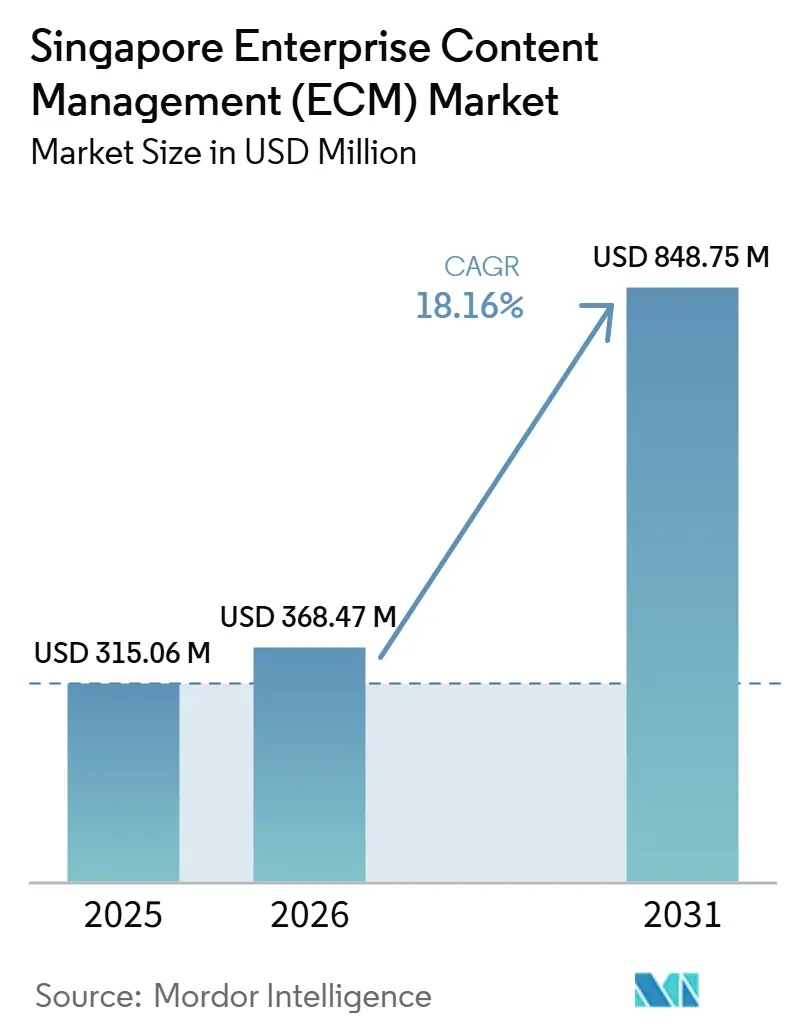
| Base Year Market Size (2025) | USD 315.06 Million |
| Market Size (2026) | USD 368.47 Million |
| Market Size (2031) | USD 848.75 Million |
| Growth Rate (2026 - 2031) | 18.16% CAGR |
| Market Concentration | Medium |
Major Players *Disclaimer: Major Players sorted in no particular order Image © Mordor Intelligence. Reuse requires attribution under CC BY 4.0. | |
Singapore Enterprise Content Management (ECM) Market Analysis by Mordor Intelligence
The Singapore enterprise content management (ECM) market size was valued at USD 315.06 million in 2025 and estimated to grow from USD 368.47 million in 2026 to reach USD 848.75 million by 2031, at a CAGR of 18.16% during the forecast period 2026-2031. Growth in the Singapore enterprise content management (ECM) market is being shaped by digital public policy, tighter rules in regulated sectors, and strong cloud and AI investment across the country. The market is also benefiting from rising demand for content tools that can support secure data handling, faster approvals, and better audit readiness across large organizations. Vendor competition is moving toward AI-led workflow control, not just file storage and retrieval, which is changing how buyers assess platform value. Demand is also rising for locally or regionally governed hosting models, as enterprises in finance, healthcare, and the public sector are placing greater weight on sovereignty, trust, and regulatory alignment when choosing new platforms. The opportunity in the Singapore enterprise content management (ECM) market is widening as SMEs enter the category faster, while large enterprises continue to anchor overall spending.
Key Report Takeaways
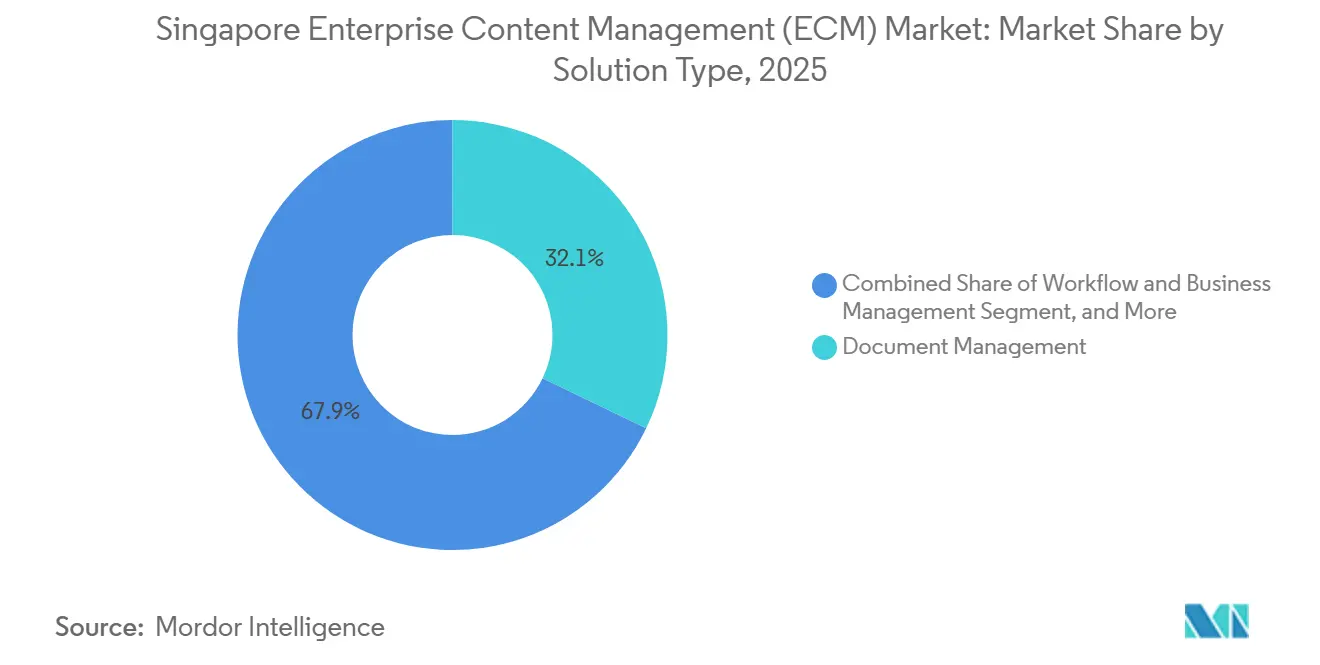
- By solution type, document management held 32.14% of the Singapore enterprise content management (ECM) market share in 2025, while workflow and business process management is projected to expand at a 20.83% CAGR through 2031.
- By deployment mode, cloud accounted for 79.41% share of the Singapore enterprise content management (ECM) market size in 2025, and it is projected to expand at a 21.24% CAGR through 2031.
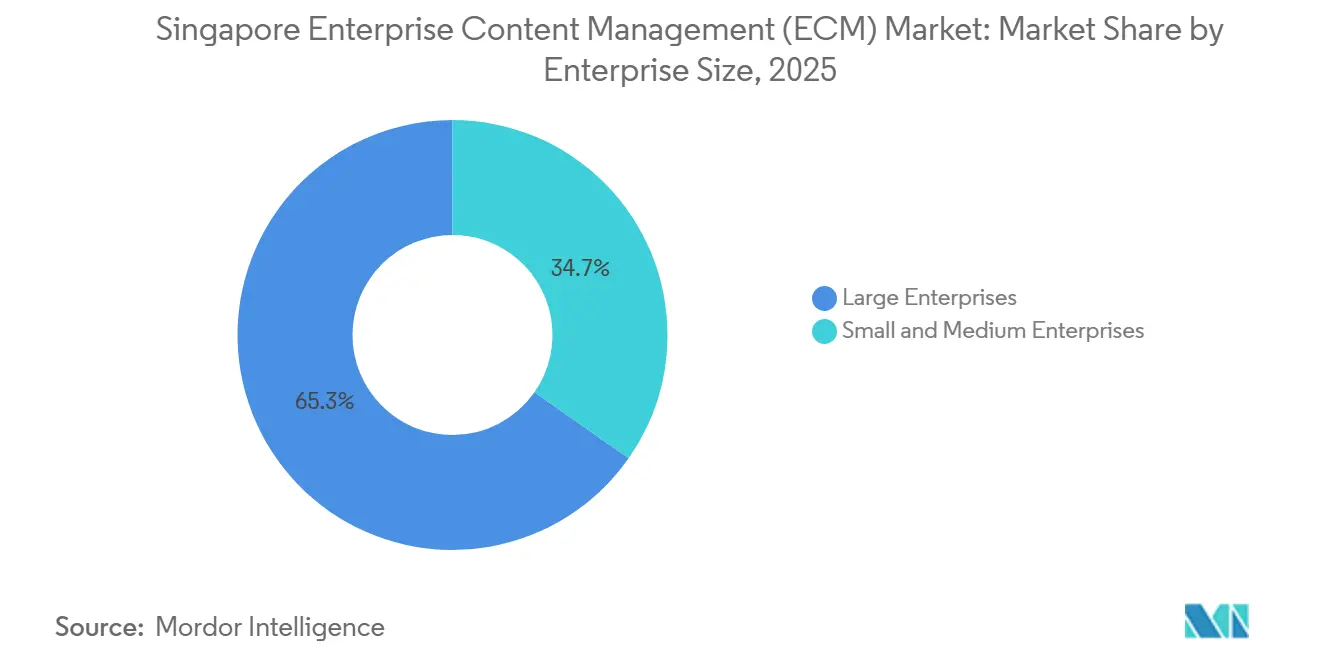
- By enterprise size, large enterprises held 65.28% share in 2025, while SMEs are expected to record the fastest growth at a 20.62% CAGR through 2031.
- By end-user industry, BFSI accounted for 26.53% share in 2025, while healthcare is projected to advance at a 21.41% CAGR through 2031.
Note: Market size and forecast figures in this report are generated using Mordor Intelligence’s proprietary estimation framework, updated with the latest available data and insights as of January 2026.
Singapore Enterprise Content Management (ECM) Market Trends and Insights
Drivers Impact Analysis*
| Driver | (~) % Impact on CAGR Forecast | Geographic Relevance | Impact Timeline |
|---|---|---|---|
| AI Copilots in Content Workflows | +4.5% | Global, led by Singapore BFSI and government sectors | Short term (≤ 2 years) |
| Data Residency and Sovereignty Rules | +3.8% | Singapore and wider APAC regulated sectors | Medium term (2-4 years) |
| Zero Trust Content Access Controls | +3.0% | Singapore financial services and critical infrastructure sectors | Short term (≤ 2 years) |
| Cloud Migration of Legacy Repositories | +2.8% | Global, concentrated in Singapore regulated enterprises | Medium term (2-4 years) |
| Industry-Specific Compliance Automation | +2.5% | Singapore healthcare, BFSI, and government and public sector | Medium term (2-4 years) |
| No-Code Workflow Orchestration Demand | +2.0% | Singapore SME sector and national productivity programs | Long term (≥ 4 years) |
| Source: Mordor Intelligence | |||
AI Copilots Embedded in Content Workflows
AI copilots are changing how the Singapore enterprise content management (ECM) market handles stored information, because users now expect platforms to guide work rather than only retrieve files. These tools can suggest classifications, route approvals, and surface exceptions during document handling, reducing manual effort for operations and compliance teams. Hyland launched its Enterprise Context Engine in June 2026, featuring sector-specific ontologies for healthcare, financial services, insurance, and government, demonstrating how vendors are integrating domain-aware AI into content systems.[1]Hyland Software, “Hyland Launches Next Wave of AI Platform Innovations,” Hyland Software, hyland.com GovTech also deployed AISAY v2 in Singapore government agencies, and the platform can process large document sets in seconds and return structured JSON outputs for workflow use. This shift is boosting demand in the Singapore enterprise content management (ECM) market, as buyers now see AI-driven content handling as part of day-to-day process control rather than a future add-on.
Data Residency and Sovereignty Requirements
Data residency rules are becoming a core buying factor in the Singapore enterprise content management (ECM) market, especially for organizations that manage sensitive financial, personal, or clinical records. Singapore’s PDPA imposes obligations on how personal data is handled and transferred, keeping cross-border controls central to content platform selection.[2]Personal Data Protection Commission, “Overview of the Personal Data Protection Act,” PDPC, pdpc.gov.sg This issue is more visible in BFSI and healthcare, where content repositories hold records that need clear jurisdictional protection and stronger governance controls. Microsoft’s USD 5.5 billion investment in cloud and AI infrastructure in Singapore from 2025 through 2029 reinforces the local capacity needed to support this demand in the Singapore enterprise content management (ECM) market. As a result, vendors that can align cloud performance with jurisdictional assurance are better placed in competitive evaluations across the Singapore enterprise content management (ECM) market.
Zero Trust Content Access Controls
Zero-trust access design is becoming more important in the Singapore enterprise content management (ECM) market as financial institutions face tighter oversight on technology risk and content access. The Monetary Authority of Singapore proposed broad amendments to its Technology Risk Management Notice in June 2026, including continuous monitoring, immutable offline backup, and stronger IT risk controls.[3]onetary Authority of Singapore, “Consultation Paper on Proposed Amendments to Notices on Technology Risk Management,” Monetary Authority of Singapore, mas.gov.sg MAS guidelines also recommend zero-trust principles for cloud-based systems, which support least-privilege access and stronger control over content stores. This matters because many older content systems were built around perimeter models and do not meet the same level of access discipline. That gap is pushing refresh cycles in the Singapore enterprise content management (ECM) market, particularly among regulated financial buyers.
Cloud Migration of Legacy Repositories
Migration from older repositories to cloud-native platforms remains a major growth driver for the Singapore enterprise content management (ECM) market. Many long-running content estates were built with proprietary interfaces, layered connectors, and older folder structures that now work poorly with modern collaboration and AI tools. OpenText released Cloud Editions 26.2 in June 2026 and introduced the first agentic capabilities in Content Aviator, which lowered the barrier for customers moving from older on-premises environments.[4]OpenText Corporation, “What’s New in OpenText Content Management 26.2,” OpenText, opentext.com This is important in Singapore because large regulated enterprises need ways to modernize without long disruption windows or full system replacement. The pressure to leave high-maintenance legacy stacks is therefore becoming a practical growth force across the Singapore enterprise content management (ECM) market.
Restraints Impact Analysis*
| Restraint | (~) % Impact on CAGR Forecast | Geographic Relevance | Impact Timeline |
|---|---|---|---|
| High Integration Complexity With Legacy Systems | -0.7% | Global, most acute in Singapore large enterprise BFSI and public sector | Short term (≤ 2 years) |
| User Resistance to Content Governance Discipline | -0.4% | Singapore enterprises across all sectors | Medium term (2-4 years) |
| Vendor Lock-In Concerns in Platform Suites | -0.2% | Singapore IT and BFSI sectors | Long term (≥ 4 years) |
| Skills Gap in Intelligent Content Operations | -0.1% | Singapore-wide, concentrated in SME and public sector segments | Medium term (2-4 years) |
| Source: Mordor Intelligence | |||
High Integration Complexity With Legacy Systems
Integration complexity remains the biggest structural restraint in the Singapore enterprise content management (ECM) market, especially among large enterprises with long-established information systems. Older repositories in BFSI and government often include custom metadata structures, point-to-point links, and poorly documented connections to ERP, HRMS, and core operating systems. This makes migration slower, costlier, and more dependent on staged transition plans than many buyers first expect. A May 2026 GeBIZ tender from the Housing and Development Board for an AI-driven knowledge management system explicitly required integration with existing information systems, document storage, and role-based access controls, underscoring the centrality of the integration burden. Because of this, deployment timelines in the Singapore enterprise content management (ECM) market can stretch well beyond initial plans even when procurement approval is already in place.
User Resistance to Content Governance Discipline
User behavior still slows adoption depth in the Singapore enterprise content management (ECM) market, even when the technology case is clear. Many employees remain used to shared drives, email attachments, and unmanaged cloud storage, which weakens the shift toward structured tagging, retention rules, and controlled workflows. Workday’s 2025 findings, as cited in the provided material, showed that 52% of Singapore business leaders struggled with the time required to reskill employees, reflecting the broader effort needed to support new operating habits. The Ministry of Manpower also reported that PMET vacancies left open for at least 6 months rose from 14.4% in 2024 to 16.0% in 2025, with employers citing specialization gaps. These workforce realities keep the Singapore enterprise content management (ECM) market from scaling as quickly as the technology itself now allows.
*Our forecasts treat driver/restraint impacts as directional, not additive. The impact forecasts reflect baseline growth, mix effects, and variable interactions.
Segment Analysis
By Solution Type: Document Management Anchors Platform Adoption, Workflow Automation Leads Growth
Document management held the largest share at 32.14% in 2025, which made it the clearest entry point for buyers in the Singapore enterprise content management (ECM) market. It remained central because BFSI institutions needed reliable control over loan files, KYC records, and regulatory correspondence that aligned with retention and audit expectations. This part of the Singapore enterprise content management (ECM) industry also kept its weight because compliance-driven document handling is recurring and less exposed to short-term budget swings. Records management and case management stayed smaller, but they remained important where organizations needed stronger lifecycle control and structured handling of regulated files.
Workflow and business process management is projected to grow at a 20.83% CAGR from 2026 to 2031, making it the fastest-growing solution area in the Singapore enterprise content management (ECM) market. Growth is being driven by the broader adoption of AI for approval routing, exception handling, and cross-team handoffs that were once handled manually. Digital asset management continued to serve more focused needs in media, retail, and marketing functions, while web content management supported publishing and disclosure workflows across financial services and the public sector. The other solutions group, which includes document capture and email archiving, remained relevant for mid-market buyers entering the Singapore enterprise content management (ECM) market through early-stage digitization programs.



By Deployment Mode: Cloud Consolidates as the Default Architecture
Cloud deployment held a 79.41% share in 2025 and ranked as the fastest-growing mode at a 21.24% CAGR, underscoring how firmly the Singapore enterprise content management (ECM) market has aligned around cloud-first buying. This is not a split market between old and new architectures, because most new investments are now expanding cloud use rather than testing it for the first time. The fact that cloud is both the largest and fastest-growing segment suggests that enterprise confidence in this model has already moved beyond the pilot stage. For many buyers, cloud is now the default architecture for new content programs in the Singapore enterprise content management (ECM) market.
That momentum is supported by local infrastructure expansion and stronger confidence in governed hosting environments. Microsoft’s multiyear infrastructure commitment in Singapore is reinforcing the capacity needed for sovereign and AI-ready workloads. Hybrid deployment still held a practical role among large BFSI institutions and government agencies that needed tighter control over selected content classes, while on-premises systems remained necessary in limited use cases involving sensitive or classified material. Even so, the longer-term direction still points toward additional migration away from traditional deployments, which should keep the cloud at the center of the Singapore enterprise content management (ECM) market.
By Enterprise Size: Large Enterprises Anchor Spend, SMEs Accelerate Fastest
Large enterprises accounted for 65.28% of revenue in 2025, which kept them at the core of the Singapore enterprise content management (ECM) market share structure. Their lead came from heavier document volumes, more complex workflows, and recurring compliance budgets that support enterprise-grade platforms. These organizations also tended to sign multi-year contracts, which gave vendors stronger revenue visibility and supported local delivery, training, and customer support. As a result, large enterprises continued to shape platform standards and procurement requirements across the Singapore enterprise content management (ECM) market.
SMEs are projected to expand at a 20.62% CAGR from 2026 to 2031, making them the fastest-growing segment in the Singapore enterprise content management (ECM) market. Growth is being supported by government programs that reduce the cost and effort needed to adopt cloud-based document and workflow tools. The Ministry of Digital Development and Information stated that the upcoming EDGE framework will combine multiple grant pathways into one portal and provide annual support of up to SGD 100,000 (USD 77,396) which should ease adoption for smaller businesses. No-code and easier-to-configure platforms are also widening access, which should expand vendor opportunities below the top enterprise tier in the Singapore enterprise content management (ECM) market.
By End-User Industry: Regulated Verticals Propel Demand
BFSI held the largest end-user share at 26.53% in 2025, which confirmed its role as the leading demand center in the Singapore enterprise content management (ECM) market. Financial institutions face ongoing requirements for risk management, AML documentation, KYC records, oversight of outsourcing, and secure retention, which keep formal content systems central to daily operations. MAS reiterated the importance of these functions in its June 2026 consultation on proposed Technology Risk Management amendments. That regulatory depth keeps BFSI spending durable within the Singapore enterprise content management (ECM) market, even when broader enterprise software priorities shift.
Healthcare is projected to expand at a 21.41% CAGR from 2026 to 2031, making it the fastest-growing end-user segment and an important contributor to the growth of the Singapore enterprise content management (ECM) market. The Health Information Act 2026 requires licensed healthcare providers to contribute patient records to the National Electronic Health Record system and meet statutory cybersecurity obligations by early 2027. The Ministry of Health also stated that the NEHR Contribution Grant began from July 2026 to support subscription-based health information systems that meet HIA requirements. Government and public sector remained the second-largest revenue contributor, while IT and telecommunications, manufacturing, retail, media and entertainment, education, and energy and utilities continued to add incremental demand across the Singapore enterprise content management (ECM) market.
Geography Analysis
Singapore enterprise content management (ECM) market strength came from high digital readiness, a dense mix of financial and technology headquarters, and a regulatory structure that made formal content controls more necessary than optional. BFSI, government and public sector, and healthcare formed the clearest demand anchors because they faced the most defined rules on records, access, and audit control. This made spending in the Singapore enterprise content management (ECM) market more recurring than one-time, especially in regulated settings.
Singapore’s digital government strategy also gave the country a distinct profile compared to most neighboring markets. GovTech’s AISAY v2 showed that agencies were already using AI-enabled document analysis tools in operational settings by mid-2026. The Housing and Development Board’s May 2026 tender for an AI-driven knowledge management system showed that public procurement was moving from repository tools toward more intelligent content environments. These decisions matter because government standards often shape what enterprise suppliers and private contractors must support. That dynamic reinforces the Singapore enterprise content management (ECM) market as both a local demand center and a reference point for regional deployment standards.
Singapore’s role as a financial hub also gave it influence beyond domestic demand. Regional and multinational institutions often used Singapore-based governance practices as a model for Southeast Asian operations, which increased the regional importance of the Singapore enterprise content management (ECM) market. IMDA’s Model AI Governance Framework for Agentic AI was added to that position in January 2026, providing vendors with an early policy reference for AI-enabled content platforms. The result was a market in which AI policy, public procurement, and regulated enterprise demand reinforced one another.
Competitive Landscape
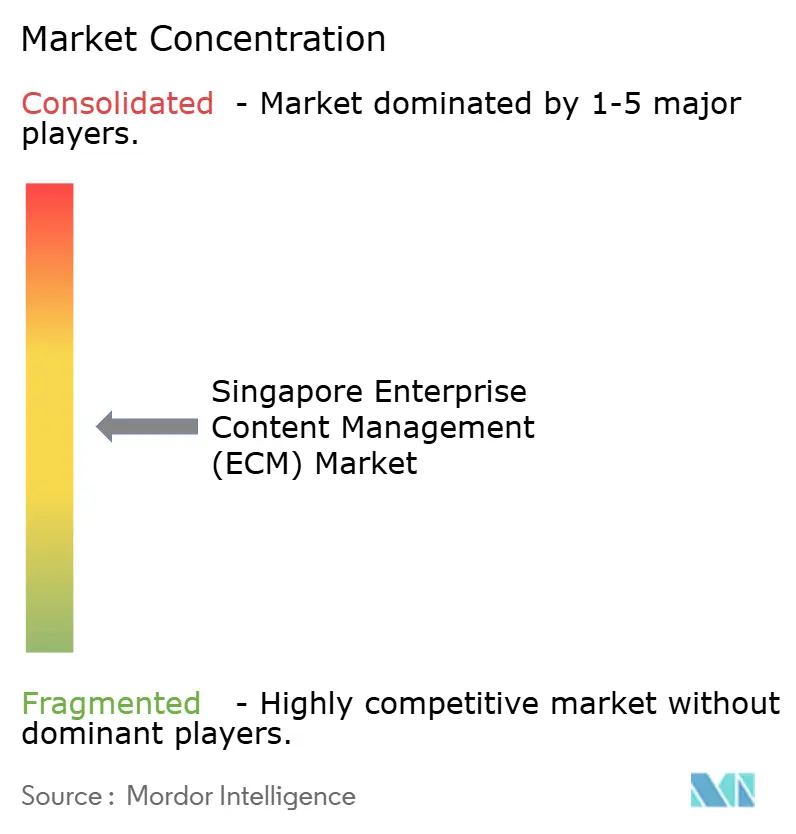
The Singapore enterprise content management (ECM) market was moderately concentrated at the top, with Microsoft, OpenText, Hyland, IBM, and Oracle leading enterprise-grade contracts across finance and government. Microsoft’s ecosystem held a strong structural position because SharePoint and Microsoft 365 were already embedded in many enterprise environments, making them a natural base for broader content programs. That did not remove room for specialist vendors, but it did change the terms of competition. In the Singapore enterprise content management (ECM) market, suppliers increasingly had to demonstrate deeper governance, stronger AI enablement, and tighter regulatory alignment, rather than just broad enterprise software coverage.
OpenText remained important because it continued to align product updates with the needs of regulated customers. Its June 2026 Cloud Editions 26.2 release introduced agentic capabilities in Content Aviator, supporting migration and AI-native document handling for customers moving from older systems. The company had also announced Content Next with Fiserv in September 2025, targeting financial institution workflows on its multi-tenant SaaS core content platform. Microsoft also strengthened its strategic position through its USD 5.5 billion infrastructure commitment in Singapore, which supported the cloud conditions that many ECM buyers now require. These moves show that leading vendors in the Singapore enterprise content management (ECM) market are competing through product depth, ecosystem control, and local infrastructure readiness.
Hyland also strengthened its relevance by launching new AI platform features in June 2026, including the Enterprise Context Engine, which showed a clear push toward domain-aware content intelligence. Mid-market suppliers such as M-Files, Newgen Software Technologies, and iManage still had a place in narrower use cases where speed, vertical fit, or ease of configuration mattered more than enterprise scale. Value-oriented players such as Zoho and DocuWare remained more relevant for first-time SME buyers entering the Singapore enterprise content management (ECM) market. Overall, competition was still active, but the advantage was shifting toward vendors that could connect AI functionality with clear governance, security, and deployment credibility.
Singapore Enterprise Content Management (ECM) Industry Leaders
OpenText Corporation
Hyland Software, Inc.
IBM Corporation
Microsoft Corporation
Box, Inc.
- *Disclaimer: Major Players sorted in no particular order

Recent Industry Developments
- June 2026: OpenText Corporation released Cloud Editions 26.2, introducing the first agentic capabilities in OpenText Content Aviator. The release targets regulated enterprises migrating from legacy on-premises deployments, enabling AI-native document processing without full platform re-architecture.
- June 2026: The Monetary Authority of Singapore published a consultation paper proposing systematic amendments to its Technology Risk Management Notice, covering eight areas including continuous security monitoring, immutable offline data backup, and IT risk assessment frameworks. The consultation closed on July 31, 2026, with a 12-month compliance window expected post-finalization.
- May 2026: The Housing and Development Board (HDB) issued a GeBIZ tender for design, development, and maintenance of an AI-driven LLM knowledge management system and business intelligence solutions, valued at SGD 10 million (USD 7.72 million). The scope included document storage, role-based access controls, and integration with existing HDB information systems.
- April 2026: Microsoft Corporation announced a USD 5.5 billion investment in cloud and AI infrastructure in Singapore from 2025 through 2029, including sovereign cloud capacity for government workloads, and a regional AI training hub targeting 100,000 workers through accredited Azure AI programs by 2027.


Singapore Enterprise Content Management (ECM) Market Report Scope
The Singapore enterprise content management (ECM) market refers to the ecosystem of software solutions and services designed to systematically capture, manage, store, preserve, and deliver an organization's unstructured and structured content and documents within the country. This includes technologies such as document management, records management, workflow, business process management, case management, digital asset management, and web content management. Deployed on-premises, in the cloud, or in hybrid models, these solutions cater to organizations ranging from small and medium enterprises to large corporations across diverse industries, including BFSI, government, healthcare, IT, and manufacturing. Driven by Singapore's position as a highly digitalized global business hub, the government's Smart Nation initiatives, and the need for stringent data governance and regulatory compliance (such as the PDPA), ECM solutions enable local businesses to streamline operations, enhance collaboration, ensure data security, and transition from manual, paper-based processes to efficient, digitized workflows to improve overall productivity.
The Singapore Enterprise Content Management (ECM) Market Report is Segmented by Solution Type (Document Management, Records Management, Workflow and Business Process Management, Case Management, Digital Asset Management, Web Content Management, and Other Solutions), Deployment Mode (On-Premises, Cloud, and Hybrid), Enterprise Size (Small and Medium Enterprises, and Large Enterprises), and End-User Industry (BFSI, Government and Public Sector, Healthcare, IT and Telecommunications, Manufacturing, Retail, Media and Entertainment, Education, Energy and Utilities, and Other End-User Industries). The Market Forecasts are Provided in Terms of Value (USD).
| Document Management |
| Records Management |
| Workflow and Business Process Management |
| Case Management |
| Digital Asset Management |
| Web Content Management |
| Other Solutions |
| On-Premises |
| Cloud |
| Hybrid |
| Small and Medium Enterprises |
| Large Enterprises |
| BFSI |
| Government and Public Sector |
| Healthcare |
| IT and Telecommunications |
| Manufacturing |
| Retail |
| Media and Entertainment |
| Education |
| Energy and Utilities |
| Other End-User Industries |
| By Solution Type | Document Management |
| Records Management | |
| Workflow and Business Process Management | |
| Case Management | |
| Digital Asset Management | |
| Web Content Management | |
| Other Solutions | |
| By Deployment Mode | On-Premises |
| Cloud | |
| Hybrid | |
| By Enterprise Size | Small and Medium Enterprises |
| Large Enterprises | |
| By End-User Industry | BFSI |
| Government and Public Sector | |
| Healthcare | |
| IT and Telecommunications | |
| Manufacturing | |
| Retail | |
| Media and Entertainment | |
| Education | |
| Energy and Utilities | |
| Other End-User Industries |


Key Questions Answered in the Report
What is the current size of the Singapore enterprise content management (ECM) space?
The Singapore enterprise content management (ECM) market stands at USD 368.47 million in 2026 and is forecast to reach USD 848.75 million by 2031 at an 18.16% CAGR.
What is driving adoption of ECM platforms in Singapore?
The main demand drivers are AI-enabled workflows, tighter data governance, zero trust access needs, and continued migration from older repositories to cloud-based platforms.
Which solution segment leads demand in Singapore?
Document management led with 32.14% share in 2025, supported by recurring compliance needs in BFSI and government environments.
Which deployment model is growing fastest?
Cloud is both the largest and fastest-growing mode, with 79.41% share in 2025 and a projected 21.24% CAGR through 2031.
Why is healthcare becoming more important for ECM vendors in Singapore?
Healthcare is projected to grow at 21.41% through 2031 because the Health Information Act 2026 and NEHR contribution requirements are pushing providers to upgrade compliant record systems.
How are competitive dynamics changing among ECM vendors in Singapore?
Competition is moving away from basic storage toward AI-led workflow orchestration, stronger governance tools, and local infrastructure readiness for regulated buyers.
Page last updated on:






