
Server DRAM Market Size and Share
Market Overview
| Study Period | 2020 - 2031 |
|---|---|
| Market Size (2026) | USD 44.43 Billion |
| Market Size (2031) | USD 98.57 Billion |
| Growth Rate (2026 - 2031) | 17.28 % |
| Fastest Growing Market | Asia-Pacific |
| Largest Market | Asia-Pacific |
| Market Concentration | High |
Major Players *Disclaimer: Major Players sorted in no particular order Image © Mordor Intelligence. Reuse requires attribution under CC BY 4.0. | |
Server DRAM Market Analysis by Mordor Intelligence
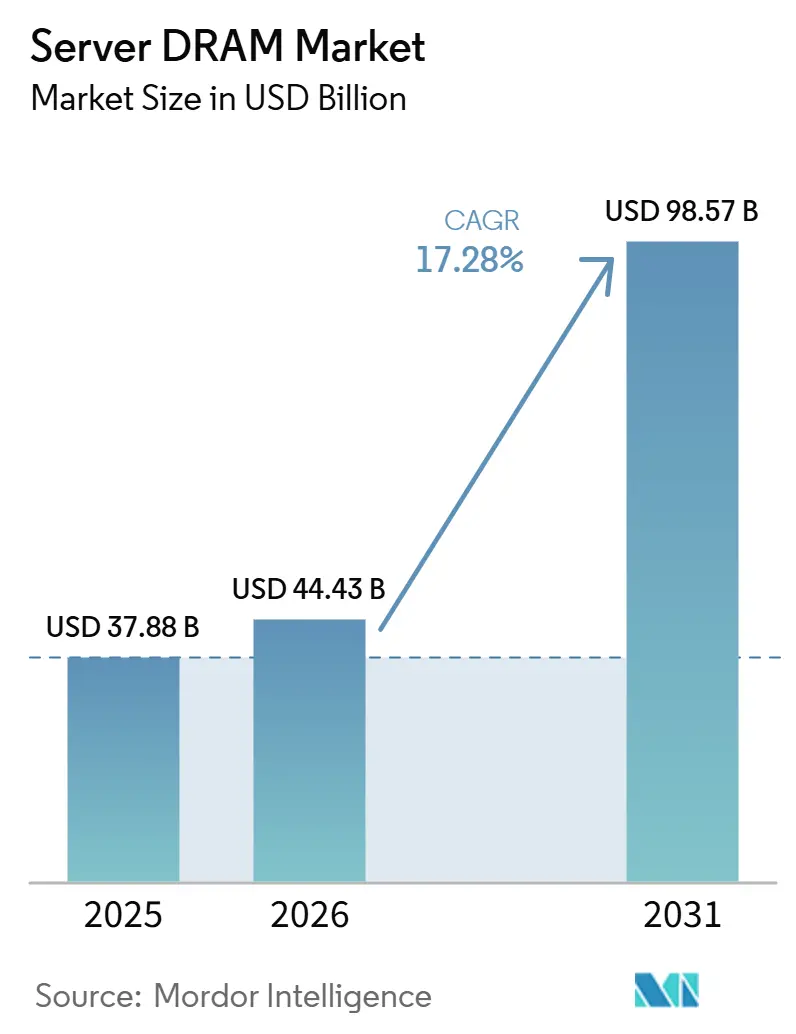
The server DRAM market size was valued at USD 37.88 billion in 2025 and is estimated to grow from USD 44.43 billion in 2026 to reach USD 98.57 billion by 2031, at a CAGR of 17.28% during the forecast period (2026-2031). Growth in the current cycle is being led by structural demand rather than short-term inventory recovery, because AI infrastructure is raising memory requirements per server across both hyperscale and enterprise deployments. The shift from training-heavy demand to broader inference deployment is also increasing the amount of CPU-attached memory needed in systems previously treated as conventional server builds. At the same time, suppliers are directing more wafer capacity toward premium AI memory products, tightening server-grade DRAM availability and making supply agreements more important than spot-market price negotiations. Product strategy in the server DRAM market is therefore moving toward higher-capacity DDR5 RDIMMs, LPDRAM server modules, and early CXL-based memory expansion, while procurement strategy is moving toward longer planning cycles and deeper supplier alignment. This leaves the clearest openings in memory-dense AI inference servers, enterprise DDR5 refreshes, and architecture shifts that extend usable memory beyond physical CPU slot limits in the server DRAM market.
Key Report Takeaways
- By memory technology, DDR5 led with 53.2% revenue share of the server DRAM market in 2025, while LPDRAM-based server modules are forecast to expand at 19.21% CAGR through 2031.
- By capacity per module, 32GB-128GB accounted for 46.8% of the server DRAM market in 2025, while capacities above 256GB are projected to grow at a 19.86% CAGR through 2031.
- By workload, general-purpose enterprise and cloud servers accounted for 38.4% of the server DRAM market revenue in 2025, while AI and accelerated computing servers are expected to grow at a 19.72% CAGR through 2031.
- By end user, hyperscale cloud providers held 35.1% revenue share in 2025, while AI infrastructure and GPU cloud providers are projected to record the highest CAGR at 18.98% through 2031.
- By geography, Asia-Pacific accounted for 43.9% of global server DRAM revenue in 2025 and is also forecast to post the fastest regional CAGR of 18.27% through 2031.
Note: Market size and forecast figures in this report are generated using Mordor Intelligence’s proprietary estimation framework, updated with the latest available data and insights as of January 2026.
Market Trends and Insights
Drivers Impact Analysis of Server DRAM Market*
| Driver | (~) % Impact on CAGR Forecast | Geographic Relevance | Impact Timeline |
|---|---|---|---|
| AI Server Memory Intensity Rising Per Node | +3.8% | Global | Short term (≤ 2 years) |
| Enterprise Refresh Cycle Shifting From DDR4 To DDR5 | +2.5% | Global, North America and Europe leading | Medium term (2-4 years) |
| 32Gb Dies Enabling 128GB And 256GB RDIMMs | +1.9% | Global | Short term (≤ 2 years) |
| CXL-Attached Memory Expansion And Pooling | +1.5% | North America and Asia-Pacific, early gains in Europe | Long term (≥ 4 years) |
| MRDIMM Bandwidth Ramp For AI And HPC Platforms | +1.2% | Global, concentrated on Intel Xeon 6 platform markets | Medium term (2-4 years) |
| LPDRAM-Based Server Modules Emerging For Inference Servers | +0.9% | Global | Medium term (2-4 years) |
| Source: Mordor Intelligence | |||
AI Server Memory Intensity Rising Per Node
Each new generation of AI server architecture is raising the amount of CPU-attached DRAM needed per node in the server DRAM market. As generative AI workloads shift from training to sustained inference, KV cache requirements often exceed on-chip HBM capacity, shifting more of the memory burden to high-capacity DDR5 RDIMMs in host systems. Long-context workloads deepen this effect because KV cache demand scales with both context length and batch size. Micron reported that moving KV cache to 1.5TB of CPU-attached memory reduced time-to-first-token by up to 98% and supported 2x larger concurrent request batch sizes in long-context real-time inference.[1]Micron Technology, “LPDDR at Scale for LLM Inference,” Micron Technology, micron.com That evidence matters because it shows that memory is not only supporting model execution, but it is increasingly setting the usable throughput profile of inference servers. As a result, the server DRAM market is being lifted not only by dedicated accelerator clusters, but also by a growing class of CPU server deployments that now carry AI memory loads.
Enterprise Refresh Cycle Shifting From DDR4 To DDR5
The DDR4-to-DDR5 platform transition has moved beyond early adopters and is now shaping a broad enterprise refresh cycle across the server DRAM market. Intel Xeon 6 and AMD EPYC Turin server families standardize on DDR5-only memory interfaces, which removes backward compatibility with DDR4 in next-generation server configurations. JEDEC states that DDR5 provides 1.7x to 2.1x the bandwidth of DDR4 at 3,200MT/s, along with on-die ECC and dual 32-bit sub-channel architecture that improves burst efficiency.[2]JEDEC Solid State Technology Association, “JEDEC’s SOCAMM2: Low Power Compact LPDDR5X Modules Poised to Power Next-Gen AI Servers,” JEDEC, jedec.org The installed base from 2024 and 2025 gives North America and Europe a multi-year refresh runway because many financial services, healthcare, and government data centers still operate on longer hardware replacement cycles. A less visible effect is the growing mismatch at the module assembly layer, where DDR4 inventory can become stranded while upstream die supply is absorbed by hyperscalers that are locking in DDR5 volume. JEDEC interoperability standards also reduce customer hesitation because the transition does not depend on a proprietary ecosystem, which supports faster confidence building in the server DRAM market.
32GB Dies Enabling 128GB And 256GB RDIMMs
The move to 32Gb monolithic DRAM dies is lowering the barrier to 128GB and 256GB RDIMM deployment in the server DRAM market. This approach enables high-capacity configurations without through-silicon via stacking, which improves power density, simplifies thermal behavior, and supports better manufacturing yield. SK hynix became the first supplier to complete Intel Data Center Certification for a 32Gb die-based 256GB DDR5 RDIMM in December 2025, and the product delivered 16% higher inference performance with 18% lower power use than prior 16Gb-based 256GB products. Micron was also first to validate and ship a 128GB DDR5 RDIMM built on 32Gb 1β technology in May 2024, with 45% higher bit density and 22% better energy efficiency than competitive 3DS TSV products. These product steps matter because rack power limits are becoming tighter as AI server power envelopes rise, and fewer larger modules help manage those limits. The result is a faster shift in the server DRAM market toward high-capacity modules than older TSV-based roadmaps had implied.
CXL-Attached Memory Expansion And Pooling
CXL memory expansion has moved from concept work to practical deployment and is beginning to change how capacity is added in the server DRAM market. Researchers at the University of Wisconsin showed in 2026 that CXL Type-1 memory expansion is workable on current server platforms and offers a realistic path toward broader pooling and sharing models.[3]Mark D. Hill et al., “CXL Memory Expansion in Practice,” IEEE Transactions on Computers, cs.wisc.edu Marvell launched the Structera S 30260 CXL 3.x switch in March 2026, and the platform supports up to 48TB of shared memory across 16-32 hosts at 4TB/s of aggregate bandwidth. Astera Labs also confirmed production deployment of its Leo CXL Smart Memory Controllers on Microsoft Azure M-series virtual machines, which gave cloud-scale validation to CPU-attached CXL memory.[4]Astera Labs, “Astera Labs’ Leo CXL Smart Memory Controllers on Microsoft Azure M-Series Virtual Machines Overcome the Memory Wall,” Astera Labs, asteralabs.com Penguin Solutions then introduced a production-ready CXL-based KV cache server with up to 11TB of addressable memory per node, which showed how memory disaggregation is moving into live inference infrastructure. Over time, this will let the server DRAM market decouple a larger share of memory procurement from fixed CPU socket limits and shift more value toward pooled and fabric-attached memory capacity.
Restraints Impact Analysis of Server DRAM Market*
| Restraint | (~) % Impact on CAGR Forecast | Geographic Relevance | Impact Timeline |
|---|---|---|---|
| HBM Capacity Crowd-Out Tightening Server DRAM Supply | -3.2% | Global | Short term (≤ 2 years) |
| Server DRAM Price Spikes And Long-Term Supply Lockups | -2.3% | Global, North America, Europe, and Asia-Pacific most exposed | Short term (≤ 2 years) |
| MRDIMM Ecosystem Immaturity And Platform Concentration | -1.2% | Global, concentrated on Intel Xeon 6 platform markets | Medium term (2-4 years) |
| CXL Software And Latency Overheads Slowing Broad Deployment | -0.8% | Global | Medium term (2-4 years) |
| Source: Mordor Intelligence | |||
HBM Capacity Crowd-Out Tightening Server DRAM Supply
The biggest near-term constraint on the server DRAM market is that more wafer capacity is being directed toward HBM, which leaves less output available for standard DDR5 RDIMMs and LPDRAM server modules. Samsung, SK hynix, and Micron have all leaned further into HBM because AI memory products carry stronger pricing and stronger strategic pull from major accelerator platforms. That allocation choice reduces the flexibility of supply for ordinary server memory even while overall fab investment continues to rise. The direct result is that non-hyperscale buyers face a tighter supply environment for high-capacity server modules and have less room to hold to earlier procurement budgets or timelines. This can delay enterprise refresh decisions, reduce planned build volumes, and keep buyers in legacy configurations for longer than expected. The restraint is likely to remain in place while HBM ramps further and new front-end capacity comes online more gradually across the memory supply base.
Server DRAM Price Spikes And Long-Term Supply Lockups
Pricing pressure is also limiting near-term expansion in the server DRAM market because the current price environment is tied to structural supply tightness rather than a short-lived spike. Network World reported that DDR5 64GB RDIMM prices were expected to nearly double from early 2025 levels by the end of 2026. At the same time, Maeil Kyungjae reported that 70% of server DDR5 volume had already been secured under long-term supply agreements across Korean, U.S., and Japanese manufacturers. That structure favors hyperscalers and large AI infrastructure operators that can commit to multi-year purchase volumes, while enterprise IT buyers and smaller colocation providers are left with less predictable supply. The server DRAM market, therefore, behaves as a two-tier market, with strategic buyers protecting pricing and availability while spot buyers absorb the sharpest increases. Prolonged volatility may push some enterprise operators toward OEM-led purchasing or early CXL expansion strategies, but it still reduces flexibility in direct module procurement.
*Our forecasts treat driver/restraint impacts as directional, not additive. The impact forecasts reflect baseline growth, mix effects, and variable interactions.
Server DRAM Market Segment Analysis
By Memory Technology:
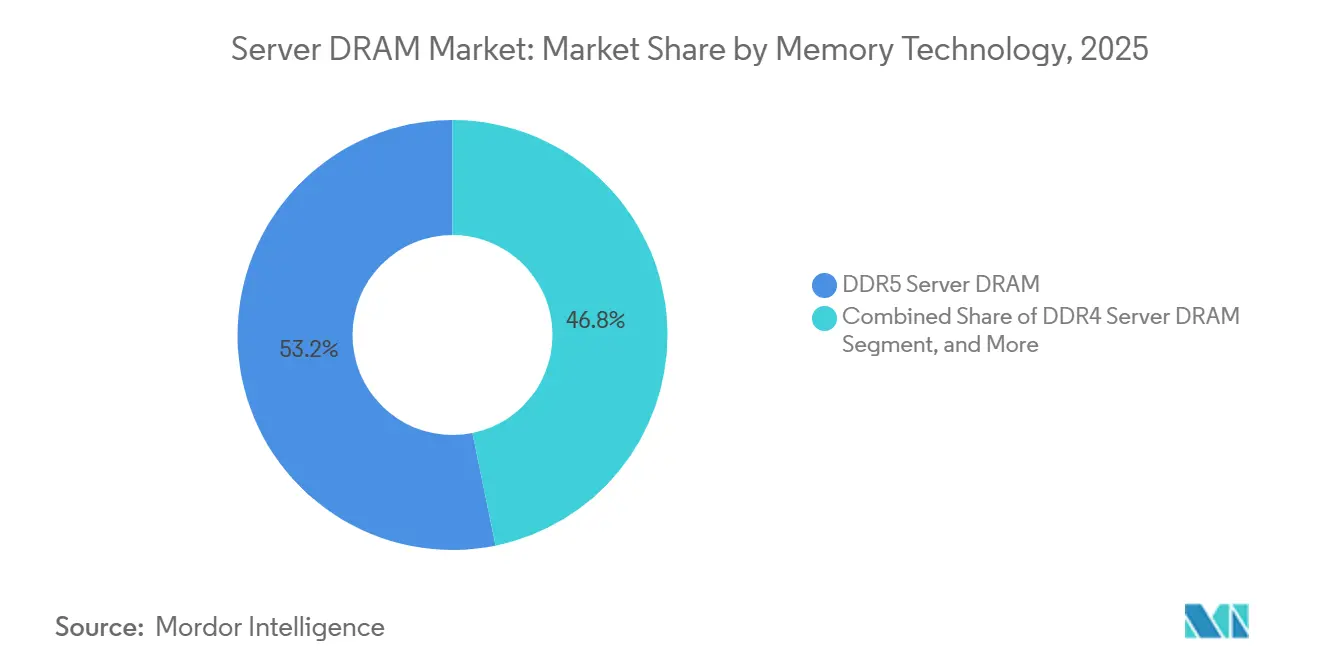
DDR5 Leads While LPDRAM Reshapes Inference Server MemoryDDR5 held 53.2% of the server DRAM market share in 2025, which marked the point at which it became the majority technology across hyperscale and enterprise server refreshes. LPDRAM-based server modules are the fastest-growing technology category and are projected to expand at 19.21% CAGR from 2026 to 2031 as LPDDR5X in SOCAMM2 form factors gains acceptance in AI CPU server designs. JEDEC said in October 2025 that the JESD328 SOCAMM2 standard was nearing completion, which matters because OEMs and hyperscalers want interoperability across multiple suppliers before committing to platform-scale adoption. DDR4 still ships into legacy refresh cycles and into some CXL expansion uses, which gives the server DRAM market a longer tail than earlier deprecation expectations suggested.
Micron’s March 2026 launch of a 256GB LPDRAM SOCAMM2 module showed that LPDRAM is moving beyond a niche role and becoming a platform option for select high-capacity server builds. The module provides 2TB of LPDRAM per 8-channel CPU and uses one-third the power and one-third the footprint of equivalent RDIMM configurations, which is meaningful where rack density and thermal budgets are tight. Micron also reported that SOCAMM2 modules used for KV cache offload can cut time-to-first-token by up to 98% and support 2x larger concurrent request batch sizes. That makes the server DRAM market more workload-specific, with DDR5 RDIMMs favored in bandwidth-heavy HPC and analytics servers, and LPDRAM gaining share in inference-focused CPU server designs. This split should keep both product tracks active across major suppliers and limit full substitution of one technology by the other in the server DRAM industry.



By Capacity Per Module:
Mid-Tier Capacity Leads While Ultra-High-Density Modules AccelerateThe 32GB-128GB tier accounted for 46.8% of the server DRAM market size in 2025, which reflected its position as the standard memory range for enterprise data centers, cloud infrastructure, and general server deployments. The above 256GB segment is growing fastest and is projected to record 19.86% CAGR from 2026 to 2031 as AI and HPC workloads move beyond the practical ceiling of 128GB configurations. The move to 32Gb monolithic dies is the key technical enabler because it supports 128GB and 256GB RDIMMs without through-silicon via stacking, which improves power density and manufacturing efficiency. SK hynix completed Intel Data Center Certification for a 256GB DDR5 RDIMM in December 2025, and that product delivered 16% higher inference performance and 18% lower power use than earlier 16Gb-based 256GB modules.
Intel’s certification framework is helping the server DRAM market move more quickly toward larger modules because it reduces platform integration risk for OEMs and end buyers. Micron became the first supplier to validate and ship a 128GB DDR5 RDIMM using 32Gb 1β technology in May 2024, and it reported 45% higher bit density and 22% improved energy efficiency over competitive 3DS TSV products. The up to 32GB segment still serves edge servers, telecom infrastructure, and lighter enterprise workloads, which keeps its demand base stable even if it is not the main growth engine. The above 128GB-256GB range is also gaining ground as a standard fit for AI-augmented enterprise servers running mixture-of-experts models and in-memory analytics. Over the forecast period, lower cost per bit and wider certification coverage should steadily narrow the gap between mid-tier and ultra-high-capacity modules across the server DRAM market.
By Server Class:
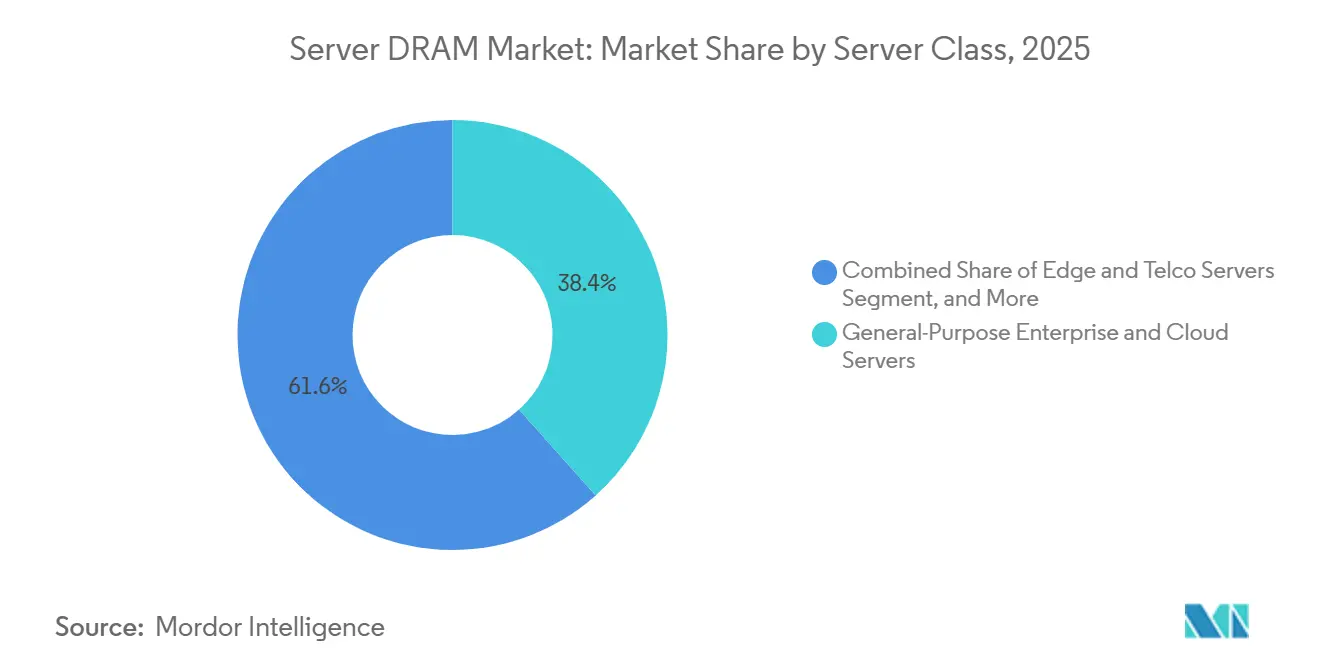
AI Servers Set The Fastest Memory Provisioning PaceGeneral-purpose enterprise and cloud servers remained the largest workload category and held 38.4% of revenue in 2025. AI and accelerated computing servers are expanding fastest at 19.72% CAGR through 2031, which shows how memory-intensive LLM inference and GPU cluster growth are reshaping the server DRAM market. HPC and analytics servers still require the highest per-socket memory footprints, especially as MRDIMM raises sustained bandwidth from 500GB/s to more than 700GB/s and improves performance by 27-41% for bandwidth-bound workloads. Storage and data infrastructure servers continue to provide a stable demand layer because in-memory databases, distributed caching, and real-time streaming workloads favor large DDR5 RDIMM footprints.
Edge and telecom servers add a smaller but durable layer of demand as 5G core disaggregation and open RAN deployments extend refresh activity into more distributed environments. A notable change in the server DRAM market is that general-purpose enterprise servers are increasingly handling AI memory work as firms deploy inference APIs and retrieval-augmented generation pipelines on conventional infrastructure rather than dedicated AI appliances. The same MRDIMM evaluation also showed up to 30% server energy savings for memory-bound applications, which broadens relevance beyond traditional HPC clusters. That widens the addressable demand base for high-bandwidth memory in existing enterprise data centers, not only in new accelerated platforms. Other server classes, including industrial IoT hubs, digital twin nodes, and scientific instrument servers, keep a meaningful long tail of demand for lower-power DDR5 RDIMMs and LPDRAM across the server DRAM industry.
By End User:
Hyperscalers Lead Demand While AI Cloud Providers Scale RapidlyHyperscale cloud providers held 35.1% of the server DRAM market share in 2025 and remained the anchor buyers for high-capacity DDR5 RDIMMs and LPDRAM server modules. AI infrastructure and GPU cloud providers are the fastest-growing end-user group and are projected to expand at 18.98% CAGR from 2026 to 2031 as specialized operators build memory-dense inference and fine-tuning infrastructure. Long-term supply agreements already cover a large share of server DDR5 volume, which gives hyperscalers stronger pricing and supply visibility than buyers relying on open-market procurement. Enterprise data centers remain the second-largest demand pool because DDR4-to-DDR5 refresh cycles in financial services, healthcare, and government continue on multi-year schedules that are not fully dependent on AI server demand.
Telecom and network operators are also shifting toward DDR5 as virtualized 5G core and open RAN functions become more memory-intensive. Government, defense, and research demand follow a different pattern in the server DRAM market because domestic sourcing and supply-chain assurance often matter more than the lowest cost. Micron said its plan includes USD 150 billion in U.S. DRAM manufacturing investment and USD 50 billion in R&D, supported by up to USD 6.4 billion in CHIPS Act direct funding, which directly supports these onshore supply needs. Colocation and managed infrastructure providers are also increasing per-rack memory density to support multi-tenant AI workloads where available memory shapes the model size that can be deployed. Across end users, rising per-server memory budgets continue to support both volume growth and firmer average selling prices in the server DRAM market.
Geography Analysis
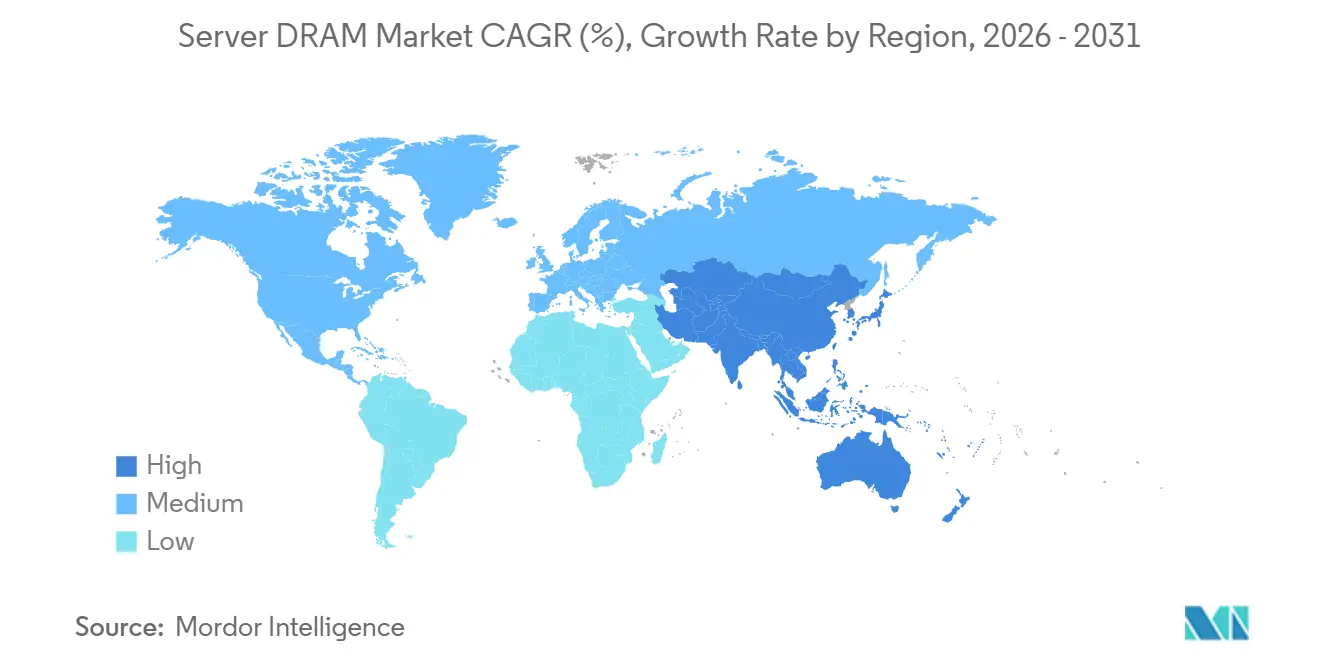
APAC Server DRAM Market
Asia-Pacific represented 43.9% of the server DRAM market size in 2025 and is also the fastest-growing regional market, with 18.27% CAGR projected through 2031. South Korea remains the center of global DRAM manufacturing, and SK hynix’s Yongin Y1 fab, a KRW 31 trillion investment equal to USD 22.8 billion, is expected to begin operations in early 2027 while the M15X Cheongju site ramps toward 70,000 wafers per month by the end of 2026. Japan also remains important because semiconductor-related companies posted record combined net profits in fiscal year 2025, supported by AI and data center demand. China is increasing its role in the server DRAM market as domestic cloud service providers expand AI data center capacity, and CXMT lifted its global DRAM share from 3% to 8% year over year in Q1 2026 while mainly supplying the domestic DDR4 server segment. India and the rest of Asia-Pacific are also adding demand through sovereign cloud programs and government-backed national AI infrastructure projects.
North America Server DRAM Market
North America is the second-largest server DRAM market and sets the demand pace for high-capacity DDR5 RDIMMs and LPDRAM modules because it hosts the largest hyperscale cloud platforms and several major AI cloud fleets. U.S.-based operators continue to scale some of the world’s largest AI server fleets, which supports strong demand for 128GB and 256GB modules in both accelerator clusters and inference-optimized CPU server groups. Micron began 1-alpha DRAM production at its Manassas, Virginia facility in May 2026, which marked the start of commercially meaningful domestic DRAM output and aligned with a broader USD 200 billion multi-site U.S. manufacturing program. Canada is strengthening cloud infrastructure corridors in Ontario and Quebec, while Mexico is emerging as a nearshoring location for lighter data center operations tied to North American supply-chain changes. The region also carries the highest revenue per rack because AI deployments and enterprise refreshes favor premium memory configurations.
EMEA and South America Server DRAM Market
Europe’s server DRAM market is being supported by enterprise data center modernization, cloud adoption in financial services and manufacturing, and sovereign data mandates in Germany, France, and the United Kingdom. German hyperscale projects and United Kingdom financial services refresh cycles supported 2025 revenue growth, while Italy and other markets benefited from EU-backed digital infrastructure programs. The Rest of the World region, which includes the Middle East, Africa, and South America, is growing from a smaller base as sovereign-backed AI data center projects and hyperscale buildouts create new demand pools for the server DRAM market. Europe and the Rest of the World continue to carry pricing premiums over Asia-Pacific because supply chains are longer and direct manufacturing remains limited.

Competitive Landscape
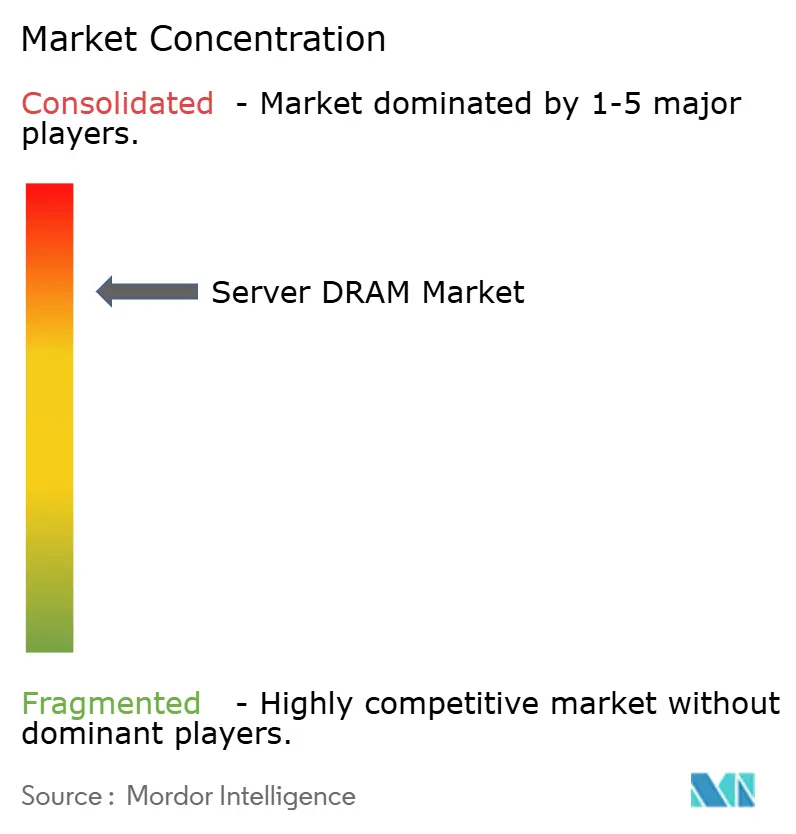
The server DRAM market remains highly concentrated, with Samsung Electronics, SK hynix, and Micron Technology accounting for most global server DRAM wafer output. This concentration gives the top suppliers substantial control over allocation, pricing, and product mix across the server DRAM market. Micron has redirected more of its focus toward AI data center demand, while SK hynix strengthened its position through HBM leadership, and Samsung regained volume leadership. The result is an oligopolistic structure in which supply changes at one vendor can quickly affect availability across the server DRAM market.
The module assembly layer includes Kingston Technology, SMART Modular Technologies, ADATA, and other firms that compete on customization, qualifications, and supply-chain service rather than on die-level pricing power. That layer remains important for enterprise customers, but the deepest leverage still sits with die suppliers that control advanced-node output in the server DRAM market. CXMT has emerged as the clearest fourth challenger, and its global DRAM share rose from 3% to 8% year over year in Q1 2026 by supplying domestic Chinese server buyers with DDR4 products. Its progress matters because it creates a stronger local supply path for China, even though its DDR5 roadmap still faces equipment access limits under export controls. Rambus also remains relevant through JEDEC-aligned licensing tied to memory interface architecture, which is a structural compliance issue for new entrants participating in the server DRAM market.
Competition is widening beyond raw memory supply and into the CXL controller and memory interface layer, where Astera Labs, Marvell Technology, Montage Technology, Renesas Electronics, and Rambus are active. Marvell launched the Structera S 30260 in March 2026, and the switch supports up to 48TB of shared memory and 4TB/s of aggregate bandwidth. Montage Technology also demonstrated a live CXL 3.2 Dynamic Capacity Device system in 2026, which confirmed that multi-host memory pooling is moving closer to broader deployment. As CXL matures and domestic manufacturing incentives reshape supply geography, value in the server DRAM market will extend further into control silicon, platform interoperability, and memory orchestration software.
Server DRAM Industry Leaders
Samsung Electronics Co., Ltd.
SK hynix Inc.
Micron Technology, Inc.
Nanya Technology Corporation
ChangXin Memory Technologies
- *Disclaimer: Major Players sorted in no particular order
Server DRAM Market Companies Covered in this Report
- Samsung Electronics Co., Ltd.
- SK hynix Inc.
- Micron Technology, Inc.
- Nanya Technology Corporation
- ChangXin Memory Technologies
- SMART Modular Technologies, Inc.
- Kingston Technology Company, Inc.
- ADATA Technology Co., Ltd.
- Innodisk Corporation
- Apacer Technology Inc.
- Transcend Information, Inc.
- ATP Electronics, Inc.
- Virtium LLC
- Netlist, Inc.
- Rambus Inc.
- Renesas Electronics Corporation
- Montage Technology Co., Ltd.
- Astera Labs, Inc.
- Marvell Technology, Inc.

Recent Industry Developments in Server DRAM Market
- May 2026: Micron Technology sampled the world's first 256GB DDR5 RDIMM modules based on 1-gamma DRAM technology to ecosystem partners, achieving data rates of up to 9,200 MT/s, over 40% faster than then-current modules, while reducing operating power by over 40% compared to 2 x 128GB configurations. The module targets next-generation AI and HPC server platforms requiring maximum bandwidth at the lowest power-per-bit profile.
- May 2026: Micron Technology began 1-alpha DRAM production at its Manassas, Virginia fabrication facility, marking the most advanced DRAM manufactured in the United States to date, with plans to quadruple DDR4 wafer output and expand the site as part of a USD 200 billion multi-site U.S. manufacturing program.
- April 2026: JEDEC published the DDR5 MDB standard JESD82-552, advanced the forthcoming DDR5MRCD02 clock driver specification, and announced the MRDIMM Gen2 module roadmap targeting 12,800 MT/s, approximately 45% faster than the 8,800 MT/s Gen1 ceiling, with Gen3 at 17,600 MT/s already in early development. These milestones extend the DDR5 MRDIMM performance roadmap through the latter half of the forecast period.
- March 2026: Marvell Technology launched the Structera S 30260, a 260-lane CXL 3.x switch enabling rack-level memory pooling at up to 48TB shared capacity and 4TB/s aggregate bandwidth, with customer sampling scheduled for Q3 2026. The product represents the first commercially available CXL fabric switch capable of multi-rack memory disaggregation at hyperscale.


Global Server DRAM Market Report Scope
The Server DRAM market comprises dynamic random-access memory (DRAM) devices and server-grade memory modules designed for deployment in enterprise, cloud, hyperscale, AI, HPC, telecommunications, and storage servers. The market includes DDR4 Server DRAM, DDR5 Server DRAM, and emerging LPDRAM-based server modules used to provide high-capacity, high-bandwidth, and low-latency system memory for modern server platforms.
The Server DRAM Market Report is Segmented by Memory Technology (DDR4 Server DRAM, DDR5 Server DRAM, and LPDRAM-based Server Modules), Capacity per Module (Up to 32 GB, 32 GB to 128 GB, Above 128 GB to 256 GB, and Above 256 GB), Workload/Server Class (General-Purpose Enterprise and Cloud Servers, AI and Accelerated Computing Servers, High-Performance Computing and Analytics Servers, Storage and Data Infrastructure Servers, Edge and Telco Servers, and Other Server Classes), End User (Hyperscale Cloud Providers, Enterprise Data Centers, Telecom and Network Operators, Government, Defense, and Research Institutions, Colocation and Managed Infrastructure Providers, AI Infrastructure and GPU Cloud Providers, and Other End Users), and Geography (North America, Europe, Asia-Pacific, and Rest of the World). The Market Forecasts are Provided in Terms of Value (USD).
| DDR4 Server DRAM |
| DDR5 Server DRAM |
| LPDRAM-based Server Modules |
| Up to 32GB |
| 32GB to 128GB |
| 128GB to 256GB |
| Above 256GB |
| General-Purpose Enterprise and Cloud Servers |
| AI and Accelerated Computing Servers |
| High-Performance Computing and Analytics Servers |
| Storage and Data Infrastructure Servers |
| Edge and Telco Servers |
| Other Server Classes |
| Hyperscale Cloud Providers |
| Enterprise Data Centers |
| Telecom and Network Operators |
| Government, Defense, and Research Institutions |
| Colocation and Managed Infrastructure Providers |
| AI Infrastructure and GPU Cloud Providers |
| Other End Users |
| North America | |
| Europe | |
| Asia-Pacific | China |
| Japan | |
| South Korea | |
| Taiwan | |
| Rest of Asia-Pacific | |
| Rest of the World |
| By Memory Technology | DDR4 Server DRAM | |
| DDR5 Server DRAM | ||
| LPDRAM-based Server Modules | ||
| By Capacity per Module | Up to 32GB | |
| 32GB to 128GB | ||
| 128GB to 256GB | ||
| Above 256GB | ||
| By Server Class | General-Purpose Enterprise and Cloud Servers | |
| AI and Accelerated Computing Servers | ||
| High-Performance Computing and Analytics Servers | ||
| Storage and Data Infrastructure Servers | ||
| Edge and Telco Servers | ||
| Other Server Classes | ||
| By End User | Hyperscale Cloud Providers | |
| Enterprise Data Centers | ||
| Telecom and Network Operators | ||
| Government, Defense, and Research Institutions | ||
| Colocation and Managed Infrastructure Providers | ||
| AI Infrastructure and GPU Cloud Providers | ||
| Other End Users | ||
| By Geography | North America | |
| Europe | ||
| Asia-Pacific | China | |
| Japan | ||
| South Korea | ||
| Taiwan | ||
| Rest of Asia-Pacific | ||
| Rest of the World | ||


Key Questions Answered in the Report
What is driving growth in server DRAM market through 2031?
Demand is being driven by AI infrastructure, broader inference deployment, and rising memory per server. The server DRAM market is projected to reach USD 98.57 billion by 2031 at 17.28% CAGR.
Which memory technology is leading server deployments today?
DDR5 led in 2025 with 53.2% revenue share, supported by enterprise and hyperscale platform refreshes. LPDRAM-based server modules are growing faster because of power and density advantages in inference servers.
Which capacity tier is expanding the fastest in server memory?
The above 256GB module tier is projected to grow at 19.86% CAGR through 2031. This is tied to AI and HPC workloads that need more memory than 128GB configurations can efficiently support.
Which end users matter most for server DRAM demand?
Hyperscale cloud providers remained the largest end-user group with 35.1% share in 2025. AI infrastructure and GPU cloud providers are the fastest-growing buyers with 18.98% CAGR through 2031.
Which region leads global revenue for server DRAM?
Asia-Pacific led with 43.9% of global revenue in 2025 and is also expected to post the fastest regional growth at 18.27% CAGR. Manufacturing concentration in South Korea and Taiwan remains a major reason.
How is CXL changing server memory architecture?
CXL is starting to extend memory capacity beyond fixed CPU slot limits through expansion and pooling. This matters for inference workloads and could shift more value toward memory fabrics, control silicon, and disaggregated capacity over time.
Page last updated on:





