
Search Engine Marketing Software Market Size and Share
Market Overview
| Study Period | 2020 - 2031 |
|---|---|
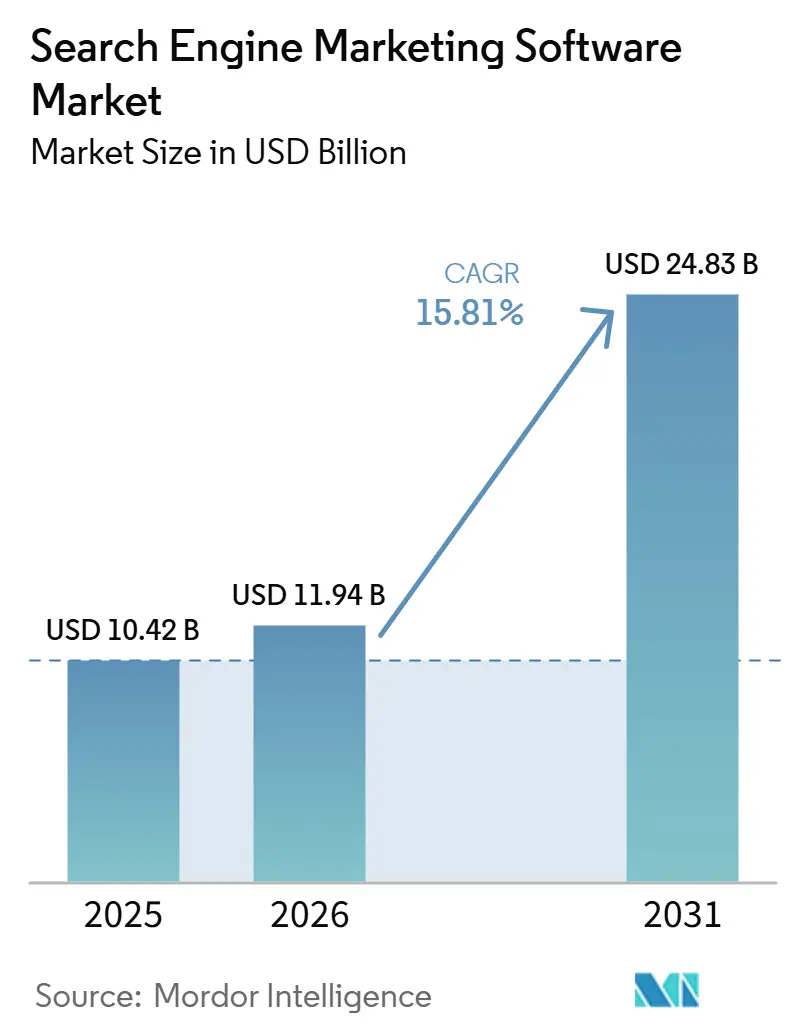
| Market Size (2026) | USD 11.94 Billion |
| Market Size (2031) | USD 24.83 Billion |
| Growth Rate (2026 - 2031) | 15.81% CAGR |
| Fastest Growing Market | Asia-Pacific |
| Largest Market | North America |
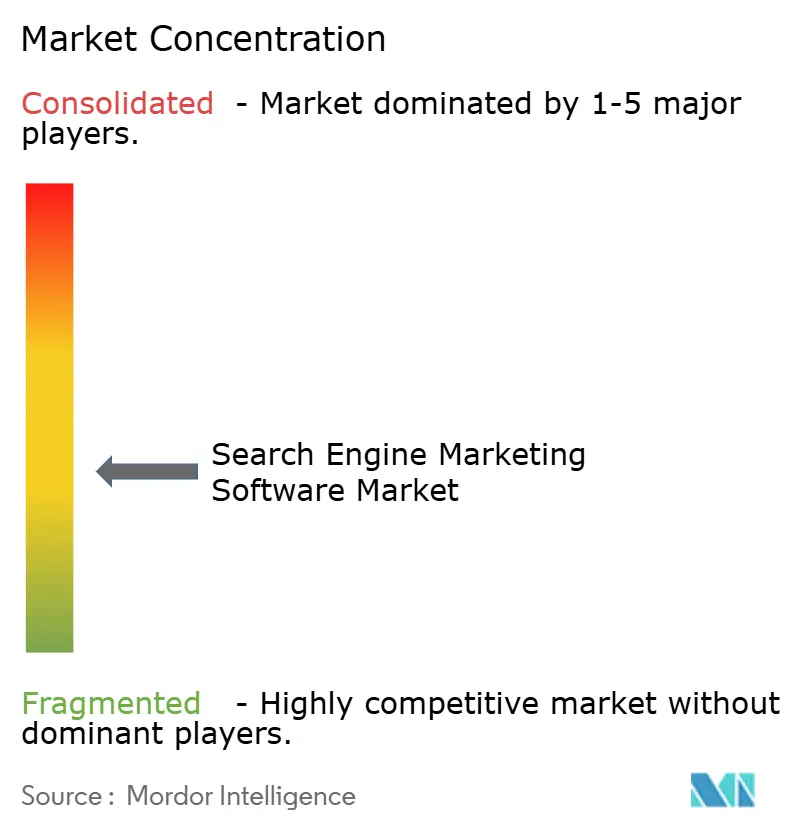
| Market Concentration | Medium |
Major Players *Disclaimer: Major Players sorted in no particular order Image © Mordor Intelligence. Reuse requires attribution under CC BY 4.0. | |
Search Engine Marketing Software Market Analysis by Mordor Intelligence
The Search engine marketing software market size was valued at USD 10.42 billion in 2025 and estimated to grow from USD 11.94 billion in 2026 to reach USD 24.83 billion by 2031, at a CAGR of 15.81% during the forecast period (2026-2031). The search engine marketing software market is changing as advertisers manage paid search across AI-based answers, retail media, and social search alongside conventional search results, instead of treating search as a single channel with one set of campaign controls, and this change requires teams to understand how discovery, clicks, conversion paths, and attribution differ across formats before they can use automation with confidence. This underscores the value of platforms that bring campaign data, reporting, and budget controls into a single workflow, particularly when teams need to compare outcomes measured differently across advertising environments. First-party data is becoming more important because advertisers need dependable conversion signals for automated bidding and audience activation, while consent requirements make data collection and transfer a practical product consideration. Large vendors are extending their offerings through acquisitions and product integration, while independent providers are focusing on cross-platform reporting, governance, and specialized commerce functions that solve defined operational problems for agency, brand, and retail users. The search engine marketing software market also has room for cloud tools that reduce operational burden for smaller businesses, support connections to evolving advertising platforms, and enable routine campaign automation without a large internal technical team. In practical terms, these products can give growing advertisers access to shared reporting, standardized workflows, and managed integrations that would otherwise require significant internal development work.
Key Report Takeaways
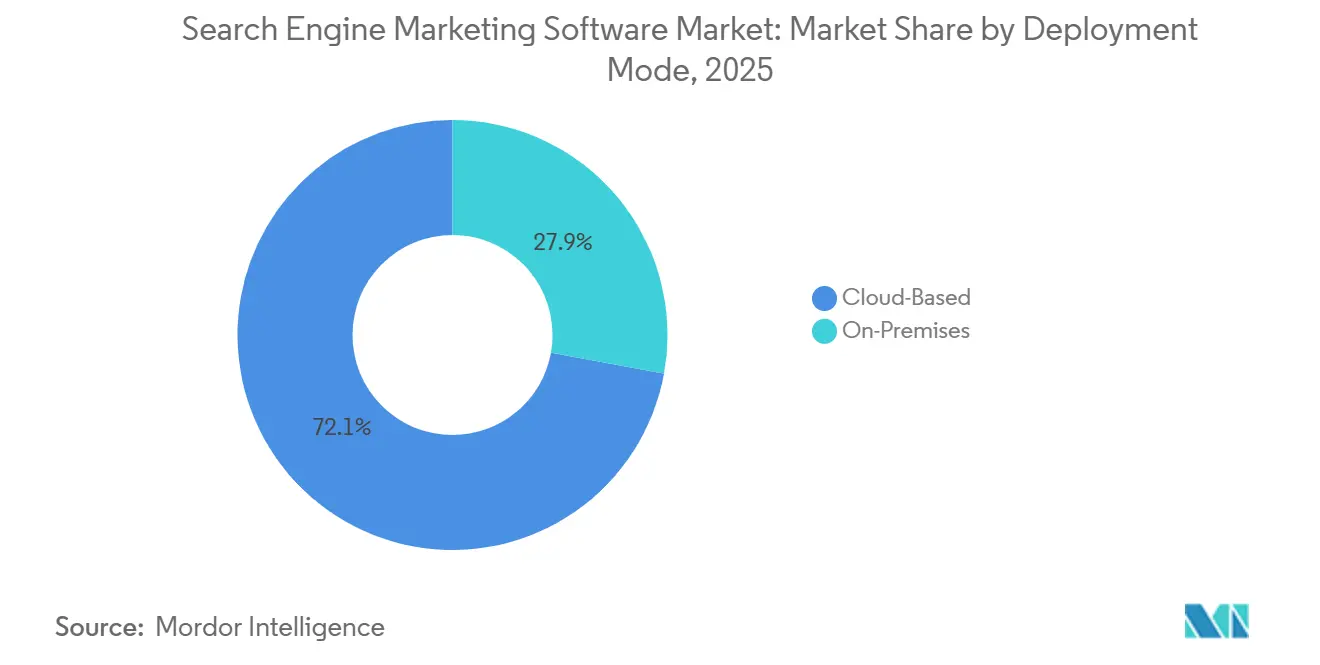
- By deployment mode, cloud-based tools held 72.14% of the search engine marketing software market share in 2025 and are projected to expand at an 18.05% CAGR through 2031.
- By organization size, large enterprises accounted for 70.23% of the search engine marketing software market revenue in 2025, while SMEs are projected to record the highest CAGR of 18.37% through 2031.
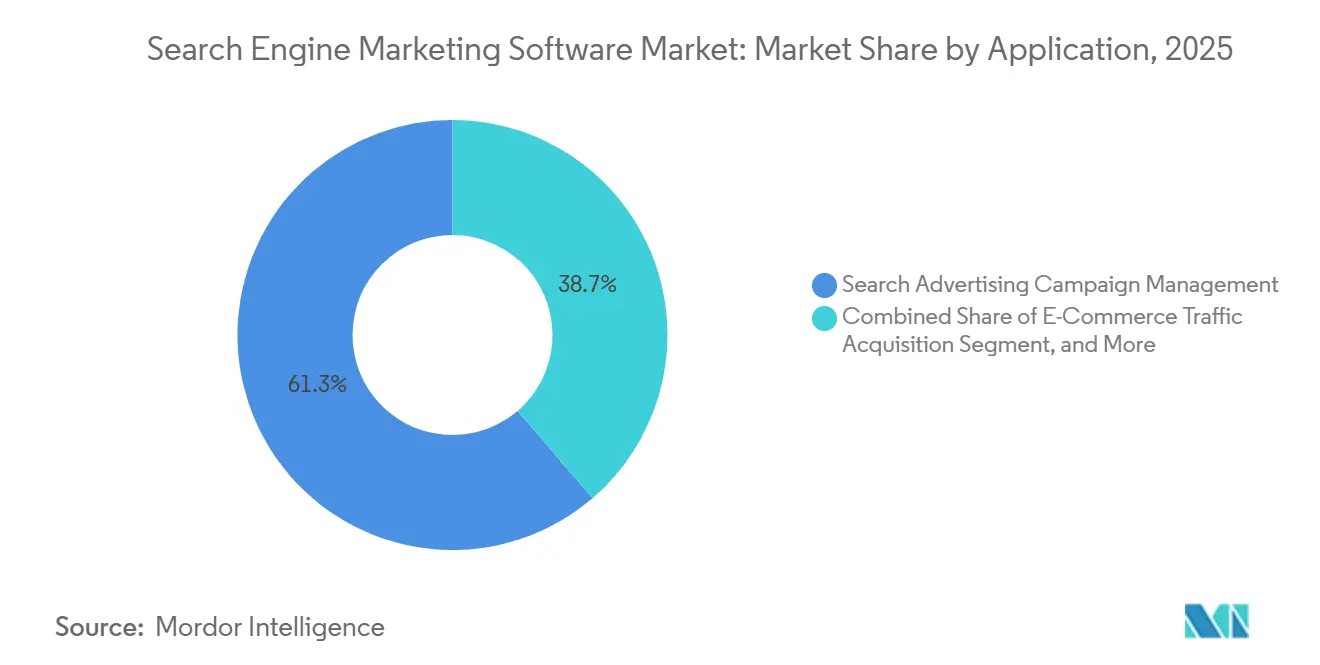
- By application, search advertising campaign management accounted for 61.29% of the search engine marketing software market revenue in 2025, while e-commerce traffic acquisition is projected to grow at a 17.36% CAGR through 2031.
- By end user, brands and advertisers held 59.41% of the search engine marketing software market revenue in 2025, while e-commerce businesses are projected to expand at a 17.71% CAGR through 2031.
- By geography, North America held 37.12% of revenue in 2025, while Asia-Pacific is projected to grow at a 17.04% CAGR through 2031.
Note: Market size and forecast figures in this report are generated using Mordor Intelligence’s proprietary estimation framework, updated with the latest available data and insights as of January 2026.
Global Search Engine Marketing Software Market Trends and Insights
Drivers Impact Analysis*
| Driver | (~) % Impact on CAGR Forecast | Geographic Relevance | Impact Timeline |
|---|---|---|---|
| Rising Paid Search Spend Across Digital Channels | +3.5% | Global | Medium term (2-4 years) |
| Adoption of AI-Driven Bid and Budget Optimization | +3.2% | Global, strongest in North America and Asia-Pacific | Short term (≤ 2 years) |
| Expansion of E-Commerce and Performance Marketing Budgets | +2.8% | Asia-Pacific, North America, Europe | Medium term (2-4 years) |
| Growing Need for First-Party Audience Activation | +2.4% | North America and EU, spill-over to Asia-Pacific | Short term (≤ 2 years) |
| Shift Toward Privacy-Resilient Demand Generation Workflows | +1.8% | EU, North America | Medium term (2-4 years) |
| Increased Demand for Cross-Channel Attribution and Reporting | +1.5% | Global | Medium term (2-4 years) |
| Source: Mordor Intelligence | |||
Rising Paid Search Spend Across Digital Channels
Traditional paid search is projected to grow as AI answer engines, retail media networks, and social search compete for commercial-intent spending. This broader channel mix increases the work involved in managing reach, budgets, and measurement across Google AI Mode, Microsoft Copilot Search, and Amazon, because teams must reconcile different campaign structures, reporting fields, auction behavior, and timing before they can make a consistent budget decision. The search engine marketing software market benefits when advertisers need a single operating layer across different auction rules and reporting systems, especially for agencies and large brands that need to apply common approval standards while retaining enough detail to manage individual platforms effectively. The business case is stronger where a common system reduces manual reconciliations and helps managers identify which changes require action rather than simply generating more platform-specific information. Dentsu projects that algorithm-driven activity will account for 75% of total advertising spending by 2028, increasing the need for structured campaign data, bidding rules, and oversight tools.
Adoption of AI-Driven Bid and Budget Optimization
Native AI bidding has changed the work expected from search engine marketing software rather than removing the need for it, as advertisers still need independent reporting, exception handling, policy controls, and a practical way to compare results from different automated systems. Google introduced AI Max for Search campaigns in May 2025, adding AI-based targeting and creative capabilities. Google reported an average 14% increase in conversions at similar CPA and ROAS targets for AI Max, with a 27% uplift for campaigns moving from exact and phrase match to broad match. Dynamic Search Ads are scheduled to move to AI Max by September 2026, which shortens the adjustment cycle for advertisers and software providers. Microsoft Advertising opened an AI Max for Search pilot to all advertisers in May 2026, extending campaign reach into Copilot Search and Copilot Answers.[1]Microsoft Advertising, “Building a New AI Economy That Creates Value for Everyone,” Microsoft Advertising, about.ads.microsoft.com The search engine marketing software market increasingly rewards providers that offer cross-engine diagnostics, controls, and multi-account intelligence beyond native dashboards.
Expansion of E-Commerce and Performance Marketing Budgets
E-commerce operators are becoming a major growth customer group because they require close control over acquisition costs and product-level performance, particularly where product availability, margins, promotions, and catalog changes can make a simple click-based performance measure inadequate for commercial decisions. Digital advertising generated INR 49,731 crore (USD 5.96 billion) in economic output for Indian MSMEs in 2025, according to a Google study of 3,249 Indian MSMEs conducted with the India SME Forum. The same study reported that India’s e-commerce activity is projected to grow threefold to USD 250 billion by 2030. These conditions support demand for profit-aware bidding, product-feed management, and return-on-ad-spend analysis by margin tier. E-commerce buyers judge software on the link between advertising activity and product economics, rather than on visibility metrics alone. The search engine marketing software industry, therefore, faces stronger demand for specialized commerce features than for general campaign management alone.
Growing Need for First-Party Audience Activation
First-party data activation has become more important as third-party audience signals have become less dependable, placing greater weight on the quality of customer records, consent management, and the integration between business systems and campaign platforms. Advertisers increasingly need owned customer records that can be linked to campaign measurement and used in accordance with appropriate consent controls. Adobe reported that AI traffic to U.S. retail websites rose 269% year over year by March 2026, making owned customer signals more important as discovery shifts toward AI-curated pathways. Google, Meta, and Microsoft have expanded server-side and enhanced conversion options that use first-party event data for campaign optimization. The search engine marketing software market favors platforms that can connect CRM segments, manage consent-aware matching, and maintain live audience pipelines. Advertisers with stronger first-party data infrastructure are better placed to interpret automated campaign outcomes and maintain control over audience activation.
Restraints Impact Analysis*
| Restraint | (~) % Impact on CAGR Forecast | Geographic Relevance | Impact Timeline |
|---|---|---|---|
| Signal Loss From Cookie Degradation and Platform Privacy Controls | -2.8% | EU, North America, global spill-over | Short term (≤ 2 years) |
| High Competitive Saturation and Feature Parity Across Vendors | -2.2% | Global | Long term (≥ 4 years) |
| Dependence on Search Engine Policy and Auction Rule Changes | -1.6% | Global | Short term (≤ 2 years) |
| Rising Enterprise Integration and Change-Management Costs | -1.2% | North America, Europe | Medium term (2-4 years) |
| Source: Mordor Intelligence | |||
Signal Loss From Cookie Degradation and Platform Privacy Controls
Signal degradation is a central measurement issue for search engine marketing software users in 2026. Google adopted a user-choice model for Chrome third-party cookies in April 2025, but campaign measurement remains affected by continuing browser restrictions and privacy controls. Safari and Firefox continue to block third-party cookies, while iOS App Tracking Transparency has reduced the availability of mobile advertising identifiers. Consent rejection rates in Germany ranged from 40% to 54% in the data reviewed alongside Google's Consent Mode guidance, limiting observable campaign behavior. The IAB Tech Lab warned that Privacy Sandbox restrictions could reduce the industry’s ability to deliver relevant and effective advertising. Without a correct Consent Mode v2 implementation, European Google Ads campaigns may optimize based on incomplete behavioral data, increasing the risk of inaccurate budget decisions.
High Competitive Saturation and Feature Parity Across Vendors
The search engine marketing software market includes native search platforms, marketing cloud suites, dedicated paid-search tools, and combined SEO and SEM intelligence offerings. Bid automation, keyword research, rank tracking, and basic reporting are now widely available across many mid-tier products. Adobe announced its agreement to acquire Semrush in November 2025 for USD 1.9 billion and completed the transaction in April 2026. The transaction combined search intelligence, paid media analysis, and generative engine optimization within Adobe CX Enterprise. Native optimization tools from Google and Microsoft can reduce the perceived need for separate software among some SMEs. Providers need a clear workflow advantage in AI-based analysis, governance, or cross-platform reporting to avoid customer movement toward native tools or integrated suites.
*Our forecasts treat driver/restraint impacts as directional, not additive. The impact forecasts reflect baseline growth, mix effects, and variable interactions.
Segment Analysis
By Deployment Mode: Cloud Tools Remain the Default Architecture
Cloud-based deployment held 72.14% of the search engine marketing software market share in 2025 and is projected to grow at an 18.05% CAGR through 2031. This combination shows that cloud delivery has both the largest installed base and the strongest growth within deployment choices, because buyers can add capacity, user access, and integrated functions without the capital outlay and prolonged technical setup associated with locally managed systems. Modern SEM operations depend on cloud APIs for bidding data, search query reports, and AI-generated auction insights. Google and Microsoft provide much of this information through cloud endpoints that are better suited to continuously updated software environments. Cloud providers can distribute platform integrations, model updates, and reporting changes to customers without a separate local software update. This helps advertisers respond when advertising platforms change campaign requirements or measurement methods. Multi-tenant SaaS delivery also supports shared product improvements across a vendor’s customer base. These operating advantages make cloud systems more practical for teams that manage frequent campaign changes. They also support the search engine marketing software market as buyers seek faster implementation and routine product updates. On-premises tools remain relevant where strict internal data controls shape procurement decisions.
On-premises deployment remains a viable option in regulated enterprise settings, including financial services and government-adjacent organizations. These users may require specific data residency rules, internal security reviews, or controlled integration processes. Even in these cases, campaign data and advertising-platform functionality increasingly depend on external cloud interfaces. This limits the ability of a fully local deployment to keep pace with feature updates available to cloud products, a constraint that supports the search engine marketing software market, as buyers prioritize timely access to platform functions. SMEs are adopting the cloud because subscription pricing reduces the upfront implementation burden of manual or locally managed tools. Smaller teams can begin with focused functions and add automation as campaign volume increases. For large organizations, infrastructure maintenance, upgrades, and integration work can make local systems more expensive than comparable subscriptions. The difference is particularly important when campaign platforms introduce new AI-based formats or reporting requirements. Cloud delivery offers a simpler route to maintain current capabilities across multiple advertising accounts. This supports continued movement away from on-premises deployment during the forecast period.


By Organization Size: Enterprise Revenue Leads While SME Adoption Grows
Large enterprises held 70.23% of the search engine marketing software market share in 2025, while SMEs are projected to register an 18.37% CAGR through 2031. Enterprise revenue remains high because contracts often include onboarding, customer support, custom API access, and security controls, while the size of advertising portfolios makes a standardized operating process more valuable than separate account-level tools. Large advertisers also manage substantial budgets across many campaigns, brands, and geographic markets. These conditions create switching costs and support longer vendor relationships. Enterprise buyers often need centralized approval controls, detailed reporting, and ownership of campaign logic. They also require integrations with internal analytics, customer data, and financial systems. These needs sustain demand for robust software even as native advertising tools improve. The search engine marketing software market continues to rely on enterprise contracts for a large share of its current revenue. However, enterprise growth trails the faster expansion recorded among smaller organizations. Vendors must therefore maintain enterprise depth while reducing complexity for smaller buyers.
SME adoption reflects the growing availability of AI-supported campaign management without the need for large specialist teams. Automation can reduce the technical work needed to manage keywords, budgets, creative assets, and campaign adjustments. Google’s 2026 MSME survey found that AI-driven tools could improve SME profitability by 30%-35% through improved targeting and automation. Smaller businesses often select products based on e-commerce storefront integration, a simple setup, and low minimum spend requirements. They place less value on the multi-entity management features that are important to global enterprises. This creates a distinct product and pricing need within the search engine marketing software industry and broadens the market beyond the historically dominant enterprise customer base. Vendors that serve SMEs well can build early relationships with firms that may later require broader capabilities. Their challenge is to provide useful automation without creating the implementation burden of enterprise software. The expanding SME base also broadens the number of organizations that can use dedicated SEM tools. This makes the segment important to platform revenue growth through 2031.
By Application: Campaign Management Holds Scale as Commerce Use Expands
Search advertising campaign management accounted for 61.29% of the search engine marketing software market size in 2025, while e-commerce traffic acquisition is projected to grow at a 17.36% CAGR through 2031. Campaign management remains the largest use because structured keyword campaigns remain central to paid search operations, providing the day-to-day controls teams use to set bids, organize activity, review search queries, and monitor budget performance. Organizations use these tools to organize bids, monitor performance, set budgets, and coordinate advertisements across search accounts. The large share also shows that many buyers have not fully expanded their software use beyond core operational needs. This leaves room for adjacent uses in performance analysis, commerce optimization, brand visibility, and local search, which expands the search engine marketing software market opportunity without displacing the core campaign-management workflow. Performance marketing and conversion optimization are gaining attention as teams link advertising activity with landing-page testing and conversion management. Brand awareness and share-of-voice tools have become more relevant as AI-curated results alter how brands appear in search. Local search functions also benefit from mobile-first behavior and the growing demand for nearby products and services. The search engine marketing software market can extend beyond campaign execution when providers connect these needs in a clear workflow. The pace of expansion will depend on whether products support both standard search operations and newer discovery channels.
E-commerce traffic acquisition is growing because retailers need campaign decisions that reflect inventory, margins, and product demand. General campaign software may not provide the detailed feed and product controls that e-commerce operators require. BrightEdge’s July 2026 research reviewed 300 million monthly searches through its AI Hyper Cube platform. It found that Facebook appeared in 19.5 million Google AI Overview responses, while Instagram appeared 877,000 times. This supports the view that commerce discovery is becoming less tied to one conventional search results page. E-commerce tools need to account for signals and content sources that sit beyond keyword-auction data. Product-feed management, margin-aware bidding, and return-on-ad-spend reporting are therefore increasingly important application functions. Providers also need to explain results across search, social, retail, and AI-based discovery pathways. This keeps the e-commerce application segment connected to broader changes in digital commerce. It also raises the functional requirements for suppliers competing for retail advertising budgets.

By End User: Brands Lead Revenue While E-Commerce Buyers Grow Faster
Brands and advertisers accounted for 59.41% of the search engine marketing software market in 2025, while e-commerce businesses are projected to grow at a 17.71% CAGR through 2031. Brands and advertisers have long relied on paid search for direct-response customer acquisition, and their software requirements now extend from campaign execution to a dependable view of results across brand, product, geographic, and channel-level activity. Their established budget cycles and campaign volume support continued SEM tool spending. These buyers often need cross-channel reporting, share-of-voice monitoring, and controls that apply across brand portfolios. They also benefit from systems that bring search performance into broader marketing reporting. Their revenue position reflects the scale of direct advertiser budgets rather than a reliance on intermediary agencies. The largest brands increasingly need governance as AI systems take a larger role in bidding and creative delivery. They require a clear record of where budgets were allocated and how platform changes affected results. These requirements sustain demand for the search engine marketing software market among direct budget owners. At the same time, different end users evaluate value through distinct measures and workflows.
E-commerce businesses focus more closely on profit per click, product availability, and feed quality than many brand advertisers do. This group needs detailed bid controls that account for product margins and changing inventory. Digital marketing agencies benefit when advertising platforms use different AI auction systems and reporting APIs across client accounts. They require shared dashboards and operating processes that help teams manage many clients efficiently. Enterprises and in-house marketing teams use SEM products as part of wider marketing-technology consolidation. These buyers may bring campaign control in-house to improve budget transparency and retain ownership of campaign logic. The end-user groups, therefore, have different priorities despite using many of the same basic search functions. Brand advertisers prioritize visibility measurement and combined reporting across channels. E-commerce operators prioritize inventory-aware bidding and product-level performance. Vendors that attempt to serve every group with one rigid product structure may face increasing configuration complexity.
Geography Analysis
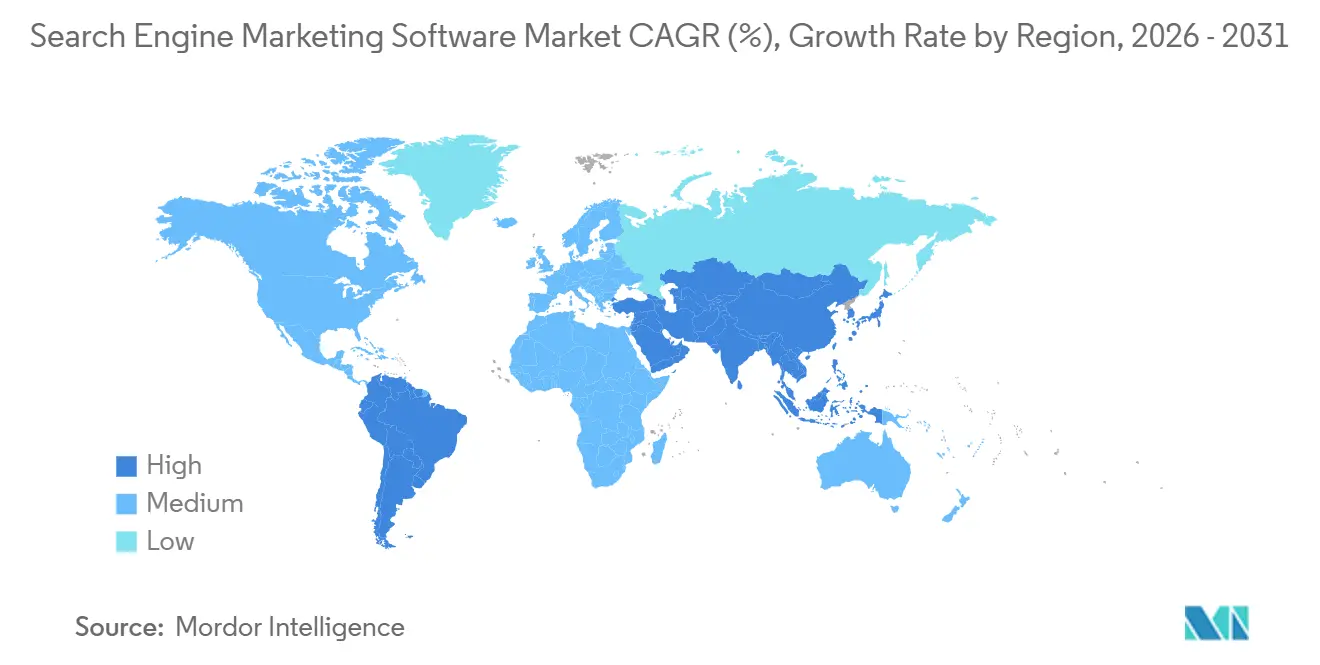
North America held 37.12% of the search engine marketing software market share in 2025, reflecting the region’s established advertiser base, mature SaaS procurement practices, and concentration of platform and software-provider capabilities. The region has a deep concentration of software vendors, experienced advertisers, and established SaaS buying processes, alongside large advertisers that can test new AI-enabled campaign types and then apply successful practices across broader portfolios. Google, Microsoft, and Amazon each provide important advertising environments in the United States. This creates a need for products that combine portfolio allocation and reporting across multiple platforms, while Canada adds bilingual advertising requirements and Mexico adds depth through an expanding e-commerce sector.
Asia-Pacific is projected to record the fastest regional CAGR of 17.04% through 2031, as a mix of mobile-first behavior, expanding e-commerce activity, small-business digitalization, and changing search habits expands the addressable customer base across several distinct national markets. India is supported by MSME digitalization and e-commerce expansion, including USD 5.96 billion in 2025 economic output linked to digital advertising for Indian MSMEs. Japan’s digital marketing activity grew 14.1% year over year in 2025, according to Yano Research Institute data reported by Nikkei, while Hakuhodo DY Holdings identified movement from keyword search to AI platforms as an important factor reshaping Japanese commercial search behavior. In China, Baidu reported that its ERNIE model processed 1.5 billion API calls per day, while data-residency requirements under the Personal Information Protection Law shape the local procurement environment. South Korea, Australia, Indonesia, Thailand, and Vietnam add demand through mature or mobile-first digital advertising activity.
Europe remains a significant part of the search engine marketing software market, with compliance requirements shaping product selection, as buyers must consider data collection, consent transmission, audience management, and reporting design alongside standard campaign management requirements. Germany’s online advertising spending reached EUR 35.6 billion (USD 38.3 billion) in 2026, based on Dentsu regional tracking.[2]Dentsu, “Ad Spend Growth Is Projected to Slow to 5.0% in 2026, Still Outpacing Economic Growth,” Dentsu, dentsu.com Bitkom found that data-protection costs remained high among German companies, supporting interest in tools with Consent Mode v2 and server-side tracking capabilities, while the United Kingdom and France support demand through mature e-commerce activity. South America is emerging as Brazil and Argentina expand e-commerce and local search inventory, although infrastructure limits and currency volatility affect enterprise procurement. The Middle East and Africa remain earlier-stage adoption areas, with growth concentrated in large cities and government-backed digital commerce programs.

Competitive Landscape
The search engine marketing software market has a concentrated upper tier and an active mid-market, with major platform companies shaping core advertising functions. At the same time, specialized providers compete through workflow design, regional depth, reporting breadth, and services tailored to particular customer groups. Google and Microsoft set the platform benchmark with native AI bidding tools, including Google AI Max for Search and Microsoft’s comparable offering, and independent suppliers must demonstrate value beyond the functions available directly in the advertising platforms. Adobe completed its USD 1.9 billion acquisition of Semrush in April 2026, and the combination brought SEO, paid media analytics, generative engine optimization, and agentic content optimization into Adobe CX Enterprise.[3]Adobe, “Adobe and Semrush: Helping Brands Win in the Era of AI Discovery,” Adobe, partners.adobe.com This move strengthened the position of integrated marketing suites at the upper end of the market. At the same time, specialized providers continue to serve agencies and mid-market businesses that need focused paid-search automation or competitive intelligence. At the same time, SE Ranking and SISTRIX have built positions in Europe through local search visibility information and lower-cost SaaS offerings. These vendors compete where enterprise-suite pricing or breadth does not fit the buyer's needs.
Competition is moving toward commerce intelligence, AI-based campaign controls, and reliable measurement across search surfaces, as providers seek functions that remain valuable when native advertising platforms assume a larger share of routine bidding and creative optimization work, while customers continue to need independent evidence for internal decisions. Vendors that connect directly with e-commerce platforms can support product-margin-aware bidding at the SKU level, which is useful for retailers that need advertising decisions to reflect product economics. EU compliance also creates a product opportunity for providers with consent-signal pipelines, server-side tagging guidance, and GDPR-compatible audience handling, thereby reducing implementation effort for mid-market buyers. Measurement quality is becoming more important as native advertising platforms automate more tactical bidding decisions, and providers are investing in audience modeling and cross-surface attribution to address that need. AI search optimization specialists are beginning to overlap with traditional SEM suppliers, putting pressure on legacy vendors to expand their products beyond conventional search advertising workflows.
Adobe launched Adobe Brand Visibility in June 2026, combining Semrush AI search intelligence with Adobe agentic content optimization capabilities. The product is designed to help brands monitor presence across ChatGPT, Google AI Mode, Microsoft Copilot, and Perplexity. Microsoft opened its AI Max pilot to global advertisers in May 2026, adding AI-powered query expansion, personalized creative assets, and reporting for AI search environments. Semrush also introduced an MCP connector with Perplexity in June 2026 to provide search-intelligence access within the AI search interface. These actions show that leading suppliers are extending products toward AI discovery and automated workflows.
Search Engine Marketing Software Industry Leaders
Google LLC
Microsoft Corporation
Adobe Inc.
HubSpot, Inc.
BrightEdge Technologies, Inc.
- *Disclaimer: Major Players sorted in no particular order

Recent Industry Developments
- July 2026: Marin Software was acquired by Zax Capital, repositioning the company toward an AI-first performance marketing model with a new roadmap centered on predictive forecasting, always-on cross-channel optimization, and measurable lift outcomes. The acquisition signals investor appetite for AI-native mid-market SEM platforms and marks a structural transition for a vendor that built its position in the rules-based bid management era.
- June 2026: Adobe launched Adobe Brand Visibility at Cannes Lions, the first unified solution combining Semrush's AI search intelligence with Adobe's agentic content optimization capabilities. The product enables brands to monitor and improve presence across ChatGPT, Google AI Mode, Microsoft Copilot, and Perplexity, making it the first integrated generative engine optimization offering within a major software suite's commercial stack.
- May 2026: Microsoft Advertising opened an AI Max for Search pilot to all advertisers globally, extending search campaigns into Copilot Search and Copilot Answers with AI-powered query expansion, personalized creative assets, and search-term landing-page reporting. The rollout included a new Offer Highlights ad format for AI-chat surfaces and an AI-powered audience generation tool, marking a material expansion of Microsoft's monetization of conversational search environments.
- April 2026: Adobe completed its acquisition of Semrush Holdings, Inc. for USD 1.9 billion. The deal integrates Semrush's proprietary dataset, used by more than 28 million users globally, with Adobe CX Enterprise, deepening Adobe's paid media analytics, SEO, and agentic search optimization capabilities within a single commercial offering.


Global Search Engine Marketing Software Market Report Scope
The Search Engine Marketing Software Market comprises software platforms that enable organizations to plan, execute, manage, optimize, and analyze search engine marketing activities across paid and organic search channels. These solutions offer capabilities such as keyword research, search advertising campaign management, bid optimization, rank tracking, search performance analytics, competitor intelligence, audience targeting, and attribution measurement. Organizations use these platforms to improve online visibility, increase website traffic, generate leads, enhance search-driven customer acquisition, and maximize return on marketing investments.
The Search Engine Marketing Software Market Report is Segmented by Deployment Mode (Cloud-Based and On-Premises), Organization Size (Large Enterprises and Small and Medium Enterprises [SMEs]), Application (Search Advertising Campaign Management, Performance Marketing and Conversion Optimization, E-Commerce Traffic Acquisition, Brand Awareness and Share of Voice Management, and Local Search and Location-Based Marketing), End User (Brands and Advertisers, Digital Marketing Agencies, E-Commerce Businesses, and Enterprises and In-House Marketing Teams), and Geography (North America, South America, Europe, Asia-Pacific, Middle East, and Africa). The Market Forecasts are Provided in Terms of Value (USD).
| Cloud-Based |
| On-Premises |
| Large Enterprises |
| Small and Medium Enterprises (SMEs) |
| Search Advertising Campaign Management |
| Performance Marketing and Conversion Optimization |
| E-Commerce Traffic Acquisition |
| Brand Awareness and Share of Voice Management |
| Local Search and Location-Based Marketing |
| Brands and Advertisers |
| Digital Marketing Agencies |
| E-Commerce Businesses |
| Enterprises and In-House Marketing Teams |
| North America | United States |
| Canada | |
| Mexico | |
| South America | Brazil |
| Argentina | |
| Rest of South America | |
| Europe | Germany |
| United Kingdom | |
| France | |
| Italy | |
| Spain | |
| Russia | |
| Rest of Europe | |
| Asia-Pacific | China |
| Japan | |
| India | |
| South Korea | |
| Australia and New Zealand | |
| Rest of Asia-Pacific | |
| Middle East | Saudi Arabia |
| United Arab Emirates | |
| Turkey | |
| Rest of Middle East | |
| Africa | South Africa |
| Nigeria | |
| Rest of Africa |
| By Deployment Mode | Cloud-Based | |
| On-Premises | ||
| By Organization Size | Large Enterprises | |
| Small and Medium Enterprises (SMEs) | ||
| By Application | Search Advertising Campaign Management | |
| Performance Marketing and Conversion Optimization | ||
| E-Commerce Traffic Acquisition | ||
| Brand Awareness and Share of Voice Management | ||
| Local Search and Location-Based Marketing | ||
| By End User | Brands and Advertisers | |
| Digital Marketing Agencies | ||
| E-Commerce Businesses | ||
| Enterprises and In-House Marketing Teams | ||
| By Geography | North America | United States |
| Canada | ||
| Mexico | ||
| South America | Brazil | |
| Argentina | ||
| Rest of South America | ||
| Europe | Germany | |
| United Kingdom | ||
| France | ||
| Italy | ||
| Spain | ||
| Russia | ||
| Rest of Europe | ||
| Asia-Pacific | China | |
| Japan | ||
| India | ||
| South Korea | ||
| Australia and New Zealand | ||
| Rest of Asia-Pacific | ||
| Middle East | Saudi Arabia | |
| United Arab Emirates | ||
| Turkey | ||
| Rest of Middle East | ||
| Africa | South Africa | |
| Nigeria | ||
| Rest of Africa | ||


Key Questions Answered in the Report
What is the size of the search engine marketing software market?
The search engine marketing software market was valued at USD 10.42 billion in 2025 and is estimated at USD 11.94 billion in 2026. It is projected to reach USD 24.83 billion by 2031 at a 15.81% CAGR, as advertisers adopt tools for increasingly complex search and discovery workflows.
What is driving demand for search engine marketing software?
Demand is supported by paid-search activity across AI search, retail media, and social search, along with a greater need for first-party data activation and cross-platform reporting. Buyers also need practical controls over budgets, campaign data, and performance reporting when each advertising environment uses different automation and measurement methods.
Which deployment model leads adoption?
Cloud-based deployment held 72.14% of revenue in 2025 and is projected to grow at an 18.05% CAGR through 2031. Cloud tools support ongoing API connections, regular product updates, and faster access to changes in bidding, reporting, and advertising-platform integrations, which are difficult to maintain in locally deployed systems.
Which users are expected to adopt these platforms fastest?
SMEs are projected to grow at an 18.37% CAGR, while e-commerce businesses are projected to grow at a 17.71% CAGR through 2031. SMEs benefit from accessible automation and simpler subscription models, while e-commerce users need detailed campaign controls linked to product feeds, inventory, margins, and return on advertising spend.
Which application is growing fastest?
E-commerce traffic acquisition is projected to record a 17.36% CAGR through 2031, supported by demand for product-feed management and profit-aware bidding. Retailers are looking beyond basic keyword management and need tools that explain how advertising decisions affect product-level performance across a broader set of discovery pathways.
Which region is expected to grow the fastest?
Asia-Pacific is projected to grow at a 17.04% CAGR through 2031, supported by digitalization, mobile-first use, and expanding e-commerce activity. India, China, Japan, Australia, South Korea, and Southeast Asian markets each add demand through different combinations of MSME adoption, AI search change, and established digital advertising activity, as platform features and local business practices continue to vary substantially across the region.
Page last updated on:






