
Saudi Arabia Social Commerce Market Size and Share
Market Overview
| Study Period | 2020 - 2031 |
|---|---|
| Forecast Data Period | 2026 - 2031 |
| Base Year Market Size (2025) | USD 44.06 Billion |
| Market Size (2026) | USD 55.87 Billion |
| Market Size (2031) | USD 134.02 Billion |
| Growth Rate (2026 - 2031) | 19.12 % |
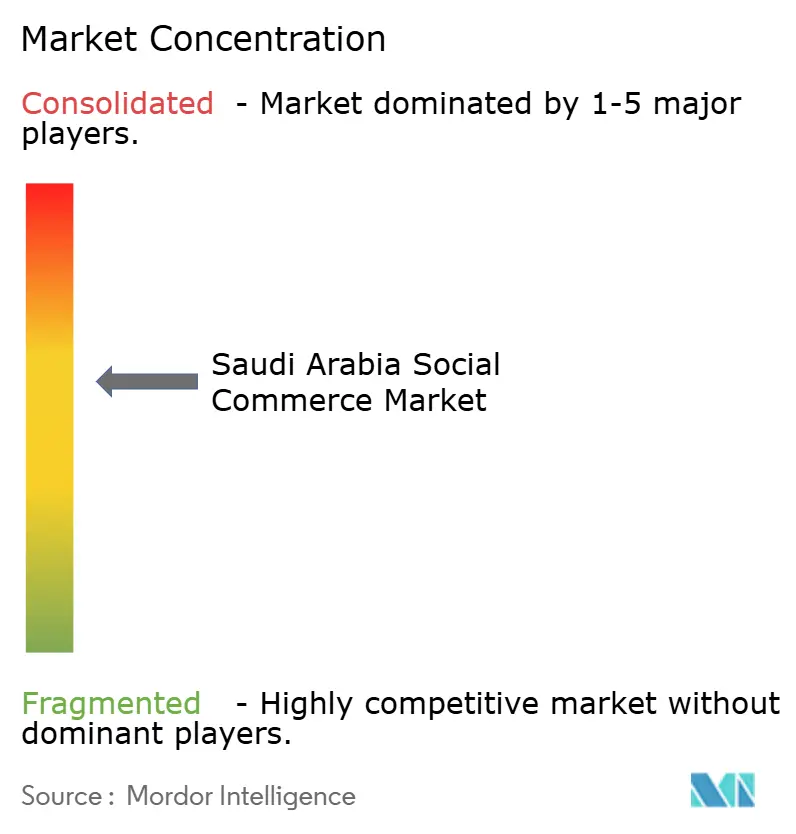
| Market Concentration | Medium |
Major Players *Disclaimer: Major Players sorted in no particular order Image © Mordor Intelligence. Reuse requires attribution under CC BY 4.0. | |
Saudi Arabia Social Commerce Market Analysis by Mordor Intelligence
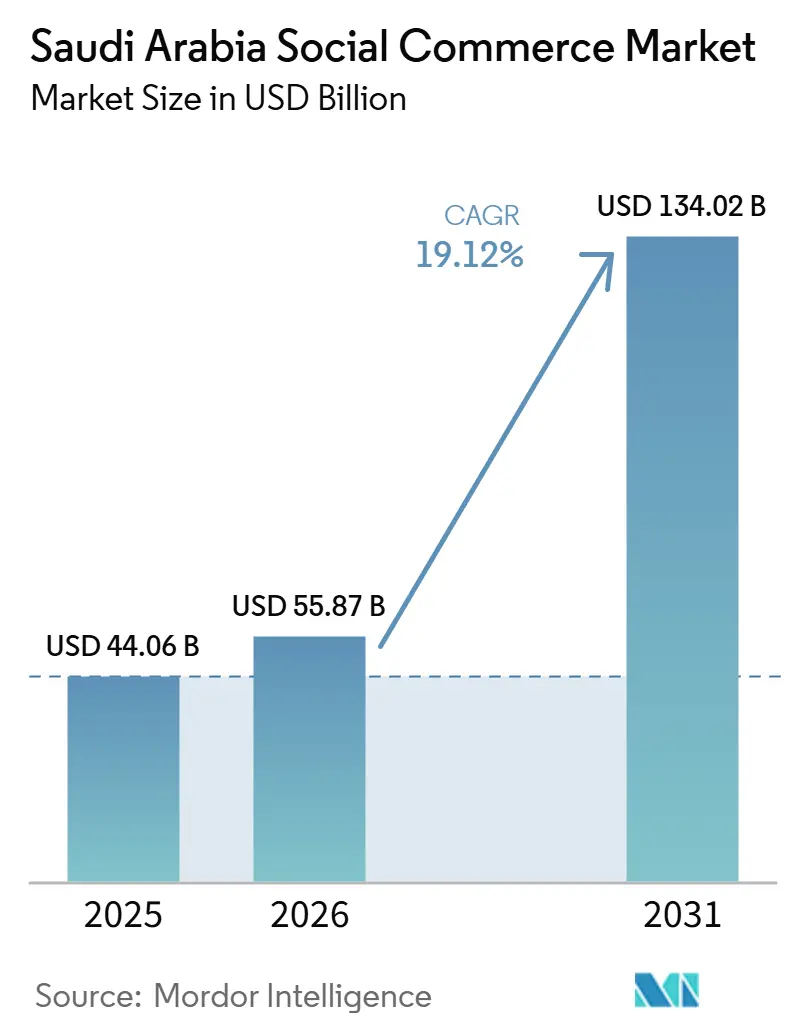
The Saudi Arabia Social Commerce Market size was valued at USD 44.06 billion in 2025 and estimated to grow from USD 55.87 billion in 2026 to reach USD 134.02 billion by 2031, at a CAGR of 19.12% during the forecast period (2026-2031). The market is supported by social discovery, in-app payment, and checkout functions that now occur within a single mobile session. High internet use, broad mobile broadband access, and a young population support frequent use of social platforms for product discovery and purchase. Merchants are placing greater emphasis on Arabic-language storefronts, local payment methods, and short checkout journeys because these features align with how consumers use smartphones. The opportunity is strongest for businesses that can connect content, payment, order management, and fulfillment without requiring shoppers to leave the platform. Data privacy requirements and changes to platform algorithms remain important operating risks, especially for smaller sellers.
Key Report Takeaways
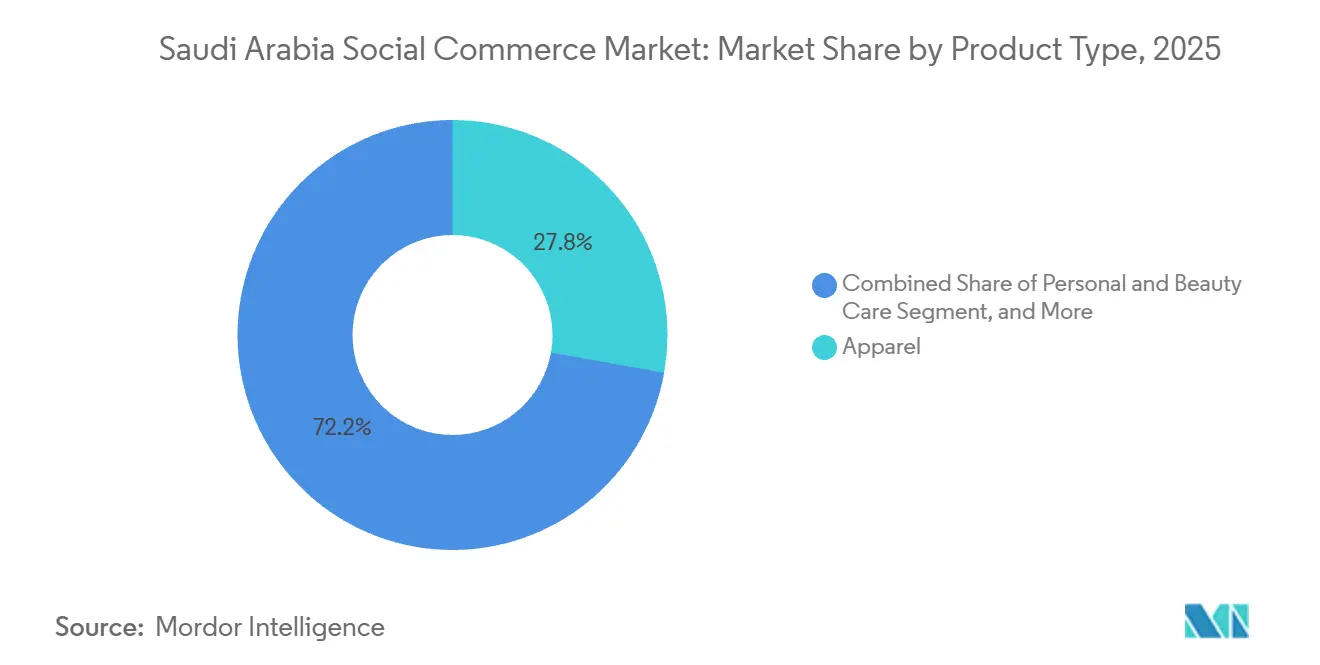
- By product type, apparel held 27.81% of the Saudi Arabia Social Commerce Market share in 2025, while personal and beauty care is projected to expand at a 20.19% CAGR through 2031.
- By device, smartphones accounted for 77.23% of the Saudi Arabia social commerce market share in 2025 and are projected to grow at a 19.78% CAGR through 2031.
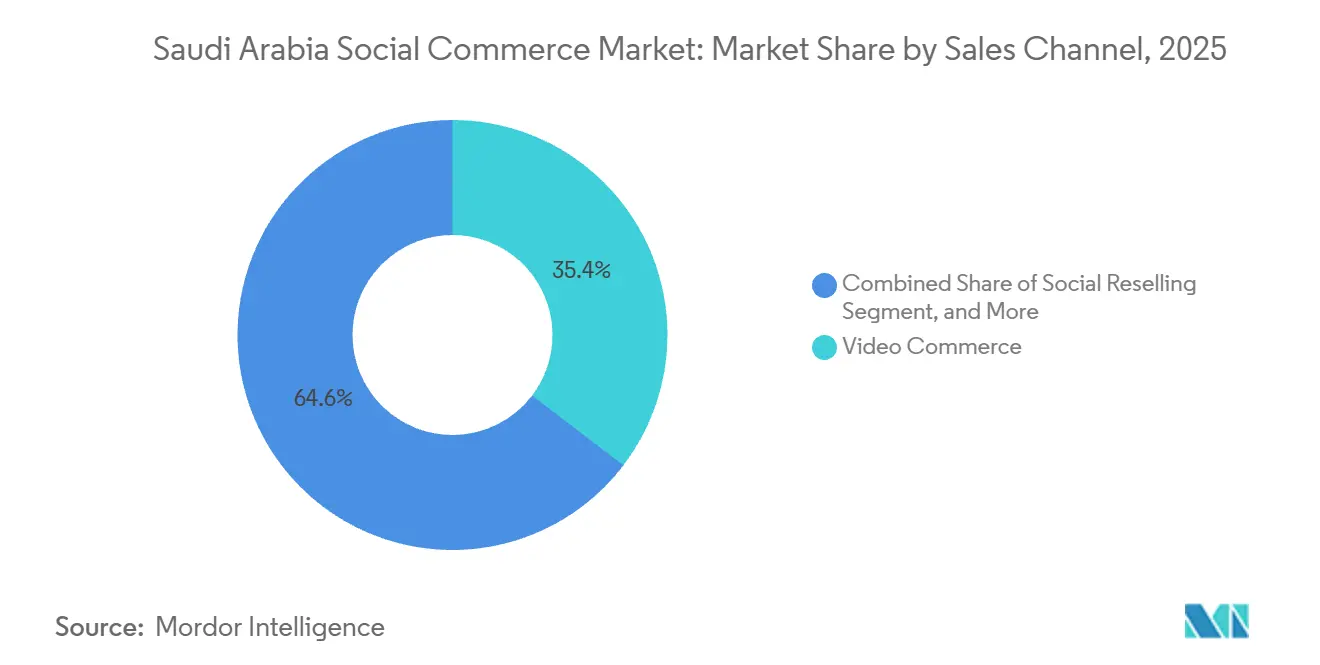
- By sales channel, video commerce held 35.36% of the Saudi Arabia Social Commerce Market in 2025, while social reselling is expected to expand at a 20.51% CAGR through 2031.
Note: Market size and forecast figures in this report are generated using Mordor Intelligence’s proprietary estimation framework, updated with the latest available data and insights as of January 2026.
Saudi Arabia Social Commerce Market Trends and Insights
Drivers Impact Analysis*
| Driver | (~) % Impact on CAGR Forecast | Geographic Relevance | Impact Timeline |
|---|---|---|---|
| Smartphone-First Purchase Journeys | +3.8% | National | Short term (≤ 2 years) |
| In-App Shopping and Conversational Commerce Integration | +3.1% | National, with highest concentration in Riyadh and Jeddah | Short term (≤ 2 years) |
| Creator-Led Product Discovery and Live Selling | +2.8% | National | Short term (≤ 2 years) |
| TikTok Shop Expansion and Scroll-to-Buy Behavior | +2.3% | National, early concentration in urban centers | Short term (≤ 2 years) |
| SME Access to Low-Cost Digital Distribution | +1.9% | National, with SME-led gains in Riyadh and Jeddah | Medium term (2-4 years) |
| Social Checkout Adaptation to Cash-Constrained Consumers | +1.5% | National | Short term (≤ 2 years |
| Source: Mordor Intelligence | |||
Smartphone-First Purchase Journeys
Saudi Arabia’s smartphone penetration reached 99%, and median mobile speed reached 194 Mbps in late 2025.[1] These conditions allow consumers to watch content, compare products, and complete payment on a single device, rather than switching among a social platform, a browser, and a separate payment page. Electronic payments accounted for 85% of retail transactions in 2025, up from 79% in 2024. The growth in digital payments has strengthened the payment infrastructure for mobile shopping and reduced interruptions during checkout.[2] Smartphones accounted for 77.23% of transactions in 2025 and are expected to retain their central role as merchants improve mobile checkout, Arabic-language storefront design, local payment integration, and order confirmation speed.
In-App Shopping and Conversational Commerce Integration
Native checkout functions on TikTok and Instagram remove the redirect that can interrupt a purchase. TikTok advertising reach exceeded 138% of Saudi Arabia’s adult population, while Instagram had 18.2 million users in late 2025.[3] WhatsApp Business also supports direct seller-to-consumer conversations and preserves the personal trust associated with local shopping. Saudi consumers respond to Arabic-language content and messaging that reflect local shopping habits, especially when sellers can answer questions in the same conversation that leads to a purchase. TikTok is more suited to lower-priced impulse purchases, while Instagram supports premium and lifestyle products with higher order values. Brands therefore need to match the content format, price point, checkout method, and level of customer interaction to the platform, rather than treating every social channel the same way.
Creator-Led Product Discovery and Live Selling
Saudi Arabia’s creator economy grew 32.37% in the first quarter of 2025 as brands used more affiliate and longer-term ambassador arrangements. The Mawthooq framework requires influencer licensing and disclosure of sponsored content, which gives consumers clearer signals when a promotion is paid. Live shopping is gaining attention, with activity concentrated on Thursday and Friday evenings and during Ramadan. The format allows creators to showcase products, answer questions, explain how to use an item, and build confidence before a customer completes an order. Vision 2030 targets SAR 47 billion (USD 12.52 billion) in media-sector output and 150,000 content-sector jobs, which supports a wider pool of creators and production capability. This expansion gives merchants more opportunities to use creators for discovery, product explanation, direct audience engagement, and conversion.
TikTok Shop Expansion and Scroll-to-Buy Behavior
TikTok Shop launched its full commerce offering in Saudi Arabia in early 2025, including Shop Tab, LIVE shopping, shoppable video ads, and an affiliate creator marketplace. The service brings discovery and checkout into the same content environment, reducing the number of steps between a consumer seeing an item and confirming payment. The platform gives small and medium-sized businesses tools to connect product content, affiliate promotion, and checkout in one place. The platform’s discovery system can surface products based on engagement signals rather than only on paid placements. This gives smaller brands a route to reach users without building a large media budget at the outset, provided their content can generate sufficient engagement. MBC Media Solutions became TikTok’s official advertising reseller in Saudi Arabia in July 2026, strengthening local support for brands and agencies.[4]
Restraints Impact Analysis*
| Restraint | (~) % Impact on CAGR Forecast | Geographic Relevance | Impact Timeline |
|---|---|---|---|
| Data Privacy and Consumer Protection Compliance Costs | -1.9% | National, SDAIA enforcement concentrated in formal digital commerce | Short term (≤ 2 years) |
| Platform Algorithm Volatility and Rising Customer Acquisition Costs | -1.5% | National, with highest exposure in urban seller concentrations | Short term (≤ 2 years) |
| Weak Livestream Purchase Confidence and Trust Gaps | -1.2% | National, more pronounced in non-urban demographics | Medium term (2-4 years) |
| Informal Seller Documentation and Fulfillment Constraints | -0.9% | National, highest concentration among non-platform-dependent sellers | Long term (≥ 4 years) |
| Source: Mordor Intelligence | |||
Data Privacy and Consumer Protection Compliance Costs
Saudi Arabia’s Personal Data Protection Law has been enforced by the Saudi Data and Artificial Intelligence Authority since September 2024. The law allows fines of up to SAR 5 million (USD 5 million) for a violation, with higher penalties for repeat breaches. A 2026 study of 100 Saudi e-commerce websites found that only 31% disclosed all 4 key privacy-policy compliance items. Gaps were especially visible in statements on data retention and complaint processes. Consent management, user preferences, data-deletion processes, and clear privacy notices can raise costs for independent social merchants with limited administrative support. These obligations may favor larger platforms that can provide merchants with established compliance tools.
Platform Algorithm Volatility and Rising Customer Acquisition Costs
The Saudi Arabia Social Commerce Market relies on algorithms controlled by social platforms, which leaves many merchants exposed to sudden changes in reach. This dependence exposes sellers when platform rules, service availability, or content distribution methods change. More merchants are also competing for paid visibility on Instagram and TikTok, which can raise acquisition costs during peak periods when brands are trying to secure limited advertising inventory. Creator partnerships may become more expensive as demand for creator inventory rises before Expo 2030 and the 2034 FIFA World Cup. Sellers can reduce this exposure by using TikTok, Instagram, and Snapchat together, although this requires stronger content and operating capabilities. Smaller brands may find it difficult to build that level of coordination while protecting margins.
*Our forecasts treat driver/restraint impacts as directional, not additive. The impact forecasts reflect baseline growth, mix effects, and variable interactions.
Segment Analysis
By Product Type: Apparel Leads While Beauty Gains Momentum
Apparel held 27.81% of sales in the Saudi Arabia Social Commerce Market in 2025, reflecting a close fit with visual platforms. Consumers can view styling, compare trends, and respond to creator demonstrations before purchasing. Fast-fashion models, including SHEIN and regional players, have helped establish expectations for rapid fulfillment after discovery through short videos. Personal and beauty care is projected to be the fastest-growing category at a 20.19% CAGR through 2031. Beauty was the fastest-growing influencer-content niche in the first quarter of 2025, with 56% year-over-year growth.
Live demonstrations allow beauty creators to apply, review, and explain products in real time, which can strengthen customer confidence before payment. Accessories benefit from gifting behavior and fashion interest, while home products are attracting attention through lifestyle content focused on interior design and home aesthetics. Health supplements are gaining traction amid Ramadan wellness cycles and growing interest in fitness among younger consumers. Food and beverages remains less established because dedicated delivery services already handle a large part of the category’s online demand. The Saudi Arabia Social Commerce Market is centered on visual, frequently purchased products that are easy to demonstrate through social content.

By Device: Smartphones Maintain the Main Transaction Role
Smartphones accounted for 77.23% of the Saudi Arabia Social Commerce Market in 2025 and are projected to grow at a 19.78% CAGR through 2031. This position reflects the continued adoption of mobile shopping rather than a market that has stopped developing. Broadband mobile connections accounted for 98.5% of mobile connections in late 2025, while median mobile speed reached 194 Mbps. Saudi Arabia ranked 1st in the International Telecommunication Union’s ICT Development Index in July 2026, with a score of 99.8 out of 100. These conditions support video, payment, checkout, augmented reality product trials, personalized recommendations, and one-tap checkout.
Laptops and desktops continue to play a smaller role in electronics, luxury products, and business-to-business orders that require detailed comparison. Their share is likely to decline as in-app checkout and buy-now-pay-later options are increasingly integrated into mobile experiences. Salla’s Arabic-first mobile approach and Shopify’s focus on storefront performance reflect the priority placed on the smartphone transaction. Creative material, payments, and fulfillment options need to work smoothly on a small vertical screen. These requirements make smartphone design central to the size of the Saudi Arabia Social Commerce Market for transaction activity.
By Sales Channel: Video Commerce Leads While Social Reselling Expands
Video commerce held 35.36% of sales in 2025. Short-form video and live formats are central to social media use in the kingdom. Research by Snap and Publicis Media found that 79% of Saudi apparel shoppers completed their purchase journey without leaving a social app. The same research found that live content generated conversion rates 3 times those of static posts. Ramadan creates an important commercial window because spending rises 35%, and late-night live events can capture active viewers.
Social reselling is projected to be the fastest-growing channel in the Saudi Arabia Social Commerce Market at a 20.51% CAGR through 2031. TikTok and Instagram affiliate programs allow creators to earn commissions from completed sales rather than receiving only a fixed content fee. Haraj represents the informal end of this activity through its local trust model for secondhand goods, while TikTok’s affiliate marketplace and Salla Ads support a more formal model. Social network-led commerce, group buying, and product review platforms comprise the remaining channels in the Saudi Arabia Social Commerce Market. Group buying remains relevant because purchase decisions often involve family, friends, and trusted community networks.
Geography Analysis
The Saudi Arabia Social Commerce Market is nationally distributed, although Riyadh, Jeddah, and Dammam have the strongest commercial concentration because they combine purchasing power, digital infrastructure, and creator networks. Saudi Arabia’s digital economy contributed SAR 495 billion (USD 132 billion) in 2025 and represented 15% of gross domestic product. E-commerce reached SAR 84.6 billion (USD 22.54 billion) in 2025. These conditions make the kingdom the largest e-commerce market in the Middle East and North Africa and support higher social media conversion rates in urban areas.
Riyadh serves as the leading center for the Saudi Arabia Social Commerce Market because it combines administrative, commercial, media, and creator-economy activity. Saudi Media City and Riyadh Creative District concentrate studios, agencies, talent management, and advertising technology in the city. This cluster supports Arabic-language content for domestic audiences and regional export. Jeddah is the secondary growth center, supported by its retail base, its role in cross-border e-commerce, and its particular strength in fashion and beauty. Saudi Arabia retained its 1st position in the ITU ICT Development Index in July 2026, underscoring strong digital infrastructure nationwide.
Smaller cities and rural areas are joining the Saudi Arabia Social Commerce Market through Instagram and Snapchat storefronts. These channels let producers of health supplements, food, and artisanal goods reach customers without operating a physical store. Snapchat had 25.3 million Saudi users in late 2025, representing 87.7% of the population and extending its reach beyond major cities into semi-urban and rural communities. The E-Commerce Law and the January 2026 ZATCA guide apply consistent requirements to sellers and platforms across geographies. The rules can encourage formalization among informal sellers, including those based outside major urban centers.
Competitive Landscape
The Saudi Arabia Social Commerce Market is moderately consolidated at the platform level and fragmented among merchants and individual sellers. Meta Platforms and ByteDance dominate the primary attention surfaces through Instagram and TikTok, while Snapchat has 25.3 million Saudi users and a commerce potential that is less developed than its reach suggests. Competition increasingly centers on merchant services rather than storefront creation alone. Salla acquired Sweply in February 2025, relaunched the product as Salla Ads, and integrated campaign management into the merchant dashboard for more than 68,000 active stores.
Zid partnered with Trendyol in May 2025, giving Saudi small and medium-sized businesses access to a broader marketplace infrastructure without requiring a separate operating stack. Tamara and Tabby are reshaping the payment layer as buy-now-pay-later services move toward loyalty, consumer credit, and merchant activation. Tamara secured financing of up to USD 2.4 billion in 2026. Tabby reached a USD 4.5 billion valuation in 2026, making it the highest-valued consumer fintech company from the Arab world. Their ability to offer credit near product discovery can influence conversion in higher-value categories.
Salla filed for marketplace-level value-added tax compliance certification with ZATCA in June 2026, indicating that regulatory alignment can become a competitive advantage for platforms serving many sellers. Larger operators can provide payment, advertising, tax, and order-management tools in a single system, while smaller independent sellers may find it harder to offer these functions and meet data and tax requirements. TikTok Shop’s local commerce tools and MBC Media Solutions’ July 2026 advertising-reseller role add further support for platform-led merchant activity. The Saudi Arabia Social Commerce Market is likely to favor businesses that combine local compliance, creator access, payments, and merchant operations.
Saudi Arabia Social Commerce Industry Leaders
-
Amazon.com, Inc.
-
Salla Holding Company
-
SHEIN Group Ltd.
-
Haraj Information Technology Company
-
Noon E Commerce LLC
- *Disclaimer: Major Players sorted in no particular order
Recent Industry Developments
- July 2026: MBC Media Solutions (MMS) became TikTok's official advertising reseller in Saudi Arabia, giving brands and agencies direct access to TikTok's full advertising inventory, creator-led campaigns, and AI-powered Symphony Agent tools for campaign creation. The partnership strengthens TikTok's commercial infrastructure across the kingdom's expanding social commerce advertising budgets and formalizes a local support structure for brand investment.
- July 2026: Saudi Arabia retained the top position in the ITU ICT Development Index for the second consecutive year, scoring 99.8 out of 100. The ranking validates the kingdom's mobile and connectivity infrastructure as the foundational enabler for next-phase social commerce applications including AR shopping and AI-personalized discovery.
- June 2026: Tabby received consumer finance and SME finance licences from SAMA, enabling the company to offer larger-value installment plans on purchases over SAR 2,000 (USD 530) and provide working capital products to businesses, materially expanding the addressable checkout pool for higher-value social commerce categories such as electronics and luxury goods.
- March 2026: Tamara Finance secured a financing package of up to USD 2.4 billion from Goldman Sachs, Citi, and Apollo funds, among the largest fintech financing transactions in the Gulf, supporting expanded credit analytics capability, omnichannel BNPL rollout, and potential cross-border market entry.
Saudi Arabia Social Commerce Market Report Scope
The Saudi Arabia social commerce market refers to the ecosystem of buying and selling goods and services directly through social media platforms, influencer networks, and community-driven channels within Saudi Arabia. This market encompasses transactions facilitated via video commerce, social network-led storefronts, social reselling, group buying, and product discovery platforms across devices such as smartphones and desktops. By integrating e-commerce functionalities directly into the social media experiences of Saudi consumers, this market enables brands and retailers to shorten the customer journey from product discovery to final purchase, leveraging interactive content, live streaming, and peer recommendations to drive sales of apparel, personal care, and other consumer goods.
The Saudi Arabia Social Commerce Market Report is Segmented by Product Type (Apparel, Personal and Beauty Care, Accessories, Home Products, Health Supplements, Food and Beverages, and Other Product Types), Device (Laptops and Desktops, and Smartphone), and Sales Channel (Video Commerce, Social Network-Led Commerce, Social Reselling, Group Buying / Team Purchase, and Product Review and Discovery Platforms). The Market Forecasts are Provided in Terms of Value (USD).
| Apparel |
| Personal and Beauty Care |
| Accessories |
| Home Products |
| Health Supplements |
| Food and Beverages |
| Other Product Types |
| Laptops and Desktops |
| Smartphone |
| Video Commerce |
| Social Network-Led Commerce |
| Social Reselling |
| Group Buying / Team Purchase |
| Product Review and Discovery Platforms |
| By Product Type | Apparel |
| Personal and Beauty Care | |
| Accessories | |
| Home Products | |
| Health Supplements | |
| Food and Beverages | |
| Other Product Types | |
| By Device | Laptops and Desktops |
| Smartphone | |
| By Sales Channel | Video Commerce |
| Social Network-Led Commerce | |
| Social Reselling | |
| Group Buying / Team Purchase | |
| Product Review and Discovery Platforms |
Key Questions Answered in the Report
What is the size of the Saudi Arabia social commerce market?
The Saudi Arabia Social Commerce Market was valued at USD 44.06 billion in 2025, is estimated at USD 55.87 billion in 2026, and is forecast to reach USD 134.02 billion by 2031. The forecast represents a CAGR of 19.12% from 2026 to 2031.
What is driving social commerce adoption in Saudi Arabia?
High smartphone use, widespread mobile broadband, electronic payments, in-app checkout, and creator-led discovery are supporting adoption. Local payment integration and Arabic-language content also make the transaction journey easier for shoppers.
Which product category leads social commerce sales in Saudi Arabia?
Apparel led with a 27.81% share in 2025 because video content, trend discovery, and creator demonstrations suit the category. Personal and beauty care is expected to expand at a 20.19% CAGR through 2031.
Which device is used most for social commerce purchases in Saudi Arabia?
Smartphones accounted for 77.23% of transactions in 2025 and are expected to grow at a 19.78% CAGR through 2031. Mobile design is important because discovery, payment, and checkout increasingly occur in the same session.
Which sales channel is growing fastest in Saudi social commerce?
Social reselling is expected to be the fastest-growing sales channel in the Saudi Arabia Social Commerce Market, with a projected CAGR of 20.51% through 2031. Affiliate models link creator compensation more directly to completed sales.
What challenges do social commerce sellers face in Saudi Arabia?
Sellers face privacy compliance costs, platform algorithm changes, rising paid-acquisition costs, and fulfillment or documentation constraints. These pressures are often harder for informal and independent sellers to manage.