
Saudi Arabia Project Logistics Market Size and Share
Market Overview
| Study Period | 2020 - 2031 |
|---|---|
| Forecast Data Period | 2026 - 2031 |
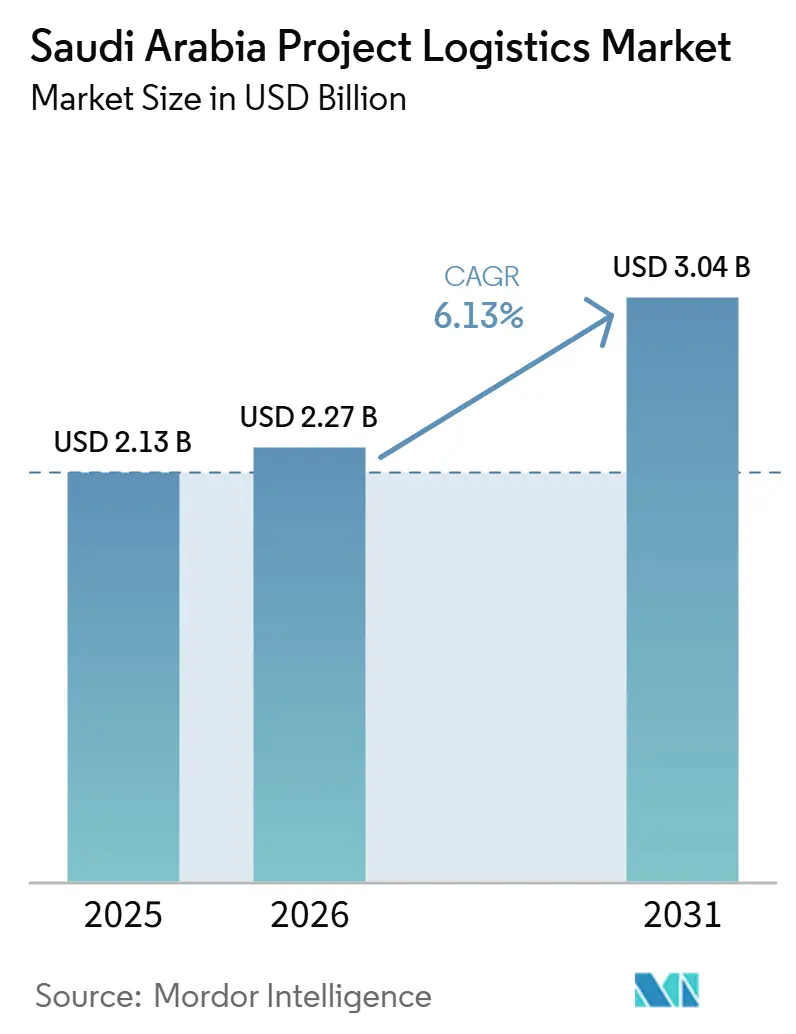
| Base Year Market Size (2025) | USD 2.13 Billion |
| Market Size (2026) | USD 2.27 Billion |
| Market Size (2031) | USD 3.04 Billion |
| Growth Rate (2026 - 2031) | 6.13 % |
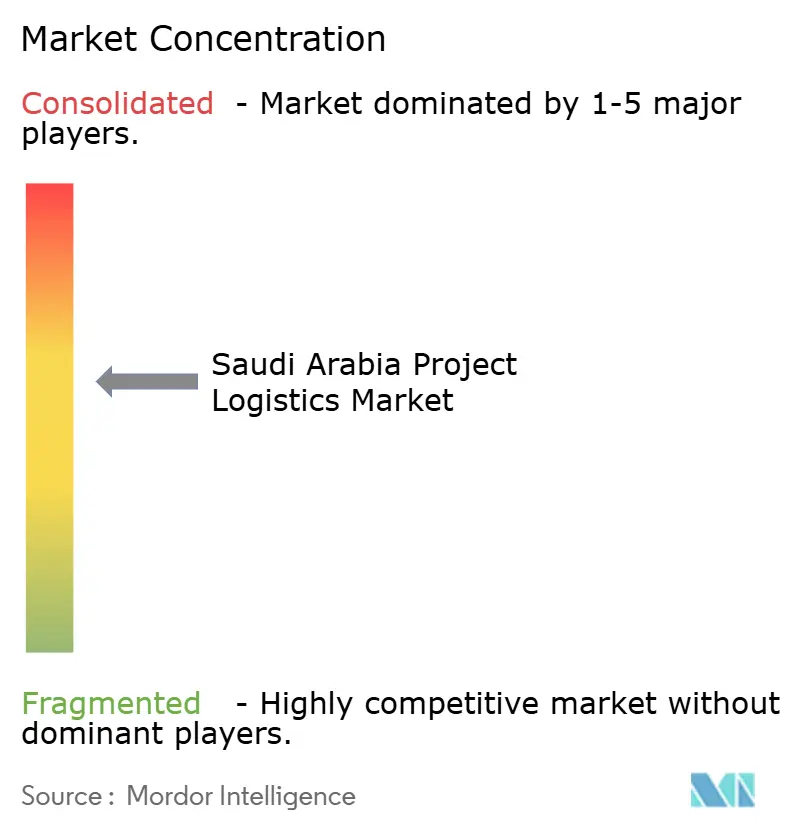
| Market Concentration | Medium |
Major Players *Disclaimer: Major Players sorted in no particular order Image © Mordor Intelligence. Reuse requires attribution under CC BY 4.0. | |
Saudi Arabia Project Logistics Market Analysis by Mordor Intelligence
The Saudi Arabia project logistics market size was valued at USD 2.13 billion in 2025 and estimated to grow from USD 2.27 billion in 2026 to reach USD 3.04 billion by 2031, at a CAGR of 6.13% during the forecast period (2026-2031).
Growth is being supported by the Kingdom’s unusually large construction and industrial project pipeline, with Public Investment Fund-backed developments and national infrastructure programs continuing to create demand for heavy-haul transport, breakbulk handling, and specialized warehousing. Aramco’s gas expansion work at Jafurah is also keeping project cargo flows active in 2026 because large gas processing and pipeline contracts still require complex equipment movements and sequenced site delivery. Renewable energy projects are widening the opportunity set because solar, wind, and battery storage programs require repeated movements of turbines, transformers, nacelles, blades, and containerized storage systems across several provinces. Competition is shifting toward operators that can combine engineering capability, permit management, multimodal planning, and local compliance under the iktva framework, which is raising the value of Saudi-based execution depth. Permit delays for abnormal loads and the slower operating ramp at NEOM still weigh on execution speed, but new logistics hubs, corridor investments, and added port capacity are improving system resilience and keeping the Saudi Arabia project logistics market on a firm expansion path[1].
Key Report Takeaways
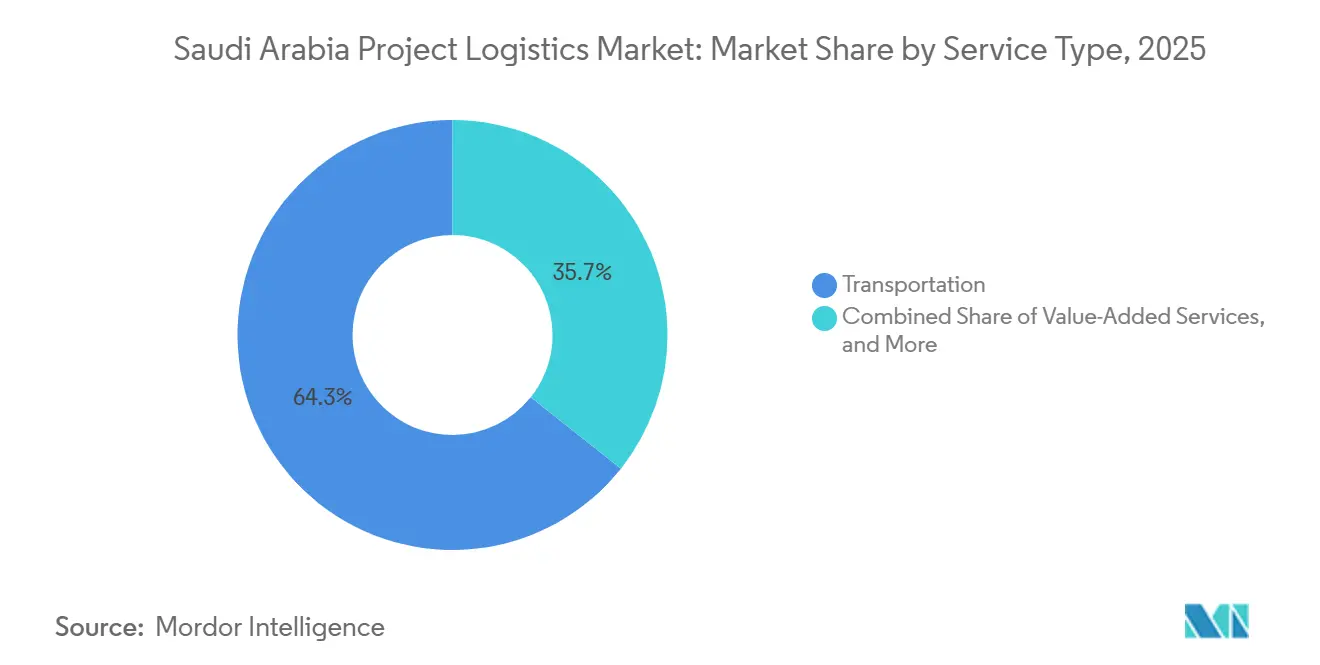
- By service, transportation accounted for 64.32% of the Saudi Arabia project logistics market share in 2025, while value-added services and others are forecast to expand at a 7.06% CAGR through 2031.
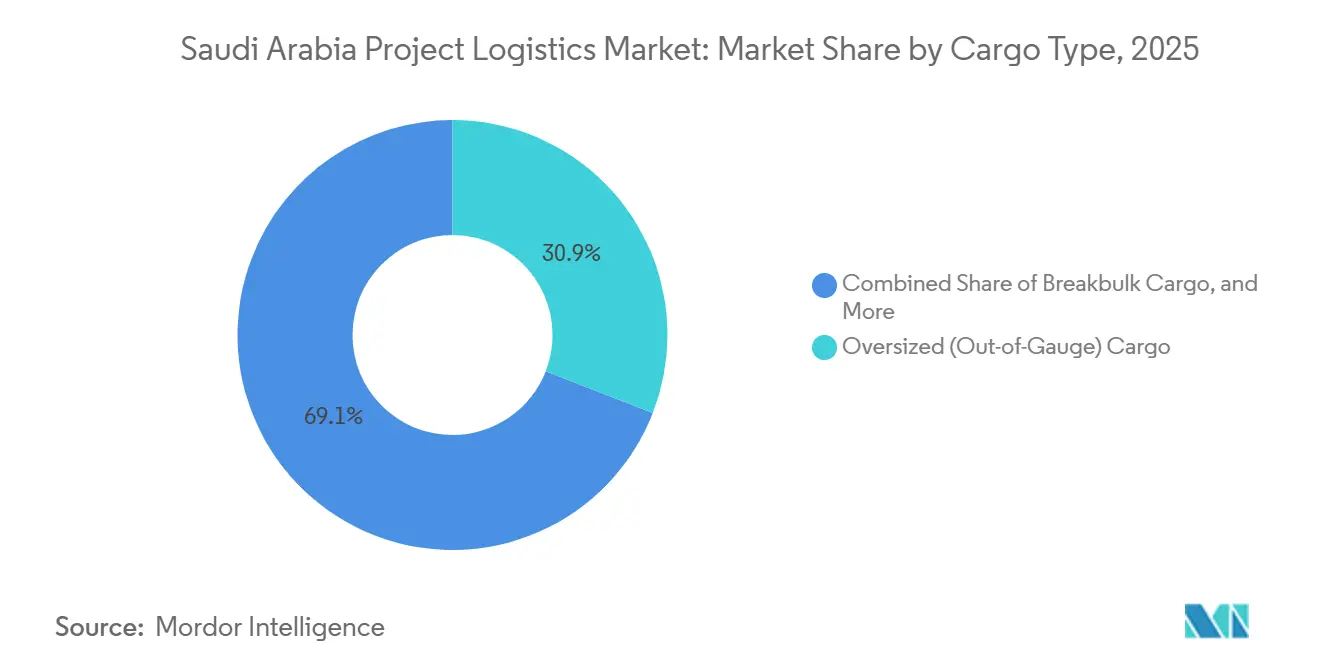
- By cargo type, oversized or out-of-gauge cargo accounted for 30.91% of the Saudi Arabia project logistics market size in 2025, while heavy-lift cargo is projected to grow at 6.90% CAGR through 2031.
- By end-user industry, oil and gas and mining and quarrying accounted for 36.55% of the Saudi Arabia project logistics market share in 2025, while energy generation and transmission is forecast to advance at a 7.73% CAGR through 2031.
Note: Market size and forecast figures in this report are generated using Mordor Intelligence’s proprietary estimation framework, updated with the latest available data and insights as of January 2026.
Saudi Arabia Project Logistics Market Trends and Insights
Drivers Impact Analysis*
| Driver | (~) % Impact on CAGR Forecast | Geographic Relevance | Impact Timeline |
|---|---|---|---|
| Growing Megaproject Pipeline under Vision 2030 | +1.8% | National, with peak activity in Tabuk or NEOM, Eastern Province, and Riyadh | Medium term (2-4 years) |
| Rising Outsourcing of Heavy-Lift and Specialized Transportation | +0.9% | Eastern Province, Western Region | Short term (≤ 2 years) |
| Expansion of Industrial Zones and Logistics Corridors | +0.8% | National, concentrated in Dammam, Riyadh, and Jeddah industrial cities | Medium term (2-4 years) |
| Increasing Demand for End-to-End Cargo Visibility | +0.5% | Global, with strong uptake at Jeddah Islamic Port and SPARK logistics zone | Short term (≤ 2 years) |
| Growth in Energy, Petrochemical, and Utility Investments | +1.0% | Eastern Province and Western renewable corridors | Long term (≥ 4 years) |
| Localization of Industrial Supply Chains | +0.5% | National, anchored at MODON industrial cities across major provinces | Medium term (2-4 years) |
| Source: Mordor Intelligence | |||
Growing Megaproject Pipeline under Vision 2030
Saudi Arabia’s giga-project program remains the largest single source of demand for the Saudi Arabia project logistics market. PIF’s 2026 to 2030 strategy kept NEOM, Qiddiya, Red Sea Global, and major event infrastructure at the center of national investment plans. That project mix keeps demand broad because stadium packages, transport systems, utilities, and tourism assets all need oversized structures, engineered lifting, and carefully timed delivery windows. The spending shift within the national project slate has not eliminated logistics work; instead, it has redirected contract activity toward other complex builds linked to Expo 2030 and the 2034 FIFA World Cup. Port of NEOM became operational in 2026 and added a new northern gateway that can shorten routes for cargo moving to the Red Sea and Tabuk area developments. This broad pipeline keeps the Saudi Arabia project logistics market active across port handling, heavy-haul road planning, project forwarding, and site coordination through the forecast period[2].
Rising Outsourcing of Heavy-Lift and Specialized Transportation
Project owners are increasingly moving heavy-lift and specialized transport work to dedicated contractors, thereby concentrating revenue with firms that already have technical fleets and engineering depth. Sarens handled 34 modules and 108 pieces of equipment for the Jafurah Gas Plant project, using 72 axle lines of self-propelled modular transporters and a 1,250-tonne crawler crane, which shows the level of specialization now expected on major assignments. This shift matters for the Saudi Arabia project logistics market because more clients now buy bundled execution rather than only transport capacity. Aramco’s iktva framework is reinforcing that pattern because local content targets favor Saudi-based contractors and joint ventures that can keep execution and value addition inside the Kingdom. The result is a more structured vendor environment where compliance, local registration, and Saudi operating depth matter as much as equipment ownership. That is pushing the Saudi Arabia project logistics market toward a smaller group of operators that can manage engineering, transport, lifting, and regulatory interfaces under a single contract.
Expansion of Industrial Zones and Logistics Corridors
Industrial zone expansion is creating fixed logistics demand points that extend beyond one-off cargo arrivals into equipment staging, maintenance support, and recurring plant supply. The Ministry of Transport and Logistics Services has set out a plan to expand the national logistics zone network from 22 to 59 zones by 2030, supported by investments above SAR 10 billion (USD 2.66 billion). MODON also secured SAR 8.8 billion (USD 2.35 billion) in industrial and logistics investment commitments in 2025 across sites totaling more than 3.3 million square meters. In May 2026, ASMO began construction of a 1.4 million square meter logistics hub at SPARK, designed for large, complex energy cargo with controlled storage, automation, and open industrial yards. Corridor investments are making this network more usable by enabling cargo to move between the Eastern region and Red Sea gateways with less reliance on congested urban approaches. These developments expand the physical base of the Saudi Arabia project logistics market and support longer contract cycles around inbound project cargo, storage, and inland distribution.
Increasing Demand for End-to-End Cargo Visibility
Cargo visibility has moved from a value-added feature to a normal requirement in the Saudi Arabia project logistics market, especially on projects with multiple suppliers and narrow installation windows. Operators are under greater pressure to provide real-time location data, customs readiness, and permit status updates, as even short delays can affect crane allocation, site labor scheduling, and contractor sequencing. ASMO’s SPARK facility is being built with automation and smart warehouse systems from the start, demonstrating that visibility tools are now embedded in infrastructure rather than added later. Customs execution is also part of this shift, as risk-based inspections can delay urgent project cargo if documents and pre-clearance steps are not aligned in advance. That makes digital route planning and customs intelligence more valuable for time-critical oilfield, utility, and renewable equipment movements. Providers that can combine those functions with transport execution are gaining stronger pricing power inside the Saudi Arabia project logistics market[3].
Restraints Impact Analysis*
| Restraint | (~) % Impact on CAGR Forecast | Geographic Relevance | Impact Timeline |
|---|---|---|---|
| Permit complexity for oversized and abnormal loads | -0.5% | National, most acute around Jubail Industrial City and remote northern project zones | Short term (≤ 2 years) |
| Limited availability of specialized assets and skilled handlers | -0.6% | National, with acute pressure in Eastern Province and NEOM Tabuk area | Medium term (2-4 years) |
| Congestion and route constraints around key industrial hubs | -0.4% | Jeddah port approaches and Eastern Province heavy-haul corridors | Short term (≤ 2 years) |
| Weather and site access challenges | -0.2% | Northern desert zones and coastal humidity corridors | Long term (≥ 4 years) |
| Source: Mordor Intelligence | |||
Permit Complexity for Oversized and Abnormal Loads
Permit complexity still slows project execution across the Saudi Arabia project logistics market. Cargo above the abnormal load thresholds requires route surveys, escort plans, vehicle details, and compliance with timing requirements under the Saudi permit framework, and many movements remain limited to nighttime windows. Delays are becoming more serious around Jubail, Yanbu, and the northern development corridors because projects there depend on sequenced heavy deliveries rather than flexible general cargo schedules. In 2026, a 420-tonne reactor move into Jubail required temporary storage when permit issuance slowed, which shows how administrative timing can add direct cost before a component even reaches the site. These delays ripple through crane bookings, civil works, and installation windows because project cargo delivery typically sits within a fixed chain of milestones. That is why permit management remains a core differentiator for operators competing in the Saudi Arabia project logistics market.
Limited Availability of Specialized Assets and Skilled Handlers
The supply of specialized lifting assets and qualified heavy-lift teams remains tight as several large projects advance simultaneously. This constraint affects self-propelled modular transporters, high-capacity crawler cranes, port handling systems, and experienced engineering crews, especially in the Eastern Province and around NEOM-linked work fronts. Port of NEOM invested in 10 Liebherr mobile harbor cranes with a 150-tonne lifting capacity and has already handled single cargo units weighing over 1,000 tonnes, reflecting a direct response to equipment scarcity in the wider market. Capacity pressure also affects urgent air cargo, as a 90-tonne oilfield charter in May 2026 still had to work through aircraft availability and slot coordination limits. Operators that secured regional fleets early are therefore in a stronger position than new entrants that still depend on mobilizing scarce assets from outside the Kingdom. This constraint supports pricing for established firms, but it also limits how quickly the Saudi Arabia project logistics market can absorb new cargo peaks[4].
*Our forecasts treat driver/restraint impacts as directional, not additive. The impact forecasts reflect baseline growth, mix effects, and variable interactions.
Segment Analysis
By Service: Transportation Dominates; Value-Added Services Accelerate
Transportation held 64.32% of the Saudi Arabia project logistics market share in 2025, which kept it far ahead of warehousing and value-added services. That lead reflects the basic structure of project execution in the Kingdom, where cargo must move from seaports and airports to dispersed inland energy, construction, and industrial sites. Road transport remains central because final-mile delivery still depends on controlled heavy-haul corridors linking Dammam, Jeddah, Riyadh, Jubail, and northern development zones. Sea and barge services support offshore and coastal projects, while rail remains a smaller option with selective relevance for certain inland corridors. Air freight serves the premium end of the Saudi Arabia project logistics market when urgent out-of-gauge or high-value components must bypass slower marine schedules. Warehousing, distribution, and inventory management have a more strategic role than a simple storage function because modular construction and phased commissioning depend on careful staging of equipment before site release. This supports steady demand for port-adjacent yards, secure temporary holding areas, and inventory sequencing that reduces site congestion.
Value-added services and others is forecast to grow at 7.06% CAGR through 2031, which makes it the fastest-rising service line in the Saudi Arabia project logistics industry. Kuehne+Nagel’s coordination model for wind turbine cargo into NEOM, which involved vessel chartering, transport engineering, and rigging expertise, shows why integrated execution is taking a larger share of project contracts. The National Transport and Logistics Strategy adds policy support to this shift because it favors capability building, higher service quality, and a larger logistics role in national GDP.

By Cargo Type: OOG Cargo Leads; Heavy-Lift Set for Strongest Growth
Oversized or out-of-gauge cargo accounted for 30.91% of Saudi Arabia project logistics share by cargo type in 2025. This segment leads because large construction packages, modular process units, structural steel, prefabricated elements, and industrial components are moving across multiple project classes simultaneously. That gives oversized cargo a wider base than narrower specialist categories, as it serves both traditional energy projects and newer urban, tourism, and infrastructure projects. Breakbulk cargo also plays a significant role in the Saudi Arabia project logistics market, as pipe bundles, fabricated steel, and mixed project consignments continue to move through multipurpose port services.
Heavy-lift cargo is projected to grow at a 6.90% CAGR from 2026 to 2031, the fastest pace within this segmentation. The growth case is tied to reactor vessels, gas processing trains, wind turbine nacelles, transformers, and other single pieces that require engineered lifting, route studies, and dedicated site handling. Goldwind’s 2026 dispatch of nacelles, blades, and lifting equipment for the 3GW PIF5 wind project illustrates the scale and planning intensity now linked to renewable cargo flows into the Kingdom. The Saudi Power Procurement Company’s renewable program also spreads this demand across several provinces, which increases the number of active heavy-haul corridors rather than concentrating movements in one cluster. This means the Saudi Arabia project logistics industry is likely to see sustained demand for route engineering, escort planning, and coordinated marine-to-road transfer work.
By End-User Industry: Oil and Gas Anchors Spend; Renewables Drive the Growth Rate
Oil and gas, mining, and quarrying accounted for 36.55% of the Saudi Arabia project logistics market size in 2025. That leadership came from the continued capital pull of Jafurah, alongside maintenance and expansion work in established petrochemical and industrial centers such as Jubail and Yanbu. The segment remains the anchor of the Saudi Arabia project logistics market because it generates recurring movements of modules, process equipment, drilling support cargo, and replacement units rather than isolated project shipments. Construction and infrastructure stand as the next major demand block because stadiums, mobility systems, urban development, and tourism assets tied to national events are expanding cargo needs in parallel. Manufacturing and industrial plants, aerospace and defense, and maritime activities add breadth to the end-user mix and reduce dependence on a single spending cycle.
Energy generation and transmission are forecast to expand at a 7.73% CAGR through 2031, making it the fastest-growing end-user segment in the Saudi Arabia project logistics market. That momentum is tied to concurrent solar, wind, and battery storage deployment across several provinces rather than a single project corridor. COSCO SHIPPING Special Transport completed 13 voyages carrying 2,386 containerized battery energy storage units totaling 12.5GWh to a Saudi project in 2025, which shows that renewable cargo volumes are already operating at large industrial scale. Hansa Meyer also coordinated transformer movements into Saudi Arabia through 2025 and 2026, which reflects the cross-continental supply chains now supporting grid expansion. Bahri’s integrated logistics revenue reached SAR 285 million (USD 75.94 million) in Q1 2026, up 7% year on year, partly reflecting stronger energy-sector project cargo activity.
Geography Analysis
Saudi Arabia’s Eastern Province remains the largest geography in the Saudi Arabia project logistics market because it combines Aramco assets, the Jubail and Dhahran industrial corridors, and the SPARK logistics zone into a dense operating cluster. Jubail alone supports a continuous stream of gas, petrochemical, desalination, and industrial project cargo that requires heavy-lift planning and oversized road transport. Expansion work at King Abdulaziz Port Dammam reinforced this gateway role in 2025, with quay extension, deeper berths, and total terminal capacity reaching 3.8 million TEUs across Terminal 1 and Terminal 2. The proposed 850,000 square meter logistics zone in Dammam 2nd Industrial City adds another layer of support for staged storage, inland transfer, and project cargo handling.
The Western Region is the most dynamic geography in 2026 for the Saudi Arabia project logistics market because Jeddah, NEOM, and Red Sea developments are creating both gateway and destination demand. Jeddah Islamic Port is adding cargo equipment and support infrastructure to meet rising import demand, thereby strengthening its role in handling project cargo bound for western and central Saudi sites. The dedicated truck corridor between Jeddah Islamic Port and Al-Khumrah Logistics Park is also reducing urban bottlenecks and improving the movement of heavy cargo from the port to inland logistics nodes. The Port of NEOM began operations in 2026 and launched a Europe-Egypt-GCC transit corridor, providing northern projects with a more direct route for time-sensitive and oversized consignments. The port has already handled more than 200 wind turbine components, which shows that renewable and industrial cargo is moving through the facility at a meaningful scale.
Riyadh and the central region are emerging as inland coordination centers for the Saudi Arabia project logistics market, as event infrastructure, bonded zones, and airport-linked logistics projects are strengthening their role in domestic distribution. SAL’s planned SAR 4.2 billion (USD 1.14 billion) logistics zone in northern Riyadh is aimed at high-capacity, technology-enabled cargo handling tied to air-connected supply chains. The Riyadh Integrated Special Logistics Zone also reached 55% leasing for Phase 1 land in 2025 and moved toward a 1.6 million square meter Phase 2 plan, which points to strong occupier demand for bonded infrastructure. Southern corridors such as Jizan and Yanbu are still smaller, but they are becoming more relevant as secondary support routes for oil logistics and bonded storage programs.
Competitive Landscape
The Saudi Arabia project logistics market is moderately consolidated in the specialist heavy-lift and project forwarding tier, while standard road transport and breakbulk activities still show a broader field of regional operators. Competitive strength is increasingly defined by engineering capability, familiarity with Saudi regulatory requirements, and the ability to manage customs, permits, lifting, and inland routing within a single operating chain. This raises entry barriers because complex contracts now require more than fleet access, and they reward firms with local entities, compliance systems, and established industrial relationships. The Saudi Arabia project logistics market, therefore, favors operators that can combine global project cargo experience with dependable in-Kingdom execution.
Bahri remains one of the most visible domestic leaders because it combines maritime reach with integrated logistics exposure and a direct role in Saudi energy-linked cargo flows. The company reported Q1 2026 integrated logistics revenue of SAR 285 million (USD 75.94 million), up 7% year on year, suggesting continued strength in project-related energy activity. Aramco’s iktva framework is also shaping the field by pushing more contract value toward Saudi-resident operators and joint ventures that can demonstrate local content alignment. ASMO’s 1.4 million square meter hub at SPARK shows how value-chain players are investing in dedicated logistics infrastructure rather than relying only on outsourced third-party capacity. In the same way, Sarens’ Jafurah execution highlights how specialist contractors are defending their position through asset intensity and difficult-to-replicate field engineering.
White space still exists in the Saudi Arabia project logistics market for companies that can offer digital shipment visibility, proactive customs preparation, and dedicated heavy-haul fleets for mid-sized project packages. That opportunity is strongest where clients need reliability across several smaller contracts rather than one headline giga-project award. deugro’s investment in specialized marine assets and stronger Saudi management presence in 2026 reflects this push toward deeper local execution and multimodal control. Kuehne+Nagel’s wind cargo coordination at NEOM also shows that service integration is becoming a stronger differentiator than transport capacity alone. Overall, the Saudi Arabia project logistics market is not closed to new entrants, but it clearly rewards firms that enter with local compliance depth, specialist assets, and proven delivery records on technically difficult cargo.
Saudi Arabia Project Logistics Industry Leaders
-
DHL Group
-
DSV A/S
-
Bahri
-
Almajdouie Logistics
-
GAC
- *Disclaimer: Major Players sorted in no particular order
Recent Industry Developments
- July 2026: Mawani announced a USD 170 million investment in Jeddah Islamic Port's cargo-handling infrastructure, adding 3 container cranes, 27 rubber-tired gantry cranes, and 91 terminal trucks, while expanding terminal space by 200,000 square meters and cold-storage capacity from 8 to 75 rooms. The investment was structured as a tripartite partnership with DP World and Red Sea Gateway Terminal and is linked to the March 2026 Logistics Corridors Initiative, reinforcing Red Sea gateway capacity to absorb redirected cargo from eastern Saudi ports.
- July 2026: SAL Logistics Services signed a memorandum of understanding with SPARK Logistics (King Salman Energy City Dry Port) to evaluate joint cooperation across cargo handling, warehousing, transportation, and supply chain services for industrial and logistics projects. The partnership opens integration pathways between SAL's logistics platform and SPARK's dry port infrastructure in the Eastern Province. Breakbulk News,
- July 2026: Bahri Logistics signed orders for 2 offshore support vessels from Grandweld Shipyard, targeting delivery in August 2026. The vessels are custom-built for offshore activities at Ras Tanura Port and align with Bahri's strategy to deepen its energy logistics corridor capabilities in the Arabian Gulf.
- May 2026: Mawani and Saudi Global Ports signed a SAR 2 billion (USD 528 million) concession to expand and modernize Jubail Commercial Port's container terminal, extending the quay to approximately 1,400 meters, deepening berths to 18 meters, and deploying ship-to-shore and rubber-tired gantry cranes, thereby increasing total capacity to 2.4 million TEUs annually.
Saudi Arabia Project Logistics Market Report Scope
| Transportation | Road |
| Rail | |
| Air | |
| Sea/Barge | |
| Warehousing, Distribution and Inventory Management | |
| Value-added Services and Others |
| Oversized (Out-of-Gauge) Cargo |
| Heavy-Lift Cargo |
| Breakbulk Cargo |
| Others |
| Oil and Gas, Mining and Quarrying |
| Energy Generation and Transmission (Includes Renewable Energy) |
| Construction and Infrastructure |
| Manufacturing and Industrial Plants |
| Aerospace and Defense |
| Others (Maritime and Shipbuilding, Telecommunications, etc.) |
| By Service | Transportation | Road |
| Rail | ||
| Air | ||
| Sea/Barge | ||
| Warehousing, Distribution and Inventory Management | ||
| Value-added Services and Others | ||
| By Cargo Type | Oversized (Out-of-Gauge) Cargo | |
| Heavy-Lift Cargo | ||
| Breakbulk Cargo | ||
| Others | ||
| By End-User Industry | Oil and Gas, Mining and Quarrying | |
| Energy Generation and Transmission (Includes Renewable Energy) | ||
| Construction and Infrastructure | ||
| Manufacturing and Industrial Plants | ||
| Aerospace and Defense | ||
| Others (Maritime and Shipbuilding, Telecommunications, etc.) |
Key Questions Answered in the Report
What is the 2026 value of Saudi Arabia project logistics?
The Saudi Arabia project logistics market stands at USD 2.27 billion in 2026 and is forecast to reach USD 3.04 billion by 2031 at a 6.13% CAGR.
Which service category leads revenue in Saudi Arabia project logistics?
Transportation led with 64.32% of revenue in 2025 because project cargo still depends on road, sea, and final-mile heavy-haul execution across dispersed sites.
Which cargo type is growing fastest through 2031?
Heavy-lift cargo is forecast to grow at 6.9% CAGR through 2031 as gas processing trains, transformers, turbine components, and other large units move across the Kingdom.
Which end-user group drives the largest spending?
Oil and gas, mining and quarrying held 36.55% of spend in 2025, supported by Jafurah and established industrial corridors such as Jubail and Yanbu.
Why is renewable energy becoming more important for logistics providers in Saudi Arabia?
Renewable projects are creating repeated cargo demand for nacelles, blades, transformers, and battery storage units, and energy generation and transmission is projected to grow at 7.73% CAGR through 2031.
What are the main execution risks for project cargo operators in Saudi Arabia?
Permit delays for abnormal loads and tight availability of specialized cranes, SPMTs, and skilled crews remain the main constraints on timing and capacity.