
Saudi Arabia ITSM Market Size and Share
Market Overview
| Study Period | 2024 - 2035 |
|---|---|
| Forecast Data Period | 2026 - 2035 |
| Base Year Market Size (2025) | USD 148.99 Million |
| Market Size (2026) | USD 176.67 Million |
| Market Size (2035) | USD 430.10 Million |
| Growth Rate (2026 - 2031) | 19.48% CAGR |
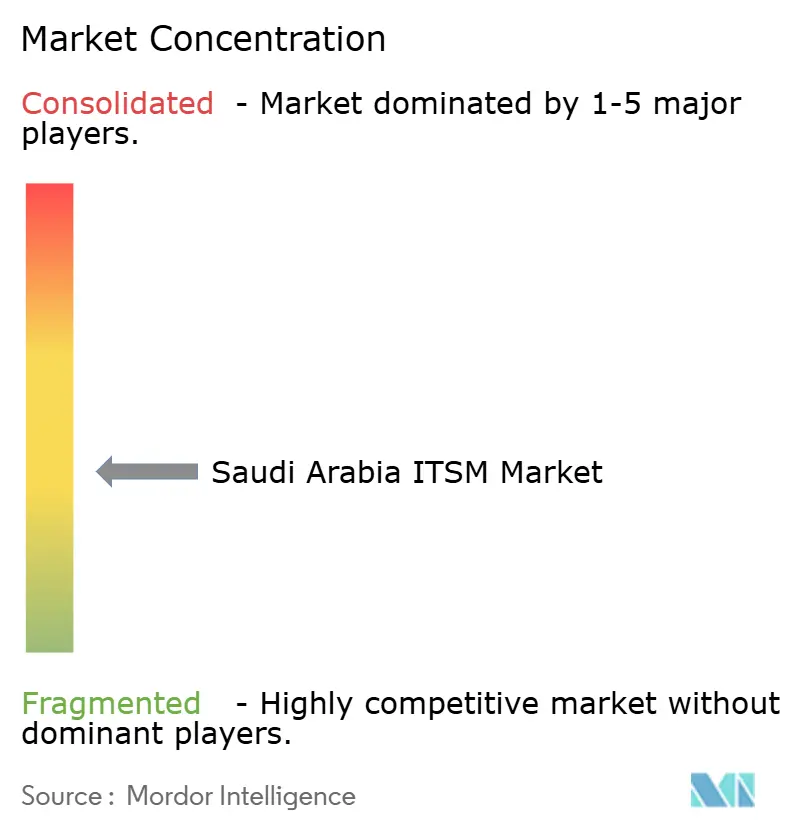
| Market Concentration | Medium |
Major Players *Disclaimer: Major Players sorted in no particular order Image © Mordor Intelligence. Reuse requires attribution under CC BY 4.0. | |
Saudi Arabia ITSM Market Analysis by Mordor Intelligence
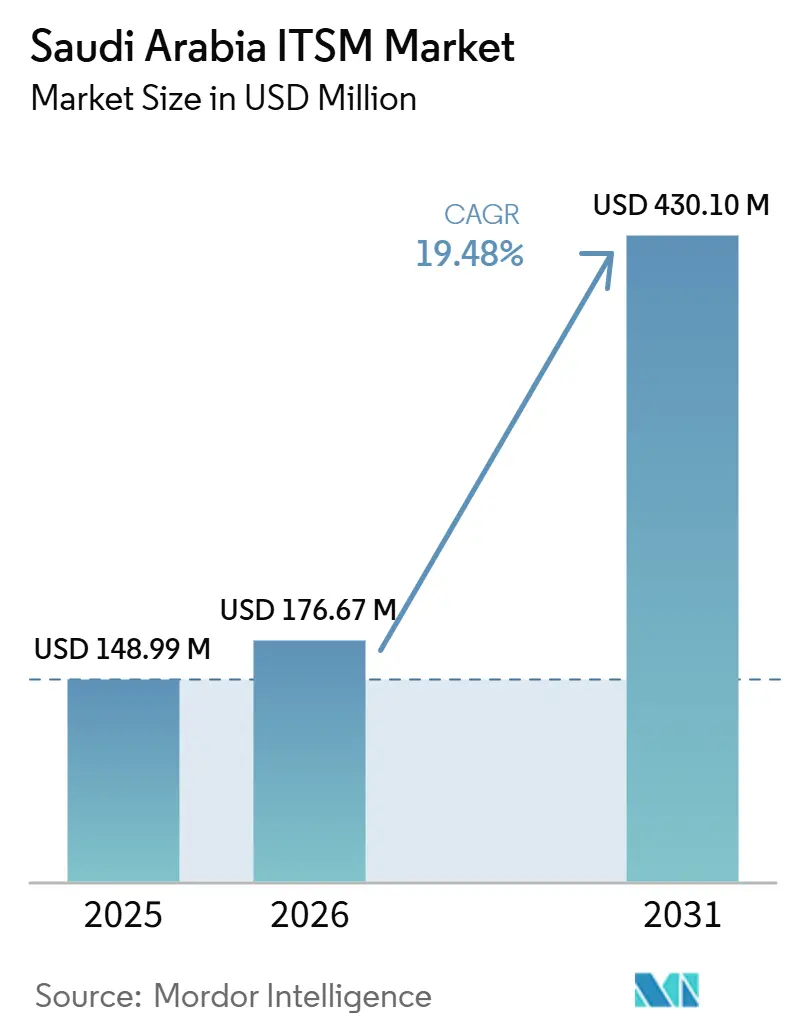
The Saudi Arabia ITSM Market size was valued at USD 148.99 million in 2025 and is estimated to grow from USD 176.67 million in 2026 to reach USD 430.10 million by 2035, at a CAGR of 19.48% during the forecast period (2026-2035).
This expansion is tied closely to the way Vision 2030 has pushed digital delivery deeper into government operations and into enterprise technology planning across regulated sectors. The Saudi Arabia ITSM market is also benefiting from a shift in buyer priorities, because organizations now need service governance, workflow consistency, and auditable control layers rather than stand-alone help desk tools. Demand is moving beyond initial platform purchases and toward long-running service relationships that cover integration, managed support, automation tuning, and workforce enablement. The competitive setting reflects that change, with global platform vendors pursuing deeper local commitments and Saudi implementation partners gaining importance where compliance, Arabic-language delivery, and local execution matter most. Growth is still moderated by migration cost and talent constraints, but those same limits are increasing the appeal of low-code delivery, knowledge-centered service operations, and AI-enabled support models across the Saudi Arabia ITSM market.
Key Report Takeaways
- By component, solutions led with 70.04% share in 2025, while services is projected to expand at a 23.65% CAGR through 2031.
- By deployment, cloud held 72.33% share in 2025, and cloud is also expected to record the highest CAGR at 21.08% through 2031 in the Saudi Arabia ITSM market.
- By application, service desk and incident management accounted for 31.40% share in 2025, while knowledge management is projected to grow at a 19.92% CAGR through 2031.
- By end-user industry, BFSI held 22.34% share in 2025, while healthcare is projected to register the fastest CAGR at 20.13% through 2031.
- By enterprise size, large enterprises represented 59.21% share in 2025, while SMEs are projected to expand at a 20.40% CAGR through 2031.
Note: Market size and forecast figures in this report are generated using Mordor Intelligence’s proprietary estimation framework, updated with the latest available data and insights as of January 2026.
Saudi Arabia ITSM Market Trends and Insights
Drivers Impact Analysis*
| Driver | (~) % Impact on CAGR Forecast | Geographic Relevance | Impact Timeline |
|---|---|---|---|
| Rising Government Digital Transformation Programs | +6.5% | National, with highest intensity in Riyadh, Jeddah, and Eastern Province | Short term (≤ 2 years) |
| Increasing Cloud Migration Across Enterprise IT Stacks | +4.2% | National, with early adoption concentrated in Riyadh and Dammam | Medium term (2-4 years) |
| Accelerating Adoption of AI-Enabled Service Desk Workflows | +3.1% | National, with concentration in BFSI and government hubs | Medium term (2-4 years) |
| Expanding Cybersecurity and Compliance Requirements | +2.0% | National, driven by NCA and SAMA mandates across regulated sectors | Short term (≤ 2 years) |
| Greater Need for ITSM Automation in Hybrid Work Environments | +1.5% | National | Medium term (2-4 years) |
| Growing Demand for Standardized ITIL-Based Service Operations | +0.8% | National, with initial gains in government and BFSI verticals | Long term (≥ 4 years) |
| Source: Mordor Intelligence | |||
Rising Government Digital Transformation Programs
Government digitization has moved IT service management from a supporting function to an operating requirement across ministries, municipalities, and public utilities in the Saudi Arabia ITSM market. A 2025 peer-reviewed study based on 80 Saudi public-sector IT managers found that higher ITSM maturity was associated with stronger service uptime and better citizen satisfaction, which gives the market a direct public-service rationale rather than a narrow technology one[1]European Scientific Journal, “Employing IT Service Management to Accelerate Digital Government Transformation in Saudi Arabia, A Vision 2030 Perspective,” European Scientific Journal, eujournal.org. The Ministry of Justice also showed how quickly that operating model can scale, after automating around 180 processes and deploying around 20 custom business services within 4 months on a consolidated platform that served 40,000 staff. That type of rollout matters because it creates visible proof that large Saudi institutions can standardize workflows, reduce manual handoffs, and support higher service volumes through structured service management. It also creates a dependable demand base for vendors and implementation partners, since public-sector digital programs continue to move from basic service digitization toward automation, knowledge management, and more unified operations. The result is that the Saudi Arabia ITSM market is being shaped by policy-backed demand that keeps platform adoption and follow-on services spending closely connected.
Increasing Cloud Migration Across Enterprise IT Stacks
Cloud migration is changing how organizations buy and use service management platforms in the Saudi Arabia ITSM market. Buyers increasingly prefer operating models that can scale faster, support remote administration, and turn platform use into recurring service relationships instead of only one-time license projects. ServiceNow’s planned in-Kingdom data center launch in 2026 and the broader localization moves described around Saudi digital transformation show that vendors see local hosting and local delivery as necessary for enterprise adoption, not optional additions. This is why the cloud shift is not only lifting software adoption, it is also increasing the need for configuration, integration, managed support, and architecture services across mixed environments. Many Saudi organizations are not moving from fully on-premises estates to fully cloud-based estates in one step, so hybrid operating models remain important during the transition period. That structure explains why platform demand and services demand are rising together rather than moving in separate cycles in the Saudi Arabia ITSM market.
Accelerating Adoption of AI-Enabled Service Desk Workflows
AI-enabled service operations are becoming more relevant because organizations want faster ticket routing, better case summaries, cleaner escalation paths, and more consistent first-response quality in the Saudi Arabia ITSM market. The June 2026 IBM and ServiceNow collaboration was positioned around enterprise AI, data, automation, and autonomous IT operations, which shows how leading vendors are now linking service management directly to broader operational AI priorities. That matters at the service desk level because AI has more value when it can classify incidents, connect requests to usable context, and support action without requiring the same level of manual intervention for every step. It also raises the value of structured knowledge repositories, since AI-driven service environments work better when service histories, fixes, policies, and operating procedures are clearly organized. This is one reason knowledge management is gaining importance alongside core incident handling instead of remaining a secondary module. In practical terms, the Saudi Arabia ITSM market is moving toward a model where automation quality depends as much on process discipline and knowledge structure as it does on the AI layer itself.
Expanding Cybersecurity and Compliance Requirements
Cybersecurity and compliance requirements are making service management harder to postpone across the Saudi Arabia ITSM market. The National Cybersecurity Authority’s control frameworks require structured governance, documented responsibilities, and auditable operating controls, which aligns closely with the role ITSM platforms play inside regulated organizations. As a result, service management decisions increasingly sit at the intersection of IT, risk, operations, and compliance rather than staying within infrastructure teams alone. That shift often makes procurement cycles longer, but it also tends to widen the scope of implementations because organizations want service workflows, change governance, and reporting structures that stand up to internal and external review. The demand base is especially durable in sectors that operate under stronger governance expectations, because delaying service management investment can create operational and regulatory exposure at the same time. For that reason, compliance pressure is not simply supporting demand in the Saudi Arabia ITSM market; it is also changing who influences product selection and how vendors position their platforms.
Restraints Impact Analysis*
| Restraint | (~) % Impact on CAGR Forecast | Geographic Relevance | Impact Timeline |
|---|---|---|---|
| High Cost of Migration from Legacy Tools | -2.1% | National, most acute in manufacturing and government agencies outside Riyadh | Short term (≤ 2 years) |
| Shortage of ITSM and Process Automation Talent | -1.4% | National, compounded in emerging cities and secondary provinces | Medium term (2-4 years) |
| Data Residency and Sovereign Cloud Constraints | -0.7% | National, particularly affecting multi-national vendor deployments | Medium term (2-4 years) |
| Integration Complexity Across Fragmented Enterprise Systems | -0.5% | National, most pronounced in large government entities and industrial conglomerates | Long term (≥ 4 years) |
| Source: Mordor Intelligence | |||
High Cost of Migration From Legacy Tools
Migration cost remains a real barrier because many established organizations in the Saudi Arabia ITSM market still operate with fragmented tools, older workflows, and partial process ownership spread across functions. When those environments shift to modern platforms, the actual burden extends beyond software replacement and includes data migration, system integration, workflow redesign, user training, and temporary productivity loss during transition. Research focused on Saudi public entities identified legacy infrastructure as one of the main structural barriers to stronger ITSM maturity, which supports the view that this is a system-level challenge rather than a short project delay. The effect is usually strongest outside the most mature enterprise clusters, where organizations may still be running older tools that remain partly functional and therefore harder to justify replacing quickly. This slows adoption in lower-maturity accounts, even when the long-term business case is clear. It also creates a commercial opening for phased deployment models, shared-risk implementation structures, and service packages that reduce the upfront strain of migration in the Saudi Arabia ITSM market.
Shortage of ITSM and Process Automation Talent
The shortage of experienced service management and automation talent continues to limit the pace at which organizations can fully use their platforms in the Saudi Arabia ITSM market. The same public-sector research that highlighted legacy infrastructure also identified skills shortages as a core barrier to higher ITSM maturity, which suggests that the issue is embedded in workforce depth rather than in isolated hiring gaps. In response, vendors and partners have started building local enablement capacity, including the ServiceNow-focused collaboration announced by NextEra, backed by LTIMindtree and Aramco Digital, which included a Centre of Excellence and a proximity center in Dammam. Those moves are important because platform value depends on configuration quality, ongoing optimization, and the ability to connect service workflows to wider enterprise operating needs. Where internal teams remain thin, buyers are more likely to rely on managed services, partner-led operations, and tools that reduce the amount of specialist intervention needed for daily administration. This keeps talent availability closely tied to both deployment speed and long-term service revenue in the Saudi Arabia ITSM market.
*Our forecasts treat driver/restraint impacts as directional, not additive. The impact forecasts reflect baseline growth, mix effects, and variable interactions.
Segment Analysis
By Component: Solutions Lead While Services Deepen Long-Term Value
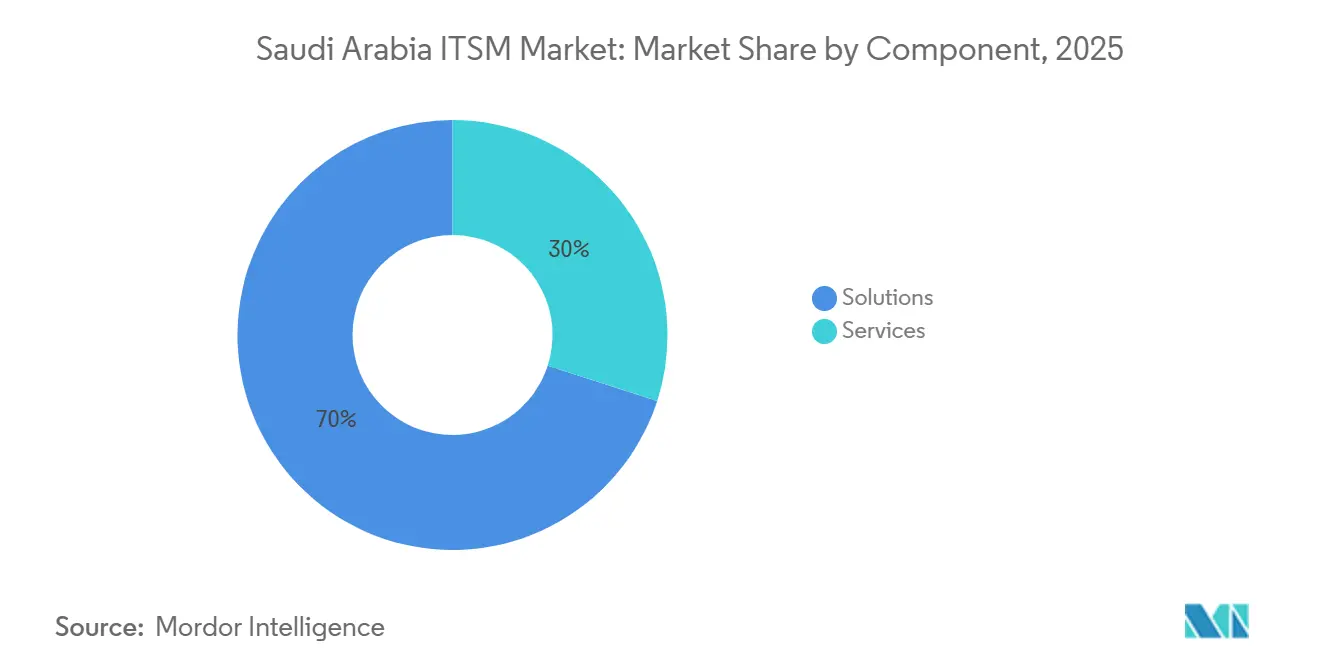
Solutions held 70.04% of the market in 2025, which made them the largest revenue contributor within this segmentation of the Saudi Arabia ITSM market. That share reflected the current buying order across Saudi organizations, because a platform must usually be selected, licensed, and rolled out before service revenue can build around it. Solutions also benefited from large institutional deployments where ministries, regulated enterprises, and other large buyers needed unified workflows, incident handling, and governance layers as their first priority. In that sense, the lead position of solutions was not only a product story, it was also a timing story within the broader technology adoption cycle. The segment’s weight in 2025 therefore showed where budget allocation sat during the earlier phase of standardization across the Saudi Arabia ITSM market.
Even with that lead, the longer runway now sits with services, which are projected to advance at a 23.65% CAGR through 2031. As more organizations move past initial implementation, they need ongoing configuration work, integration support, process redesign, user training, and operational tuning to make those platforms produce measurable value. This is why services is closing the gap, not because solutions are losing relevance, but because live environments create continuous work after go-live. The Saudi Arabia ITSM market size for solutions was supported by its 70.04% share in 2025, while the services side is set to benefit from the operating complexity that follows broader adoption. The talent shortage described in the draft adds another layer to that shift, because buyers with limited internal capability are more likely to retain outside support instead of building large in-house service management teams. Over time, this makes the component mix more balanced and turns service relationships into a stronger competitive factor than simple product access across the Saudi Arabia ITSM market.


By Deployment: Cloud Leads Adoption While Hybrid Stays Operationally Important
Cloud deployment accounted for 72.33% of the market in 2025, which gave it the clear lead across deployment models in the Saudi Arabia ITSM market. That result showed that buyers already favored platforms with faster rollout potential, easier scaling, and less dependence on dedicated on-site infrastructure. It also indicated that the local conversation had already moved past whether cloud delivery was acceptable for many use cases and toward how quickly enterprises could expand that model inside regulated or mixed environments. This is why cloud did not only hold the lead in 2025, it also remained central to the next stage of platform expansion. The Saudi Arabia ITSM market share linked to cloud at 72.33% in 2025 reflected a delivery preference that had become mainstream rather than experimental.
Cloud is also projected to grow at 21.08% through 2031, which kept it as the fastest-growing deployment type in the Saudi Arabia ITSM market. That combination of current scale and future momentum is important because it suggests the market has not yet reached a plateau in hosted delivery. At the same time, on-premises systems still matter in environments where data sensitivity, infrastructure isolation, or sector-specific security expectations continue to shape architecture choices. Hybrid deployment, therefore, holds structural relevance because many organizations are modernizing only part of the estate at a time and need continuity across old and new environments. That makes integration quality, monitoring discipline, and configuration consistency especially important in mixed deployments. It also supports the wider shift toward services revenue, since hybrid environments often require more sustained technical support than simpler single-model deployments in the Saudi Arabia ITSM market.
By Application: Service Desk Remains Foundational While Knowledge Management Gains Weight
Service desk and incident management commanded 31.40% of the application segment in 2025, which made it the largest application area in the Saudi Arabia ITSM market. That position was consistent with how service management maturity usually develops, because organizations tend to start with incident visibility, response control, and service continuity before widening investment into adjacent workflow areas. In practical terms, that means the first budget often goes to the operating layer most visible to internal users and most directly tied to daily service stability. The lead share of service desk and incident management, therefore, reflected immediate business needs rather than a narrow preference for one module over another. It also showed that the Saudi Arabia ITSM market continued to treat support continuity as the baseline for wider workflow standardization.
The second part of the application story sits with knowledge management, which is projected to grow at a 19.92% CAGR through 2031. As organizations seek more self-service, more automation, and better AI-supported resolution quality, knowledge libraries become harder to treat as side repositories. They start to function as operating assets that help reduce repeat tickets, improve response consistency, and support faster decision paths across support teams. That is why knowledge management is moving up in importance even where service desk spending still leads the Saudi Arabia ITSM market. Other applications, including asset and configuration management, service request management, and change and release management, remain essential because they connect incident response to broader operational control. Together, these layers show that application demand is widening from reactive support toward more structured governance and more reusable service intelligence across the Saudi Arabia ITSM market.
By End-User Industry: BFSI Leads Current Demand While Healthcare Expands Fastest
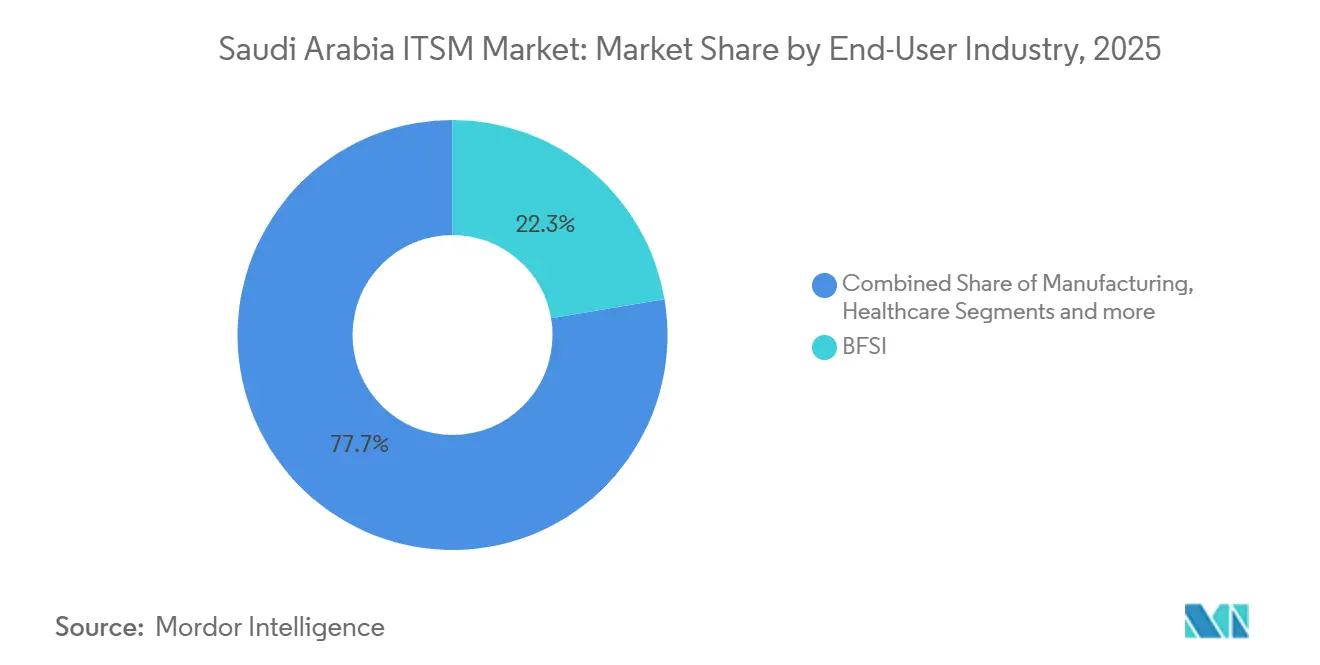
BFSI represented 22.34% of the market in 2025, which made it the largest end-user vertical in the Saudi Arabia ITSM market. That position fits the operating needs of financial institutions, where service availability, workflow accountability, and formal control structures carry high importance in everyday operations. The segment also benefits from the fact that financial organizations tend to have stronger technology budgets, deeper governance expectations, and lower tolerance for service interruption than many other buyers. Those conditions make them early adopters of enterprise-wide platforms and broader automation layers. The Saudi Arabia ITSM market size tied to BFSI was therefore supported by a demand profile that rewards standardized service management more quickly than many other verticals.
Healthcare, however, is projected to grow at a 20.13% CAGR through 2031, which makes it the fastest-growing end-user segment in the Saudi Arabia ITSM market. The Health Sector Transformation Program and the expansion of digital health access, including more than 31 million users enrolled on the Sehhaty platform by 2025, point to a care environment that increasingly depends on connected systems and coordinated service support[2]Saudi Vision 2030, “Health Sector Transformation Program,” Saudi Vision 2030, vision2030.gov.sa. As hospitals and health networks digitize more workflows, the need for stable incident handling, structured requests, change control, and knowledge sharing rises alongside them. Government, manufacturing, IT and telecom, retail and consumer goods, travel and hospitality, and other industries each bring different demand patterns, but all of them rely on stronger workflow discipline as digital dependency rises. The Saudi Arabia ITSM market share remains led by BFSI in current revenue terms, while healthcare is creating the sharper growth slope because its service requirements are becoming broader and more operationally critical. This mix shows a market where regulated leaders still anchor spending, but newer growth is coming from sectors that are digitizing service environments at greater depth.

By Enterprise Size: Large Enterprises Hold Scale While SMEs Raise the Growth Rate
Large enterprises held 59.21% of the market in 2025, which made them the main revenue base for the Saudi Arabia ITSM market. That outcome reflected the concentration of early adoption among ministries, major financial institutions, telecom operators, and other organizations that had both the scale and the budget to deploy multi-module service platforms. These buyers also had stronger incentives to formalize service operations because their user volumes, compliance obligations, and infrastructure complexity were already high. In many cases, the value of ITSM for large enterprises extends beyond ticketing and into change governance, asset visibility, and cross-functional service coordination. The Saudi Arabia ITSM market size linked to large enterprises therefore remained significant because the segment could support broader, more mature, and more expensive implementations.
SMEs are projected to grow at a 20.40% CAGR through 2031, which makes them the fastest-moving enterprise size cohort in the Saudi Arabia ITSM market. This growth rate suggests that cloud-native delivery, modular packaging, and lower entry barriers are finally making formal service management practical for organizations with leaner teams. Smaller firms still face budget limits and talent constraints, but they no longer need the same level of internal infrastructure or specialist staffing that older deployment models often required. As a result, the SME opportunity is expanding from simple ticketing needs toward broader workflow standardization and self-service adoption. This matters strategically because the next layer of market expansion is unlikely to come only from larger accounts that already adopted core platforms. The Saudi Arabia ITSM market is therefore broadening from an enterprise-led base toward a more distributed demand profile, where smaller organizations can adopt service management earlier in their growth cycle and with lower implementation friction.
Geography Analysis
Riyadh represented the largest concentration of demand in the Saudi Arabia ITSM market, even though the draft did not quantify a formal regional share. The city’s role as the administrative capital and the main base for ministries, financial institutions, and large technology buyers made it the primary center of platform procurement and partner activity. The Ministry of Justice rollout showed the scale possible in that environment, with around 180 automated processes, around 20 custom business services, and a user base of 40,000 staff delivered within 4 months[3]ServiceNow, “Saudi Arabian Ministry of Justice Customer Story,” ServiceNow, servicenow.com. Riyadh’s importance also comes from sequencing, because many public entities that digitized front-end services earlier are now moving into deeper workflow control, automation, and knowledge-centered operations. This keeps Riyadh at the front of the Saudi Arabia ITSM market as spending shifts from foundational digitization toward more advanced service management capability.
Jeddah and the Eastern Province formed the next two major demand layers in the Saudi Arabia ITSM market, but each did so for different operational reasons. Jeddah’s commercial profile supported demand from retail, logistics, healthcare, tourism, and other service-heavy activities that rely on stable user-facing systems and fast incident handling. That profile tends to favor service desk strength, request management discipline, and workflow coordination across business units that interact more directly with customers or patients. The Eastern Province, by contrast, is shaped more strongly by energy, petrochemicals, and industrial operations, which raises the importance of asset visibility, configuration control, and service continuity across complex technical estates. The NextEra proximity center launched at Imam Abdulrahman Bin Faisal University in Dammam in September 2025 reflected deliberate investment in local delivery capacity for those sectors and for the wider region. These regional differences matter because they shape not only where demand appears, but also which modules, service models, and partner capabilities matter most within the Saudi Arabia ITSM market.
Emerging development corridors such as NEOM, Diriyah, and Qiddiya added a longer-term geographic layer to the Saudi Arabia ITSM market. Their importance comes from the fact that digital systems are being built into operations from the start rather than added later on top of older estates. That favors cloud-ready workflows, stronger automation logic, and earlier use of integrated service environments. It also means some future demand may enter the market without the same migration burden seen in older organizations, which could change adoption speed in those corridors. At the national level, the Saudi Arabia ITSM market still stands apart in the GCC because policy-led digital transformation, public-sector scale, and localized delivery investment are all moving at the same time.
Competitive Landscape
The Saudi Arabia ITSM market showed moderate concentration at the enterprise tier, with a small group of global platform vendors holding strong positions while local implementation partners shaped execution quality. Competition was not based only on software breadth, because buyers increasingly evaluated local delivery readiness, compliance alignment, language support, and the ability to operate within Saudi organizational structures. This gave global vendors a clear edge in platform depth, but it also preserved room for Saudi and regional partners that could translate products into locally workable operating models. The result was a market where product leadership and delivery leadership were related, but not always held by the same firms.
Strategic moves over the last two years showed how that balance is evolving inside the Saudi Arabia ITSM market. In June 2026, IBM and ServiceNow expanded their collaboration around AI, data, and automation to support autonomous IT operations, which strengthened high-end positioning around enterprise-scale transformation[4]IBM Newsroom, “IBM and ServiceNow Expand Collaboration to Unlock Enterprise Data for AI at Scale,” IBM Newsroom, newsroom.ibm.com. In September 2025, NextEra, backed by LTIMindtree and Aramco Digital, announced a strategic partnership with ServiceNow and tied it to a Centre of Excellence and a Dammam proximity center, which showed that workforce development and local execution capacity are now part of competitive strategy. In January 2026, SAP and EVConnect completed a rapid public-sector ERP deployment for the National Center for the Development of the Non-Profit Sector, reinforcing the role of large enterprise software vendors in building digital operating foundations that can later support broader workflow management and automation. These moves show that leading players are competing through ecosystem depth, implementation reach, and adjacency to broader transformation programs rather than through ticketing features alone.
The competitive white space remains strongest where adoption barriers are different from those of the largest enterprise accounts in the Saudi Arabia ITSM market. Mid-sized buyers, healthcare organizations, and sector-specific operators often need simpler commercial models, faster onboarding, and more flexible support structures than top-tier public institutions or large banks. That creates room for vendors and partners that can package service management in a more accessible way without losing governance quality. At the same time, enterprise concentration can still rise if AI capabilities, sovereign operating expectations, and local service capacity become harder for smaller vendors to match. This keeps the Saudi Arabia ITSM market open enough for targeted challengers, but still tilted toward firms that can combine platform depth with credible Saudi execution.
Saudi Arabia ITSM Industry Leaders
ServiceNow, Inc.
BMC Software, Inc.
International Business Machines Corporation
Ivanti, Inc.
Freshworks Inc.
- *Disclaimer: Major Players sorted in no particular order

Recent Industry Developments
- June 2026: IBM and ServiceNow expanded their collaboration to address enterprise AI barriers at scale, combining IBM's AI, data, and automation capabilities with the ServiceNow AI Platform to modernize legacy applications and enable autonomous IT operations. Joint solutions targeting the world's largest enterprises are expected in the second half of 2026, with material implications for large-scale deployments in Saudi Arabia.
- January 2026: The National Center for the Development of the Non-Profit Sector (NCNP) in Saudi Arabia completed one of the fastest ERP implementations in the Kingdom's public sector, deploying SAP S/4HANA and SAP SuccessFactors in partnership with SAP and EVConnect (EVC). The project established a scalable digital foundation for AI adoption within the non-profit public sector, directly advancing Vision 2030's digital economy objectives.
- September 2025: NextEra, a joint venture between LTIMindtree and Aramco Digital, announced a strategic partnership with ServiceNow to drive ITSM-led digital transformation across Saudi Arabia and MENA. The partnership includes a ServiceNow Centre of Excellence for local workforce training and a NextEra proximity center at Imam Abdulrahman Bin Faisal University in Dammam, targeting energy, BFSI, government, and giga-project sectors.


Saudi Arabia ITSM Market Report Scope
The Saudi Arabia IT Service Management (ITSM) Market Report is Segmented by Component (Solutions, Services), Deployment (Cloud, On-Premises, Hybrid), Application (Service Desk and Incident Management, Asset and Configuration Management, and More), End-User Industry (BFSI, Manufacturing, and More), and Enterprise Size (Large Enterprises, Small and Medium Enterprises). The Market Forecasts are Provided in Terms of Value (USD).
| Solutions |
| Services |
| Cloud |
| On-Premise |
| Hybrid |
| Service Desk and Incident Management |
| Asset and Configuration Management |
| Change and Release Management |
| Service Request Management |
| Knowledge Management |
| Other Applications |
| BFSI |
| Manufacturing |
| Government and Public Sector |
| IT and Telecommunications |
| Retail and E-Commerce |
| Healthcare |
| Travel and Hospitality |
| Other End-User Industries |
| Large Enterprises |
| Small and Mid-Size Enterprises (SMEs) |
| By Component | Solutions |
| Services | |
| By Deployment | Cloud |
| On-Premise | |
| Hybrid | |
| By Application | Service Desk and Incident Management |
| Asset and Configuration Management | |
| Change and Release Management | |
| Service Request Management | |
| Knowledge Management | |
| Other Applications | |
| By End-User Industry | BFSI |
| Manufacturing | |
| Government and Public Sector | |
| IT and Telecommunications | |
| Retail and E-Commerce | |
| Healthcare | |
| Travel and Hospitality | |
| Other End-User Industries | |
| By Enterprise Size | Large Enterprises |
| Small and Mid-Size Enterprises (SMEs) |


Key Questions Answered in the Report
What is the Saudi Arabia ITSM market size in 2026 and how fast is it growing?
The Saudi Arabia ITSM market stands at USD 176.67 million in 2026 and is projected to reach USD 430.10 million by 2031 at a CAGR of 19.48%.
Which deployment model leads service management adoption in Saudi Arabia?
Cloud led with 72.33% share in 2025 and is also projected to post the fastest growth at 21.08% through 2031.
Why is BFSI the largest end-user segment for IT service management in Saudi Arabia?
BFSI held 22.34% share in 2025 because the sector needs stronger governance, service continuity, and auditable operating controls than many other buyer groups.
Which application area is growing fastest after service desk and incident management?
Knowledge management is projected to grow at a 19.92% CAGR through 2031, supported by stronger self-service needs and the rise of AI-enabled service workflows.
What is driving faster growth among SMEs in Saudi Arabia?
SMEs are projected to grow at a 20.40% CAGR because cloud-native platforms reduce deployment friction, lower entry barriers, and make formal service management more practical for lean IT teams.
Which region generates the strongest demand for ITSM platforms in Saudi Arabia?
Riyadh remains the leading demand center because it concentrates ministries, large regulated enterprises, and major transformation programs that require structured service management.
Page last updated on:






