
Saudi Arabia Enterprise Content Management Market Size and Share
Market Overview
| Study Period | 2020 - 2031 |
|---|---|
| Forecast Data Period | 2026 - 2031 |
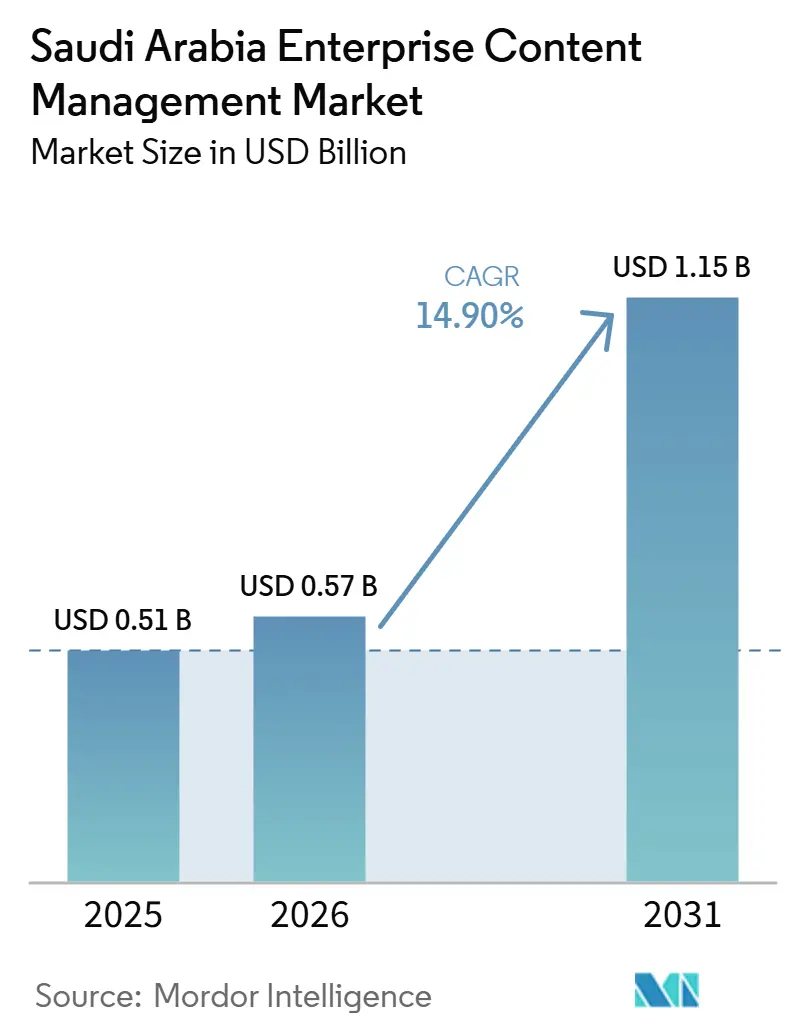
| Base Year Market Size (2025) | USD 0.51 Billion |
| Market Size (2026) | USD 0.57 Billion |
| Market Size (2031) | USD 1.15 Billion |
| Growth Rate (2026 - 2031) | 14.90% CAGR |
| Market Concentration | Medium |
Major Players *Disclaimer: Major Players sorted in no particular order Image © Mordor Intelligence. Reuse requires attribution under CC BY 4.0. | |
Saudi Arabia Enterprise Content Management Market Analysis by Mordor Intelligence
The Saudi Arabia enterprise content management market size was valued at USD 0.51 billion in 2025 and is projected to reach USD 1.15 billion by 2031, expanding at a CAGR of 14.90% during 2026-2031. The Saudi Arabia enterprise content management market is growing because document control, records retention, and audit trails are now moving from optional back-office tools into core operating requirements across ministries, banks, hospitals, and large enterprises. The strongest demand is coming from organizations that have already digitized front-end services and now need systems that can govern the records created behind those services at scale. Cloud adoption is reinforcing this shift because enterprises want content platforms that can support distributed teams while still meeting local hosting and data governance requirements. Competition is also changing because vendors are no longer winning only on workflow features or storage scale; they are winning on compliance readiness, Arabic-language processing, and local implementation depth. This leaves clear room for growth in platforms that can simplify migration from older repositories, reduce manual classification work, and shorten compliance-heavy deployment cycles.
Key Report Takeaways
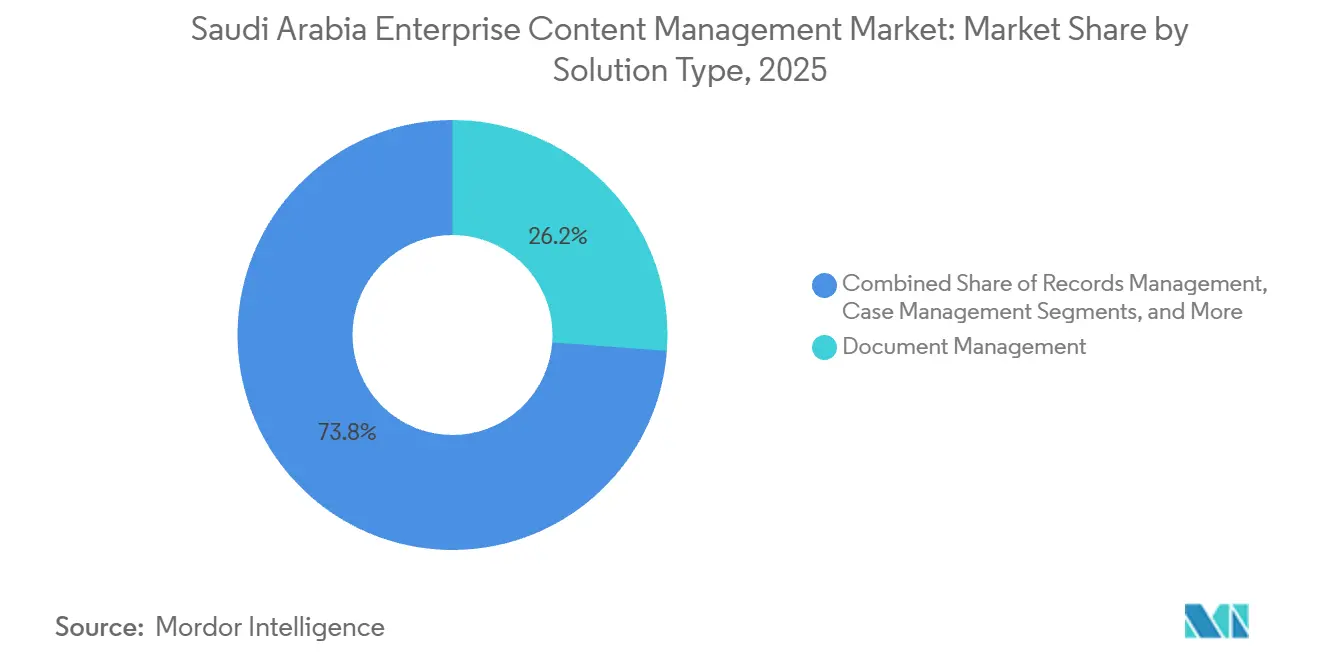
- By solution type, document management held 26.18% share in 2025, while workflow and business process management is projected to expand at a 16.21% CAGR through 2031.
- By deployment mode, cloud held 78.46% of the Saudi Arabia enterprise content management market share in 2025 and is projected to grow at a 15.48% CAGR through 2031.
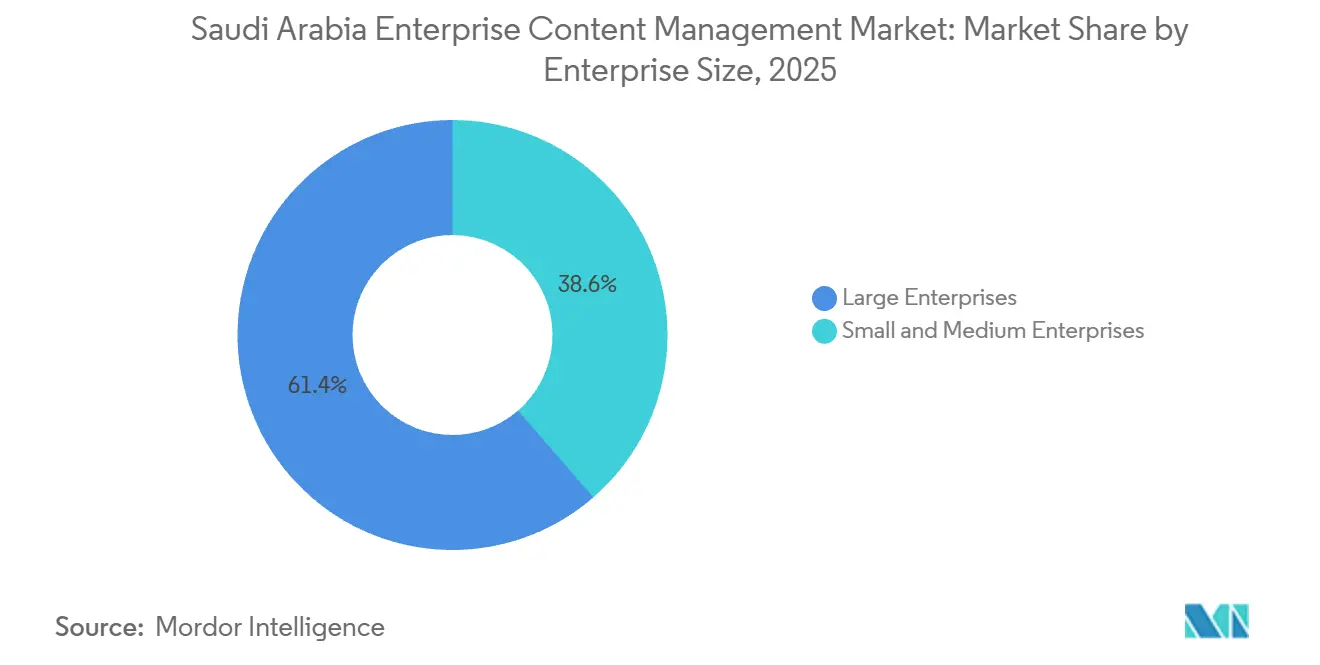
- By enterprise size, large enterprises accounted for 61.37% share in 2025, while small and medium enterprises are projected to record the fastest CAGR at 15.83% through 2031.
- By end-user industry, government and public administration accounted for 26.54% of the Saudi Arabia enterprise content management market size in 2025, while healthcare and lifesciences is projected to advance at a 17.06% CAGR through 2031.
Note: Market size and forecast figures in this report are generated using Mordor Intelligence’s proprietary estimation framework, updated with the latest available data and insights as of January 2026.
Saudi Arabia Enterprise Content Management Market Trends and Insights
Drivers Impact Analysis*
| Driver | (~) % Impact on CAGR Forecast | Geographic Relevance | Impact Timeline |
|---|---|---|---|
| Vision 2030-Led Public Sector Digitization | +4.2% | National, concentrated in Riyadh and Eastern Province | Short term (≤ 2 years) |
| Mandatory Electronic Records Retention Across Regulated Workflows | +2.6% | National, accelerated in BFSI and healthcare | Medium term (2-4 years) |
| AI-Assisted Classification and Retrieval to Reduce Search Friction | +2.2% | National, led by Riyadh-based government deployments | Medium term (2-4 years) |
| Cloud-Native Content Governance for Distributed Teams | +1.9% | National, with early adoption in technology and BFSI clusters | Short term (≤ 2 years) |
| Local Data Residency Demand From Critical Sectors | +1.4% | National, highest in BFSI, government, and healthcare | Long term (≥ 4 years) |
| Long-Tail Compliance Workloads in SMEs | +1.0% | National, with early gains in Riyadh's SME corridors | Long term (≥ 4 years) |
| Source: Mordor Intelligence | |||
Vision 2030-Led Public Sector Digitization
Vision 2030 remains the clearest demand catalyst for the Saudi Arabia enterprise content management market because digitized government services also create larger records management obligations behind the service layer. Saudi Arabia moved up to 6th place in the United Nations E-Government Development Index by 2024, which showed that digital public service expansion had already become a national execution priority rather than a limited technology program. The Vision 2030 annual report also stated that the digital economy contributed 15.8% to GDP by 2025 and that more than 1,300 government services were available through Tawakkalna in a paperless format, which keeps content capture, retention, and retrieval needs on a rising path.[1]Saudi Vision 2030, “Vision 2030 Annual Report 2025 — Executive Summary,” Saudi Vision 2030, vision2030.gov.sa Hyland stated in August 2025 that its deployments were active at the Saudi Ministry of Justice, Ministry of Economy and Planning, Ministry of Tourism, and Diriyah Gate Development Authority, which shows that ministries are moving away from isolated tools toward wider platform use. As the policy focus shifts from putting more services online to improving how those services are governed, ministries need stronger auditability, retention discipline, and repository consistency across agencies.
Mandatory Electronic Records Retention Across Regulated Workflows
Mandatory retention and traceability requirements are strengthening the Saudi Arabia enterprise content management market because regulated workflows now need content governance that can stand up to formal review. PDPL enforcement from September 2024 pushed organizations handling personal data toward stronger classification, lifecycle control, and document traceability across day-to-day processes. That shift matters because enterprises that delayed platform upgrades now face both a records management gap and a compliance gap at the same time. The Ministry of Tourism's December 2025 launch of ARDOC was built for NCAR guideline alignment and PDPL compliance, which shows that procurement is increasingly shaped by regulatory fit rather than by generic workflow features alone. This makes compliance-ready architectures more attractive than highly customized builds because buyers want shorter approval cycles and lower governance risk after deployment.
AI-Assisted Classification and Retrieval to Reduce Search Friction
AI-enabled processing is changing the Saudi Arabia enterprise content management market because Arabic-language repositories have long been harder to classify, search, and migrate accurately at scale. CompTech stated that the Ministry of Tourism's ARDOC deployment used deep learning-based Arabic OCR with 98% accuracy and automated metadata extraction for Arabic and English bilingual documents, which directly addressed a long-standing digitization bottleneck. This matters because many older repositories contain mixed-language files, stamps, tables, and handwritten elements that raise the cost of manual indexing and reduce retrieval precision. Once classification quality improves, organizations can move faster from basic storage and scanning into governed search, case routing, and lifecycle management. The result is a shorter path from document digitization to enterprise-wide content services, especially in public institutions with large Arabic-first archives.
Cloud-Native Content Governance for Distributed Teams
Cloud deployment is lifting the Saudi Arabia enterprise content management market because organizations want content governance that can support collaboration across locations without losing control over data handling. The Digital Government Authority reported in 2025 that cloud adoption had become a major part of emerging technology readiness in government, which reinforces the role of cloud-native platforms in future administrative workflows. In practice, cloud growth is being reinforced by buyer preference for systems that can combine central governance with easier rollout across agencies, branches, and satellite teams. Hyland's continued expansion in Saudi Arabia and the UAE in 2025 also points to rising regional demand for locally supported cloud content deployments in regulated environments. Vendors with in-Kingdom delivery readiness are in a better position because local support, faster implementation, and stronger hosting confidence now shape purchasing decisions more directly.
Restraints Impact Analysis*
| Restraint | (~) % Impact on CAGR Forecast | Geographic Relevance | Impact Timeline |
|---|---|---|---|
| High Integration Complexity With Legacy Arabic and Bilingual Repositories | -2.1% | National, most acute in government and BFSI | Medium term (2-4 years) |
| Limited In-House ECM Administration Skills in Mid-Market Firms | -1.6% | National, concentrated among SMEs outside Riyadh | Long term (≥ 4 years) |
| Procurement Friction From Security Review, Hosting Approval, and Data Residency Checks | -1.2% | National, highest in government and critical infrastructure sectors | Medium term (2-4 years) |
| Change Resistance From Paper-Heavy Workflows and Manual Approvals | -0.9% | National, prevalent in education and industrial sectors | Long term (≥ 4 years) |
| Source: Mordor Intelligence | |||
High Integration Complexity With Legacy Arabic and Bilingual Repositories
Legacy repository integration remains a major drag on the Saudi Arabia enterprise content management market because older systems were often not built for Arabic-first content governance at the current scale. CompTech said that the Ministry of Tourism moved away from fragmented legacy FileNet and SharePoint environments into a unified cloud-native platform, which underlines how difficult it had become to manage unstructured Arabic content through siloed systems.[2]CompTech Saudi Arabia, “The Ministry of Tourism Launches the First Modernised and AI-Powered Archives and Records Management System,” CompTech Saudi Arabia, comptech.sa Many repositories also contain Arabic and English text in the same file, along with tables, stamps, and handwritten annotations, which makes extraction and re-indexing more difficult than standard document migration. Earlier OCR limitations mean some content that was digitized before recent tool improvements may still carry classification errors that create downstream governance problems. This slows adoption because buyers must spend more time on cleansing, validation, and migration assurance before they can capture the full benefit of newer platforms.
Limited In-House ECM Administration Skills in Mid-Market Firms
Skills shortages continue to limit the Saudi Arabia enterprise content management market because many mid-sized organizations do not have enough internal capacity to operate ECM platforms with the level of control that regulated environments require. This issue goes beyond simple software administration because document retention, role-based access, metadata quality, and audit trail discipline all need ongoing oversight after implementation. Mid-market firms are more exposed because they often lack specialized teams that can manage bilingual repository rules, workflow changes, and compliance configuration together. As a result, platform adoption can stall after purchase if governance ownership stays unclear or if day-to-day administration depends too heavily on a small external support base. Vendors and integrators that package managed services with deployment are better placed to address this issue because the demand is not only for software, but also for sustained operating capability.
*Our forecasts treat driver/restraint impacts as directional, not additive. The impact forecasts reflect baseline growth, mix effects, and variable interactions.
Segment Analysis
By Solution Type: Document Management Leads While Workflow Automation Gains Ground
Document Management held 26.18% of the Saudi Arabia enterprise content management market share in 2025, which confirmed its role as the first layer of adoption across ministries, banks, and other large institutions. That position reflects how most organizations still begin with document capture, repository control, retrieval, and version discipline before they expand into more advanced content workflows. The Saudi Arabia enterprise content management market then moves into a second phase when buyers want to connect stored content with approvals, routing, and exception handling. Workflow and Business Process Management is projected to grow at a 16.21% CAGR through 2031 because organizations that have already digitized documents now want those documents to flow through governed business processes. The shift is less about replacing document management and more about building on it with stronger operational orchestration.
The Ministry of Tourism's move in December 2025 from fragmented FileNet and SharePoint repositories to the ARDOC platform captured this transition clearly because the project combined archives, records, and AI-based processing in one architecture. Records Management has also gained more weight because retention schedules and compliance obligations are turning it into a visible operating requirement rather than a back-office archive function. Case Management is becoming more relevant in BFSI and healthcare where multiple documents, users, and approval points must be tracked from intake to closure. Digital Asset Management and Web Content Management remain important for media, retail, and public portal use cases, but they sit behind the larger demand created by document-heavy compliance environments. Other solution areas, including enterprise search, email management, and output management, still matter for specialized requirements, yet procurement budgets are leaning more heavily toward document control and workflow-linked governance.



By Deployment Mode: Cloud Holds the Lead While Hybrid Supports Transition
Cloud deployment accounted for 78.46% of the Saudi Arabia enterprise content management market size in 2025, and it is projected to grow at a 15.48% CAGR through 2031. This lead shows that buyers increasingly prefer platforms that can be deployed faster, updated more consistently, and accessed across distributed operations without losing governance control. The Saudi Arabia enterprise content management market is therefore becoming more cloud-centered, especially where in-Kingdom hosting confidence and stronger vendor support reduce implementation hesitation. Cloud also aligns well with the needs of organizations that want unified repositories across several departments or branch networks rather than separate local systems. That makes it the default path for many new deployments, even when some sensitive workloads remain outside the cloud.
On-premises deployments still matter in defense-linked and highly sensitive public sector settings where sovereign or isolated configurations remain necessary. Hybrid models fill the transition gap because many organizations are not moving from old systems to full cloud setups in one step. Instead, they are keeping selected repositories on existing infrastructure while shifting targeted workflows, records sets, or business functions to cloud environments over time. This pattern is especially relevant in entities working through phased compliance roadmaps, because governance needs and migration readiness do not always advance at the same pace. The result is a market where cloud stays dominant, but hybrid retains a practical role for organizations balancing legacy estates, security review demands, and staged modernization plans.
By Enterprise Size: Large Enterprises Dominate While SMEs Build Momentum
Large enterprises accounted for 61.37% of the Saudi Arabia enterprise content management market share in 2025, which reflected the purchasing power of ministries, national banks, major healthcare systems, and large industrial groups. These organizations usually have broader digital transformation programs in place, which makes ECM adoption easier to fund and easier to align with ERP, workflow, and compliance programs already underway. Their scale also creates larger record volumes and higher audit exposure, so the need for structured content governance tends to surface earlier. This explains why large enterprises have anchored current demand across the Saudi Arabia enterprise content management market. Their installed base also gives vendors a stronger route into wider sector deployments through reference projects and adjacent modules.
Small and medium enterprises are projected to grow at a 15.83% CAGR through 2031, which makes them the fastest-moving size segment even though their starting base is smaller. PDPL enforcement and the spread of more structured governance expectations are drawing smaller firms into formal document control for the first time. This growth is especially relevant for document-intensive professional services, healthcare support businesses, and supplier networks that need stronger client confidentiality and traceability. The opportunity is not only in selling smaller licenses, but in offering simpler cloud packages with built-in governance structures that reduce dependence on internal specialists. As a result, SME expansion is likely to come from platforms that package usability, managed support, and compliance-ready design together rather than from feature-heavy systems that require large in-house teams.
By End-User Industry: Government Remains the Core Buyer While Healthcare Expands Faster
Government and Public Administration held 26.54% of the Saudi Arabia enterprise content management market size in 2025, which reflected the concentration of procurement within ministries and other public entities that must digitize services while maintaining formal records discipline. This leadership position is tied to the scale of public administration, the volume of citizen-facing workflows, and the need to standardize retention across agencies. The segment also benefits from the fact that every new digital service generates additional records, approvals, and document trails that must be managed beyond the front-end transaction. That keeps public sector demand central to the Saudi Arabia enterprise content management market even after early digitization milestones have been achieved. In this segment, content governance is increasingly treated as operating infrastructure rather than a supporting application.
Healthcare and Lifesciences is projected to grow at a 17.06% CAGR through 2031 because privatization, interoperability needs, and electronic clinical documentation requirements are pushing providers toward stronger content control. Alrajhi Medicine became the first private healthcare group in Saudi Arabia to adopt Oracle Health and Oracle Fusion Cloud Applications as a unified digital platform in January 2026, which showed how providers are linking clinical and operational information management more closely. BFSI remains a major user because banking processes rely on governed documents at each approval and servicing step, even when the original driver is workflow modernization. IT and telecommunications, industrial manufacturing, and energy and utilities also sustain demand through high volumes of technical, regulatory, and operational documentation. Retail, media, and education broaden the use case base further as digital channels mature and create more demand for web content control, digital assets, and searchable institutional records.
Geography Analysis
The Saudi Arabia enterprise content management market is geographically centered on the Kingdom's major economic corridors, with Riyadh remaining the strongest demand hub because it houses the main concentration of ministries, national institutions, and vendor offices. This concentration matters because public sector procurement, banking decisions, and large transformation programs are still directed primarily from the capital. Hyland opened dedicated offices in Riyadh and Dubai in August 2025 and confirmed active deployments at major Saudi public entities, which reinforces Riyadh's position as the operating center for high-value content platform activity.[3]Hyland Software, “Hyland Expands in Saudi Arabia and UAE for GCC Growth,” Hyland Newsroom, hyland.com Riyadh also tends to set the pace for procurement models that later influence adoption patterns in other cities. That gives the capital a wider role than simple headquarters density, because it shapes buying standards, compliance expectations, and partner ecosystems across the Saudi Arabia enterprise content management market.
The Eastern Province adds a different type of demand because it is tied more closely to energy, petrochemicals, and industrial operations that generate large volumes of engineering records, asset documents, and operational content. These use cases place greater weight on technical document control, lifecycle traceability, and structured retrieval across long operating cycles. Jeddah and the Western Region contribute a broader commercial base where retail, service industries, and customer-facing organizations are expanding digital channels and the back-office governance that supports them. That makes the regional mix more varied than a simple government-led narrative would suggest, even though Riyadh still leads overall procurement direction.
Saudi Arabia also stands apart within the GCC because its population scale, policy depth, and public digitization agenda create a larger and more institutionally driven opportunity than most peer markets. The Vision 2030 annual report stated that Saudi Arabia ranked 1st globally in the Global Cybersecurity Index for the 2nd consecutive year, which signals a regulatory environment that is both advanced and demanding for enterprise technology adoption. That depth creates demand because more entities must manage content formally, and it also creates friction because procurement and deployment can take longer where governance scrutiny is higher. As a result, the Saudi Arabia enterprise content management market combines a stronger scale with tighter execution conditions than lighter-governed neighboring environments. This balance of opportunity and control is one of the main reasons the country remains the focal point for ECM investment in the Gulf.
Competitive Landscape
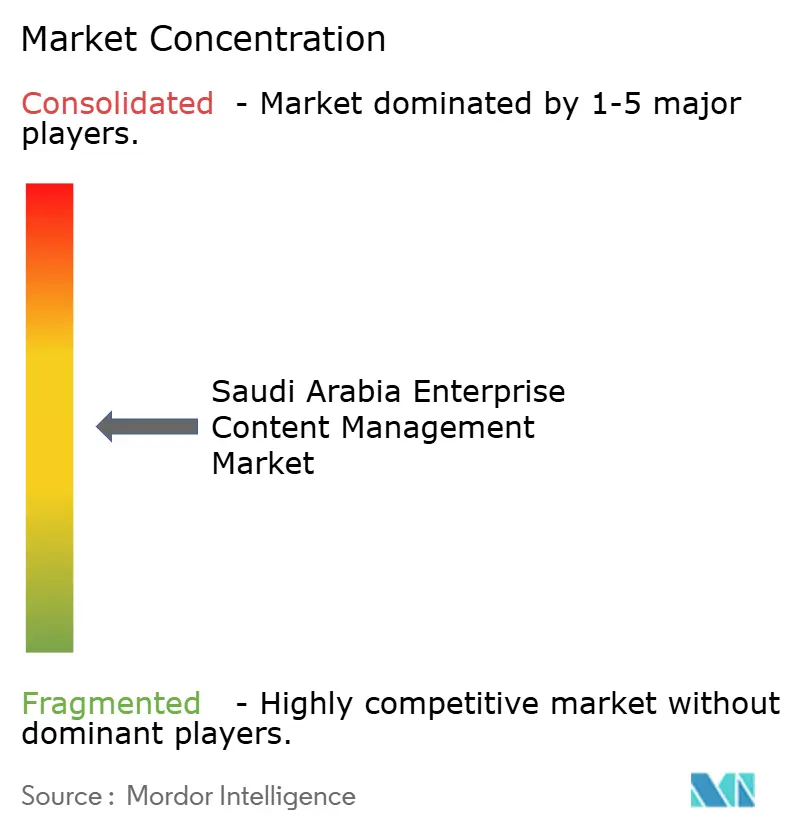
The Saudi Arabia enterprise content management market operates through a split structure where the platform layer is moderately consolidated, while the implementation layer remains much more fragmented. At the platform level, OpenText, Microsoft, IBM, Hyland, Oracle, and SAP have the strongest visibility in large enterprise and public sector opportunities because they can support large repositories, broad workflow integration, and formal governance requirements. This does not make competition simple, because buyers are comparing vendors on Arabic-language handling, deployment flexibility, compliance readiness, and local execution depth at the same time. The result is a field where established vendors hold an advantage in scale, but project wins still depend heavily on how well they adapt to Saudi operating conditions. That balance keeps the Saudi Arabia enterprise content management market from becoming tightly concentrated across all layers of delivery.
Strategic moves in 2025 and 2026 show how the leading vendors are positioning themselves more directly inside the Kingdom. Hyland expanded in Saudi Arabia and the UAE in August 2025 and pointed to active deployments across Saudi ministries and public entities, which strengthened its regional delivery footprint and local credibility. OpenText expanded its collaboration with SAP in November 2025 to deliver AI-ready cloud content management at scale, which reinforced its push into customers who want content governance more tightly linked with core enterprise systems.[4]OpenText Corporation, “OpenText Expands Collaboration with SAP to Deliver AI-Ready Cloud Content Management at Scale,” OpenText, opentext.com CompTech's December 2025 ARDOC launch showed that local players can compete where buyers want architectures built specifically around NCAR and PDPL alignment rather than being adapted later. These moves show that local presence, ecosystem partnerships, and compliance-ready packaging are becoming as important as traditional software capability.
White-space opportunity is strongest where the market still has practical gaps rather than where broad feature catalogs already exist. Arabic-native classification, simpler SME-focused cloud bundles, and healthcare-specific records environments remain attractive because they address operating frictions that large generic suites do not always solve cleanly. Accely's 2025 Hyland OnBase implementations at a Saudi health science university and a Saudi medical research firm showed that specialized document governance demand is extending into academic and research settings as well. The input also made clear that Tencent Holdings Limited and Alibaba Cloud are not central competitive references for this space, while Saudi-focused players such as Naseej and CompTech are more relevant in Arabic content and regulated deployment contexts. This supports a competitive view where global suites lead major platform decisions, but sector fit and local specialization still shape a meaningful share of actual buying decisions.
Saudi Arabia Enterprise Content Management Industry Leaders
CompTechCo
OpenText Corporation
Hyland Software, Inc.
DataServe & Turnkey Solutions Co.
Microsoft Corporation
- *Disclaimer: Major Players sorted in no particular order

Recent Industry Developments
- June 2026: Alrajhi Medicine became the first private healthcare group in Saudi Arabia to adopt Oracle Health and Oracle Fusion Cloud Applications as a unified digital platform, integrating clinical and business operations to support AI-driven care delivery across its multi-specialty hospital network.
- December 2025: Saudi Ministry of Tourism launched ARDOC, a cloud-native, AI-powered archives and records management system built on the Hyland-Nuxeo ECM platform, incorporating deep learning-based Arabic OCR with 98% accuracy and automated metadata extraction, in full compliance with NCAR guidelines and PDPL requirements.
- November 2025: OpenText expanded its collaboration with SAP to deliver AI-ready cloud content management at scale, deepening integration of OpenText governance tools with SAP S/4HANA Cloud to strengthen compliance, records management, and enterprise workflow automation for joint customers.
- August 2025: Hyland opened dedicated offices in Riyadh and Dubai to support GCC growth, appointing Yasmina Abu-Roomi Santana as Managing Director for the region, with active deployments at the Saudi Ministry of Justice, Ministry of Economy and Planning, Ministry of Tourism, and Dariyah Gate Development Authority.


Saudi Arabia Enterprise Content Management Market Report Scope
The Saudi Arabia enterprise content management market comprises software platforms and related services that enable organizations to capture, create, manage, store, secure, govern, and distribute enterprise content and business documents throughout their lifecycle. The market includes document management, records management, workflow and business process management, case management, digital asset management, web content management, and other content-centric solutions delivered through cloud, on-premises, and hybrid deployment models. Market estimates represent revenue generated from enterprise content management software licenses, subscriptions, maintenance, implementation, consulting, integration, training, and managed services within Saudi Arabia.
The Saudi Arabia Enterprise Content Management Market Report is Segmented by Solution Type (Document Management, Records Management, Workflow and Business Process Management, Case Management, Digital Asset Management, Web Content Management, and Other Solutions), Deployment Mode (On-Premises, Cloud, and Hybrid), Enterprise Size (Small and Medium Enterprises, and Large Enterprises), and End-user Industry (BFSI, Government and Public Administration, Healthcare and Lifesciences, IT and Telecommunications, Industrial Manufacturing, Retail and E-Commerce, Media and Entertainment, Education, Energy and Utilities, and Other End-user Industries). The Market Forecasts are Provided in Terms of Value (USD).
| Document Management |
| Records Management |
| Workflow and Business Process Management |
| Case Management |
| Digital Asset Management |
| Web Content Management |
| Other Solutions |
| On-Premises |
| Cloud |
| Hybrid |
| Small and Medium Enterprises |
| Large Enterprises |
| BFSI |
| Government and Public Administration |
| Healthcare and Lifesciences |
| IT and Telecommunications |
| Industrial Manufacturing |
| Retail and E-Commerce |
| Media and Entertainment |
| Education |
| Energy and Utilities |
| Other End-User Industries |
| By Solution Type | Document Management |
| Records Management | |
| Workflow and Business Process Management | |
| Case Management | |
| Digital Asset Management | |
| Web Content Management | |
| Other Solutions | |
| By Deployment Mode | On-Premises |
| Cloud | |
| Hybrid | |
| By Enterprise Size | Small and Medium Enterprises |
| Large Enterprises | |
| By End-User Industry | BFSI |
| Government and Public Administration | |
| Healthcare and Lifesciences | |
| IT and Telecommunications | |
| Industrial Manufacturing | |
| Retail and E-Commerce | |
| Media and Entertainment | |
| Education | |
| Energy and Utilities | |
| Other End-User Industries |


Key Questions Answered in the Report
What is the size outlook for enterprise content management in Saudi Arabia?
The Saudi Arabia enterprise content management market was valued at USD 0.51 billion in 2025 and is projected to reach USD 1.15 billion by 2031 at a 14.90% CAGR over 2026-2031.
Which solution area leads current demand in Saudi Arabia?
Document Management led in 2025 with a 26.18% share because most organizations still start with core repository control, retrieval, and version management before expanding into wider workflow automation.
Which deployment model is most common across Saudi enterprises?
Cloud is the leading deployment model, with 78.46% share in 2025, because enterprises want faster rollout, easier multi-site access, and stronger support for centralized governance.
Why is healthcare becoming a faster-growing buyer group?
Healthcare and Lifesciences is projected to grow at a 17.06% CAGR through 2031 as privatization, interoperability requirements, and electronic documentation needs push providers toward stronger content control.
Why does Riyadh matter so much for content platform demand?
Riyadh remains the main procurement hub because it concentrates ministries, national institutions, and vendor offices, which makes it the center of large public sector and enterprise decisions.
What is pushing SMEs to adopt structured content systems faster?
SMEs are projected to grow at a 15.83% CAGR through 2031 because compliance expectations are spreading beyond large enterprises and cloud-based packages make formal document governance easier to adopt.
Page last updated on:






