
Saudi Arabia Customs Brokerage Market Size and Share
Market Overview
| Study Period | 2021 - 2032 |
|---|---|
| Forecast Data Period | 2027 - 2032 |
| Base Year Market Size (2026) | USD 570.84 Million |
| Market Size (2027) | USD 603.61 Million |
| Market Size (2032) | USD 795.26 Million |
| Growth Rate (2027 - 2032) | 5.67 % |
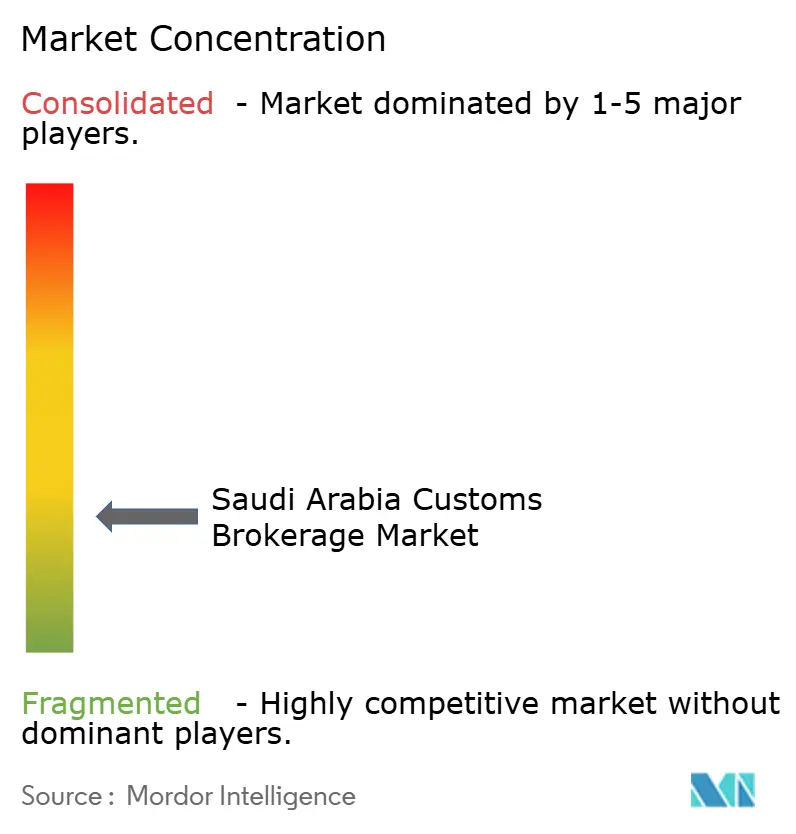
| Market Concentration | Low |
Major Players *Disclaimer: Major Players sorted in no particular order Image © Mordor Intelligence. Reuse requires attribution under CC BY 4.0. | |
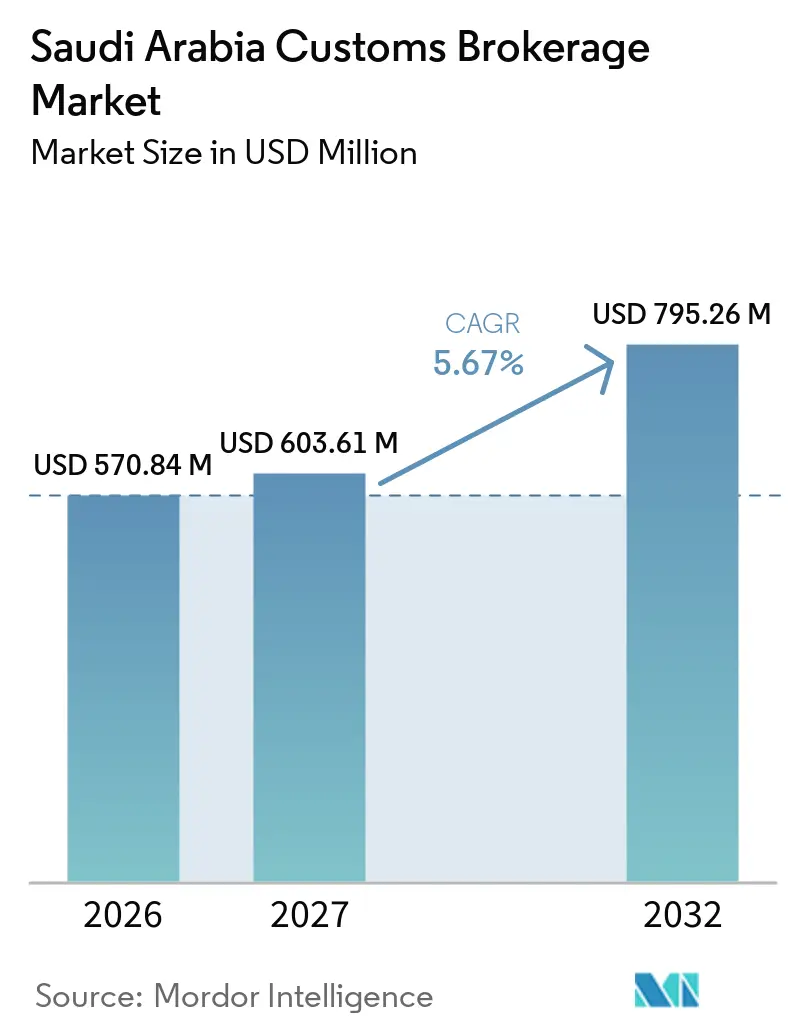
Saudi Arabia Customs Brokerage Market Analysis by Mordor Intelligence
The Saudi Arabia customs brokerage market size is valued at USD 570.84 million in 2026. It is estimated to grow from USD 603.61 million in 2027 to reach USD 795.26 million by 2032, at a CAGR of 5.67% during the forecast period (2027-2032).
Trade facilitation investment, industrial imports, and cross-border parcel flows are increasing the number and variety of customs transactions handled in Saudi Arabia. The market is moving from manual declaration filing toward pre-arrival preparation, product classification, and compliance management. Brokers with Fasah connectivity, Authorized Economic Operator credentials, and presence across major gateways are better placed to serve large importers. The shift also creates room for specialized providers that support regulated goods, bonded activities, and complex customs cases. At the same time, automation and bundled logistics contracts are reducing the value of routine declaration work for smaller standalone providers.
Key Report Takeaways
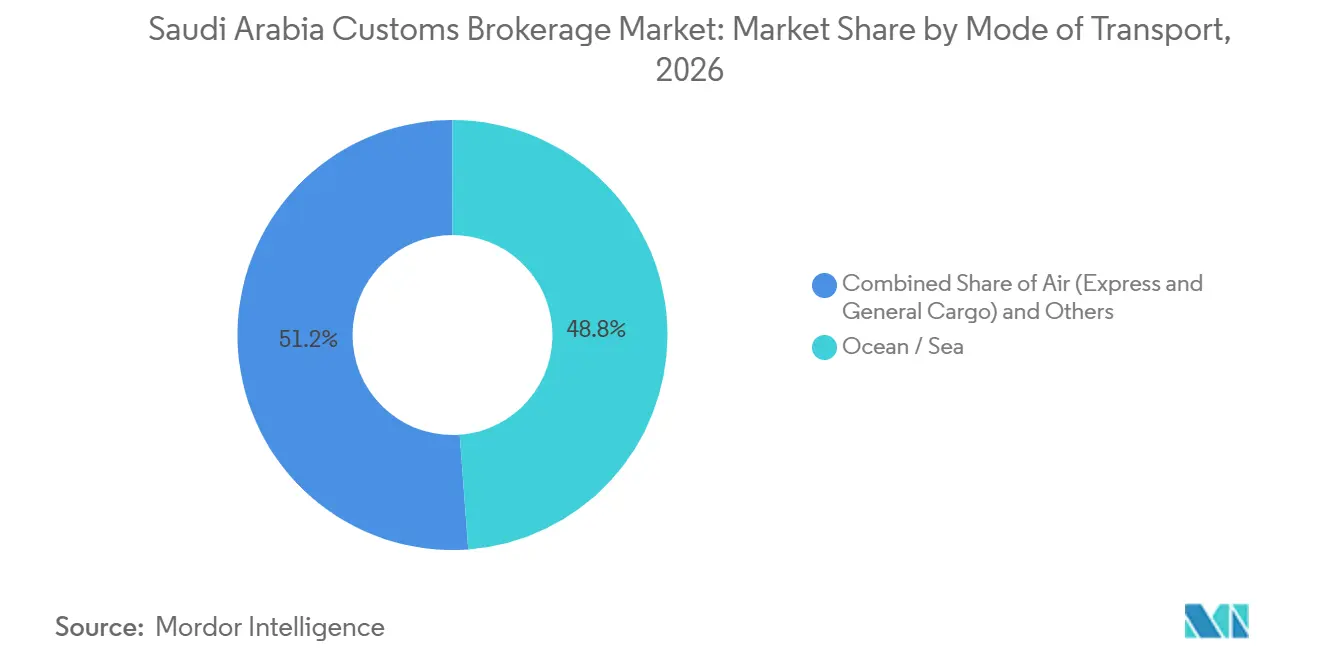
- By mode of transport, ocean/sea accounts for 48.83% of the Saudi Arabia customs brokerage market share in 2026, while air freight is forecast to register a 6.60% CAGR through 2032.
- By broker type, freight forwarder/3PL-integrated brokers account for 72.45% of the Saudi Arabia customs brokerage market size in 2026 and are forecast to register at a 7.98% CAGR through 2032.
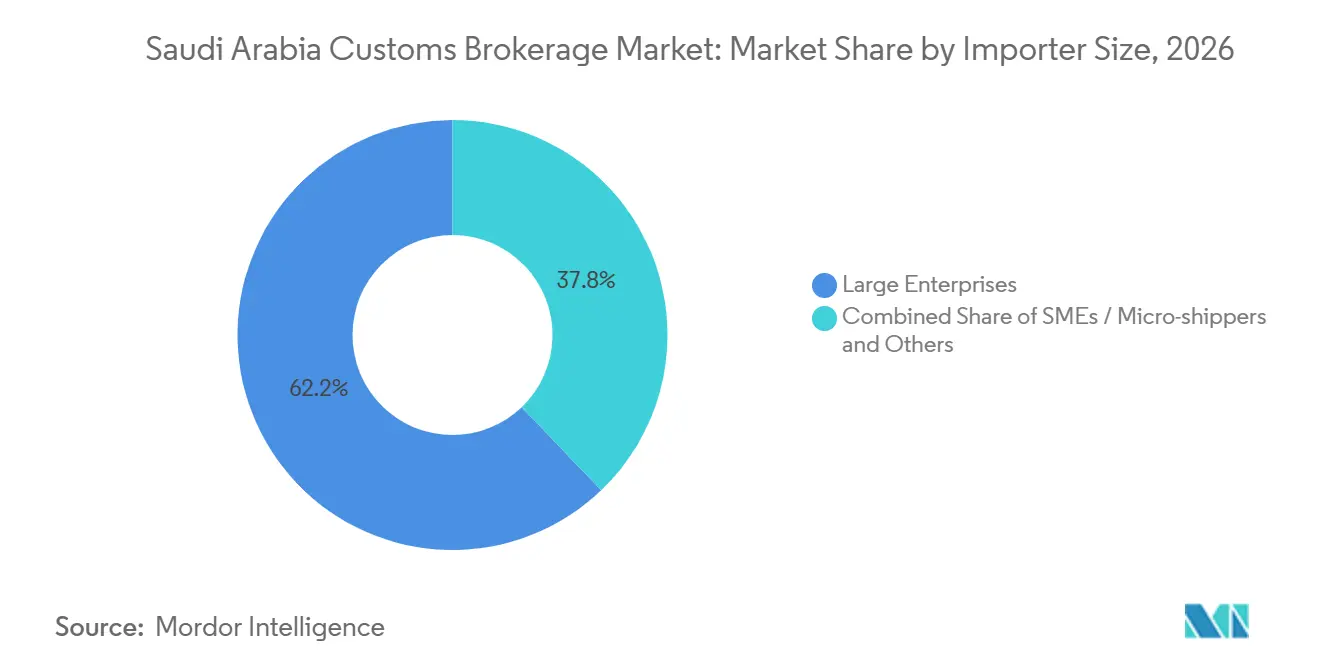
- By importer size, large enterprises account for 62.16% of the Saudi Arabia customs brokerage market share in 2026, while SMEs and micro-shippers are forecast to register at a 6.67% CAGR through 2032.
- By digital adoption, traditional brokerages account for 83.82% of the Saudi Arabia customs brokerage market size in 2026, while digital-first/API-based brokerages are forecast to register at an 8.92% CAGR through 2032.
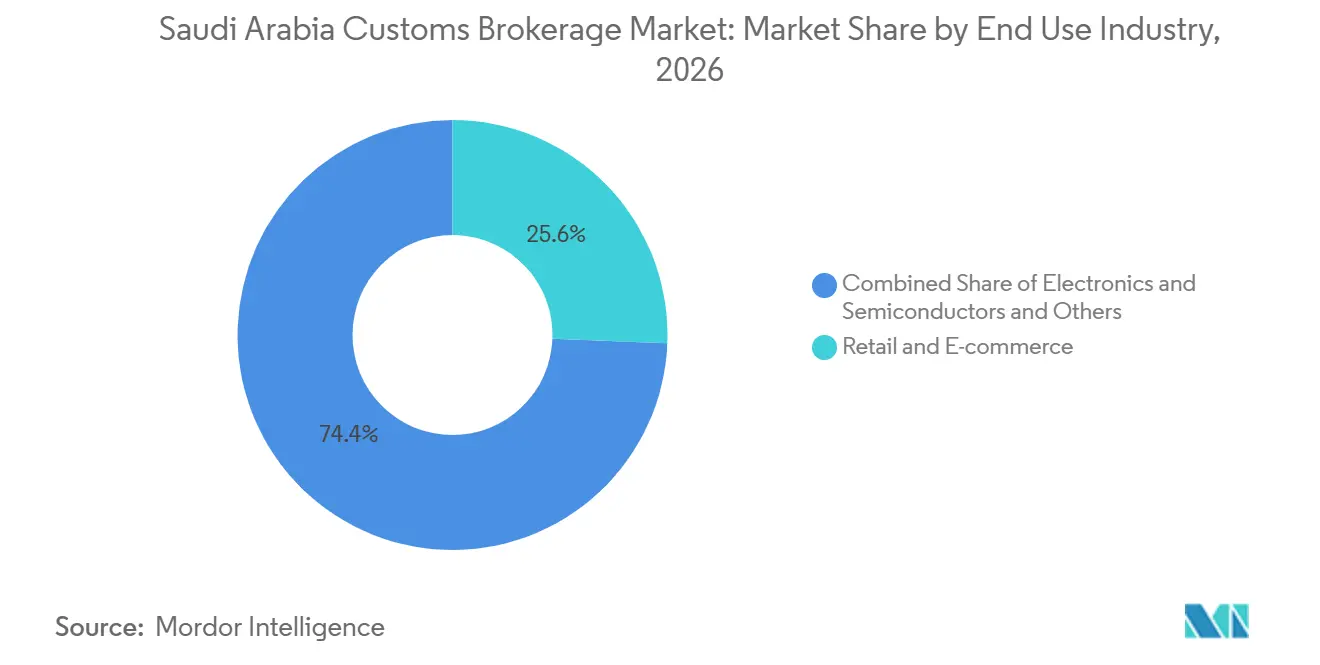
- By end-use industry, retail and e-commerce accounts for 25.61% of the Saudi Arabia customs brokerage market share in 2026, while electronics and semiconductors are forecast to register at a 6.26% CAGR through 2032.
- By geography, the Western region accounts for 35.72% of the Saudi Arabia customs brokerage market size in 2026, while the Northern region is forecast to register at a 6.61% CAGR through 2032.
Note: Market numbers in this report are based on Mordor Intelligence's proprietary estimation framework, which combines nine months of actuals with Q4 projections for base year 2026.
Market Trends and Insights
Drivers Impact Analysis of Saudi Arabia Customs Brokerage Market*
| Driver | (~) % Impact on CAGR Forecast | Geographic Relevance | Impact Timeline |
|---|---|---|---|
| Vision 2030 Investment Strengthening Trade Facilitation Infrastructure | +1.5% | Global, concentrated in Western, Central, and Northern regions | Long term (≥ 4 years) |
| Cross-Border E-Commerce Increasing Formal Customs Clearance Demand | +1.2% | Global, with the highest impact in Western and Central regions | Medium term (2-4 years) |
| Fasah Digitalization Improving Customs Processing and Visibility | +1.0% | Global, including Jeddah, Dammam, and NEOM gateways | Short term (≤ 2 years) |
| AEO Adoption Accelerating Priority Customs Clearance Processes | +0.8% | Global, with early gains in Jeddah, Dammam, Riyadh, the Eastern Province, and NEOM | Medium term (2-4 years) |
| Industrial Imports Expanding Customs Brokerage Service Demand | +0.7% | Concentrated in Eastern and Central regions | Medium term (2-4 years) |
| Bonded-Zone Growth Increasing Re-Export Brokerage Activity | +0.5% | Western, Northern, and Eastern regions | Long term (≥ 4 years) |
| Source: Mordor Intelligence | |||
Vision 2030 Investment Strengthening Trade Facilitation Infrastructure
Investment in logistics facilities is increasing the range of customs procedures that brokers must manage. New logistics centers, free-zone activity, and industrial sites require brokers to understand different operating rules across gateways. This expands demand for services related to customs exemptions, tariff classification, bonded movements, and re-export documentation. The Ministry of Industry and Mineral Resources reported processing 739 customs-exemption requests for industrial inputs in September 2025, showing the administrative needs created by manufacturing activity[1]. Industrial projects can turn an initial import into recurring declarations for equipment, spare parts, and production materials. Providers that combine customs knowledge with industrial sector experience are therefore likely to compete on service quality rather than filing price alone.
Cross-Border E-Commerce Increasing Formal Customs Clearance Demand
Cross-border e-commerce is bringing more low-value parcels into formal customs processes in the Saudi Arabia customs brokerage market. Parcel shipments require product classification, conformity documentation, duty treatment, and data exchange even when the individual shipment value is low. ZATCA set a SAR 15 (USD 4) customs-declaration fee for online orders valued at SAR 1,000 (USD 266.46) or less, which creates a formal process for a large volume of small transactions. CJ Logistics opened a cross-border e-commerce hub at King Khalid International Airport in February 2026, with capacity to process 20,000 parcels a day and customs clearance embedded in the operation. Saudi Post also reported a 98% delivery success rate after integrating automated pre-clearance into inbound parcel processing. These changes favor brokers that can process high volumes through connected systems while resolving the exceptions that automated workflows cannot handle.
Fasah Digitalization Improving Customs Processing and Visibility
Fasah digitalization is shifting the Saudi Arabia customs brokerage market toward earlier document preparation and continuous shipment visibility. ZATCA requires advance cargo-manifest submission for seaport arrivals from October 29, 2025, moving essential customs work before vessel arrival. This requirement raises the importance of timely document collection and integrated shipment information. Fasah and SABER workflows reduce repetitive manual entry for standard shipments, while increasing the value of handling exceptions and permit issues. The system also makes digital filing a basic requirement for brokers seeking enterprise contracts. Providers without connected processes may find it harder to meet pre-arrival timelines or provide customers with accurate status information.
AEO Adoption and Specialized Compliance Supporting Higher-Value Services
The AEO program is creating a stronger role for compliance capability within the Saudi Arabia customs brokerage market. Saudi Arabia relaunched the program in November 2025 with Bronze, Silver, and Gold tiers designed for different types of establishments. Although AEO status can reduce inspections and support priority treatment, importers still need brokers that understand their operational and reporting responsibilities. The World Customs Organization expanded its pool of AEO pre-accredited experts for the Middle East and North Africa in July 2025 through a workshop hosted by ZATCA. Kuehne+Nagel became the first company certified in Saudi Arabia specifically in the Customs Brokerage category in May 2025. Brokers can use sector knowledge, AEO support, and bonded-zone procedures to create higher-value offerings as industrial imports and re-export activity rise.
Restraints Impact Analysis of Saudi Arabia Customs Brokerage Market*
| Restraint | (~) % Impact on CAGR Forecast | Geographic Relevance | Impact Timeline |
|---|---|---|---|
| Regulatory Complexity Increasing Customs Documentation Burden | -0.5% | Global; heightened in Western (Jeddah) and Eastern (Dammam) gateways | Short-term (≤ 2 years) |
| Integrated 3PL Competition Compressing Brokerage Service Margins | -0.4% | Global; concentrated among large enterprise importers in Central and Western regions | Medium-term (2–4 years) |
| Compliance Talent Shortages and Saudization Cost Pressures | -0.3% | National; most acute in Central (Riyadh) and Eastern (Dammam) regions | Medium-term (2–4 years) |
| Uneven Digital Readiness Among SME Brokers and Importers | -0.2% | National; pronounced in Northern and Southern regions | Long-term (≥ 4 years) |
| Source: Mordor Intelligence | |||
Regulatory Complexity Increasing Customs Documentation Burden
Regulatory complexity can raise operating costs for providers in the Saudi Arabia customs brokerage market. The GCC moved to a 12-digit Harmonized System code structure in January 2025, expanding Saudi Arabia's tariff classifications from 7,800 to more than 13,400 lines[2]. More tariff lines increase the need for accurate product descriptions and technical classification knowledge. Brokers may also need to coordinate requirements that involve ZATCA, the Saudi Food and Drug Authority, the Saudi Standards, Metrology and Quality Organization, and SABER processes. Expeditors reported customs process changes in December 2025 that restricted broker access to airport warehouse areas and added inspection zones at 3 international airports. These burdens are more difficult for smaller brokers that lack dedicated teams for classification, permits, and compliance review.
Integrated 3PL Competition Compressing Brokerage Service Margins
Integrated 3PLs can package customs brokerage with transportation, warehousing, and distribution in the Saudi Arabia customs brokerage market. This approach can make brokerage appear as part of a wider logistics contract instead of a separately priced service. DHL Global Forwarding, DSV, Kuehne+Nagel, and CEVA Almajdouie offer multimodal logistics services that can include customs support. DSV completed its Schenker integration go-live in Saudi Arabia in February 2026, creating a combined organization across Air and Sea, Contract Logistics, and Road. The scale of these providers can place pressure on standalone brokers that depend on enterprise accounts. Pure-play providers can still defend selected business through hazardous-goods experience, regulated-product knowledge, regional corridor coverage, and close attention to individual customers.
*Our forecasts treat driver/restraint impacts as directional, not additive. The impact forecasts reflect baseline growth, mix effects, and variable interactions.
Saudi Arabia Customs Brokerage Market Segment Analysis
By Mode of Transport:
Air Freight Gaining Ground Against Sea’s Volume BaseOcean/sea accounts for 48.83% of the Saudi Arabia customs brokerage market share in 2026. The segment benefits from containerized imports through Jeddah Islamic Port and King Abdulaziz Port in Dammam. Seaports processed 2.5 million containers in 2025, supporting a broad and recurring base of maritime customs declarations. Sea shipments require careful classification and valuation work for industrial equipment, consumer goods, machinery, and re-export cargo. The large port base gives brokers a role in compliance support as well as routine declaration submission.
Air freight is forecast to register at a 6.60% CAGR through 2032. Its growth is linked to time-sensitive semiconductors, pharmaceuticals, e-commerce consignments, and other high-value goods. These shipments require fast document preparation, accurate declarations, and coordination across airport cargo facilities. SAL’s digital initiatives support connected cargo handling for freight forwarders and shippers. Cross-Border Land remains important at northern and eastern borders, where brokers serve regional truck traffic and route-specific compliance needs.

By Broker Type:
Integrated 3PLs Dominate, but Pure Brokers Defend in NichesFreight forwarder/3PL-integrated brokers account for 72.45% of the Saudi Arabia customs brokerage market size in 2026. The same category is forecast to register a 7.98% CAGR through 2032. Large importers often prefer a single provider for freight, storage, customs work, and delivery. This preference gives integrated providers a strong position in recurring enterprise contracts. DHL Group announced more than EUR 500 million (USD 588.16 million) in investment across fast-growing Middle East markets through 2030, strengthening the resources available to integrated logistics networks.
Pure Customs Brokers serve specialized trade lanes and sectors that require support with permits, regulatory compliance, customs documentation, and local procedures. Their expertise is particularly relevant for shipments involving complex clearance requirements or specific regulatory obligations. Hazardous chemicals, defense goods, pharmaceuticals, and other controlled products can require expertise that is not easily standardized within broad logistics contracts. AEO recognition can help specialist brokers demonstrate high compliance standards. Saudi licensing and staffing requirements are another local operating consideration for international logistics groups.
By Importer Size:
Large Enterprises Anchor Revenue While SMEs Drive Declaration Volume GrowthLarge enterprises account for 62.16% of the Saudi Arabia customs brokerage market in 2026. Industrial, energy, and large retail importers account for high import values and often use long-term service agreements. Their scale provides a stable revenue base for brokers and 3PLs. These buyers can also negotiate strongly because they compare offers across several service providers. Reliability, compliance performance, gateway coverage, and account management are therefore important to retaining enterprise business.
SMEs and micro-shippers are forecast to register at a 6.67% CAGR through 2032. More small businesses are entering formal import channels through e-commerce, industrial supply chains, and regional sourcing. Saudi EXIM introduced an initiative in May 2025 to streamline industrial input access for local manufacturers, supporting supply-chain financing and imports. Mid-market importers need professional customs support but may not need a large enterprise logistics bundle. This group creates an opening for brokers with sector expertise, transparent pricing, and connected filing tools
By Digital Adoption:
API-Based Brokerages Outpace the Market Despite a Modest Current BaseTraditional brokerages account for 83.82% of the Saudi Arabia customs brokerage market share in 2026. Their position reflects established relationships, Arabic-language support, and physical presence at ports and border crossings. Many customers value brokers that can coordinate practical issues across local agencies and cargo facilities. Traditional providers also have operational knowledge built through handling recurring trade flows. This base remains relevant where shipments need physical intervention or close customer contact.
Digital-first/API-based brokerages are forecast to register an 8.92% CAGR through 2032. Their model supports pre-clearance, real-time declaration tracking, and automated duty calculations through connected systems. Fasah 2.0 makes integration more important for e-commerce platforms, technology importers, and multinational logistics providers. SAL and Elm agreed in August 2025 to develop an integrated platform for scheduling, payments, and appointments at airport stations[3]. The service opportunity moves toward exception management, classification, and complex regulatory coordination.
By End-Use Industry:
E-Commerce Leads Volume, Semiconductors Drive Value GrowthRetail and e-commerce accounts for 25.61% of the Saudi Arabia customs brokerage market share in 2026. This segment produces frequent parcel declarations that often have low value per shipment. Its operating model rewards accurate, automated processing and predictable customs status updates. The parcel fee and wider SABER-related procedures make customs activity more visible within cross-border consumer flows. Brokers in this area need scalable systems for classification, certificate review, and shipment-level data exchange.
Electronics and semiconductors are forecast to register at a 6.26% CAGR through 2032. These goods can carry complex tariff classification and conformity requirements that increase the need for specialized customs expertise. Pharmaceutical and life-sciences shipments also require coordination with Saudi Food and Drug Authority approvals and temperature-sensitive supply-chain procedures. GEODIS started sustainable pharmaceutical airfreight trials in Saudi Arabia in June 2026, reflecting specialist handling needs in this corridor. Aerospace, defense, chemicals, and automotive goods each create their own permit and handling requirements.
Geography Analysis
The Western region accounts for 35.72% of the Saudi Arabia customs brokerage market share in 2026. Jeddah Islamic Port gives the region a central role in Red Sea trade, container imports, e-commerce entry, and bonded activity. MAWANI has expanded logistics capacity at Saudi ports, strengthening the infrastructure around maritime customs work. Maersk and Saudi Post signed a memorandum of understanding in July 2025 for e-commerce customs clearance and bonded fulfillment using Maersk’s Jeddah Integrated Logistics Park. Bahri Integrated Logistics opened its Bahri Bonded Zone at Jeddah Islamic Port in July 2026. The site adds customs-supervised storage and re-export capacity to the western coastline.
The Central region supports the Saudi Arabia customs brokerage market through Riyadh’s role across air-, land-, and sea-supported supply chains. The special integrated logistics zone is close to King Khalid International Airport and has a bonded-corridor connection. DHL Supply Chain agreed to a EUR 130 million (USD 152.92 million) investment for a 78,000 m² warehouse at SILZ, with completion expected in Q2 2027[4]. SAL and Sela agreed in March 2025 to develop the SAL Logistics Zone in Falcon City across more than 1.5 million m². The Eastern region has a large industrial customs base through Jubail and Dammam gateways. Its demand is tied to equipment, chemicals, and manufacturing supply chains requiring technical classification and permit coordination.
The Northern region opens a growth path for the Saudi Arabia customs brokerage market and is forecast to register at a 6.61% CAGR through 2032. Port of NEOM is extending the region’s role as a Red Sea gateway and a connection point for routes involving Egypt and Iraq. Port of NEOM received remote-controlled ship-to-shore and electric rubber-tired gantry cranes in June 2025. CEVA Almajdouie Logistics and Port of NEOM signed a memorandum of understanding in October 2026 to develop integrated logistics and customs-clearance solutions for the Europe-Egypt-Saudi Arabia-GCC-Iraq corridor. The Southern region is smaller but is developing its maritime base through Jizan. GAC Saudi Arabia opened its 10th Saudi office in Jizan in November 2025, extending vessel handling and cargo coordination services.
Competitive Landscape
The Saudi Arabia customs brokerage market is fragmented in the middle tier but more concentrated in enterprise accounts. Kuehne+Nagel, DHL Global Forwarding, DSV, CEVA Almajdouie Logistics, and A.P. Moller-Maersk compete across transport modes and provide wider logistics services. Their models combine customs support with forwarding, warehousing, and distribution. This breadth appeals to large importers seeking fewer service providers and consistent processes across gateways. Digital connectivity, compliance teams, and AEO capability strengthen their position in complex accounts.
Smaller licensed brokers remain important where local knowledge, sector expertise, and customer access are more valuable than national scale. Competition increasingly depends on the ability to prepare declarations before arrival and manage exceptions quickly. Fasah integration has become a practical requirement for many enterprise and e-commerce mandates. Brokers that automate routine tasks can direct more staff toward classification disputes, permits, audit support, and other complex work. DSV’s February 2026 integration with Schenker increased the combined organization’s coverage across Air and Sea, Contract Logistics, and Road.
The most contested customer group is the mid-market importer. These buyers may require more compliance support than a traditional broker can provide, while viewing a full 3PL contract as too costly or broad. Providers offering connected filing, sector knowledge, and responsive account support can address this gap. Kuehne+Nagel’s AEO certification in the Customs Brokerage category is one example of a compliance-oriented differentiator. Maersk and Saudi Post’s July 2025 collaboration is another example, combining e-commerce customs clearance, bonded fulfillment, transport, and final-mile delivery.
Saudi Arabia Customs Brokerage Industry Leaders
-
SAL Saudi Logistics Services Company
-
Four Winds Saudi Arabia Limited
-
Kuehne+Nagel
-
DHL Group
-
DSV A/S (including DB Schenker)
- *Disclaimer: Major Players sorted in no particular order
Saudi Arabia Customs Brokerage Market Companies Covered in this Report
- A.P. Moller - Maersk
- AJEX Logistics Services
- Aramex PJSC
- BAFCO International Shipping & Logistics Co. Ltd
- Bahri Integrated Logistics
- CEVA Almajdouie Logistics
- Crane Worldwide Logistics
- DHL Group
- DSV A/S (including DB Schenker)
- Expeditors International of Washington, Inc.
- Flow Progressive Logistics
- Four Winds Saudi Arabia Limited
- GAC Saudi Arabia
- GEODIS
- Hellmann Worldwide Logistics
- KILFAD Logistics (formerly EFS Logistics)
- Kuehne+Nagel
- Munawla Cargo Co. Ltd.
- SAL Saudi Logistics Services Company
- Saudi Post | SPL (including NAQEL Express)
- Wared Logistics
- Zajil Express
Recent Industry Developments in Saudi Arabia Customs Brokerage Market
- October 2026: CEVA Almajdouie Logistics and Port of NEOM signed an MoU to develop integrated end-to-end logistics and customs clearance solutions across the Europe-Egypt-Saudi Arabia-GCC-Iraq multimodal corridor.
- August 2026: DHL eCommerce finalized its acquisition of a minority stake in AJEX Logistics Services, a GCC supply-chain and transportation company owned by Ajlan & Bros Holding Group with a network of over 60 facilities and 1,200 vehicles.
- April 2026: FedEx launched its FedEx Import Tool in Saudi Arabia, integrating customs documentation, shipment tracking, and import management into a digital platform to simplify regulatory compliance and improve clearance efficiency
- February 2026: DSV completed the DSV x Schenker integration go-live in Saudi Arabia, creating a unified organization covering Air & Sea, Contract Logistics, and Road, substantially expanding the combined entity's customs brokerage footprint across the Kingdom's major gateways
Saudi Arabia Customs Brokerage Market Report Scope
Segmentation Overview
| Ocean / Sea |
| Air (Express and General Cargo) |
| Cross-Border Land (Truck and Rail) |
| Pure Customs Broker |
| Freight Forwarder / 3PL-Integrated Brokers |
| Large Enterprises |
| Mid-Market |
| SMEs / Micro-shippers |
| Traditional Brokerages |
| Digital-first / API-based Brokerages |
| Retail and E-commerce |
| Automotive and EV |
| Electronics and Semiconductors |
| Pharmaceuticals and Life Sciences |
| Aerospace and Defense |
| Chemicals and Industrial Goods |
| Central (Riyadh, Al-Qassim, and Hail) |
| Eastern (Ash-Sharqiyah) |
| Western (Al-Bahah, Makkah, Medina, and Tabuk) |
| Northern (Al-Jouf and Arar) |
| Southern (Asir, Jazan, and Najran) |
| By Mode of Transport | Ocean / Sea |
| Air (Express and General Cargo) | |
| Cross-Border Land (Truck and Rail) | |
| By Broker Type | Pure Customs Broker |
| Freight Forwarder / 3PL-Integrated Brokers | |
| By Importer Size | Large Enterprises |
| Mid-Market | |
| SMEs / Micro-shippers | |
| By Digital Adoption | Traditional Brokerages |
| Digital-first / API-based Brokerages | |
| By End-Use Industry | Retail and E-commerce |
| Automotive and EV | |
| Electronics and Semiconductors | |
| Pharmaceuticals and Life Sciences | |
| Aerospace and Defense | |
| Chemicals and Industrial Goods | |
| By Region | Central (Riyadh, Al-Qassim, and Hail) |
| Eastern (Ash-Sharqiyah) | |
| Western (Al-Bahah, Makkah, Medina, and Tabuk) | |
| Northern (Al-Jouf and Arar) | |
| Southern (Asir, Jazan, and Najran) |
Key Questions Answered in the Report
What is the forecast value of Saudi Arabia customs brokerage services by 2032?
The sector is forecast to reach USD 795.26 million by 2032, growing at a 5.67% CAGR from 2027 to 2032.
Which transport mode has the largest role in customs brokerage services in Saudi Arabia?
Ocean/Sea leads with 48.83% in 2026, supported by containerized imports through major Red Sea and Gulf gateways.
Why are digital customs brokers growing in Saudi Arabia?
Digital-first/API-based providers are forecast to register at an 8.92% CAGR through 2032 because pre-arrival filing and connected customs workflows are becoming more important.
Which customer group is growing fastest for customs service providers?
SMEs and Micro-shippers are forecast to register at a 6.67% CAGR through 2032 as formal imports expand through e-commerce and industrial supply chains.
Which Saudi region offers the strongest growth opportunity for customs brokers?
The Northern region is forecast to register at a 6.61% CAGR through 2032, supported by Port of NEOM and new regional trade corridors.
How do integrated 3PLs affect standalone customs brokers in Saudi Arabia?
Integrated 3PLs accounts for 72.45% in 2026 and can bundle customs work with freight and warehousing, pushing standalone brokers toward specialized services.