
Saudi Arabia Art Logistics Market Size and Share
Market Overview
| Study Period | 2020 - 2031 |
|---|---|
| Forecast Data Period | 2026 - 2031 |
| Base Year Market Size (2025) | USD 41.24 Million |
| Market Size (2026) | USD 43.74 Million |
| Market Size (2031) | USD 57.92 Million |
| Growth Rate (2026 - 2031) | 5.78 % |
| Market Concentration | Medium |
Major Players *Disclaimer: Major Players sorted in no particular order Image © Mordor Intelligence. Reuse requires attribution under CC BY 4.0. | |
Saudi Arabia Art Logistics Market Analysis by Mordor Intelligence
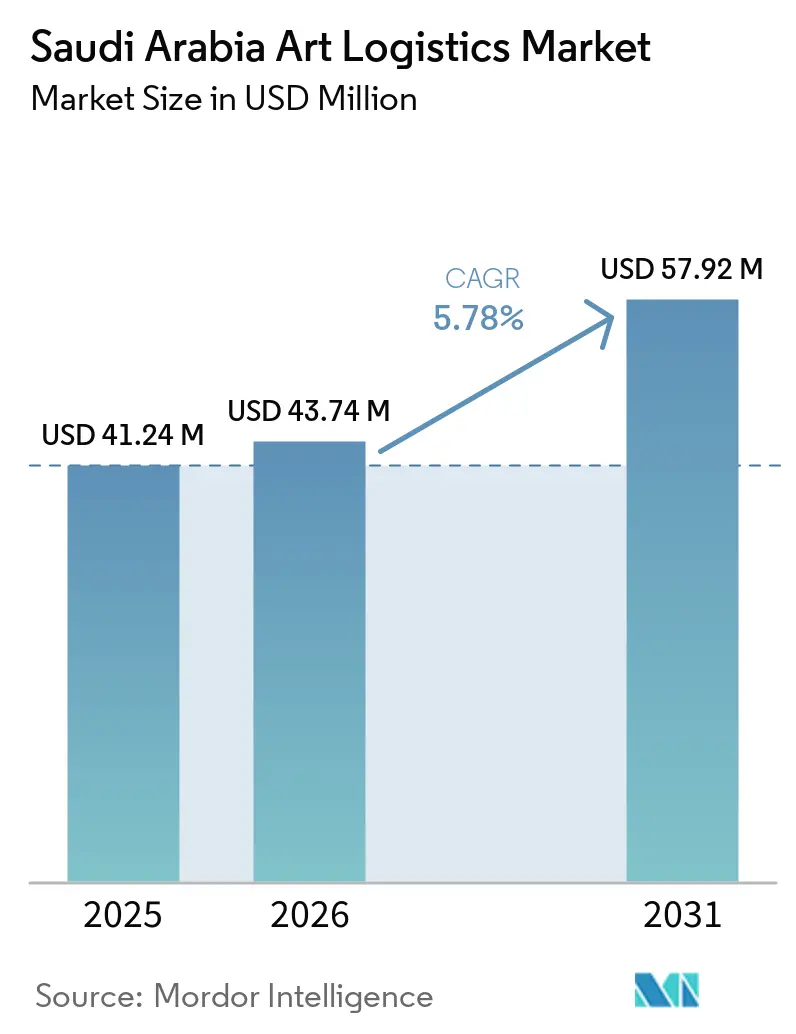
The Saudi Arabia art logistics market size is expected to grow from USD 41.24 million in 2025 to USD 43.74 million in 2026 and is forecast to reach USD 57.92 million by 2031 at 5.78% CAGR over 2026-2031.
Vision 2030’s record cultural spending has produced a nationwide pipeline of new museums, biennales, and heritage restorations that require purpose-built transport, bonded storage, and white-glove last-mile services. Global auction houses, led by Sotheby’s and Christie’s, are now operating permanent Saudi offices, deepening the private-sector collector base and stimulating demand for temperature-controlled residential delivery. Airport upgrades by SAL Saudi Logistics Services, in partnership with Global Critical Logistics (GCL), are shortening freight hand-offs and strengthening Riyadh and Jeddah as regional gateways. Meanwhile, training programs at MiSK Art Institute and the Royal Institute of Traditional Arts are expanding the pool of registrars and art handlers, though the skills gap continues to drive reliance on expatriate technicians. Regulatory reforms, such as the June 2024 ATA Carnet accession, reduce customs friction for temporary imports, yet the 15% VAT plus 5% duty on permanent acquisitions continue to weigh on the Saudi Arabia art logistics market.[1]
Key Report Takeaways
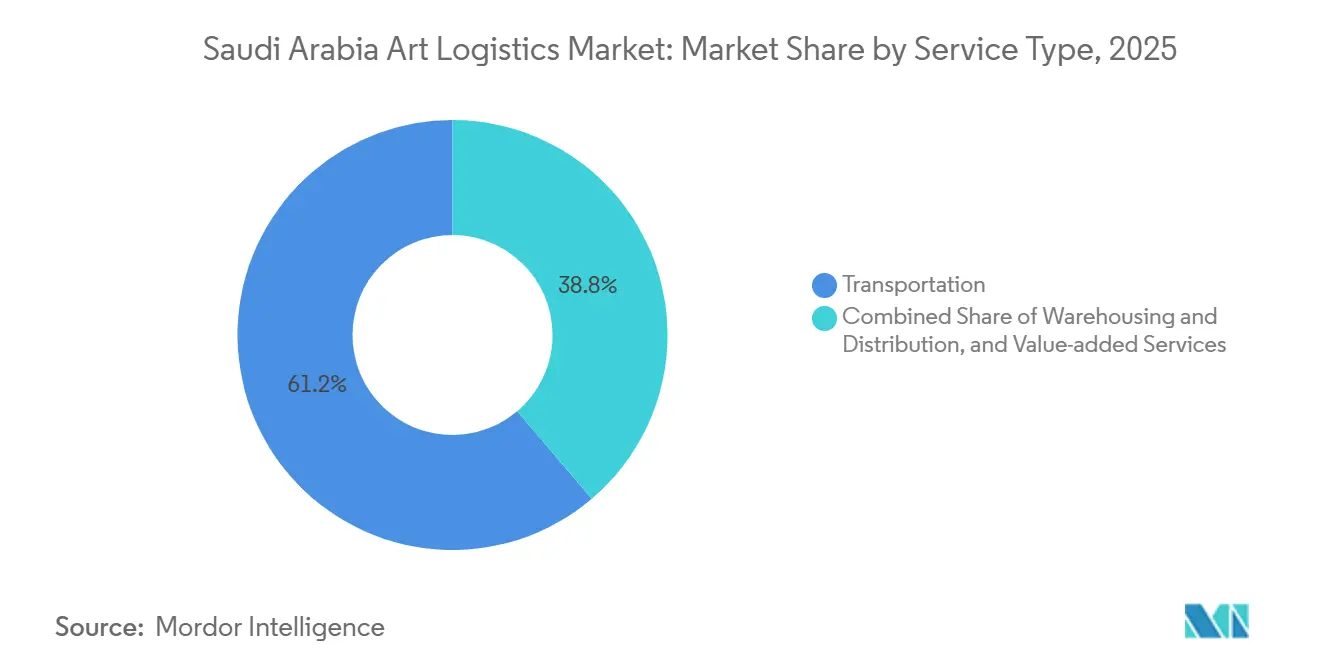
- By service type, transportation led with 61.21% of the Saudi Arabia art logistics market size in 2025, while value-added services are forecast to expand at a 7.20% CAGR to 2031.
- By application, art dealers and galleries held 38.67% of the Saudi Arabia art logistics market share in 2025, while museums are projected to grow at a 6.66% CAGR through 2031.
Note: Market size and forecast figures in this report are generated using Mordor Intelligence’s proprietary estimation framework, updated with the latest available data and insights as of January 2026.
Saudi Arabia Art Logistics Market Trends and Insights
Drivers Impact Analysis*
| Drivers | (~) % Impact on CAGR Forecast | Geographic Relevance | Impact Timeline |
|---|---|---|---|
| Vision 2030 Cultural-Infrastructure Investment Surge | +1.8% | National, focused on Riyadh, Jeddah, AlUla, and Diriyah | Long term (≥ 4 years) |
| Rising International and Domestic Exhibitions/Biennales | +1.4% | Nationwide events with global participation | Medium term (2-4 years) |
| Expansion of Museum-Grade Domestic Storage Capacity | +0.9% | Riyadh, Jeddah, AlUla | Medium term (2-4 years) |
| ATA Carnet Adoption Streamlining Temporary Imports | +0.7% | All land, sea, and airports | Short term (≤ 2 years) |
| SAL–GCL Exclusive Partnership Boosting Airport Capability | +0.6% | Riyadh, Jeddah, Dammam, Madinah hubs | Medium term (2-4 years) |
| Growth of Climate-Controlled Last-Mile Services for Collectors | +0.4% | Riyadh, Jeddah, emerging in AlUla | Short term (≤ 2 years) |
| Source: Mordor Intelligence | |||
Vision 2030 Cultural-Infrastructure Investment Surge
Saudi Arabia has allocated over USD 21.6 billion since the launch of Vision 2030 to build museums, galleries, and heritage sites, a capital wave that anchors long-term demand for packing, crating, and storage. Jeddah Central Project alone, a USD 19.9 billion mixed-use waterfront, will open multiple cultural venues by 2027, ensuring steady inter-city freight flows. Riyadh Art’s target of 1,000 public artworks keeps installation teams active year-round, while Noor Riyadh’s 450 light works across five festivals have normalized complex rigging and multi-site lifts. Government data show cultural GDP rising to USD 9.4 billion, validating the economic pull-through on logistics. The sustained pipeline translates into predictable, long-term revenue for the Saudi Arabia art logistics market.
Rising International and Domestic Exhibitions/Biennales
The Diriyah Biennale Foundation now runs twin biennales that together stretch from January to May in alternating years, locking in a five-month peak logistics season. Noor Riyadh’s 2025 edition welcomed 7 million visitors to 60 light artworks, creating daily shuttle requirements between six urban sites. Partnerships with Christie's and Center Pompidou highlight the mix of private and public lenders shipping works in and out under tight timelines. Each new edition restarts the cycle of customs clearing, climate-controlled warehousing, and high-reach installation. This regular cadence raises baseline volumes and underpins the Saudi Arabia art logistics market.[2]
Expansion of Museum-Grade Domestic Storage Capacity
The Red Sea Museum in Jeddah and the Black Gold Museum in Riyadh opened climate-regulated vaults in 2025, adding capacity for more than 1,300 combined objects. WSM and DHL are finalizing the country’s first bonded fine-art warehouse, giving lenders an alternative to temporary airport storage. Sadr Park’s cold rooms currently serve FMCG, yet its temperature bands prove that desert warehousing can remain within conservation ranges. Getty Conservation Institute studies show sensor-equipped crates allow broader humidity tolerances, reducing HVAC loads in harsh climates. The incremental vault space lowers outbound storage leakages to Dubai and underpins the Saudi Arabia art logistics market.
ATA Carnet Adoption Streamlining Temporary Imports
Saudi Arabia joined the ATA Carnet system in 2024, and customs now clear exhibition loans with a single carnet booklet rather than a bank guarantee. ZATCA’s five-day e-approval window has shortened dwell times for biennale lenders, and fines for late re-export encourage punctual returns. While permanent imports still face a 20.75% landed-cost burden, most exhibition loans qualify for duty-free passage, improving cost predictability. Smooth carnet processing boosts the country’s attractiveness to overseas lenders. Faster customs cycles directly raise throughput for the Saudi Arabia art logistics market.
Restraints Impact Analysis*
| Restraints | (~) % Impact on CAGR Forecast | Geographic Relevance | Impact Timeline |
|---|---|---|---|
| 15% VAT + 5% Duty Inflating Landed Cost | −0.8% | Nationwide | Medium term (2-4 years) |
| Shortage of Trained Fine-Art Handlers and Technicians | −0.5% | Riyadh, Jeddah, AlUla | Short term (≤ 2 years) |
| Documentation Delays from Cultural-Content Reviews | −0.3% | Major customs posts | Short term (≤ 2 years) |
| High Insurance Premiums for Road Transit in Desert Climate | −0.2% | Inter-city highways | Medium term (2-4 years) |
| Source: Mordor Intelligence | |||
15% VAT + 5% Duty Inflating Landed Cost
Permanent imports face a combined 20% tax burden, which raises acquisition prices for collectors and museums. For a USD 3 million Picasso, taxes add up to USD 600,000, nudging buyers toward temporary loans under ATA Carnet exemptions. Fasah e-declarations must be filed 48 hours before arrival, and extra fees apply for bonded storage after three days. The GCC Unified Customs Tariff update in 2025 adds classification complexity that can delay clearance. Higher landed costs temper the long-term expansion of the Saudi Arabia art logistics market.[3]
Shortage of Trained Fine-Art Handlers and Technicians
Museum openings have outpaced the talent pipeline, creating a deficit of certified handlers, registrars, and conservators. MiSK’s five-day masterclasses in 2025 trained only dozens of professionals, while new biennales require hundreds of technicians each season. Wrth’s two-year curation degree will not yield graduates until 2027, prolonging reliance on expatriate crews. Scarcity inflates labor costs and forces logistics firms to rotate staff between cities. The talent gap restrains service scalability in the Saudi Arabia art logistics market.
*Our forecasts treat driver/restraint impacts as directional, not additive. The impact forecasts reflect baseline growth, mix effects, and variable interactions.
Segment Analysis
By Service Type: Transportation Anchors, Value-Added Services Accelerate
Transportation held 61.21% of the Saudi Arabia art logistics market share in 2025, reflecting the constant rhythm of international freight, airport transfers, and inter-city hauls required by Noor Riyadh, the Diriyah Biennale, and the Islamic Arts Biennale. Constantine KSA’s fleet of climate-controlled trucks, each fitted with air-ride suspension and in-house GPS, moves art between airports and venues without trans-loading. SAL’s partnership with GCL provides show organizers with a single chain of custody from global origin to the Riyadh hangar, supporting full courier-on-board services. The Saudi Arabia art logistics market size for transportation services is projected to grow steadily as every new exhibition multiplies origin-destination combinations.
Value-added services are the fastest-growing segment, forecast to grow at a 7.20% CAGR to 2031, as museums demand registrar reporting, installation supervision, and conservation advice. The Red Sea Museum’s 1,000-item collection and Black Gold Museum’s 350-piece display require digital loan files, humidity tracking, and integrated insurance documentation. Crown Fine Art’s tender responses now include vibration-monitoring sensors and witness-load options to justify higher quotes. MiSK Art Institute’s registrar masterclass exposes curators to logistics paperwork, fueling professional awareness of full-cycle project management. Consequently, the proportion of non-freight revenue inside the Saudi Arabia art logistics market is set to rise.
By Application: Dealers and Galleries Lead, Museums Gain Momentum
Art dealers and galleries captured 38.67% of the Saudi Arabia art logistics market size in 2025 on the back of a maturing commercial scene highlighted by ATHR Gallery’s three venues and Hayy Jameel’s multi-disciplinary complex. Sotheby’s January 2026 Origins II sale moved 80 lots worth USD 17 million under tight climate control and neutral-delivery protocols. Christie’s Riyadh license widens competitive depth and adds outbound shipments for Dubai auctions. Private collectors increasingly request in-villa unpacking and wall-mounting, expanding the Saudi Arabia art logistics market size in the high-margin final mile.
Museums are projected to advance at a 6.66% CAGR through 2031, the fastest among applications, as the Museums Commission rolls out a national network and international loan programs. The AlUla Contemporary Art Museum’s Arduna exhibition required the fabrication of oversized crates and the provision of desert-climate storage ahead of its 2026 public launch. Future openings inside the USD 19.9 billion Jeddah Central Project and Riyadh Art’s permanent installations will deepen institutional demand. As purpose-built bonded vaults come online, museum traffic will account for a growing slice of the Saudi Arabia art logistics market share by the end of the forecast period.
Geography Analysis
Riyadh anchors the Saudi Arabia art logistics market as both the capital and the principal air-cargo hub, benefiting from SAL’s USD 400 million facility upgrades that shorten ramp-to-warehouse times and enlarge temperature-controlled zones. The city hosts Noor Riyadh and multiple Riyadh Art sub-projects, producing high-frequency intra-city moves between JAX District, King Abdulaziz Historical Center, and new subway stations that double as projection-mapping canvases. Sotheby’s and Christie’s offices in Al Faisaliah Tower drive collector traffic that translates into white-glove final-mile deliveries within the capital.
Jeddah ranks second, underpinned by the Red Sea Museum and the Islamic Arts Biennale at the Western Hajj Terminal, which together sustain a pipeline of maritime containers and air charters during the winter exhibition season. Jeddah Central Project’s museums and opera house, scheduled for significant completion by 2027, are expected to lift the city’s share of the Saudi Arabia art logistics market. Proximity to the port also enables cost-competitive sea-freight options for bulky installations, though supplementary road moves to Riyadh remain common.
AlUla is emerging as the fastest-growing geography, with the AlUla Contemporary Art Museum and the annual Desert X AlUla exhibitions creating demand spikes for bespoke crating and convoyed desert transport. Limited existing warehouse capacity pushes shippers to stage works in Riyadh or Jeddah before final overland transfer, increasing the total kilometrage handled by fine-art carriers. As new bonded storage near AlUla airport materializes, the sub-region’s contribution to the Saudi Arabia art logistics market share is expected to climb quickly through 2031.[4]
Competitive Landscape
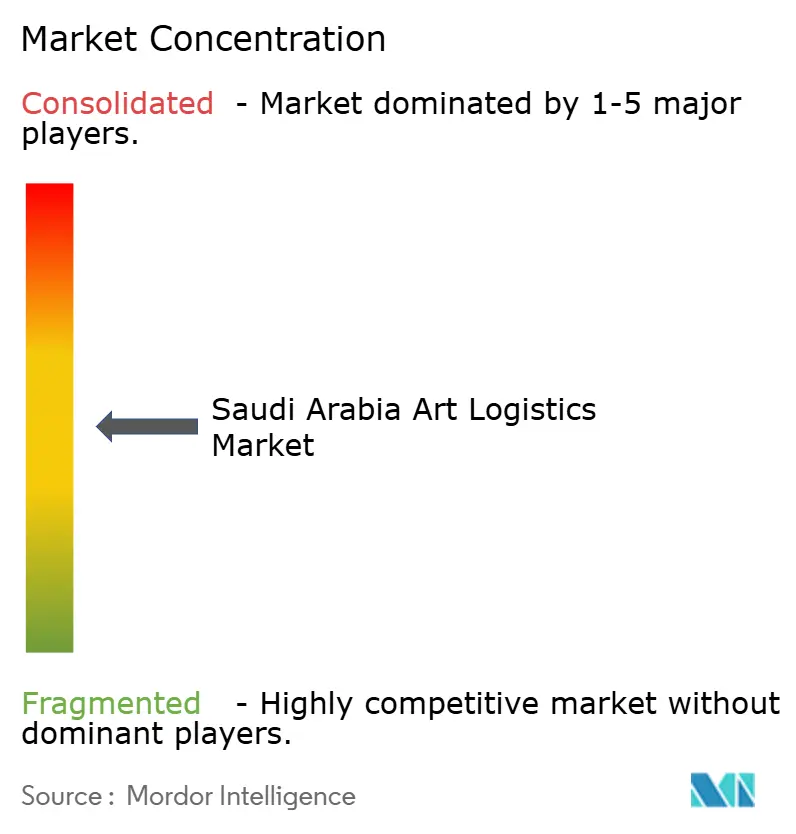
Competition centers on four capability tiers: local specialists, international fine-art firms, national cargo handlers, and global integrators. Constantine KSA leads the home-grown tier with purpose-built trucks, air-side access at all major airports, and an in-house customs desk that advertises zero hold-ups. Crown Fine Art Middle East operates across the Gulf and differentiates through Kevlar-reinforced crates and Lloyd ’s-backed insurance, courting institutions with high-value outbound loans.
SAL Saudi Logistics Services effectively holds a near-monopoly on airport ground handling and leverages its GCL alliance to offer turnkey show logistics from any global origin to Saudi venues. Its dominance reduces exhibition organizers' switching options but ensures standardized temperature controls and bonded corridors. DHL Supply Chain’s forthcoming 53,000 m² hub at Riyadh SILZ widens capacity for bonded storage, though its primary focus is technology and retail rather than fine art.
White-space opportunities persist in technology adoption. Getty Conservation Institute trials prove that crate-level sensors and real-time telemetry can relax museum climate setpoints, yet such innovations remain rare in Saudi fleets. Training-as-a-service is another gap, with MiSK and Wrth courses covering only entry-level competencies. As Vision 2030 projects come online, demand for bonded fine-art storage and accredited handlers will outstrip present supply, encouraging newcomers to specialize and intensifying the Saudi Arabia art logistics market’s competitive dynamics.
Saudi Arabia Art Logistics Industry Leaders
-
Constantine KSA
-
LOSART Company
-
Hasenkamp
-
Crown Fine Art
-
Martini Fine Art
- *Disclaimer: Major Players sorted in no particular order
Recent Industry Developments
- February 2026: The AlUla Contemporary Art Museum launched its inaugural pre-opening exhibition, Arduna, featuring over 80 major works.
- January 2026: Sotheby’s Origins II auction in Diriyah totaled USD 19.58 million and set a Saudi artist record, requiring secure last-mile deliveries.
- December 2025: Red Sea Museum launched in Jeddah with 1,000+ objects, boosting bonded storage needs.
- November 2025: DHL Supply Chain committed USD 150 million to a 53,000 m² Riyadh SILZ hub for completion in 2027.
Saudi Arabia Art Logistics Market Report Scope
| Transportation |
| Warehousing & Distribution |
| Value-added Services (Labelling, Kitting, Consulting) |
| Art Dealers and Galleries |
| Auction Houses |
| Museums |
| Art Fairs |
| Private Collectors |
| Other Applications |
| By Service Type | Transportation |
| Warehousing & Distribution | |
| Value-added Services (Labelling, Kitting, Consulting) | |
| By Application | Art Dealers and Galleries |
| Auction Houses | |
| Museums | |
| Art Fairs | |
| Private Collectors | |
| Other Applications |
Key Questions Answered in the Report
What is the current value of the Saudi Arabia art logistics market?
The market stands at USD 43.74 million in 2026 and is forecast to reach USD 57.92 million by 2031.
Which service category holds the largest share?
Transportation services command 61.21% of market revenue thanks to recurring biennales and festival cycles.
Which segment is projected to grow fastest to 2031?
Value-added services, covering condition reporting and installation supervision, are projected to expand at a 7.20% CAGR.
How will museums influence future demand?
Museum projects are set to grow at a 6.66% CAGR as the Museums Commission develops new venues and loan programs, raising demand for bonded storage and registrar services.
What tax factors impact permanent art imports?
Permanent acquisitions face a combined 15% VAT and 5% customs duty, adding a 20% premium to landed cost and influencing buyers toward temporary ATA Carnet imports.
Which airports dominate art freight?
Riyadh’s King Khalid International and Jeddah’s King Abdulaziz International dominate due to SAL’s near-monopoly on air-cargo handling and its partnership with Global Critical Logistics.