
SaaS Marketing Services Market Size and Share
Market Overview
| Study Period | 2020 - 2031 |
|---|---|
| Market Size (2026) | USD 5.72 Billion |
| Market Size (2031) | USD 14.12 Billion |
| Growth Rate (2026 - 2031) | 19.81 % |
| Fastest Growing Market | Asia-Pacific |
| Largest Market | North America |
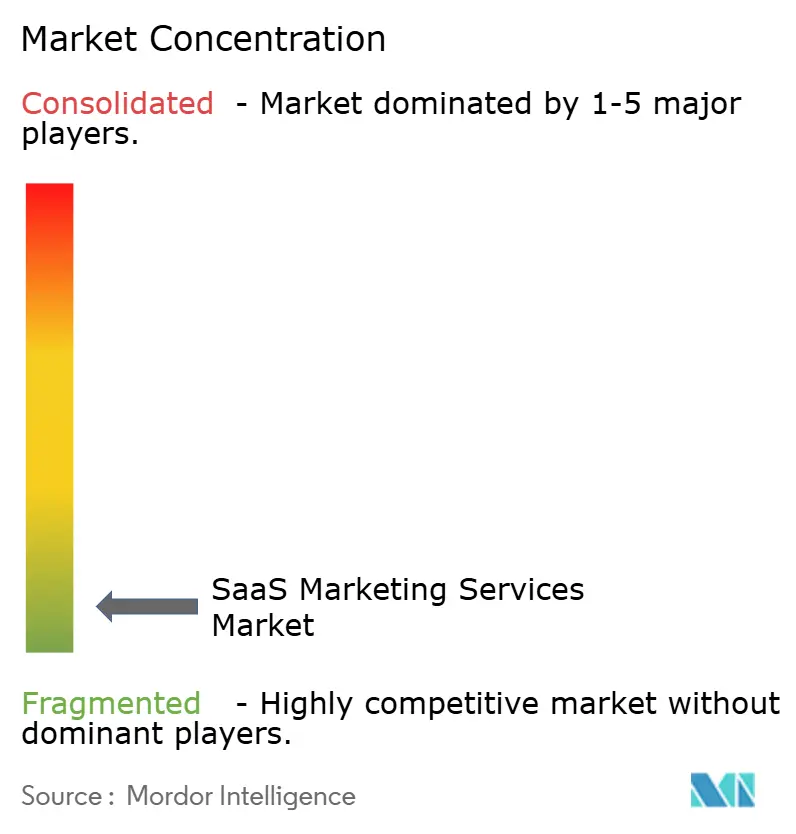
| Market Concentration | Low |
Major Players *Disclaimer: Major Players sorted in no particular order Image © Mordor Intelligence. Reuse requires attribution under CC BY 4.0. | |
SaaS Marketing Services Market Analysis by Mordor Intelligence
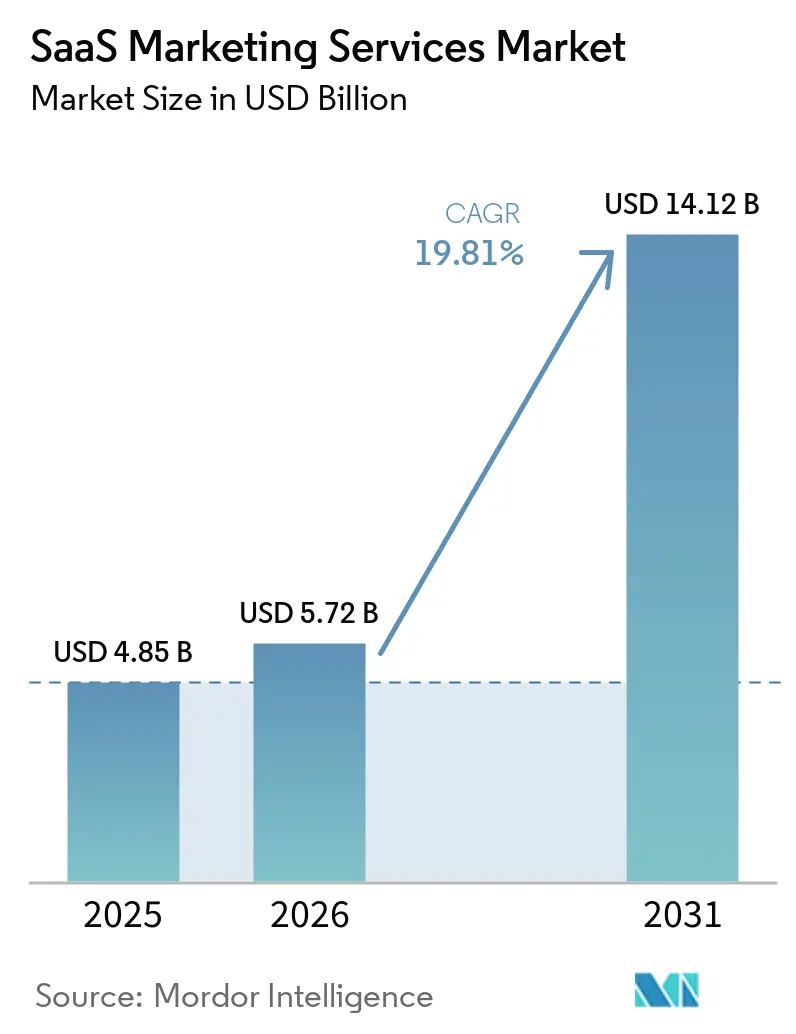
The SaaS marketing services market size was valued at USD 4.85 billion in 2025 and is estimated to grow from USD 5.72 billion in 2026 to reach USD 14.12 billion by 2031, at a CAGR of 19.81% during the forecast period (2026-2031). The SaaS marketing services market is moving toward relationships that link marketing work with pipeline and revenue outcomes. Buyers are placing more value on providers that can combine demand generation, attribution, customer lifecycle work, and revenue operations. The loss of third-party cookies and the growth of AI-based search are making campaign measurement and organic discovery harder to manage. This is expanding the scope of specialist engagements while increasing pressure on agencies to show clear commercial results. Providers that combine technical delivery with accountable reporting are better placed to retain work as clients review external spending.
Key Report Takeaways
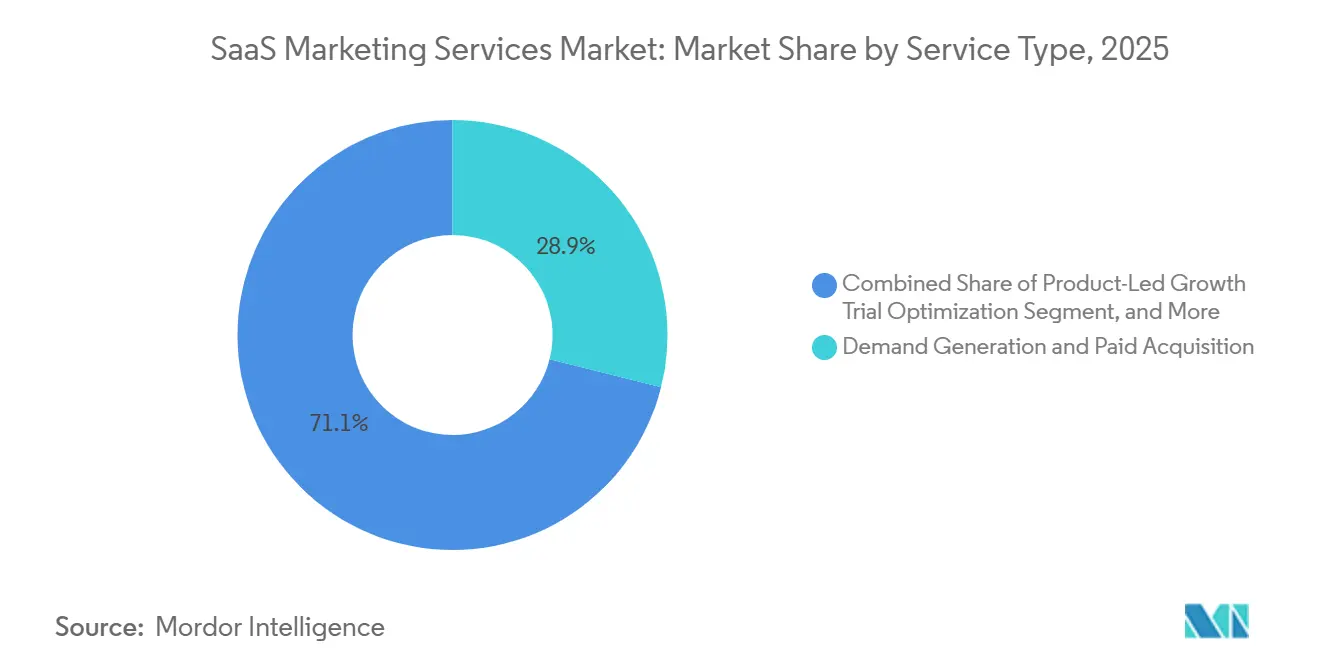
- By service type, demand generation and paid acquisition led with 28.91% of the SaaS marketing services market share in 2025, while product-led growth and trial optimization are projected to grow at a 20.75% CAGR through 2031.
- By enterprise size, large enterprises held 68.42% of the SaaS marketing services market share in 2025, while SMEs are forecast to grow at a 20.58% CAGR through 2031.
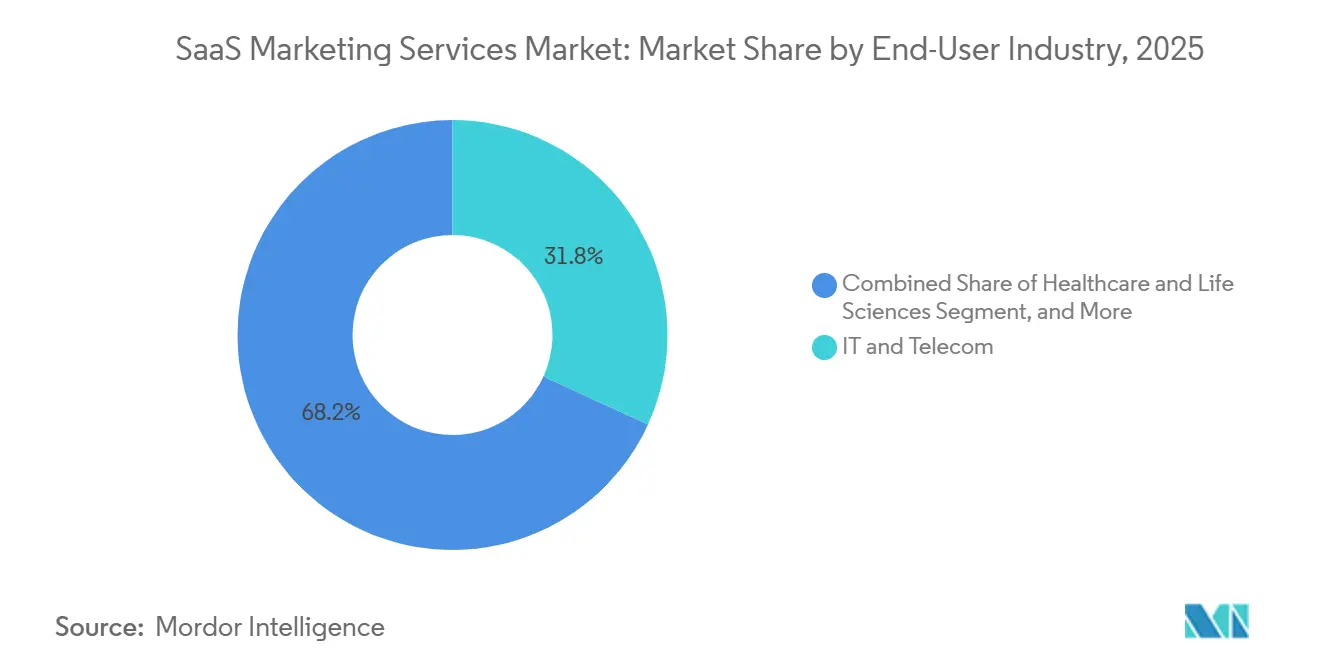
- By end-user industry, IT and telecom accounted for 31.83% of the market in 2025, while healthcare and life sciences are forecast to expand at a 20.96% CAGR through 2031.
- By geography, North America held 40.12% share in 2025, while Asia-Pacific is forecast to grow at a 20.87% CAGR through 2031.
Note: Market size and forecast figures in this report are generated using Mordor Intelligence’s proprietary estimation framework, updated with the latest available data and insights as of January 2026.
Market Trends and Insights
Drivers Impact Analysis of SaaS Marketing Services Market*
| Driver | (~) % Impact on CAGR Forecast | Geographic Relevance | Impact Timeline |
|---|---|---|---|
| Demand For Revenue-Linked Marketing Outcomes | +4.5% | Global | Medium term (2-4 years) |
| Account-Based Marketing Adoption In B2B SaaS | +3.8% | North America and Europe, with rapid expansion in Asia-Pacific | Medium term (2-4 years) |
| AI-Enabled Campaign Optimization And Content Production | +3.5% | Global | Short term (≤ 2 years) |
| Outsourcing Of Martech, SEO, And Paid Media Execution | +3.0% | North America and Europe | Short term (≤ 2 years) |
| Zero-Party And First-Party Data Re-Architecture After Cookie Loss | +2.5% | Global, with compliance complexity affecting the European Union and Asia-Pacific | Medium term (2-4 years) |
| Generative Search Discovery And AI Citation Optimization Spend | +2.0% | North America and Europe, with early adoption in Asia-Pacific | Short term (≤ 2 years) |
| Source: Mordor Intelligence | |||
Rising Demand for Revenue-Linked Marketing Outcomes
SaaS companies increasingly expect agencies to show CAC payback, pipeline contribution, and influence on net revenue retention rather than activity measures alone. The SaaS marketing services market is therefore shifting toward contracts that connect campaign work with commercial systems and sales outcomes. Gripped reported that 62% of underperforming SaaS providers viewed marketing as a cost center, while weaker alignment between marketing and finance was associated with a higher likelihood of midyear budget cuts. This requirement expands the scope of engagement because agencies must support attribution design, customer relationship management integration, and performance reporting. Providers with revenue operations capabilities can connect campaign activity to account scoring, deal progression, and closed revenue. The SaaS marketing services market is likely to favor fewer providers that can demonstrate measurable returns across these linked activities.
Accelerating Adoption of Account-Based Marketing in B2B SaaS
Account-based marketing is increasing the demand for agencies that can coordinate targeting across several buyers within the same account. The SaaS marketing services market benefits when these programs require specialist technology, content, and journey design. Inflection Group found that 70% of surveyed large-enterprise programs used AI for content creation, while 63% planned investment in AI-supported journey orchestration.[1]Inflexion Group, “New Inflexion Group Research Reveals How Account-Based Thinking Is Shaping B2B Marketing Transformation,” Inflexion Group, inflexiongroup.com The same study reported that nearly 20% of large-enterprise marketing budgets were dedicated to account-based marketing, and only 37% of teams handled activation fully in-house. These programs make agency relationships more integrated because delivery depends on the client’s revenue technology and account data. This favors service providers that can operate across strategy, execution, and measurement rather than offering isolated campaign support.
Artificial Intelligence-Enabled Campaign Optimization and Content Production
AI is changing content production, audience targeting, and campaign measurement in the SaaS marketing services market. It gives agencies that use automation effectively a way to improve speed while preserving accountability for results. BCG reported that 86% of CMOs believed creative agencies were not yet using AI at scale, which indicates a gap between client expectations and agency delivery. The report also stated that many CMOs expected AI to manage most media workflows within 2 to 3 years. Agencies can use automated workflows to reduce time spent on repetitive production and campaign management tasks. The SaaS marketing services market is consequently placing more value on providers that pair AI-enabled delivery with responsible oversight and transparent measurement.[2]LeanData, “B2B State of Martech and Revenue Operations 2026,” LeanData, leandata.com
Greater Outsourcing of Martech, Search Engine Optimization, and Paid Media Execution
Marketing technology administration, paid media operations, and technical search work continue to exceed the capacity of many internal SaaS teams. This supports external demand for providers that manage specialized tools and operational processes. Gartner reported that paid media accounted for 30.6% of total marketing budgets and marketing technology for 22% in its 2025 CMO spending survey. Companies are more likely to retain strategic positioning and go-to-market planning internally while assigning technical execution to outside specialists. This creates demand for both advisory engagements and execution-focused contracts in the SaaS marketing services market. European AI compliance requirements can further increase the need for outside support where internal teams do not have governance resources.
Restraints Impact Analysis of SaaS Marketing Services Market*
| Restraint | (~) % Impact on CAGR Forecast | Geographic Relevance | Impact Timeline |
|---|---|---|---|
| Budget Scrutiny and Longer Vendor Approval Cycles | -3.2% | Global | Short term (≤ 2 years) |
| In-House Teams and Automation Platforms Replacing Agency Scope | -2.8% | North America and Europe | Medium term (2-4 years) |
| Weak Product Instrumentation Limiting Product-Led Growth and Lifecycle Returns | -1.6% | Global | Medium term (2-4 years) |
| Attribution Blind Spots Across Dark Social and Multi-Stakeholder Buying | -1.2% | Global | Long term (≥ 4 years) |
| Source: Mordor Intelligence | |||
Budget Scrutiny and Longer Vendor Approval Cycles
Budget scrutiny is the most immediate constraint on demand for external SaaS marketing services. Gartner found that 39% of CMOs planned to reduce agency budgets in 2025, including by reducing the number of relationships, renegotiating contracts, and narrowing the scopes of work. This climate makes finance leaders more likely to require proof of revenue impact before approving an engagement. Longer evaluations can weaken the economics of winning new work, especially for smaller specialist providers. The pressure is strongest for recurring retainers that need senior financial approval. The SaaS marketing services market remains exposed to this constraint until providers can demonstrate outcomes that justify their cost relative to in-house alternatives.
In-House Teams and Automation Platforms Replacing Agency Scope
Lower-cost marketing technology and accessible AI tools allow some in-house teams to assume work that was previously outsourced. Gartner reported that 22% of CMOs said generative AI allowed reduced reliance on external agencies for creative and strategic work. The first areas affected are content production and basic paid media management, where automation reduces manual work. The risk is usually scope compression rather than complete replacement of agencies. Complex needs such as attribution architecture, account-based marketing orchestration, and generative search strategy remain more difficult to internalize. The SaaS marketing services market will favor providers that demonstrate how automation improves client productivity rather than treating it as a substitute for service redesign.
*Our forecasts treat driver/restraint impacts as directional, not additive. The impact forecasts reflect baseline growth, mix effects, and variable interactions.
SaaS Marketing Services Market Segment Analysis
By Service Type:
Demand Generation Leads While Product-Led Growth ExpandsDemand generation and paid acquisition accounted for 28.91% of the market in 2025, making it the largest service category in the SaaS marketing services market. Rising acquisition costs sustain demand for agencies that manage paid programs and protect the cost of qualified leads. Product-led growth and trial optimization is the fastest-growing service line, with a 20.75% CAGR projected through 2031. Perspective AI reported that AI onboarding tools increased activation rates by 41%, reduced time to first value by 64%, and improved top-quartile trial-to-paid conversion from 32% in 2024 to 38.2% in 2026. These changes extend agency work beyond campaign acquisition to include onboarding and early customer experience.[3]Perspective AI, “State of AI Onboarding 2026: SaaS Companies See 41 Percent Activation Lift After Replacing Forms,” Perspective AI, getperspective.ai
Strategy and go-to-market advisory often establishes the basis for later demand generation, lifecycle, and revenue operations work. Lifecycle marketing and customer expansion are gaining importance as mature SaaS providers direct more budget to programs after the initial sale. Revenue operations and attribution are high-value categories in which internal teams cannot connect campaign touchpoints to opportunity and revenue data. LeanData identified attribution architecture as a leading operational gap in enterprise go-to-market maturity in its 2026 survey. Organic growth and website conversion work are also being redesigned around structured data, AI-readable content, and citation visibility.



By Enterprise Size:
Large Enterprises Lead as SMEs Adopt Fractional SupportLarge enterprises held a 68.42% share in 2025, supported by large contracts covering account-based marketing, demand generation, lifecycle marketing, and revenue operations. Their mandates require integration across customer relationship management, marketing technology, and performance reporting systems. Inflection Group found that 86% of large enterprises reported the same or higher account-based marketing budget year over year in 2026. The resulting work supports recurring service relationships with dedicated teams and complex attribution requirements. Procurement standards also make reporting quality and systems integration central to the enterprise's position in the SaaS marketing services market.
SMEs are forecast to grow at a 20.58% CAGR through 2031, ahead of the overall SaaS marketing services market size. They need broad marketing capabilities without the fixed cost of a large internal team. Fractional chief marketing officer and execution-as-a-service models provide access to strategic and multichannel support, as described by Kalungi for B2B SaaS businesses. These companies increasingly outsource trial optimization, onboarding personalization, and product-qualified lead scoring as they move beyond product-market fit. AI-supported delivery can reduce the minimum viable cost of specialist support and widen the buyer base for boutique providers.
By End-User Industry:
IT and Telecom Leads as Healthcare and Life Sciences AccelerateIT and telecom accounted for 31.83% of the market in 2025, making them the largest end-user category in the SaaS marketing services market. The sector relies on account-based marketing, technical content, and multichannel demand generation to develop an enterprise pipeline. Capgemini found that 65% of enterprises expected technology providers to coordinate an ecosystem of IT, software, integrators, and hyperscalers, while 35% believed this expectation was met. This gap creates a need for clearer positioning and related content. Long evaluations and complex buying groups sustain work across lead creation and sales enablement.
Healthcare and life sciences are projected to grow at a 20.96% CAGR through 2031. Digital health platforms and privacy expectations are increasing the demand for specialized delivery. Amsive and Freshpaint reported that healthcare organizations were adapting to privacy-first attribution infrastructure while managing a measurement challenge.[4]Amsive and Freshpaint, “The State of Healthcare Marketing in 2026,” Amsive, amsive.com FINN Partners identified lead generation, brand awareness, and generative search engine optimization as the leading health IT marketing challenges in 2026. BFSI, retail and e-commerce, automotive, and media and entertainment add further specialized demand as software adoption develops in those verticals.
Geography Analysis
North America SaaS Marketing Services Market
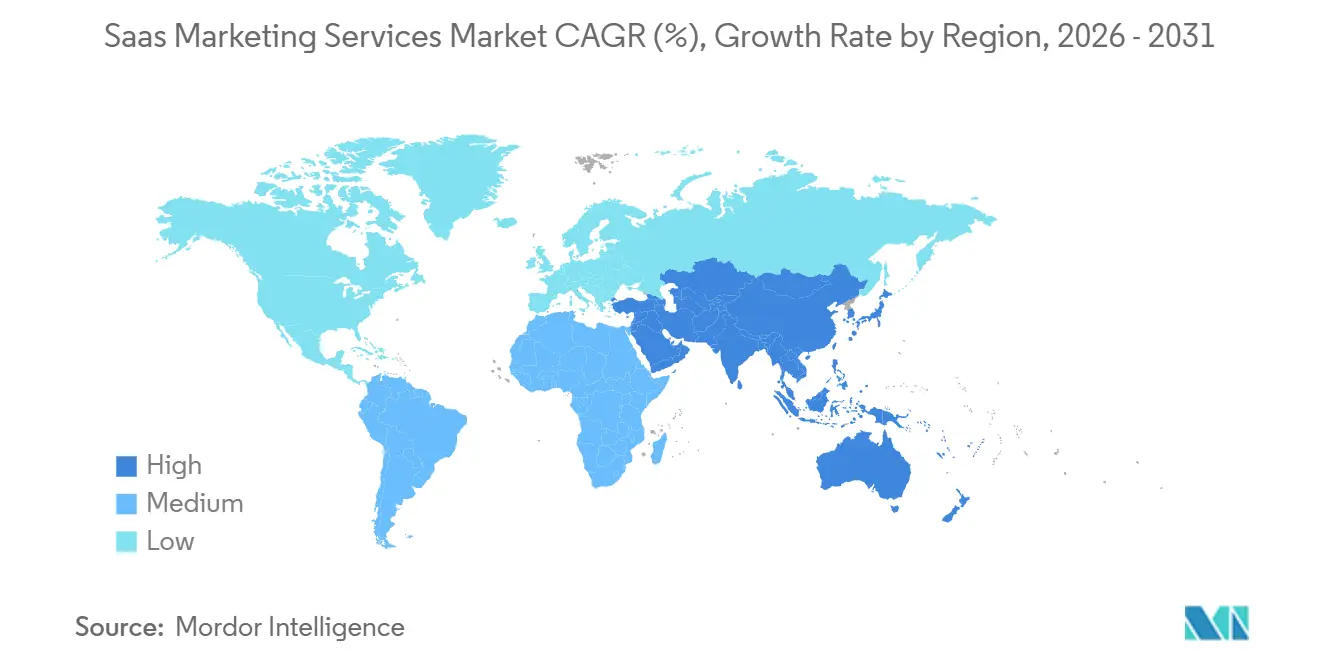
North America held 40.12% share in 2025 and remains the largest regional base for the SaaS marketing services market. A large concentration of B2B SaaS vendors, enterprise budgets, and account-based marketing specialists supports that position. High acquisition costs and extensive use of marketing technology sustain demand for providers that improve pipeline efficiency. These conditions support broad relationships across paid media, content, lifecycle programs, and revenue operations.
APAC SaaS Marketing Services Market
Asia-Pacific is projected to grow at a 20.87% CAGR through 2031, the fastest regional rate. SaaS adoption and a maturing agency base in India and Singapore support regional demand. ISG reported that Asia-Pacific XaaS spending reached USD 556 million in the first quarter of 2025 and was forecast to grow in 2026. India combines a SaaS delivery role with a growing domestic buyer market, while Singapore supports commercialization across Southeast Asia. Japan, South Korea, Australia, and China add demand, although data localization rules shape cross-border delivery in China.
EMEA and South America SaaS Marketing Services Market
Europe remains meaningful through the United Kingdom, Germany, France, and the Netherlands. Consent architecture, first-party data governance, and AI transparency requirements can create less discretionary agency work. GWA reported that German agency revenue declined 2.7% in 2025, although 60% of agencies expected positive conditions in 2026. South America is smaller, but Brazil shows demand across fintech, health technology, and education technology. The Middle East and Africa are earlier-stage areas where Saudi Arabia, the United Arab Emirates, Israel, South Africa, Nigeria, Egypt, and Kenya are developing SaaS ecosystems.

Competitive Landscape
The SaaS marketing services market is fragmented among providers, although client spending is becoming more concentrated. SaaS companies are reducing vendor rosters and directing work to agencies with proven measurement capability. SmartBug Media launched Point Success Media in January 2026 as a separate brand for its digital advertising business. The brand serves more than 500 service-based businesses and more than 10 franchise networks. The move shows how agencies can separate service lines while maintaining clearer positions for different buyer groups.
Directive Consulting uses its Customer Generation model to link campaign investment with closed revenue rather than marketing-qualified lead volume. Refine Labs changed ownership in 2025 when founder Chris Walker exited, and Grandin Holdings became an equity partner. These actions show how providers are adapting their commercial models to client accountability requirements. Those opportunities are particularly relevant in Asia-Pacific, South America, and the Middle East, where fractional models are not standardized at scale.
Technology-led entrants are changing the competitive conditions of the SaaS marketing services market. Metadata.io introduced MetadataONE in 2025, while Zeta Global introduced Athena for Agencies to automate media activation. Bluefish launched Agentic Campaigns in June 2026 for automated answer engine optimization and AI citation management for Fortune 500 marketers. Automated content, media, and reporting are becoming key dimensions of agency review. Providers are responding with AI-enabled delivery, customer relationship management-connected dashboards, and broader service scopes.
SaaS Marketing Services Industry Leaders
SmartBug Media, Inc.
Directive Consulting, Inc.
Refine Labs, LLC
Ironpaper, Inc.
Kalungi, Inc.
- *Disclaimer: Major Players sorted in no particular order
SaaS Marketing Services Market Companies Covered in this Report
- SmartBug Media, Inc.
- Kalungi, Inc.
- Directive Consulting, Inc.
- Ironpaper, Inc.
- Refine Labs, LLC
- Bay Leaf Partners, LLC
- Gripped Ltd
- SimpleTiger LLC
- Powered by Search Inc.
- Single Grain LLC
- Omniscient Digital, LLC
- Hey Digital OÜ
- Growthcurve Ltd
- Enlmtd Group
- Unfoldify Inc.
- SledPull LLC
- Paul Sullivan Marketing Limited
- Queens Digital Agency Inc.
- TimeZ Marketing, Inc.
- Maxiality B.V.

Recent Industry Developments in SaaS Marketing Services Market
- 2026: Bluefish, an agentic marketing platform, launched Agentic Campaigns for Fortune 500 marketers, enabling automated answer engine optimization and AI citation management across ChatGPT, Claude, Gemini, and Perplexity. The launch introduced a scalable, structured GEO campaign management capability to the enterprise SaaS marketing segment, a service category that had no dedicated managed-service equivalent before 2026. It also signaled the productization of AI citation as a billable line item in SaaS marketing programs, as enterprise teams seek a coordinated way to manage AI discovery rather than treating it as an isolated content task.
- February 2026: SmartBug Media was named North American Partner of the Year in HubSpot's 2025 Performance Impact Awards for the 2nd consecutive year, its 4th win in 8 years. The recognition underscored SmartBug's AI-integrated RevOps-aligned service architecture and its role as a benchmark provider in the HubSpot-native SaaS marketing segment across healthcare, manufacturing, finance, and technology clients. It also reflected the continuing importance of platform partnerships for providers whose work combines website, customer relationship management, and demand generation delivery.
- January 2026: SmartBug Media launched Point Success Media, spinning off its digital advertising division as an independent brand managing digital advertising programs for more than 500 service-based businesses and serving as a preferred partner for more than 10 franchise networks. The spin-off reflected the broader agency trend of separating service portfolios into distinct brand identities for different buyer profiles as AI reshapes advertising delivery models. It allowed the business to serve varied advertising requirements without changing the specialist positioning of the core SmartBug brand.
- July 2025: Refine Labs completed a structural ownership change. Founder Chris Walker sold his remaining shares and exited the business, and CEO Megan Bowen assumed majority ownership with investment from Grandin Holdings. The equity transaction was among the first institutional capital events in the specialist B2B SaaS demand generation agency niche. It signaled the segment's maturation from founder-led practices toward institutionally scalable business structures and gave the provider a different basis for expanding beyond its earlier operating model.


Global SaaS Marketing Services Market Report Scope
The SaaS marketing services market refers to professional and managed services specifically designed to help software-as-a-service (SaaS) companies acquire, convert, and retain customers. This includes specialized offerings such as go-to-market advisory, demand generation, product-led growth (PLG), trial optimization, lifecycle marketing, revenue operations (RevOps), and website conversion optimization. Unlike traditional product marketing, these services focus heavily on subscription economics, reducing churn, and driving recurring revenue through freemium models and account-based strategies. Catering to SaaS providers of all sizes across various industries, these services enable companies to optimize customer acquisition costs, accelerate time-to-value, and maximize customer lifetime value in a highly competitive digital landscape.
The SaaS Marketing Services Market Report is Segmented by Service Type (Strategy and GTM Advisory, Demand Generation and Paid Acquisition, Product-Led Growth and Trial Optimization, Lifecycle Marketing and Customer Expansion, Organic Growth Marketing, Revenue Operations and Attribution, and Website and Conversion Optimization), Enterprise Size (Large, and SMEs), End-User Industry (Retail and E-commerce, Media and Entertainment, IT and Telecom, BFSI, Healthcare and Life Sciences, Automotive, and Others (Education, Travel and Hospitality, and Industrial Manufacturing amongst Others)), and Geography (North America, South America, Europe, Asia-Pacific, Middle East, and Africa). The Market Forecasts are Provided in Terms of Value (USD).
| Strategy and GTM Advisory |
| Demand Generation and Paid Acquisition |
| Product-Led Growth and Trial Optimization |
| Lifecycle Marketing and Customer Expansion |
| Organic Growth Marketing |
| Revenue Operations and Attribution |
| Website and Conversion Optimization |
| Large |
| SMEs |
| Retail and E-commerce |
| Media and Entertainment |
| IT and Telecom |
| BFSI |
| Healthcare and Life Sciences |
| Automotive |
| Others (Education, Travel and Hospitality, and Industrial Manufacturing amongst others) |
| North America | United States |
| Canada | |
| Mexico | |
| South America | Brazil |
| Argentina | |
| Chile | |
| Rest of South America | |
| Europe | Germany |
| United Kingdom | |
| France | |
| Italy | |
| Spain | |
| Rest of Europe | |
| Asia-Pacific | China |
| Japan | |
| India | |
| South Korea | |
| Australia | |
| Rest of Asia-Pacific | |
| Middle East | United Arab Emirates |
| Saudi Arabia | |
| Qatar | |
| Rest of Middle East | |
| Africa | South Africa |
| Egypt | |
| Nigeria | |
| Rest of Africa |
| By Service Type | Strategy and GTM Advisory | |
| Demand Generation and Paid Acquisition | ||
| Product-Led Growth and Trial Optimization | ||
| Lifecycle Marketing and Customer Expansion | ||
| Organic Growth Marketing | ||
| Revenue Operations and Attribution | ||
| Website and Conversion Optimization | ||
| By Enterprise Size | Large | |
| SMEs | ||
| By End-User Industry | Retail and E-commerce | |
| Media and Entertainment | ||
| IT and Telecom | ||
| BFSI | ||
| Healthcare and Life Sciences | ||
| Automotive | ||
| Others (Education, Travel and Hospitality, and Industrial Manufacturing amongst others) | ||
| By Geography | North America | United States |
| Canada | ||
| Mexico | ||
| South America | Brazil | |
| Argentina | ||
| Chile | ||
| Rest of South America | ||
| Europe | Germany | |
| United Kingdom | ||
| France | ||
| Italy | ||
| Spain | ||
| Rest of Europe | ||
| Asia-Pacific | China | |
| Japan | ||
| India | ||
| South Korea | ||
| Australia | ||
| Rest of Asia-Pacific | ||
| Middle East | United Arab Emirates | |
| Saudi Arabia | ||
| Qatar | ||
| Rest of Middle East | ||
| Africa | South Africa | |
| Egypt | ||
| Nigeria | ||
| Rest of Africa | ||


Key Questions Answered in the Report
What is the expected growth rate for SaaS marketing services?
The sector is projected to grow at a 19.81% CAGR from 2026 to 2031, reaching USD 14.12 billion by 2031, as clients seek more measurable commercial outcomes from agency work. Growth is supported by broader needs across acquisition, onboarding, lifecycle marketing, attribution, paid media management, technical search work, and customer relationship management-linked reporting.
Which SaaS marketing service is growing fastest?
Product-led growth and trial optimization is forecast to expand at a 20.75% CAGR through 2031, reflecting greater focus on activation and trial conversion. Agencies in this area support onboarding design, personalization, product-qualified lead scoring, and the movement of trial users toward paying customer status.
Which companies are the largest buyers of SaaS marketing services?
Large enterprises held 68.42% share in 2025 because they use complex, multichannel programs, integrated reporting, and service teams that support several internal stakeholders.
Which end-user sector is expected to grow fastest?
Healthcare and life sciences is projected to grow at a 20.96% CAGR through 2031, supported by privacy, measurement, and specialized digital health marketing needs.
Which region offers the strongest growth opportunity?
Asia-Pacific is forecast to grow at a 20.87% CAGR through 2031, supported by SaaS adoption, developing provider ecosystems, and expanding domestic buyer markets.
How is AI changing SaaS agency services?
AI is changing content, media, search visibility, and measurement, increasing the value of providers that pair automation with accountable reporting and governance support.
Page last updated on:


 Your data is secure and never sold or shared.


