
Russia Pet Treats Market Size and Share
Market Overview
| Study Period | 2021 - 2031 |
|---|---|
| Forecast Data Period | 2026 - 2031 |
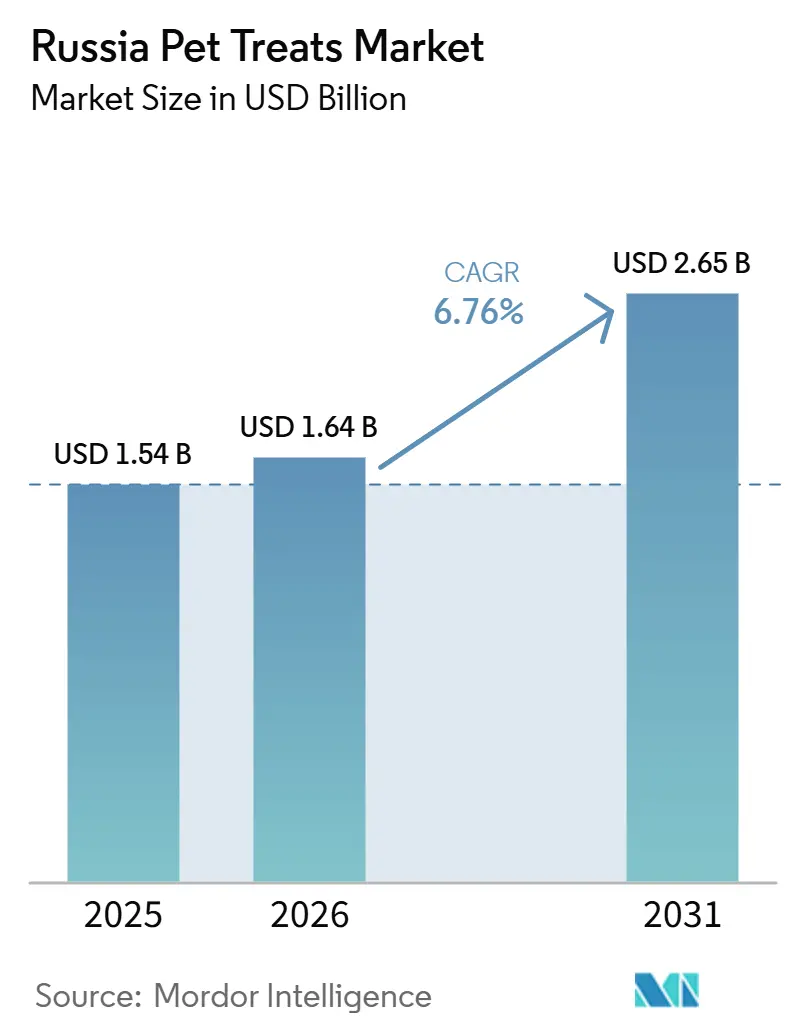
| Base Year Market Size (2025) | USD 1.54 Billion |
| Market Size (2026) | USD 1.64 Billion |
| Market Size (2031) | USD 2.65 Billion |
| Growth Rate (2026 - 2031) | 6.76 % |
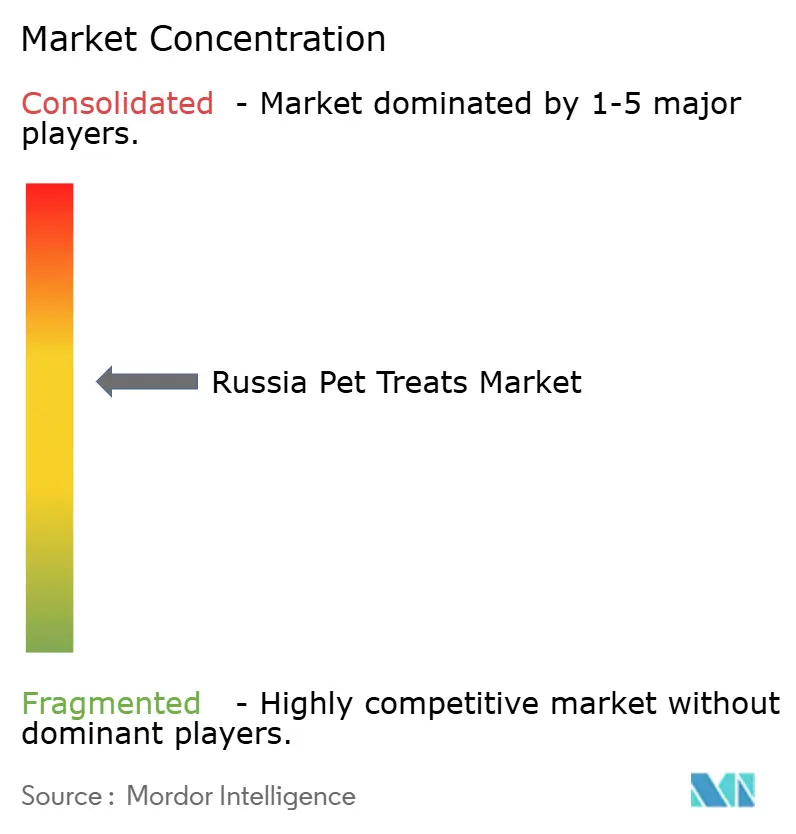
| Market Concentration | Medium |
Major Players *Disclaimer: Major Players sorted in no particular order Image © Mordor Intelligence. Reuse requires attribution under CC BY 4.0. | |
Russia Pet Treats Market Analysis by Mordor Intelligence
The Russia pet treats market size was valued at USD 1.54 billion in 2025 and USD 1.64 billion in 2026, and is estimated to grow to USD 2.65 billion by 2031 at a CAGR of 6.76% during 2026-2031. The category continues to benefit from steady household attachment to pets, which keeps treat buying tied to daily care, routine interaction, and repeat purchase behavior rather than occasional discretionary use. Product mix is also moving upward as buyers show stronger interest in recipes linked to dental care, joint support, digestive comfort, and age-specific needs, which supports a healthier price structure across the Russia pet treats market. Online discovery, wider assortment visibility, and easier access to niche products continue to improve category reach, especially for premium formats that need more explanation than standard shelf products usually receive. At the same time, import substitution, local manufacturing expansion, and tighter compliance requirements are changing how companies compete, which is creating more openings for domestic producers that can scale quality, packaging, and regulatory discipline. The result is a Russia pet treats market that is still growing on clear demand fundamentals, while becoming more selective in terms of product credibility, channel fit, and execution quality.
Key Report Takeaways
- By sub-product, crunchy treats were the largest segment with 23.8% of the Russia pet treats market share in 2025, while freeze-dried and jerky treats are the fastest-growing segment with a 7.6% CAGR through 2031.
- By pet type, dogs were the largest segment, accounting for 58.3% of the Russia pet treats market size in 2025, while cats are the fastest-growing segment with a 7.4% CAGR through 2031.
- By distribution channel, supermarkets and hypermarkets were the largest segment, accounting for 48.2% of the Russia pet treats market in 2025, while the online channel is the fastest-growing segment, with a 7.5% CAGR through 2031.
Note: Market size and forecast figures in this report are generated using Mordor Intelligence’s proprietary estimation framework, updated with the latest available data and insights as of January 2026.
Russia Pet Treats Market Trends and Insights
Drivers Impact Analysis*
| Driver | (~) % Impact on CAGR Forecast | Geographic Relevance | Impact Timeline |
|---|---|---|---|
| Rising pet humanization and treat feeding frequency | +2.3% | National, with strongest commercial intensity in Moscow, Saint Petersburg, and Yekaterinburg | Short term (≤ 2 years) |
| Premiumization of health-linked treats | +1.6% | Urban Russia, led by tier-1 cities with gradual expansion into secondary cities | Medium term (2-4 years) |
| E-commerce expansion and digital shelf access | +1.4% | National, supported by marketplace reach into tier-2 cities | Short term (≤ 2 years) |
| Domestic production expansion and import substitution | +1.0% | National, with production centered in Belgorod, Kaluga, Kursk, and Novosibirsk regions | Medium term (2-4 years) |
| Local private label acceleration under price polarization | +0.8% | National, especially in hypermarkets and broad grocery retail | Short term (≤ 2 years) |
| Aging dog population and senior-specific treat demand | +0.6% | National, with stronger demand concentration in dense urban areas | Long term (≥ 4 years) |
| Source: Mordor Intelligence | |||
Rising Pet Humanization and Treat Feeding Frequency
Pet ownership in Russia increasingly supports frequent treat use because treats are now tied to affection, routine interaction, training, and everyday reward behavior across urban and non-urban households. This shift matters because categories linked to emotional care usually hold their place in the basket even when buyers become more selective in other discretionary areas. In the Russia pet treats market, this pattern supports repeat demand across both value and premium price bands, since households do not approach every treat purchase as a special occasion. It also broadens the role of treats beyond simple snacking, which makes format innovation more relevant for age, texture, flavor, and health positioning. The scale of the pet base further strengthens this pattern because a large installed population gives producers a wide recurring demand pool to work against over the forecast period. As a result, the Russia pet treats market benefits from a behavioral base that is steadier than one built only on novelty or seasonal purchasing.
Premiumization of Health-Linked Treats
The Russia pet treats market is also moving toward a better product mix as more buyers connect treat selection with visible health benefits and ingredient credibility. Dental care, digestive support, skin and coat support, and joint-focused recipes are gaining a stronger commercial role because these positions fit the broader shift toward preventive pet care. Freeze-dried, jerky, and function-led soft chew formats are especially well placed because they combine higher perceived value with clearer use cases that consumers can understand quickly. This shift supports price realization because buyers are more willing to accept premium pricing when a product appears to solve a recognizable everyday need. It also raises the quality threshold for producers because health-linked formats require stronger formulation discipline, better packaging communication, and more consistent production standards. In practical terms, premiumization is expanding the value captured per purchase in the Russia pet treats market, even where total unit growth remains uneven across regions.
E-Commerce Expansion and Digital Shelf Access
Digital retail continues to improve reach and product visibility across the Russia pet treats market because online shelves are not limited by the same space constraints that shape store assortments. This matters most for niche products, premium recipes, and specialized formats that usually need more room for product explanation than a supermarket shelf can provide. Online listings also help buyers compare ingredients, texture, feeding purpose, and life-stage suitability before purchase, which is useful in a category where trust and repeatability are important. For smaller and local brands, digital access lowers the barrier to nationwide visibility because physical rollout costs are no longer the only path to category presence. That has widened the competitive field while also supporting faster adoption of premium and specialized products that might otherwise remain limited to a few metropolitan stores. The Russia pet treats market therefore gains both distribution breadth and product depth from online growth, even as physical retail remains central for mass-volume sales.
Domestic Production Expansion and Import Substitution
Import substitution remains a meaningful support factor because local manufacturing gives the Russia pet treats market more control over supply continuity, pricing flexibility, and production response times. As domestic pet food capacity has expanded, the operating base for treat-adjacent production has also become broader, which helps companies adapt existing capabilities toward higher-value snack formats. This matters because treats often need packaging precision, texture consistency, and shorter innovation cycles than commodity dry food lines typically require. Local production also reduces some of the exposure to external supply disruptions, especially where retailers need stable fill rates for nationally distributed products. At the same time, a larger domestic base makes private label expansion easier because retailers can source more directly from Russian manufacturers with closer lead times and lower freight pressure. Over time, this gives the Russia pet treats market a stronger local operating foundation and makes competition less dependent on imported finished goods.
Restraints Impact Analysis*
| Restraint | (~) % Impact on CAGR Forecast | Geographic Relevance | Impact Timeline | ||
|---|---|---|---|---|---|
| Sanctions-driven input and logistics disruptions | -0.80% | National, with highest exposure among producers dependent on imported specialty ingredients | Medium term (2-4 years) | ||
| Price sensitivity and trading down in routine purchases | -0.60% | National, especially in tier-2 and tier-3 cities and lower-income urban areas | Short term (≤ 2 years) | ||
| Limited cold-chain and specialty distribution outside major cities | -0.40% | Siberia, the Far East, and secondary cities beyond the Urals | Long term (≥ 4 years) | ||
| Regulatory scrutiny on functional and health claims | -0.30% | National, with stronger pressure on small and midsized manufacturers | Medium term (2-4 years) | ||
| Source: Mordor Intelligence | |||||
Sanctions-Driven Input and Logistics Disruptions
The Russia pet treats market still faces high costs and planning challenges due to disruptions in external sourcing, as many specialized ingredients remain more difficult to secure than standard local inputs. Premium and functional formats are the most exposed because they depend on precise premixes, palatants, proteins, and micronutrient systems that are harder to replace without affecting product performance. Longer lead times can reduce producers' flexibility when running broader assortments or launching specialized stock-keeping units (SKUs) at scale. Higher landed costs also narrow the margin space in a category where consumers can still trade down if pricing moves too far ahead of perceived value. This pressure does not remove demand, but it slows how quickly certain premium layers of the Russia pet treats market can expand outside the strongest urban spending pockets. It also makes formulation discipline and supplier management more important competitive capabilities than they were before. A Rosselkhoznadzor letter issued in April 2025 tightened sampling requirements for imported feed additives of mixed plant and animal origin, which added another compliance layer for imported functional inputs. These factors weigh most heavily on premium products, where precise formulation and ingredient-specific claims remain central to brand positioning[1]Source: Rosselkhoznadzor, “On the Need to Adjust Sampling of Foreign-Produced Feed Additives,” Federal Service for Veterinary and Phytosanitary Surveillance, consultant.ru .
Price Sensitivity and Trading Down in Routine Purchases
Price sensitivity remains a restraint because the Russia pet treats market is not uniform in its ability to absorb premium pricing across all household types and regions. Many buyers still keep treats in the basket, but they may change brand, reduce pack size, or shift from mid-tier branded products to entry-level or retailer-owned alternatives. This affects the pace of premium penetration, especially in cities where everyday spending pressure is more visible and pet care budgets are managed more tightly. The result is a category that can still grow while carrying more mix pressure than volume pressure. Producers without clear health, ingredient, or channel differentiation are more exposed because they struggle to justify higher prices in a routine purchase setting. In this sense, the restraint acts more as a cap on pricing power within the Russia pet treats market than as a direct block to category demand.
*Our forecasts treat driver/restraint impacts as directional, not additive. The impact forecasts reflect baseline growth, mix effects, and variable interactions.
Segment Analysis
By Sub-product: Freeze-Dried Formats Gain Ground in Premium Treats
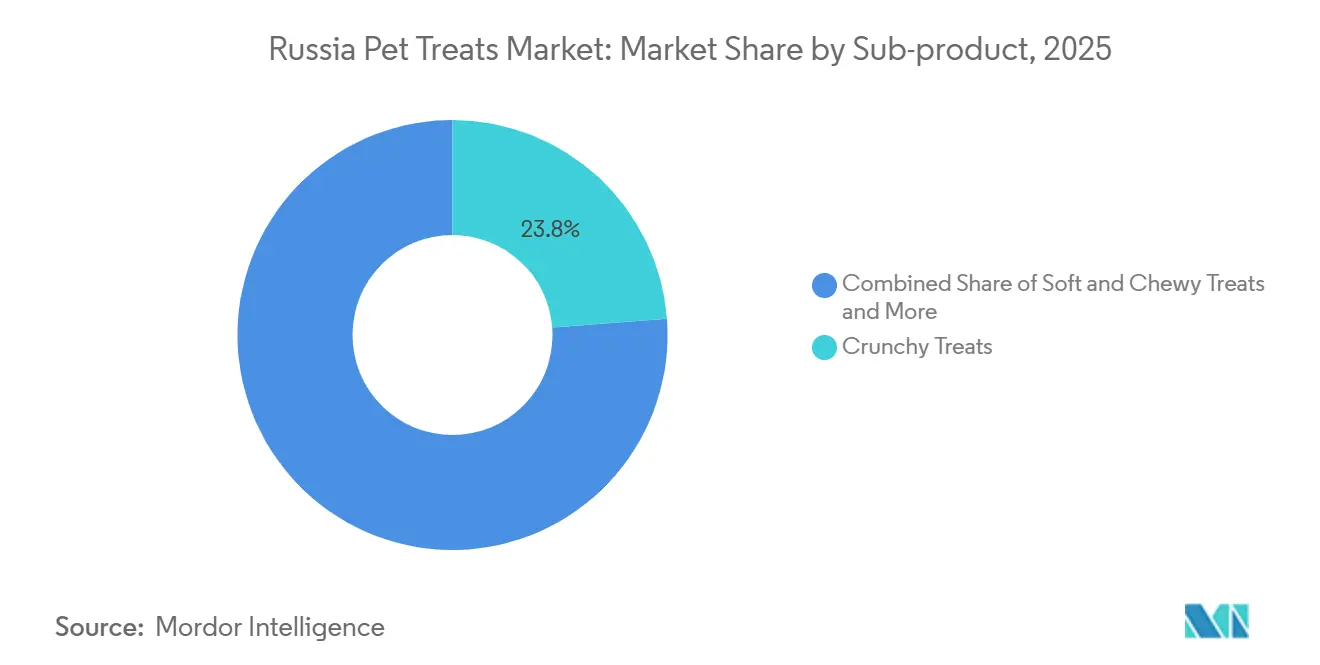
Crunchy treats were the largest sub-product in 2025, with 23.8% of the Russia pet treats market share, while freeze-dried and jerky treats were the fastest sub-product at a 7.6% CAGR through 2031. The largest position came from broad price accessibility, stronger supermarket visibility, and long-standing buyer familiarity across mass retail. In the Russia pet treats industry, crunchy formats fit repeat household buying because they are easy to stock and price, and are widely understood by first-time buyers. Freeze-dried and jerky products, by contrast, advanced faster because they matched demand for simple ingredients, dense nutrition, and premium feeding routines.
Soft and chewy treats held a durable place in training and daily bonding, especially among dog owners in urban apartments where reinforcement-based feeding is common. Dental treats stayed important because veterinary-backed oral care claims supported higher price points in specialty and clinic-linked channels. Other treat types, including cream-style, yogurt-based, and interactive novelty formats, gained attention online as innovation widened in the Russia pet treats market. The pace of discovery was stronger on digital channels, helping newer sub-products find buyers faster than they typically would in store-led rollouts.



By Pets: Dogs Lead Volume as Cat Segment Accelerates
Dogs were the largest pet segment in 2025, accounting for 58.3% of the Russia pet treats market, while cats were the fastest-growing segment with a 7.4% CAGR through 2031. The dog segment was supported by Russia’s 25.5-26.0 million domestic dogs and by stronger per-animal spending in urban households. Dog treats also held a strong position in specialty stores, where advice-driven purchases and breed-specific needs mattered more. Another support factor for dogs was the growing demand for age-specific products, including joint, dental, and cognitive support for senior animals.
Cats grew faster because Russia had 49.2 million cats, the largest base in Europe, which widened the long-run addressable demand pool. ZooInform reported that cat food spending reached RUB 132 billion (USD 1.6 billion) in the first half of 2025, compared with RUB 45 billion (USD 0.5 billion) for dog food, indicating a wider spending base for cats. Non-specialized retail accounted for 65.6% of cat treat sales by value, embedding many cat treat purchases in routine grocery shopping. Other pets remained a small niche, but they continued to attract specialized manufacturers serving enthusiast demand with small-batch offerings.
By Distribution Channel: Online Platforms Gain as Supermarkets Lead Volume
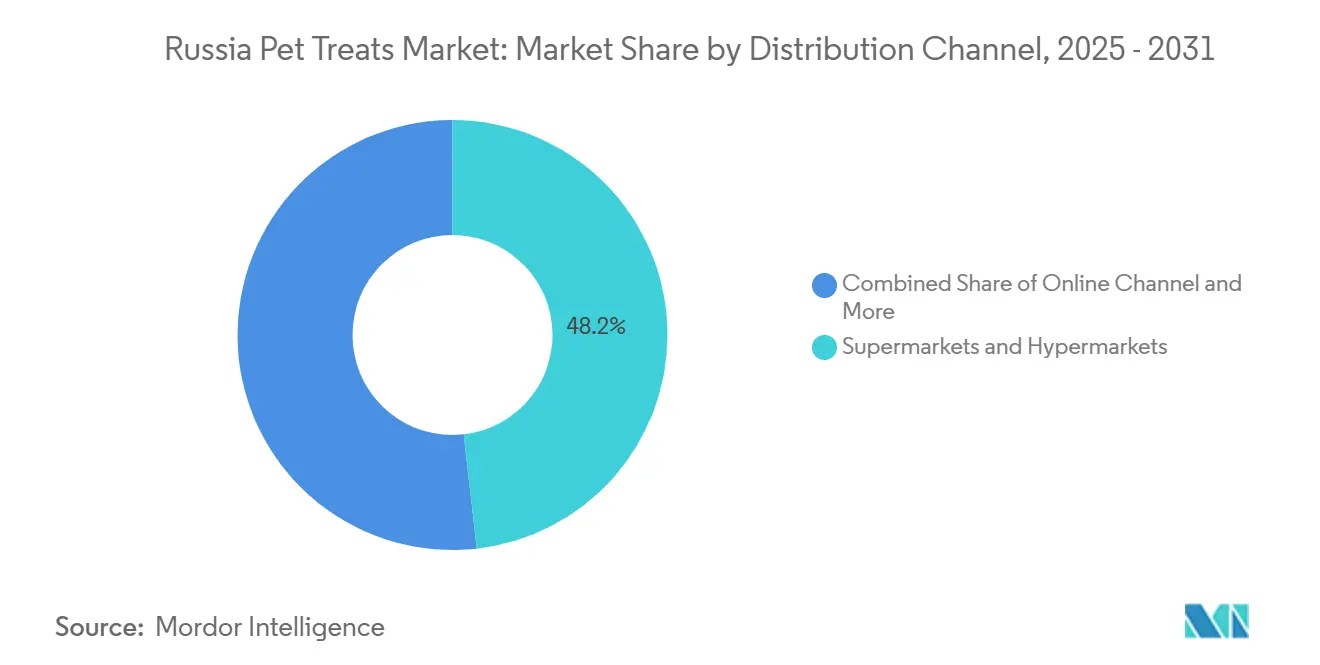
Supermarkets and hypermarkets were the largest distribution channel in 2025, accounting for 48.2% of the Russia pet treats market, while the online channel was the fastest-growing, with a 7.5% CAGR through 2031. Their largest position reflected the fact that mainstream consumers still added treats during routine grocery trips rather than making separate specialty shopping trips. Non-specialized retail accounted for 56.2% of total Russian pet product sales value in 2025, reinforcing the scale advantage of broad grocery distribution. Private label expansion by chains such as Pyaterochka and Lenta widened access while increasing margin pressure on mid-tier branded suppliers.
The online channel advanced faster because it offered a wider assortment and improved visibility for functional, freeze-dried, and niche cat products. In the Russia pet treats industry, digital retail reduced the need for immediate physical shelf space and helped smaller brands reach national demand clusters more efficiently. Specialty stores still mattered for premium and veterinary-adjacent formats because in-store guidance remained important for conversion in more technical sub-categories. Convenience stores remained minor, but they still served as impulse-purchase outlets in dense metropolitan areas near clinics and transport corridors.
Geography Analysis
Russia made it the largest single-country position in the region and set the scale backdrop for the Russia pet treats market. Moscow, Saint Petersburg, and Yekaterinburg served as the main premium consumption centers because average pet product basket values in these cities were higher than those in many other large Russian cities. Premium formats such as freeze-dried treats, dental products, and life-stage-specific recipes moved faster in these cities because veterinary access, specialty retail density, and e-commerce fulfillment were stronger. That concentration gave suppliers a profitable urban base, but it also meant premium sales were still uneven across the national footprint. In practical terms, the largest premium demand pools were still metropolitan rather than broadly national.
An estimated 60-70% of specialty pet food and treat sales were concentrated in Moscow and Saint Petersburg, which showed how much the premium layer still depended on a few urban centers. Secondary cities such as Novosibirsk, Krasnodar, Nizhny Novgorod, Kazan, and Yekaterinburg formed the fastest-expanding frontier because online channels and domestic supply helped close availability gaps. The production corridor across Belgorod, Kaluga, Kursk, and Novosibirsk improved supply reach into those markets at a lower logistics cost than imported alternatives. Siberia and the Far East still faced the strongest access constraints, especially for cold-chain dependent and premium specialty formats.
Russia exported 106,000 metric tons of pet food worth USD 256 million in 2025, which strengthened its role as a regional supply hub within the Eurasian Economic Union (EAEU) trade space[2]Source: Pet Food Industry Editorial Team, “Russia Sets Pet Food Export Record as Domestic Oversupply Looms,” Pet Food Industry, petfoodindustry.com. Belarus alone received 54,000 metric tons valued at USD 176 million, underscoring the importance of nearby markets for export absorption. Russia’s digital labeling model for pet food and treats also began to shape trade alignment across Belarus, Kazakhstan, and Armenia, which could influence future product movement standards in the region. This broader regional role supports manufacturing depth, but domestic premium consumption remains far more concentrated than national production capacity.
Competitive Landscape
The Russia pet treats market was moderately concentrated at the premium and mid-market levels in 2025. Nestlé S.A. (Purina) committed RUB 12 billion (USD 143.5 million) to expand its Vorsino facility in the Kaluga region, reflecting long-term confidence in local production. This investment also signaled a broader strategy to strengthen domestic manufacturing capacity amid evolving trade conditions. VAFO Group a.s. and Aller Petfood A/S maintained their presence through established distribution channels and super-premium positioning targeted at urban buyers. Both companies continued to differentiate their offerings through product quality and brand reputation rather than price competition. As a result, the Russia pet treats market was divided between established premium players and a more fragmented value tier, where domestic and smaller regional brands competed primarily on price and availability.
Domestic companies became more active in product expansion and capacity building. Limkorm Group launched treats, specialty vitamins, and veterinary diet lines developed with Russian veterinary specialists, which showed that local firms were moving beyond economy dry food into more specialized categories. MIRATORG launched canned pet food in quarter 1 (Q1) 2025 at its Kursk Oblast site, which showed that vertically integrated meat groups now see companion animal nutrition as a meaningful adjacent category. APK Damate also filed to register the Indilite Pets trademark in 2025, which signaled another protein-backed domestic entrant with cost advantages.
Competition at the value end widened as more than 267 new pet food brands entered the market in 2024, and private-label ranges spread across major retailers. The Chestnyi ZNAK system also raised entry requirements because traceability readiness became more important for shelf access and digital listings[3]Source: Russian Government, “On Mandatory Labeling of Pet Food,” Russian Government, trts.info. FARMINA PET FOODS S.p.A. returned to the Russian market in 2025, which restored the availability of hyper-premium imported nutrition and treat-adjacent lines. White space remained strongest in senior dog treats for secondary cities, veterinary-linked functional products, and freeze-dried private label supply, but those openings sit within a market where compliance, scale, and distribution discipline now matter more than before.
Russia Pet Treats Industry Leaders
Mars, Incorporated
Nestle S.A. (Purina)
Hill’s Pet Nutrition (Colgate-Palmolive Co.)
VAFO Group a.s.
FARMINA PET FOODS S.p.A.
- *Disclaimer: Major Players sorted in no particular order

Recent Industry Developments
- June 2026: Petexpert, the production arm of Russian pet specialty retailer Chetyre Lapy, is developing a pet food production facility in the Lipetsk Special Economic Zone under an investment agreement with regional authorities. The project aims to expand local production of cat and dog food, supporting domestic manufacturing and import substitution in Russia's pet food industry.
- May 2026: Limkorm Petfood has expanded its production capacity by launching a second extrusion line at its pet food plant, increasing dry pet food production capacity to approximately 120,000 metric tons per year across its two production sites. The company also highlights a highly automated manufacturing process and contract manufacturing capabilities.
- April 2026: In 2025, Russia set a national record for pet food exports, shipping approximately 106,000 metric tons valued at USD 256 million, a 23% increase from 2024. Belarus was the largest importer, with 54,000 metric tons valued at USD 176 million. Qatar, Iraq, Jordan, and Bangladesh were first-time export destinations.


Russia Pet Treats Market Report Scope
Pet treats are commercial food products formulated specifically for pets. They are not designed to provide complete and balanced nutrition but are intended for occasional feeding as rewards, during training, or for enjoyment. The Russia Pet Treats Market Report is Segmented by Sub Product (Crunchy Treats, Dental Treats, Freeze-Dried and Jerky Treats, Soft and Chewy Treats, and Other Treats), by Pets (Cats, Dogs, and Other Pets), and by Distribution Channel (Convenience Stores, Online Channel, Specialty Stores, Supermarkets/Hypermarkets, and Other Channels). The Market Forecasts are Provided in Terms of Value (USD) and Volume (Metric Tons).
| Dental Treats |
| Crunchy Treats |
| Soft & Chewy Treats |
| Freeze-dried and Jerky Treats |
| Other Treats |
| Cats |
| Dogs |
| Other Pets |
| Convenience Stores |
| Online Channel |
| Specialty Stores |
| Supermarkets/Hypermarkets |
| Other Channels |
| Sub Product | Dental Treats |
| Crunchy Treats | |
| Soft & Chewy Treats | |
| Freeze-dried and Jerky Treats | |
| Other Treats | |
| Pets | Cats |
| Dogs | |
| Other Pets | |
| Distribution Channel | Convenience Stores |
| Online Channel | |
| Specialty Stores | |
| Supermarkets/Hypermarkets | |
| Other Channels |


Key Questions Answered in the Report
What is the projected value of the Russia pet treats market by 2031?
The Russia pet treats market is forecast to reach USD 2.65 billion by 2031, up from USD 1.54 billion in 2025, at a 6.76% CAGR during 2026-2031.
Which sub-product category leads pet treats sales in Russia?
Crunchy treats were the largest sub-product in 2025 with 23.8% share, while freeze-dried and jerky treats are projected to grow the fastest through 2031.
Why are cat treats growing faster than dog treats in Russia?
Cats are supported by a much larger installed pet base of 49.2 million animals, and the cat segment is projected to expand at a 7.4% CAGR through 2031.
Which sales channel is expanding fastest for pet treats in Russia?
The online channel is the fastest-growing distribution route with a 7.5% CAGR through 2031, while supermarkets and hypermarkets remained the largest channel in 2025.
What is driving premium product demand in Russia pet treats?
Health-linked positioning, freeze-dried formats, better digital product explanation, and stronger interest in preventive pet care are all supporting premium demand.
How concentrated is competition in Russia pet treats?
Competition is moderately concentrated because Mars, Incorporated and Nestle S.A. (Purina) together held 75% of Russian dog and cat food sales in 2025, while local producers and private labels are widening the value end.
Page last updated on:





