
Robot Calibration Vision Systems Market Size and Share
Market Overview
| Study Period | 2020 - 2031 |
|---|---|
| Market Size (2026) | USD 160.45 Million |
| Market Size (2031) | USD 291.45 Million |
| Growth Rate (2026 - 2031) | 12.68 % |
| Fastest Growing Market | Middle East and Africa |
| Largest Market | Asia-Pacific |
| Market Concentration | Medium |
Major Players *Disclaimer: Major Players sorted in no particular order Image © Mordor Intelligence. Reuse requires attribution under CC BY 4.0. | |
Robot Calibration Vision Systems Market Analysis by Mordor Intelligence
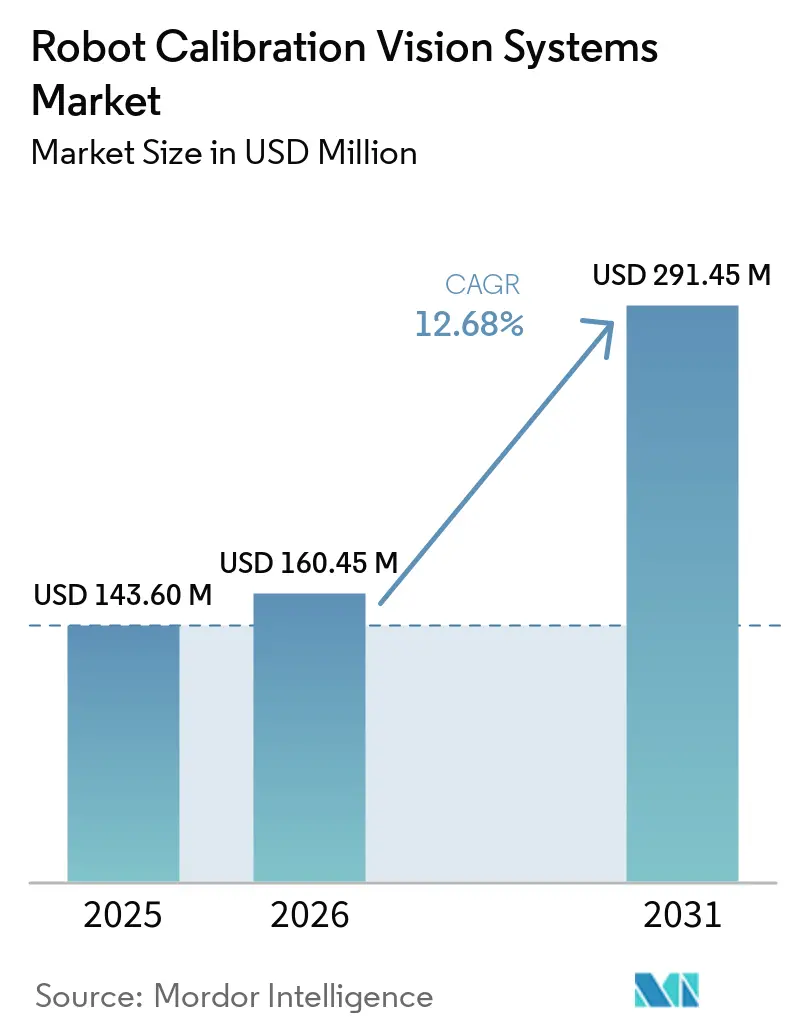
The Robot Calibration Vision Systems Market size is projected to expand from USD 143.60 million in 2025 to USD 160.45 million in 2026, and to USD 291.45 million by 2031, registering a CAGR of 12.68% between 2026 and 2031. Smart factory investments are increasing the need for systems that maintain accurate robot vision during production. Calibration is becoming part of production quality control rather than a periodic maintenance activity. Manufacturers are seeking tighter assembly tolerances and lower defect rates in automotive, electronics, and logistics operations. This supports demand for software that can manage multiple robots, cameras, and sensors within a single cell. Suppliers are responding with hardware-agnostic platforms, embedded AI, and tools that reduce commissioning work. The Robot Calibration Vision Systems Market also faces limitations due to legacy equipment, incompatible interfaces, and a shortage of integration skills.
Key Report Takeaways
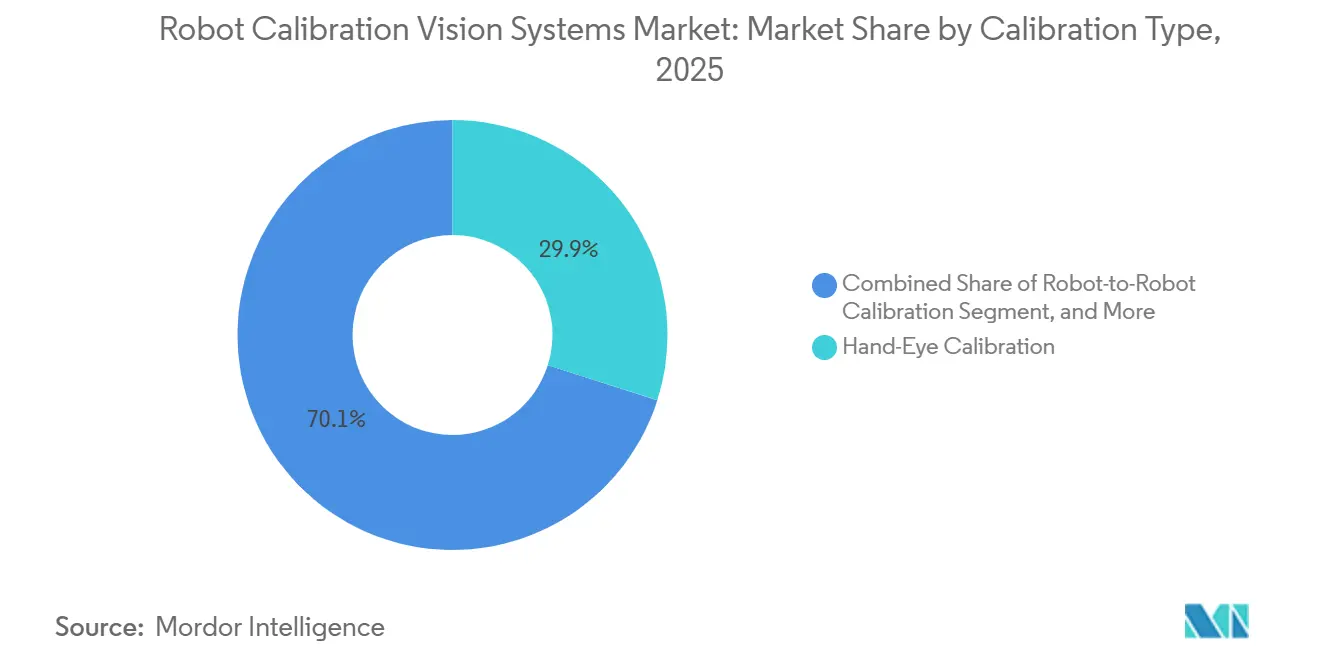
- By calibration type, hand-eye calibration held 29.91% of the Robot Calibration Vision Systems Market share in 2025, while robot-to-robot calibration is projected to expand at a 14.23% CAGR through 2031.
- By robot type, industrial robots held 61.34% revenue share in 2025, while mobile robots, including AMR and AGV platforms, are projected to expand at an 18.45% CAGR through 2031.
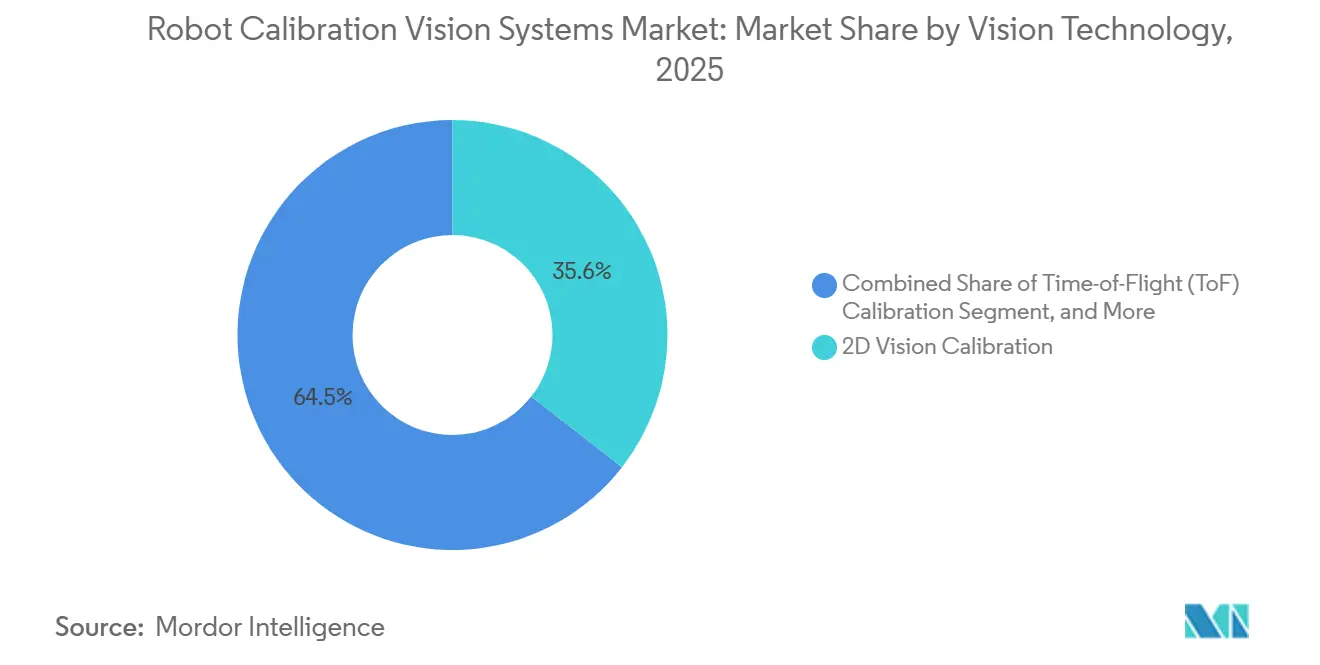
- By vision technology, 2D vision calibration accounted for 35.55% of Robot Calibration Vision Systems Market revenue in 2025, while time-of-flight calibration is projected to expand at a 16.31% CAGR through 2031.
- By end-user industry, automotive and mobility accounted for 28.55% of revenue in 2025, while logistics and warehousing are projected to expand at a 15.89% CAGR through 2031.
- By geography, Asia-Pacific held 38.72% of the Robot Calibration Vision Systems Market revenue share in 2025, while the Middle East and Africa are projected to expand at a 14.52% CAGR through 2031.
Note: Market size and forecast figures in this report are generated using Mordor Intelligence’s proprietary estimation framework, updated with the latest available data and insights as of January 2026.
Global Robot Calibration Vision Systems Market Trends and Insights
Drivers Impact Analysis*
| Driver | (~) % Impact on CAGR Forecast | Geographic Relevance | Impact Timeline |
|---|---|---|---|
| Expansion of Vision-Guided Robotics in Smart Factories | +3.2% | Global, concentrated in Asia-Pacific and North America | Short term (≤ 2 years) |
| Adoption of AI-Enabled 3D Vision for Complex Assembly | +2.8% | North America and Europe, expanding to Asia-Pacific | Medium term (2-4 years) |
| Growth of Collaborative Robots and Autonomous Mobile Robots | +2.4% | Global | Medium term (2-4 years) |
| Demand for High-Precision Inspection and Zero-Defect Manufacturing | +1.8% | North America and Europe, with growing relevance in Asia-Pacific | Short term (≤ 2 years) |
| Automated Calibration for Multi-Camera and Multi-Sensor Cells | +1.4% | North America, Europe, and Asia-Pacific | Medium term (2-4 years) |
| Self-Calibrating Vision Software in Brownfield Facilities | +0.9% | Europe and North America | Long term (≥ 4 years) |
| Source: Mordor Intelligence | |||
Expansion of Vision-Guided Robotics in Smart Factories
Smart factory projects are creating new demand for the Robot Calibration Vision Systems Market and increasing upgrade activity in existing fleets. A higher robot density reduces the time available for manual calibration across a production cell. Manufacturers are therefore moving toward coordinated calibration of multiple robots and sensors. ABB launched OmniCore EyeMotion in September 2025, allowing OmniCore-powered robots to use third-party cameras and sensors for real-time 2D and 3D applications. ABB stated that the system reduced commissioning time by up to 90% compared with custom solutions.[1]ABB Ltd., “ABB Robotics Launches OmniCore EyeMotion for Vision-Powered Autonomy,” ABB Ltd., new.abb.com KUKA’s iiQKA.AI Vision combined camera calibration, system calibration, and AI-supported training in one drag-and-drop workflow.
Adoption of AI-Enabled 3D Vision for Complex Assembly
AI-enabled 3D vision introduces depth-calibration requirements to established 2D systems in the Robot Calibration Vision Systems Market. This is important for assembly tasks with variable part geometry and changing work positions. ABB and NVIDIA announced RobotStudio HyperReality in March 2026, combining NVIDIA Omniverse libraries with ABB Absolute Accuracy technology. ABB reported that the technology reduced positioning errors from 8-15 mm in uncalibrated systems to 0.5 mm, while Foxconn piloted the first use case at 99% accuracy. A 2026 manufacturing study described the 3DVAC-HiPRoM method, which used a calibration board for coarse alignment and a flexible rod for refined alignment.[2]Scientific Reports, “Vision-Guided Robotic Pick-and-Place with Variable Focal Length Optics: Mathematical Modelling, Illumination Optimisation, and Sub-Millimetre Accuracy Assessment,” Nature, nature.com These approaches support demand for software platforms that can accommodate task-specific calibration methods.
Growth of Collaborative Robots and Autonomous Mobile Robots
Cobots and AMRs operate in less fixed environments than conventional industrial robots. Their cameras and sensors need to retain a shared spatial reference while the equipment moves and conditions change. This makes continuous calibration more relevant to the Robot Calibration Vision Systems Market. Yaskawa announced the MOTOMAN NEXT agentic robot system in July 2026 with built-in machine vision, path planning, and force sensing. Food, beverage, and pharmaceutical deployments may need additional calibration after washdown cycles shift camera positions. A 2025 study reported repeatability below 0.1 mm in position and 0.3 mrad in orientation using a self-reflective visual servoing approach.
Demand for High-Precision Inspection and Zero-Defect Manufacturing
Quality requirements are moving calibration into regular production verification for the Robot Calibration Vision Systems Market. Automotive, aerospace, and medical device facilities need documented accuracy and repeatability. A 2026 review found that machine learning vision systems exceeded 95% defect-detection accuracy, with some controlled implementations reaching 98-100%. The same review found that 77% of implementations remained at prototype or pilot scale. Cognex launched the In-Sight 3900 in May 2026 with inspection speeds up to 4 times faster than prior-generation systems and resolutions up to 25 MP. ISO 9283 measurement requirements also make traceable calibration records relevant for regulated production settings.[3]MDPI Sensors, “Machine Learning-Powered Vision for Robotic Inspection in Smart Manufacturing,” MDPI Sensors, mdpi.com
Restraints Impact Analysis*
| Restraint | (~) % Impact on CAGR Forecast | Geographic Relevance | Impact Timeline |
|---|---|---|---|
| High Integration Costs with Legacy Production Lines | -2.4% | Global, especially South America, Middle East and Africa, and Rest of Europe | Long term (≥ 4 years) |
| Shortage of Robot Vision Integration Expertise | -1.8% | Global, with critical gaps in Middle East and Africa and South America | Medium term (2-4 years) |
| Calibration Drift from Thermal, Mechanical, and Optical Variations | -1.1% | Global, strongest in high-throughput automotive and electronics facilities | Medium term (2-4 years) |
| Fragmented Robot, Camera, and Software Interoperability Standards | -0.9% | Global | Long term (≥ 4 years) |
| Source: Mordor Intelligence | |||
High Integration Costs with Legacy Production Lines
Legacy production lines can cost more to integrate than the calibration hardware itself. Proprietary controllers, incompatible fieldbus protocols, and fixed PLC logic raise engineering requirements. Establishing camera-to-robot coordinate frames can also delay deployment in cells that use several robot brands. ABB stated that RobotStudio HyperReality could reduce setup and commissioning costs by up to 40% through virtual design, testing, and optimization. That benefit applies to facilities using OmniCore-generation controllers, leaving older installations with fewer options. This constraint limits the adoption of Robot Calibration Vision Systems in South America, the Middle East, and Africa, where integrator coverage and OEM support are less extensive.
Shortage of Robot Vision Integration Expertise
Deployment of Robot Calibration Vision Systems requires knowledge of optics, mechanical alignment, and software configuration. This combination is harder to source than general robot programming skills. A 2026 study found that performance depended on lighting, focal length, and hand-eye calibration settings, achieving 0.12-pixel reprojection error and 0.450 mm positional uncertainty in its best configuration. OMRON’s FH Series uses self-learning AI to select training images and develop inspection models. KUKA offers drag-and-drop tools for camera and system calibration. These tools ease initial configuration, but field recalibration and drift management still require experienced personnel.
*Our forecasts treat driver/restraint impacts as directional, not additive. The impact forecasts reflect baseline growth, mix effects, and variable interactions.
Segment Analysis
By Calibration Type: Hand-Eye Systems Lead While Multi-Robot Demand Grows
Hand-eye calibration accounted for 29.91% of revenue in 2025. It is used in pick-and-place, bin picking, welding, and assembly tasks that mount cameras on a robot wrist or flange. The camera moves with the end effector, which helps preserve its spatial relationship with the tool. However, tooling changes or mechanical impacts can require recalibration. The Robot Calibration Vision Systems Market benefits from the technique’s established use across common vision-guided tasks.
Robot-to-robot calibration is forecast to grow at a 14.23% CAGR through 2031. Automotive and electronics plants are using more workcells where robots transfer parts directly between stations. This makes the positional relationship among robots as important as each robot’s independent accuracy. Hexagon launched SARCA in July 2026 for multi-zone and multi-tool routines that improve absolute robot positioning accuracy by up to 10 times. This expands the Robot Calibration Vision Systems Market opportunity for robot-to-world, TCP, and multi-camera configurations.



By Robot Type: Industrial Robots Retain Scale While Mobile Robots Expand
Industrial robots accounted for 61.34% of revenue in 2025, giving them the largest share in the Robot Calibration Vision Systems Market. Their installed base spans automotive body-in-white production, electronics assembly, and heavy material handling. Much of this demand comes from recalibration, software upgrades, and replacements rather than new installations. Delta and SCARA models are important for fast pick-and-place work in food and pharmaceutical packaging. Cobots are also being used more often for machine tending, inspection, and kitting tasks.
Mobile robots are forecast to grow at an 18.45% CAGR through 2031. AMRs must combine information from RGB cameras, LiDAR, ToF sensors, and ultrasonic arrays in a common coordinate frame. Vibration, chassis flex, and collisions can shift those sensors during use. This creates an ongoing requirement for on-board monitoring in the Robot Calibration Vision Systems Market, rather than relying solely on scheduled calibration. Yaskawa’s MOTOMAN NEXT demonstrates how vision, path planning, and force sensing are integrated into the robot platform.[4]Yaskawa Electric Corporation, “MOTOMAN NEXT AI Robot’s Agentic Robot System Powered by Gemini Robotics,” Yaskawa Electric Corporation, yaskawa-global.com
By Vision Technology: 2D Calibration Leads While ToF Gains Use
2D vision calibration accounted for 35.55% of revenue in 2025. It is used for flat-surface inspection, barcode reading, and planar pick-and-place tasks. The segment benefits from established calibration algorithms and lower-cost monochrome and color cameras. It also remains a practical entry point for manufacturers looking to add vision guidance to robot cells. This established base supports the Robot Calibration Vision Systems Market while 3D stereo and structured-light systems address dimensional inspection and bin-picking requirements.
ToF calibration is forecast to grow at a 16.31% CAGR through 2031. It supports AMR localization, cobot workspace monitoring, and safety applications that need real-time depth information. Cognex launched the NVIDIA Jetson-powered In-Sight 6900 Vision Controller in April 2026 for complex inference at the production edge. FARO CREAFORM also released refined DTEX processing algorithms for its Laser Line Probe portfolio in April 2026. Laser and 3D scanner calibration remains relevant for metrology, aerospace, and energy applications.
By End-User Industry: Automotive Leads While Logistics Speeds Ahead
Automotive and mobility accounted for 28.55% of revenue in 2025. EV battery module and pack lines need accurate vision guidance for polarity checks, dimensional inspection, and adhesive dispensing. Electronics and semiconductor production also require calibration to maintain spatial accuracy during thermal cycles and vibration. These uses keep automotive central to the Robot Calibration Vision Systems Market. Aerospace, general manufacturing, pharmaceutical, and medical device applications have different precision requirements, while aerospace and medical device suppliers increasingly use ISO 17025-accredited processes for qualification.
Logistics and warehousing are forecast to grow at a 15.89% CAGR through 2031. Large AMR fleets introduce variations in sensor types and firmware versions, which can create fleet-level calibration risks. Siemens, Universal Robots, and Zivid demonstrated a multi-vendor fulfillment solution in March 2024 that combined SIMATIC Robot Pick AI, a UR20 cobot, and Zivid 3D cameras. Food, beverage, and pharmaceutical sites also require frequent recalibration because washdown and temperature changes affect equipment. Robot-mounted systems remain common in precision assembly, while mobile systems are gaining use in logistics and large-format manufacturing.
Geography Analysis
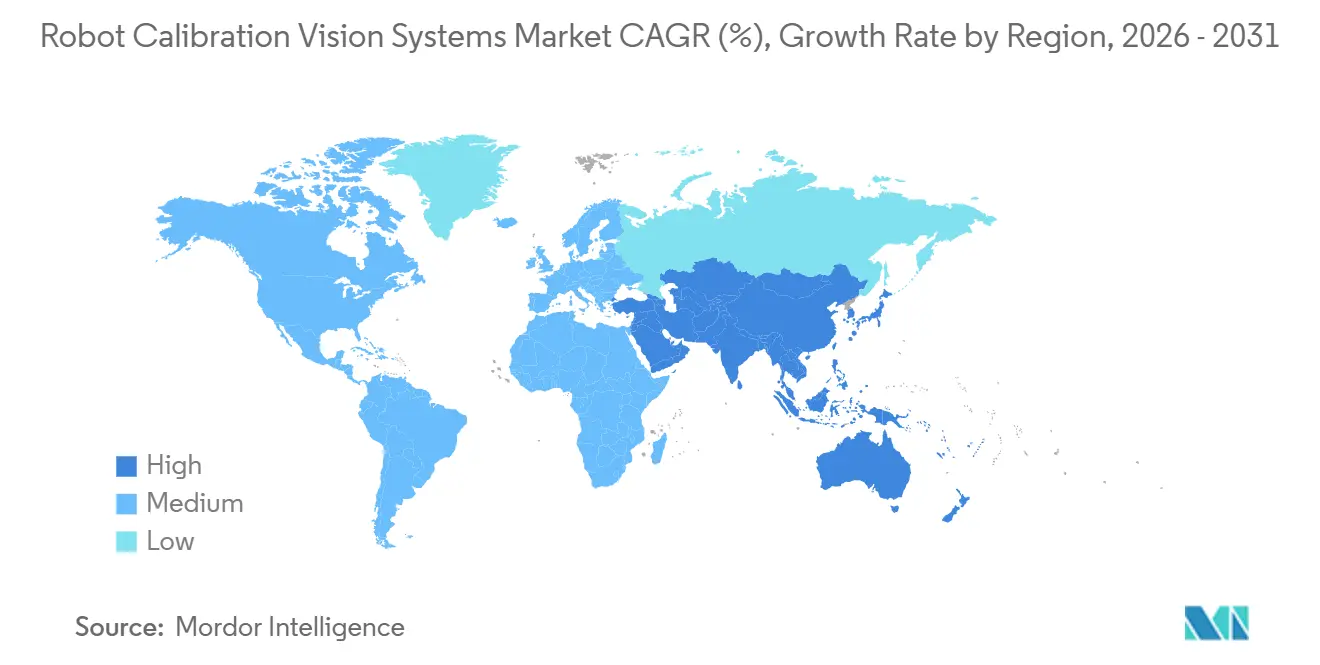
Asia-Pacific held 38.72% of the Robot Calibration Vision Systems Market share in 2025. China, Japan, and South Korea have a high concentration of industrial robot installations. China’s smart manufacturing programs support investment in vision-guided automation. Japan’s OEM base, including FANUC, Yaskawa, and OMRON, supports continuing system upgrades. South Korean semiconductor and display manufacturing requires regular calibration verification for sub-micron inspection.
North America maintained a significant position in the Robot Calibration Vision Systems Market in 2025, driven by EV manufacturing, aerospace assembly, and logistics automation. The United States is home to Cognex and Teledyne Technologies, both of which support the development of embedded AI vision systems. Reshoring of electronics and defense manufacturing is creating demand in new and retooled facilities. Europe has established machine vision and metrology capabilities through KUKA, SICK, Basler, Hexagon, and ABB. Germany’s automotive manufacturers support demand for multi-camera and structured-light systems in body-in-white and EV powertrain assembly.
The Middle East and Africa are forecast to grow at a 14.52% CAGR through 2031. Saudi Arabia’s Vision 2030-linked manufacturing projects and the UAE’s automation programs are supporting new deployments. South Africa and Nigeria are adding automotive assembly and logistics capacity, while Brazil is South America’s main demand center, and Argentina’s agroindustrial automation adds smaller demand. This regional expansion supports the Robot Calibration Vision Systems Market, although limited local integrator coverage and reliance on overseas OEM support continue to limit adoption.

Competitive Landscape
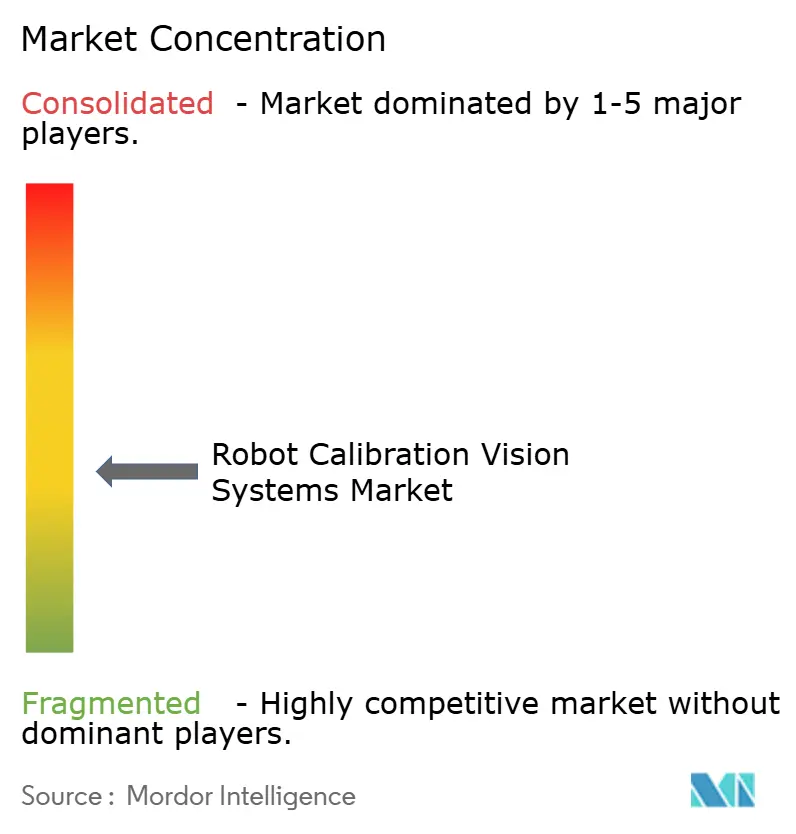
The Robot Calibration Vision Systems Market is moderately fragmented across robotics OEMs, vision specialists, and metrology suppliers. ABB, Cognex, Hexagon, FANUC, SICK, and KEYENCE compete through hardware, software, and integration capabilities. ABB is building its OmniCore EyeMotion and RobotStudio HyperReality offerings around reusable vision and calibration workflows. Cognex is extending its cloud-to-edge approach through OneVision and embedded AI vision products. Hexagon uses SARCA and SpatialAnalyzer to target traceable robot accuracy in demanding production environments.
Hexagon introduced SARCA in July 2026 to improve industrial robot positioning accuracy by up to 10 times through multi-zone calibration. Cognex launched the In-Sight 3900 in May 2026 with 25 MP resolution and inspection speeds up to 4 times faster than prior-generation systems. FANUC is using its installed base to extend iRVision functions into embedded calibration tools, while Photoneo, LMI Technologies, and MVTec compete in the Robot Calibration Vision Systems Market, where depth quality and algorithmic flexibility are important. SICK’s patented approach combines camera and LiDAR data using calibration boards.
Real-time drift compensation remains a need in high-throughput cells. Thermal expansion, mechanical wear, and optical variation can introduce errors during production. Periodic offline calibration does not fully address these changing conditions. A 2025 study described a machine-vision positioning compensation system for industrial robots. The Robot Calibration Vision Systems Market is, therefore, rewarding suppliers that combine accuracy with simpler deployment and ongoing monitoring.
Robot Calibration Vision Systems Industry Leaders
Cognex Corporation
KEYENCE CORPORATION
SICK AG
Basler AG
Teledyne Technologies Incorporated
- *Disclaimer: Major Players sorted in no particular order

Recent Industry Developments
- September 2026: Hexagon AB announced HYPERSCAN SR, a fully wireless optical tracking 3D scanner designed for direct integration onto cobots and industrial robots, with its global debut planned at IMTS 2026, September 14-19, Chicago. The system supports multiple scanning modes including hole flash capture and edge detection, and it joins the HYPERSCAN series to address high-throughput automated inspection requirements across cobot-mounted and fixed-robot applications.
- July 2026: Hexagon Manufacturing Intelligence launched SARCA, SpatialAnalyzer Robot Calibration Appliance, a dedicated robot-calibration device that improves industrial robot absolute positioning accuracy by up to 10 times through multi-zone, multi-tool calibration routines. Paired with SpatialAnalyzer 2026.1, which introduces OPC UA client connectivity for real-time metrology integration into production workflows, SARCA targets aerospace, energy, and large-scale manufacturing applications requiring traceable robot positioning accuracy.
- July 2026: Hexagon Manufacturing Intelligence launched SARCA, SpatialAnalyzer Robot Calibration Appliance, a dedicated robot-calibration device that improves industrial robot absolute positioning accuracy by up to 10 times through multi-zone, multi-tool calibration routines. Paired with SpatialAnalyzer 2026.1, which introduces OPC UA client connectivity for real-time metrology integration into production workflows, SARCA targets aerospace, energy, and large-scale manufacturing applications requiring traceable robot positioning accuracy.
- May 2026: ognex Corporation launched the In-Sight 3900 Vision System, a fully embedded AI edge vision platform powered by Qualcomm Dragonwing, delivering inspection speeds up to 4 times faster than prior-generation systems at up to 25 MP resolution. Integrated with Cognex OneVision for centralized cloud-to-edge model training and multi-site deployment, the platform enables manufacturers to update calibrated inspection models centrally while executing them locally at production line speed.


Global Robot Calibration Vision Systems Market Report Scope
Robot Calibration Vision Systems are specialized optical measurement and software solutions that enhance the absolute accuracy and repeatability of robotic arms by correcting kinematic errors, aligning coordinate frames between robots and sensors, and precisely determining tool center points for high-precision industrial applications.
The Robot Calibration Vision Systems Market Report is Segmented by Calibration Type (Robot-to-World Calibration, Hand-Eye Calibration, Tool Center Point (TCP) Calibration, Robot-to-Robot Calibration, and Multi-Camera / Multi-Sensor Calibration), Robot Type (Industrial Robots, Collaborative Robots (Cobots), Mobile Robots (AMR/AGV), Delta / SCARA Robots, and Other Robot Types), Vision Technology (2D Vision Calibration, 3D Stereo Vision Calibration, Structured-Light 3D Calibration, Time-of-Flight (ToF) Calibration, Laser / 3D Scanner Calibration, and Other Vision Technologies), End-User Industry (Automotive and Mobility, Electronics and Semiconductors, General Manufacturing, Aerospace and Defense, Food and Beverage, Pharmaceutical and Medical Devices, Logistics and Warehousing, and Other End-User Industries), and Geography (North America, South America, Europe, Asia-Pacific, Middle East and Africa). The Market Forecasts are Provided in Terms of Value (USD).
| Robot-to-World Calibration |
| Hand-Eye Calibration |
| Tool Center Point (TCP) Calibration |
| Robot-to-Robot Calibration |
| Multi-Camera / Multi-Sensor Calibration |
| Industrial Robots |
| Collaborative Robots (Cobots) |
| Mobile Robots (AMR/AGV) |
| Delta / SCARA Robots |
| Other Robot Types |
| 2D Vision Calibration |
| 3D Stereo Vision Calibration |
| Structured-Light 3D Calibration |
| Time-of-Flight (ToF) Calibration |
| Laser / 3D Scanner Calibration |
| Other Vision Technologies |
| Automotive and Mobility |
| Electronics and Semiconductors |
| General Manufacturing |
| Aerospace and Defense |
| Food and Beverage |
| Pharmaceutical and Medical Devices |
| Logistics and Warehousing |
| Other End-User Industries |
| Robotic-Mounted Vision Systems |
| Mobile / Autonomous Vision Systems |
| North America | United States | |
| Canada | ||
| Mexico | ||
| South America | Brazil | |
| Argentina | ||
| Rest of South America | ||
| Europe | Germany | |
| United Kingdom | ||
| France | ||
| Italy | ||
| Spain | ||
| Rest of Europe | ||
| Asia-Pacific | China | |
| Japan | ||
| India | ||
| South Korea | ||
| Rest of Asia-Pacific | ||
| Middle East and Africa | Middle East | Saudi Arabia |
| United Arab Emirates | ||
| Turkey | ||
| Rest of the Middle East | ||
| Africa | South Africa | |
| Nigeria | ||
| Rest of Africa | ||
| By Calibration Type | Robot-to-World Calibration | ||
| Hand-Eye Calibration | |||
| Tool Center Point (TCP) Calibration | |||
| Robot-to-Robot Calibration | |||
| Multi-Camera / Multi-Sensor Calibration | |||
| By Robot Type | Industrial Robots | ||
| Collaborative Robots (Cobots) | |||
| Mobile Robots (AMR/AGV) | |||
| Delta / SCARA Robots | |||
| Other Robot Types | |||
| By Vision Technology | 2D Vision Calibration | ||
| 3D Stereo Vision Calibration | |||
| Structured-Light 3D Calibration | |||
| Time-of-Flight (ToF) Calibration | |||
| Laser / 3D Scanner Calibration | |||
| Other Vision Technologies | |||
| By End-User Industry | Automotive and Mobility | ||
| Electronics and Semiconductors | |||
| General Manufacturing | |||
| Aerospace and Defense | |||
| Food and Beverage | |||
| Pharmaceutical and Medical Devices | |||
| Logistics and Warehousing | |||
| Other End-User Industries | |||
| Robotic-Mounted Vision Systems | |||
| Mobile / Autonomous Vision Systems | |||
| By Geography | North America | United States | |
| Canada | |||
| Mexico | |||
| South America | Brazil | ||
| Argentina | |||
| Rest of South America | |||
| Europe | Germany | ||
| United Kingdom | |||
| France | |||
| Italy | |||
| Spain | |||
| Rest of Europe | |||
| Asia-Pacific | China | ||
| Japan | |||
| India | |||
| South Korea | |||
| Rest of Asia-Pacific | |||
| Middle East and Africa | Middle East | Saudi Arabia | |
| United Arab Emirates | |||
| Turkey | |||
| Rest of the Middle East | |||
| Africa | South Africa | ||
| Nigeria | |||
| Rest of Africa | |||


Key Questions Answered in the Report
What is the Robot Calibration Vision Systems Market size?
The market was USD 160.45 million in 2026 and is forecast to reach USD 291.45 million by 2031, at a 12.68% CAGR.
Which calibration type led revenue in 2025?
Hand-eye calibration led with a 29.91% share because it is broadly used in robot-mounted camera applications.
Which robot platform is expanding fastest?
Mobile robots, including AMR and AGV platforms, are projected to expand at an 18.45% CAGR through 2031.
Why is time-of-flight calibration gaining adoption?
ToF systems provide real-time depth information for AMR localization, cobot monitoring, and human-robot safety applications.
Which region held the leading share in 2025?
Asia-Pacific held 38.72% revenue share, supported by robot installations in China, Japan, and South Korea.
What limits adoption of robot calibration systems?
High legacy-line integration costs and limited availability of skilled vision integration personnel slow deployments.
Page last updated on:





