
Road Roller Market Size and Share
Market Overview
| Study Period | 2020 - 2032 |
|---|---|
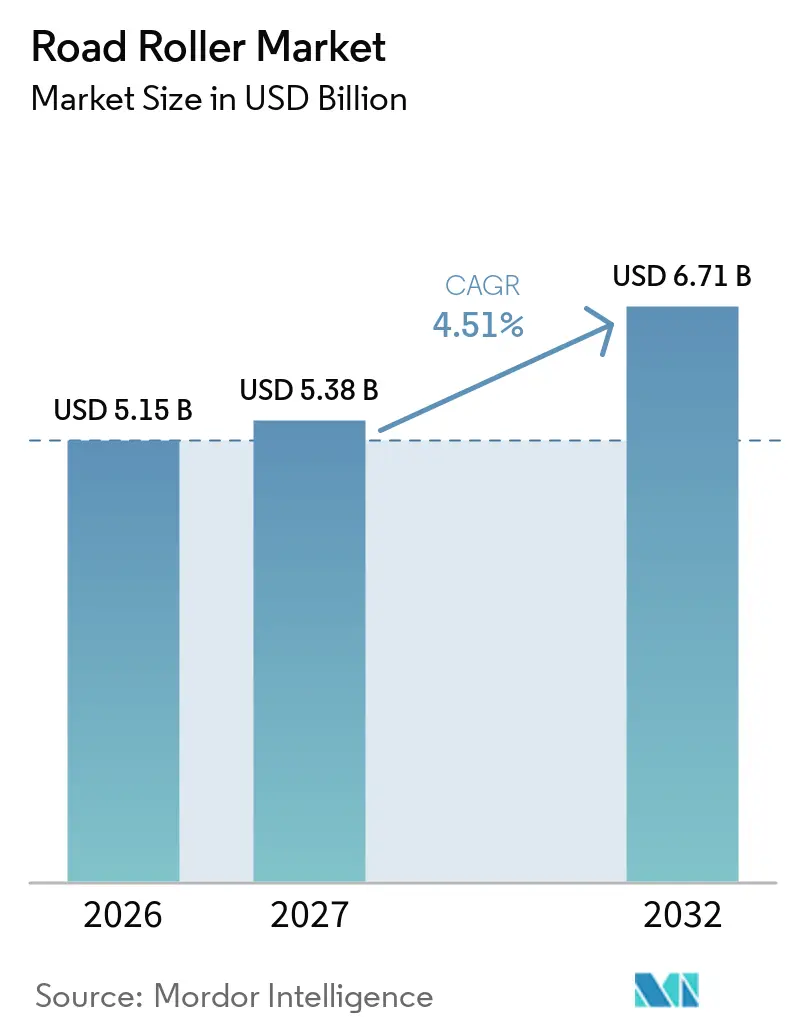
| Market Size (2027) | USD 5.38 Billion |
| Market Size (2032) | USD 6.71 Billion |
| Growth Rate (2027 - 2032) | 4.51 % |
| Fastest Growing Market | Middle East and Africa |
| Largest Market | Asia-Pacific |
| Market Concentration | Medium |
Major Players *Disclaimer: Major Players sorted in no particular order Image © Mordor Intelligence. Reuse requires attribution under CC BY 4.0. | |
Road Roller Market Analysis by Mordor Intelligence
The road roller market size was valued at USD 5.15 billion in 2026 and is expected to grow from USD 5.38 billion in 2027 to USD 6.71 billion by 2032, at a CAGR of 4.51% during 2027-2032. Demand follows work that is already under construction because each earthwork and asphalt layer must meet density requirements before the next layer can proceed. This gives the road roller market a closer connection to active project delivery than to early-stage project announcements. Public infrastructure programs therefore support equipment demand when they move from planning into execution. Rental fleets also widen access to full-weight equipment for contractors that do not want to own machines with uneven utilization. Intelligent compaction and telematics are becoming more important in purchasing decisions because they document quality and help contractors manage work across constrained paving windows.
Key Report Takeaways
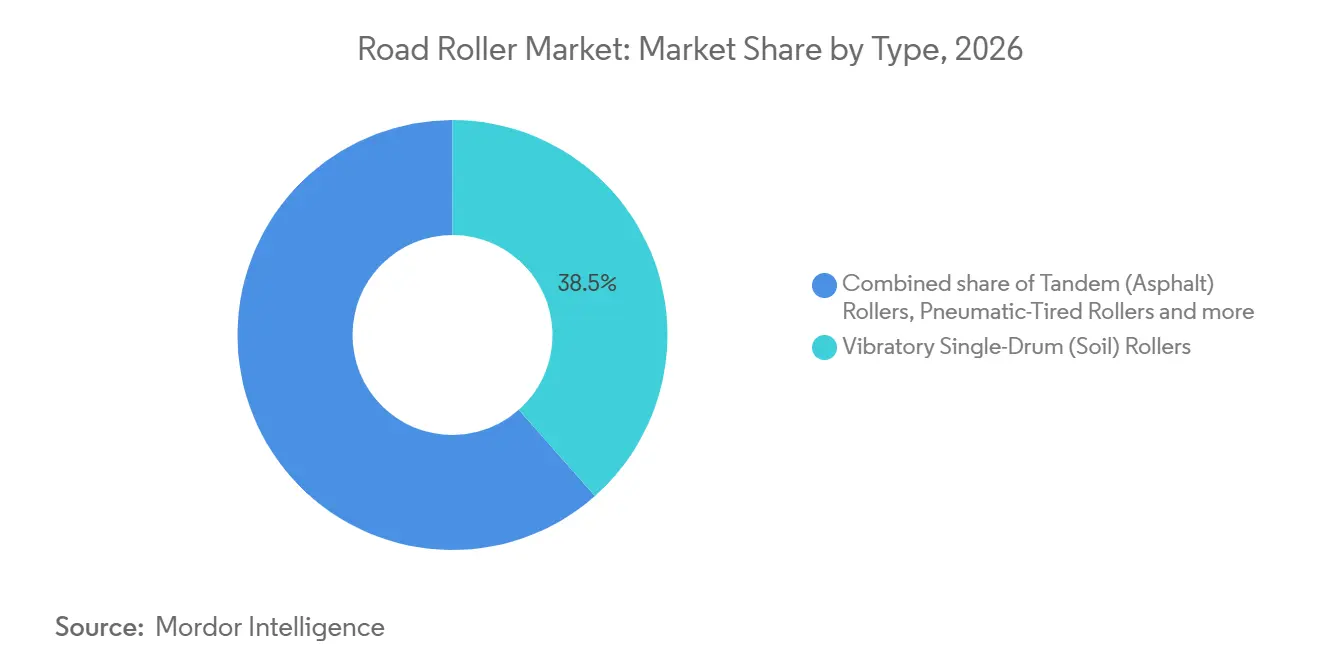
- By type, vibratory single-drum soil rollers held a 38.46% share in 2026, while tandem asphalt rollers are forecast to grow at a 5.37% CAGR through 2032.
- By operating weight, medium rollers (5 to 12 tons) held a 44.27% share in 2026, while light rollers below 5 tons are forecast to grow at a 5.18% CAGR through 2032.
- By drum type, smooth drum equipment held a 71.36% share in 2026, while padfoot drum equipment is forecast to grow at a 5.03% CAGR through 2032.
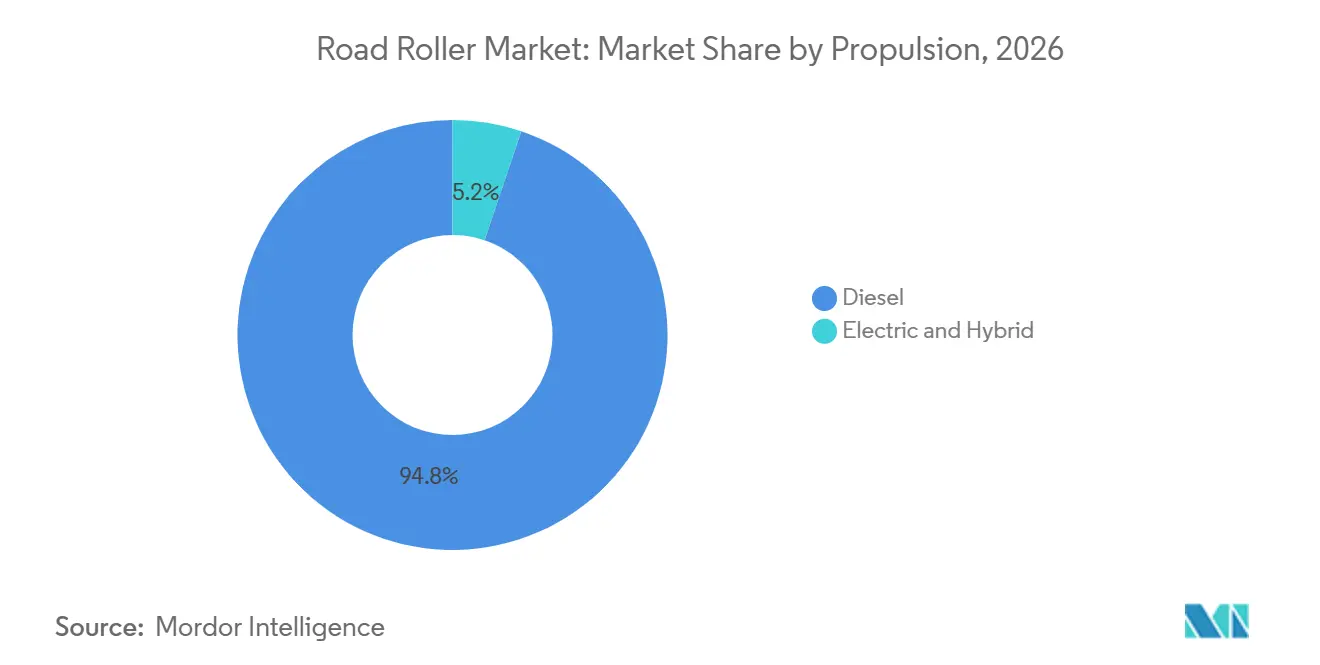
- By propulsion, diesel equipment held a 94.82% share in 2026, while electric and hybrid equipment is forecast to grow at a 14.63% CAGR through 2032.
- By application, road construction held a 52.18% share in 2026, while road maintenance and rehabilitation is forecast to grow at a 5.27% CAGR through 2032.
- By geography, Asia-Pacific held a 48.63% share in 2026, while the Middle East and Africa is forecast to grow at a 5.84% CAGR through 2032.
Note: Market numbers in this report are based on Mordor Intelligence's proprietary estimation framework, which combines nine months of actuals with Q4 projections for base year 2026.
Market Trends and Insights
Drivers Impact Analysis of Road Roller Market*
| Driver | (~) % Impact on CAGR Forecast | Geographic Relevance | Impact Timeline |
|---|---|---|---|
| Global Road and Highway Construction Pipeline Expansion | +1.5% | Global, concentrated in Asia-Pacific and Middle East and Africa | Long term (≥ 4 years) |
| Road Maintenance and Resurfacing Backlog | +1.2% | North America and Europe | Medium term (2–4 years) |
| Intelligent Compaction and Telematics Adoption | +0.7% | Global, concentrated in Asia-Pacific and North America | Medium term (2–4 years) |
| Rental and Leasing Adoption Reducing Upfront Fleet Costs | +0.5% | Asia-Pacific, South America, and Africa | Short term (≤ 2 years) |
| Higher Productivity for Shorter Paving Windows | +0.4% | North America and Europe | Short term (≤ 2 years) |
| Tightening Emission Standards Accelerating Fleet Renewal | +0.3% | North America, Europe, India | Medium term (2–4 years) |
| Source: Mordor Intelligence | |||
Global Road and Highway Construction Pipeline Expansion
The road roller market is supported by the scale and duration of road programs that require continuous earthwork and asphalt placement. The Asian Transport Observatory identifies roads as a central component of transport investment needs across low- and middle-income Asian economies, with maintenance also requiring sustained funding[1]. China, India, and Southeast Asian countries provide a broad mix of corridor, highway, and urban road work. Gulf transport corridors and large civil projects add another source of equipment demand in the Middle East. A long pipeline gives manufacturers clearer production planning and gives rental providers a stronger basis for fleet deployment. It also makes demand less dependent on a single contractor or a single short construction package.
Road Maintenance and Resurfacing Backlog
Deferred road maintenance is creating steady demand for compaction equipment, particularly in mature transport networks. The Pew Charitable Trusts identified substantial deferred maintenance needs for US roads and bridges, underscoring the need for recurring resurfacing and rehabilitation[2]. These projects usually require tandem asphalt rollers, pneumatic-tired rollers, and combination machines capable of completing work within limited traffic closures. Unlike greenfield construction, maintenance programs spread activity across many smaller sites and can keep machines in use throughout the year. Contractors also need equipment that can mobilize quickly and deliver consistent surface quality on constrained paving schedules. This makes the road roller market increasingly dependent on fleet availability, dealer support, and rental access in North America and Europe.
Intelligent Compaction and Telematics Adoption
The road roller market is moving toward equipment that records the quality of work while it is being completed. Federal guidance describes intelligent compaction as a system that combines roller-based measurements with position and temperature-related data to improve coverage and documentation. This shifts the procurement discussion toward data quality, repeatability, and reporting. Ammann has embedded automatic control of amplitude and frequency in its ACE pro system, showing how intelligence is being placed within the machine rather than offered separately. XCMG has introduced compaction control functions on its XS series single-drum rollers to reduce over- and under-compaction. Contractors that standardize these systems may face higher switching costs because equipment data becomes part of their site-management process.
Rental and Leasing Adoption Reducing Upfront Fleet Costs
Rental and leasing are widening access to road rollers for smaller contractors that cannot justify the capital commitment of an owned fleet. This model allows contractors to obtain the machine class required for a specific job without carrying the full cost during periods of low utilization. It is particularly relevant in fragmented contractor markets across Asia-Pacific, South America, and Africa. Rental providers can also standardize equipment specifications across their fleets, which gives connected compaction systems and telematics greater visibility among smaller operators. The buying decision therefore shifts toward rental companies, which place more emphasis on machine durability, serviceability, and residual value. The road roller market benefits because rental fleets can place equipment with a wider group of end users than direct ownership alone.
Restraints Impact Analysis of Road Roller Market*
| Restraint | (~) % Impact on CAGR Forecast | Geographic Relevance | Impact Timeline |
|---|---|---|---|
| High Upfront Purchase and Financing Costs | -0.6% | Global, concentrated in South America and Africa | Medium term (2–4 years) |
| Fuel and Operating-Cost Volatility | -0.3% | Global | Short term (≤ 2 years) |
| Shortage of Skilled Roller Operators and Service Technicians | -0.2% | North America and Europe | Medium term (2–4 years) |
| Fragmented Contractor Demand and Long Replacement Cycles | -0.2% | South America, Southeast Asia, and Africa | Long term (≥ 4 years) |
| Source: Mordor Intelligence | |||
High Upfront Purchase and Financing Costs
The road roller market faces a clear affordability constraint, with limited financing and tight project schedules. Heavy soil rollers and equipment fitted with intelligent compaction functions can require a larger initial outlay than smaller contractors can support. Those buyers may keep older units for longer or use rentals instead of purchasing new equipment. The pressure is strongest in markets where infrastructure work is expanding, but contractor balance sheets remain narrow. New emissions requirements can bring forward replacement decisions and make the capital burden more immediate. The result is uneven demand between large fleet owners and smaller independent operators.
Fuel and Operating-Cost Volatility
Fuel and operating-cost volatility can delay replacement decisions when contractor margins are under pressure. Diesel remains the primary fuel for road rollers, so changes in fuel costs directly affect daily fleet economics. Contractors may not recover higher operating costs immediately because project contracts often adjust more slowly than fuel prices. This can encourage operators to extend the use of older equipment or favor short-term rentals over new purchases. Hybrid equipment can reduce fuel consumption in certain maintenance applications, but the benefits vary with duty cycle, job-site conditions, and charging access. The restraint is most significant where contractors have limited financing flexibility and little room to absorb higher operating expenses.
*Our forecasts treat driver/restraint impacts as directional, not additive. The impact forecasts reflect baseline growth, mix effects, and variable interactions.
Road Roller Market Segment Analysis
By Type:
Soil Compaction Leads While Asphalt Density Work ExpandsVibratory single-drum soil rollers held 38.46% of the road roller market share in 2026. Their position comes from their role in preparing subgrades for highways, land development, dam work, and other large earthwork projects. Every greenfield road needs suitable soil compaction before asphalt can be placed. This makes the equipment essential across large corridor programs in Asia-Pacific and other developing regions. The machines also suit varied ground conditions when contractors need depth and compaction force, which is useful when a project moves between natural soils, engineered fill, and granular layers that each require a controlled and repeatable compaction approach. Their relevance is therefore linked to the earliest and most equipment-intensive stage of many road projects, where contractors need reliable output before they can safely schedule paving crews, material deliveries, and subsequent construction activities.
Tandem asphalt rollers are projected to grow at a 5.37% CAGR through 2032 within the road roller market. Their demand is closely tied to resurfacing work, which usually needs consistent finish quality and rapid completion. The road roller industry uses these machines where traffic restrictions limit the time available for paving. Pneumatic-tired rollers remain useful for surface finishing and joint sealing on airport, industrial, and highway work, where their tire contact can help contractors achieve the surface treatment required for specific pavement designs and operating environments. Combination rollers are gaining attention on urban jobs because they can reduce the need to move several machines between sites. Static and three-wheel machines continue to serve specialist uses, although they occupy a narrower share of new procurement, because contractors usually prefer equipment that can deliver predictable results across a wider set of paving and maintenance assignments.

By Operating Weight:
Medium Machines Remain the Fleet Standard While Light Units Gain GroundMedium rollers in the 5- to 12-ton range held 44.27% of road roller market revenue in 2026. This category balances compaction capability with transport practicality and fleet economics. It can handle common highway widths and many earthwork and asphalt tasks, allowing contractors to manage much of the routine work without transferring a highly specialized machine between phases or locations of a project. Rental companies favor this flexibility because a single machine can serve multiple contractor types. The machines also fit the working patterns of projects that move frequently between dispersed sites. As a result, medium equipment remains a practical default for fleet expansion, particularly for rental businesses that must maintain high utilization while serving customers with varying project sizes, materials, and site access conditions.
Light rollers below 5 tons are forecast to grow at a 5.18% CAGR through 2032 in the road roller market. Urban resurfacing, constrained work areas, and rental demand support this group. Smaller machines are easier to deploy where streets, utilities, and nearby buildings restrict access, helping crews work within congested locations where a larger roller may disrupt traffic flow, conflict with site logistics, or require extra transport planning. They are also well suited to electric configurations, which can meet local requirements for lower on-site emissions. Ammann’s eARX 26-2 shows how battery-powered tandem equipment is being positioned for such work. Heavy rollers remain necessary for major sub-bases, dam construction, and mining access roads, but their longer replacement cycles slow near-term order growth because their owners often retain them through several project cycles before a replacement becomes commercially necessary.
By Drum Type:
Smooth Drum Equipment Is Widely Used While Padfoot Demand BuildsSmooth drum equipment held 71.36% of road roller market revenue in 2026. Its lead reflects its broad use in asphalt compaction and granular sub-base preparation. Tandem compactors commonly depend on smooth drums to create an even surface finish. Single-drum machines also use smooth configurations where surface sensitivity matters, particularly when contractors need a versatile machine that can move between granular preparation work and applications requiring a controlled surface condition. This versatility allows fleet owners to use the same basic configuration across many jobs. It consequently remains the standard choice for wide parts of the equipment fleet, since contractors can assign it to routine paving and preparation work without maintaining a separate machine for each basic surface condition.
Padfoot drum equipment is forecast to grow at a 5.03% CAGR through 2032 in the road roller market. The drum design is important in cohesive soils and work that requires stronger penetration into the material. Middle Eastern and African earthworks create favorable conditions for this type of compaction, because large projects can involve soil profiles that require deeper engagement than a smooth drum normally provides during the initial stages of ground preparation. Hamm’s G-Tier compactors offer smooth and padfoot alternatives in similar weight classes, giving contractors more flexibility without expanding the number of basic platforms they support. Specialized drum profiles continue to serve trench, rail-ballast, and utility applications. These smaller uses provide stable demand even though they do not match the breadth of smooth drum equipment, as utilities and rail operators still need suitable compaction tools for recurring maintenance and site-specific ground conditions.
By Propulsion:
Diesel Holds the Installed Base While Electric and Hybrid Equipment DevelopsDiesel equipment held 94.82% of the road roller market share in 2026. Its position reflects the long shifts, high energy needs, and limited access to charging on many active job sites. Larger machines in particular need dependable power through earthwork and paving cycles. Existing dealer capability and familiar service practices also reinforce diesel adoption, since contractors can generally obtain trained support, replacement components, and routine maintenance without redesigning their existing service arrangements or changing field operating practices. Newer diesel equipment remains relevant where contractors need compliance improvements without changing site energy arrangements. This keeps diesel central to the near-term equipment base, especially for fleets that operate beyond fixed urban locations and need machines that can run continuously without relying on on-site charging arrangements.
Electric and hybrid equipment is projected to grow at a 14.63% CAGR in the road roller market through 2032. Growth begins from a small installed base and does not indicate near-term displacement of diesel in every class. Dynapac’s electric soil and tandem models show that electrification is moving into utility-class equipment, giving fleet managers additional options for jobs where emissions, noise, or access to a controlled charging location shape the equipment specification. BOMAG has also tested a battery-electric single-drum concept intended for a full work shift. These products are most suitable where charging, daily travel, and duty cycles can be managed with confidence. Regulations and customer requirements could enlarge this niche, but practical site conditions will continue to determine adoption, including the availability of charging, the length of shifts, ambient conditions, and the ability of dealers to support unfamiliar powertrains.
By Application:
Construction Has the Largest Base While Rehabilitation Expands FasterRoad construction accounted for 52.18% of road roller application demand in 2026. New corridors, highway widening, urban roads, and related earthworks require repeated compaction across each project stage. This creates demand for soil and asphalt machines rather than one narrowly defined equipment type. The road roller market size tied to road construction is therefore supported by both subgrade work and final paving activity. Large construction packages also support higher machine utilization when several project phases run at once, since equipment can be shifted between teams preparing ground, placing base material, and compacting asphalt rather than standing idle between isolated tasks. Contractors commonly need broad fleets to manage this mix of work, because the same program can move from deep earthworks to base preparation and then to asphalt finishing within a relatively short delivery schedule.
Road maintenance and rehabilitation is forecast to grow at a 5.27% CAGR through 2032 in the road roller market. Deferred repairs and aging surfaces create a sustained need for resurfacing rather than isolated replacement work. Tandem, pneumatic-tired, and combination rollers have a stronger role in these jobs. Network-wide maintenance can also produce more annual operating hours because activity continues across many smaller locations, allowing rental fleets and contractors to redeploy equipment from one resurfacing assignment to another as individual road sections are completed. Land development offers a stable secondary source of demand for soil compaction. Airport and industrial work is smaller in volume but can require heavier equipment and more specialized configurations, making these projects important for revenue even when their equipment volumes do not match those of public road programs.
Geography Analysis
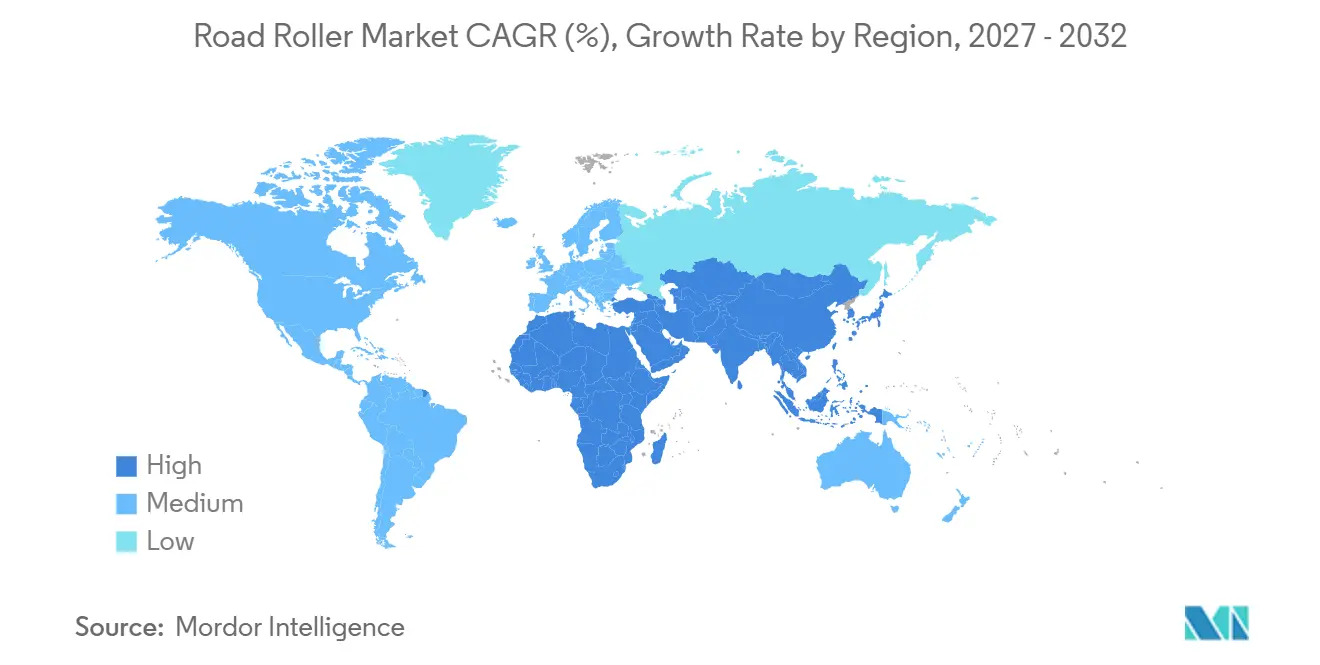
Asia-Pacific held 48.63% of road roller market revenue in 2026. China’s transport projects, India’s highway expansion, and Southeast Asian urban road activity support high equipment use across the region. The wide project base covers subgrade preparation, asphalt paving, and periodic road upgrades. The Asian Transport Observatory highlights the central role of road and maintenance investment in regional transport needs. This mix gives manufacturers and rental companies a large and varied base of customers, ranging from major infrastructure contractors with dedicated fleets to smaller local firms that may obtain equipment through rental channels for specific assignments. It also keeps demand distributed across national infrastructure programs rather than reliant on one market, which gives suppliers a better opportunity to balance production, dealer inventories, and rental fleet placements across different countries. Australia adds medium growth supported by road activity and broad access to rental fleets.
The Middle East and Africa is forecast to grow at a 5.84% CAGR through 2032 in the road roller market. Sovereign-supported transport corridors and civil works programs increase the need for soil compaction and asphalt equipment. The region’s project mix favors single-drum vibratory rollers during heavy earthwork phases, while later paving stages create a separate demand for asphalt compaction equipment capable of meeting the finish expectations of highway and urban road contractors. North and East African road-network expansion provides a further source of demand beyond Gulf projects. South America is forecast to record more moderate growth, supported by ongoing highway concessions and infrastructure partnership activity. Russia is expected to remain constrained because financing conditions and geopolitical disruption limit broader commercial road-building activity.
North America and Europe have a more maintenance-led demand profile. In the United States, deferred maintenance supports recurring resurfacing needs rather than a solely greenfield construction cycle. European demand similarly favors tandem and combination equipment used in rehabilitation work. The Committee for European Construction Equipment (CECE) reported a moderate recovery in European construction equipment sales in 2025, with 4.6% growth, which is consistent with steady rather than exceptional equipment demand. These regions place a premium on machine uptime, operator efficiency, and service coverage because projects frequently operate with tight traffic and labor constraints, leaving contractors with limited tolerance for equipment that is difficult to repair or slow to mobilize.
Competitive Landscape
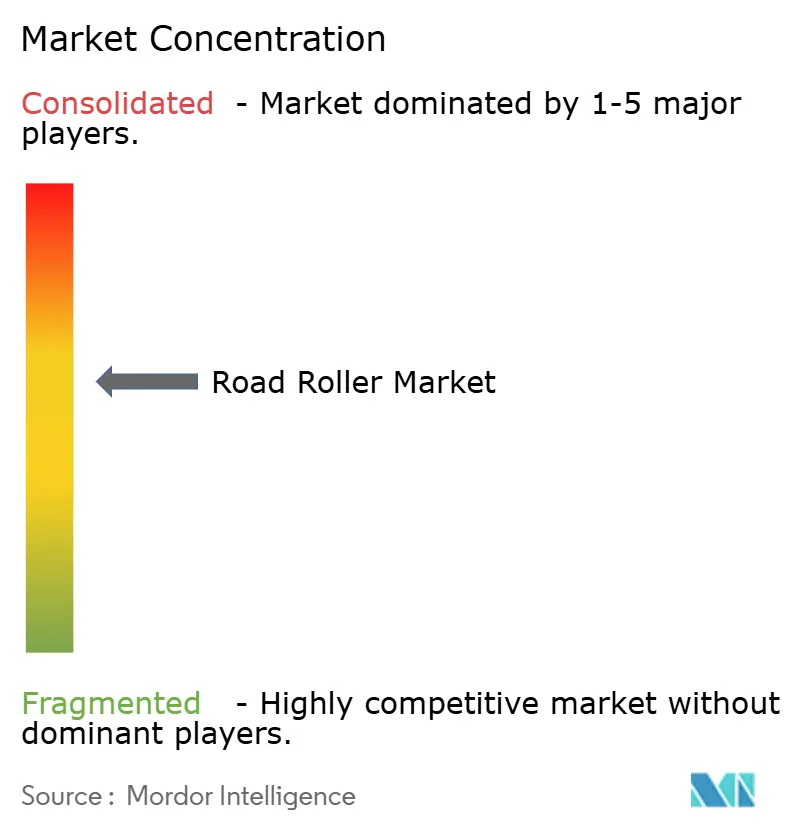
The road roller market is moderately concentrated, reflecting a semi-consolidated structure in which several global suppliers lead premium and mid-market equipment while regional brands compete on value. Fayat Group sells through BOMAG and Dynapac, while Deere & Company operates Hamm through the Wirtgen Group. These firms compete through intelligent compaction, electrification, digital documentation, and broad product coverage, giving buyers different ways to balance machine performance, data requirements, dealer support, service arrangements, and the need to standardize equipment across a mixed fleet. Caterpillar relies on its dealer, rental, and aftermarket network to support availability across weight classes. XCMG competes across a broad range of machines with active product development in conventional and new-energy equipment. Ammann holds a defined position in tandem rollers, pneumatic-tired equipment, and operator-focused controls.
Technology depth is becoming a practical competitive difference in the road roller market. BOMAG’s BOMAP Pave connects paving and rolling activity, which supports project documentation across multiple machines. Dynapac has introduced electric soil and tandem rollers through its zero-emission program. XCMG has added hybrid equipment and digital compaction controls to its road machinery range. These moves show that suppliers are competing on work quality, operating data, and equipment availability as well as basic compaction output, particularly when contractors need evidence that the specified density and surface result have been achieved during a limited paving window. Customers that use connected equipment across a fleet may be less willing to change suppliers because data systems, operator practices, and dealer support become linked.
There remains room for suppliers that can address the installed base of machines without advanced telematics. Affordable retrofits could appeal to fleet owners that need better reporting but cannot replace all equipment at once. Low-emission packages also need to remain dependable in hot climates and at high altitude. Ammann’s SaMoTer 2026 display, which included the ARX 40-2 C combination roller and the ARP 75 tandem roller, illustrated the value of a broad compaction offer. Fayat’s agreement to acquire Mecalac indicates closer links between earthmoving and roadbuilding equipment portfolios. Other Chinese manufacturers such as Shantui, LiuGong, and SANY continue to expand their new-energy offers and distribution reach, particularly where emissions compliance is an important buying consideration.
Road Roller Industry Leaders
-
Fayat Group
-
Deere & Company
-
Caterpillar Inc.
-
XCMG Construction Machinery Co., Ltd.
-
Ammann Group Holding AG
- *Disclaimer: Major Players sorted in no particular order
Road Roller Market Companies Covered in this Report
- Caterpillar Inc.
- Deere & Company
- Fayat Group
- Ammann Group Holding AG
- Sakai Heavy Industries, Ltd.
- Volvo AB
- XCMG Construction Machinery Co., Ltd.
- SANY Heavy Industry Co., Ltd.
- Guangxi LiuGong Machinery Co., Ltd.
- Shantui Construction Machinery Co., Ltd.
- J.C. Bamford Excavators Ltd.
- Wacker Neuson SE
- CNH Industrial N.V.
- Xiamen XGMA Machinery Co., Ltd.
- Zoomlion Heavy Industry Science and Technology Co., Ltd.
- Escorts Kubota Limited
- Mahindra and Mahindra Ltd.
- Komatsu Ltd.
- Liebherr-International AG
- SINOMACH Heavy Industry Corporation
Recent Industry Developments in Road Roller Market
- September 2026: SANY India launched the STR90C-10 PRO single-drum soil compactor at bauma CONEXPO INDIA 2026 in Greater Noida, with a 9,200 kg operating weight, a 54.6 kW Ashok Leyland engine, and CEV Stage V emission compliance.
- May 2026: Ammann displayed the ARX 40-2 C combination roller and the ARP 75 tandem roller at SaMoTer 2026 in Verona, Italy.
- March 2026: BOMAG released the BW 18 RH pneumatic-tired roller for asphalt applications, with an 18-ton maximum operating weight and multiple ballasting options.
- March 2026: Dynapac introduced the CC7000 VI, a 16-ton-class asphalt roller, at CONEXPO-CON/AGG 2026, marking its return to that weight class.
- March 2026: Dynapac launched the CP28 pneumatic-tired roller with an adjustable working weight of 10.5 to 31 tons.
Global Road Roller Market Report Scope
The Road Roller Market is segmented by Type, Operating Weight, Drum Type, Propulsion, Application, and Geography. By Type, the market is segmented into Vibratory Single-Drum (Soil) Rollers, Tandem (Asphalt) Rollers, Static/Three-Wheel Rollers, Pneumatic-Tired Rollers, Combination Rollers, and Others (Walk-Behind, Trench Rollers). By Operating Weight, the market is segmented into Light (Below 5 Tons), Medium (5 to 12 Tons), and Heavy (Above 12 Tons). By Drum Type, the market is segmented into Smooth Drum, Padfoot Drum, and Others. By Propulsion, the market is segmented into Diesel and Electric and Hybrid. By Application, the market is segmented into Road Construction, Road Maintenance and Rehabilitation, Land Development, Industrial and Airport Construction, and Others. By Geography, the market is segmented into North America (United States, Canada, and Mexico), Europe (Germany, France, United Kingdom, Italy, Spain, Russia, Poland, Netherlands, and Rest of Europe), Asia-Pacific (China, India, Japan, South Korea, Indonesia, Thailand, Vietnam, Australia, and Rest of Asia-Pacific), South America (Brazil, Argentina, Chile, Colombia, and Rest of South America), and Middle East and Africa (Saudi Arabia, United Arab Emirates, Turkey, Israel, South Africa, Egypt, Nigeria, Morocco, and Rest of Middle East and Africa). Market forecasts are provided in terms of Value (USD) and Volume (Units).
Segmentation Overview
| Vibratory Single-Drum (Soil) Rollers |
| Tandem (Asphalt) Rollers |
| Static/Three-Wheel Rollers |
| Pneumatic-Tired Rollers |
| Combination Rollers |
| Others (Walk-Behind, Trench Rollers) |
| Light (Below 5 Tons) |
| Medium (5 to 12 Tons) |
| Heavy (Above 12 Tons) |
| Smooth Drum |
| Padfoot Drum |
| Others |
| Diesel |
| Electric and Hybrid |
| Road Construction |
| Road Maintenance and Rehabilitation |
| Land Development |
| Industrial and Airport Construction |
| Others |
| North America | United States |
| Canada | |
| Mexico | |
| Europe | Germany |
| France | |
| United Kingdom | |
| Italy | |
| Spain | |
| Russia | |
| Poland | |
| Netherlands | |
| Rest of Europe | |
| Asia-Pacific | China |
| India | |
| Japan | |
| South Korea | |
| Indonesia | |
| Thailand | |
| Vietnam | |
| Australia | |
| Rest of Asia-Pacific | |
| South America | Brazil |
| Argentina | |
| Chile | |
| Colombia | |
| Rest of South America | |
| Middle East and Africa | Saudi Arabia |
| United Arab Emirates | |
| Turkey | |
| Israel | |
| South Africa | |
| Egypt | |
| Nigeria | |
| Morocco | |
| Rest of Middle East and Africa |
| By Type | Vibratory Single-Drum (Soil) Rollers | |
| Tandem (Asphalt) Rollers | ||
| Static/Three-Wheel Rollers | ||
| Pneumatic-Tired Rollers | ||
| Combination Rollers | ||
| Others (Walk-Behind, Trench Rollers) | ||
| By Operating Weight | Light (Below 5 Tons) | |
| Medium (5 to 12 Tons) | ||
| Heavy (Above 12 Tons) | ||
| By Drum Type | Smooth Drum | |
| Padfoot Drum | ||
| Others | ||
| By Propulsion | Diesel | |
| Electric and Hybrid | ||
| By Application | Road Construction | |
| Road Maintenance and Rehabilitation | ||
| Land Development | ||
| Industrial and Airport Construction | ||
| Others | ||
| By Geography | North America | United States |
| Canada | ||
| Mexico | ||
| Europe | Germany | |
| France | ||
| United Kingdom | ||
| Italy | ||
| Spain | ||
| Russia | ||
| Poland | ||
| Netherlands | ||
| Rest of Europe | ||
| Asia-Pacific | China | |
| India | ||
| Japan | ||
| South Korea | ||
| Indonesia | ||
| Thailand | ||
| Vietnam | ||
| Australia | ||
| Rest of Asia-Pacific | ||
| South America | Brazil | |
| Argentina | ||
| Chile | ||
| Colombia | ||
| Rest of South America | ||
| Middle East and Africa | Saudi Arabia | |
| United Arab Emirates | ||
| Turkey | ||
| Israel | ||
| South Africa | ||
| Egypt | ||
| Nigeria | ||
| Morocco | ||
| Rest of Middle East and Africa | ||
Key Questions Answered in the Report
What is the projected value of the road roller market by 2032?
The road roller market is forecast to reach USD 6.71 billion by 2032, growing at a CAGR of 4.51% from 2027 to 2032.
Which road roller type has the largest revenue share?
Vibratory single-drum soil rollers held the largest share, at 38.46% in 2026, because they are widely used in highway subgrade and earthwork preparation.
Which propulsion category is forecast to grow fastest?
Electric and hybrid rollers are forecast to grow at a 14.63% CAGR through 2032, although diesel remains the dominant installed technology.
Why is road maintenance important for roller suppliers?
Rehabilitation activity needs frequent resurfacing and favors tandem, pneumatic-tired, and combination rollers that can operate within shorter paving windows. It also supports recurring equipment use across many smaller jobs instead of reliance on a limited number of greenfield construction projects, which can help stabilize fleet utilization over time across local maintenance contracts and recurring paving work.