
Retail Fuel Storage Tanks Market Size and Share
Market Overview
| Study Period | 2021 - 2031 |
|---|---|
| Market Size (2026) | USD 3.52 Billion |
| Market Size (2031) | USD 4.48 Billion |
| Growth Rate (2026 - 2031) | 4.94 % |
| Fastest Growing Market | Asia-Pacific |
| Largest Market | North America |
| Market Concentration | Low |
Major Players *Disclaimer: Major Players sorted in no particular order Image © Mordor Intelligence. Reuse requires attribution under CC BY 4.0. | |
Retail Fuel Storage Tanks Market Analysis by Mordor Intelligence
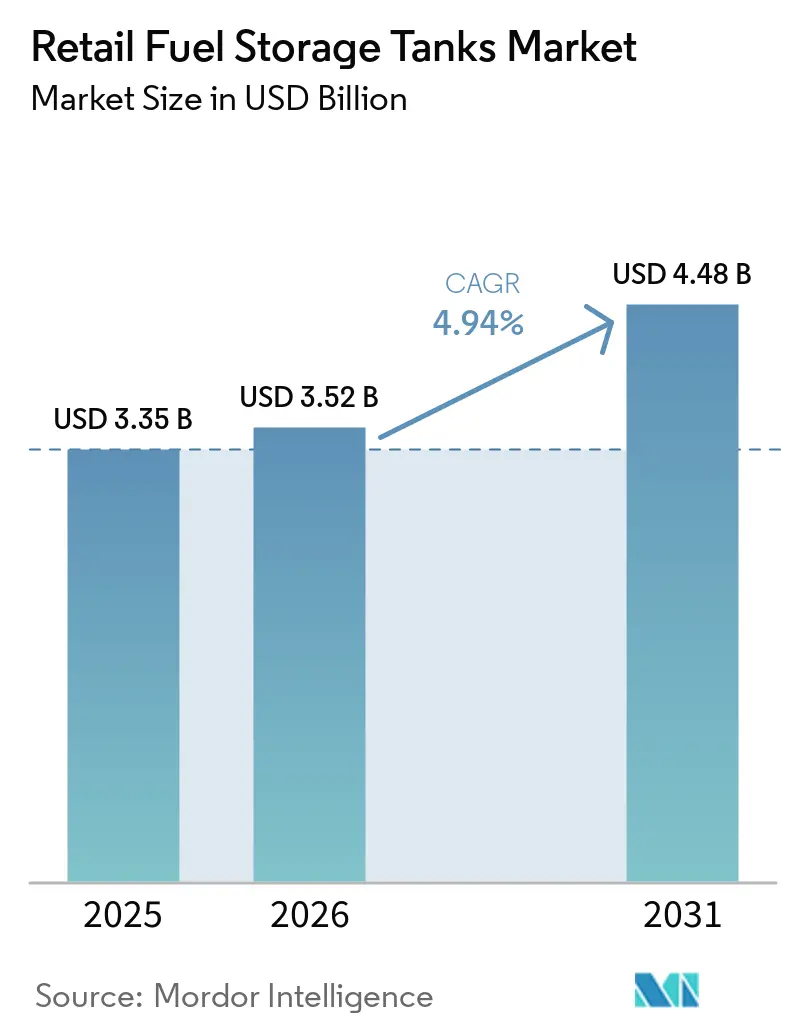
The Retail Fuel Storage Tanks Market size is expected to grow from USD 3.35 billion in 2025 to USD 3.52 billion in 2026 and is forecast to reach USD 4.48 billion by 2031 at 4.94% CAGR over 2026-2031. The retail fuel storage tanks market is supported by replacement demand in established fuel networks and new station construction in developing fuel retail corridors. Regulatory requirements are shortening the replacement cycle for single-wall systems, particularly where secondary containment rules have become more stringent. Modern retailers also need equipment that can store several fuel grades while meeting compatibility and release-prevention requirements. This favors manufacturers that can supply certified double-wall, multicompartment, and biofuel-compatible equipment with dependable delivery schedules. The retail fuel storage tanks market also faces higher project costs and longer installation schedules when excavation, permitting, and qualified contractor capacity are limited.
Key Report Takeaways
- By tank type, double-wall tanks held 65.1% of the retail fuel storage tanks market share in 2025 and are forecast to grow at a 5.8% CAGR through 2031.
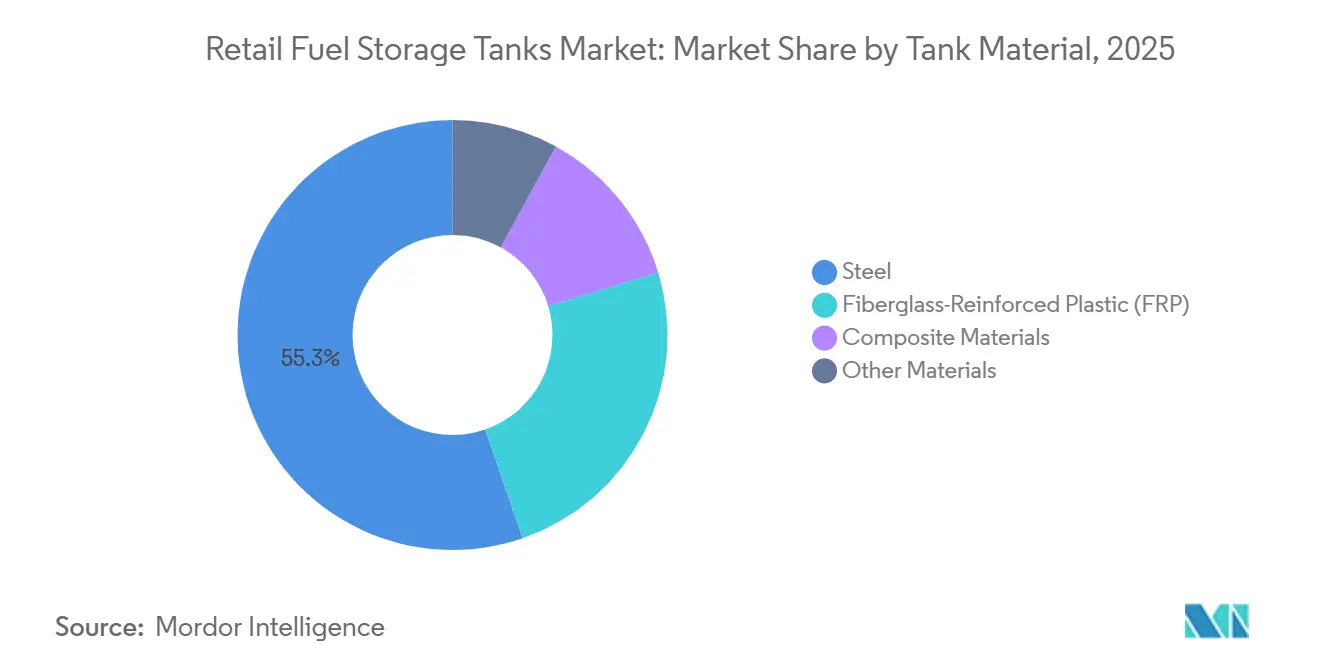
- By tank material, steel held 55.3% of the retail fuel storage tanks market share in 2025, while fiberglass-reinforced plastic is forecast to grow at a 6.3% CAGR through 2031.
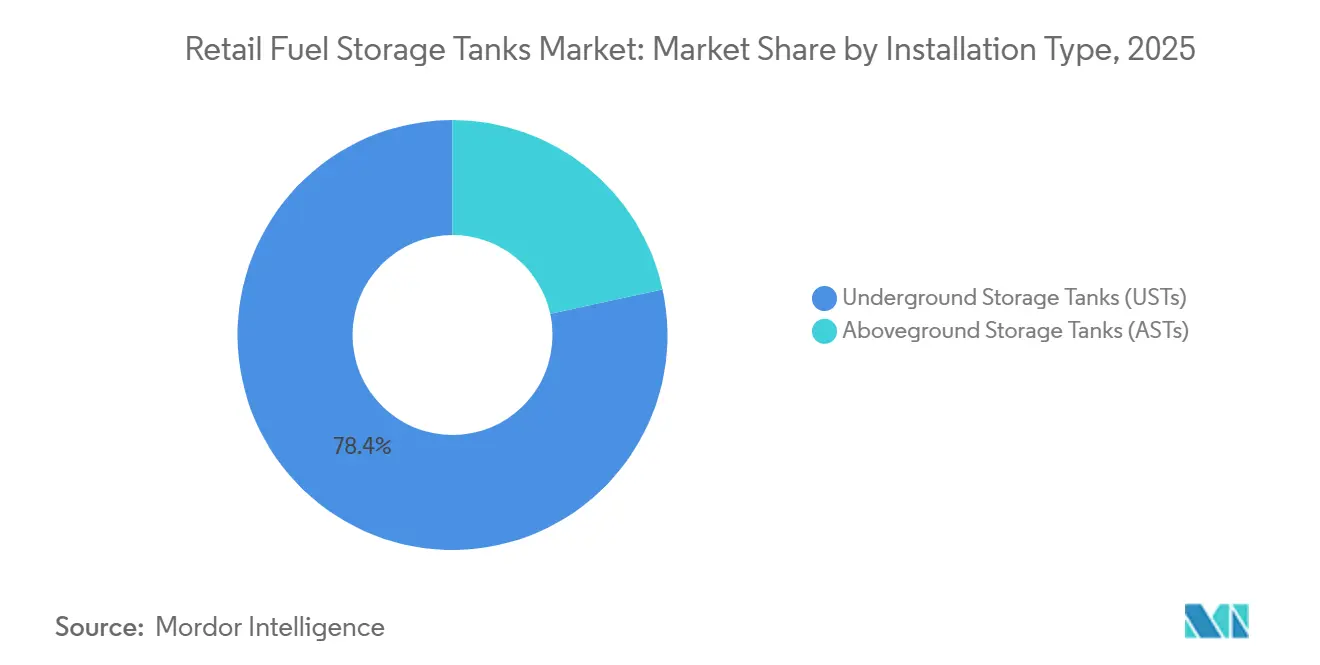
- By installation type, underground storage tanks held 78.4% share in 2025, while aboveground storage tanks are forecast to grow at a 5.9% CAGR through 2031.
- By tank capacity, the 20,000-40,000-gallon range held 38.2% share in 2025, while the above-40,000-gallon range is forecast to grow at a 6.1% CAGR through 2031.
- By geography, North America held 31.4% share in 2025, while the Asia-Pacific is forecast to grow at a 6.7% CAGR through 2031.
Note: Market size and forecast figures in this report are generated using Mordor Intelligence’s proprietary estimation framework, updated with the latest available data and insights as of January 2026.
Market Trends and Insights
Drivers Impact Analysis of Retail Fuel Storage Tanks Market*
| Driver | (~) % Impact on CAGR Forecast | Geographic Relevance | Impact Timeline |
|---|---|---|---|
| Aging Single-Wall UST Replacement Mandates | +1.80% | North America (US primary, Canada secondary) | Short term (≤ 2 years) |
| Multi-Fuel Retailing Requires Multicompartment Tanks | +0.80% | Global, with strong pull in North America and Europe | Medium term (2–4 years) |
| Convenience-Store Network Expansion in Asia-Pacific | +1.00% | Asia-Pacific core, spill-over to Middle East and Africa | Medium term (2–4 years) |
| Mainstream Adoption of Ethanol and Biodiesel Blends | +0.60% | North America and EU, early adoption in APAC | Medium term (2–4 years) |
| Digital Leak Detection and Remote Inventory Monitoring | +0.50% | Global | Medium term (2–4 years) |
| California-Led Secondary-Containment Compliance Spillover | +1.20% | North America and EU, with regulatory influence in APAC | Short term (≤ 2 years) |
| Source: Mordor Intelligence | |||
Aging Single-Wall UST Replacement Mandates Fuel Near-Term Demand
The retirement of single-wall underground storage tanks is a direct source of demand for the retail fuel storage tanks market. California required the permanent closure of noncompliant single-wall USTs by December 31, 2025. Since January 1, 2026, noncompliance has carried penalties of USD 500 to USD 5,000 per tank each day.[1] The US Environmental Protection Agency reported in December 2024 that at least 7 states had incentive programs that paired financial support with upgrade or removal requirements.[2] The agency's fiscal year 2025 performance reporting also found that double-wall systems had a lower release tendency than single-wall configurations. These rules shift purchasing toward pre-engineered double-wall units, especially where operators need to meet a defined closure date.
Multi-Fuel Retailing Drives Multicompartment Tank Demand
Retailers increasingly need to store regular, premium, mid-grade, ethanol-blended fuel, diesel, and renewable fuels at the same site. A multicompartment tank keeps several products within one structure and can reduce site footprint and equipment complexity. The retail fuel storage tanks market, therefore, benefits when new stations are designed for more than one liquid fuel category. Xerxes states that its fiberglass multicompartment tank uses a double-wall fiberglass bulkhead as a standard feature. US regulations require operators to give notice before switching to regulated substances containing more than 10% ethanol or 20% biodiesel. Operators must also demonstrate that the complete UST system is compatible with the new substance, which makes tank configuration part of the fuel change decision.
Convenience-Store Network Expansion in Asia-Pacific Anchors the Long-Term Volume Story
New convenience and fuel retail formats are expanding the installed base in several Asia-Pacific countries. Petron Malaysia opened its 800th service station at the end of 2024 and continued to invest in new stations and conversions. Sinopec's Fujian division issued a public tender for 2025-2026 procurement of SF double-wall tanks in sizes from 10 m³ to 50 m³. The retail fuel storage tanks market is also supported by Japan's corrosion-prevention requirements for underground tanks with defined risk characteristics. These programs combine greenfield construction with upgrades at established sites. They also sustain demand across several tank capacities rather than concentrating procurement in one standardized format. Manufacturers that can meet public tender specifications and local certification requirements are better placed to serve this volume.
Mainstream Adoption of Ethanol and Biodiesel Blends Demands Infrastructure Reconfiguration
Higher ethanol and biodiesel blends can require equipment changes even when a fuel station does not need a full site modernization. The US Environmental Protection Agency has proposed that newly installed UST systems use components compatible with ethanol blends up to E100. The Steel Tank Institute states that compliant steel tanks can store ethanol blends from E10 to E100 and biodiesel blends from B2 to B100.[3] The Alternative Fuels Data Center recommends consideration of multicompartment tanks when operators install B20 equipment and expect more fuel grades later. This favors tank systems that have documented compatibility and can accommodate additional compartments. The retail fuel storage tanks industry also gains from mid-life replacements when legacy systems were certified only for conventional petroleum products.
Restraints Impact Analysis of Retail Fuel Storage Tanks Market*
| Restraint | (~) % Impact on CAGR Forecast | Geographic Relevance | Impact Timeline |
|---|---|---|---|
| High Site-Disruption and Excavation Costs | -0.80% | Global (most acute in urban North America and EU) | Short term (≤ 2 years) |
| Permit and Contractor Bottlenecks for Tank Replacement | -0.60% | North America and EU, secondary impact in APAC | Medium term (2–4 years) |
| Corrosion and Compatibility Risk from New Fuel Blends | -0.40% | Global | Medium term (2–4 years) |
| Retail-Fuel Demand Uncertainty from Vehicle Electrification | -0.50% | North America and EU; long-term APAC risk | Long term (≥ 4 years) |
| Source: Mordor Intelligence | |||
High Site-Disruption and Excavation Costs Throttle Replacement Velocity
Excavation and site restoration can cost more than the tank itself, which slows replacement activity at smaller sites. A February 2025 comparison prepared for Port San Luis showed USD 190,500 in excavation and dewatering costs for a 6,000-gallon UST replacement.[4] The same document placed the total project estimate at USD 620,500 before considering the wider effect on station operations. This cost profile can defer compliance work where operators have limited capital or a narrow construction window. It can also make aboveground options more attractive at sites where local rules permit them. The retail fuel storage tanks market may see fewer projects from small independent retailers when civil works costs cannot be spread across a larger network. Larger chains have greater scope to coordinate upgrades, which can support consolidation in fuel retailing while narrowing the independent customer base.
Retail-Fuel Demand Uncertainty from Vehicle Electrification Introduces Long-Range Risk
Vehicle electrification affects the expected economic life of fuel storage equipment at some locations. As of February 1, 2026, the United States had 77,086 public EV charging sites, and that total exceeded half of the country's 150,000 fueling locations. This may lead purchasers to favor options with lower initial site work where throughput is uncertain. The effect is uneven because highway, fleet, and dense urban locations can retain substantial liquid-fuel traffic. The retail fuel storage tanks market remains supported by compliance work even when an operator also adds charging equipment. European requirements for alternative fuels may add capital needs at forecourts, but they do not remove existing containment and safety obligations for liquid fuels. The timing of tank investment will therefore depend on each site's fuel volume, charging plan, and regulatory deadline.
*Our forecasts treat driver/restraint impacts as directional, not additive. The impact forecasts reflect baseline growth, mix effects, and variable interactions.
Retail Fuel Storage Tanks Market Segment Analysis
By Tank Type:
Double-Wall Equipment Leads Replacement PurchasesDouble-wall tanks held 65.1% share in 2025 and are projected to grow at a 5.8% CAGR through 2031. Their position in the retail fuel storage tanks market reflects rules that favor secondary containment for new installations and replacement projects. California's single-wall closure requirement created an immediate reason for operators to procure compliant replacement equipment. Canada also updated the technical standards incorporated into its petroleum storage tank regulations in 2025. The retail fuel storage tanks market size for double-wall products is strengthened by both regulatory replacement and new-site construction.
Triple-wall tanks remain a specialized option for sites near sensitive groundwater or in jurisdictions with more demanding containment rules. Compartmented and jacketed variants become more relevant when stations offer several fuels from a constrained footprint. The European Commission adopted Implementing Decision 2026/989 in May 2026, updating the harmonized standard EN 13616-1:2025 for overfill-prevention devices on static liquid fuel tanks. The decision reinforces the importance of documented product compliance across new installations in member states. Suppliers must therefore compete on certification, installation support, and the ability to meet site-specific fuel and containment requirements.
By Tank Material:
Steel Leads While FRP Gains from Corrosion ResistanceSteel held 55.3% share by material in 2025. Its position in the retail fuel storage tanks market is supported by established manufacturing capacity, familiar installation practices, and broad fuel compatibility. STI/SPFA states that qualified steel tanks can be used with ethanol blends from E10 to E100 and biodiesel blends from B2 to B100. This makes steel a practical option for operators who expect future fuel blend changes. Steel also remains relevant in large capacity and aboveground applications where product strength and conventional fabrication are valued.
Fiberglass-reinforced plastic is the fastest-growing material category, with a forecast CAGR of 6.3% through 2031. Its corrosion resistance is important in aggressive soil environments and where long service life is a procurement priority. Xerxes offers fiberglass fuel tanks with multicompartment configurations and double-wall bulkheads. Mattr began production at new composite technology facilities in Blythewood, South Carolina, and Rockwall, Texas, in July 2024 under a USD 60 million growth investment. The Blythewood facility is expected to approach normalized production in 2026.
By Installation Type:
USTs Remain Predominant While ASTs Gain AppealUnderground storage tanks held 78.4% share in 2025. This installed base in the retail fuel storage tanks market reflects decades of fuel retail construction in urban and suburban locations. USTs remain the established format for many forecourts because they preserve surface space for vehicles, dispensers, and customer access. Their renewal is tied to containment, release detection, and compatibility requirements. Yet excavation, dewatering, permitting, and site closure can make a like-for-like underground replacement difficult.
Aboveground storage tanks are forecast to grow at a 5.9% CAGR through 2031. The retail fuel storage tanks market size for ASTs benefits when operators want to avoid ground-penetration work or need a prefabricated solution. The Port San Luis assessment demonstrated the cost impact of excavation and dewatering on underground projects. Modern Welding's Flameshield product line is certified under UL 142 and tested to Southwest Research Institute SwRI 97-04 requirements. Fire-rated double-wall construction is central to AST use in locations where fire authorities apply elevated safety requirements.
By Tank Capacity:
Larger Tanks Support High-Throughput Fueling SitesThe 20,000-40,000-gallon range accounted for 38.2% of the retail fuel storage tanks market size in 2025. In the retail fuel storage tanks market, this range fits the operating needs of many multi-product retail stations in North America and Europe. It can balance delivery efficiency, station throughput, and available site area. Standardization in this capacity range supports repeatable station designs for fuel retailers. It also gives suppliers a large base for conventional steel and fiberglass offerings.
The above-40,000-gallon category is forecast to grow at a 6.1% CAGR through 2031. Larger units are needed at highway corridors, truck stops, fleet locations, and stations that seek fewer tanker deliveries. The retail fuel storage tanks industry serves these locations with equipment designed for sustained throughput and demanding logistics. Western Global moved its Canadian operation to a 26,850-square-foot facility in Winnipeg to serve demand for larger tanks in major projects and mining applications. The 10,000-20,000-gallon range remains suitable for rural stations and urban infill sites where larger tanks are impractical.
Geography Analysis
North America Retail Fuel Storage Tanks Market
North America held 31.4% share in 2025. California's enforcement action from January 1, 2026, is driving near-term procurement of compliant double-wall USTs and ASTs. The EPA identified state programs that combine financial support with upgrade or removal requirements. Canada gazetted amendments in September 2025 that updated technical standards for storage tank systems. Mexico adds demand at highway corridor stations where operators are adopting multi-fuel and larger-capacity storage to support cross-border logistics.
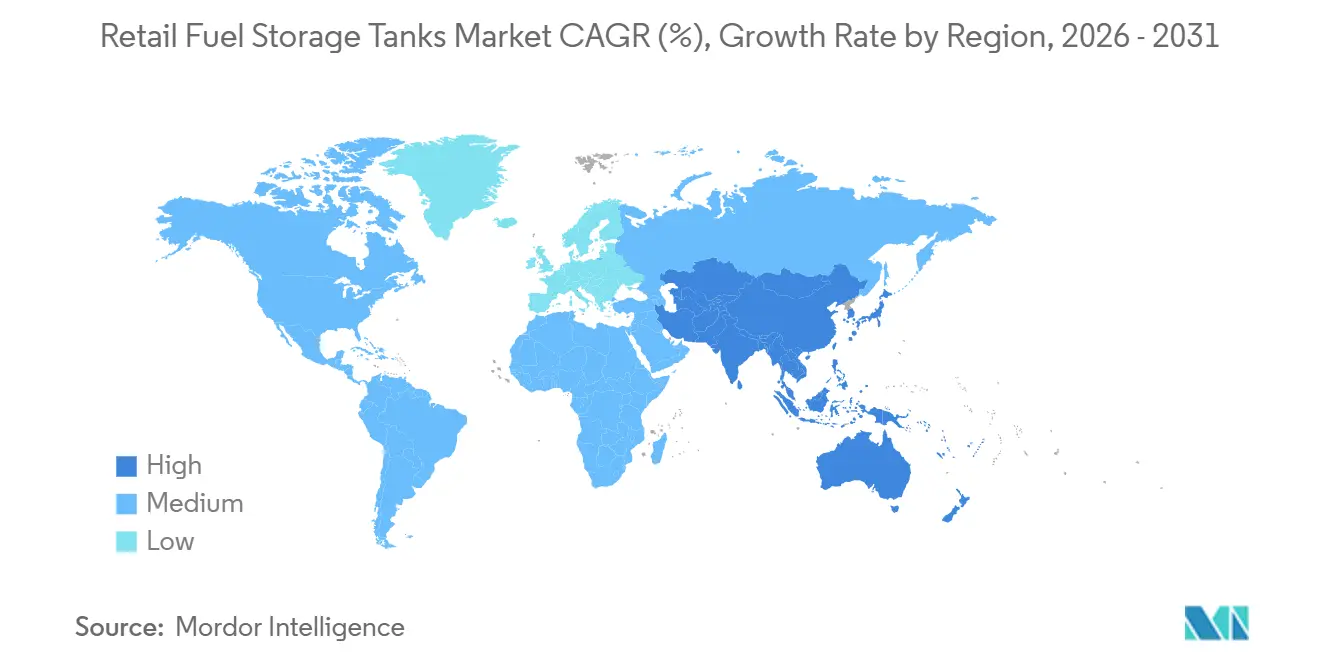
APAC Retail Fuel Storage Tanks Market
Asia-Pacific is the fastest-growing area in the retail fuel storage tanks market, at a forecast 6.7% CAGR through 2031. Sinopec issued tenders covering SF double-wall tanks in several sizes, including a Fujian procurement for 2025-2026. Japan requires internal coating, cathodic protection, or double-shell measures for underground tanks assessed as having high corrosion risk. Shell agreed in May 2025 to transfer its Indonesia gas station business and Gresik fuel storage terminal to a Citadel Pacific and Sefas joint venture. Chandra Asri Pacific agreed in October 2025 to acquire ExxonMobil's retail fuel stations in Singapore.
EMEA Retail Fuel Storage Tanks Market
Europe retained a meaningful position in the retail fuel storage tanks market in 2025, with Germany, France, and Poland among the active installation markets. The European Commission's 2026 decision updated the harmonized standard for overfill-prevention devices on static liquid fuel tanks. This increases the need for current certification documentation on new product lines. The Middle East and Africa offer a longer-term opportunity as Saudi Arabia and the UAE upgrade retail networks, while foreign exchange volatility and financing constraints in South Africa can delay projects.
Competitive Landscape
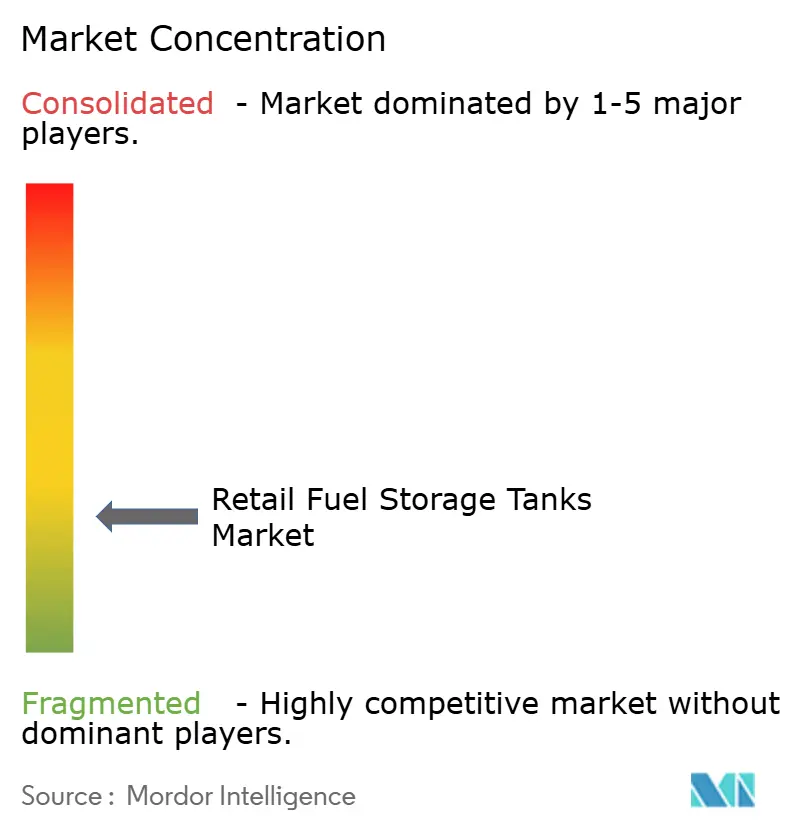
The retail fuel storage tanks market is fragmented, and no competitor has a controlling global position. Xerxes Corporation, Modern Welding Company, Highland Tank, KBK Industries, and Granby Industries have meaningful positions in North America through certified product portfolios and established manufacturing or distribution networks. Competition in the retail fuel storage tanks market rests on product approval, delivery lead time, corrosion performance, tank configuration, and field support. Highland Tank's High-LINK digital fuel management system shows how suppliers are adding monitoring functions to physical tank equipment. Xerxes uses a standard double-wall FRP multicompartment design for relevant fuel tank applications.
Mattr committed USD 60 million to growth capital for new Xerxes facilities in South Carolina and Texas. Production at those sites began in July 2024, increasing capacity before the present regulatory replacement cycle. Granby Industries introduced a 13,235-liter aboveground steel tank in June 2025, certified to ULC S601 for flammable and combustible liquids and designed for biofuel compatibility. Granby had also introduced ULC-S602-certified fiberglass day tanks in April 2024. These launches show a focus on certified products for adjacent liquid-fuel applications.
Tank monitoring remains uneven among smaller independent retailers in the retail fuel storage tanks market. Energos.ai reported that its system for 200 Shell fuel stations combined IoT edge gateways, real-time inventory functions, and alarm prioritization. Western Global's larger Canadian facility reflects a strategy to supply large tanks to infrastructure and mining projects in addition to fuel retail applications. The retail fuel storage tanks market is therefore defined by regional specialists, differentiated compliance capability, and demand spread across replacement and new construction projects.
Retail Fuel Storage Tanks Industry Leaders
-
Xerxes Corporation (Mattr)
-
NOV Inc.
-
Modern Welding Company, Inc.
-
Highland Tank LLC
-
CST Industries, Inc.
- *Disclaimer: Major Players sorted in no particular order
Retail Fuel Storage Tanks Market Companies Covered in this Report
- Belco Manufacturing Company
- CST Industries, Inc.
- Eaton Sales & Service LLC
- Fiberglass Tank Solutions
- General Industries Co. Ltd.
- Granby Industries
- Highland Tank LLC
- KBK Industries
- Modern Welding Company, Inc.
- NOV Inc.
- Roben Manufacturing, Inc.
- Roth Industries GmbH & Co. KG
- Superior Tank Co., Inc.
- Tank Connection
- Tank Solutions Pty Ltd
- Western Global Limited
- Xerxes Corporation (Mattr)
Recent Industry Developments in Retail Fuel Storage Tanks Market
- May 2026: The European Commission adopted Implementing Decision (EU) 2026/989, updating the harmonised standard for overfill prevention devices on static liquid fuel tanks to EN 13616-1:2025. The revision requires manufacturers operating in EU markets to re-certify product lines, raising the compliance bar for all new tank installations across member states and creating near-term demand for updated hardware.
- October 2025: Chandra Asri Pacific agreed to acquire ExxonMobil's network of approximately 60 Esso-branded retail petrol stations in Singapore, including associated supply agreements. The transaction was expected to close by year-end 2025 and triggers a fresh compliance review of inherited UST infrastructure under Singapore's regulatory framework, representing a meaningful near-term demand event for tank inspection and potential replacement services.
- September 2025: Canada's Department of the Environment gazetted amendments to the Storage Tank Systems for Petroleum Products and Allied Petroleum Products Regulations, effective August 28, 2025. The amendments update the incorporated technical standards to current UL/ULC certification thresholds, requiring all newly installed tanks under federal jurisdiction to meet revised specification baselines.
- June 2025: Granby Industries launched a 13,235-liter, 3,000 imperial gallon, aboveground steel tank certified to ULC S601 for flammable and combustible liquids, specifically designed to meet biofuel compatibility requirements. The product extends the company's commercial steel tank range to 13,235 liters and targets operators upgrading for higher biodiesel blend storage.
Global Retail Fuel Storage Tanks Market Report Scope
Retail fuel storage tanks are specialized tanks used at fuel retail outlets, such as petrol stations and service stations, to safely store petroleum products, including gasoline, diesel, ethanol-blended fuels, and other liquid fuels, before dispensing them to vehicles or other customers. These tanks are typically installed underground (underground storage tanks, USTs), although aboveground storage tanks are also used in certain applications. They are designed to withstand fuel exposure, prevent leakage and vapor emissions, and comply with applicable environmental and safety regulations.
The Global Retail Fuel Storage Tanks Market is segmented by tank type, tank material, installation type, tank capacity, and geography. By tank type, the market is segmented into single-wall, double-wall, triple-wall, and other tank types. By tank material, the market is segmented into steel, fiberglass-reinforced plastic (FRP), composite, and other materials. By installation type, the market is segmented into underground storage tanks (USTs) and aboveground storage tanks (ASTs). By tank capacity, the market is segmented into below 10,000 gallons, 10,000–20,000 gallons, 20,000–40,000 gallons, and above 40,000 gallons. The report also covers the market size and forecasts for the global retail fuel storage tanks market across 26 countries in key regions. For each segment, the market sizing and forecasts have been provided on the basis of value (USD).
Segmentation Overview
| Single-Wall Tanks |
| Double-Wall Tanks |
| Triple-Wall Tanks |
| Other Tank Types |
| Steel |
| Fiberglass-Reinforced Plastic (FRP) |
| Composite Materials |
| Other Materials |
| Underground Storage Tanks (USTs) |
| Aboveground Storage Tanks (ASTs) |
| Below 10,000 Gallons |
| 10,000–20,000 Gallons |
| 20,000–40,000 Gallons |
| Above 40,000 Gallons |
| North America | United States |
| Canada | |
| Mexico | |
| Europe | Germany |
| France | |
| Italy | |
| Spain | |
| United Kingdom | |
| Poland | |
| Russia | |
| Rest of Europe | |
| Asia-Pacific | China |
| India | |
| Japan | |
| South Korea | |
| Australia | |
| Indonesia | |
| Vietnam | |
| Thailand | |
| Rest of Asia-Pacific | |
| South America | Brazil |
| Argentina | |
| Chile | |
| Rest of South America | |
| Middle East and Africa | Saudi Arabia |
| United Arab Emirates | |
| Egypt | |
| South Africa | |
| Morocco | |
| Rest of Middle East and Africa |
| By Tank Type | Single-Wall Tanks | |
| Double-Wall Tanks | ||
| Triple-Wall Tanks | ||
| Other Tank Types | ||
| By Tank Material | Steel | |
| Fiberglass-Reinforced Plastic (FRP) | ||
| Composite Materials | ||
| Other Materials | ||
| By Installation Type | Underground Storage Tanks (USTs) | |
| Aboveground Storage Tanks (ASTs) | ||
| By Tank Capacity | Below 10,000 Gallons | |
| 10,000–20,000 Gallons | ||
| 20,000–40,000 Gallons | ||
| Above 40,000 Gallons | ||
| By Geography | North America | United States |
| Canada | ||
| Mexico | ||
| Europe | Germany | |
| France | ||
| Italy | ||
| Spain | ||
| United Kingdom | ||
| Poland | ||
| Russia | ||
| Rest of Europe | ||
| Asia-Pacific | China | |
| India | ||
| Japan | ||
| South Korea | ||
| Australia | ||
| Indonesia | ||
| Vietnam | ||
| Thailand | ||
| Rest of Asia-Pacific | ||
| South America | Brazil | |
| Argentina | ||
| Chile | ||
| Rest of South America | ||
| Middle East and Africa | Saudi Arabia | |
| United Arab Emirates | ||
| Egypt | ||
| South Africa | ||
| Morocco | ||
| Rest of Middle East and Africa | ||
Key Questions Answered in the Report
What is the projected value of retail fuel storage tanks by 2031?
The retail fuel storage tanks market is forecast to reach USD 4.48 billion by 2031, from USD 3.52 billion in 2026, at a 4.94% CAGR.
Which tank type has the leading position in fuel retail applications?
Double-wall tanks held 65.1% share in 2025 and are also forecast to grow at a 5.8% CAGR through 2031.
Why are double-wall tanks being adopted more widely?
Single-wall closure rules, release-prevention requirements, and new containment standards are increasing replacement demand for double-wall systems.
Which material is growing fastest for fuel storage tanks?
Fiberglass-reinforced plastic is forecast to grow at a 6.3% CAGR through 2031 because of corrosion resistance and available multicompartment designs.
Are aboveground tanks gaining use at fuel stations?
Yes. Aboveground tanks are forecast to grow at a 5.9% CAGR as operators seek to avoid excavation, dewatering, and some underground installation work.
Which region is growing fastest for retail fuel storage tanks?
Asia-Pacific is forecast to grow at a 6.7% CAGR through 2031, supported by procurement programs and new fuel retail infrastructure.