
Responsible AI Compliance Platforms Market Size and Share
Market Overview
| Study Period | 2020 - 2031 |
|---|---|
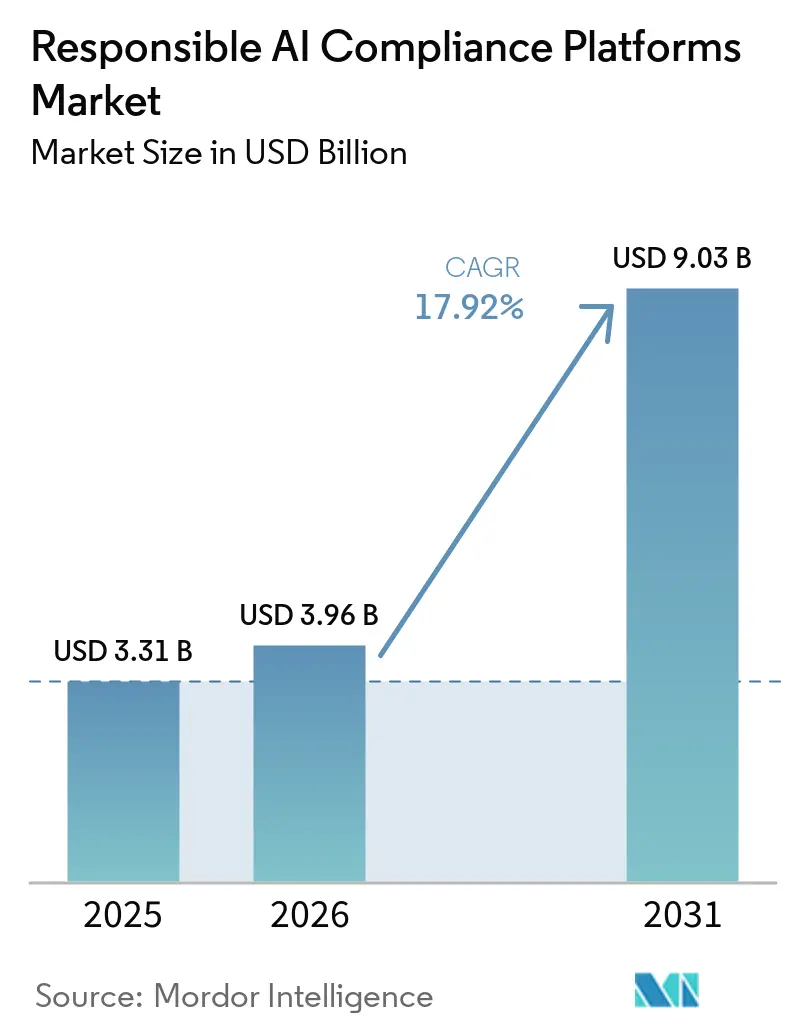
| Market Size (2026) | USD 3.96 Billion |
| Market Size (2031) | USD 9.03 Billion |
| Growth Rate (2026 - 2031) | 17.92 % |
| Fastest Growing Market | Asia-Pacific |
| Largest Market | North America |
| Market Concentration | Low |
Major Players *Disclaimer: Major Players sorted in no particular order Image © Mordor Intelligence. Reuse requires attribution under CC BY 4.0. | |
Responsible AI Compliance Platforms Market Analysis by Mordor Intelligence
The Responsible AI Compliance Platforms Market size is projected to expand from USD 3.31 billion in 2025 to USD 9.03 billion by 2031, registering a CAGR of 17.92% between 2026 and 2031. Enforceable AI rules, board oversight, and wider deployment of AI in core workflows are shaping the Responsible AI Compliance Platforms Market. Enterprises need records that show how systems were assessed, approved, monitored, and changed. This requirement favors platforms that connect risk controls to operational evidence rather than to isolated policy documents. Demand also rises because autonomous agents require oversight during operation, not only before deployment. The Responsible AI Compliance Platforms Market, therefore, offers opportunities for providers that support regulatory mapping, reusable evidence, and controls across mixed technical environments.
Key Report Takeaways
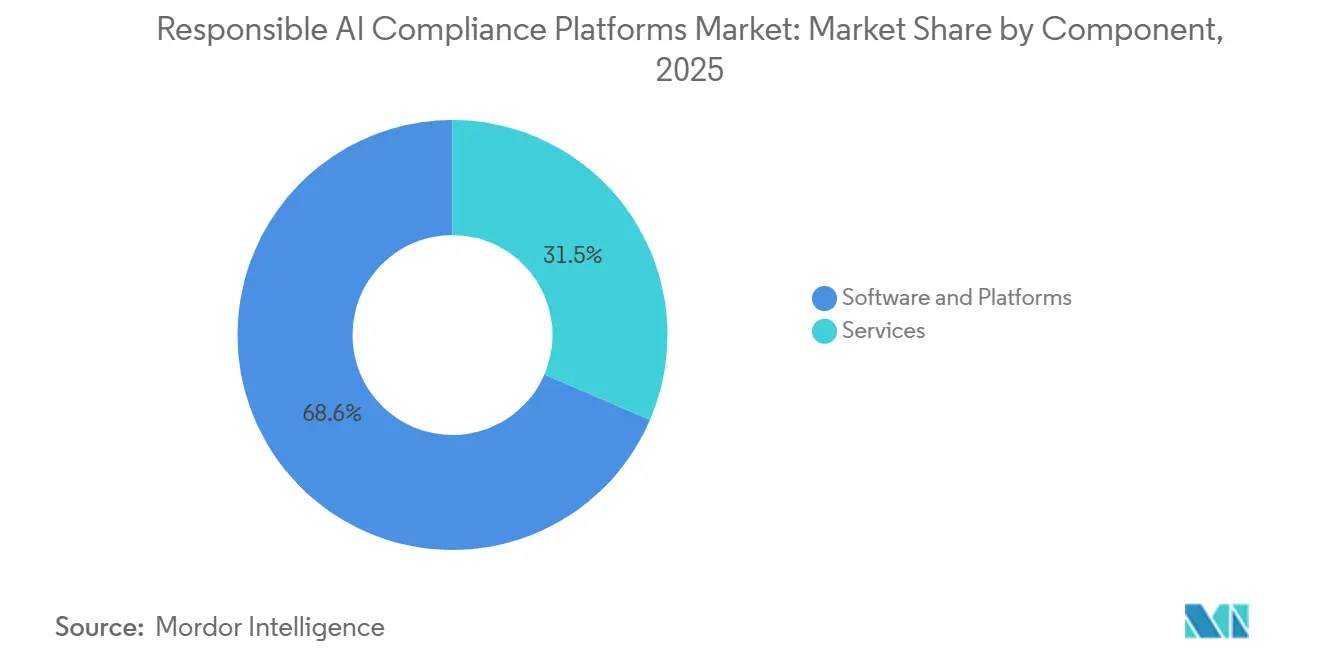
- By component, software and platforms held 68.55% of the Responsible AI Compliance Platforms Market share in 2025, while services are forecast to grow at an 18.52% CAGR through 2031.
- By capability, risk, and impact assessment accounted for 24.61% of revenue in 2025, while bias, fairness, and robustness testing are forecast to grow at an 18.73% CAGR through 2031.
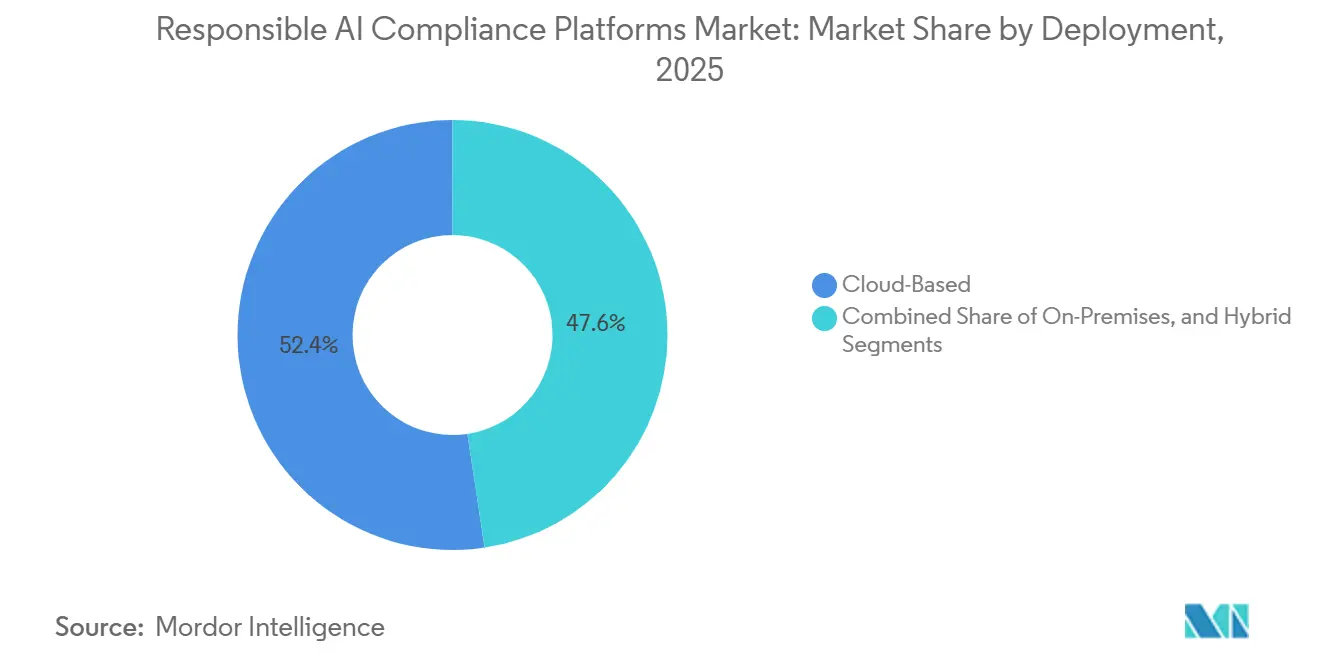
- By deployment, cloud-based platforms accounted for 52.38% of the Responsible AI Compliance Platforms Market revenue in 2025 and are forecast to grow at an 18.78% CAGR through 2031.
- By organization size, large enterprises held 74.55% of revenue in 2025, while SMEs are forecast to grow at an 18.95% CAGR through 2031.
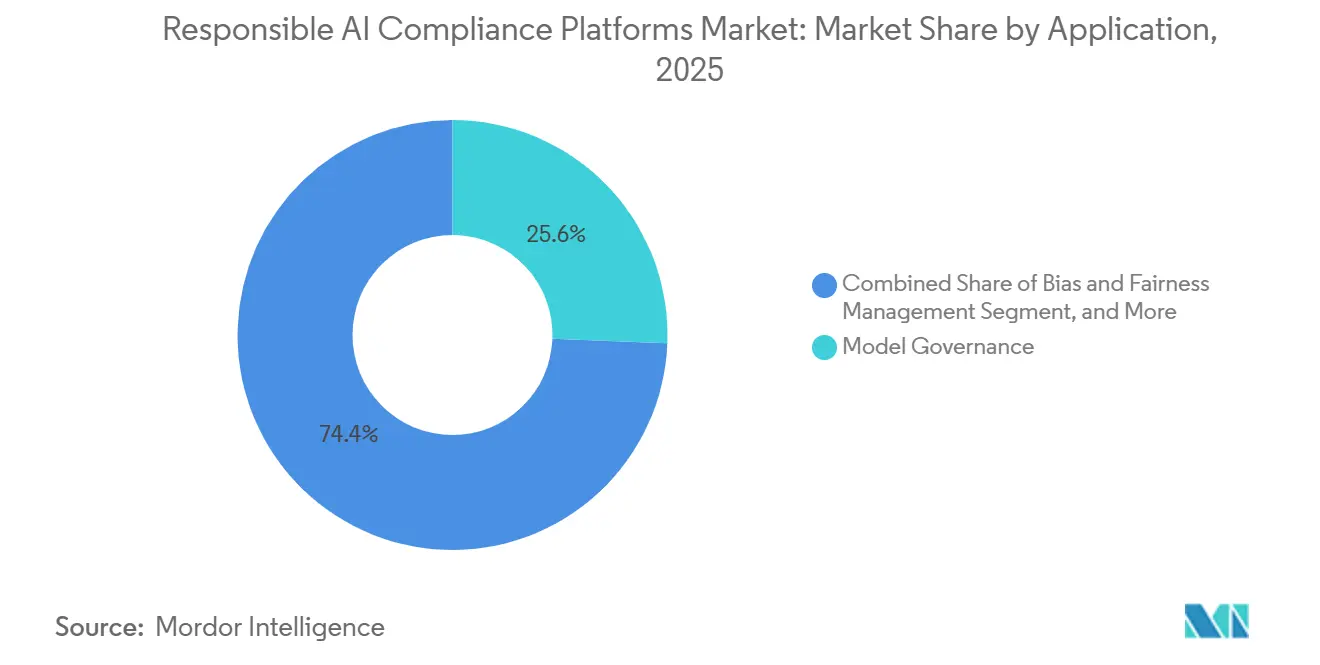
- By application, model governance held 25.61% of revenue in the Responsible AI Compliance Platforms Market in 2025, while generative AI and large language model auditing are forecast to grow at an 18.94% CAGR through 2031.
- By end-use industry, BFSI accounted for 26.78% of revenue in 2025, while healthcare and life sciences are forecast to grow at an 18.83% CAGR through 2031.
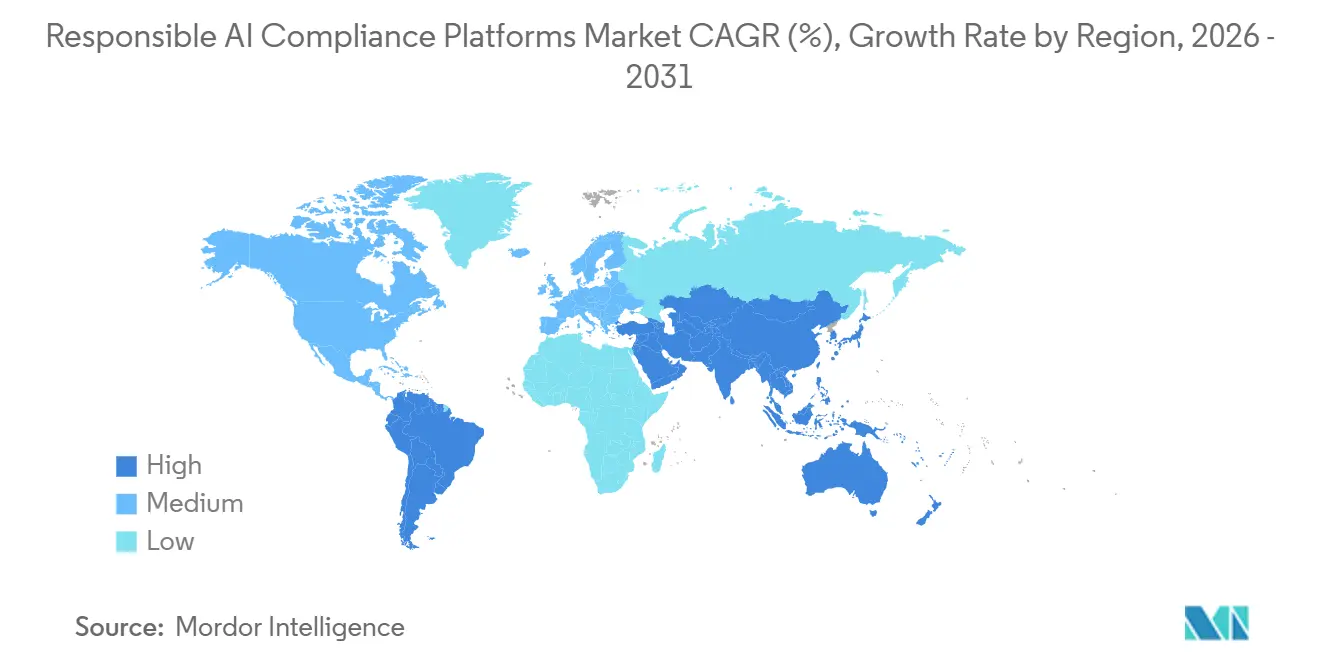
- By geography, North America accounted for 38.74% of revenue in the Responsible AI Compliance Platforms Market in 2025, while Asia-Pacific is forecast to grow at an 18.85% CAGR through 2031.
Note: Market size and forecast figures in this report are generated using Mordor Intelligence’s proprietary estimation framework, updated with the latest available data and insights as of January 2026.
Market Trends and Insights
Drivers Impact Analysis of Responsible AI Compliance Platforms Market*
| Driver | (~) % Impact on CAGR Forecast | Geographic Relevance | Impact Timeline |
|---|---|---|---|
| Phased AI Regulation and Enforcement Deadlines | +4.2% | Global, highest urgency in Europe and Asia-Pacific | Short term (≤ 2 years) |
| Enterprise AI Deployment Outpacing Governance Capacity | +3.8% | Global | Medium term (2-4 years) |
| Board-Level Demand for Auditable Responsible AI | +3.2% | Global, led by North America and Europe | Short term (≤ 2 years) |
| Expansion of Agentic AI and Runtime Oversight | +2.8% | Global, early gains in North America and Europe | Medium term (2-4 years) |
| Standardized Evidence Reuse Across AI Frameworks | +2.1% | Europe and North America | Medium term (2-4 years) |
| Insurance and Procurement Incentives for Governed AI | +1.6% | North America and Europe | Long term (≥ 4 years) |
| Source: Mordor Intelligence | |||
Phased AI Regulation and Enforcement Deadlines
The Responsible AI Compliance Platforms Market benefits from binding rules with defined compliance dates. The European Union AI Act applied prohibitions on specified AI practices from February 2025 and obligations for general-purpose AI models from August 2025. Its transparency requirements under Article 50 and broader enforcement powers applied in August 2026, with penalties that can reach EUR 35 million or 7% of worldwide annual turnover.[1] Organizations cannot treat all obligations as a single future event because the requirements have different start dates. They need a clear view of which rules currently apply to each system. ISO/IEC 42001 also supports the sharing of control evidence across frameworks, which can reduce duplicate compliance work.
Enterprise AI Deployment Outpacing Governance Capacity
The Responsible AI Compliance Platforms Market is driven by AI deployment that outpaces internal review processes. The Federal Reserve reported that 18% of U.S. firms had adopted AI by late 2025, while more than 20% expected to start using it in the first half of 2026.[2] This creates a large inventory of models, tools, and applications that must be identified and assessed. Unapproved use by business teams can leave governance teams without a complete record of AI activity. IBM introduced tooling in 2025 that combines agentic AI security and governance and supports compliance checks across 12 frameworks. The need to document frequent model updates makes manual review especially difficult.
Board-Level Demand for Auditable Responsible AI
Stronger expectations for executive oversight also influence the Responsible AI Compliance Platforms Market. Directors and audit committees need evidence that policies were applied to systems and decisions. This shifts governance work from a separate ethics process toward internal controls and accountability. The Committee of Sponsoring Organizations of the Treadway Commission published guidance on effective internal control over generative AI in February 2026. That guidance raises the importance of documenting how AI-assisted judgments are formed. Platforms that create dated records, decision trails, and review evidence can help organizations support board reporting.
Expansion of Agentic AI and Runtime Oversight
The Responsible AI Compliance Platforms Market gains relevance as agentic systems select tools and perform multistep actions. These systems require controls during execution because a pre-deployment assessment alone cannot prevent every unsafe action. Runtime controls need to address tool misuse, identity abuse, memory poisoning, and similar risks. Microsoft released its Agent Governance Toolkit in April 2026 to address the 10 risks in the OWASP Agentic AI Top 10. United Nations University research published in 2025 also identified the agent execution layer as a separate subject for governance and assurance. These requirements increase demand for controls that can act before a policy breach causes a business outcome.[3]
Restraints Impact Analysis of Responsible AI Compliance Platforms Market*
| Restraint | (~) % Impact on CAGR Forecast | Geographic Relevance | Impact Timeline |
|---|---|---|---|
| Shortage of AI Governance and Assurance Specialists | -2.8% | Global | Long term (≥ 4 years) |
| Integration Complexity Across Legacy MLOps and Multi-Cloud | -2.1% | Global, most acute in Asia-Pacific and emerging markets | Medium term (2-4 years) |
| Fragmented Regulatory Interpretation Across Jurisdictions | -1.5% | Global, most complex across Europe, Asia-Pacific, and the United States | Long term (≥ 4 years) |
| Unverifiable Risk Metrics for Foundation and Agentic Models | -1.1% | Global | Long term (≥ 4 years) |
| Source: Mordor Intelligence | |||
Shortage of AI Governance and Assurance Specialists
The Responsible AI Compliance Platforms Market faces a shortage of practitioners who understand both AI behavior and regulatory obligations. A platform license does not replace the people needed to classify risks, set controls, and review evidence. Vistage reported that 84% of surveyed small and midsize business CEOs had deployed generative AI tools by spring 2026, while only 22% had a comprehensive AI governance policy. The shortage is more severe for SMEs and public bodies that lack large governance teams. It raises demand for automated evidence collection and policy mapping. It can also slow adoption when buyers cannot staff a program after procurement.
Integration Complexity Across Legacy MLOps and Multi-Cloud
The Responsible AI Compliance Platforms Market must work across legacy MLOps pipelines, cloud registries, on-premises systems, and third-party model interfaces. AI assets can be retrained regularly and can use multiple foundation models within a single workflow. This makes maintaining consistent records harder than in a typical single-system software deployment. In 2026, DataRobot stated that its governance capabilities support sovereign, air-gapped, edge, hybrid, and cloud environments. Agent connections to external tools create additional places where organizations need policy controls. Integration costs can be a material barrier for smaller buyers and companies operating in several jurisdictions.
*Our forecasts treat driver/restraint impacts as directional, not additive. The impact forecasts reflect baseline growth, mix effects, and variable interactions.
Responsible AI Compliance Platforms Market Segment Analysis
By Component:
Platforms Lead Revenue While Services Expand with Implementation NeedsSoftware and platforms held 68.55% of the Responsible AI Compliance Platforms Market share in 2025. Large enterprises use licensed governance systems because policies, inventories, and monitoring need to operate continuously. These systems can align internal processes with ISO/IEC 42001 and the NIST AI Risk Management Framework. The component also supports common evidence records for audit and reporting work. The Responsible AI Compliance Platforms Market size for this component reflects the need for ongoing governance rather than periodic consulting reviews.
Services are forecast to expand at an 18.52% CAGR from 2026 to 2031. Organizations need help mapping their AI portfolios to regulatory duties and configuring controls for their own processes. Managed governance services can help teams with limited internal expertise. IBM expanded its responsible AI advisory work in 2025 to include AI discovery, secure-by-design implementation, and regulatory guidance.[4] Agentic AI can add service work because runtime controls require specialized setup. Software and services, therefore, operate together rather than as separate buyer choices.
By Capability:
Risk Assessment Leads While Testing Gains PriorityRisk and impact assessment accounted for 24.61% of the Responsible AI Compliance Platforms Market in 2025. Risk classification is the entry point for deciding which controls, reviews, and records a system needs. It supports an organized inventory and helps organizations direct scarce review capacity toward higher-risk systems. This capability is central to the EU AI Act and the NIST AI Risk Management Framework workflows. It also gives management a consistent record of why a system received a particular treatment.
Bias, fairness, and robustness testing is forecast to grow at an 18.73% CAGR through 2031. Financial services, civil rights enforcement, and public procurement can require evidence that AI outcomes have been tested. The Responsible AI Compliance Platforms Market share held by this capability is expected to be supported by requirements that overlap across frameworks. The European Banking Authority described links between existing fairness duties and AI Act obligations for banking and payments in November 2025. Inventory, policy management, and explainability functions are also needed as buyers move from isolated tools to integrated governance suites.
By Deployment:
Cloud Remains the Main Governance ArchitectureCloud-based deployment held 52.38% of revenue in 2025. It is also forecast to grow at an 18.78% CAGR through 2031. Cloud systems fit requirements for real-time monitoring, automatic framework updates, and scalable coverage across distributed portfolios. They can distribute regulatory changes to customer environments without a separate update process at every site. This is valuable when obligations change on a defined regulatory timetable. Cloud delivery also supports teams that need a shared governance view across several locations. The deployment model is therefore aligned with the continuous nature of AI compliance activity.
The Article 50 transparency obligations that apply in August 2026 reinforce the need to promptly update controls and documentation. On-premises and hybrid systems remain important where data residency, security, or operating constraints limit cloud use. DataRobot's 2026 announcement described consistent governance across sovereign, air-gapped, and hybrid settings. European financial services and critical infrastructure users also consider DORA and NIS2 requirements when choosing a deployment architecture. The responsible AI compliance platforms market needs to serve these users without sacrificing centralized policy management. Buyers are likely to assess deployment options based on their data location, integration needs, and ability to maintain current controls. This leaves room for cloud, hybrid, and on-premises offerings, even as cloud adoption leads. The choice depends on where data is held, how models are connected, and whether teams can administer controls continuously. A practical governance design must accommodate those constraints while preserving evidence that is usable across the organization.

By Organization Size:
Large Enterprises Lead While SMEs ExpandLarge enterprises accounted for 74.55% of the Responsible AI Compliance Platforms Market in 2025. They generally have larger AI portfolios, higher regulatory exposure, and established model risk management practices. Many had built governance processes around frameworks such as SR 11-7, ISO/IEC 42001, and the NIST AI Risk Management Framework. Their scale also supports investment in enterprise platforms and specialist staff. This group sets many of the supplier requirements for auditability and integration.
SMEs are forecast to grow at an 18.95% CAGR through 2031. High-risk AI obligations can apply regardless of organization size, and large customers increasingly expect suppliers to demonstrate governance. The difference between AI adoption and governance readiness supports the Responsible AI Compliance Platforms Market size for SMEs. Vistage found that only 22% of surveyed CEOs of small and midsize businesses had a comprehensive policy, despite 84% deploying generative AI tools. The United Kingdom government’s AI Management Essentials guidance also offers a structured assessment approach for smaller organizations. Simpler onboarding and assisted workflows remain important for this buyer group.
By Application:
Model Governance Leads While Generative AI Auditing Grows FastestModel governance held 25.61% of revenue in the Responsible AI Compliance Platforms Market in 2025. Organizations need to identify, approve, monitor, and document models before managing narrower control areas. This application is well established in financial services because of its model risk management practices. It provides the recordkeeping base for regulatory, fairness, and incident management functions. Its leading position reflects the need for consistent model-level controls across enterprise AI portfolios.
Generative AI and large language model auditing are forecast to grow at an 18.94% CAGR through 2031. Deployed language model applications require testing for hallucinations, prompt injection, traceability, and other risks. Internal control expectations are placing greater emphasis on records related to AI-assisted decisions. Regulatory reporting, privacy and security governance, explainability, and incident management add demand for unified audit trails. Buyers are increasingly seeking one system that can connect these processes.
By End-Use Industry:
BFSI Leads While Healthcare and Life Sciences AccelerateBFSI held 26.78% of the Responsible AI Compliance Platforms Market share in 2025. The sector has longstanding model risk management and fair lending responsibilities. It also faces AI requirements that intersect with financial resilience, privacy, and prudential rules. EIOPA published an opinion on AI governance and risk management for insurance in August 2025. These requirements support demand for documented controls and evidence that internal and external stakeholders can review.
Healthcare and life sciences are forecast to grow at an 18.83% CAGR through 2031. The sector must manage clinical risk, data protection, and documentation across the AI lifecycle. The U.S. Food and Drug Administration had authorized nearly 1,000 AI-enabled medical devices by 2024, indicating the scale of lifecycle documentation needs. Government, it and telecommunications, retail and e-commerce, and manufacturing and automotive organizations also use the Responsible AI Compliance Platforms Market. Their demand comes from procurement requirements and the growing scale of internal AI deployments. Healthcare’s combination of clinical and regulatory responsibilities supports its faster growth.
Geography Analysis
North America Responsible AI Compliance Platforms Market
North America held 38.74% of the Responsible AI Compliance Platforms Market share in 2025. The region has a high concentration of financial institutions, healthcare organizations, and large technology users. U.S. financial institutions draw on established model risk management practices, while healthcare organizations face AI device requirements. Microsoft Azure AI Foundry Models and Microsoft Security Copilot achieved ISO/IEC 42001:2023 certification in 2025. Canada’s AI policy work and financial sector guidance also support regional demand.
Europe Responsible AI Compliance Platforms Market
Europe is the second-largest regional area in the Responsible AI Compliance Platforms Market. The EU AI Act, the General Data Protection Regulation, the Digital Operational Resilience Act, and NIS2 create overlapping requirements for many buyers. The Responsible AI Compliance Platforms Market size in Europe is driven by phased AI Act requirements, which necessitate ongoing regulatory tracking. Article 50 transparency duties and broader enforcement powers applied in August 2026. Germany is a significant market because its industrial and regulated sectors require systems that can link AI risk to existing standards. The deferred deadline for some high-risk requirements shifts immediate attention toward general-purpose AI governance.
APAC and MEA Responsible AI Compliance Platforms Market
Asia-Pacific is forecast to grow at an 18.85% CAGR from 2026 to 2031. The region is seeing more binding AI governance measures in major economies, which increases the need for localized regulatory mapping. Singapore’s model AI governance framework and financial sector AI risk management work create demand in regulated finance. Japan also saw new domestic governance offerings from Citadel AI and DataSign in 2026. The Middle East is an emerging region led by Saudi Arabia and the United Arab Emirates, while activity in Africa remains early-stage and concentrated in South African financial services.
Competitive Landscape
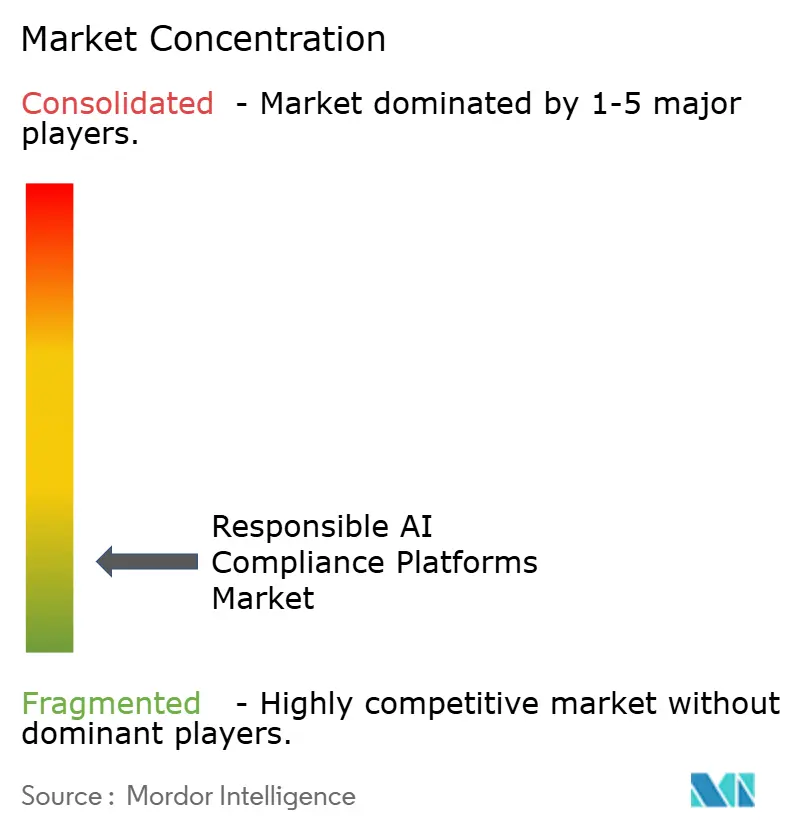
The Responsible AI Compliance Platforms Market is fragmented among large cloud providers, while specialized vendors remain active. IBM, Microsoft, Google, and Amazon Web Services place governance features within their AI development environments. Their offerings include model inventories, policy controls, and audit records. This position benefits customers who already use their cloud platforms. Specialized vendors compete through deeper regulatory mapping, framework-neutral evidence trails, and agentic runtime oversight.
Integration and product expansion are important competitive approaches in the Responsible AI Compliance Platforms Market. IBM introduced unified governance and security software for agentic and generative AI in June 2025, with checks against 12 frameworks. Microsoft released the Agent Governance Toolkit in April 2026 to provide open-source runtime policy enforcement for AI agents. Fiddler AI acquired Lumeus in January 2026 to extend its control plane into coding-agent workflows. These moves show that vendors are expanding from model oversight into agent behavior and development workflows.
The Responsible AI Compliance Platforms Market has room for products designed for SMEs, cross-jurisdictional evidence reuse, and agent authorization chains. Buyers need to apply controls across Europe, the United States, and Asia-Pacific without creating separate evidence libraries for every rule. ISO/IEC 42001 certification is becoming a visible signal for providers that want to demonstrate structured AI management. Microsoft achieved this certification for Azure AI Foundry Models and Security Copilot in 2025. DataSign launched AI MONBAN in Japan in June 2026 to help enterprises visualize, control, and audit AI use. Competition remains consistent with a moderately consolidated market, as broad providers have distribution advantages, while specialized suppliers retain differentiated capabilities.
Responsible AI Compliance Platforms Industry Leaders
-
IBM Corporation
-
Microsoft Corporation
-
Google LLC
-
Amazon Web Services, Inc.
-
Credo AI, Inc.
- *Disclaimer: Major Players sorted in no particular order
Responsible AI Compliance Platforms Market Companies Covered in this Report
- IBM Corporation
- Microsoft Corporation
- Google LLC
- Amazon Web Services, Inc.
- Credo AI, Inc.
- SAS Institute Inc.
- FICO, Inc.
- SAP SE
- Salesforce, Inc.
- ServiceNow, Inc.
- DataRobot, Inc.
- Holistic AI, Inc.
- ModelOp, Inc.
- Monitaur, Inc.
- Fairly AI Inc.
- Fiddler Labs, Inc.
- ArthurAI, Inc.
- OneTrust, LLC
- Collibra NV
- Dataiku SAS
- Modulos AG
- LatticeFlow AG
Recent Industry Developments in Responsible AI Compliance Platforms Market
- July 2026: Cognizant launched Neuro AI Trust, a centralized real-time AI assurance platform covering continuous governance, runtime policy evaluation, predictive risk detection, and audit-ready records across models, agents, and multi-agent networks. The platform supports NIST AI RMF, EU AI Act, OECD Principles, and ISO/IEC 42001.
- June 2026: DataSign launched AI MONBAN in Japan, an enterprise governance platform that enables organizations to visualize, control, and audit AI usage.
- April 2026: Microsoft released the Agent Governance Toolkit as an open-source project addressing the OWASP Agentic AI Top 10 risks with policy enforcement and regulatory mapping.
- January 2026: Fiddler AI acquired Lumeus, extending its AI Control Plane into coding-agent workflows.
Global Responsible AI Compliance Platforms Market Report Scope
The Responsible AI Compliance Platforms Market Report is Segmented by Component (Software and Platforms and Services), Capability (AI Inventory and Cataloging, Risk and Impact Assessment, Policy and Control Management, Bias, Fairness, and Robustness Testing, Explainability and Interpretability, and Other Capablities), Deployment (Cloud-Based, On-Premises, and Hybrid), Organization Size (Large Enterprises and Small and Medium-Sized Enterprises), Application (Model Governance, Regulatory Compliance and Reporting, Bias and Fairness Management, Generative AI and Large Language Model Auditing, Data Privacy and Security Governance, Explainability and Transparency Management, and Incident, Complaints, and Remediation Management), End-Use Industry (Banking, Financial Services, and Insurance, Healthcare and Life Sciences, Government and Public Sector, Information Technology and Telecommunications, Retail and E-Commerce, Manufacturing and Automotive, and Other End-User Industries), and Geography (North America, South America, Europe, Asia-Pacific, Middle East, and Africa). The Market Forecasts are Provided in Terms of Value (USD).
| Software and Platforms |
| Services |
| AI Inventory and Cataloging |
| Risk and Impact Assessment |
| Policy and Control Management |
| Bias, Fairness, and Robustness Testing |
| Explainability and Interpretability |
| Others Capabilities |
| Cloud-Based |
| On-Premises |
| Hybrid |
| Large Enterprises |
| Small and Medium-Sized Enterprises |
| Model Governance |
| Regulatory Compliance and Reporting |
| Bias and Fairness Management |
| Generative AI and Large Language Model Auditing |
| Data Privacy and Security Governance |
| Explainability and Transparency Management |
| Incident, Complaints, and Remediation Management |
| Banking, Financial Services, and Insurance |
| Healthcare and Life Sciences |
| Government and Public Sector |
| Information Technology and Telecommunications |
| Retail and E-Commerce |
| Manufacturing and Automotive |
| Other End-Use Industries |
| North America | United States |
| Canada | |
| Mexico | |
| South America | Brazil |
| Rest of South America | |
| Europe | Germany |
| United Kingdom | |
| France | |
| Russia | |
| Rest of Europe | |
| Asia-Pacific | China |
| Japan | |
| India | |
| South Korea | |
| Australia | |
| Rest of Asia-Pacific | |
| Middle East | United Arab Emirates |
| Saudi Arabia | |
| Israel | |
| Turkey | |
| Rest of Middle East | |
| Africa | South Africa |
| Rest of Africa |
| By Component | Software and Platforms | |
| Services | ||
| By Capability | AI Inventory and Cataloging | |
| Risk and Impact Assessment | ||
| Policy and Control Management | ||
| Bias, Fairness, and Robustness Testing | ||
| Explainability and Interpretability | ||
| Others Capabilities | ||
| By Deployment | Cloud-Based | |
| On-Premises | ||
| Hybrid | ||
| By Organization Size | Large Enterprises | |
| Small and Medium-Sized Enterprises | ||
| By Application | Model Governance | |
| Regulatory Compliance and Reporting | ||
| Bias and Fairness Management | ||
| Generative AI and Large Language Model Auditing | ||
| Data Privacy and Security Governance | ||
| Explainability and Transparency Management | ||
| Incident, Complaints, and Remediation Management | ||
| By End-Use Industry | Banking, Financial Services, and Insurance | |
| Healthcare and Life Sciences | ||
| Government and Public Sector | ||
| Information Technology and Telecommunications | ||
| Retail and E-Commerce | ||
| Manufacturing and Automotive | ||
| Other End-Use Industries | ||
| By Geography | North America | United States |
| Canada | ||
| Mexico | ||
| South America | Brazil | |
| Rest of South America | ||
| Europe | Germany | |
| United Kingdom | ||
| France | ||
| Russia | ||
| Rest of Europe | ||
| Asia-Pacific | China | |
| Japan | ||
| India | ||
| South Korea | ||
| Australia | ||
| Rest of Asia-Pacific | ||
| Middle East | United Arab Emirates | |
| Saudi Arabia | ||
| Israel | ||
| Turkey | ||
| Rest of Middle East | ||
| Africa | South Africa | |
| Rest of Africa | ||
Key Questions Answered in the Report
How large is the responsible AI compliance platforms market?
The market was valued at USD 3.31 billion in 2025 and is forecast to reach USD 9.03 billion by 2031 at a 17.92% CAGR.
What is driving demand for responsible AI compliance platforms?
Enforceable AI rules, faster enterprise AI adoption, board oversight, and the need for runtime controls for AI agents are supporting demand.
Which component leads revenue in responsible AI compliance platforms?
Software and platforms led with 68.55% revenue share in 2025, while services is forecast to grow at an 18.52% CAGR through 2031.
Why are cloud-based responsible AI compliance platforms growing?
Cloud deployment led with 52.38% share in 2025 and is forecast to grow at an 18.78% CAGR because it supports real-time monitoring and centralized updates.
Which end-use sector has the largest adoption of responsible AI compliance platforms?
BFSI led with 26.78% of revenue in 2025 because of established model risk, fair lending, and regulatory documentation requirements.
Which region is growing fastest for responsible AI compliance platforms?
Asia-Pacific is forecast to grow at an 18.85% CAGR through 2031 as AI governance requirements expand across major economies.