
Residential Battery Energy Storage Systems Market Size and Share
Market Overview
| Study Period | 2021 - 2031 |
|---|---|
| Market Size (2026) | USD 4.69 Billion |
| Market Size (2031) | USD 7.97 Billion |
| Growth Rate (2026 - 2031) | 11.17 % |
| Fastest Growing Market | Middle East and Africa |
| Largest Market | Asia-Pacific |
| Market Concentration | Medium |
Major Players *Disclaimer: Major Players sorted in no particular order Image © Mordor Intelligence. Reuse requires attribution under CC BY 4.0. | |
Residential Battery Energy Storage Systems Market Analysis by Mordor Intelligence
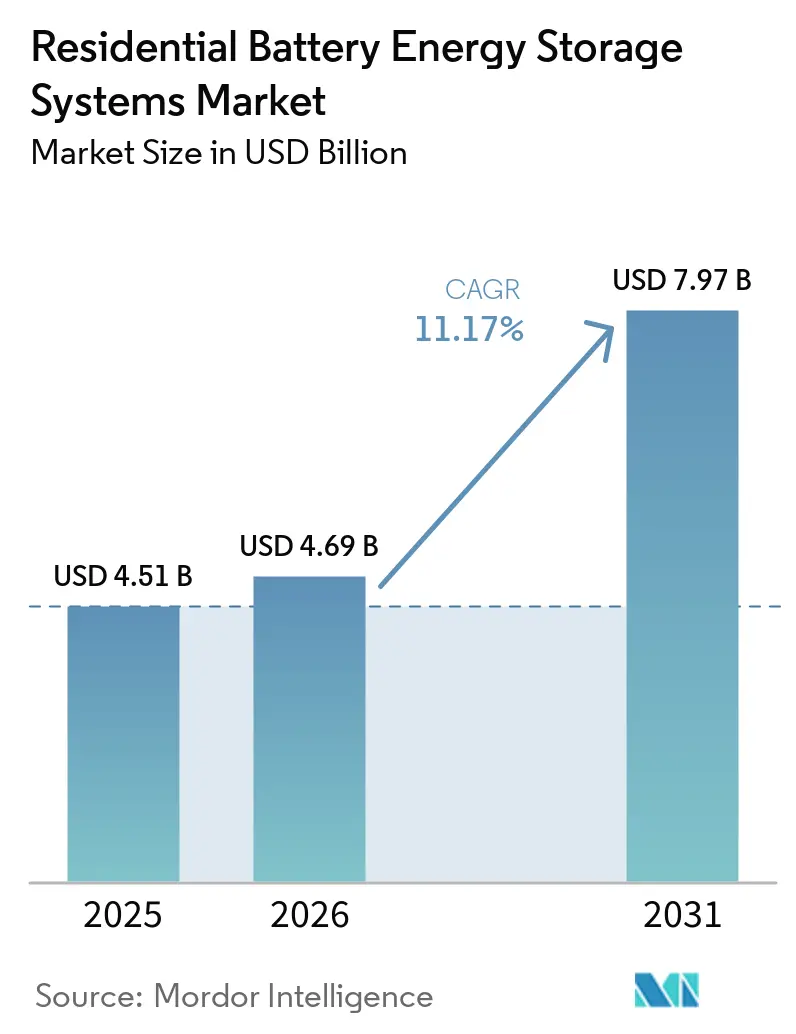
The Residential Battery Energy Storage Systems Market size is projected to expand from USD 4.51 billion in 2025 and USD 4.69 billion in 2026 to USD 7.97 billion by 2031, at a CAGR of 11.17% between 2026 and 2031. The residential battery energy storage systems market is supported by lower lithium iron phosphate, or LFP, system costs, wider rooftop solar use, and tariff structures that reward storing electricity for later use. Global residential energy storage shipments reached 35.1 GWh in 2025, which showed that household demand was extending beyond early adopters as project payback periods improved[1]. Time-of-use tariffs, reduced solar export payments, and virtual power plant programs are changing batteries from backup products into assets that can lower household bills and provide grid services. Manufacturers are responding with integrated batteries, inverters, applications, and energy management software, while installers and financing providers remain central to whether demand becomes completed installations. Vehicle-to-grid programs may also supplement dedicated home batteries in some grid-service programs, which creates a more complex opportunity for the residential battery energy storage systems market.
Key Report Takeaways
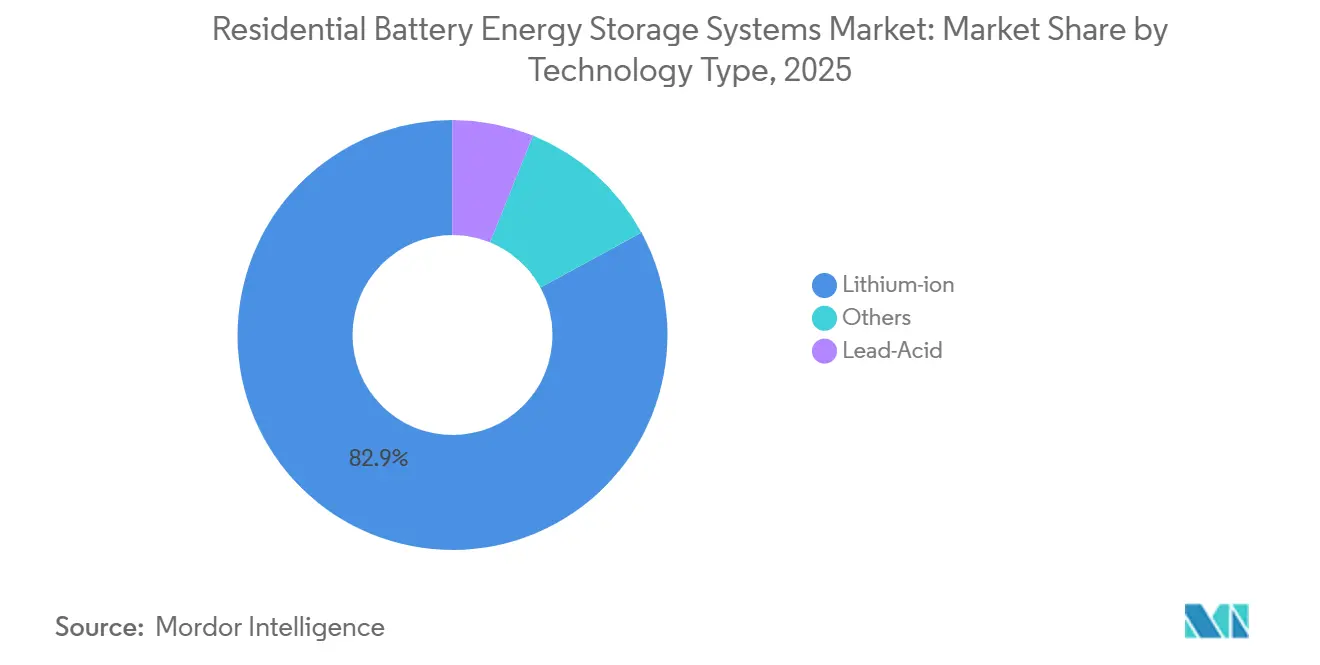
- By technology type, lithium-ion batteries held 82.9% of the residential battery energy storage systems market share in 2025 and are expected to grow at a 11.2% CAGR through 2031.
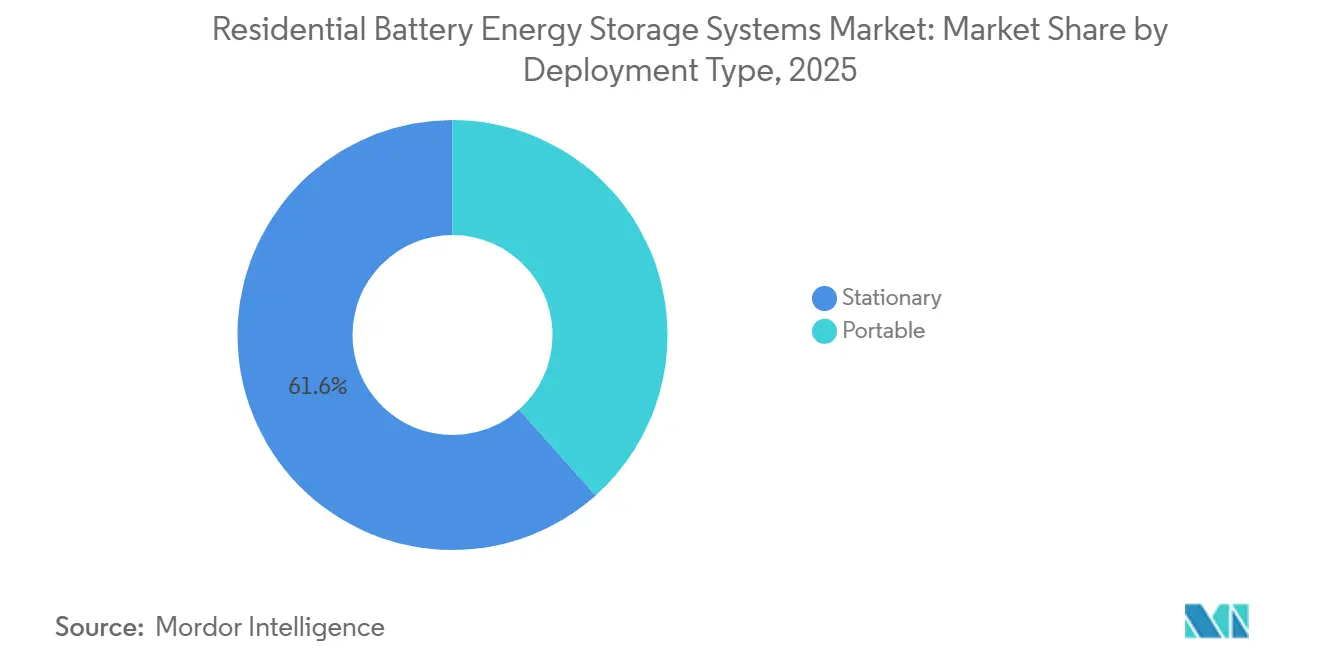
- By deployment type, stationary systems held 61.6% of the residential battery energy storage systems market share in 2025, while portable systems are expected to grow at a 11.6% CAGR through 2031.
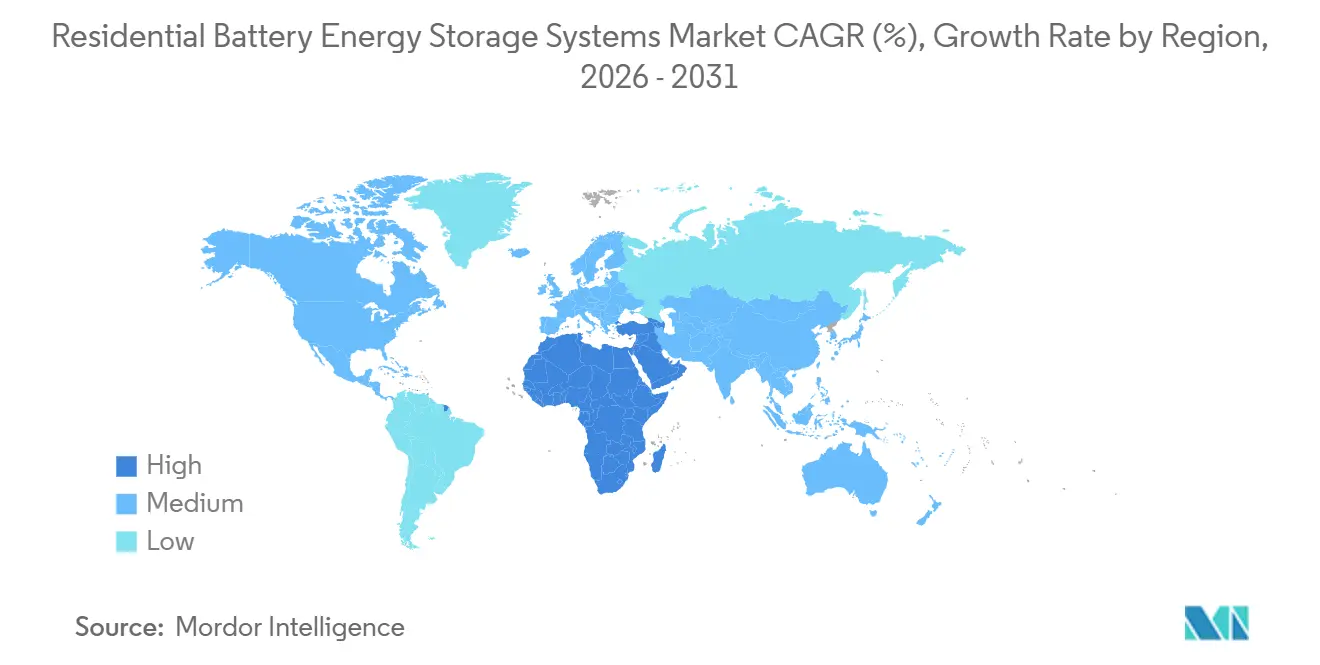
- By geography, Asia-Pacific held 50.2% of the residential battery energy storage systems market share in 2025, while Middle East and Africa are expected to grow at a 12.7% CAGR through 2031.
Note: Market size and forecast figures in this report are generated using Mordor Intelligence’s proprietary estimation framework, updated with the latest available data and insights as of January 2026.
Market Trends and Insights
Drivers Impact Analysis of Residential Battery Energy Storage Systems Market*
| Driver | (~) % Impact on CAGR Forecast | Geographic Relevance | Impact Timeline |
|---|---|---|---|
| Rooftop Solar and Battery Attachment Growth | +3.20% | Global; concentrated in Australia, US (California, Texas, Hawaii), Germany, Netherlands | Short term (≤ 2 years) |
| Falling LFP Pack and System Costs | +2.60% | Global; primary in Asia-Pacific and Europe | Short term (≤ 2 years) |
| Time-of-Use Tariffs and Net-Billing Economics | +2.00% | North America, Europe (Germany, Netherlands, UK), Asia-Pacific (Australia, Japan) | Medium term (2-4 years) |
| Virtual Power Plant Revenue Stacking | +1.30% | US (ERCOT, CAISO, PJM), Australia, UK, Germany | Medium term (2-4 years) |
| Grid Outage and Extreme-Weather Resilience Demand | +1.10% | North America (Southeast US), South Africa, MEA, Asia-Pacific | Short term (≤ 2 years) |
| Electrification of Household Loads and Bidirectional EV Charging | +0.70% | US, Europe (Germany, UK), Japan, South Korea | Long term (≥ 4 years) |
| Source: Mordor Intelligence | |||
Rooftop Solar and Battery Attachment Growth
Rooftop solar deployment is a consistent demand driver because reduced export compensation makes self-consumption more valuable for households and makes the solar-plus-storage decision more closely linked at the point of sale. California's net billing tariff reduced the value of exported residential solar generation, making a battery more relevant to the economics of a new solar system[2]. Sunrun reported a battery attachment rate of 74% in the second quarter of 2026, compared with 70% in the second quarter of 2025. Australia’s point-of-sale subsidy structure supported strong installation activity and did not depend on a household’s tax position, which avoided the administrative limits of a tax-based program. This approach can reach households that may not fully benefit from tax-credit programs, improve socioeconomic access to storage, and broaden participation in the residential battery energy storage systems market.
Falling LFP Pack and System Costs
LFP pack costs fell below USD 130 per kWh at the residential system level in 2025, which reduced the payback period for household projects and improved the purchase case in both developed and emerging markets. LFP chemistry offers more than 6,000 cycles, compared with 3,000 to 4,000 cycles for nickel manganese cobalt, or NMC, chemistry, which supports lower lifetime storage costs without requiring a further decline in cell prices. BYD stated that it installed more than 1.5 million residential BatteryBox systems worldwide by December 2025[3]. Enphase introduced the IQ Battery 10C in July 2025 with 34% greater energy density than its predecessor, reducing the space required for a comparable installation and limiting a source of installation labor cost[4]. Manufacturing scale, cell selection, and modular designs therefore affect project economics across the residential battery energy storage systems market rather than through cell prices alone.
Time-of-Use Tariffs and Net-Billing Economics
Time-of-use tariffs and net-metering reforms are making residential batteries more useful for energy arbitrage as well as backup power, particularly when household solar production is highest outside peak consumption hours. Germany had 2.4 million residential storage systems with more than 25 GWh of installed capacity at the end of 2025, according to the German Solar Association. Dynamic tariffs give consumers a reason to charge batteries when electricity is cheaper and use stored electricity during higher-priced periods, while virtual power plant-compatible products can add a grid-service option. European electricity-market rules and national solar policies increasingly encourage flexibility, which improves the value of connected battery systems. This environment places greater importance on inverter controls, software, and cloud connectivity in the residential battery energy storage systems market.
Virtual Power Plant Revenue Stacking
Virtual power plants create a second potential revenue source by allowing customers to receive payment when batteries support the grid, instead of relying only on savings from solar self-consumption. PG&E launched its Seasonal Aggregation of Versatile Energy program in March 2025 and enrolled up to 1,500 residential battery customers for peak-demand dispatch. Vistra expanded its Battery Rewards program to include Enphase IQ Batteries in Texas during March 2026. These programs can improve the net value of a battery without requiring direct government capital grants and can reduce the importance of upfront incentives in deregulated electricity markets. They also make participation rules, dispatch reliability, customer enrollment, and retailer relationships important parts of the residential battery energy storage systems market.
Restraints Impact Analysis of Residential Battery Energy Storage Systems Market*
| Restraint | (~) % Impact on CAGR Forecast | Geographic Relevance | Impact Timeline |
|---|---|---|---|
| High Upfront Installed Cost and Financing Gaps | -2.00% | North America, Europe, Emerging Markets (MEA, South America) | Medium term (2-4 years) |
| Permitting, Interconnection, and Installer Bottlenecks | -0.90% | North America (US, Canada), Australia, Europe (UK, Germany) | Short term (≤ 2 years) |
| Fire-Safety Compliance and Insurance Scrutiny | -0.70% | Global; concentrated regulatory activity in North America and Europe | Medium term (2-4 years) |
| Critical-Mineral and Battery-End-of-Life Exposure | -0.50% | Global; highest supply concentration risk in APAC and North America | Long term (≥ 4 years) |
| Source: Mordor Intelligence | |||
High Upfront Installed Cost and Financing Gaps
Lower battery pack prices have not removed the cost of inverters, electrical work, labor, permitting, and financing, which together remain material for a household installation. The end of the United States Section 25D residential clean energy credit changes the economics for direct-purchase systems and shifts attention toward leases and other third-party ownership structures. These models can lower the initial payment required from households, support installation where customer financing is limited, and make the provider, rather than the homeowner, responsible for more system costs. In South America, sub-Saharan Africa, and Southeast Asia, interest in backup power may not convert into installations without concessional finance or point-of-sale rebates. The shift toward service models can expand adoption but can also place more long-term revenue and operating control with energy service providers.
Fire-Safety Compliance and Insurance Scrutiny
Fire-safety requirements can add cost and time to residential battery projects, especially for systems installed in or near occupied buildings and multifamily properties. UL 9540B established a residential fire-testing protocol for systems with a capacity of 20 kWh or less, and UL 9540A was updated in March 2025. NFPA 855 sets installation requirements for stationary energy storage systems and affects project design, site selection, and contractor practices. Compliance can be more difficult for smaller installers and newer suppliers that do not have established certification, testing, and training processes. Insurance underwriting requirements can add an indirect cost to a household project, even where the battery itself meets technical standards.
*Our forecasts treat driver/restraint impacts as directional, not additive. The impact forecasts reflect baseline growth, mix effects, and variable interactions.
Residential Battery Energy Storage Systems Market Segment Analysis
By Technology Type:
LFP Leads Residential Battery DemandLithium-ion batteries held 82.9% of the residential battery energy storage systems market size in 2025, making chemistry selection the main determinant of current system design. LFP is the leading lithium-ion chemistry because its longer cycle life and thermal characteristics suit daily home storage use and regular cycling from rooftop solar. It's more than 6,000-cycle life compared with 3,000 to 4,000 cycles for NMC chemistry, which improves lifetime system economics and reduces the relevance of residual capacity loss over a long operating period. Enphase's 2025 IQ Battery 10C shows how energy density and simpler installation have become important alongside energy capacity. The European Union Battery Regulation will require minimum recycled-content levels for relevant battery materials in future years, which will affect sourcing, product documentation, and procurement planning for the residential battery energy storage systems market.
Lead-acid batteries retain a limited role in off-grid and price-sensitive applications, where lithium-ion installation systems remain less accessible and immediate capital cost remains the main purchase criterion in the residential battery energy storage systems market. Continued LFP cost reductions are narrowing the gap, particularly where solar systems are paired with batteries and daily cycling can use LFP's longer operating life. Sodium-ion and redox-flow products remain at early commercialization stages within the other technologies category. Sodium-ion can reduce exposure to lithium and cobalt supply chains, but current energy-density limits restrict its near-term role in homes where wall space and equipment footprint matter. Chinese suppliers use integrated cell production and are extending their offerings into inverters and energy management platforms, which link lower cell costs to higher-value system services in the residential battery energy storage systems industry.

By Deployment Type:
Portable Systems Expand Through Flexible UseStationary systems accounted for 61.6% of the residential battery energy storage systems market share in 2025, reflecting their established role in larger owner-occupied homes. They remain the standard option for households seeking solar self-consumption, backup power, and virtual power plant enrollment through a permanently connected asset within the residential battery energy storage systems market. Their established installation practices and grid-interconnection processes support utility programs that require dependable dispatchable capacity during defined grid events. Portable systems have the highest forecast CAGR at 11.6% between 2026 and 2031. Demand comes from renters, apartment residents, and households facing complex interconnection requirements or seeking a product that can move with a change in residence.
Germany’s Market Master Data Register recorded 30.6% of 2025 home storage units as balcony-compatible systems under 2 kW, although they represented only 11.4% of installed capacity. Micro-system installations below 1 kW rose 167% during that year, showing the difference between rapid unit growth and the more limited addition of energy capacity. Portable products can reach consumers through direct online retail and do not always require the same installer network as stationary systems, which can reduce the time between purchase and use. This sales model is relevant in countries where balcony solar systems are accepted and grid connections are simple. The deployment mix will therefore depend on housing types, retail channels, safety standards, local rules for connecting small systems, and the degree to which renters can participate in household energy programs.
Geography Analysis
APAC Residential Battery Energy Storage Systems Market
Asia-Pacific held 50.2% of the residential battery energy storage systems market share in 2025. China supports both domestic demand and global pricing through its LFP manufacturing base, vertically integrated supply chain, and exports of cells and storage equipment. Australia’s Community Home Battery Program supported more than 400,000 home battery installations and 11.2 GWh of cumulative residential capacity by May 2026. Its point-of-sale subsidy design supported strong installation activity, provided access outside tax-credit structures, and showed how direct rebates can speed adoption in the residential battery energy storage systems market. Japan’s household resilience requirements also support demand for reliable backup power systems that can operate when grid service is disrupted.
Europe Residential Battery Energy Storage Systems Market
Europe installed 9.8 GWh of residential storage in 2025, a 6% decline from the previous year, while the region excluding Italy grew 18%. Germany exceeded 2.4 million residential storage systems and 25 GWh of installed capacity by the end of 2025. The Netherlands increased installations before the expected end of net metering in 2027, while the United Kingdom installations more than doubled in the first half of 2025 as dynamic tariffs became more relevant. Three-phase backup capability is important in continental Europe, where residential grid connections often use three-phase power, and Poland offers an expanding opportunity because higher electricity prices and new rooftop solar systems improve the financial case for the residential battery energy storage systems market.
The Americas and MEA Residential Battery Energy Storage Systems Market
The United States installed 1.3 GWh of residential energy storage in the first quarter of 2026, up 86% from the prior year. Tax-credit changes may reduce direct-purchase demand, although leases and subscription models can limit the effect by replacing a high initial payment with a recurring charge. The Middle East and Africa have the fastest forecast CAGR of 12.7% through 2031 in the residential battery energy storage systems market. South Africa added 2.1 GWh of residential storage in 2025, up 110%, as load-shedding made backup power a practical need rather than solely an electricity-bill management tool. Brazil and Chile are also developing demand as grid reliability concerns, tariff volatility, distributed-generation rules, and solar attachment policies improve the investment case.
Competitive Landscape
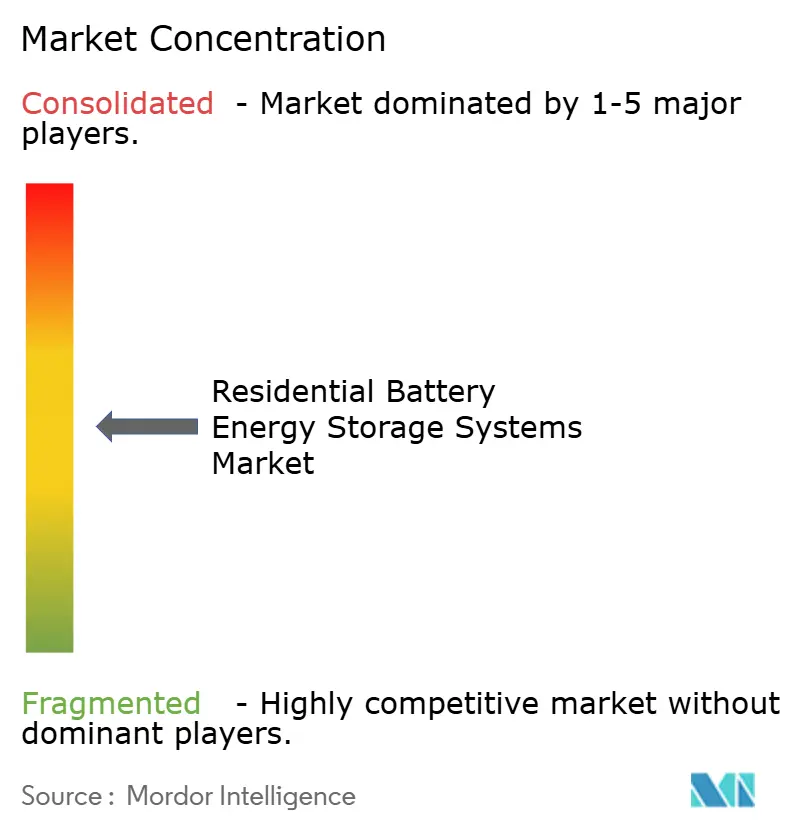
The residential battery energy storage systems market is moderately fragmented, with Tesla, Huawei, BYD, Sungrow, and Sigenergy among the leading suppliers by 2025 shipment volume, and the leading suppliers have narrow shipment gaps, which limits the ability of any one supplier to dictate residential battery energy storage systems market direction and leaves room for regional providers with established installer relationships. Chinese manufacturers compete through integrated LFP cell supply and platforms that combine batteries, inverters, applications, and cloud energy management, allowing them to manage cost and product compatibility across the system. BYD reported more than 1.5 million BatteryBox residential systems installed worldwide in December 2025. In Germany, the 5 largest manufacturers held just over 45% of installed capacity in 2025, compared with nearly 55% in 2024, which indicates that smaller suppliers and balcony-storage specialists are gaining ground.
Software-led energy management, virtual power plant access, and distribution in emerging markets remain important areas of competition because hardware can no longer be assessed separately from the services that use it in the residential battery energy storage systems market. Vistra’s 2026 expansion of Battery Rewards to Enphase IQ Battery customers shows how suppliers can connect home hardware to retailer and utility programs. Tesla reported 46.7 GWh of energy storage deployments in 2025, up 48% year over year, and its installed base supports its participation in connected energy services. BYD’s full-link product strategy combines battery, inverter, application, and cloud platform functions, offering an alternative integrated route from equipment sale to customer management. These moves show why companies are competing on customer control, services, and channel access in addition to battery specifications.
Smaller suppliers can win business through modular products, installer incentives, and channels that serve portable and balcony-storage customers. Enphase’s fourth-generation system placed emphasis on system integration, whole-home backup options, and a 15-year warranty. FranklinWH stated that it was expanding its Santa Clara production capacity in 2026 and planned participation in virtual power plant programs. These actions show that manufacturing capacity, local service, utility relationships, and the ability to support installers can affect a supplier’s position alongside price in the residential battery energy storage systems market. The residential battery energy storage systems market is therefore likely to remain open to new competitors that can offer credible products, software integration, accessible installation channels, and financing or service arrangements suited to local consumer needs.
Residential Battery Energy Storage Systems Industry Leaders
-
Tesla Inc.
-
BYD Company Ltd.
-
LG Energy Solution Ltd.
-
Enphase Energy, Inc.
-
Panasonic Holdings Corporation
- *Disclaimer: Major Players sorted in no particular order
Residential Battery Energy Storage Systems Market Companies Covered in this Report
- Alpha ESS Co., Ltd.
- Amara Raja Energy and Mobility Limited
- BYD Company Ltd.
- Delta Electronics, Inc.
- Enphase Energy, Inc.
- FENECON GmbH
- FranklinWH Energy Storage Inc.
- Generac Power Systems, Inc.
- GoodWe Technologies Co., Ltd.
- Growatt New Energy Technology Co., Ltd.
- Huawei Technologies Co., Ltd.
- LG Energy Solution Ltd.
- Panasonic Holdings Corporation
- Samsung SDI Co., Ltd.
- Schneider Electric SE
- SMA Solar Technology AG
- SolarEdge Technologies, Inc.
- Sonnen GmbH
- Sungrow Power Supply Co., Ltd.
- Tesla Inc.
- VARTA AG
Recent Industry Developments in Residential Battery Energy Storage Systems Market
- March 2026: Vistra expanded its Battery Rewards VPP with Enphase Energy, aggregating Enphase IQ Batteries into a Texas virtual power plant through TXU Energy via Kraken's AI-powered dispatch platform. Participating Enphase customers earn financial incentives for exporting stored energy during grid peak-demand events.
- December 2025: BYD Energy Storage surpassed 1.5 million BatteryBox residential systems installed worldwide, adding 500,000 units in 18 months after its 1 million milestone at The Smarter E conference in June 2024. BYD simultaneously launched a full-link solution integrating battery, inverter, app, and cloud platform using Blade Battery cell technology.
- October 2025: Wallbox completed the first US residential V2H installations using Quasar 2 bidirectional chargers paired with Kia EV9 vehicles in 6 Menifee, California homes. The collaboration with Kia America and UC Irvine, under a US Department of Energy Connected Microgrid project, validated mass-market vehicle-to-home charging, with findings published in the Journal of Energy Conversion and Management.
- July 2025: Enphase launched the IQ Battery 10C, the core of its fourth-generation energy system, delivering 10 kWh of usable energy at 34% greater energy density with sufficient US content to qualify for domestic incentives. The system's IQ Meter Collar enables whole-home backup without rewiring and carries a 15-year warranty.
Global Residential Battery Energy Storage Systems Market Report Scope
Residential battery energy storage systems (BESS) are installed in homes to store electricity for later use. These systems typically use rechargeable batteries, most commonly lithium-ion batteries, to store excess electricity generated by rooftop solar panels or purchased from the grid during lower-cost periods. Residential BESS provides backup power during grid outages, increases solar self-consumption, reduces electricity costs through peak-load shifting, and enhances household energy independence. A typical system consists of a battery pack, battery management system (BMS), inverter or power conversion system, and control and monitoring software.
The Residential Battery Energy Storage Systems (BESS) Market is segmented by technology type, deployment type, and geography. By technology type, the market is segmented into lithium-ion, lead-acid, and other technologies. By deployment type, the market is segmented into stationary and portable systems. The report also covers the market size and forecasts for the global residential battery energy storage systems market across 26 countries in key regions. For each segment, the market sizing and forecasts have been provided on the basis of value (USD).
Segmentation Overview
| Lithium-ion |
| Lead-Acid |
| Others |
| Stationary |
| Portable |
| North America | United States |
| Canada | |
| Mexico | |
| Europe | Germany |
| France | |
| Italy | |
| Spain | |
| United Kingdom | |
| Poland | |
| Russia | |
| Rest of Europe | |
| Asia-Pacific | China |
| India | |
| Japan | |
| South Korea | |
| Australia | |
| Indonesia | |
| Vietnam | |
| Thailand | |
| Rest of Asia-Pacific | |
| South America | Brazil |
| Argentina | |
| Chile | |
| Rest of South America | |
| Middle East and Africa | Saudi Arabia |
| United Arab Emirates | |
| Egypt | |
| South Africa | |
| Morocco | |
| Rest of Middle East and Africa |
| By Technology Type | Lithium-ion | |
| Lead-Acid | ||
| Others | ||
| By Deployment Type | Stationary | |
| Portable | ||
| By Geography | North America | United States |
| Canada | ||
| Mexico | ||
| Europe | Germany | |
| France | ||
| Italy | ||
| Spain | ||
| United Kingdom | ||
| Poland | ||
| Russia | ||
| Rest of Europe | ||
| Asia-Pacific | China | |
| India | ||
| Japan | ||
| South Korea | ||
| Australia | ||
| Indonesia | ||
| Vietnam | ||
| Thailand | ||
| Rest of Asia-Pacific | ||
| South America | Brazil | |
| Argentina | ||
| Chile | ||
| Rest of South America | ||
| Middle East and Africa | Saudi Arabia | |
| United Arab Emirates | ||
| Egypt | ||
| South Africa | ||
| Morocco | ||
| Rest of Middle East and Africa | ||
Key Questions Answered in the Report
What is driving demand for residential battery energy storage systems?
Lower LFP system costs, rooftop solar growth, changing export tariffs, and virtual power plant payments support demand.
How large is the residential battery energy storage systems market?
The sector is estimated at USD 4.69 billion in 2026 and is forecast to reach USD 7.97 billion by 2031 at an 11.17% CAGR.
Which battery technology leads home energy storage?
Lithium-ion batteries held 82.9% share in 2025, with LFP favored for its cycle life and thermal characteristics.
Are stationary or portable home batteries growing faster?
Stationary systems held 61.6% share in 2025, while portable systems have the fastest projected CAGR at 11.6% through 2031.
Which region is growing fastest for home battery systems?
The Middle East and Africa are projected to record the highest CAGR at 12.7% through 2031, supported by grid-reliability needs.
How do virtual power plants affect household battery value?
They allow participating customers to receive payments for providing stored electricity during peak grid-demand events.