
Reputation Management Software Market Size and Share
Market Overview
| Study Period | 2020 - 2031 |
|---|---|
| Market Size (2026) | USD 4.91 Billion |
| Market Size (2031) | USD 9.68 Billion |
| Growth Rate (2026 - 2031) | 14.60% CAGR |
| Fastest Growing Market | Asia-Pacific |
| Largest Market | North America |
| Market Concentration | Medium |
Major Players *Disclaimer: Major Players sorted in no particular order Image © Mordor Intelligence. Reuse requires attribution under CC BY 4.0. | |
Reputation Management Software Market Analysis by Mordor Intelligence
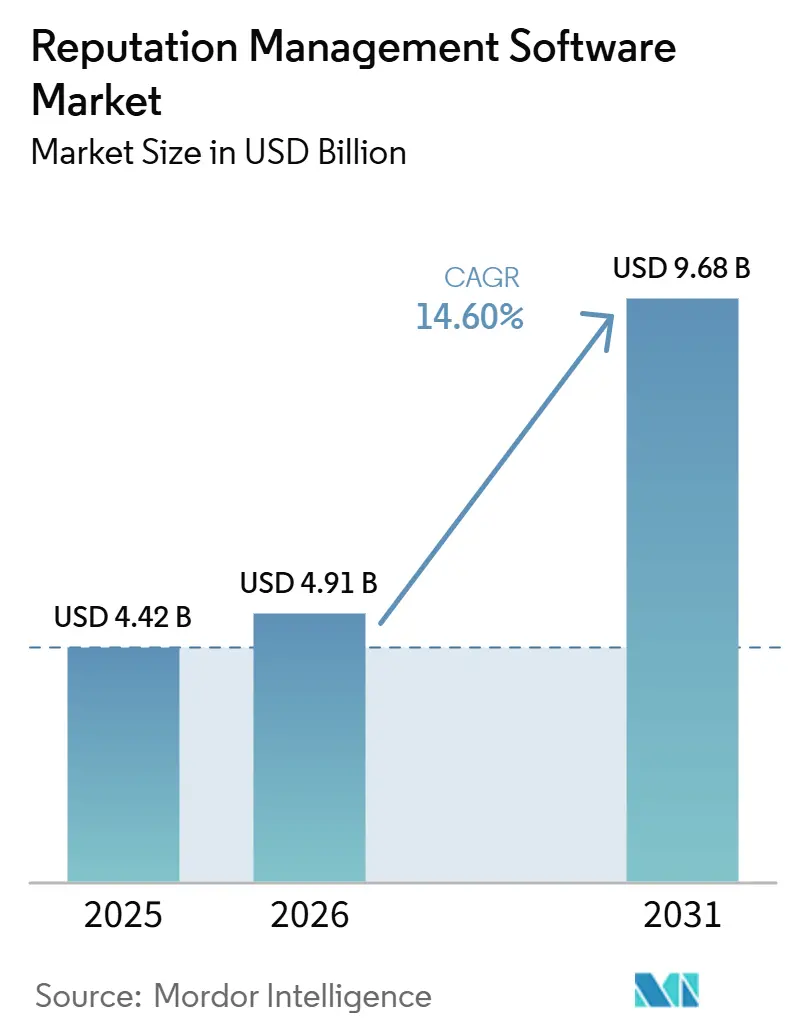
The reputation management software market size is projected to expand from USD 4.42 billion in 2025 and USD 4.91 billion in 2026 to USD 9.68 billion by 2031, registering a CAGR of 14.60% between 2026 and 2031. The market is growing because digital credibility now affects revenue, customer retention, and compliance more directly than it did a few years ago. Demand is rising as brands rely more on review monitoring, AI-based sentiment tracking, and faster response workflows across social, search, and listing channels. Large buyers are also shifting spending toward unified platforms that combine monitoring, analytics, review response, and visibility tools, which is changing how vendors compete in the reputation management software market. North America remains the most established region, while Asia-Pacific is expanding faster as digital commerce and smartphone-led engagement deepen across major consumer economies. The main limits on growth are privacy compliance, the lower pricing power of basic review tools, and the integration burden of connecting multiple enterprise systems.
Key Report Takeaways
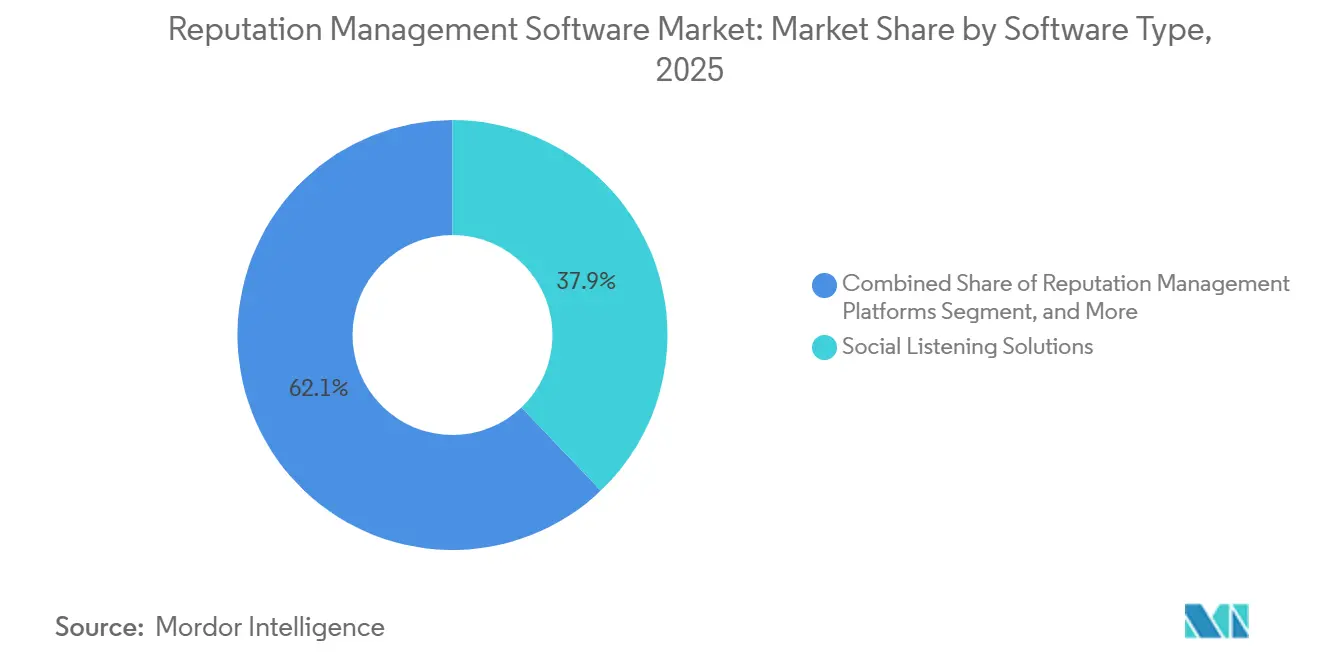
- By software type, Social Listening Solutions held 37.88% of the reputation management software market share in 2025, while Review Management Solutions are projected to expand at 16.77% CAGR through 2031.
- By deployment, cloud-based deployment accounted for 67.49% of the reputation management software market share in 2025, while hybrid deployment is projected to grow at 17.12% CAGR through 2031.
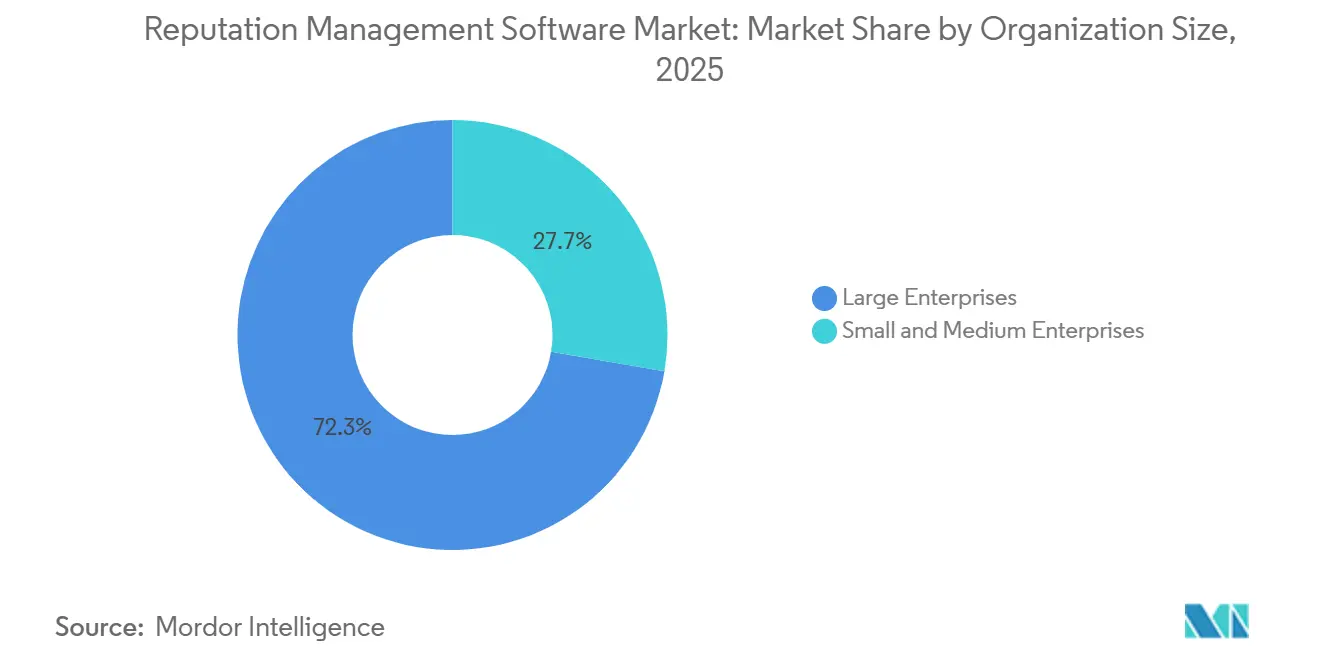
- By organization size, large enterprises captured 72.31% of the reputation management software market share in 2025, while small and medium enterprises are projected to expand at 17.45% CAGR through 2031.
- By industry vertical, retail and e-commerce held 28.12% of the reputation management software market share in 2025, while healthcare and life sciences are projected to grow at 16.09% CAGR through 2031.
- By geography, North America accounted for 36.15% share in 2025, while Asia-Pacific is projected to expand at 16.38% CAGR through 2031.
Note: Market size and forecast figures in this report are generated using Mordor Intelligence’s proprietary estimation framework, updated with the latest available data and insights as of January 2026.
Global Reputation Management Software Market Trends and Insights
Drivers Impact Analysis*
| Driver | (~) % Impact on CAGR Forecast | Geographic Relevance | Impact Timeline |
|---|---|---|---|
| Rising Consumer Reliance on Online Reviews | +3.5% | Global, concentrated in North America, Europe, and APAC e-commerce hubs | Short term (≤ 2 years) |
| Faster Adoption of AI-Enabled Sentiment and Response Automation | +3.2% | Global, with strongest acceleration in North America and APAC | Medium term (2-4 years) |
| Growing Need for Multi-Location Brand Consistency | +2.4% | North America and Europe, with spill-over to APAC franchise markets | Medium term (2-4 years) |
| Compliance Pressure from Privacy and Review Governance Rules | +1.8% | North America and EU core, with emerging impact across APAC and MEA | Short term (≤ 2 years) |
| Platform-Native Reputation Features Raising Enterprise Awareness | +1.2% | Global, led by North America enterprise adopters | Long term (≥ 4 years) |
| Reputation Attacks and Review Manipulation Across Social Platforms | +0.9% | Global, highest impact in consumer-facing verticals | Short term (≤ 2 years) |
| Source: Mordor Intelligence | |||
Rising Consumer Reliance on Online Reviews
Online reviews now influence customer choice much closer to the point of purchase, which raises the value of always-on monitoring in the reputation management software market. Brands can no longer rely on a strong historical rating because visibility and trust now depend more on fresh, credible, and well-managed feedback. That shift makes review generation and review response part of daily operations rather than a periodic marketing task. It also increases the importance of tools that can track review quality, flag suspicious activity, and support timely engagement across locations. The pressure to maintain trusted review environments is evident in the scale of fraud-control activity on major platforms, including Trustpilot’s removal of 7.8 million fake reviews in 2025, which underscored how central review credibility has become to digital trust.
Faster Adoption of AI-Enabled Sentiment and Response Automation
The reputation management software market is moving from keyword alerts toward AI systems that interpret context, rank urgency, and guide response actions. Sprout Social introduced Trellis in November 2025 to turn large volumes of social data into enterprise intelligence and earlier crisis detection, which shows how vendors are repositioning social monitoring as a decision layer rather than a listening feed. Meltwater also reported in its 2026 mid-year release that Mira had handled more than 1.3 million customer prompts, suggesting that AI support is being used in daily workflows rather than in limited pilots. This adoption matters because smaller teams can now manage broader reputation workloads without adding the same level of headcount. As a result, vendors in the reputation management software market are now competing more on governance, explainability, and brand-safe automation than on monitoring speed alone.
Growing Need for Multi-Location Brand Consistency
Multi-location brands face a wider reputation surface because each storefront, clinic, branch, or restaurant can affect how the full brand is perceived in search and review channels. This is pushing enterprise buyers toward centralized platforms that can enforce response standards, listing accuracy, and brand voice at scale. The same shift is also making orchestration more important than isolated feature depth in the reputation management software market. Birdeye’s 2026 enterprise messaging stated that customers increasingly prefer integrated solutions that unify structured data, reputation management, content creation and activation, and AI visibility intelligence, which support the move toward broader control layers for distributed brands. Vendors that lack strong multi-location workflows are therefore more likely to lose enterprise consideration even when their core listening or analytics tools remain technically sound.
Compliance Pressure From Privacy and Review Governance Rules
Regulation is becoming a direct buying factor in the reputation management software market because review handling now carries formal legal exposure. The FTC consumer review rule took effect on October 21, 2024, and it prohibits fake reviews, undisclosed incentives, and review suppression, with civil penalties that can reach USD 53,088 per violation. The FTC also signaled active enforcement in December 2025, issuing warning letters and describing ongoing monitoring of complaints, social media, and company websites. In Europe, the interaction between platform obligations and privacy law is tightening operating requirements for companies that publish or process user-generated content. This is increasing demand for audit trails, policy controls, and automated workflows that can document compliant review handling across brands and geographies.
Restraints Impact Analysis*
| Restraint | (~) % Impact on CAGR Forecast | Geographic Relevance | Impact Timeline |
|---|---|---|---|
| Data Privacy, Consent, and Platform Policy Constraints | -1.8% | EU, North America, and expanding to APAC under national data laws | Short term (≤ 2 years) |
| Commoditization of Basic Monitoring and Review Aggregation | -1.4% | Global, most acute in the SME and mid-market segments | Medium term (2-4 years) |
| Integration Complexity Across CRM, Social, and Help Desk Stacks | -1.0% | North America and Europe, where enterprise technology stacks are most complex | Medium term (2-4 years) |
| Shortage of High-Quality Moderation and Localization Workflows | -0.6% | APAC, South America, Middle East, and Africa - markets with multilingual review volumes | Long term (≥ 4 years) |
| Source: Mordor Intelligence | |||
Data Privacy, Consent, and Platform Policy Constraints
Privacy rules are limiting how freely vendors in the reputation management software market can collect, process, and move customer-generated data. The European Data Protection Board stated in its 2025 guidance that Digital Services Act processing still requires a valid GDPR legal basis and must follow data minimization principles, thereby raising control requirements for review and content workflows.[1]European Data Protection Board, “Guidelines 3/2025 on the Interplay between the DSA and the GDPR, Version 1.1,” European Data Protection Board, edpb.europa.eu This makes architecture design more difficult for vendors that serve multiple regions and multiple data categories. At the same time, third-party API policies on major platforms can limit access to review and mention data, weakening coverage for listening and monitoring tools. The result is that vendors must spend more on compliant infrastructure and data partnerships, just as buyers expect broader, faster, and more complete monitoring.
Commoditization of Basic Monitoring and Review Aggregation
Basic review monitoring is becoming harder to price at a premium because many small businesses can access similar functions through low-cost or platform-native tools. This is creating margin pressure at the lower end of the reputation management software market, especially for buyers who do not yet need deeper analytics or cross-channel workflow control. Vendors are responding by pushing further into AI response support, integrated analytics, and broader automation layers. Birdeye’s Search AI launch in September 2025 showed how platform vendors are adding generative engine optimization and AI-search visibility features to move beyond standard monitoring. The market is therefore splitting between enterprise platforms with broader value and simpler tools that face steadily weaker pricing power.
*Our forecasts treat driver/restraint impacts as directional, not additive. The impact forecasts reflect baseline growth, mix effects, and variable interactions.
Segment Analysis
By Software Type: Social Listening Anchors Share while Review Tools Drive Growth
Social Listening Solutions accounted for 37.88% of the reputation management software market share in 2025, which made them the largest software category in the market. Their lead reflects the speed and scale of brand conversations across social channels, where manual monitoring is no longer practical for large organizations. Buyers use these tools as early warning systems because reputation problems often surface on social feeds before spreading to news coverage or formal complaints. Sprout Social’s Trellis launch in November 2025 showed how vendors are extending this segment from passive monitoring into AI-led intelligence and earlier crisis detection.
Review Management Solutions are projected to expand at a 16.77% CAGR through 2031, making them the fastest-growing software type in the reputation management software market. Growth is supported by stricter review governance and a stronger role for recent reviews in digital visibility and customer choice. The FTC rule has made fake reviews, undisclosed incentives, and review suppression more visible compliance issues for brands that depend on online trust.[2]Federal Trade Commission, “Trade Regulation Rule on the Use of Consumer Reviews and Testimonials,” Federal Register, govinfo.gov Reputation Management Platforms are also gaining ground as buyers consolidate tools, while Customer Feedback Solutions and Reputation Analytics Solutions are finding a place in sectors that need structured surveys, benchmarking, and long-term sentiment analysis. Other software types remain narrower, but demand is rising where brands need content removal, suppression support, or protection against manipulated review activity.



By Deployment: Cloud Dominates but Hybrid is the Enterprise Growth Vector
Cloud-based deployment accounted for 67.49% of the reputation management software market in 2025, reflecting how well cloud models support real-time monitoring and frequent feature updates. Cloud environments support continuous data ingestion, faster model changes, and easier scaling during event-driven traffic spikes. That advantage matters in the reputation management software industry because always-on monitoring loses value when data feeds or response workflows are delayed. On-premises deployment still matters in regulated settings, especially where external data processing remains restricted or closely reviewed.
Hybrid deployment is projected to grow at a 17.12% CAGR through 2031, making it the primary enterprise growth vector across deployment models. Flexera reported in 2026 that 73% of organizations operate hybrid estates, which supports the broader infrastructure logic behind this shift. In practice, hybrid adoption in the reputation management software market often reflects governance needs rather than simple infrastructure preference. Enterprises can keep sensitive review data in defined locations while using cloud environments for aggregate analytics and AI processing. That balance is likely to remain attractive as privacy controls and cross-border data requirements continue to tighten in several large markets.
By Organization Size: Large Enterprises Lead while SMEs Set the Pace For Expansion
Large enterprises captured 72.31% of the reputation management software market in 2025, which shows how strongly complex brand networks still shape demand. Global retailers, healthcare systems, franchise operators, and large service brands need centralized control over reviews, listings, alerts, and response policies across many locations. That operating complexity makes integrated platforms more attractive than single-function tools. Birdeye stated in early 2026 that customers increasingly prefer solutions that unify reputation management, structured data, content activation, and AI-visibility intelligence, which supports the ongoing shift toward suite-based buying.
Small and medium enterprises are projected to expand at a 17.45% CAGR through 2031, making them the fastest-growing segment by organization size. Subscription pricing, easier deployment, and AI-assisted response workflows are lowering the budget and staffing barriers that once limited sophisticated adoption to larger buyers. A 2026 peer-reviewed study in the Journal of Small Business Studies found that online reputation management was positively associated with small business performance through customer acquisition and brand equity. This growth is also changing product design because vendors now need simpler onboarding, clearer templates, and lower-friction workflows. Those SME-focused design choices are starting to influence enterprise platforms as well, since large buyers also want faster adoption across distributed teams.
By Industry Vertical: Retail Holds Scale while Healthcare Builds Momentum
Retail and e-commerce accounted for 28.12% of the market in 2025, making it the largest vertical in the reputation management software market. The segment leads because ratings, review freshness, and listing quality can affect conversion almost immediately in online and multi-location retail settings. Retail brands also manage a large reputational surface across stores, delivery experience, product pages, and customer service interactions. BFSI remains an important segment because trust damage can spread quickly after service failures or security events, while hospitality and travel continue to rely heavily on review response and ranking management.
Healthcare and life sciences are projected to expand at a 16.09% CAGR through 2031, making them the fastest-growing vertical in the reputation management software industry. Patient choice increasingly follows review-driven behavior, and providers are responding by embedding reputation tools more closely into clinical and administrative workflows. In April 2026, athenahealth partnered with rater8 to add AI-powered review management, listing maintenance, and sentiment monitoring to athenaOne, serving nearly 300 healthcare practices across 30+ specialties. The same release reported a 443% increase in patient reviews and an 84% increase in Google listing views at Campbell Clinic Orthopedics, highlighting the measurable value of integrated reputation workflows in provider settings. Healthcare also carries sector-specific compliance requirements, creating a durable opportunity for vendors that can align review handling with patient privacy obligations.
Geography Analysis
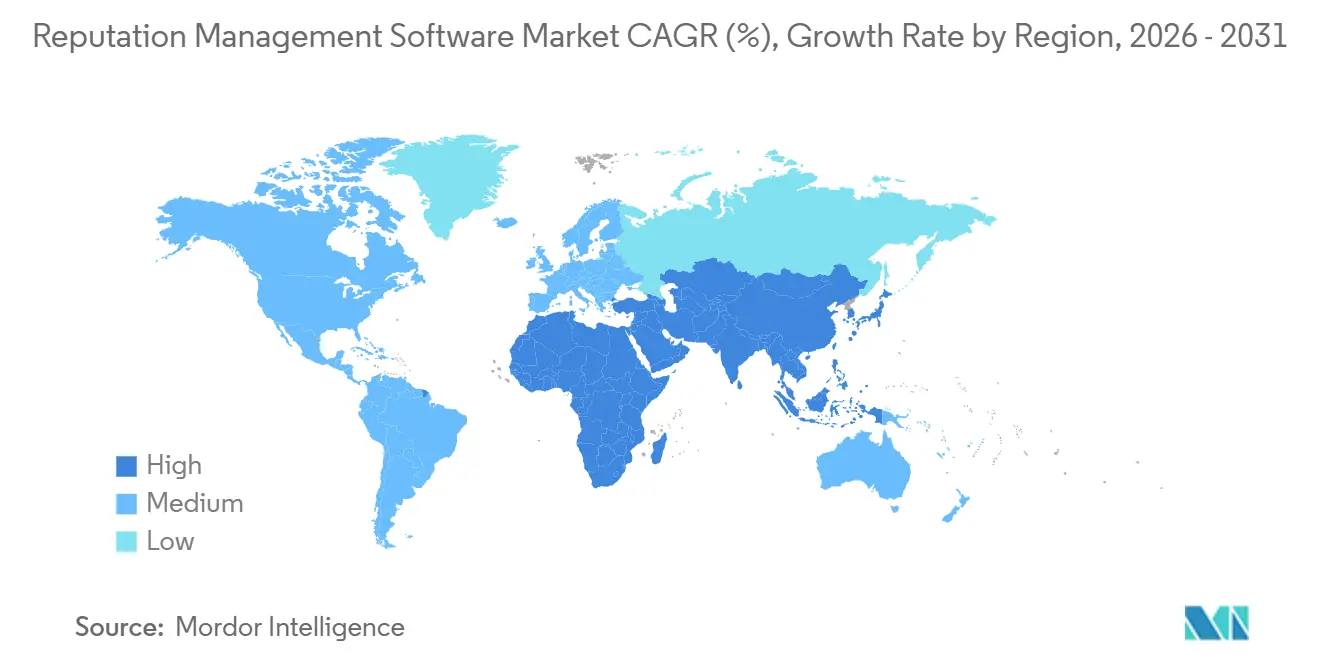
North America held 36.15% of the reputation management software market share in 2025, maintaining its leading regional position. The United States remains the largest national contributor because it combines mature review platforms, large multi-location brands, and early enforcement around review governance. The FTC rule, which became effective in October 2024, added urgency for brands that need audit-ready controls for review collection and moderation. Canada and Mexico add scale through cross-border brand operations, often managed on shared platforms.
Europe remained the second-largest regional market for reputation management software, driven by heightened scrutiny of privacy, authenticity, and platform accountability. Trustpilot reported removing 7.8 million fake reviews in 2025, equal to 11% of total submissions, underscoring both the scale of manipulation risk and the compliance burden platforms and brands face in the region.[3]Trustpilot, “FY 2025 Fact Sheet,” Trustpilot, assets.ctfassets.net Regulatory pressure is also intensifying at the national level, as shown by Trustpilot’s 2026 disclosure that it would appeal an AGCM finding in Italy that included a EUR 4 million (USD 4.44 million) fine. This environment supports demand for platforms that combine review handling, fraud controls, and privacy governance within a single workflow.
The reputation management software market in Asia-Pacific is projected to expand at a 16.38% CAGR through 2031, making it the fastest-growing geography. China, India, Japan, and South Korea are driving most of that expansion as digital commerce, local social ecosystems, and smartphone-based discovery deepen across large user bases. The region is also more complex because brand mentions and consumer feedback often sit within local-language environments that global tools do not cover as well. India stands out as a strong growth area because digital-first businesses are using reputation tools to build trust and retention as mobile commerce scales further. South Korea shows a mature review culture, while Australia and New Zealand follow a more compliance-led adoption path. South America, the Middle East, and Africa remain early-stage markets, but internet adoption, e-commerce growth, and broader social media use are creating a clear runway for future demand in the reputation management software market.

Competitive Landscape
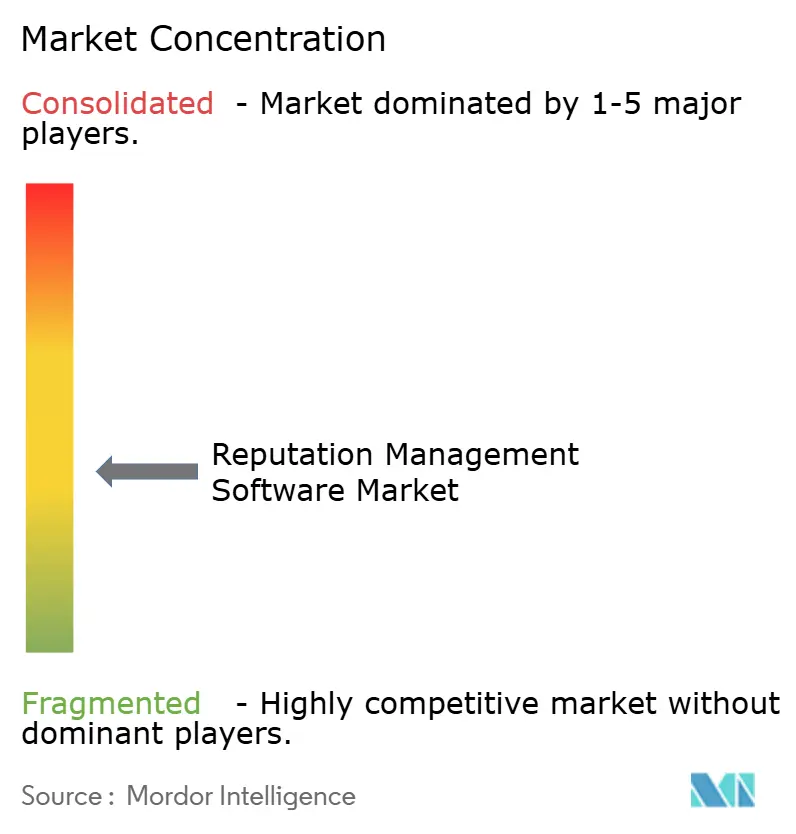
The reputation management software market is moderately consolidated at the enterprise tier and more fragmented in the mid-market. Large platform vendors compete on AI capability, multi-location control, integration depth, and vertical fit rather than on basic monitoring alone. At the same time, smaller review-only and listening-only tools face pressure from free or low-cost platform-native features, which are forcing clearer differentiation. This is why the reputation management software market is increasingly defined by who can unify data, workflows, and visibility in a single platform.
Strategic moves in 2025 and 2026 show how quickly the category is shifting toward AI-led control layers. Birdeye launched Search AI in September 2025 to help multi-location brands audit accuracy, track sentiment, and improve visibility across AI search environments such as ChatGPT, Gemini, and Perplexity.[4]Birdeye, “Birdeye Launches Search AI to Put Multi-Location Brands at the Top of AI Answers,” Birdeye, birdeye.com Sprout Social launched Trellis in November 2025, extending its offering from social management into enterprise-grade AI intelligence and proactive alerting. Yext then opened Scout MCP and Scout API to partners in May 2026, which showed a broader push to become an infrastructure layer for third-party AI agents and visibility tools.
Competition is also moving toward deeper workflow integration in high-value verticals. The athenahealth and Rater8 partnership showed how reputation features can be embedded directly into healthcare operating systems rather than managed as separate point tools. That kind of integration strengthens vendor stickiness by linking review management to day-to-day workflows. Another shift is the growing relevance of structured data and agent connections, which allows reputation data to feed AI systems outside the vendor’s own dashboard. Vendors that build strong API and connector ecosystems early are likely to hold an advantage as enterprise buyers treat reputation intelligence as an always-on operating input. White space remains strongest in multilingual coverage and in tightly regulated sectors where generic tools still fall short.
Reputation Management Software Industry Leaders
Reputation.com, Inc.
Birdeye, Inc.
Podium Corporation, Inc.
Yext, Inc.
Hootsuite Inc.
- *Disclaimer: Major Players sorted in no particular order

Recent Industry Developments
- May 2026: Yext launched Scout MCP and Scout API, opening its visibility and competitive intelligence infrastructure to global partners and enabling third-party AI agents to access structured reputation data across 12 million+ business locations. The move positions Yext as an enterprise data layer for the agentic marketing era rather than solely an application vendor.
- May 2026: Yext made Apple Business delegation available to channel partners as of May 13, 2026, enabling partners to connect clients' Apple Maps accounts through Yext, unlocking analytics, branding customization, and post management in Showcase. Apple's data indicates that claimed accounts see 30% more Apple Maps views compared to unclaimed listings.
- April 2026: athenahealth announced a strategic partnership with rater8, embedding AI-powered patient review management, listing maintenance, and sentiment monitoring directly into its athenaOne electronic health record platform, serving nearly 300 healthcare practices across 30+ specialties.
- April 2026: Ann and Robert H. Lurie Children's Hospital of Chicago expanded its partnership with NRC Health to include NRC Health's Reputation module, integrating online review monitoring with Market Insights and Patient Experience data to build a unified reputation intelligence capability.


Global Reputation Management Software Market Report Scope
The Reputation Management Software Market consists of software solutions that help organizations monitor, analyze, manage, and improve their online reputation across digital channels, review platforms, search engines, social media networks, and websites. These platforms offer capabilities such as review management, sentiment analysis, brand monitoring, social listening, crisis management, and competitive reputation analysis. The growing importance of digital brand perception, increasing influence of online reviews on purchasing decisions, and rising focus on customer experience management drive the market. These solutions help organizations protect brand value, enhance customer trust, and proactively address reputation-related risks and opportunities.
The Reputation Management Software Market Report is Segmented by Software Type (Reputation Management Platforms, Review Management Solutions, Social Listening Solutions, Customer Feedback Solutions, Reputation Analytics Solutions, and Other Software Types), Deployment (Cloud-Based, On-Premises, and Hybrid), Organization Size (Small and Medium Enterprises, and Large Enterprises), Industry Vertical (Retail and E-Commerce, Banking, Financial Services, and Insurance [BFSI], Healthcare and Life Sciences, Hospitality and Travel, IT and Telecommunication, Media and Entertainment, Government and Public Administration, and Other Industry Verticals), and Geography (North America, South America, Europe, Asia-Pacific, Middle East, and Africa). The Market Forecasts are Provided in Terms of Value (USD).
| Reputation Management Platforms |
| Review Management Solutions |
| Social Listening Solutions |
| Customer Feedback Solutions |
| Reputation Analytics Solutions |
| Other Software Types |
| Cloud-Based |
| On-Premises |
| Hybrid |
| Small and Medium Enterprises |
| Large Enterprises |
| Retail and E-Commerce |
| Banking, Financial Services, and Insurance (BFSI) |
| Healthcare and Life Sciences |
| Hospitality and Travel |
| IT and Telecommunication |
| Media and Entertainment |
| Government and Public Administration |
| Other Industry Verticals |
| North America | United States |
| Canada | |
| Mexico | |
| South America | Brazil |
| Argentina | |
| Rest of South America | |
| Europe | Germany |
| United Kingdom | |
| France | |
| Italy | |
| Spain | |
| Russia | |
| Rest of Europe | |
| Asia-Pacific | China |
| Japan | |
| India | |
| South Korea | |
| Australia and New Zealand | |
| Rest of Asia-Pacific | |
| Middle East | Saudi Arabia |
| United Arab Emirates | |
| Turkey | |
| Rest of Middle East | |
| Africa | South Africa |
| Nigeria | |
| Rest of Africa |
| By Software Type | Reputation Management Platforms | |
| Review Management Solutions | ||
| Social Listening Solutions | ||
| Customer Feedback Solutions | ||
| Reputation Analytics Solutions | ||
| Other Software Types | ||
| By Deployment | Cloud-Based | |
| On-Premises | ||
| Hybrid | ||
| By Organization Size | Small and Medium Enterprises | |
| Large Enterprises | ||
| By Industry Vertical | Retail and E-Commerce | |
| Banking, Financial Services, and Insurance (BFSI) | ||
| Healthcare and Life Sciences | ||
| Hospitality and Travel | ||
| IT and Telecommunication | ||
| Media and Entertainment | ||
| Government and Public Administration | ||
| Other Industry Verticals | ||
| By Geography | North America | United States |
| Canada | ||
| Mexico | ||
| South America | Brazil | |
| Argentina | ||
| Rest of South America | ||
| Europe | Germany | |
| United Kingdom | ||
| France | ||
| Italy | ||
| Spain | ||
| Russia | ||
| Rest of Europe | ||
| Asia-Pacific | China | |
| Japan | ||
| India | ||
| South Korea | ||
| Australia and New Zealand | ||
| Rest of Asia-Pacific | ||
| Middle East | Saudi Arabia | |
| United Arab Emirates | ||
| Turkey | ||
| Rest of Middle East | ||
| Africa | South Africa | |
| Nigeria | ||
| Rest of Africa | ||


Key Questions Answered in the Report
What is the current and projected size of the reputation management software market?
The reputation management software market was worth USD 4.42 billion in 2025, reached USD 4.91 billion in 2026, and is projected to reach USD 9.68 billion by 2031 at a 14.60% CAGR.
Which software category leads revenue in reputation management platforms?
Social Listening Solutions led with 37.88% share in 2025 because large brands need real-time visibility across fast-moving social and public channels.
Which deployment model is growing fastest through 2031?
Hybrid deployment is projected to grow at 17.12% CAGR as enterprises balance cloud analytics with tighter data control and regional compliance needs.
Why are healthcare providers adopting these tools faster now?
Healthcare and life sciences are projected to grow at 16.09% CAGR because patient choice is increasingly shaped by reviews, listings, and sentiment visibility inside care workflows.
Which region offers the strongest growth outlook?
Asia-Pacific is the fastest-growing region with a projected 16.38% CAGR through 2031, supported by digital commerce growth, smartphone use, and broader online engagement.
How are leading vendors differentiating their offerings in 2026?
Leading vendors are moving beyond basic monitoring into AI response automation, generative engine optimization, API-based integrations, and multi-location workflow control.
Page last updated on:






