
Regulated AI Medical Software Market Size and Share
Market Overview
| Study Period | 2020 - 2031 |
|---|---|
| Market Size (2026) | USD 2.96 Billion |
| Market Size (2031) | USD 6.74 Billion |
| Growth Rate (2026 - 2031) | 17.90 % |
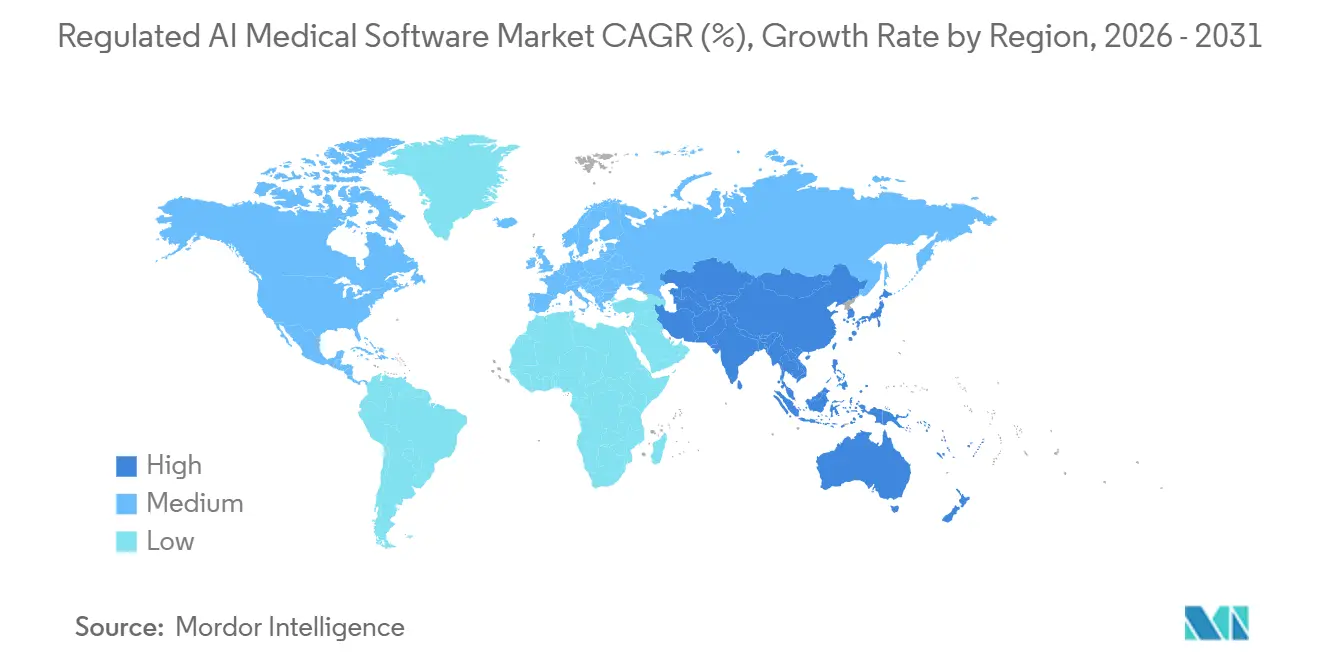
| Fastest Growing Market | Asia-Pacific |
| Largest Market | North America |
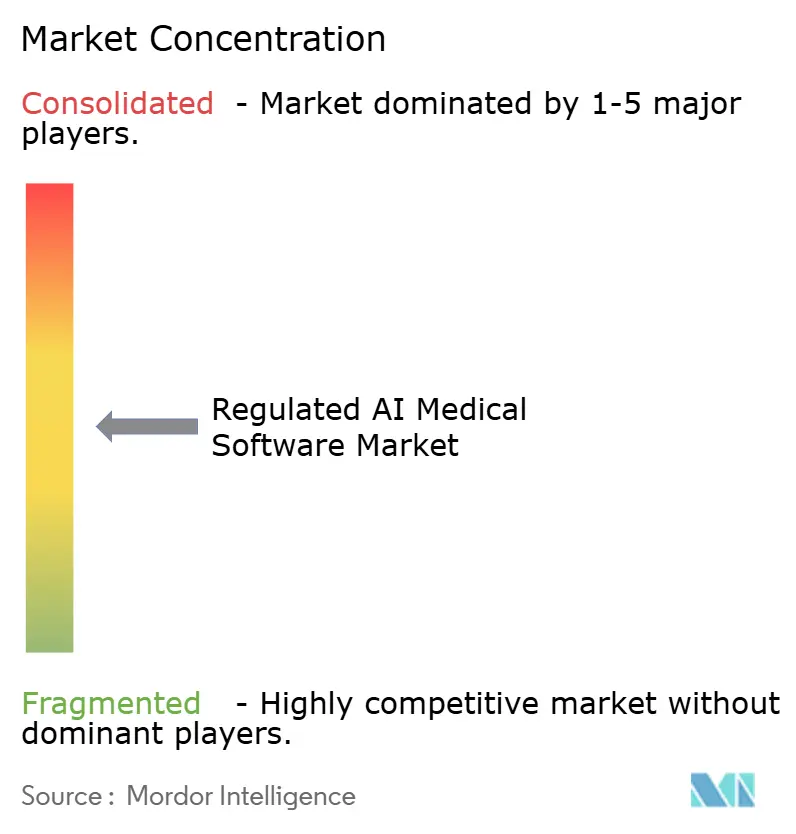
| Market Concentration | Medium |
Major Players *Disclaimer: Major Players sorted in no particular order Image © Mordor Intelligence. Reuse requires attribution under CC BY 4.0. | |
Regulated AI Medical Software Market Analysis by Mordor Intelligence
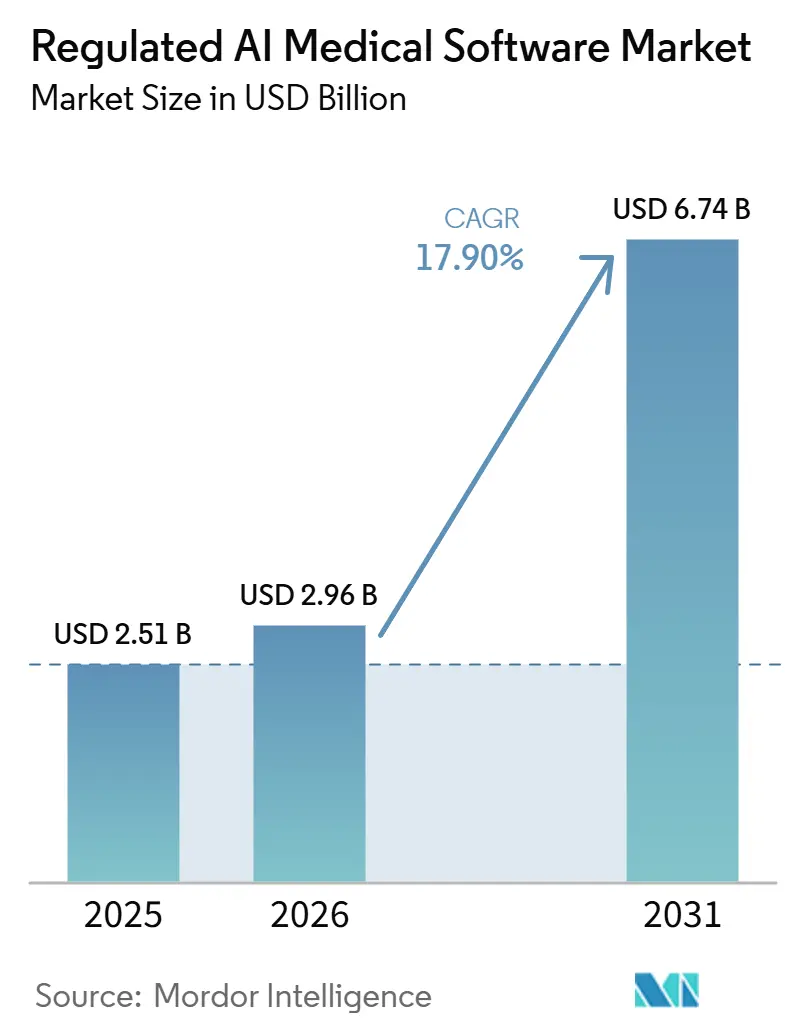
The regulated AI medical software market size was valued at USD 2.51 billion in 2025 and is estimated to grow from USD 2.96 billion in 2026 to reach USD 6.74 billion by 2031, at a CAGR of 17.90% during the forecast period (2026-2031).
The regulated AI medical software market is moving from isolated clinical pilots toward broader institutional use as providers seek dependable tools for diagnosis, reporting, and care coordination. Greater regulatory clarity gives developers a more practical route for maintaining and improving software after launch. Health systems also need tools that can extend clinician capacity without changing clinical accountability. These conditions favor vendors that combine clinical evidence, reliable integration, and clear governance. The regulated AI medical software market therefore offers its strongest opportunities where software can fit established workflows and meet institutional procurement requirements.
Key Report Takeaways
- By product type, AI-enabled diagnostic software held 33.22% of the regulated AI medical software market share in 2025, while AI-enabled digital pathology and in vitro diagnostic software is forecast to grow at a 21.93% CAGR through 2031.
- By deployment model, cloud-based deployment accounted for 36.23% of the regulated AI medical software market share in 2025, while hybrid deployment is projected to expand at a 19.67% CAGR through 2031.
- By clinical function, diagnosis and classification accounted for 59.34% of the regulated AI medical software market share in 2025, while prognosis and risk prediction is forecast to grow at an 18.35% CAGR through 2031.
- By end user, hospitals and integrated delivery networks held 32.88% of the regulated AI medical software market share in 2025, while diagnostic imaging centers and laboratories are projected to grow at a 19.45% CAGR through 2031.
- By geography, North America held 39.76% share in 2025, while Asia-Pacific is forecast to grow at a 19.56% CAGR through 2031.
Note: Market size and forecast figures in this report are generated using Mordor Intelligence’s proprietary estimation framework, updated with the latest available data and insights as of January 2026.
Market Trends and Insights
Drivers Impact Analysis of Regulated AI Medical Software Market*
| DRIVER | (~) % IMPACT ON CAGR FORECAST | GEOGRAPHIC RELEVANCE | IMPACT TIMELINE |
|---|---|---|---|
| Specialist clinician and diagnostic capacity shortages | +2.5% | Global, most acute in South Asia, Sub-Saharan Africa, and rural North America | Medium term (2-4 years) |
| Multimodal clinical data and precision medicine expansion | +2.0% | Global, with concentrated early gains in North America, the EU, and East Asia | Long term (≥4 years) |
| Hospital demand for productivity and throughput improvement | +2.5% | Global, particularly North America and Western Europe | Short term (≤ 2 years) |
| Investment in interoperable health data infrastructure | +1.5% | North America and the EU core, with spillover to Asia-Pacific and GCC countries | Medium term (2-4 years) |
| Maturing regulatory pathways for AI-enabled devices | +3.5% | Global, led by the United States, the EU, South Korea, Japan, and China | Short term (≤ 2 years) |
| Local validation and monitoring requirements | +1.0% | National, with early gains in the United States, the EU, South Korea, and Japan | Long term (≥4 years) |
| Source: Mordor Intelligence | |||
Shortage of Specialist Clinicians and Diagnostic Capacity
The regulated AI medical software market benefits from clinician shortages, which have become an operating constraint for many providers. The World Health Organization projects a global shortfall of 11 million health workers by 2030, with shortages concentrated in diagnosis and specialized care roles.[1]World Health Organization, “National Health Workforce Accounts: Health Workforce Levels and Trends 2026,” World Health Organization, who.int Radiology, pathology, and cardiology face rising pressure as specialist review volumes increase. In the United States, HRSA projected a shortfall of 81,180 full-time equivalent physicians by 2035 across 26 of 36 specialty categories.[2]U.S. Health Resources and Services Administration, “Physician Workforce: Projections, 2020–2035,” Health Resources and Services Administration, hrsa.gov
Regulatory Pathway Maturation for AI-Enabled Devices
Regulatory clarity is making the regulated AI medical software market more accessible for developers with robust quality systems. The FDA's 2025 lifecycle guidance established a clearer approach to iterative updates for AI-enabled devices, while Predetermined Change Control Plans gave manufacturers a structured way to manage certain model changes after authorization.[3]GE HealthCare, “GE HealthCare Receives FDA 510(k) Clearance for MIM Contour ProtégéAI+ 2.0,” GE HealthCare, gehealthcare.com GE HealthCare received FDA 510(k) clearance for MIM Contour ProtégéAI+ 2.0 in June 2026, including a PCCP for expanded clinical capabilities. Germany's Federal Network Agency also issued guidance in May 2026 on AI medical device regulatory questions.
Hospital Demand for Productivity and Throughput Improvement
Hospitals increasingly buy AI medical software to improve daily operations rather than simply add diagnostic features. A 2026 multisite study reported that AI scribe use reduced clinician electronic record time by 13.4 minutes per session and supported 0.49 additional weekly patient visits per clinician.[4]Nature Communications, “Artificial Intelligence for Predicting Hospital Admissions from the Emergency Department,” Nature Communications, nature.com A 2026 study of AI-assisted coronary CT angiography reporting reduced reporting time from 10.0 minutes to 6.0 minutes per case. Demand remains strongest when software reduces administrative work, shortens reporting steps, or supports case prioritization.[5]BMC Medical Imaging, “A Study to Measure the Utility of an AI-Enhanced Reporting Tool,” BMC Medical Imaging, springer.com
Public Investment in Interoperable Health Data Infrastructure
Interoperable data infrastructure supports the regulated AI medical software market because software performance depends on access to usable clinical information. In June 2026, HHS reported that the TEFCA network had exchanged more than 1 billion health records after beginning with 10 million records. Standardized exchange can improve patient information retrieval across care settings and reduce the effort required to connect validated software with local data systems. Japan enacted health data and clinical research reforms between December 2025 and April 2026.
Restraints Impact Analysis of Regulated AI Medical Software Market*
| RESTRAINT | (~) % IMPACT ON CAGR FORECAST | GEOGRAPHIC RELEVANCE | IMPACT TIMELINE |
|---|---|---|---|
| Prospective clinical evidence and generalizability gaps | -1.5% | Global, most acute in markets with stringent reimbursement requirements, including the EU and Japan | Medium term (2-4 years) |
| Cybersecurity, privacy, and third-party model dependency | -1.0% | Global, with direct effects in the EU and the United States | Medium term (2-4 years) |
| Workflow integration and reimbursement friction | -1.2% | Global, particularly North America and Western Europe | Medium term (2-4 years) |
| Model drift, change control, and post-market surveillance burden | -0.8% | Global, with prescriptive requirements in EU and United States frameworks | Long term (≥4 years) |
| Source: Mordor Intelligence | |||
Prospective Clinical Evidence and Generalizability Gaps
Prospective evidence remains a restraint for the regulated AI medical software market, as decision-makers need confidence that performance will transfer across care settings. Retrospective testing can establish technical performance, but it may not show how clinicians use a tool under normal time and workflow pressures. A prospective study in 2026 found that an AI admission-prediction tool reduced median emergency department length of stay by 12 minutes while physician volume remained constant. Health systems and payers still evaluate whether outcomes will remain consistent across community hospitals, specialist centers, and different patient populations, making local validation plans and clear evidence packages critical for broad adoption.
Cybersecurity, Privacy, and Third-Party Model Dependency
Cybersecurity and privacy requirements can delay purchases in the regulated AI medical software market when providers lack full visibility into data movement. AI software may involve external models, cloud processing, third-party data sources, and ongoing vendor support, each of which must protect patient information and maintain auditable controls. The 2025 HIPAA Security Rule update increased attention on stronger safeguards for systems that handle protected health information, while European requirements added governance considerations for high-risk health AI. These obligations make hybrid architecture, transparent vendor agreements, and continuous security monitoring important procurement factors for health systems.
*Our forecasts treat driver/restraint impacts as directional, not additive. The impact forecasts reflect baseline growth, mix effects, and variable interactions.
Regulated AI Medical Software Market Segment Analysis
By Product Type:
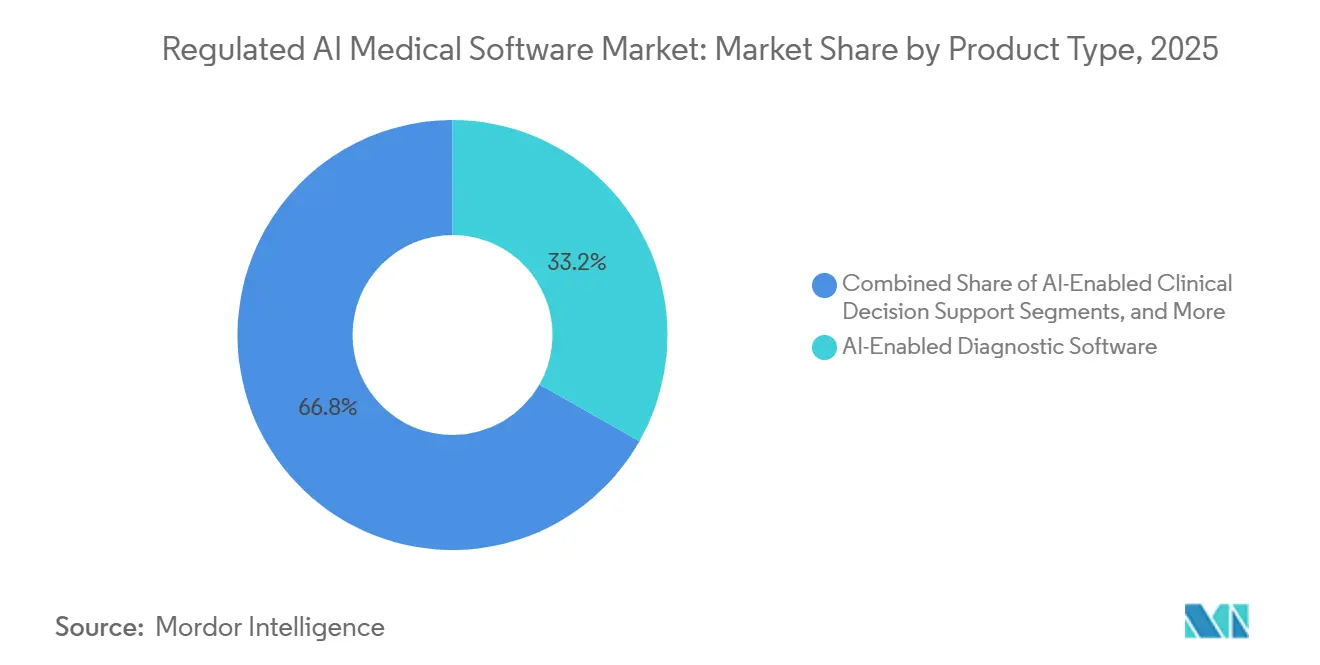
Diagnostic Software Leads, Digital Pathology AcceleratesAI-enabled diagnostic software held 33.22% of the regulated AI medical software market size in 2025. This leadership reflected early adoption in radiology and cardiac imaging, where providers used these tools for image interpretation, quantification, and case prioritization. The software fit into established reading workflows without requiring major care pathway redesign, while radiologists’ familiarity with software-assisted imaging supported broader use across diagnostic departments.
AI-enabled digital pathology and in vitro diagnostic software is forecast to grow at a CAGR of 21.93% through 2031. Digitized slide libraries, whole-slide imaging systems, and high-volume review algorithms support expansion across laboratories. Tempus reported that Articulate Pro changed the initial diagnosis or grade group in 5% of prostate biopsy cases, while 1.3% of changes affected clinical management. The study also reported a turnaround-time reduction of nearly one day, strengthening laboratory interest in standardized review workflows.



By Deployment Model:
Cloud Leads, but Hybrid Gains Ground in Regulated DeploymentsCloud-based deployment accounted for 36.23% of the regulated AI medical software market size in 2025. Early adopters favored cloud systems for scalable computing capacity and continuous updates without local hardware management. The model remained relevant for imaging centers and laboratories with limited on-premise infrastructure, while vendors used it to manage consistent software versions across distributed provider locations.
Hybrid deployment is forecast to grow at a CAGR of 19.67% through 2031. It keeps identifiable patient data within hospital or national boundaries while allowing suitable non-sensitive workloads to use cloud resources. This approach addressed data residency expectations in Germany, India, and GCC countries and gave institutions stronger control over access and retention. Edge and embedded deployment remained important for imaging hardware and interventional systems that require low latency or operate with limited connectivity.
By Clinical Function:
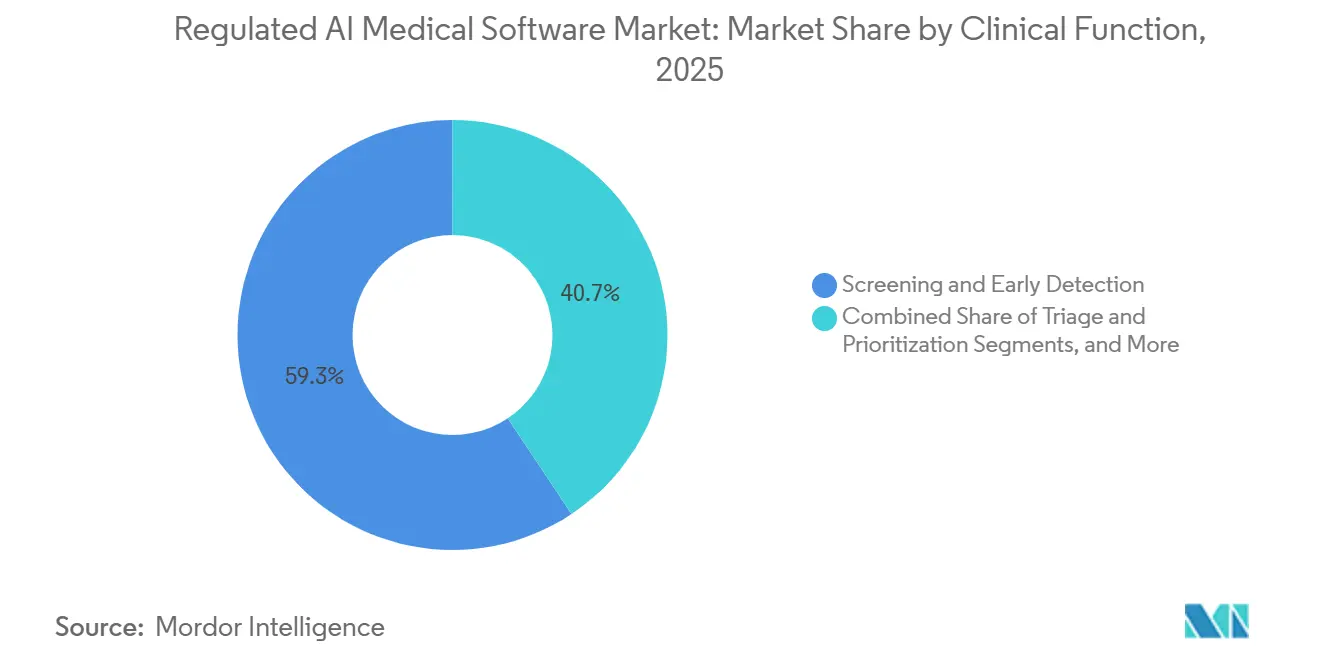
Diagnosis Dominates While Prognosis EmergesDiagnosis and classification held 59.34% of the regulated AI medical software market share in 2025. This lead reflected the established role of software-enabled medical devices in identifying, classifying, and measuring clinical findings. Diagnostic reads remained central to imaging, pathology, and specialist workflows, while screening, early detection, triage, and prioritization supported adjacent demand.
Prognosis and risk prediction is forecast to grow at a CAGR of 18.35% through 2031. These tools estimate the probability of events such as sepsis, cardiac complications, or hospital readmission, enabling earlier intervention and longitudinal care management. The market benefits from provider and payer focus on downstream cost management. A 2026 study found that AI-enabled cognitive support reduced information overload and burnout among emergency medicine and primary care clinicians.
By End User:
Hospitals Anchor Adoption While Labs AccelerateHospitals and integrated delivery networks held 32.88% of the regulated AI medical software market share in 2025. They remained the primary users of software across radiology, cardiology, emergency care, and enterprise clinical operations. Large provider networks centralized governance, cybersecurity review, data access, clinical validation, and software integration across departments. Aidoc stated that its platform was deployed across nearly 2,000 hospitals and had analyzed more than 120 million patient cases.
Diagnostic imaging centers and laboratories are forecast to grow at a CAGR of 19.45% through 2031. Growth reflects decentralized diagnostic capacity and consolidation of laboratory services into specialist networks with repeatable, high-volume workflows. Roche agreed in May 2026 to acquire PathAI for USD 750 million upfront and up to USD 300 million in milestone payments. The transaction showed the strategic value of AI pathology software for laboratory and diagnostics companies.
Geography Analysis
North America Regulated AI Medical Software Market
North America held 39.76% of the regulated AI medical software market share in 2025. The region benefited from a large installed base of advanced provider systems, strong clinical software procurement, and mature regulatory processes. HHS reported in June 2026 that TEFCA had surpassed 1 billion exchanged health records, strengthening connected clinical data exchange and reducing information gaps across care settings. Canada and Mexico also supported regional adoption through academic health centers and large hospital networks linked to United States technology ecosystems.
Europe Regulated AI Medical Software Market
Europe is the second-largest regional market for regulated AI medical software. Germany, the United Kingdom, and France are key adopters, supported by advanced care delivery and active medical technology regulation. Vendors in the region must manage medical device requirements alongside AI and data governance obligations. Germany's May 2026 orientation guide clarified issues at the intersection of AI and medical devices.
APAC, South America and MEA Regulated AI Medical Software Market
Asia-Pacific is forecast to expand at a CAGR of 19.56% through 2031. Growth is supported by domestic software development in China, device regulation in South Korea, and health data reforms in Japan. Japan's reforms between December 2025 and April 2026 addressed health data, AI, and clinical research, while the Japanese Federation of Medical Devices Associations examined review approaches for AI-enabled program medical devices in August 2025. India offers strong potential for diagnostic and decision support software as digital health infrastructure develops, while South America, the Middle East, and Africa remain earlier-stage markets.

Competitive Landscape
The regulated AI medical software market includes large imaging companies, specialist AI platforms, and precision diagnostics providers. Siemens Healthineers, GE HealthCare, and Koninklijke Philips connected software with established imaging, informatics, and service relationships. Aidoc Medical and Viz.ai competed as AI-native platforms with focused clinical applications and enterprise management tools. Tempus AI and SOPHiA GENETICS added diagnostic and genomic capabilities that supported precision medicine.
Companies increasingly invested in broader foundation-model and platform capabilities. Aidoc raised USD 150 million in Series E financing in April 2026 to scale clinical AI for earlier and safer diagnoses. Roche's agreement to acquire PathAI included USD 750 million upfront and up to USD 300 million in milestone payments. These developments showed that established diagnostics companies viewed digital pathology software as a strategic capability rather than a peripheral product.
Surgical and interventional software became another competitive area in the regulated AI medical software market. Medtronic unveiled Touch Surgery Aide in July 2026 with the FDA-cleared Instrument Exit Point application for the Hugo robotic surgery system. Philips received FDA clearance in March 2026 for EchoNavigator R5.0 with DeviceGuide, which supported real-time guidance during mitral valve repair. The available information did not provide combined company shares; therefore, a concentration score could not be calculated under the stated scoring framework.
Regulated AI Medical Software Industry Leaders
Aidoc Medical Ltd.
GE HealthCare Technologies Inc.
Koninklijke Philips N.V.
Medtronic plc
Siemens Healthineers AG
- *Disclaimer: Major Players sorted in no particular order
Regulated AI Medical Software Market Companies Covered in this Report
- Abbott Laboratories
- Aidoc Medical Ltd.
- Butterfly Network, Inc.
- Canon
- Cleerly, Inc.
- GE HealthCare Technologies Inc.
- Intuitive Surgical, Inc.
- iRhythm Technologies
- Koninklijke Philips
- Medtronic
- NVIDIA
- Owkin, Inc.
- Paige.AI, Inc.
- Shanghai United Imaging Healthcare Co., Ltd.
- Siemens Healthineers
- SOPHiA GENETICS SA
- Stryker
- Subtle Medical, Inc.
- Tempus AI, Inc.
- Viz.ai, Inc.

Recent Industry Developments in Regulated AI Medical Software Market
- July 2026: Medtronic launched Touch Surgery Aide, an AI-native surgical computing platform for operating rooms, with Instrument Exit Point alerts for the Hugo robotic-assisted surgery system.
- July 2026: Intuitive Surgical outlined its AI roadmap at the SRS 2026 Annual Meeting, using insights from over 20 million da Vinci procedure records and a live telesurgery demonstration.
- June 2026: GE HealthCare received FDA 510(k) clearance for MIM Contour ProtégéAI+ 2.0, a radiation therapy planning software supporting future anatomical model expansion.
- June 2026: GE HealthCare and Catholic Health announced a 10-year, USD 500 million Care Alliance for AI-enabled imaging technologies across more than 40 hospital sites.
- June 2026: Aidoc received its second FDA Breakthrough Device Designation in less than one year for First Read, which generated preliminary reports from chest radiographs.


Global Regulated AI Medical Software Market Report Scope
As per the scope of the report, regulated AI Medical Software is software utilizing artificial intelligence or machine learning intended for medical purposes that must meet strict government safety and performance standards. Key examples include Software as a Medical Device (SaMD), AI-enabled clinical decision support, and radiology image analysis tools.
The regulated AI medical software market is segmented by product type, deployment model, clinical function, end user, and geography. By product type, the market includes AI-enabled diagnostic software, AI-enabled monitoring and predictive analytics software, AI-enabled clinical decision support software, AI-enabled treatment planning and procedural guidance software, AI-enabled digital pathology and in vitro diagnostic software, AI-enabled therapeutic and rehabilitation software, AI-enabled surgical and robotic software, and others. By deployment model, the market is segmented into on-premise deployment, cloud-based deployment, edge and embedded deployment, and hybrid deployment. By clinical function, the market is categorized into screening and early detection, triage and prioritization, diagnosis and classification, quantification and measurement, prognosis and risk prediction, treatment selection and recommendation, treatment planning and navigation, monitoring and recurrence detection, and others. By end user, the market is segmented into hospitals and integrated delivery networks, ambulatory surgery centers, diagnostic imaging centers and laboratories, physician practices and specialty clinics, academic and research institutions, public health and government providers, and pharmaceutical and biotechnology companies. By geography, the market is analyzed across North America, Europe, Asia-Pacific, the Middle East and Africa, and South America. The report also covers the estimated market sizes and trends for 17 countries across major regions globally. The report offers the market sizes and forecasts in terms of value (USD) for the above segments.
| AI-Enabled Diagnostic Software |
| AI-Enabled Monitoring and Predictive Analytics Software |
| AI-Enabled Clinical Decision Support Software |
| AI-Enabled Treatment Planning and Procedural Guidance Software |
| AI-Enabled Digital Pathology and In Vitro Diagnostic Software |
| AI-Enabled Therapeutic and Rehabilitation Software |
| AI-Enabled Surgical and Robotic Software |
| Others |
| On-Premise Deployment |
| Cloud-Based Deployment |
| Edge and Embedded Deployment |
| Hybrid Deployment |
| Screening and Early Detection |
| Triage and Prioritization |
| Diagnosis and Classification |
| Quantification and Measurement |
| Prognosis and Risk Prediction |
| Treatment Selection and Recommendation |
| Treatment Planning and Navigation |
| Monitoring and Recurrence Detection |
| Others |
| Hospitals and Integrated Delivery Networks |
| Ambulatory Surgery Centers |
| Diagnostic Imaging Centers and Laboratories |
| Physician Practices and Specialty Clinics |
| Academic and Research Institutions |
| Public Health and Government Providers |
| Pharmaceutical and Biotechnology Companies |
| North America | United States |
| Canada | |
| Mexico | |
| Europe | Germany |
| United Kingdom | |
| France | |
| Italy | |
| Spain | |
| Rest of Europe | |
| Asia-Pacific | China |
| India | |
| Japan | |
| Australia | |
| South Korea | |
| Rest of Asia-Pacific | |
| Middle East and Africa | GCC |
| South Africa | |
| Rest of Middle East and Africa | |
| South America | Brazil |
| Argentina | |
| Rest of South America |
| By Product Type | AI-Enabled Diagnostic Software | |
| AI-Enabled Monitoring and Predictive Analytics Software | ||
| AI-Enabled Clinical Decision Support Software | ||
| AI-Enabled Treatment Planning and Procedural Guidance Software | ||
| AI-Enabled Digital Pathology and In Vitro Diagnostic Software | ||
| AI-Enabled Therapeutic and Rehabilitation Software | ||
| AI-Enabled Surgical and Robotic Software | ||
| Others | ||
| By Deployment Model | On-Premise Deployment | |
| Cloud-Based Deployment | ||
| Edge and Embedded Deployment | ||
| Hybrid Deployment | ||
| By Clinical Function | Screening and Early Detection | |
| Triage and Prioritization | ||
| Diagnosis and Classification | ||
| Quantification and Measurement | ||
| Prognosis and Risk Prediction | ||
| Treatment Selection and Recommendation | ||
| Treatment Planning and Navigation | ||
| Monitoring and Recurrence Detection | ||
| Others | ||
| By End User | Hospitals and Integrated Delivery Networks | |
| Ambulatory Surgery Centers | ||
| Diagnostic Imaging Centers and Laboratories | ||
| Physician Practices and Specialty Clinics | ||
| Academic and Research Institutions | ||
| Public Health and Government Providers | ||
| Pharmaceutical and Biotechnology Companies | ||
| By Geography | North America | United States |
| Canada | ||
| Mexico | ||
| Europe | Germany | |
| United Kingdom | ||
| France | ||
| Italy | ||
| Spain | ||
| Rest of Europe | ||
| Asia-Pacific | China | |
| India | ||
| Japan | ||
| Australia | ||
| South Korea | ||
| Rest of Asia-Pacific | ||
| Middle East and Africa | GCC | |
| South Africa | ||
| Rest of Middle East and Africa | ||
| South America | Brazil | |
| Argentina | ||
| Rest of South America | ||


Key Questions Answered in the Report
What is the projected value of regulated AI medical software by 2031?
The regulated AI medical software market is forecast to reach USD 6.74 billion by 2031, rising from USD 2.96 billion in 2026 at a 17.90% CAGR. Growth is supported by provider demand for clinical capacity, clearer regulatory pathways, and interoperable health data infrastructure.
Which product category leads regulated AI medical software?
AI-Enabled Diagnostic Software led with 33.22% share in 2025. The category benefits from established use in imaging and diagnostic workflows, where clinicians need support with interpretation, quantification, prioritization, and consistent reporting.
Which product category is growing the fastest?
AI-Enabled Digital Pathology and In Vitro Diagnostic Software is forecast to grow at a 21.93% CAGR through 2031. Digitized slide libraries, whole-slide imaging, biomarker analysis, and high-volume laboratory review are key factors behind its expansion.
Why are hospitals adopting clinical AI software?
Hospitals use these tools to support clinician capacity, reduce reporting time, improve workflow efficiency, and centralize software governance. Enterprise buyers also consider cybersecurity, data access, evidence, workflow fit, and ongoing monitoring before deployment.
Which deployment approach is expanding fastest?
Hybrid Deployment is forecast to grow at a 19.67% CAGR through 2031 because it can balance cloud capacity with data residency controls. It allows providers to retain identifiable patient data locally while directing suitable workloads to cloud infrastructure.
Which region is expected to grow fastest?
Asia-Pacific is projected to grow at a 19.56% CAGR through 2031, supported by national digital health and AI policy activity. Japan's health data reforms and the region's varied regulatory models support both local development and international market entry.
Page last updated on:





