
Registered DIMM and Load-Reduced DIMM Market Size and Share
Market Overview
| Study Period | 2020 - 2031 |
|---|---|
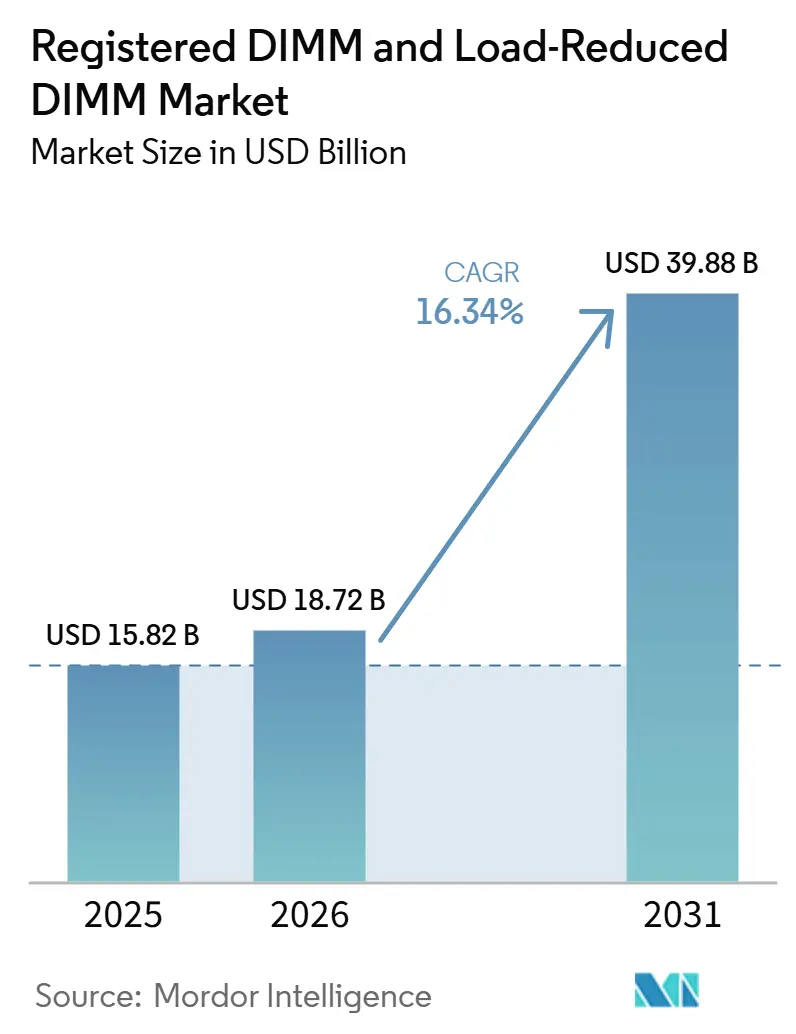
| Market Size (2026) | USD 18.72 Billion |
| Market Size (2031) | USD 39.88 Billion |
| Growth Rate (2026 - 2031) | 16.34 % |
| Fastest Growing Market | North America |
| Largest Market | Asia-Pacific |
| Market Concentration | High |
Major Players *Disclaimer: Major Players sorted in no particular order Image © Mordor Intelligence. Reuse requires attribution under CC BY 4.0. | |
Registered DIMM and Load-Reduced DIMM Market Analysis by Mordor Intelligence
The registered DIMM and load-reduced DIMM market size is projected to expand from USD 15.8 billion in 2025 and USD 18.7 billion in 2026 to USD 39.9 billion by 2031, registering a CAGR of 16.3% between 2026 and 2031. The registered DIMM (RDIMM) and load-reduced DIMM (LRDIMM) market is being shaped by a server refresh cycle that now centers on DDR5-native platforms, because Intel Xeon 6 and AMD EPYC Turin deployments no longer support DDR4 in new enterprise systems. Demand is also moving toward denser memory configurations as AI training and inference clusters require more host-side DRAM per node, which lifts the role of buffered modules in large-scale server designs. Supply conditions have become more strategic than cyclical, as leading-edge DRAM capacity is being directed toward HBM while demand for high-density RDIMM and LRDIMM is rising. This has made long-term allocation, platform qualification, and thermal design more important than spot pricing for many buyers in the registered DIMM and load-reduced DIMM market. The competitive structure, therefore, remains concentrated at the DRAM supply level and more fragmented at the module assembly level, while adjacent memory formats such as MRDIMM and SOCAMM2 are beginning to define the next layer of technology risk and opportunity.
Key Report Takeaways
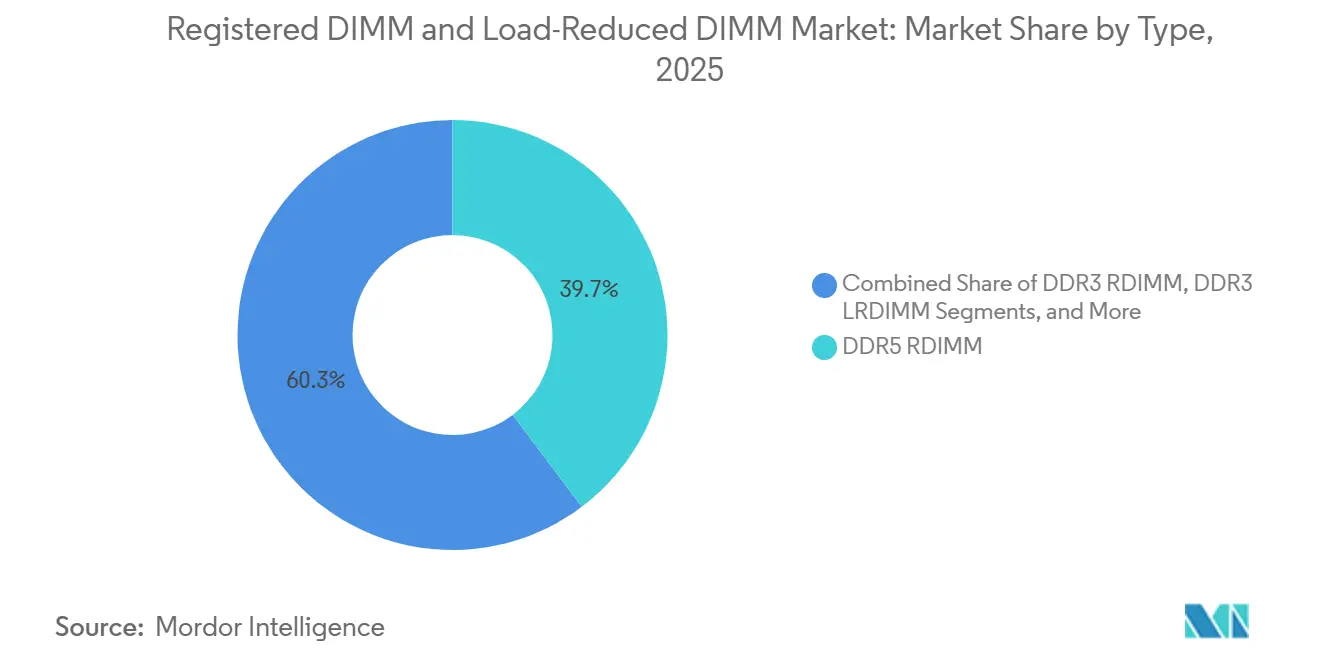
- By type, DDR5 RDIMM led with 39.7% revenue share of the registered DIMM and load-reduced DIMM market in 2025, while DDR5 LRDIMM is forecast to expand at a 17.8% CAGR through 2031.
- By capacity, 64 GB held 35.9% share of the registered DIMM and load-reduced DIMM market in 2025, while the above 128 GB segment is projected to grow at a 17.9% CAGR through 2031.
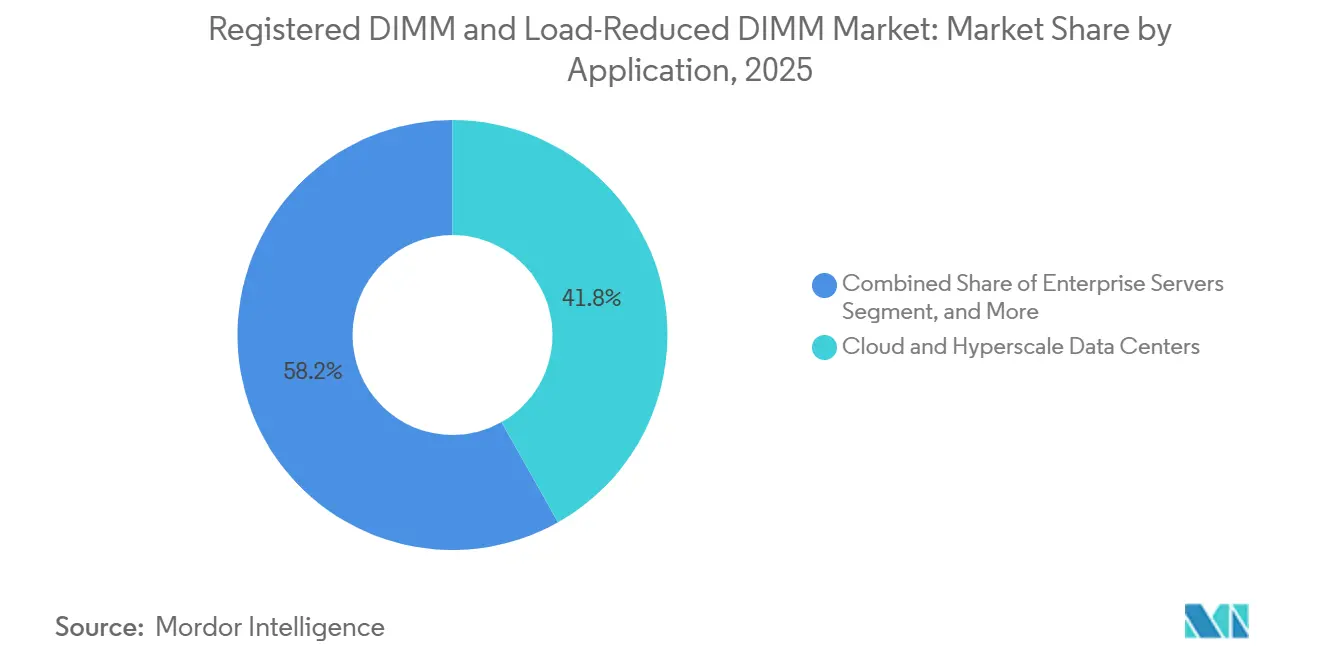
- By application, cloud and hyperscale data centers accounted for 41.8% share of the registered DIMM and load-reduced DIMM market in 2025, while AI servers recorded the highest projected CAGR at 17.2% through 2031.
- By geography, Asia-Pacific held 45.6% of revenue in 2025, while North America is expected to grow at a 17.1% CAGR through 2031.
Note: Market size and forecast figures in this report are generated using Mordor Intelligence’s proprietary estimation framework, updated with the latest available data and insights as of January 2026.
Global Registered DIMM and Load-Reduced DIMM Market Trends and Insights
Drivers Impact Analysis*
| Driver | (~) % Impact on CAGR Forecast | Geographic Relevance | Impact Timeline |
|---|---|---|---|
| AI Server Memory Density Upgrades | +5.5% | Global, with highest intensity in North America and Asia-Pacific | Short term (≤ 2 years) |
| DDR5 Platform Refresh In Enterprise Servers | +4.2% | Global, led by North America and Europe | Short term (≤ 2 years) |
| Hyperscale Data Center Expansion | +3.5% | Global, concentrated in North America, China, Japan, and Taiwan | Medium term (2-4 years) |
| ECC, Reliability, And Qualified Server BOM Preference | +2.0% | Global | Long term (≥ 4 years) |
| Memory Channel Limits Pushing Load Reduction Architecture | +1.6% | North America and APAC core, spillover to Europe | Medium term (2-4 years) |
| On-Module Thermal And Signal Integrity Improvements | +1.0% | Global | Long term (≥ 4 years) |
| Source: Mordor Intelligence | |||
AI Server Memory Density Upgrades
AI server deployments are changing how the registered DIMM and load-reduced DIMM markets are purchased, because GPU-heavy systems require much larger host memory pools than standard enterprise servers. These nodes use DRAM for model weight staging, inter-process communication, and KV-cache support, which pushes buyers toward 96 GB and 128 GB DDR5 RDIMMs and, in denser builds, toward 256 GB DDR5 LRDIMMs. Micron sampled a 256 GB DDR5 RDIMM in May 2026 that supports up to 9,200 MT/s and uses more than 40% less power than 2 equivalent 128 GB modules, which shows the product direction now shaping premium server memory roadmaps.[1]Micron Technology, Inc., “Micron Redefines AI Performance With Sampling of 256GB DDR5 Server Module,” GlobeNewswire, globenewswire.com. The clear outcome is that large hyperscalers are securing multi-quarter allocations directly with upstream DRAM suppliers, leaving less uncommitted volume for general enterprise buyers in the RDIMM and LRDIMM market. That shift is making customer tier, qualification status, and density capability more important than open-market availability.
DDR5 Platform Refresh In Enterprise Servers
The RDIMM and LRDIMM market is also benefiting from a broad enterprise platform refresh, because current server generations from Intel and AMD require DDR5 with no DDR4 backward compatibility. Every new deployment on these platforms now includes a DDR5-native memory subsystem, turning normal replacement cycles into a sustained demand stream for registered server memory. Rambus launched its DDR5 9600 server RDIMM chipset in July 2026, including the 6th-generation register clock driver that supports 9,600 MT/s and increases bandwidth by 20% over the prior generation.[2]Rambus Inc., “Rambus Enables Next-Generation AI and Data Center Platforms With DDR5 9600 Server RDIMM Chipset,” Business Wire via Morningstar, morningstar.com. As speeds rise, server OEM compatibility lists are becoming a stronger buying filter, because validated part numbers are carried through the platform lifecycle and reduce switching after deployment. This gives early qualifiers a lasting advantage in the registered DIMM and load-reduced DIMM market, even when list prices are close.
Hyperscale Data Center Expansion
Hyperscale build-outs continue to support the registered DIMM and load-reduced DIMM market, as every new AI rack requires a high count of populated memory channels, and more of those channels are now filled with dense DDR5 modules. In large AI clusters, memory procurement is no longer a secondary concern, as host DRAM density affects both rack design and overall infrastructure efficiency. Microsoft disclosed in its Q3 FY2026 10-Q that USD 25 billion of its USD 190 billion in 2026 capital expenditures was attributable to rising memory chip and component costs, underscoring how directly DRAM pricing now affects large-scale server budgets.[3]Microsoft Corporation, “Form 10-Q for the Quarterly Period, Q3 FY2026,” Investor Relations, investor.microsoft.com. That disclosure matters for the registered DIMM (RDIMM) and load-reduced DIMM (LRDIMM) market because hyperscalers can absorb higher memory costs, but they still prefer vendors with proven qualification histories and dependable supply access. This keeps the strongest growth concentrated among suppliers already on hyperscale approval lists.
ECC, Reliability, And Qualified Server BOM Preference
ECC remains a basic requirement across the registered DIMM and load-reduced DIMM market, because enterprise data centers do not treat memory reliability as a negotiable specification in mission-critical systems. RDIMM buffering and ECC support help stabilize virtualization platforms, in-memory databases, and latency-sensitive applications that operate under uptime and data integrity requirements. Qualification practices such as OEM compatibility validation and multi-cycle burn-in testing reduce the role of pure price competition, especially in large enterprise rollouts where memory faults can trigger wider system risk. This is why certified vendors tend to hold business across long platform cycles once they are approved on server lines from companies such as HPE, Dell, and Lenovo. The result is a RDIMM and LRDIMM market where trust, validation depth, and support readiness remain strong barriers to entry.
Restraints Impact Analysis*
| Restraint | (~) % Impact on CAGR Forecast | Geographic Relevance | Impact Timeline |
|---|---|---|---|
| DRAM Price Volatility And Procurement Cyclicality | -2.8% | Global | Short term (≤ 2 years) |
| Migration Costs For Platform Validation And Qualification | -1.7% | Global, most pronounced in Europe and emerging APAC markets | Medium term (2-4 years) |
| Soldered Memory Alternatives In Certain Server Designs | -0.9% | North America and APAC core | Medium term (2-4 years) |
| Interoperability Complexity Across CPU, BIOS, And Memory Controllers | -0.6% | Global | Long term (≥ 4 years) |
| Source: Mordor Intelligence | |||
DRAM Price Volatility And Procurement Cyclicality
Price volatility remains a major restraint in the registered DIMM and load-reduced DIMM market because the issue is tied to structural supply allocation rather than a short-lived inventory cycle. Leading-edge DRAM capacity is being redirected toward HBM for AI accelerators, reducing the room available for conventional DDR5 output. Microsoft stated in its Q3 FY2026 filing that memory chips and related components accounted for USD 25 billion of its 2026 capital expenditure, which confirms that rising memory costs have become a material procurement factor at hyperscale scale. Enterprise buyers without long-term supply agreements have faced sharper pricing pressure and longer lead times, especially for high-density DDR5 configurations. This keeps deployment timing and budget planning under strain across the registered DIMM (RDIMM) and load-reduced DIMM (LRDIMM) market.
Migration Costs For Platform Validation And Qualification
Migration from DDR4 to DDR5 slows the RDIMM and LRDIMM market because enterprises must validate a full stack rather than swap memory in place. DDR4 and DDR5 are physically and electrically incompatible, so organizations need BIOS sequencing, DIMM population checks, parallel testing environments, and extended burn-in before live deployment. SK hynix completed Intel Data Center Certification for its 256 GB DDR5 RDIMM in December 2025, underscoring how formal and time-intensive the qualification process remains, even for advanced suppliers. The burden increases in mixed estates because each server platform often requires its own validation cycle and operational sign-off. Smaller enterprises, therefore, move more slowly, which delays a portion of near-term demand in the registered DIMM and load-reduced DIMM market.
*Our forecasts treat driver/restraint impacts as directional, not additive. The impact forecasts reflect baseline growth, mix effects, and variable interactions.
Segment Analysis
By Type: DDR5 Generation Concentrates Volume While LRDIMM Leads Growth
DDR5 RDIMM held 39.7% of the RDIMM and LRDIMM market share in 2025, making it the largest type segment as new server platforms shifted enterprise demand toward DDR5. That lead reflects the fact that Intel Xeon 6 and AMD EPYC Turin deployments made DDR4 unusable in the newest enterprise server generations. DDR3 and DDR4 RDIMM and LRDIMM products still supported the installed base in 2025 and 2026, especially in legacy enterprise and public sector systems, but their role is narrowing as refresh cycles progress. DDR3 LRDIMM remained commercially marginal and stayed tied to older government and industrial environments outside the mainstream data center build cycle. This means the registered DIMM and load-reduced DIMM market is still carrying legacy demand, but the volume center has shifted clearly to DDR5.
DDR5 LRDIMM is forecast to grow at a 17.8% CAGR through 2031, which makes it the fastest-moving type segment in the registered DIMM (RDIMM) and load-reduced DIMM (LRDIMM) market size during the forecast period. That pace stems from an architectural need in AI servers, because multi-GPU nodes can require host memory capacity beyond what standard DDR5 RDIMMs can economically provide per slot. LRDIMM solves that issue with an isolation memory buffer that supports up to 256 GB per slot, which allows denser server builds without adding slot penalties. The latency overhead from full data buffering remains acceptable in many AI inference environments, because the capacity gain matters more than a modest latency tradeoff in that workload mix. Rambus reinforced the dual-track roadmap in July 2026 with its DDR5 9600 server RDIMM chipset launch, confirming that both RDIMM and LRDIMM performance ceilings continue to advance together rather than one replacing the other outright.



By Capacity: Dense Configurations Define The Market Growth Frontier
The 64 GB tier accounted for 35.9% of capacity demand in 2025 and remained the commercial center of the registered DIMM (RDIMM) and load-reduced DIMM (LRDIMM) market because it fits general virtualization hosts, dual-socket database servers, and mid-tier cloud compute nodes. The 32 GB tier still serves a meaningful maintenance stream from DDR4-era platforms, especially where enterprises are extending installed systems rather than replacing them immediately. The 128 GB tier fills the gap for high-memory enterprise workloads that need more capacity but do not yet justify the premium of LRDIMM in every socket. Modules up to 16 GB are now more closely tied to edge and embedded use cases, and their weight inside the registered DIMM and load-reduced DIMM market is steadily shrinking. The result is a capacity structure where mid-range densities still carry volume, even as future growth shifts upward.
The above 128 GB tier is projected to expand at a 17.9% CAGR, which places this segment at the front edge of the registered DIMM and load-reduced DIMM market size through 2031. This tier is where LRDIMM's buffering architecture shows its clearest value, because it allows much denser memory footprints in AI and advanced data center servers. Micron's May 2026 sampling of a 256 GB DDR5 RDIMM built on 1-gamma DRAM, with speeds up to 9,200 MT/s and more than 40% lower power use than 2 equivalent 128 GB modules, illustrates the product path behind this shift. A split is now forming between mainstream enterprise demand, which stays concentrated around 64 GB to 128 GB, and AI infrastructure demand, which is pulling toward 256 GB and beyond. Suppliers that lack qualification depth in these dense configurations risk missing the most profitable growth pocket of the registered DIMM and load-reduced DIMM market.
By Application: Hyperscale And AI Redefine Demand Mix
Cloud and hyperscale data centers accounted for 41.8% of application revenue in 2025, giving them the largest application footprint in the registered DIMM and load-reduced DIMM market. Their lead stems from the scale of rack deployments, the need to populate many channels per server, and the push toward DDR5 across both general cloud and AI-ready infrastructure. Enterprise servers still form a durable mid-volume base because ECC reliability, validation discipline, and standardized server BOM practices keep registered memory central to that environment. HPC remains smaller in revenue terms, but it continues to play a clear role for lower-latency registered memory in compute-bound technical workloads. Professional workstations are adding to a growing niche, as on-premises AI inference and data science work continue to expand demand for ECC-capable memory beyond the traditional server room.
AI servers are expected to grow at a 17.2% CAGR through 2031, which makes them the fastest-growing application in the registered DIMM and load-reduced DIMM market. These systems need large host DRAM pools to support inference at scale, which makes high-density RDIMM and LRDIMM supplies strategically important. Rising memory component costs have already become visible in hyperscale budgeting, as shown by Microsoft's 2026 disclosure on memory-related capital expenditure. That pressure is encouraging enterprise buyers to use shorter-term procurement tools and more multi-sourcing where qualified secondary options exist. The application mix is therefore separating into mainstream enterprise volume and premium AI-oriented configurations, and pricing behavior between those two pools is likely to keep diverging.
Geography Analysis
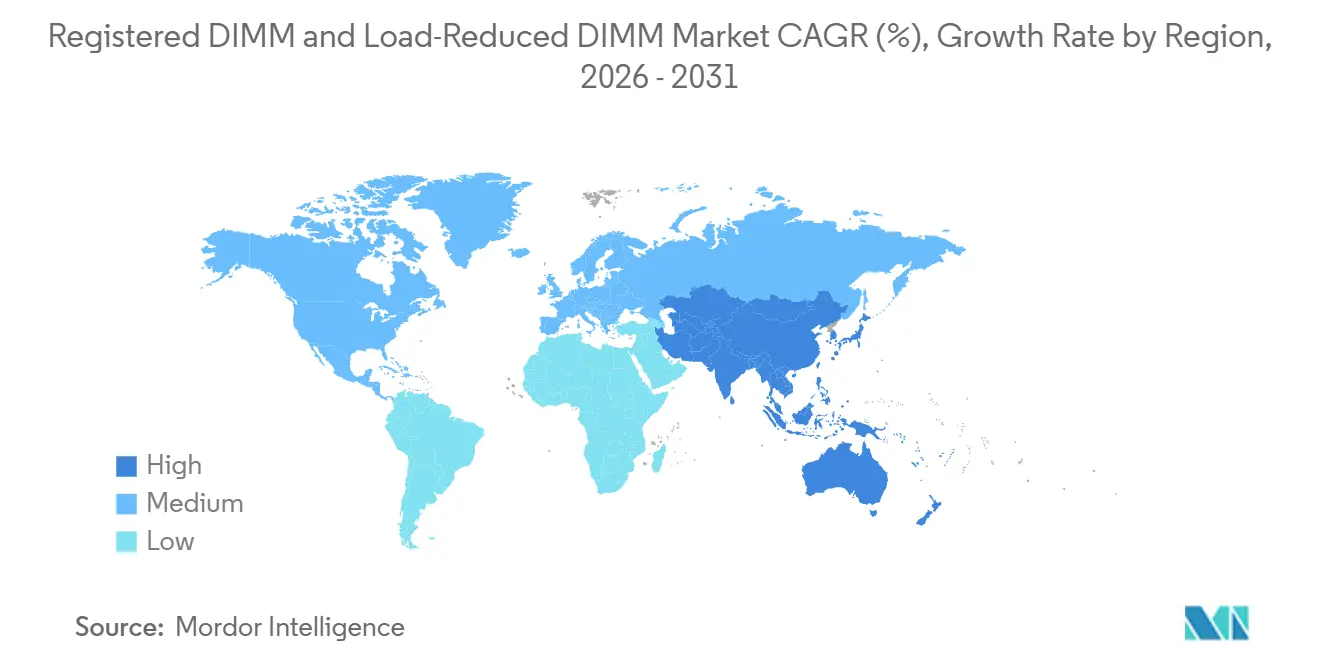
Asia-Pacific held 45.6% of revenue in 2025, which gave the region the largest position in the registered DIMM and load-reduced DIMM market share. That position rests on 2 roles at once, because the region is both the main DRAM manufacturing base and a major consumption center for new server deployments. South Korea remains central through Samsung Electronics and SK hynix, while Taiwan and China support important module assembly and server ODM activity tied to global cloud and enterprise demand. SK hynix secured Intel Data Center Certification for 256 GB DDR5 RDIMM modules in January 2025 and again in December 2025, which reflects the region's technical lead in dense module qualification.
North America is forecast to grow at a 17.1% CAGR through 2031, making it the fastest-growing geography in the registered DIMM and load-reduced DIMM market. The region benefits from the highest concentration of hyperscale cloud operators and from the rapid build-out of AI data center capacity in major U.S. clusters. Microsoft disclosed that USD 25 billion of its USD 190 billion 2026 capital expenditure was tied to rising memory chip and component costs, which gives a direct view into how important DRAM procurement has become in the region. North American deployments also skew toward high-density configurations, because AI-optimized racks require much larger memory footprints than general-purpose cloud servers. That demand pattern favors vendors that already hold platform certifications for 128 GB and above modules across Intel and AMD server ecosystems.
Europe held a meaningful but smaller share in 2025, and its pace remained more moderate because many enterprises still ran larger DDR4-era server estates that had not fully shifted to DDR5-native systems. The rest of the world, including South America, the Middle East, and Africa, stayed at an earlier stage of adoption but continued to add demand through sovereign data center programs, cloud expansion, and digitalization plans. These regions depend more heavily on North American and Asia-Pacific supply chains, so they are more exposed to constrained supply conditions and less able to influence pricing. Their weight in the RDIMM and LRDIMM market is likely to improve later in the forecast period as local infrastructure programs move from planning to deployment.

Competitive Landscape
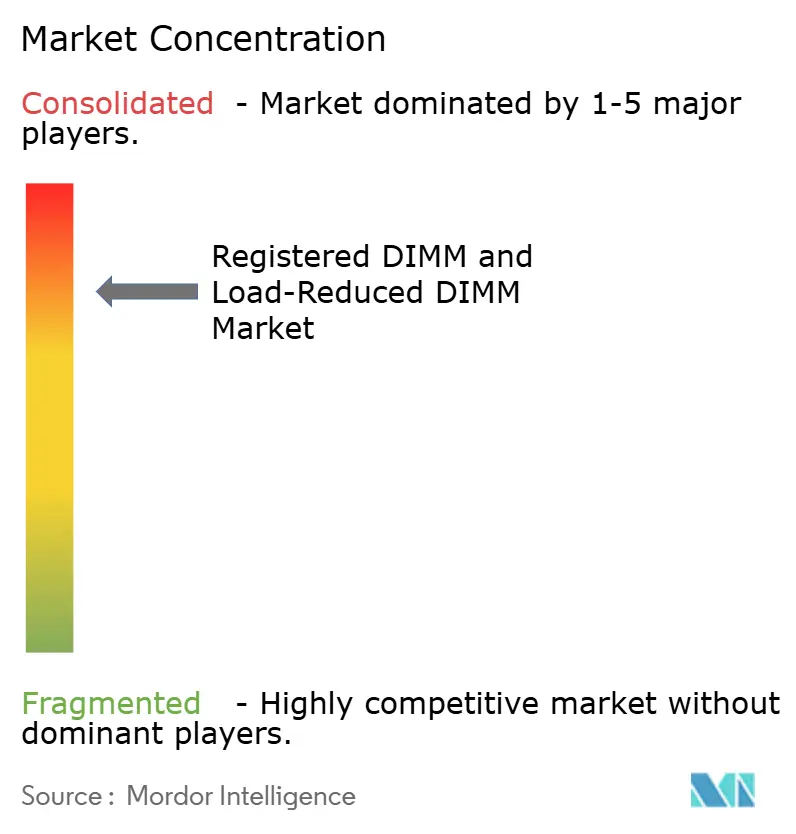
The registered DIMM and load-reduced DIMM market operates through 2 connected but distinct tiers. The first tier is dominated by DRAM die manufacturers such as Samsung Electronics, SK hynix, and Micron Technology, which control wafer capacity and shape the performance boundary of available DDR5 modules. The second tier includes module integrators such as Kingston Technology, SMART Modular Technologies, Innodisk, ATP Electronics, Netlist, Transcend Information, Apacer Technology, Team Group, and Patriot Memory, which compete on qualification depth, thermal management, form factor range, and customer support. This structure makes the registered DIMM and load-reduced DIMM market highly concentrated at the upstream supply layer but more fragmented at the module assembly layer.
Rambus holds a strategically important position because its clock drivers and data buffers influence the speed ceiling for RDIMM and LRDIMM products across the ecosystem. Its July 2026 DDR5 9600 server RDIMM chipset launch set a new benchmark for server memory performance and provided module suppliers with a path to align with next-generation AI and HPC platform requirements. Micron made another strong move in May 2026 when it sampled a 256 GB DDR5 RDIMM on 1-gamma DRAM, which tightened the link between density, bandwidth, and power efficiency in premium server memory. Micron also expanded its longer-range supply posture through a U.S. manufacturing and R&D commitment that reached USD 250 billion by mid-2026, which supports future domestic DRAM capacity growth. SK hynix strengthened its competitive standing through Intel Data Center Certification for 256 GB DDR5 RDIMM products, and that early qualification position improves access to hyperscale and OEM demand that depends on validated high-density parts.
Competitive white space is opening in thermally optimized LRDIMM products for liquid-cooled racks, in modules above 256 GB using advanced stacked die approaches, and in enterprise-grade RDIMM lines for open-standard server platforms. Qualification timing matters because OEM and platform-level certification creates switching costs that can persist for years after a product is introduced. At the same time, the registered DIMM and load-reduced DIMM market is beginning to face technology overlap from adjacent formats such as MRDIMM and SOCAMM2, which may reshape the premium end of AI server memory over time. Even with that emerging pressure, near-term competition remains defined mostly by supply control, qualification depth, and the ability to deliver dense DDR5 modules at scale.
Registered DIMM and Load-Reduced DIMM Industry Leaders
Samsung Electronics Co., Ltd.
SK hynix Inc.
Micron Technology, Inc.
Chang Xin Memory Technologies (CXMT)
Nanya Technology Corporation
- *Disclaimer: Major Players sorted in no particular order

Recent Industry Developments
- July 2026: Rambus Inc. launched its DDR5 9600 Server RDIMM chipset, anchored by the 6th Generation Registering Clock Driver, RCD06, enabling RDIMM operation at up to 9,600 MT/s, a 20% bandwidth increase over the prior generation solution. The complete chipset also integrates the PMIC5030 power management IC, SPD Hub, and temperature sensor ICs, providing a unified solution for next-generation agentic AI and HPC server platforms and simplifying time-to-market for RDIMM module manufacturers targeting the highest performance tier.
- May 2026: Micron Technology announced the sampling of 256 GB DDR5 RDIMM modules built on its leading-edge 1-gamma DRAM technology, supporting speeds of up to 9,200 MT/s, more than 40% faster than modules in current volume production. A single 256 GB module reduces operating power by more than 40% versus 2 equivalent 128 GB modules, 11.1W versus 19.4W total, delivering significant total cost of ownership advantages for AI and HPC data centers deploying at scale.
- April 2026: JEDEC's JC-40 and JC-45 committees published the JESD82-552 DDR5 Multiplexed Rank Data Buffer, DDR5MDB02, standard, advanced the MRDIMM Gen2 module standard toward completion targeting 12,800 MT/s, and commenced development of the MRDIMM Gen3 standard at 17,600 MT/s. These milestones extend the DDR5 buffered module performance roadmap and provide the interoperability framework required for next-generation AI and enterprise server memory designs across the module supplier ecosystem.
- December 2025: SK hynix became the first memory supplier in the industry to complete Intel Data Center Certification for a 32Gb 1b DRAM-based 256 GB DDR5 RDIMM module on the Intel Xeon 6 platform, following validation by Intel's Advanced Data Center Development Laboratory. The certified module delivers up to 16% higher inference performance and 18% lower power consumption compared with prior 256 GB products, enabling hyperscale data centers to consolidate memory slots while improving per-socket energy efficiency.


Global Registered DIMM and Load-Reduced DIMM Market Report Scope
The Registered DIMM and Load-Reduced DIMM Market Report is Segmented by Type (DDR3 RDIMM, DDR4 RDIMM, DDR5 RDIMM, DDR3 LRDIMM, DDR4 LRDIMM, and DDR5 LRDIMM), Capacity (Up to 16 GB, 32 GB, 64 GB, 128 GB, and Above 128 GB), Application (Enterprise Servers, Cloud and Hyperscale Data Centers, High-Performance Computing, AI Servers, and Professional Workstations), and Geography (North America, Europe, Asia-Pacific, and Rest of the World). The Market Forecasts are Provided in Terms of Value (USD).
| DDR3 RDIMM |
| DDR4 RDIMM |
| DDR5 RDIMM |
| DDR3 LRDIMM |
| DDR4 LRDIMM |
| DDR5 LRDIMM |
| Up to 16 GB |
| 32 GB |
| 64 GB |
| 128 GB |
| Above 128 GB |
| Enterprise Servers |
| Cloud and Hyperscale Data Centers |
| High-Performance Computing |
| AI Servers |
| Professional Workstations |
| North America | |
| Europe | |
| Asia-Pacific | China |
| Japan | |
| South Korea | |
| Taiwan | |
| Rest of Asia-Pacific | |
| Rest of the World |
| By Type | DDR3 RDIMM | |
| DDR4 RDIMM | ||
| DDR5 RDIMM | ||
| DDR3 LRDIMM | ||
| DDR4 LRDIMM | ||
| DDR5 LRDIMM | ||
| By Capacity | Up to 16 GB | |
| 32 GB | ||
| 64 GB | ||
| 128 GB | ||
| Above 128 GB | ||
| By Application | Enterprise Servers | |
| Cloud and Hyperscale Data Centers | ||
| High-Performance Computing | ||
| AI Servers | ||
| Professional Workstations | ||
| By Geography | North America | |
| Europe | ||
| Asia-Pacific | China | |
| Japan | ||
| South Korea | ||
| Taiwan | ||
| Rest of Asia-Pacific | ||
| Rest of the World | ||


Key Questions Answered in the Report
What is driving growth in registered DIMM and load-reduced DIMM demand through 2031?
Growth is being driven by DDR5-only server refresh cycles and rising AI server memory density needs. The market is expected to reach USD 39.9 billion by 2031 at a 16.3% CAGR.
Which module type leads current demand and which one is growing fastest?
DDR5 RDIMM led with 39.7% share in 2025, while DDR5 LRDIMM is projected to grow fastest at a 17.8% CAGR through 2031.
Why are high-capacity modules becoming more important in server memory?
AI and high-performance server builds need larger host-side DRAM pools, which is pushing adoption of dense configurations. The above 128 GB tier is projected to grow at a 17.9% CAGR through 2031.
Which application creates the strongest demand for these memory modules?
Cloud and hyperscale data centers were the largest application at 41.8% share in 2025. AI servers are the fastest-growing application, with a 17.2% CAGR through 2031.
Which region is most important for supply and demand?
Asia-Pacific led with 45.6% revenue share in 2025 because it combines DRAM production strength with major server and data center deployment activity. North America is the fastest-growing region at 17.1% CAGR.
What is the main risk for enterprise buyers in this space?
The biggest near-term risk is structural DRAM price volatility tied to supply reallocation toward HBM. That has already shown up in large buyer budgets, including Microsoft's 2026 memory-related capital spending disclosure.
Page last updated on:





