
Regenerative Aesthetics Market Size and Share
Market Overview
| Study Period | 2020 - 2031 |
|---|---|
| Market Size (2026) | USD 3.15 Billion |
| Market Size (2031) | USD 6.72 Billion |
| Growth Rate (2026 - 2031) | 16.37 % |
| Fastest Growing Market | Asia-Pacific |
| Largest Market | North America |
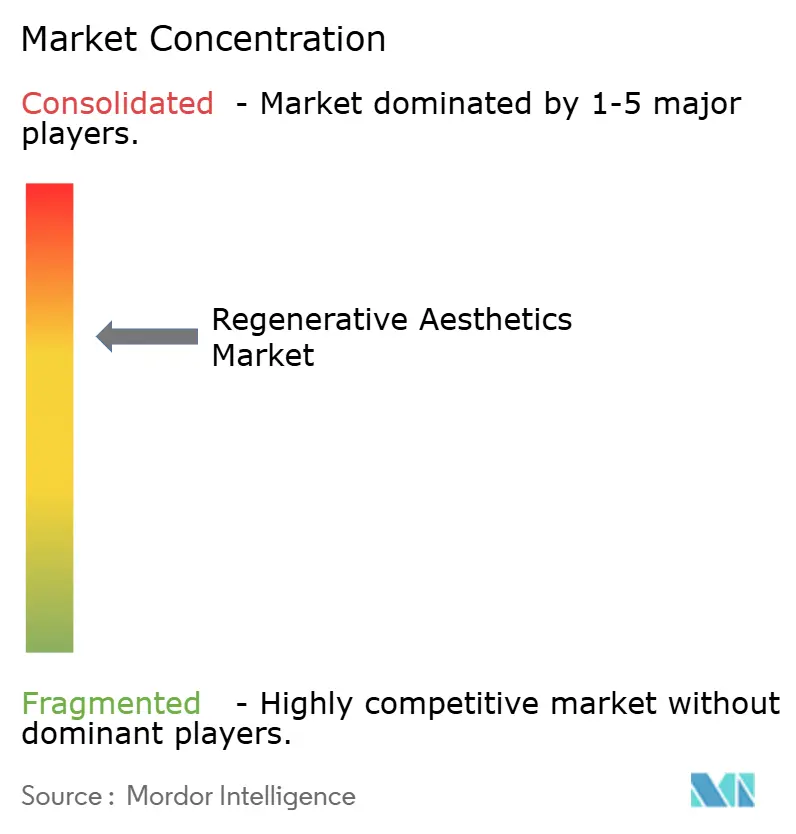
| Market Concentration | Medium |
Major Players *Disclaimer: Major Players sorted in no particular order Image © Mordor Intelligence. Reuse requires attribution under CC BY 4.0. | |
Regenerative Aesthetics Market Analysis by Mordor Intelligence
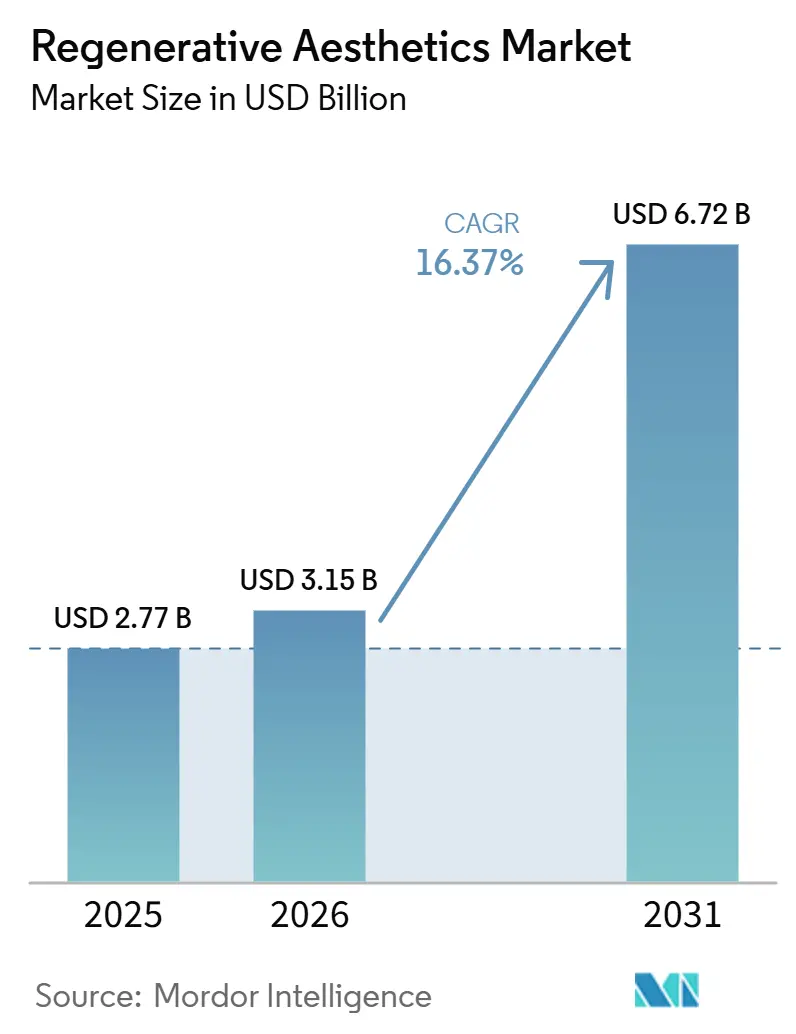
The regenerative aesthetics market is projected to expand from USD 2.77 billion in 2025 and USD 3.15 billion in 2026 to USD 6.72 billion by 2031, registering a CAGR of 16.37% between 2026 and 2031. The regenerative aesthetics market is moving beyond simple volume replacement because patients are increasingly asking for tissue repair, skin quality improvement, and results that move naturally with the face and body. That shift is changing clinic economics because longer treatment plans that combine biologics, devices, and follow-up sessions can support higher patient value than single filler visits. The regenerative aesthetics market is also benefiting from a stronger clinical base for autologous and cell-derived approaches, which is making these protocols easier for practitioners to justify in dermatology clinics and med spa settings. Competitive activity is concentrating around companies that can pair product approvals with physician education, channel access, and treatment combinations rather than relying on legacy filler demand alone. The main opportunity in the regenerative aesthetics market sits with providers and suppliers that can scale compliant biologic workflows, while the main risk remains the gap between rapid clinical interest and slower regulatory authorization for some newer product categories.
Key Report Takeaways
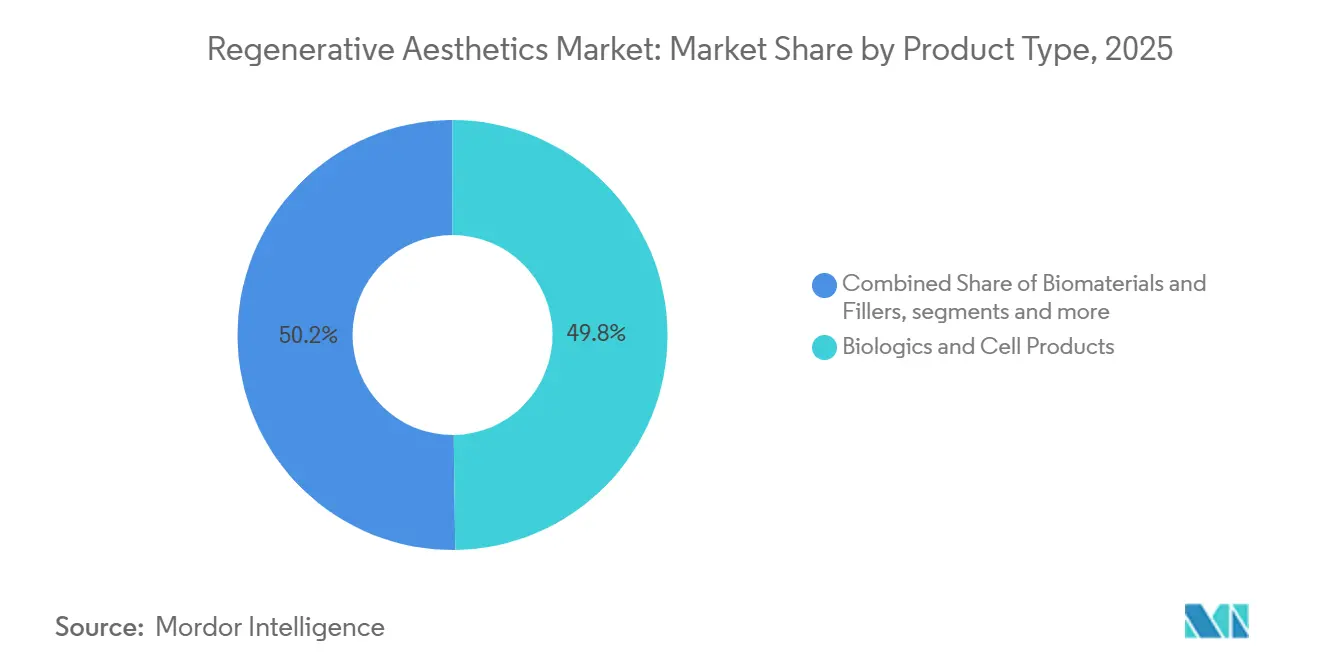
- By product type, biologics and cell products led with 49.84% revenue share in 2025, while combination products and drug-device are forecasted to expand at an 18.92% CAGR through 2031.
- By technology, autologous biologics held 53.67% revenue share in 2025, while device-assisted combination products recorded the highest projected CAGR at 19.24% through 2031.
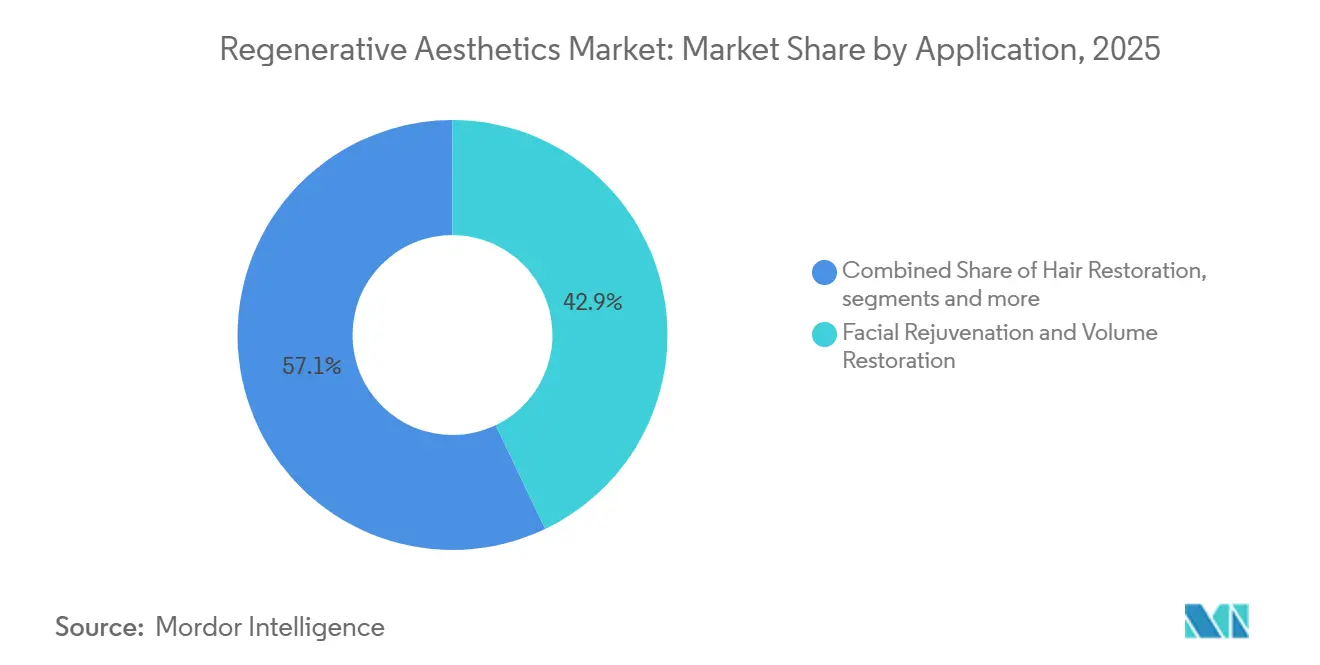
- By application, facial rejuvenation and volume restoration accounted for 42.91% share in 2025, while body contouring and soft-tissue remodeling are expected to advance at a 19.48% CAGR through 2031.
- By end-user, dermatology clinics and aesthetic practices held 47.83% revenue share in 2025, while med spas and aesthetic chains posted the highest projected CAGR at 19.11% through 2031.
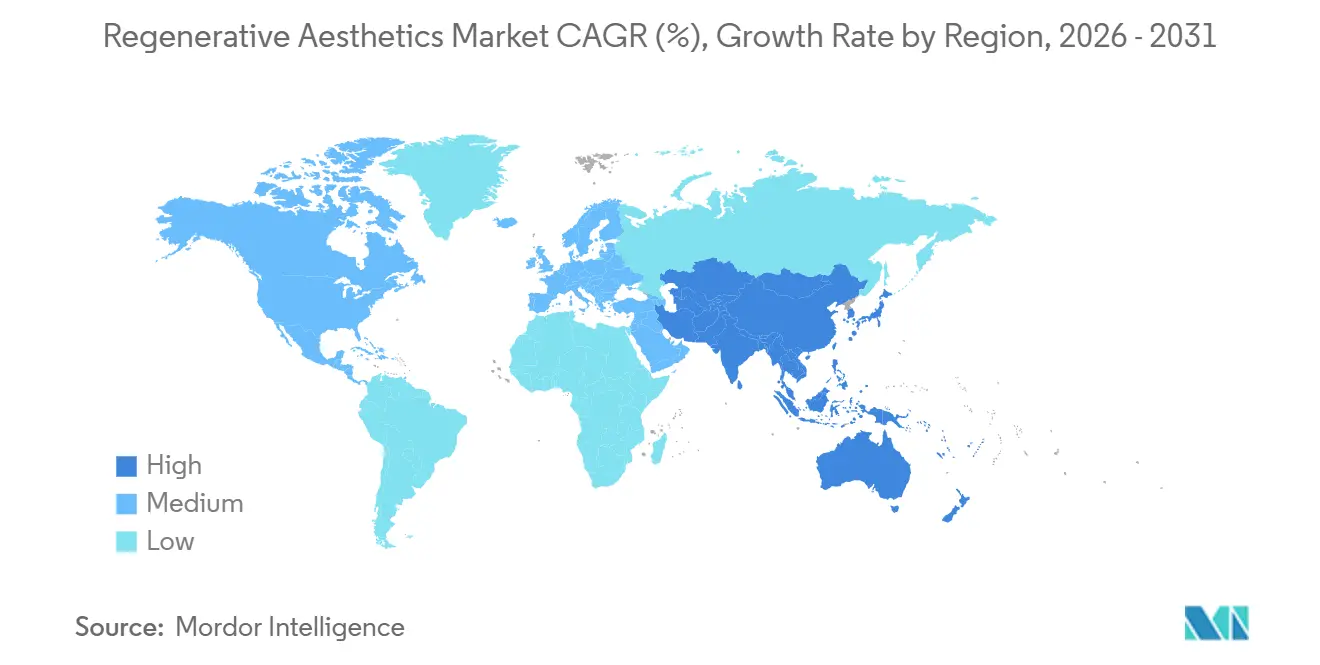
- By geography, North America accounted for 43.92% share in 2025, while the Asia-Pacific is expected to advance at a 18.76% CAGR through 2031.
Note: Market size and forecast figures in this report are generated using Mordor Intelligence’s proprietary estimation framework, updated with the latest available data and insights as of January 2026.
Market Trends and Insights
Drivers Impact Analysis of Regenerative Aesthetics Market*
| Driver | (~) % Impact on CAGR Forecast | Geographic Relevance | Impact Timeline |
|---|---|---|---|
| Durable, Natural-Looking Outcomes with Lower Retreatment Frequency | +3.2% | Global | Long term (≥ 4 years) |
| Rising Adoption of Cell-Based, Exosome, and Biomaterial Combination Protocols | +2.8% | Global, led by North America and APAC | Medium term (2-4 years) |
| Premium Clinic Chain Expansion and Medical Tourism in High-Growth Markets | +2.5% | North America and APAC core, spill-over to MEA | Short term (≤ 2 years) |
| AI-Guided Imaging, Treatment Planning, and Personalized Aesthetic Protocols | +1.8% | North America and Europe | Medium term (2-4 years) |
| Growing Consumer Preference for Minimally Invasive and Regenerative Anti-Aging Treatments | +2.4% | Global | Long term (≥ 4 years) |
| Advancements In Platelet-Rich Plasma, Platelet-Rich Fibrin, And Autologous Biologics Technologies | +2.1% | Global | Medium term (2-4 years) |
| Source: Mordor Intelligence | |||
Durable, Natural-Looking Outcomes with Lower Retreatment Frequency
The regenerative aesthetics market gained momentum as patients moved away from overfilled and static outcomes and started favoring results tied to collagen renewal, tissue remodeling, and natural movement. This change matters commercially because clinics can price regenerative protocols at a premium when they combine PRP with biostimulators and structured follow-up visits. A 2025 Journal of Clinical Medicine publication reported that adipose-derived stromal vascular fraction gel improved periorbital skin quality and collagen density, which supports the move toward biologically active treatment plans.[1]Jian Yao, “Harnessing Regenerative Science in Aesthetic Surgery, The Biologically Driven Future,” Journal of Clinical Medicine, doi.org Galderma also reported nine-month SHAPE Up HIT trial data in 2025 showing lasting patient satisfaction when Sculptra and Restylane Lyft were combined for facial volume loss linked to GLP-1 therapy use. In the regenerative aesthetics market, that kind of durability is supporting a clear premium for combinations that aim to restore tissue quality rather than only add volume.
Rising Adoption of Cell-Based, Exosome, and Biomaterial Combination Protocols
The regenerative aesthetics market still centers on PRP because it has an autologous origin, an established role in device-cleared preparation systems, and a stronger evidence base than many newer modalities. A 2025 meta-analysis in Dermatology and Therapy found that PRP was safe and effective for improving hair density and reducing hair loss, with no serious adverse events across the reviewed trials.[2]Platelet-Rich Plasma in the Management of Alopecia, A Systematic Review and Meta-Analysis of Clinical Evidence,” Dermatology and Therapy, link.springer.comAt the same time, the U.S. FDA has continued to state that exosome products intended for therapeutic injection are unapproved biologics, which is keeping regulatory pressure on allogeneic approaches and favoring compliant autologous routes. That is pushing the regenerative aesthetics market toward product strategies that stay closer to cleared PRP systems, closed preparation platforms, and biologic-device combinations with clearer regulatory footing.
Premium Clinic Chain Expansion and Medical Tourism in High-Growth Markets
The regenerative aesthetics market is also being shaped by large clinic networks because they expand demand, standardize treatment delivery, and raise the competitive bar for independent providers. VIO Med Spa signed 10 new franchise agreements in 2026 and added 15 locations to its development pipeline, showing how physician-guided chains are still expanding across major U.S. regions.[3]VIO Med Spa, “VIO Med Spa Adds 10 New Franchise Owners Across Key U.S. Markets,” PR Newswire, prnewswire.comLaserAway opened its 224th clinic in June 2026, which points to the scale advantage that larger operators now hold in staff training, site selection, and procurement. In the regenerative aesthetics market, these chains matter because they are better positioned to roll out standardized protocols and keep treatment menus closer to compliant PRP systems and approved biostimulators.
Growing Consumer Preference for Minimally Invasive and Regenerative Anti-Aging Treatments
The regenerative aesthetics market is gaining from a broad move toward minimally invasive procedures that can improve skin quality, contour, and recovery time without surgery. SkinSpirit reported a 69% year-on-year rise in microneedling treatments in 2025 and introduced a 30-minute SkinSpirit Laser Facial in early 2026 to meet demand for procedures with little downtime. That same preference is widening the customer base to younger adults seeking preventive treatment paths and to patients who want visible improvement without a long recovery period. In the regenerative aesthetics market, these patterns are lifting demand for combinations such as radiofrequency microneedling or focused ultrasound paired with biologic support, because they fit the need for lower-disruption collagen remodeling. The result is stronger momentum for treatment plans that combine comfort, speed, and repeated tissue response rather than one-time invasive correction.
Restraints Impact Analysis of Regenerative Aesthetics Market*
| Restraint | (~) % Impact on CAGR Forecast | Geographic Relevance | Impact Timeline |
|---|---|---|---|
| Regulatory Ambiguity for Exosomes, Stem Cells, and Combination Products | -1.5% | North America and EU | Medium term (2-4 years) |
| Technique Sensitivity and Lack of Standardized Clinical Protocols | -1.0% | Global | Short term (≤ 2 years) |
| High Out-of-Pocket Treatment Cost | -1.2% | Emerging Markets and South America | Long term (≥ 4 years) |
| Limited Long-Term Clinical Evidence and Reimbursement Support | -0.8% | Global | Medium term (2-4 years) |
| Source: Mordor Intelligence | |||
Regulatory Ambiguity for Exosomes, Stem Cells, and Combination Products
The regenerative aesthetics market still faces a clear regulatory gap because clinical interest in exosomes and stem-cell-linked products has moved faster than formal product authorization. The U.S. FDA has stated that exosome products intended for therapeutic use are unapproved biologics, and no exosome product has been approved for aesthetic injection in the United States. This is creating a split market where cleared autologous PRP systems and approved biostimulators can grow through standard channels while more experimental offerings remain difficult to commercialize at scale. Larger suppliers benefit because they are better able to invest in documentation, compliance, and physician education that smaller operators often cannot match. For the regenerative aesthetics market, that keeps growth concentrated in product categories with clearer approval pathways and slows wider adoption of offerings that still sit in a legal gray area.
High Out-of-Pocket Treatment Cost
The regenerative aesthetics market also remains limited by price because multi-step biologic and device-based protocols cost far more than standard filler or toxin visits. Patients usually pay entirely out of pocket for cosmetic regenerative procedures, which makes the spending hurdle especially important in price-sensitive markets and among first-time buyers. This cost gap also shapes provider behavior because clinics may favor lower-cost autologous options when patient conversion becomes harder at premium package prices. In the regenerative aesthetics market, higher treatment cost does not stop adoption in premium urban settings, but it does narrow the addressable base and slow expansion into more price-sensitive demand pools. That means suppliers and clinic networks with standardized packages and strong conversion tools are likely to be better placed than smaller operators with less pricing flexibility.
*Our forecasts treat driver/restraint impacts as directional, not additive. The impact forecasts reflect baseline growth, mix effects, and variable interactions.
Regenerative Aesthetics Market Segment Analysis
By Product Type:
Biologics and Cell Products Define the Market FoundationBiologics and cell products held 49.84% of the regenerative aesthetics market size in 2025, which made this the clear anchor of supplier revenue and clinic usage. That lead reflects the central role of PRP systems, polynucleotide injectables, and adipose-derived cellular preparations in treatment plans that clinicians view as scientifically grounded and easier to position with patients. The regenerative aesthetics market is leaning toward these products because they support the move from simple filling to tissue response, skin quality improvement, and gradual remodeling. As a result, product leadership in this category reflects both demand strength and a more workable regulatory path.
Combination products and drug-device is forecasted to expand at an 18.92% CAGR through 2031, which makes it the fastest-growing product segment in the regenerative aesthetics market. Biomaterials and Filters still hold an important place because scaffolds, extracellular matrix components, and bio-stimulatory materials are becoming more relevant in multi-step protocols. Devices and Equipment remain smaller by share, but their role is widening as radiofrequency microneedling and focused ultrasound systems are used with biologics rather than sold only as standalone procedures. This pattern suggests the regenerative aesthetics market is rewarding product designs that fit directly into integrated clinic workflows rather than single-use treatment categories.



By Technology:
Autologous Biologics Lead, Device Combinations AccelerateAutologous biologics commanded 53.67% of market revenue in 2025, giving this technology the broadest installed base in the regenerative aesthetics market. Its strength comes from low immunogenic risk, practitioner familiarity, and a growing set of studies that support PRP-derived growth factor approaches across skin and hair applications. Autologous systems, therefore, remain the most practical entry point for many clinics building or expanding regenerative treatment menus.
Device-assisted combination products is projected to grow at a 19.24% CAGR through 2031, making it the fastest-moving technology line in the regenerative aesthetics market. Biomaterials and Tissue Scaffolds remain useful in scar care, wound support, and structural applications where physical support matters alongside tissue signaling. The commercial appeal of device combinations is clear because they let clinics pair tissue stimulation with precise delivery, which improves treatment storytelling and supports premium pricing. In practice, the regenerative aesthetics market is moving toward technologies that make biologics more visible, more measurable, and easier to repeat across large treatment networks.
By Application:
Facial Rejuvenation Dominates, Body Contouring Emerges as a Structural DisruptorFacial rejuvenation and volume restoration accounted for 42.91% of application revenue in 2025, which kept it at the center of the regenerative aesthetics market. This segment benefits from the deepest practitioner training base, the widest patient awareness, and a treatment logic that can blend fillers, PRP, biostimulators, and energy devices within one care plan. The regenerative aesthetics market is now changing the economics of facial work because multi-modal protocols can generate more revenue per session than a conventional filler-only appointment.
Body contouring and soft-tissue remodeling are forecasted to expand at a 19.48% CAGR through 2031, which makes it the fastest-growing application in the regenerative aesthetics market. Scar Revision and Acne Scarring, along with Wound Healing and Reconstruction, continue to provide steady procedure flow where biologics are increasingly used to support or extend device-based outcomes. The fastest growth in body contouring reflects a wider patient need for soft-tissue support, tightening, and remodeling after major weight change, which fits well with regenerative treatment logic and staged protocols. That gives the regenerative aesthetics market a broader application base than older aesthetics cycles that depended more heavily on face-only volume correction.
By End-User:
Dermatology Clinics Anchor Revenue, Med Spas Capture GrowthDermatology clinics and aesthetic practices held 47.83% of end-user revenue in 2025, which made them the leading care setting in the regenerative aesthetics market. Their lead comes from physician oversight, access to advanced training, ownership of higher-end devices, and a stronger ability to explain treatment pathways built around biologics and biostimulators. The channel also benefits when approved product labels expand, because that makes patient communication and procedural standardization easier. In the regenerative aesthetics market, those label expansions strengthen the clinical role of dermatology-led settings and help them maintain their revenue share.
Med spas and aesthetic chains are projected to grow at a 19.11% CAGR through 2031, making it the fastest-growing end-user category in the regenerative aesthetics market. Plastic Surgery Clinics and Ambulatory Surgery Centers continue to handle more complex cases such as nanofat transfer, biologic-assisted grafting, and reconstruction-linked procedures. Hospitals and Specialty Centers remain steadier but slower because they are less exposed to consumer-facing cosmetic demand than large retail-like clinic formats. As these chains scale, the regenerative aesthetics market is likely to see faster protocol standardization, broader patient acquisition, and tighter control over which product combinations reach routine use.
Geography Analysis
North America Regenerative Aesthetics Market
North America held 43.92% of the regenerative aesthetics market share in 2025, which kept it as the largest regional revenue base. The region’s position rests on high consumer spending per procedure, dense practitioner training networks, and early access to biostimulatory injectables and device combinations. The regenerative aesthetics market in the United States is also being shaped by a more organized clinic layer, as LaserAway reached 224 clinics by June 2026 and Avelure Med Spa launched across 12 locations in May 2026. FDA enforcement also matters because it pushes provider spending toward compliant autologous biologics and approved biostimulators rather than unapproved exosome injections.
APAC Regenerative Aesthetics Market
Asia-Pacific is forecasted to grow at an 18.76% CAGR through 2031, making it the fastest-growing region in the regenerative aesthetics market. South Korea remains an innovation hub for injectable regeneration, while China and India continue to widen the regional demand base through rising procedure uptake and expanding clinic infrastructure. The regenerative aesthetics market in Asia-Pacific is moving quickly because regional providers are adopting both injectables and device-linked treatment plans rather than relying on one modality alone.
EMEA and South America Regenerative Aesthetics Market
Europe continues to hold a significant share in the regenerative aesthetics market because Germany, France, Italy, and the United Kingdom already have mature infrastructure for biostimulators and well-characterized regenerative products. The region also benefits from regulatory frameworks that support broad clinical use of established products while raising compliance requirements for newer entrants. Middle East and Africa, led by GCC markets, and South America, led by Brazil, remain smaller but are still expanding as medical tourism, clinic density, and premium treatment access improve.

Competitive Landscape
The regenerative aesthetics market is moderately concentrated in premium injectable biologics, but it remains much more fragmented in autologous preparation systems and device-assisted combinations. Galderma, AbbVie, and Merz hold strong positions because they combine approvals, physician relationships, training support, and recognized brands across core aesthetic procedures. This structure gives large companies an advantage when clinics want treatment plans that mix injectables, skin quality programs, and device support within a single supplier relationship. At the same time, specialists such as CollPlant, EmCyte, RegenLab, and Lipogems compete by focusing on modality differentiation in PRP systems, adipose-derived biologics, and regenerative platform design. That means the regenerative aesthetics market still leaves room for smaller companies when they solve a specific clinical workflow problem rather than trying to match the scale of the global leaders.
Galderma showed one leading strategy in 2026 when it announced triple approval for a new Restylane syringe across the EU, the United States, and Canada, and later launched a new Alastin Regenerating Skin Nectar built on its TriHex platform. Revance showed another path by moving quickly from FDA approval of RHA Dynamic Volume in January 2026 to commercial availability by March 2026. In the regenerative aesthetics market, these moves show that growth is coming from tighter portfolio integration, faster launch execution, and selective country expansion rather than from simple line extension.
Chain partnerships and standardized clinic programs are also becoming more important because product adoption increasingly depends on whether protocols can be repeated across a network, not only on whether the molecule or device is novel. This is why large clinic operators and physician-guided chains are becoming part of the competitive structure rather than only the distribution layer. The broader result is that the regenerative aesthetics market rewards companies that can combine evidence, approvals, training, and channel fit into one practical system for providers.
Regenerative Aesthetics Industry Leaders
Galderma SA
AbbVie Inc.
Merz Pharma GmbH and Co. KGaA
Cutera, Inc.
Suneva Medical, Inc.
- *Disclaimer: Major Players sorted in no particular order
Regenerative Aesthetics Market Companies Covered in this Report
- Abbvie
- Anika Therapeutics
- Arthrex
- BTL Industries, Inc.
- Candela Medical
- CollPlant Biotechnologies Ltd.
- Croma-Pharma GmbH
- Cutera
- EmCyte
- Galderma
- Hologic
- Integra LifeSciences
- Lipogems International SpA
- Lumenis
- Merz Pharma GmbH and Co. KGaA
- Prollenium Medical Technologies Inc.
- RegenLab SA
- Revance Therapeutics, Inc.
- Sinclair Pharma plc
- Suneva Medical

Recent Industry Developments in Regenerative Aesthetics Market
- June 2026: Allergan Aesthetics (AbbVie) received FDA approval for SKINVIVE by JUVÉDERM for the improvement of neck appearance, marking the first FDA-cleared treatment for horizontal neck wrinkles and expanding the lower-face/neck regenerative portfolio for physician-dispensed aesthetic practices.
- May 2026: Advanced MedAesthetic Partners (AMP) launched Avelure Med Spa simultaneously across 12 locations nationwide, directly filling the gap created by Ideal Image's late-2025 restructuring, signaling accelerated corporate consolidation in the U.S. aesthetic clinic channel.
- May 2026: VIO Med Spa signed 10 new franchise agreements, adding 15 locations to its development pipeline in 2026, with expansion spanning California, Florida, the Midwest, and the Northeast, reinforcing the chain model's growth velocity in physician-guided regenerative aesthetics.


Global Regenerative Aesthetics Market Report Scope
According to the report’s scope, the regenerative aesthetics market refers to the industry focused on the development and commercialization of biologically based therapies that stimulate the body's natural repair and rejuvenation processes to improve aesthetic outcomes. It includes products and procedures such as platelet-rich plasma (PRP), stem cell-based therapies, exosomes, biomaterials, and other regenerative technologies used for facial rejuvenation, skin revitalization, hair restoration, scar reduction, and body contouring.
The regenerative aesthetics market is segmented into product type, technology, application, end-user, and geography. By product type, the market is segmented into biologics and cell products, biomaterials and fillers, combination products and drug-device hybrids, and devices and equipment. By technology, the market is segmented into autologous biologics, allogeneic cell-based products, biomaterials and tissue scaffolds, and device-assisted combination procedures. By application, the market is segmented into facial rejuvenation and volume restoration, hair restoration, scar revision and acne scarring, wound healing and reconstructive adjuncts, and body contouring and soft-tissue defect repair. By end-user, the market is segmented into dermatology clinics and aesthetic physicians, plastic surgery clinics and ambulatory surgical centers, med spas and aesthetic chains, and hospitals and specialty centers. By geography, the market is segmented into North America, Europe, Asia-Pacific, the Middle East and Africa, and South America. The report also covers the estimated market sizes and trends for 17 countries across major regions globally. The report offers values (USD) for all the above segments.
| Biologics and Cell Products |
| Biomaterials and Fillers |
| Combination Products and Drug-Device Hybrids |
| Devices and Equipment |
| Autologous Biologics |
| Allogeneic Cell-Based Products |
| Biomaterials and Tissue Scaffolds |
| Device-Assisted Combination Procedures |
| Facial Rejuvenation and Volume Restoration |
| Hair Restoration |
| Scar Revision and Acne Scarring |
| Wound Healing and Reconstructive Adjuncts |
| Body Contouring and Soft-Tissue Defect Repair |
| Dermatology Clinics and Aesthetic Physicians |
| Plastic Surgery Clinics and Ambulatory Surgical Centers |
| Med Spas and Aesthetic Chains |
| Hospitals and Specialty Centers |
| North America | United States |
| Canada | |
| Mexico | |
| Europe | Germany |
| United Kingdom | |
| France | |
| Italy | |
| Spain | |
| Rest of Europe | |
| Asia-Pacific | China |
| Japan | |
| India | |
| Australia | |
| South Korea | |
| Rest of Asia-Pacific | |
| Middle East and Africa | GCC |
| South Africa | |
| Rest of Middle East and Africa | |
| South America | Brazil |
| Argentina | |
| Rest of South America |
| By Product Type | Biologics and Cell Products | |
| Biomaterials and Fillers | ||
| Combination Products and Drug-Device Hybrids | ||
| Devices and Equipment | ||
| By Technology | Autologous Biologics | |
| Allogeneic Cell-Based Products | ||
| Biomaterials and Tissue Scaffolds | ||
| Device-Assisted Combination Procedures | ||
| By Application | Facial Rejuvenation and Volume Restoration | |
| Hair Restoration | ||
| Scar Revision and Acne Scarring | ||
| Wound Healing and Reconstructive Adjuncts | ||
| Body Contouring and Soft-Tissue Defect Repair | ||
| By End-User | Dermatology Clinics and Aesthetic Physicians | |
| Plastic Surgery Clinics and Ambulatory Surgical Centers | ||
| Med Spas and Aesthetic Chains | ||
| Hospitals and Specialty Centers | ||
| By Geography | North America | United States |
| Canada | ||
| Mexico | ||
| Europe | Germany | |
| United Kingdom | ||
| France | ||
| Italy | ||
| Spain | ||
| Rest of Europe | ||
| Asia-Pacific | China | |
| Japan | ||
| India | ||
| Australia | ||
| South Korea | ||
| Rest of Asia-Pacific | ||
| Middle East and Africa | GCC | |
| South Africa | ||
| Rest of Middle East and Africa | ||
| South America | Brazil | |
| Argentina | ||
| Rest of South America | ||


Key Questions Answered in the Report
How large is regenerative aesthetics expected to become by 2031?
The regenerative aesthetics market is forecasted to reach USD 6.7 billion by 2031, up from USD 2.77 billion in 2025 to USD 3.15 billion in 2026, at a 16.37% CAGR.
Which product group leads current revenue?
Biologics and cell products led with 49.84% revenue share in 2025, supported by PRP systems, polynucleotides, and related cellular preparations.
Which application is growing the fastest right now?
Body contouring and soft-tissue remodeling is expected to be the fastest-growing application, with a projected 19.48% CAGR through 2031.
Why does North America lead in current spending?
North America held 43.92% share in 2025 because of higher procedure spending, dense provider training networks, and faster adoption of approved biologics and combination platforms.
Page last updated on:





