
Refillable Deodorants Market Size and Share
Market Overview
| Study Period | 2022 - 2032 |
|---|---|
| Market Size (2027) | USD 1.99 Billion |
| Market Size (2032) | USD 2.64 Billion |
| Growth Rate (2027 - 2032) | 5.84 % |
| Fastest Growing Market | Asia-Pacific |
| Largest Market | Europe |
| Market Concentration | Low |
Major Players *Disclaimer: Major Players sorted in no particular order Image © Mordor Intelligence. Reuse requires attribution under CC BY 4.0. | |
Refillable Deodorants Market Analysis by Mordor Intelligence
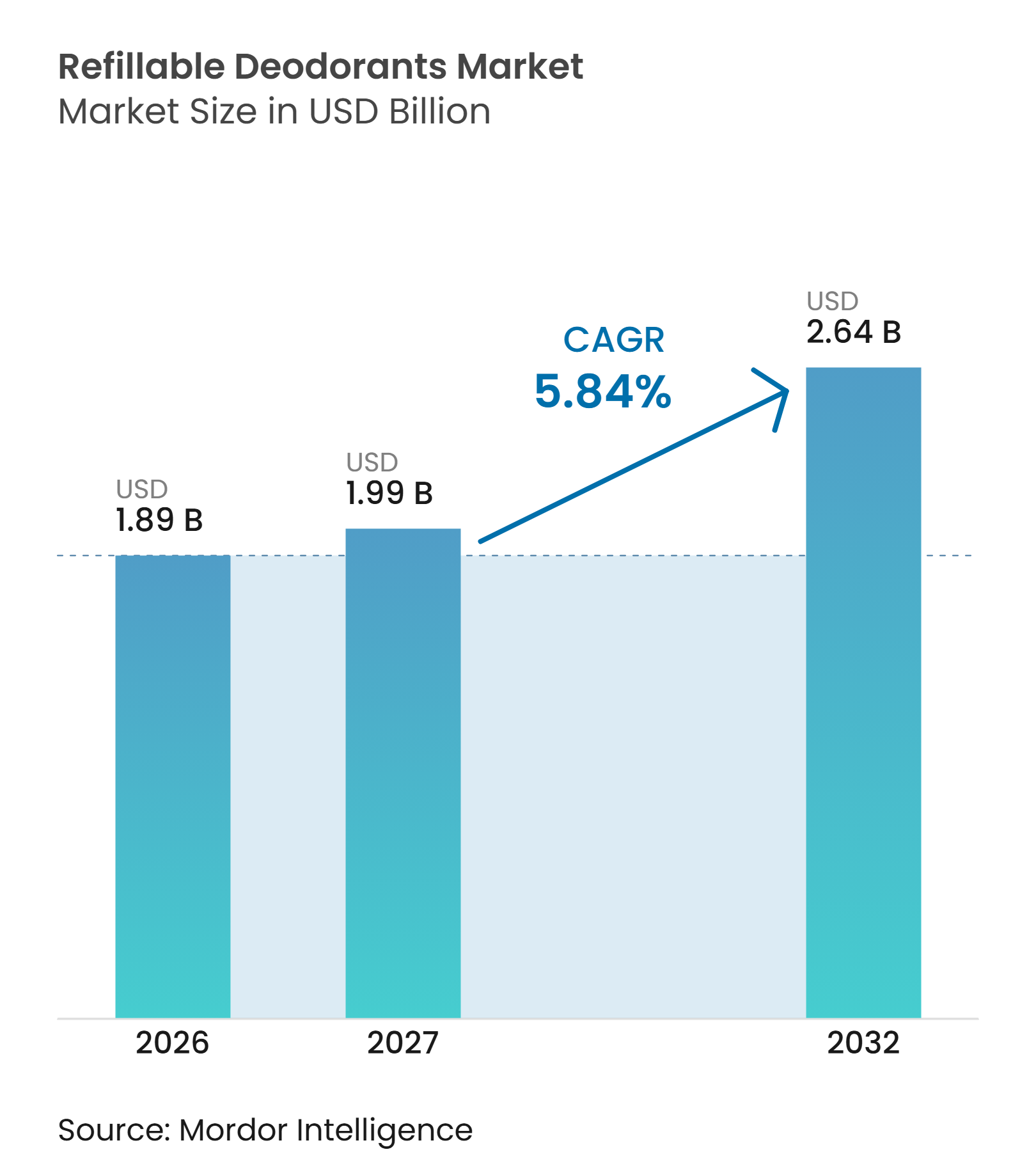
The refillable deodorants market size was valued at USD 1.89 billion in 2026 and is estimated to grow from USD 1.99 billion in 2027 to reach USD 2.64 billion by 2032, at a CAGR of 5.84% during the forecast period (2027-2032). The refillable deodorants market is evolving from niche sustainable product ranges toward broader personal care portfolios as major consumer goods companies adopt reusable formats. Europe benefits from well-established sustainable personal care retail channels and the European Union Packaging and Packaging Waste Regulation, which is scheduled to enter into force in February 2025. Market growth also depends on brands’ ability to simplify initial purchases and ensure that refills are readily available. Subscription offerings and listings in mainstream retail channels can encourage repeat purchases, while limited availability and unfamiliar refill processes may slow initial adoption.
Key Report Takeaways
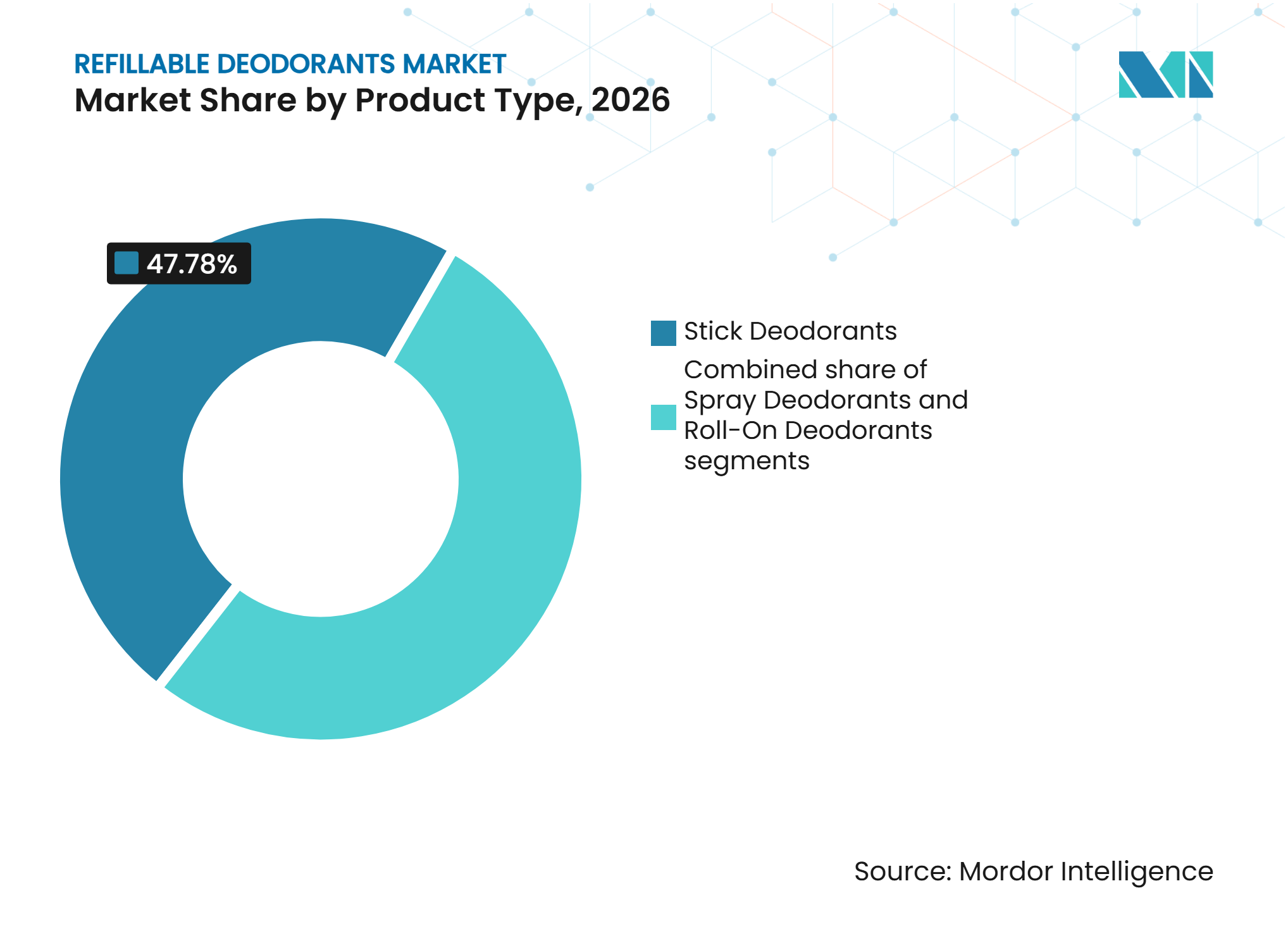
- By product type, stick deodorants dominated the refillable deodorants market with a share of 47.78% in 2026, while spray deodorants are anticipated to register the fastest CAGR of 6.92% during 2027-2032.
- By packaging, plastic dominated the market with a share of 52.63% in 2026, while metal packaging is anticipated to register the fastest CAGR of 6.78% during 2027-2032.
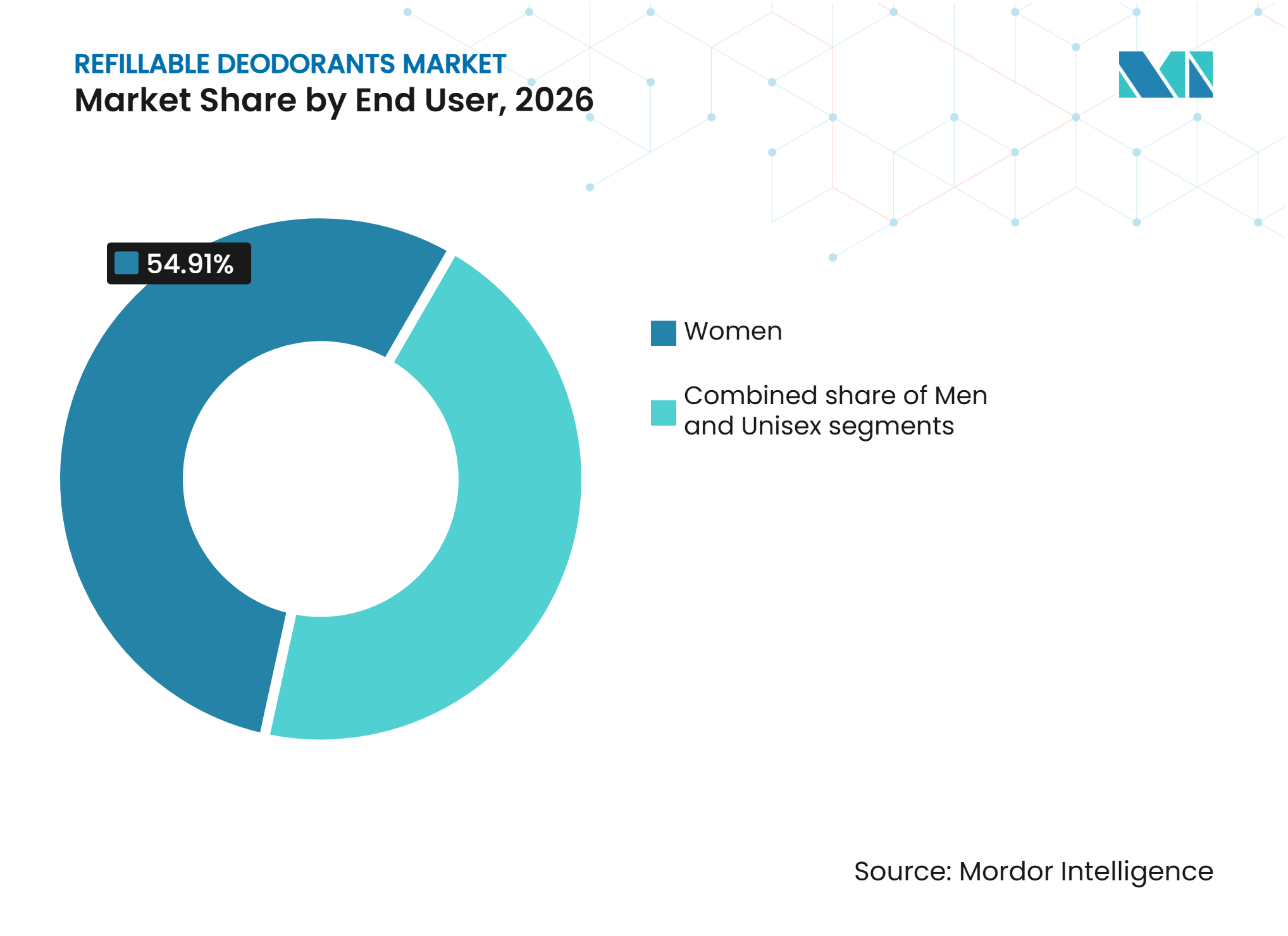
- By end user, women dominated the market with a share of 54.91% in 2026, while unisex products are anticipated to register the fastest CAGR of 6.71% during 2027-2032.
- By distribution channel, supermarkets/hypermarkets dominated the market with a share of 57.74% in 2026, while online retail stores are anticipated to register the fastest CAGR of 7.31% during 2027-2032.
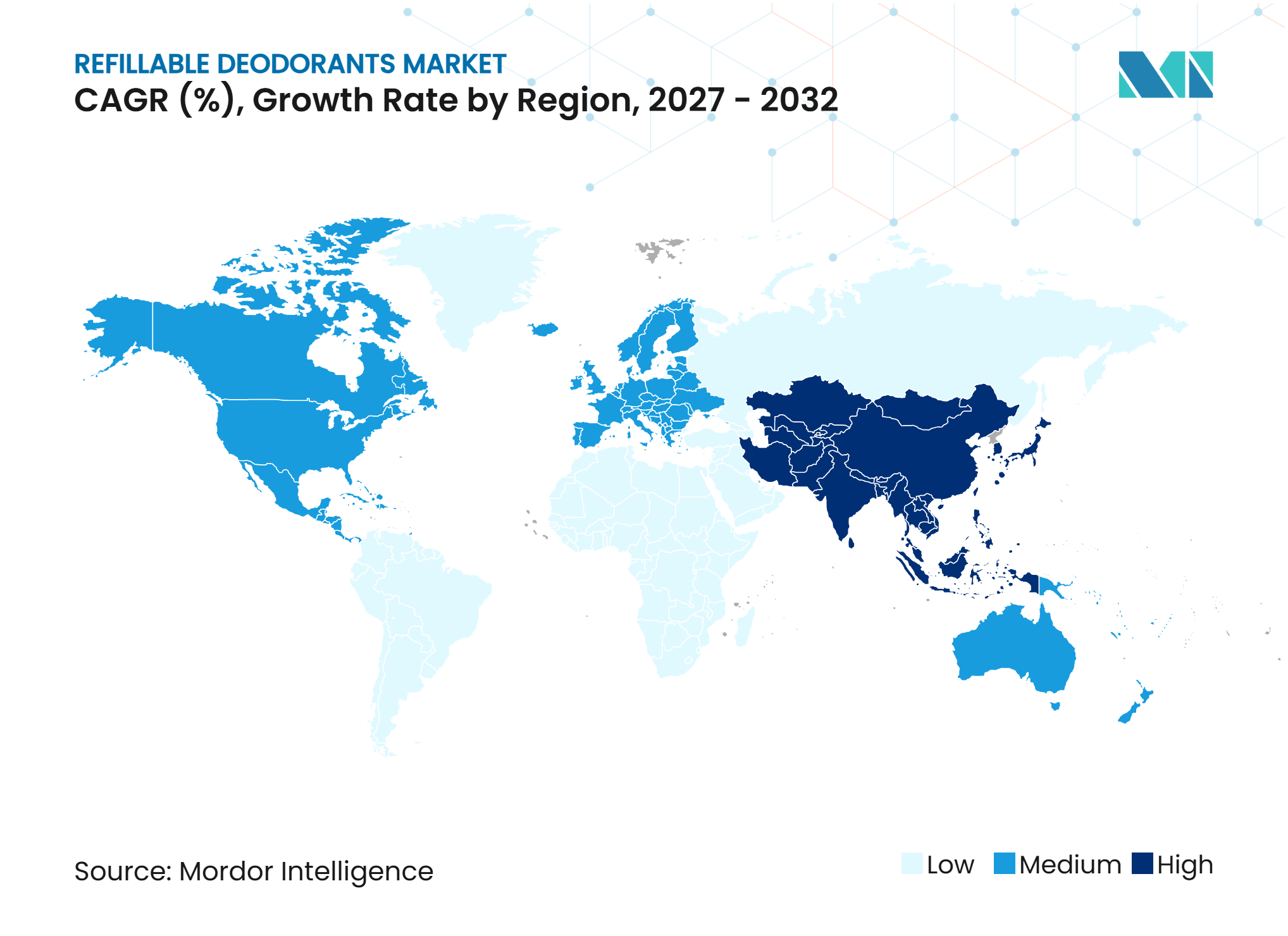
- By geography, Europe dominated the refillable deodorants market with a share of 38.12% in 2026, while Asia-Pacific is anticipated to register the fastest CAGR of 7.11% during 2027-2032.
Note: Market numbers in this report are based on Mordor Intelligence's proprietary estimation framework, which combines nine months of actuals with Q4 projections for base year 2026.
Market Trends and Insights
Drivers Impact Analysis of Refillable Deodorants Market*
| Driver | (~) % Impact on CAGR Forecast | Geographic Relevance | Impact Timeline |
|---|---|---|---|
| Rising consumer preference for sustainable personal care products | +1.4% | Global, strongest in Europe and North America | Medium term (2-4 years) |
| Growing demand for plastic waste reduction | +1.0% | Europe, with spillover to North America and Asia-Pacific | Short term (≤ 2 years) |
| Increasing adoption of refill models by established personal care brands | +0.8% | Global, led by Europe and North America | Medium term (2-4 years) |
| Increasing consumer interest in cost savings through repeated refills | +0.7% | Global, particularly Asia-Pacific and South America | Medium term (2-4 years) |
| Product innovation in refillable packaging and applicator designs | +0.6% | Global, with activity in the United Kingdom, France, and Germany | Long term (≥ 4 years) |
| Development of in-store deodorant refill infrastructure | +0.4% | Europe, North America, and selected Asia-Pacific cities | Long term (≥ 4 years) |
| Source: Mordor Intelligence | |||
Rising Consumer Preference for Sustainable Personal Care Products
Consumer interest in sustainable personal care products supports the refillable deodorants market, as reusable cases provide shoppers with a visible alternative to repeated single-use purchases. In April 2026, Wearewild’s 2025 Wild Impact Report stated that the brand sold more than 15 million refills during the year and diverted an estimated 482 metric tons of single-use plastic from landfills[1]. This scale indicates that consumers can incorporate repeat refill purchases into regular grooming routines when brands offer a simple product system. The value proposition can also support premium positioning, as consumers purchase the durable case and refill separately. Brands therefore need to communicate both environmental benefits and product performance without making the refill process appear complex. Sustainable claims require clear supporting evidence, as consumers may assess the reusable case, refill materials, and end-of-life disposal pathway collectively.
Growing Demand for Plastic Waste Reduction
Plastic reduction is creating a stronger commercial incentive for companies to develop refillable deodorant systems. In February 2025, the European Union adopted Regulation (EU) 2025/40 on Packaging and Packaging Waste, establishing measures to promote packaging reuse, refill, and waste prevention across industries[2]. This framework positions packaging design as a compliance consideration rather than solely a brand choice. The refillable deodorants market can benefit when reusable cases and refill formats help companies meet these requirements. It also increases the need for durable packaging that consumers can retain through multiple refill cycles. Consequently, manufacturers are being encouraged to invest in packaging innovations that combine material efficiency, recyclability, and repeated-use functionality.
Increasing Adoption of Refill Models by Established Personal Care Brands
Established personal care brands are increasingly integrating reusable packaging and refill-based distribution models into their product portfolios to align with national packaging regulations and circular economy objectives. In February 2025, the United Kingdom’s Department for Environment, Food and Rural Affairs (Defra), in collaboration with the devolved governments, published a joint policy statement on Extended Producer Responsibility (EPR) for packaging[3]. The policy identifies increased packaging reuse, packaging waste prevention, and reduced packaging material consumption as key framework outcomes. This regulatory direction provides additional incentives for established personal care manufacturers to explore refillable deodorant cases, replaceable cartridges, and reusable packaging systems. It also supports the development of refill-compatible product portfolios as companies adapt their packaging strategies to evolving environmental requirements.
Increasing Consumer Interest in Cost Savings Through Repeated Refills
Potential long-term cost savings are encouraging consumers to consider refillable deodorants as an alternative to conventional single-use products. Although refillable deodorants may have a higher initial purchase cost because of the reusable applicator, replacement cartridges enable consumers to buy the deodorant formulation without repeatedly paying for a complete outer container. This model can reduce recurring expenditure across multiple purchase cycles, particularly for regular deodorant users. The availability of affordable refill packs and multi-use applicators further enhances the economic appeal of these products. Consequently, the ability to manage personal care expenditure while reducing packaging purchases is driving consumer interest in refillable deodorant systems. Furthermore, the option to retain the original applicator while purchasing only replacement refills offers greater purchasing flexibility and supports repeat consumption.
Restraints Impact Analysis of Refillable Deodorants Market*
| Restraint | (~) % Impact on CAGR Forecast | Geographic Relevance | Impact Timeline |
|---|---|---|---|
| High initial cost of refillable deodorant systems | -0.9% | Global, most acute in Asia-Pacific, South America, and Middle East and Africa | Short term (≤ 2 years) |
| Consumer resistance to changing established purchasing habits | -0.7% | Global, particularly retail-led mass markets | Medium term (2-4 years) |
| Limited consumer awareness and understanding of refill systems | -0.5% | Asia-Pacific, South America, Middle East and Africa, and secondary Western markets | Medium term (2-4 years) |
| Limited availability and variety of replacement refills | -0.4% | Asia-Pacific, South America, Middle East and Africa, and niche Western markets | Long term (≥ 4 years) |
| Source: Mordor Intelligence | |||
High Initial Cost of Refillable Deodorant Systems
The relatively high upfront cost of refillable deodorant systems may restrict adoption, particularly among price-sensitive consumers accustomed to purchasing conventional deodorants at lower prices. These products typically require consumers to purchase a reusable applicator or durable outer case with the initial deodorant formulation, making the first purchase more expensive than standard disposable alternatives. In addition, the limited availability of affordable starter kits and competitively priced refill cartridges may further reduce their price appeal. This initial financial barrier may slow consumer conversion and limit the penetration of refillable deodorants across mass-market personal care segments. Consumers who are uncertain about the long-term value of refillable systems may also hesitate to pay a premium before experiencing the benefits of repeated cartridge replacements.
Consumer Resistance to Changing Established Purchasing Habits
Deodorant is a frequently purchased product, and consumers typically expect familiar formats and reliable performance. Therefore, practical design plays a critical role in adoption, as an unfamiliar replacement process may discourage repeat purchases. Although physical retail channels can increase category visibility, they may not provide the guidance first-time buyers require. Direct-to-consumer channels can address this gap by offering product instructions, reminders, and refill-ordering tools. Brands must make the refill process intuitive for the category to expand beyond environmentally motivated early adopters. Additional effort associated with replacing cartridges, maintaining reusable cases, or locating compatible refills may further discourage consumers who prioritize convenience in their daily personal care routines.
*Our forecasts treat driver/restraint impacts as directional, not additive. The impact forecasts reflect baseline growth, mix effects, and variable interactions.
Refillable Deodorants Market Segment Analysis
By Product Type:
Sticks Lead as Sprays Gain MomentumStick deodorants accounted for 47.78% of the refillable deodorants market share in 2026. Their solid-refill format fits into reusable cases without requiring liquid handling, making the product system easier to explain and use. Early refill-focused brands developed much of their product portfolios around stick formats, creating a familiar model for reusable deodorants. This format also supports durable cases that consumers can retain after finishing the original product. Retailers can position stick starter packs alongside conventional deodorant formats, potentially reducing the perceived barrier for first-time buyers and enabling shoppers to compare the format with products they already understand. This shelf presence is important because consumers who already own a reusable case need access to compatible refills within the same shopping environment.
Spray deodorants are forecast to grow at a CAGR of 6.92% through 2032. Growth is driven by pump-spray and separable refill designs that overcome the limitations of pressurized aerosol cans. These designs expand the range of application formats that can incorporate refills. Product development must preserve ease of use, as complex mechanisms could reduce the benefits of broader format choices. Companies must also ensure that consumers can distinguish reusable spray systems from conventional aerosol products. Clear instructions, visible refill compatibility, and reliable dispensing are essential, as an ineffective first-use experience may discourage consumers from purchasing the format again.



By Packaging:
Plastic Dominant, Metal Rewrites Premium AppealPlastic accounted for a 52.63% sales share in 2026, supported by its lower material costs, flexible design options, and established supply chains for mass-market products. The material remains important for brands seeking to maintain an accessible entry price. The transparent plastic cases allow consumers to view the remaining product level. This feature can improve understanding of the refill system and reduce uncertainty before the next purchase. Therefore, plastic packaging remains relevant even as brands pursue materials that offer stronger premium appeal or circularity credentials.
Metal packaging is projected to grow at a CAGR of 6.78% through 2032. Metal cases can communicate durability, supporting a higher initial purchase price for products designed for repeated use. Glass remains a niche option due to its visual appeal and chemical stability in fragrance-related applications. Other formats, including paper tubes and plant-based materials, cater to demand for alternatives to conventional plastic and metal. The category must balance material claims with practical factors such as weight, durability, cost, and compatibility with the refill format. While a premium case can help justify a long-use system, it must also withstand daily handling and remain intuitive for consumers to retain and reuse.
By End User:
Women Lead, Unisex Redefines Growth FrontierWomen accounted for 54.91% of demand in the refillable deodorants market in 2026. The consumer base provides brands with a strong foundation for reusable packaging and aluminum-free formulations. However, product messaging must continue to demonstrate efficacy alongside environmental credentials. Brands can use scent, case design, and refill availability to serve established users without positioning sustainability as the sole purchase driver. This segment represents the strongest current demand base in the refillable deodorants market and provides companies with an important platform for introducing new refill formats.
The unisex segment is forecast to grow at a CAGR of 6.71% through 2032. Neutral scents, simplified packaging, and less gender-specific marketing can help brands address household purchasing needs rather than narrowly segmented user groups. This approach may reduce the number of stock-keeping units that brands need to carry while making reusable cases suitable for a broader consumer base. However, the men’s segment remains smaller, with growing interest in premium personal care products that combine cost and sustainability benefits. Brands must still make careful scent and performance decisions to ensure that a neutral proposition does not appear generic to consumers.

By Distribution Channel:
Physical Retail Leads, Online Channels AccelerateSupermarkets and hypermarkets accounted for 57.74% of refillable deodorant sales in 2026. This channel places refillable deodorants alongside traditional products, increasing visibility and making the format more familiar to consumers. Mainstream shelf placement can reduce the perception that refill systems are intended only for specialist or online shoppers. It also allows consumers to evaluate the durable case and refill concept before making a purchase. Effective retail execution remains critical, as shoppers must be able to locate compatible replacement refills after purchasing a starter product. The channel performs best when retailers clearly distinguish and link cases and refills and maintain adequate stock levels for both products.
Online retail stores are projected to grow at a CAGR of 7.31% through 2032. Digital channels support subscription-based ordering, simplifying repeat purchases and creating a predictable refill cycle. They also enable brands to provide detailed instructions on using the case and refill, which is particularly valuable for consumers unfamiliar with reusable personal care formats. Online channels can strengthen consumer loyalty; however, companies must provide reliable delivery and straightforward cancellation terms to maintain consumer trust. Brands can also use product pages and post-purchase communications to explain product compatibility, refill timing, and care instructions. This direct communication can make the refillable deodorants market easier for new buyers to navigate and reduce the risk of incorrect product use.
Geography Analysis
Europe
Europe accounted for 38.12% of the refillable deodorants market share in 2026. The region combines established sustainable personal care retail channels with regulatory pressure on packaging design. The United Kingdom, France, and Germany remain key markets, as refillable formats have gained traction across both direct-to-consumer channels and mass retail. In Germany, natural cosmetics standards, including NATRUE and COSMOS NATURAL, can influence product positioning and strengthen consumer confidence. Europe provides the most mature market environment for companies that can offer durable cases, readily available refills, and credible packaging claims.
Asia-Pacific
Asia-Pacific is projected to grow at a CAGR of 7.11% through 2032, making it the fastest-growing geographic segment in the refillable deodorants market. The regional market comprises countries with distinct consumer behaviors, retail structures, and price points. Japan and South Korea offer receptive urban consumer bases for minimalist packaging and premium personal care products. China provides social commerce and subscription channels that can connect product discovery with repeat purchases. Indonesia, Thailand, and Singapore remain at earlier stages of adoption and require greater consumer awareness of refill mechanisms. Companies entering the region must adapt case designs, price points, and refill formats to local distribution channels rather than relying on a single regional approach.
North America, South America, and Middle East and Africa
North America presents a higher-value opportunity, where mainstream retail and direct-to-consumer subscription brands can collaborate to build consumer awareness. Established personal care distribution networks, greater consumer exposure to premium grooming products, and the presence of sustainability-focused brands support the introduction of refillable deodorant formats. The Middle East and Africa remain early-stage markets, where premium positioning is more viable in Gulf Cooperation Council (GCC) cities with access to specialty retail and e-commerce platforms. The expansion of modern retail infrastructure and digital shopping platforms can further improve access to specialized personal care products across urban markets. In addition, partnerships with regional distributors and established beauty retailers can help international brands introduce refillable formats and gradually build consumer acceptance.
Competitive Landscape
Market Concentration
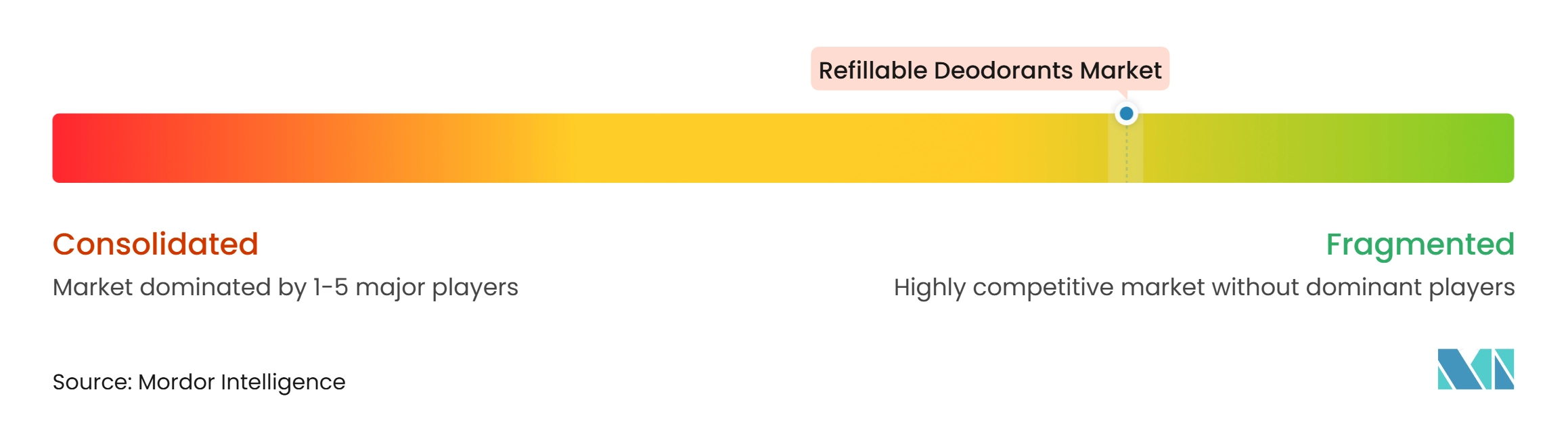
The refillable deodorants market is fragmented, with competition driven by product innovation, sustainable packaging solutions, brand positioning, and expanding retail distribution networks. Established personal care companies, such as Unilever Plc. and The Procter & Gamble Company, leverage brand recognition, product development capabilities, and extensive distribution networks to strengthen their market presence. Meanwhile, specialized brands, including Wild Cosmetics Ltd., Fussy Ltd., Myro, 900.care, and Saltair, compete through reusable applicators, interchangeable refill cartridges, and sustainability-focused product offerings.
A competition is emerging between direct-to-consumer brands and companies that prioritize physical retail. Direct-to-consumer brands can use subscription models to manage refill timing and maintain customer communication after the initial purchase. Retail-focused brands can reach a broader consumer base at the shelf and support the mainstream adoption of reusable formats. However, neither approach eliminates the need for an easy-to-use product mechanism and reliable refill availability. The refillable deodorants market rewards companies that combine effective product design with a clear purchasing journey. Brands can also differentiate through neutral scents, men’s products, travel formats, and packaging materials.
Materials and packaging design are becoming increasingly important competitive tools in the refillable deodorants market. Companies can differentiate their offerings through reusable cases, refill material options, and clear end-of-life guidance, provided they support their claims. Larger companies can leverage their distribution reach, while smaller brands can respond more quickly with new product concepts and direct-to-consumer services. Price alone is unlikely to define the market, as the durable case, refill process, and brand trust influence repeat purchases. Consequently, product execution and access to replacement refills remain central to competitive performance.
Refillable Deodorants Industry Leaders
-
Unilever Plc.
-
Wild Cosmetics Ltd
-
The Procter & Gamble Company
-
Grove Collaborative, Inc.
-
The Lekker Company
- *Disclaimer: Major Players sorted in no particular order
Refillable Deodorants Market Companies Covered in this Report
- Unilever Plc.
- The Procter & Gamble Company
- Wild Cosmetics Ltd
- Fussy Ltd
- Myro
- Grove Collaborative, Inc.
- Noniko
- The Lekker Company
- Asuvi
- Proverb Skincare
- Helmm
- L’Oréal SA
- Salt of the Earth Natural Deodorants
- Hyléance Hygiène and Beauté
- 900.care
- PiperWai
- Ben and Anna
- Muji
- Greendoor
- Saltair
Recent Industry Developments in Refillable Deodorants Market
- September 2026: Salt of the Earth introduced Aloe & Lime fragrance in refillable spray and roll-on formats. For the spray format, the range provides consumers with multiple replenishment options.rovides
- January 2026: Dove launched its first refillable antiperspirant range in the United Kingdom, offering three starter kits featuring reusable cases and interchangeable refills. The range delivers 72-hour sweat and odor protection and is available in six fragrance options.
- November 2025: Wild launched a refillable roll-on deodorant featuring a reusable aluminum case and a bio-based refill container. Developed in collaboration with Morrama, the product is available in five fragrances.
Global Refillable Deodorants Market Report Scope
Refillable deodorants are personal care products designed with reusable containers or applicators that can be replenished using replacement cartridges or refill formulations once the original product is exhausted.
The refillable deodorants market is segmented by product type, packaging, end user, distribution channel, and geography. By product type, the market is segmented into stick deodorants, spray deodorants, and roll-on deodorants. By packaging, the market is segmented into metal, plastic, glass, and other packaging types. By end user, the market is segmented into men, women, and unisex. By distribution channel, the market is segmented into supermarkets/hypermarkets, convenience/grocery stores, online retail stores, and other distribution channels. Based on geography, the market is classified into North America, Europe, South America, Asia-Pacific, and the Middle East and Africa. The market forecasts are provided in terms of value (USD).
Segmentation Overview
| Stick Deodorants |
| Spray Deodorants |
| Roll-On Deodorants |
| Metal |
| Plastic |
| Glass |
| Other Packaging Types |
| Men |
| Women |
| Unisex |
| Supermarkets/Hypermarkets |
| Convenience/Grocery Stores |
| Online Retail Stores |
| Other Distribution Channels |
| North America | United States |
| Canada | |
| Mexico | |
| Rest of North America | |
| Europe | Germany |
| United Kingdom | |
| Italy | |
| France | |
| Spain | |
| Poland | |
| Belgium | |
| Netherlands | |
| Rest of Europe | |
| Asia-Pacific | China |
| India | |
| Japan | |
| Australia | |
| Indonesia | |
| Thailand | |
| Singapore | |
| Rest of Asia-Pacific | |
| South America | Brazil |
| Argentina | |
| Peru | |
| Colombia | |
| Rest of South America | |
| Middle East and Africa | South Africa |
| Saudi Arabia | |
| United Arab Emirates | |
| Egypt | |
| Turkey | |
| Rest of Middle East and Africa |
| By Product Type | Stick Deodorants | |
| Spray Deodorants | ||
| Roll-On Deodorants | ||
| By Packaging | Metal | |
| Plastic | ||
| Glass | ||
| Other Packaging Types | ||
| By End User | Men | |
| Women | ||
| Unisex | ||
| By Distribution Channel | Supermarkets/Hypermarkets | |
| Convenience/Grocery Stores | ||
| Online Retail Stores | ||
| Other Distribution Channels | ||
| By Geography | North America | United States |
| Canada | ||
| Mexico | ||
| Rest of North America | ||
| Europe | Germany | |
| United Kingdom | ||
| Italy | ||
| France | ||
| Spain | ||
| Poland | ||
| Belgium | ||
| Netherlands | ||
| Rest of Europe | ||
| Asia-Pacific | China | |
| India | ||
| Japan | ||
| Australia | ||
| Indonesia | ||
| Thailand | ||
| Singapore | ||
| Rest of Asia-Pacific | ||
| South America | Brazil | |
| Argentina | ||
| Peru | ||
| Colombia | ||
| Rest of South America | ||
| Middle East and Africa | South Africa | |
| Saudi Arabia | ||
| United Arab Emirates | ||
| Egypt | ||
| Turkey | ||
| Rest of Middle East and Africa | ||
Key Questions Answered in the Report
What is the current and future outlook of the refillable deodorants market?
The refillable deodorants market was valued at USD 1.89 billion in 2026, reached USD 1.99 billion in 2027, and is projected to grow to USD 2.64 billion by 2032, expanding at a CAGR of 5.84% during 2027-2032.
Which product type accounted for the largest market share in 2026?
Stick deodorants dominated the market in 2026, accounting for 47.78% of total market revenue.
Which packaging format held the largest market share in 2026?
Plastic packaging led the market with a 52.63% share in 2026, owing to its affordability and widespread adoption.
Which end-user segment generated the highest revenue in 2026?
The women's segment held the largest market share at 54.91% in 2026, reflecting strong consumer demand for refillable personal care products among female consumers.
Which distribution channel dominated the refillable deodorants market in 2026?
Supermarkets and hypermarkets accounted for the largest share of the market, representing 57.74% of total sales in 2026.