
Referral Marketing Software Market Size and Share
Market Overview
| Study Period | 2020 - 2031 |
|---|---|
| Market Size (2026) | USD 1.44 Billion |
| Market Size (2031) | USD 2.57 Billion |
| Growth Rate (2026 - 2031) | 12.28% CAGR |
| Fastest Growing Market | Asia-Pacific |
| Largest Market | North America |
| Market Concentration | Medium |
Major Players *Disclaimer: Major Players sorted in no particular order Image © Mordor Intelligence. Reuse requires attribution under CC BY 4.0. | |
Referral Marketing Software Market Analysis by Mordor Intelligence
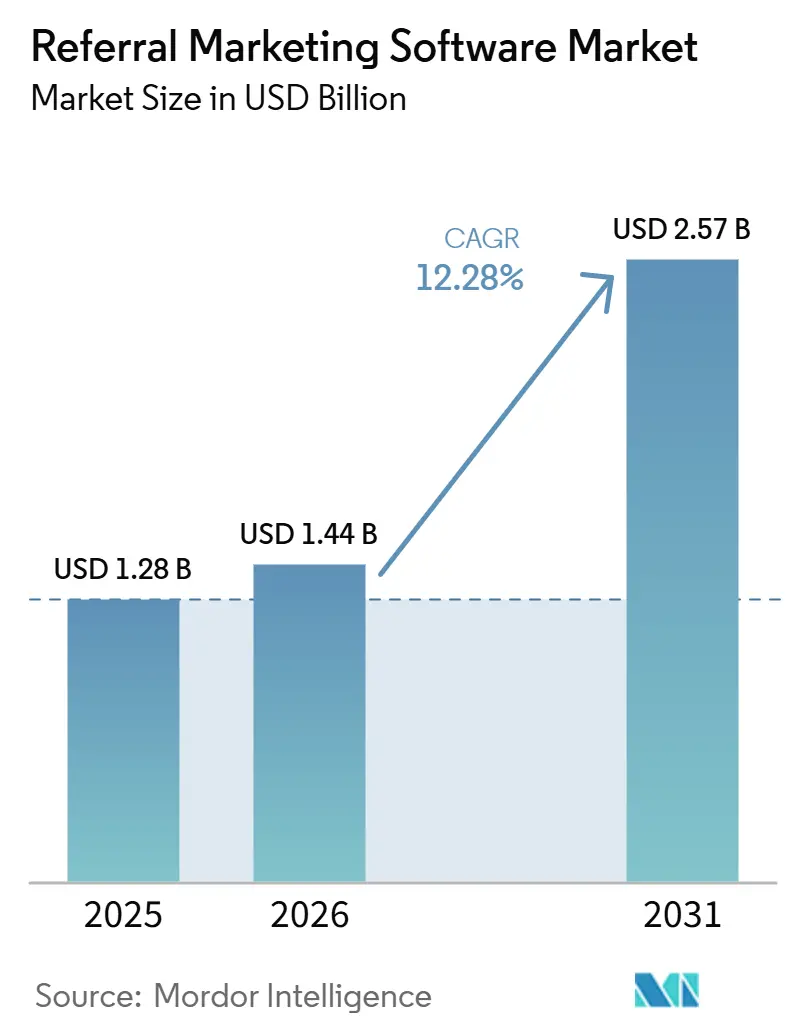
The referral marketing software market size is projected to expand from USD 1.28 billion in 2025 and USD 1.44 billion in 2026 to USD 2.57 billion by 2031, registering a CAGR of 12.28% between 2026 to 2031. Rising acquisition costs across paid search and social channels are making referral programs more important for brands seeking to protect contribution margins. The loss of third-party cookie access has also increased the value of owned and consent-based customer acquisition channels. Referral programs now support customer acquisition while creating declared-intent data that can strengthen personalization and customer data practices. Platforms that combine incentive management, fraud controls, consent handling, and server-side attribution are becoming more relevant in enterprise buying decisions. Competition remains fragmented, although Adyen’s acquisition of Talon.one indicates increasing consolidation among enterprise-focused providers.
Key Report Takeaways
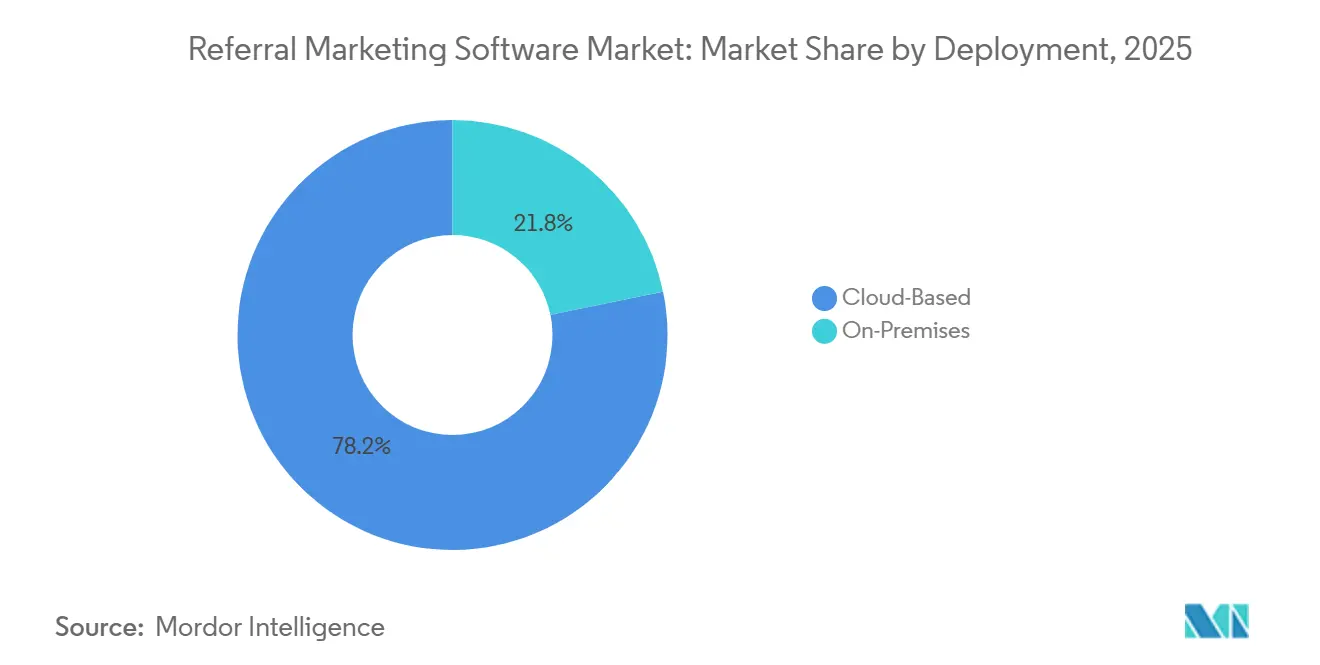
- By deployment, cloud-based platforms held 78.23% of the referral marketing software market share in 2025, while on-premises deployment is projected to expand at a CAGR of 13.86% through 2031.
- By enterprise size, large enterprises accounted for 67.39% of the market in 2025, while small and medium enterprises are expected to grow at a CAGR of 13.92% through 2031.
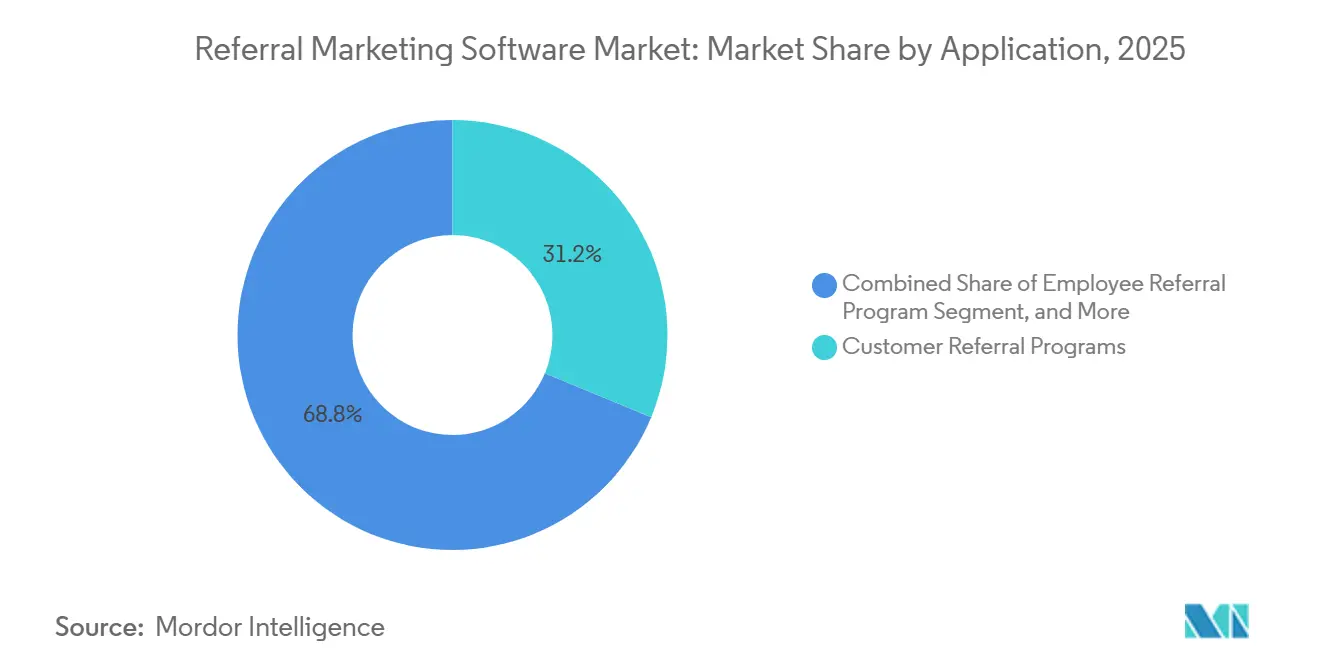
- By application, customer referral programs held a 31.24% share in 2025, while influencer and brand ambassador campaigns are projected to advance at a CAGR of 15.43% through 2031.
- By end user industry, retail and e-commerce accounted for 29.73% of the market in 2025, while the healthcare and life sciences industry is expected to expand at a CAGR of 14.71% through 2031.
- By geography, North America held 37.64% of the global market in 2025, while Asia-Pacific is projected to record a CAGR of 16.82% through 2031.
Note: Market size and forecast figures in this report are generated using Mordor Intelligence’s proprietary estimation framework, updated with the latest available data and insights as of January 2026.
Global Referral Marketing Software Market Trends and Insights
Drivers Impact Analysis*
| DRIVER | (~) % IMPACT ON CAGR FORECAST | GEOGRAPHIC RELEVANCE | IMPACT TIMELINE |
|---|---|---|---|
| Rising Customer Acquisition Costs Across Paid Media | +3.2% | Global, with greater relevance in North America and Europe | Short term (≤ 2 years) |
| Expansion of First-Party Data Strategies | +2.5% | Global, led by North America and Europe | Medium term (2-4 years) |
| Shift Toward Always-On Lifecycle Marketing | +1.8% | Global, with stronger adoption in North America and Asia-Pacific | Medium term (2-4 years) |
| Greater Need for Measurable Word-of-Mouth Attribution | +1.5% | North America, Europe, and Asia-Pacific | Medium term (2-4 years) |
| Embedded Referral Flows in E-Commerce and SaaS Stacks | +1.2% | North America and Asia-Pacific e-commerce markets | Short term (≤ 2 years) |
| AI-Assisted Incentive Optimization and Fraud Detection | +1.0% | Global | Medium term (2-4 years) |
| Source: Mordor Intelligence | |||
Rising Customer Acquisition Costs Across Paid Media
Paid digital acquisition costs are increasing across many sectors, which is placing greater pressure on marketing returns. Google Search cost per acquisition averaged USD 23.74 in 2026 and was 12% higher than the previous year, while paid customer acquisition costs for B2B SaaS have risen 47% since 2023. Referral acquisition costs in e-commerce average USD 40 to USD 65, which is lower than paid social acquisition for comparable customer quality. Enterprise software paid-search acquisition costs average USD 1,180, compared with USD 310 for referral and affiliate channels. Referred customers can also produce higher lifetime value, which improves the financial case beyond the initial acquisition event. As a result, the referral marketing software market is increasingly treated as core acquisition infrastructure rather than a discretionary campaign expense.
Expansion of First-Party Data Strategies
The phased phase-out of third-party cookies between the third quarter of 2025 and early 2026 heightened the importance of direct, consent-based customer data. A referral event records the advocate’s identity, relationship context, and stated willingness to recommend a brand. This makes referral software relevant to customer data practices as well as acquisition activity. Referral platforms can help organizations maintain program data without relying on third-party tracking methods. Privacy reviews now place more focus on consent records, data processing agreements, and the handling of customer identity data. The referral marketing software market benefits when vendors position their platforms as a practical part of compliant first-party data operations.
Shift Toward Always-On Lifecycle Marketing
Organizations are moving away from limited referral campaigns and toward persistent programs linked to customer lifecycle events. Referral prompts can now appear during onboarding, after a purchase, at renewal, or when a customer shows signs of churn. This shift makes referral platforms more closely resemble workflow infrastructure than stand-alone promotional tools. Salesforce reported that 75% of marketing organizations used at least 1 form of AI in 2026, supporting the wider adoption of automated customer engagement processes.[1]Salesforce, “State of Marketing, Tenth Edition,” Salesforce, salesforce.com Research published in Japan also indicated that consumer referrals are increasingly driven by trust and product confidence rather than direct incentives. Platforms that personalize the timing and message of a referral request can therefore support stronger customer advocacy than those focused solely on rewards.
Greater Need for Measurable Word-of-Mouth Attribution
Word-of-mouth activity has historically been difficult to connect to revenue because many interactions occur outside standard pixel-based measurement. Multi-touch attribution, server-side tracking, and conversion modeling are helping organizations connect referral activity to verified outcomes. Enterprise teams are seeking platforms that can link program activity with customer relationship management systems and reward payouts. Ambassador introduced its Attribution Engine in 2026 to connect referral activity to revenue without manual reconciliation. This capability is particularly relevant in healthcare and financial services, where auditable referral records can support compliance requirements. The referral marketing software market has an opportunity to serve organizations that need both measurable acquisition results and formal program documentation.
Restraints Impact Analysis*
| RESTRAINT | (~) % IMPACT ON CAGR FORECAST | GEOGRAPHIC RELEVANCE | IMPACT TIMELINE |
|---|---|---|---|
| Limited Incremental Lift in Saturated Loyalty-Heavy Categories | -1.8% | North America and Europe, particularly mature loyalty markets | Long term (≥ 4 years) |
| Referral Fraud and Incentive Abuse | -1.5% | Global, with greater relevance in Asia-Pacific and North America | Short term (≤ 2 years) |
| Fragmented Martech Integration and Data Ownership | -1.0% | Global, particularly mid-market organizations and emerging geographies | Medium term (2-4 years) |
| Privacy, Consent, and Attribution Compliance Complexity | -0.8% | Europe, North America, and Asia-Pacific | Long term (≥ 4 years) |
| Source: Mordor Intelligence | |||
Limited Incremental Lift in Saturated Loyalty-Heavy Categories
Referral programs can face lower incremental value in sectors with mature loyalty ecosystems, including airlines, hotels, grocery chains, and large-format retail. Many high-value customers in these categories already participate in established brand programs and may have already referred much of their close network. The remaining potential advocate base can be less responsive, requiring higher rewards to generate participation. Loyalty programs can also contain many inactive members, which increases the cost of turning existing members into active referrers. Vendors are responding by adding incrementality measurement tools that distinguish software-driven referrals from referrals that would have happened without a program. This capability is important for the referral marketing software market because enterprise buyers increasingly expect proof that referral spending delivers incremental revenue.
Referral Fraud and Incentive Abuse
Referral fraud creates direct reward costs and can weaken confidence in program reporting. Self-referral is a common method, where one person creates several accounts to claim rewards intended for both advocates and new customers. Stripe noted that fraudulent referral patterns may appear as a star-shaped account network, with a single account linked to numerous newly created accounts that show little activity after redemption.[2]Stripe, “How to Detect Promo Abuse: A Guide for Businesses,” Stripe, stripe.com Identity overlap between advocates and redeemers can create payout leakage and distort conversion metrics. Fraud also makes it harder for program managers to distinguish real customer growth from artificial activity. The referral marketing software market, therefore, favors vendors that provide fraud detection without creating excessive friction for legitimate customers.
*Our forecasts treat driver/restraint impacts as directional, not additive. The impact forecasts reflect baseline growth, mix effects, and variable interactions.
Segment Analysis
By Deployment: Cloud Platforms Lead While On-Premises Demand Expands
Cloud-based deployment held 78.23% of the referral marketing software market share in 2025. Its leading position reflects compatibility with software-as-a-service stacks, real-time reporting, and programs that operate across several countries. Cloud infrastructure can accommodate sharp traffic increases during referral campaigns without requiring brands to maintain excess internal capacity. This is useful for retail and e-commerce businesses that experience seasonal changes in referral volume. Cloud systems also support faster updates, simpler integrations, and centralized administration for distributed teams. These benefits continue to make cloud deployment the preferred model for organizations that want to launch and adjust referral programs quickly.
On-premises deployment is projected to grow at a CAGR of 13.86% through 2031. Demand is concentrated among organizations in financial services, government, and healthcare, where data residency and security policies can restrict the use of external cloud environments. These organizations may prefer to keep customer identity information within internal infrastructure or sovereign cloud systems. Hybrid deployment models are gaining attention because they allow program workflows to remain cloud-hosted while identity data stays in a controlled environment. Data localization requirements in Europe, South Korea, and India can sustain demand for these configurations. Providers that support both cloud flexibility and controlled data handling can address a wider range of enterprise requirements in the referral marketing software market.


By Enterprise Size: SMEs Gain Access Through No-Code Deployment
Large enterprises retained 67.39% of the referral marketing software market share in 2025. Their position reflects multi-year contracts, managed services, deep customer relationship management integrations, and extensive customization requirements. Large organizations have the resources to connect referral workflows with broader loyalty, customer data, and marketing systems. They also need governance tools for programs operating across business units and jurisdictions. Enterprise deployments often involve complex approval processes and formal security assessments. These needs support the continued demand for vendors with established technical and service capabilities.
Small and medium enterprises are projected to record a CAGR of 13.92% through 2031. No-code platforms, native Shopify and WooCommerce integrations, and application programming interface-led architectures have reduced deployment time from months to days for many users. Cloud delivery and AI-supported configuration have also lowered the need for dedicated implementation teams. Direct-to-consumer brands with revenue between USD 3 million and USD 30 million are using referral tools as an alternative to rising paid social spending. Small businesses can find it difficult to compete with larger advertisers in auction-based media channels. This creates a wider opportunity for the referral marketing software market as platforms provide accessible pricing, simpler setup, and faster time to value.
By Application: Customer Referrals Remain Largest While Influencer Programs Grow Fastest
Customer referral programs accounted for 31.24% of the referral marketing software market size in 2025. These programs remain the most established form of peer-to-peer acquisition because they connect current customer satisfaction with new customer conversion. Brands use them to encourage existing buyers to recommend products and services through personal networks. Referral links, reward fulfillment, and customer relationship management integrations are now common parts of digital commerce operations. The application is especially relevant for subscription businesses and direct-to-consumer brands that want repeatable acquisition channels. Its continued scale reflects the broad use of customer advocacy across retail, software, financial services, and other consumer-facing categories.
Influencer and brand ambassador campaigns are forecast to grow at a CAGR of 15.43% through 2031. Growth is supported by creator-led commerce in Southeast Asia, where affiliate and referral activity represented 50% to 70% of e-commerce revenue in certain markets.[3]Intrepid Asia, “Affiliate Marketing Drives Up to 70% of E-Commerce Sales,” BusinessWorld, bworldonline.com Affiliate and partner referral management remains another important application, particularly for B2B SaaS and subscription businesses that depend on partner-sourced revenue. Employee referral programs are also gaining relevance as organizations address high talent acquisition costs. Loyalty and reward programs are extending beyond points systems to connect reward redemption with customer advocacy. Other uses, including waitlists and viral loops, serve early-stage software companies that use referral mechanics to build demand before a full launch.

By End User Industry: Healthcare and Life Sciences Creates New Demand
Retail and e-commerce held 29.73% of the referral marketing software market share in 2025. The sector has digital infrastructure that readily supports referral links, automated reward fulfillment, and customer relationship management integration. E-commerce brands use referrals to reduce reliance on paid media and activate existing customers as advocates. Retailers can also connect referral campaigns with loyalty benefits, reviews, and direct customer communications. Seasonal sales periods create a need for flexible campaign management and reliable transaction verification. These conditions keep retail and e-commerce as the largest end-user category within the referral marketing software market.
The healthcare and life sciences industry is projected to grow at a CAGR of 14.71% through 2031. Growth comes from patient-acquisition programs used by providers and advocacy programs directed toward healthcare professionals by pharmaceutical and medical device companies. Switchboard, MD, partnered with athenahealth in July 2026 to automatically convert inbound referrals into scheduled appointments.[4]Switchboard, MD, “Switchboard, MD Becomes an athenahealth Solution Partner,” PR Newswire, prnewswire.com The example shows how referral workflows can be integrated into clinical coordination rather than treated as a separate marketing process. IT and telecommunications, banking, financial services, and insurance also remain important users, although each requires different program controls. Government, education, transportation, logistics, media, and entertainment represent further opportunities, especially where employee referral needs are more important than direct customer acquisition.
Geography Analysis
North America held 37.64% of the referral marketing software market share in 2025. The region benefits from a large concentration of enterprise software vendors, mature e-commerce operations, and substantial programmatic advertising spending. The United States accounted for most regional revenue, while Canada showed strong adoption among direct-to-consumer and subscription e-commerce brands. More than 19 US states had enacted comprehensive data privacy laws by January 2026, increasing the need for clear consent controls and data-minimization processes. These requirements are increasing demand for enterprise referral platforms with server-side attribution, automated consent management, and data processing agreements built into customer onboarding.
Europe followed North America in absolute market size, supported by continuing enterprise software investment and data protection requirements. Germany’s information technology and communications sector is forecast to grow 4.4% to EUR 245.1 billion, equivalent to USD 269.6 billion, in 2026.[5]Bitkom, “2026 Erwartet Bitkom 245 Milliarden Umsatz,” ECM Guide, ecmguide.de This spending environment supports investment in customer engagement, loyalty, and referral technology. The United Kingdom remained an important regional contributor because of its e-commerce-focused direct-to-consumer brands and established referral platform ecosystem. Referral technology suppliers serving Europe must accommodate GDPR requirements, local data handling expectations, and varying customer consent practices across countries.
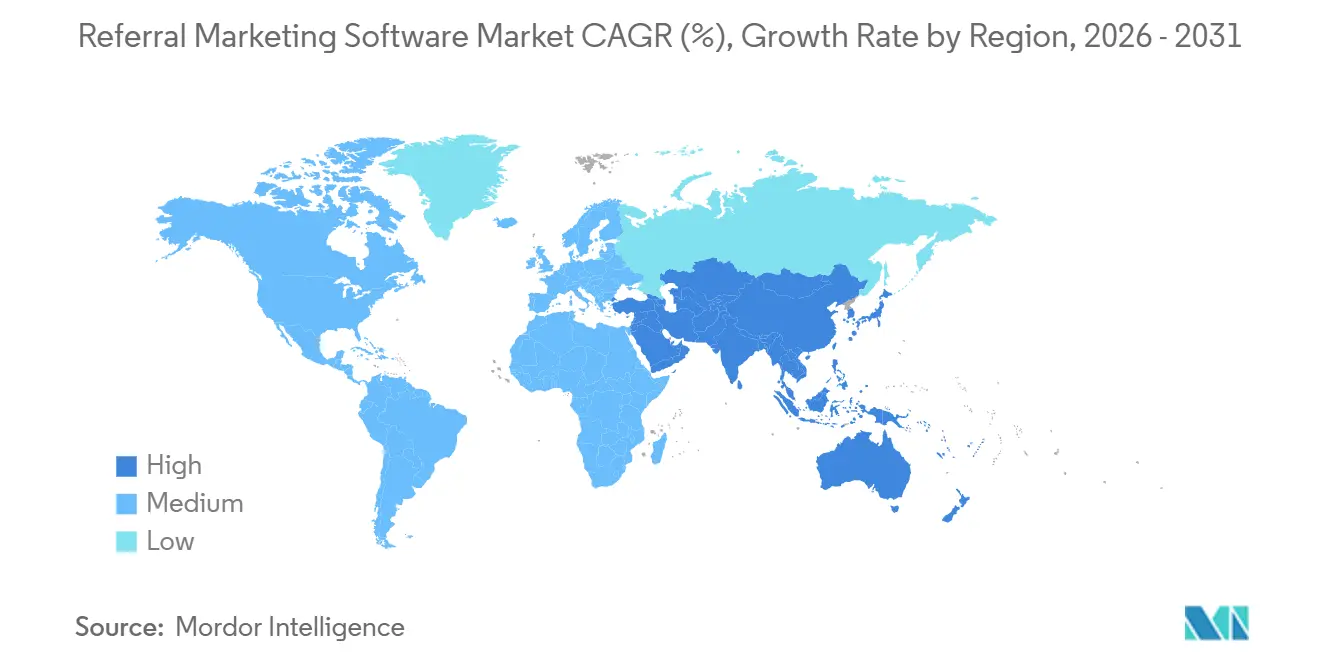
Asia-Pacific is projected to record a CAGR of 16.82% through 2031, the highest growth rate among geographic segments. China’s e-commerce penetration and Southeast Asia’s creator commerce ecosystem are important contributors to regional demand. Lazada and Shopee increased investment in affiliate and referral programs through 2025 and 2026 while competing with TikTok Shop for regional gross merchandise value. Japan is developing a more trust-based referral culture, while India, South Korea, and Australia are expanding through distinct digital commerce and mobile-first customer engagement models. Furthermore, South America is emerging as a growth area, led by Brazil, where digital commerce and mobile payments are expanding the base for referral programs. In Argentina, currency conditions are driving brands to use nonmonetary rewards, including store credit, exclusive access, and loyalty points. The Middle East and Africa remained the smallest geographic segment, though the United Arab Emirates and Saudi Arabia are advancing through digital retail growth and national digitization programs. South Africa and Nigeria are leading African adoption through fintech and mobile commerce referral programs. Cloud deployment remains preferred across South America, the Middle East, and Africa, while variable bandwidth is increasing demand for lighter referral interfaces in lower-connectivity markets.

Competitive Landscape
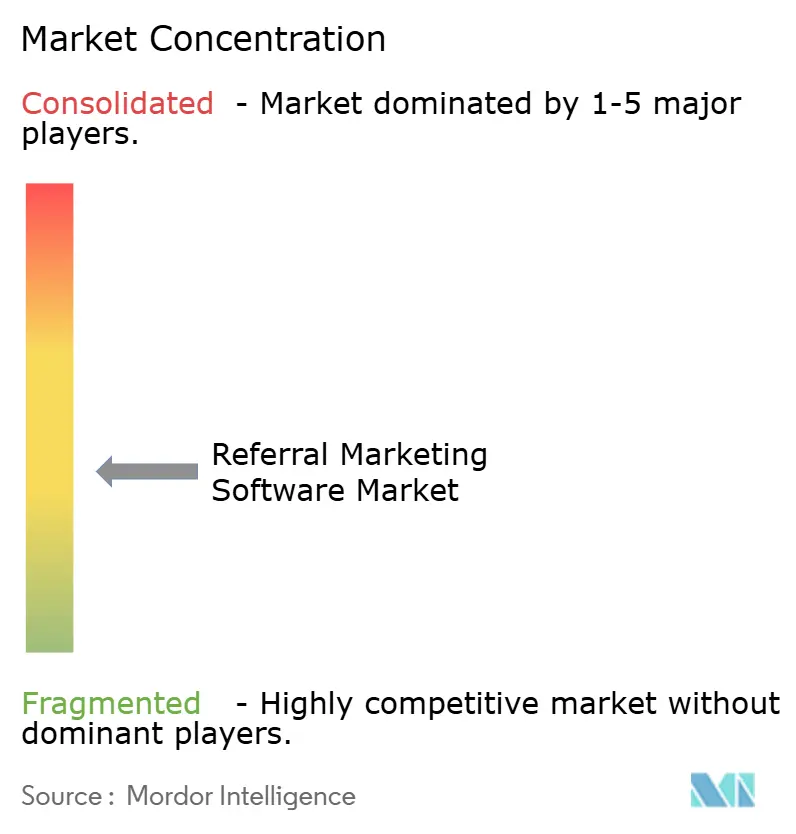
The referral marketing software market remains fragmented, with a broad mid-market group of specialized vendors and no single provider holding a dominant position. Competition is increasing at the enterprise end of the market as payments, loyalty, and customer engagement platforms expand their capabilities. Adyen completed the acquisition of Talon.one and Orb in July 2026 in a EUR 750 million transaction, equivalent to USD 825 million.[6]Adyen, “Adyen Completes Acquisitions of Talon.One and Orb,” Adyen, adyen.com The transaction connected Talon.one’s loyalty and incentive capabilities with Adyen’s payment infrastructure. This integration can enable real-time referral reward issuance during transactions and give Adyen a stronger role in enterprise promotion management.
Independent vendors are differentiating through artificial intelligence, fraud detection, attribution, integrations, and deployment flexibility. Extole launched an AI-ready developer platform in June 2026, adding expanded tools across its model context protocol server, application programming interfaces, software development kits, and command-line interface capabilities. Yotpo continues to position referrals within a broader retention product set that includes loyalty, SMS, and reviews. Talon.one introduced its Unified Incentives Protocol in January 2026 to make promotion and loyalty benefits available through AI-based shopping experiences. These strategies show that vendors are competing on distribution, automation, and ecosystem integration instead of relying only on conventional double-sided rewards.
Enterprise healthcare and life sciences remains an important opportunity because referral programs in this sector require privacy-aware data architecture and workflow integration. B2B SaaS partner referrals also provide an opportunity because customer relationship management tools often lack specialized incentive management for multilevel partner structures. Small and medium enterprises in emerging markets need no-code platforms with local-language templates, local payment options, and regional compliance tools. GrowSurf, Referral Factory, Viral Loops, Cello, Dub, and Refersion are among the providers addressing narrower referral, affiliate, or growth-focused use cases. Fraud management is becoming a more important competitive factor, especially in fintech and e-commerce, where buyers expect vendors to reduce false rewards without restricting valid customer referrals.
Referral Marketing Software Industry Leaders
Extole, Inc.
Mention Me Ltd.
ReferralCandy (Anafore Pte. Ltd.)
Friendbuy, Inc.
Talon.One GmbH
- *Disclaimer: Major Players sorted in no particular order

Recent Industry Developments
- July 2026: Adyen completed its acquisitions of Talon.one and Orb, finalizing the EUR 750 million, approximately USD 825 million, transaction. The combined platform integrates Talon.one's loyalty and incentive engine directly into Adyen's global payments infrastructure, enabling real-time offer management and referral reward issuance at the point of transaction for over 300 enterprise merchants.
- June 2026: Extole launched an AI-ready developer platform for building and managing targeted offer programs, expanding capabilities across its MCP server, APIs, SDKs, and CLI tooling. The release enables AI agents and developers to configure, manage, and optimize referral programs, lifecycle rewards, and loyalty experiences through a unified programmable layer.
- April 2026: Talon.one released a native integration with Adobe Experience Platform as a Silver Adobe Technology Partner, connecting its incentive engine with Adobe Real-Time CDP and Adobe Journey Optimizer, enabling enterprise brands to convert customer insights into executable loyalty and promotional incentives.
- January 2026: Talon.one announced its Unified Incentives Protocol, a set of platform-agnostic standards designed to surface promotions and loyalty benefits across AI agent-based shopping experiences, including new loyalty and discount extensions for Google Universal Commerce Protocol.


Global Referral Marketing Software Market Report Scope
The referral marketing software market comprises technology platforms that enable businesses to design, manage, automate, and track customer referral programs. These solutions support advocate reward management, referral activity monitoring, and campaign performance analytics. The market is driven by the growing importance of word-of-mouth marketing, the need for cost-effective customer acquisition, and the increasing adoption of data-driven loyalty and advocacy strategies across industries.
The Referral Marketing Software Market Report is Segmented by Deployment Mode (Cloud-Based, and On-Premises), Enterprise Size (Large Enterprises, and Small and Medium Enterprises), Application (Customer Referral Programs, Affiliate and Partner Referral Management, Employee Referral Program, Loyalty and Rewards Program, Influencer and Brand Ambassador Campaigns, and Other Applications), End-User Industry (Government and Public Administration, Retail and E-Commerce, Transportation and Logistics, IT and Telecommunication, Media and Entertainment, Education and Research institutions, Healthcare and Life Sciences, Banking, Financial Services, and insurance (BFSI), and Other End User Industries), and Geography (North America, South America, Europe, Asia-Pacific, and Middle East and Africa). The Market Forecasts are Provided in Terms of Value (USD).
| Cloud-Based |
| On-Premises |
| Large Enterprises |
| Small and Medium Enterprises |
| Customer Referral Programs |
| Affiliate and Partner Referral Management |
| Employee Referral Program |
| Loyalty and Rewards Program |
| Influencer and Brand Ambassador Campaigns |
| Other Applications |
| Government and Public Administration |
| Retail and E-Commerce |
| Transportation and Logistics |
| IT and Telecommunication |
| Media and Entertainment |
| Education and Research institutions |
| Healthcare and Life Sciences |
| Banking, Financial Services, and insurance (BFSI) |
| Other End User Industries |
| North America | United States | |
| Canada | ||
| Mexico | ||
| South America | Brazil | |
| Argentina | ||
| Rest of South America | ||
| Europe | Germany | |
| United Kingdom | ||
| France | ||
| Italy | ||
| Spain | ||
| Russia | ||
| Rest of Europe | ||
| Asia-Pacific | China | |
| Japan | ||
| india | ||
| South Korea | ||
| Australia | ||
| Rest of Asia-Pacific | ||
| Middle East and Africa | Middle East | Turkey |
| Saudi Arabia | ||
| United Arab Emirates | ||
| Rest of Middle East | ||
| Africa | South Africa | |
| Nigeria | ||
| Rest of Africa | ||
| By Deployment | Cloud-Based | ||
| On-Premises | |||
| By Enterprise Size | Large Enterprises | ||
| Small and Medium Enterprises | |||
| By Application | Customer Referral Programs | ||
| Affiliate and Partner Referral Management | |||
| Employee Referral Program | |||
| Loyalty and Rewards Program | |||
| Influencer and Brand Ambassador Campaigns | |||
| Other Applications | |||
| By End User Industry | Government and Public Administration | ||
| Retail and E-Commerce | |||
| Transportation and Logistics | |||
| IT and Telecommunication | |||
| Media and Entertainment | |||
| Education and Research institutions | |||
| Healthcare and Life Sciences | |||
| Banking, Financial Services, and insurance (BFSI) | |||
| Other End User Industries | |||
| By Geography | North America | United States | |
| Canada | |||
| Mexico | |||
| South America | Brazil | ||
| Argentina | |||
| Rest of South America | |||
| Europe | Germany | ||
| United Kingdom | |||
| France | |||
| Italy | |||
| Spain | |||
| Russia | |||
| Rest of Europe | |||
| Asia-Pacific | China | ||
| Japan | |||
| india | |||
| South Korea | |||
| Australia | |||
| Rest of Asia-Pacific | |||
| Middle East and Africa | Middle East | Turkey | |
| Saudi Arabia | |||
| United Arab Emirates | |||
| Rest of Middle East | |||
| Africa | South Africa | ||
| Nigeria | |||
| Rest of Africa | |||


Key Questions Answered in the Report
What is the size of the referral marketing software market?
The referral marketing software market size is projected to expand from USD 1.28 billion in 2025 and USD 1.44 billion in 2026 to USD 2.57 billion by 2031, registering a CAGR of 12.28% between 2026 to 2031.
What is driving adoption of referral marketing software?
Higher paid customer acquisition costs, stronger first-party data needs, and the shift toward ongoing lifecycle engagement are supporting adoption.
Which deployment model leads referral marketing software adoption?
Cloud-based platforms led with 78.23% share in 2025 because they support scalable deployment, integrations, and real-time program management.
Which application is growing fastest in referral marketing software?
Influencer and brand ambassador campaigns are projected to grow at a CAGR of 15.43% through 2031, supported by creator-led commerce.
Which end-user sector is expected to grow fastest?
Healthcare and life sciences is expected to record a CAGR of 14.71% through 2031 as referral workflows become more integrated with patient acquisition and care coordination.
Which region is expected to expand fastest?
Asia-Pacific is projected to grow at a CAGR of 16.82% through 2031, supported by mobile commerce, social commerce, and affiliate-led retail activity.
Page last updated on:






