
Recycled Metal Market Size and Share
Market Overview
| Study Period | 2021 - 2031 |
|---|---|
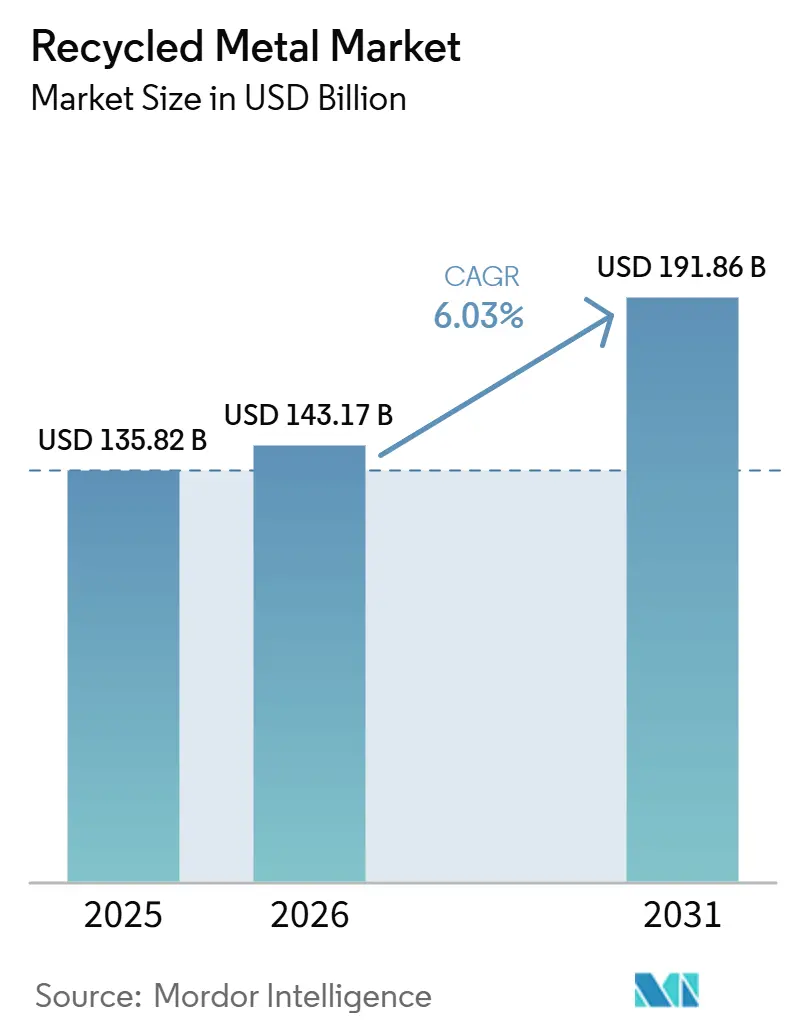
| Market Size (2026) | USD 143.17 Billion |
| Market Size (2031) | USD 191.86 Billion |
| Growth Rate (2026 - 2031) | 6.03 % |
| Fastest Growing Market | Asia-Pacific |
| Largest Market | Asia-Pacific |
| Market Concentration | Medium |
Major Players *Disclaimer: Major Players sorted in no particular order Image © Mordor Intelligence. Reuse requires attribution under CC BY 4.0. | |
Recycled Metal Market Analysis by Mordor Intelligence
The Recycled Metal Market size was valued at USD 135.82 billion in 2025 and is estimated to grow from USD 143.17 billion in 2026 to reach USD 191.86 billion by 2031, at a CAGR of 6.03% during the forecast period (2026-2031). The recycled metal market is increasingly becoming part of mainstream industrial sourcing, as manufacturers treat secondary feedstock as a supply and carbon management tool rather than a low-cost substitute for virgin material. The steel route remains central to this shift, as every ton of steel scrap consumed avoids 1.5 tons of CO2, 1.4 tons of iron ore, and 740 kg of coal, directly strengthening the case for scrap-led production models in heavy industry. This shift is also spreading through non-ferrous value chains, as recycled copper and aluminum become more relevant for transport, electrical systems, and advanced manufacturing applications that require both material security and cost control. The recycled metal market is also being shaped by policy tightening, formal collection efforts, and higher processing standards, which are pushing suppliers to improve traceability, purity, and downstream product consistency. Competitive activity now reflects this transition, with large integrated producers adding recycling-linked capacity while technology-focused recyclers concentrate on complex feedstocks, higher-purity recovery, and product forms that can earn better margins in demanding end uses.
Key Report Takeaways
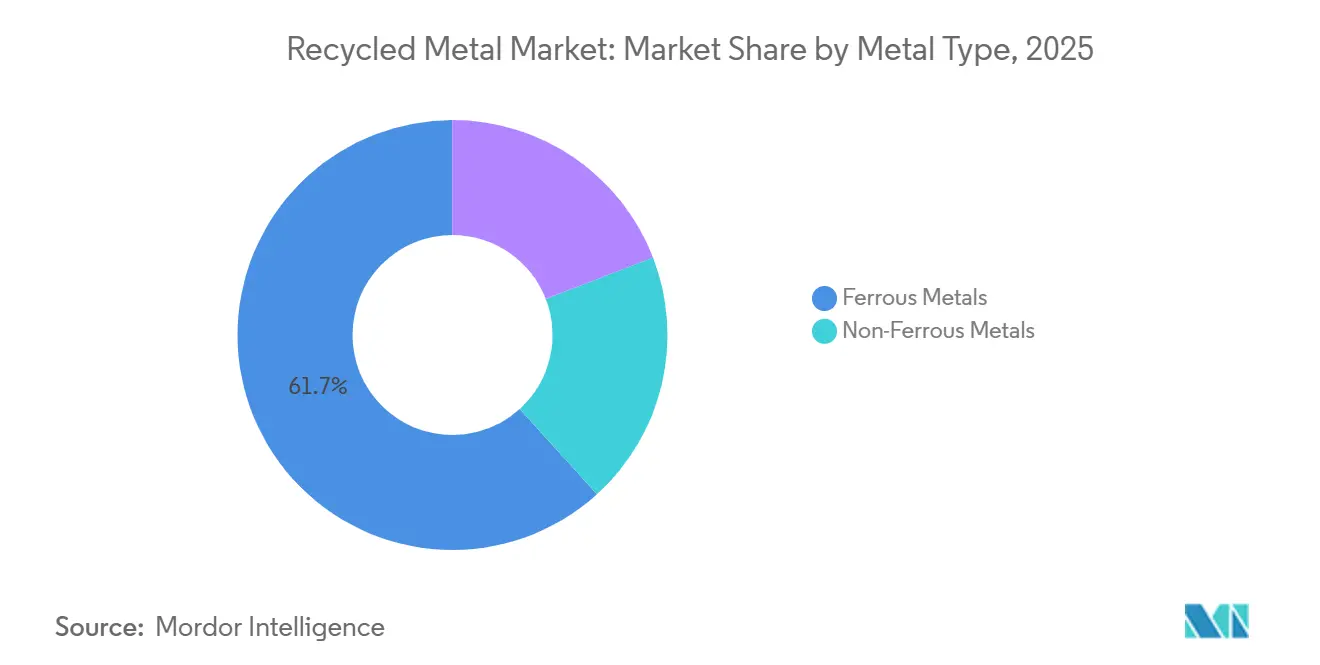
- By metal type, ferrous metals held 61.72% share in 2025, while non-ferrous metals are forecast to grow at a CAGR of 6.89% through 2031.
- By scrap source, industrial scrap accounted for 46.81% share in 2025, while post-consumer scrap is forecast to expand at a 6.32% CAGR through 2031.
- By processing method, mechanical processing captured 54.96% of the market in 2025, while hydrometallurgical processing is forecast to expand at a 7.58% CAGR through 2031.
- By product form, ingots accounted for 39.22% of the market share in 2025, while billets are projected to grow at 6.71% CAGR through 2031.
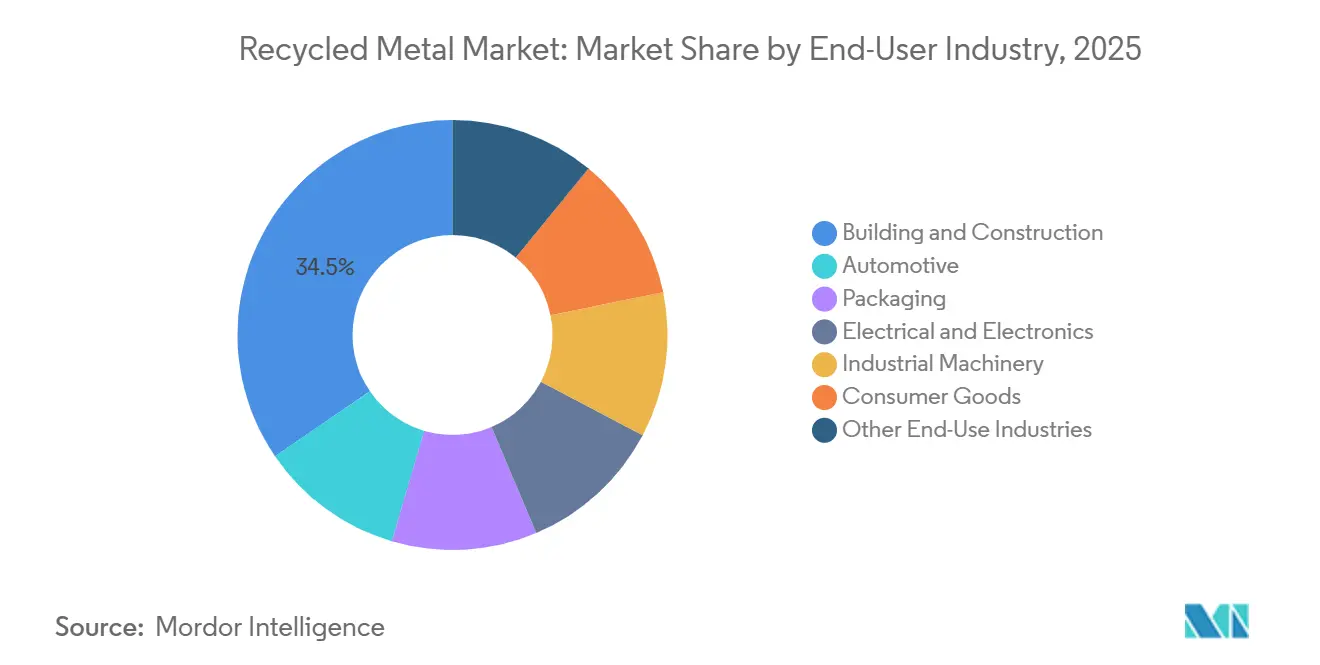
- By end-user industry, the building and construction sector accounted for 34.53% of the recycled metal market in 2025, while the automotive sector is projected to grow at a 7.14% CAGR through 2031.
- By geography, Asia-Pacific held 46.36% of the recycled metal market share in 2025, and the region is projected to expand at a 6.78% CAGR through 2031.
Note: Market size and forecast figures in this report are generated using Mordor Intelligence’s proprietary estimation framework, updated with the latest available data and insights as of January 2026.
Global Recycled Metal Market Trends and Insights
Drivers Impact Analysis*
| Drivers | (~) % Impact on CAGR Forecast | Geographic Relevance | Impact Timeline |
|---|---|---|---|
| Rising Demand Across End-User Sectors | +1.8% | Global | Short term (≤ 2 years) |
| Industrial Decarbonization and Emissions Reduction | +1.5% | Global, strongest in Europe, Japan, and North America | Medium term (2-4 years) |
| Urban Mining and Secondary Resource Recovery | +0.7% | Asia-Pacific core, with spillover to North America and Europe | Medium term (2-4 years) |
| Government Recycling Policies and Incentive Schemes | +1.0% | Asia-Pacific, Europe, and North America | Medium term (2-4 years) |
| Recovery of End-of-Life Products and Post-Consumer Scrap | +0.8% | Global, with stronger acceleration in Europe and East Asia | Long term (≥ 4 years) |
| Source: Mordor Intelligence | |||
Rising Demand for Recycled Metals Across Key End-User Sectors
Manufacturing buyers are raising expectations for recycled content as cost discipline, carbon accounting, and supply diversification simultaneously influence sourcing decisions. This trend is most evident in the automotive and electronics segments of the recycled metal market, where material specifications are becoming stricter, and suppliers are expected to support lifecycle emissions goals with reliable secondary inputs. Research on automotive body sheet pathways indicates that closed-loop aluminum and steel recycling can reduce lifecycle emissions by up to 70% by 2050, providing vehicle manufacturers with a strong basis for broader adoption of recycled inputs [1]M. Heidari et al., “Circular Economy Pathways for Decarbonizing Aluminum and Steel Automotive Body Sheet Components in the United States,” Resources, Conservation and Recycling, doi.org. Beyond volume, buyers increasingly require predictable quality, documented origin, and compatibility with high-value applications, which is changing how recyclers compete and how contracts are structured. The recycled metal market, therefore, benefits not only from broader demand but also from a gradual shift toward more formalized, specification-driven purchasing behavior among industrial customers.
Increasing Focus on Industrial Decarbonization and Emissions Reduction
Industrial decarbonization is increasing the importance of scrap-based production as a practical route to lower emissions in sectors that depend heavily on heat, ore, and large material flows. Global steel production reached 1,886 million tons in 2024, and the sector generated around 4.1 billion tons of CO2 equivalent, maintaining pressure on steelmakers to expand lower-emission production routes where feasible. The recycled metal market benefits directly from this pressure, as electric arc furnace production relies heavily on scrap and aligns with the broader push to reduce embedded emissions in steel-consuming industries. This effect extends beyond steel, as lower-carbon material choices are becoming increasingly relevant in non-ferrous applications, particularly during procurement reviews when customers compare the emissions footprints of virgin and recycled feedstocks. As a result, the recycled metal market is becoming more closely tied to decarbonization plans, plant investment decisions, and supply contracts that place greater value on the emissions profile of recovered metals.
Growing Demand for Urban Mining and Secondary Resource Recovery
Urban mining is becoming increasingly important as end-of-life electronics, vehicles, cables, and construction waste provide a growing secondary source of recoverable metals. China's recycled non-ferrous metal production reached 20.57 million tons in 2025, with recycled aluminum output at 11.60 million tons and recycled copper output at 4.85 million tons, reflecting the scale achieved in formal secondary recovery systems. The recycled metal market draws additional strength from this trend, as rising recovery volumes help stabilize feedstock availability for processors serving electrical, mobility, and industrial demand. Urban mining is also becoming more attractive as processing quality improves, with some recovered metals now reaching purity levels suitable for demanding technical applications rather than only lower-grade reuse. The recycled metal market, therefore, benefits not only from more scrap entering the system but also from a wider share of that material becoming technically usable in higher-value downstream applications.
Supportive Government Policies and Incentive Schemes for Recycling
Government action is supporting the shift toward formal recycling systems by more closely linking product design, material recovery, and compliance requirements. Taiwan's Resource Circulation Promotion Act, passed in June 2025, established a national framework connecting lifecycle management with recycling, supporting better tracking of end-of-life materials and stronger policy backing for circular material use. The European Parliament's 2026 Circular Economy Act briefing reinforced toxic-free standards for products and recycled materials, raising the quality threshold for materials entering regulated supply chains. The recycled metal market responds well to this type of policy structure, as clearer standards can improve investment confidence in collection, sorting, refining, and product qualification. Over time, the recycled metal market is likely to see more value shift toward operators that can demonstrate compliance, maintain traceability, and deliver materials that meet tightening industrial and environmental specifications.
Restraints Impact Analysis*
| Restraints | (~) % Impact on CAGR Forecast | Geographic Relevance | Impact Timeline |
|---|---|---|---|
| Volatility in Scrap Metal Prices and LME Arbitrage Disruptions | -0.9% | Global | Short term (≤ 2 years) |
| Stringent Environmental Processing Standards and Compliance Costs | -0.5% | Europe and North America | Medium term (2-4 years) |
| Inefficient Scrap Collection Infrastructure in Developing Markets | -0.7% | South Asia, the Middle-East, Africa, and South America | Long term (≥ 4 years) |
| Source: Mordor Intelligence | |||
Volatility in Scrap Metal Prices and London Metal Exchange (LME) Arbitrage Disruptions
Price volatility remains a constraint because recyclers must manage feedstock purchases, processing costs, and sales commitments in a market that can shift quickly with trade flows and benchmark spreads. The recycled metal market is exposed to this issue across ferrous and non-ferrous categories, as sudden changes in scrap values can compress margins even when physical volumes remain stable. This instability also makes it harder for processors to plan technology upgrades and long-lead capacity additions, particularly when lenders and customers require more predictable earnings and supply performance. The challenge becomes more pronounced when domestic and export channels become unbalanced, as processors may need to redirect material without sufficient time to preserve economics. The recycled metal market continues to grow despite this pressure, but profitability and investment pace can weaken when pricing conditions become unsettled.
Stringent Environmental Processing Standards and Compliance Costs
Higher environmental standards can slow expansion for some operators as compliance spending rises with tighter controls on emissions, handling, traceability, and material quality. The European Parliament's 2026 Circular Economy Act briefing highlighted toxic-free standards for products and recycled materials, which support stronger circularity goals but also raise the processing threshold for suppliers serving regulated markets[2]European Parliament, “Circular Economy Act,” European Parliamentary Research Service, europarl.europa.eu. The recycled metal market is affected unevenly, as larger operators can often meet these requirements more effectively than smaller processors with limited capital. In practical terms, this can accelerate consolidation as customers favor suppliers that demonstrate cleaner operations, stable quality, and formal compliance systems. The recycled metal market benefits from higher standards over the long run, but the adjustment cost can reduce near-term flexibility for less-equipped recyclers.
*Our forecasts treat driver/restraint impacts as directional, not additive. The impact forecasts reflect baseline growth, mix effects, and variable interactions.
Segment Analysis
By Metal Type: Non-Ferrous Metals Close the Gap on Ferrous Incumbents
Ferrous metals accounted for 61.72% of revenue in 2025, while non-ferrous metals are projected to grow at a 6.89% CAGR through 2031, indicating that volume leadership and growth leadership are no longer concentrated in the same segment of the recycled metal market. Ferrous recovery remains the backbone of the recycled metal market because construction, infrastructure, and electric arc furnace steelmaking continue to absorb large scrap flows and support stable demand for recycled steel inputs. Non-ferrous demand is rising faster because recycled copper and aluminum are becoming more important in transport electrification, power equipment, and data infrastructure, where material performance and supply resilience are key considerations. China's 2025 output of 11.60 million tons of recycled aluminum and 4.85 million tons of recycled copper reflects the scale that non-ferrous recovery has reached.
A notable shift in the recycled metal market involves not only faster non-ferrous growth, but also better alignment between recycled and primary materials in demanding applications. Hydrometallurgical and related refining routes are now producing recycled copper from waste printed circuit boards with purities of 99.64% to 99.84%, which improves its substitution potential in electronics-related applications. This matters because buyers who previously treated recycled non-ferrous feed as a lower-grade option can now consider it for applications where composition control is critical. As a result, the recycled metal market faces a competitive shift in which process capability and purity assurance are becoming more important than simple access to scrap volume alone.



By Scrap Source: Post-Consumer Recovery Redefines the Supply Mix
Industrial scrap accounted for 46.81% in 2025, while obsolete and post-consumer scrap is forecast to grow at a 6.32% CAGR through 2031, indicating that the recycled metal market is gradually broadening its supply base. Industrial scrap retains its lead because in-plant offcuts and production residues typically offer more consistent quality, lower contamination, and easier qualification for recyclers serving high-standard industrial buyers. That consistency supports strong use in automotive supply chains, rolled products, and steel applications where melt chemistry and processing efficiency are tightly managed. Post-consumer materials are gaining relevance as end-of-life vehicles, demolition waste, and discarded electronics increase the volume of metal available outside factory gates. The recycled metal market benefits from this trend because a wider stream of available material can support long-term feedstock security if sorting and recovery systems continue to improve.
The main challenge with post-consumer material is that it arrives with greater levels of mixed alloys, coatings, attachments, and contamination than most industrial scrap streams. This means the recycled metal market must invest more in dismantling, sorting, shredding, separation, and documentation if obsolete scrap is to move into higher-value end uses rather than lower-grade recycling loops. Taiwan's Resource Circulation Promotion Act is relevant in this context because it supports broader lifecycle tracking and gives policymakers a formal mechanism to improve end-of-life material visibility. As those systems improve, the recycled metal market will be better positioned to convert a larger share of post-consumer volume into reliable feedstock that can meet stricter customer specifications.
By Processing Method: Hydrometallurgy Targets High-Purity Metal Recovery
Mechanical processing accounted for a 54.96% share in 2025, while hydrometallurgical processing is projected to grow at a 7.58% CAGR through 2031, reflecting two distinct roles in the recycled metal market. Mechanical routes remain the largest because shredding, baling, and sensor-based sorting still provide the most practical approach for high-throughput recovery of ferrous and mixed scrap at scale. Hydrometallurgical processing is growing faster because it can recover high-purity non-ferrous and precious metals from e-waste, battery black mass, and other complex streams that mechanical methods alone cannot fully upgrade. Pyrometallurgical routes also remain important because they continue to support large-scale recovery systems for copper, lead, and several specialty materials within established processing networks. The recycled metal market is therefore not replacing one method with another, but adding more selective refining capability where feed complexity and value density justify it.
Aurubis AG's Richmond, Virginia, facility illustrates how this shift is being commercialized. The plant began production in September 2025 and can process up to 180,000 tons of complex recycling materials each year. The site recovers copper, nickel, tin, and precious metals from materials such as printed circuit boards and copper cable, demonstrating how complex feed processing is becoming a stronger competitive differentiator. Research published by RSC Sustainability also found that AI-based readiness assessment can improve yield predictability in hydrometallurgical recycling, reducing execution uncertainty that has often slowed capital deployment. In the recycled metal market, this combination of plant-scale proof and improving process confidence should continue to support investment in advanced recovery routes.
By Product Form: Billets Gain Ground as Near-Net-Shape Demand Rises
Ingots held a 39.22% share in 2025, while billets are projected to grow at a 6.71% CAGR through 2031, indicating a gradual shift toward product forms that better match downstream manufacturing needs in the recycled metal market. Ingots remain important because they offer a flexible intermediate form for alloy producers, smelters, and other buyers that remelt material into a wide range of final outputs. Billets are gaining ground because automotive and machinery manufacturers increasingly value feedstock that reduces machining waste, supports extrusion and forging efficiency, and aligns with tighter material control requirements. This makes billet production more attractive for recyclers who can manage chemistry, casting quality, and dimensional consistency at a higher level than basic secondary output. The recycled metal market is therefore moving further along the value chain in this segment, with product form becoming part of the competitive offer rather than simply the result of processing.
Novelis' Bay Minette rolling and recycling complex in Alabama supports this direction. The site is being commissioned in the second half of 2026 and is designed for 600,000 tons per year of finished aluminum sheet. The project also integrates recycling capacity and is expected to source around 40% of its feedstock from the co-located recycling facility, linking scrap recovery more directly to downstream rolled product output. This model is relevant for the recycled metal market because it connects collection, recycling, and finished-product supply in a single industrial system that better aligns with customer specifications. As more buyers seek recycled inputs that perform like primary material in forming and finishing operations, product-form strategy will remain a visible area of differentiation.
By End-User Industry: Automotive Sector Accelerates Recycled Metal Sourcing
Building and construction held a 34.53% share in 2025, while automotive is expected to grow at a 7.14% CAGR through 2031, reflecting the continued scale of established steel demand alongside faster change in mobility-related applications. Construction remains the largest end-user in the recycled metal market because rebar, structural sections, and other ferrous-intensive products continue to absorb large volumes of scrap-based metal across residential, commercial, and civil works. Automotive is growing faster because vehicle producers are under pressure to reduce lifecycle emissions while also managing material efficiency in body structures, closures, and selected powertrain-related applications. Research published in Resources, Conservation and Recycling found that closed-loop aluminum and steel recycling in automotive body panel supply chains could reduce vehicle-level lifecycle emissions by up to 70% by 2050. The recycled metal market benefits from this pressure because OEMs and suppliers have stronger reasons to qualify recycled content in material systems that were previously more conservative.
The remaining demand is widely distributed across packaging, electrical and electronics, industrial machinery, and consumer goods, adding resilience to the recycled metal market by reducing dependence on any single outlet. Electrical and electronics uses are particularly relevant for non-ferrous recovery because grid buildout, digital equipment, and data infrastructure require copper-rich components that benefit from improved refining quality. Industrial machinery demand follows broader capital spending cycles more closely, making it somewhat more sensitive to financing conditions and factory investment timing than construction or structural steel use. The recycled metal market continues to deepen its role across multiple end-user groups, which supports a broader base for long-term adoption.
Geography Analysis
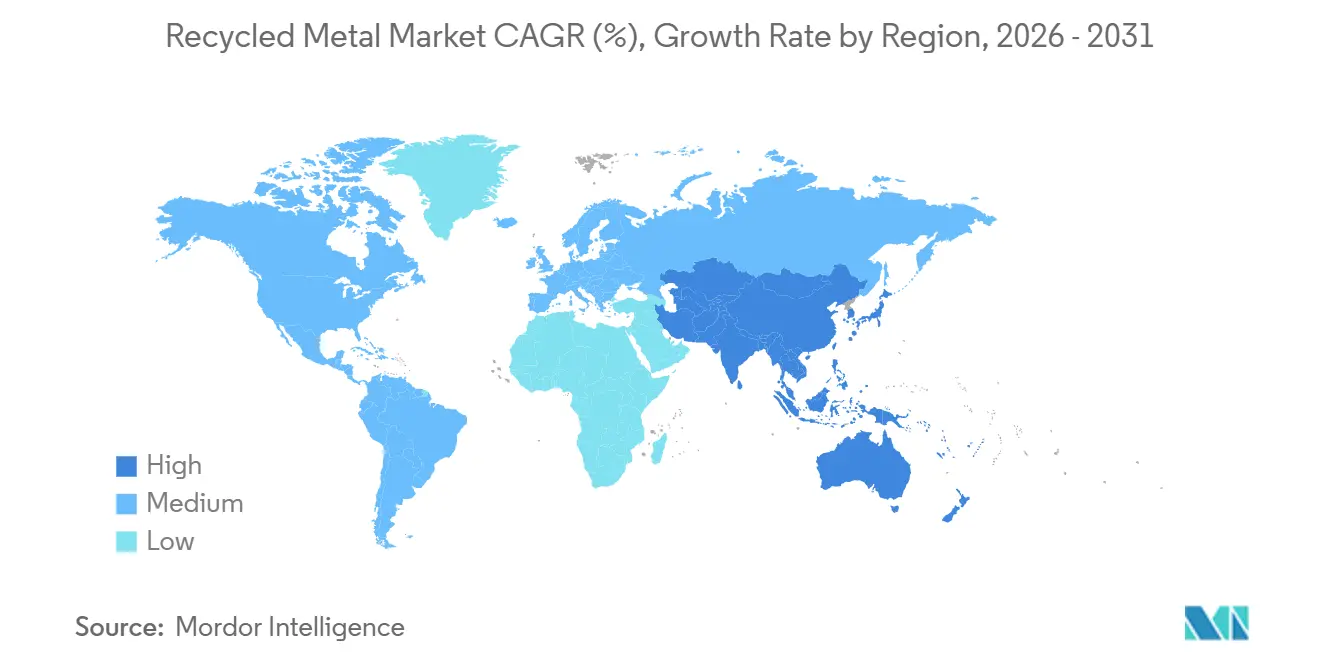
Asia-Pacific held a 46.36% share in 2025 and is forecast to expand at a 6.78% CAGR through 2031, making it the region with both the largest base and the fastest growth in the recycled metal market. China remains central to this position, with recycled non-ferrous metal recovery reaching 16.72 million metric tons in 2025 and projected by the industry association to reach 17 million metric tons in 2026. The region benefits from a large manufacturing base, strong scrap generation, and growing policy focus on organized recovery systems that connect collection with industrial reuse. Taiwan's 2025 Resource Circulation Promotion Act reflects a broader trend of Asia-Pacific governments establishing more structured frameworks for lifecycle management and post-use recovery.
North America and Europe represent higher-specification segments of the recycled metal market, where product quality, regulatory compliance, and advanced processing capabilities carry greater competitive weight. Aurubis' Richmond plant in the United States began production in September 2025, adding multimetal recycling capacity for complex feed materials that supports domestic strategic metal recovery. Novelis' Bay Minette project is commissioning in 2026, further demonstrating how North American supply chains are linking recycling capacity more closely to downstream aluminum sheet output. In Europe, the 2026 Circular Economy Act framework and the European Investment Bank's recycling-linked financing support closer alignment among policy, capital access, and material qualification in the recycled metal market.
South America, the Middle-East, and Africa remain early-stage parts of the recycled metal market, despite several countries having meaningful steel, automotive, and industrial demand. Regional progress depends less on scrap generation alone and more on how quickly formal collection, sorting, testing, and documentation systems can scale. Where these systems remain underdeveloped, material quality and traceability are uneven, limiting access to premium buyers and slowing the transition from informal recovery to industrial recycling. As a result, the recycled metal market in these regions offers room for growth, but infrastructure quality remains the key factor separating potential from near-term commercial realization.

Competitive Landscape
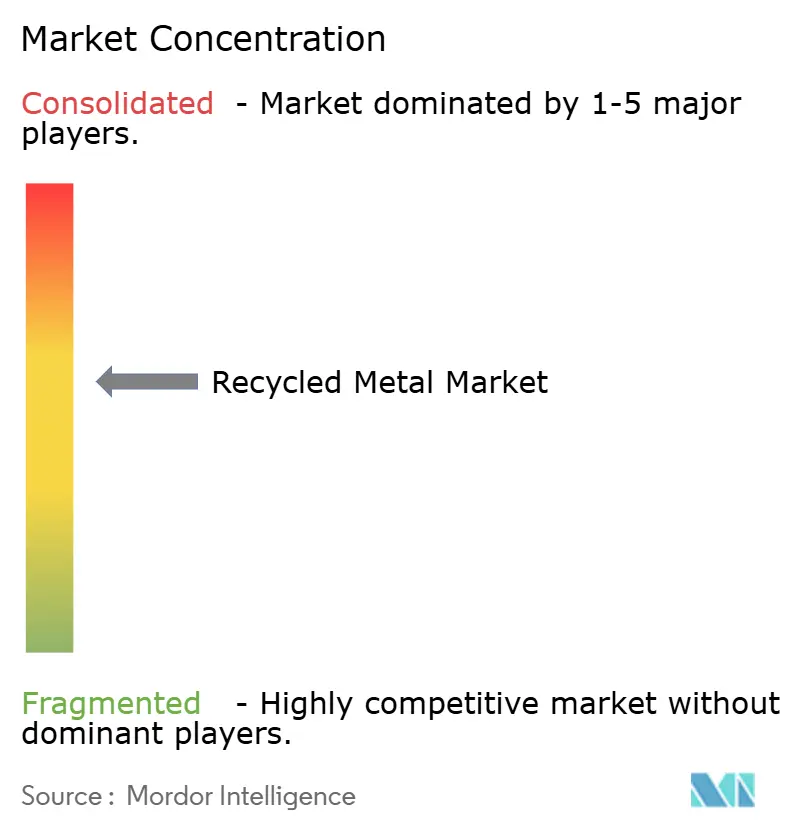
The recycled metal market is moderately consolidated. Competition is divided between large integrated groups that leverage scale, procurement reach, and downstream manufacturing links, and specialized recyclers that focus on complex feedstocks, higher-purity recovery, and process expertise. This creates two broad competitive approaches: one based on feedstock security and network depth, and another based on technology, quality, and differentiated output. The market is not consolidating around a single model, as the preferred approach depends on whether a company serves bulk ferrous demand or high-value multimetal recovery. Across both models, buyers increasingly require consistent quality, stronger traceability, and closer integration between recycling and end-use of end materials.
Aurubis illustrates one strategic approach: its Richmond facility began commercial production in September 2025, establishing a dedicated U.S. base for the recovery of multiple metals from complex recycling materials. Aurubis also secured EUR 200 million (USD 228.20 million) from the European Investment Bank in September 2025, demonstrating how policy-aligned recycling projects can attract favorable capital for expansion and modernization. Novelis offers a second example, as its Bay Minette project links a recycling facility directly to large-scale sheet production, supporting a closed-loop model for aluminum customers. These developments indicate that the market increasingly rewards companies that can connect recovery capability with end-product systems, rather than treating recycling as a stand-alone upstream activity.
Large producers such as Nucor and ArcelorMittal retain relevance in the recycled metal market because scale, scrap access, and downstream placement remain strong advantages in bulk material categories. Specialist recyclers such as Aurubis and Befesa hold a different advantage: complex material handling and higher-purity output can create a competitive position less dependent on absolute volume. Opportunities remain in segments where battery-related, electronics-related, and semiconductor-adjacent feedstocks require more advanced upgrading than conventional shredding systems can provide. Over time, competition is likely to intensify around feedstock security, processing to tighter standards, and placement into end uses where recycled content carries strategic value rather than only pricing value.
Recycled Metal Industry Leaders
ELG GmbH
Nucor Corporation
EMR Group Limited
CMC
Novelis
- *Disclaimer: Major Players sorted in no particular order

Recent Industry Developments
- April 2026: Japan's Ministry of Economy, Trade and Industry and the Ministry of the Environment announced a joint capital support program for recycling companies handling steel, aluminum, and plastics. The program is structured around low-interest financing and direct budget allocations to support equipment modernization and M and A-driven consolidation among smaller processors.
- September 2025: Aurubis AG's Richmond, Virginia, facility, the first multimetal recycling plant in the United States, commenced production with a processing capacity of up to 180,000 tons of complex recycling material annually, including printed circuit boards and copper cable. An expansion stage was launched in 2026 to reach full capacity and expand Western supply chains.


Global Recycled Metal Market Report Scope
Recycled metal is scrap metal processed from end-of-life products or manufacturing waste and transformed into raw material for new goods. Because metal does not degrade, it can be repeatedly melted down and reused without losing its original strength or properties.
The recycled metal market is segmented by metal type, scrap source, processing method, product form, end-user industry, and geography. By metal type, the market is segmented into ferrous metals and non-ferrous metals. By scrap source, the market is segmented into industrial scrap and obsolete (post-consumer) scrap. By processing method, the market is segmented into mechanical processing, pyrometallurgical processing, and hydrometallurgical processing. By product form, the market is segmented into ingots, billets, sheets and plates, rods and bars, and other forms. By end-user industry, the market is segmented into automotive, building and construction, packaging, electrical and electronics, industrial machinery, consumer goods, and other end-use industries. The report also covers the market size and forecasts for recycled metals across 16 countries in major regions. The market sizes and forecasts are provided in terms of value (USD).
| Ferrous Metals |
| Non-Ferrous Metals |
| Industrial Scrap |
| Obsolete (Post-Consumer) Scrap |
| Mechanical Processing |
| Pyrometallurgical Processing |
| Hydrometallurgical Processing |
| Ingots |
| Billets |
| Sheets and Plates |
| Rods and Bars |
| Other Forms |
| Automotive |
| Building and Construction |
| Packaging |
| Electrical and Electronics |
| Industrial Machinery |
| Consumer Goods |
| Other End-Use Industries |
| Asia-Pacific | China |
| India | |
| Japan | |
| South Korea | |
| Rest of Asia-Pacific | |
| North America | United States |
| Canada | |
| Mexico | |
| Europe | Germany |
| United Kingdom | |
| France | |
| Italy | |
| Russia | |
| Rest of Europe | |
| South America | Brazil |
| Argentina | |
| Rest of South America | |
| Middle-East and Africa | Saudi Arabia |
| South Africa | |
| Rest of Middle-East and Africa |
| By Metal Type | Ferrous Metals | |
| Non-Ferrous Metals | ||
| By Scrap Source | Industrial Scrap | |
| Obsolete (Post-Consumer) Scrap | ||
| By Processing Method | Mechanical Processing | |
| Pyrometallurgical Processing | ||
| Hydrometallurgical Processing | ||
| By Product Form | Ingots | |
| Billets | ||
| Sheets and Plates | ||
| Rods and Bars | ||
| Other Forms | ||
| By End-User Industry | Automotive | |
| Building and Construction | ||
| Packaging | ||
| Electrical and Electronics | ||
| Industrial Machinery | ||
| Consumer Goods | ||
| Other End-Use Industries | ||
| By Geography | Asia-Pacific | China |
| India | ||
| Japan | ||
| South Korea | ||
| Rest of Asia-Pacific | ||
| North America | United States | |
| Canada | ||
| Mexico | ||
| Europe | Germany | |
| United Kingdom | ||
| France | ||
| Italy | ||
| Russia | ||
| Rest of Europe | ||
| South America | Brazil | |
| Argentina | ||
| Rest of South America | ||
| Middle-East and Africa | Saudi Arabia | |
| South Africa | ||
| Rest of Middle-East and Africa | ||


Key Questions Answered in the Report
What is current market size of Recycled Metal Market?
The Recycled Metal Market size was valued at USD 135.82 billion in 2025 and is estimated to grow from USD 143.17 billion in 2026 to reach USD 191.86 billion by 2031, at a CAGR of 6.03% during the forecast period (2026-2031).
Which metal category leads in demand, and which grows faster?
Ferrous metals led with 61.72% share in 2025, while non-ferrous metals are projected to grow faster at 6.89% CAGR through 2031.
Why are manufacturers using more recycled metals?
Demand is rising because manufacturers want lower embedded emissions, greater material security, and feedstocks that meet tighter lifecycle and procurement standards across automotive, electronics, and construction applications.
Which processing route is gaining the most momentum?
Hydrometallurgical processing is growing fastest, at a 7.58% CAGR, because it is better suited to recovering high-purity non-ferrous and precious metals from complex waste streams such as e-waste and battery materials.
Page last updated on:





