
Recreational Vehicle Battery Market Size and Share
Market Overview
| Study Period | 2022 - 2032 |
|---|---|
| Market Size (2027) | USD 5.27 Billion |
| Market Size (2032) | USD 7.49 Billion |
| Growth Rate (2027 - 2032) | 7.28 % |
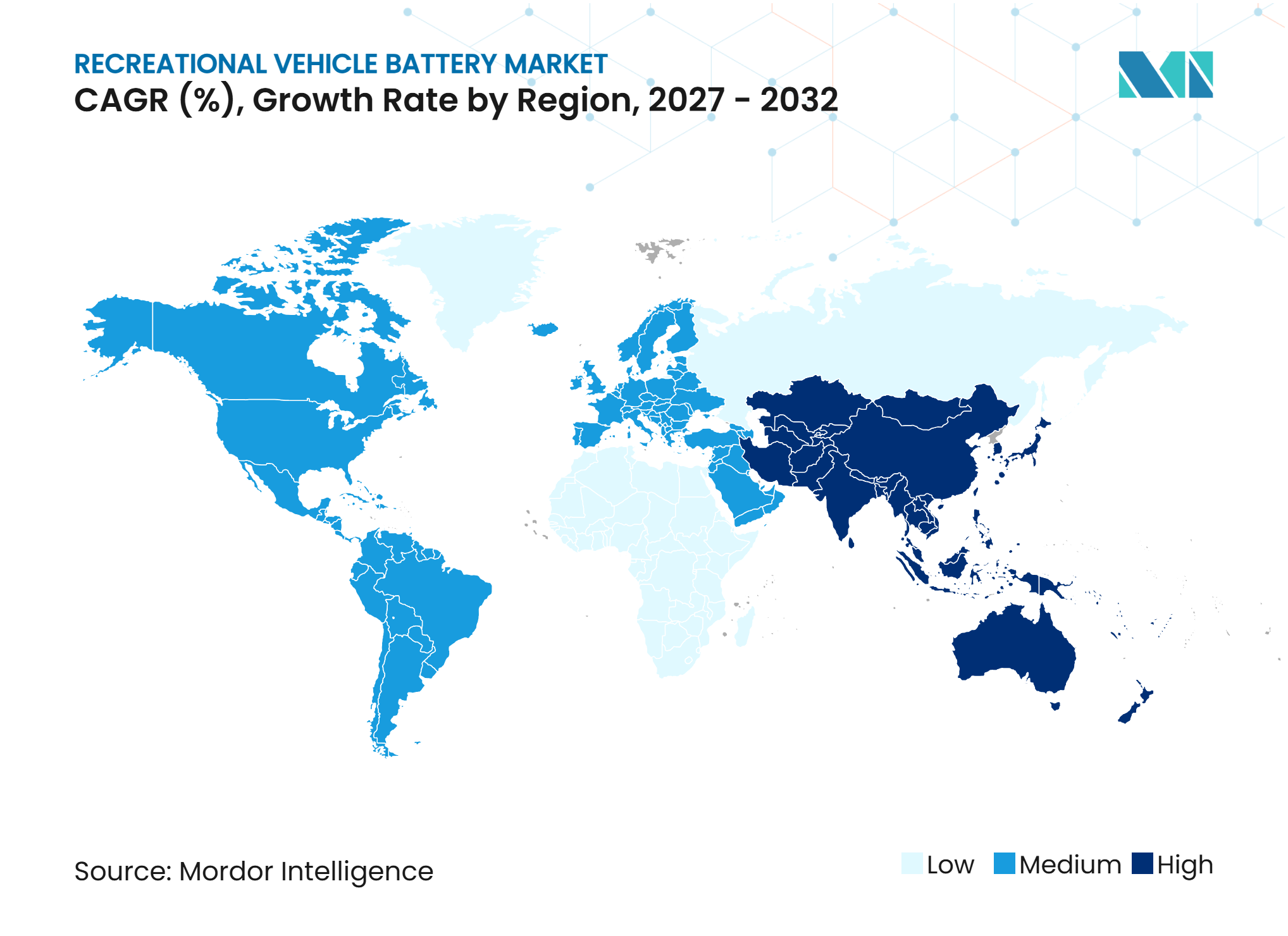
| Fastest Growing Market | Asia-Pacific |
| Largest Market | North America |
| Market Concentration | Low |
Major Players *Disclaimer: Major Players sorted in no particular order Image © Mordor Intelligence. Reuse requires attribution under CC BY 4.0. | |
Recreational Vehicle Battery Market Analysis by Mordor Intelligence
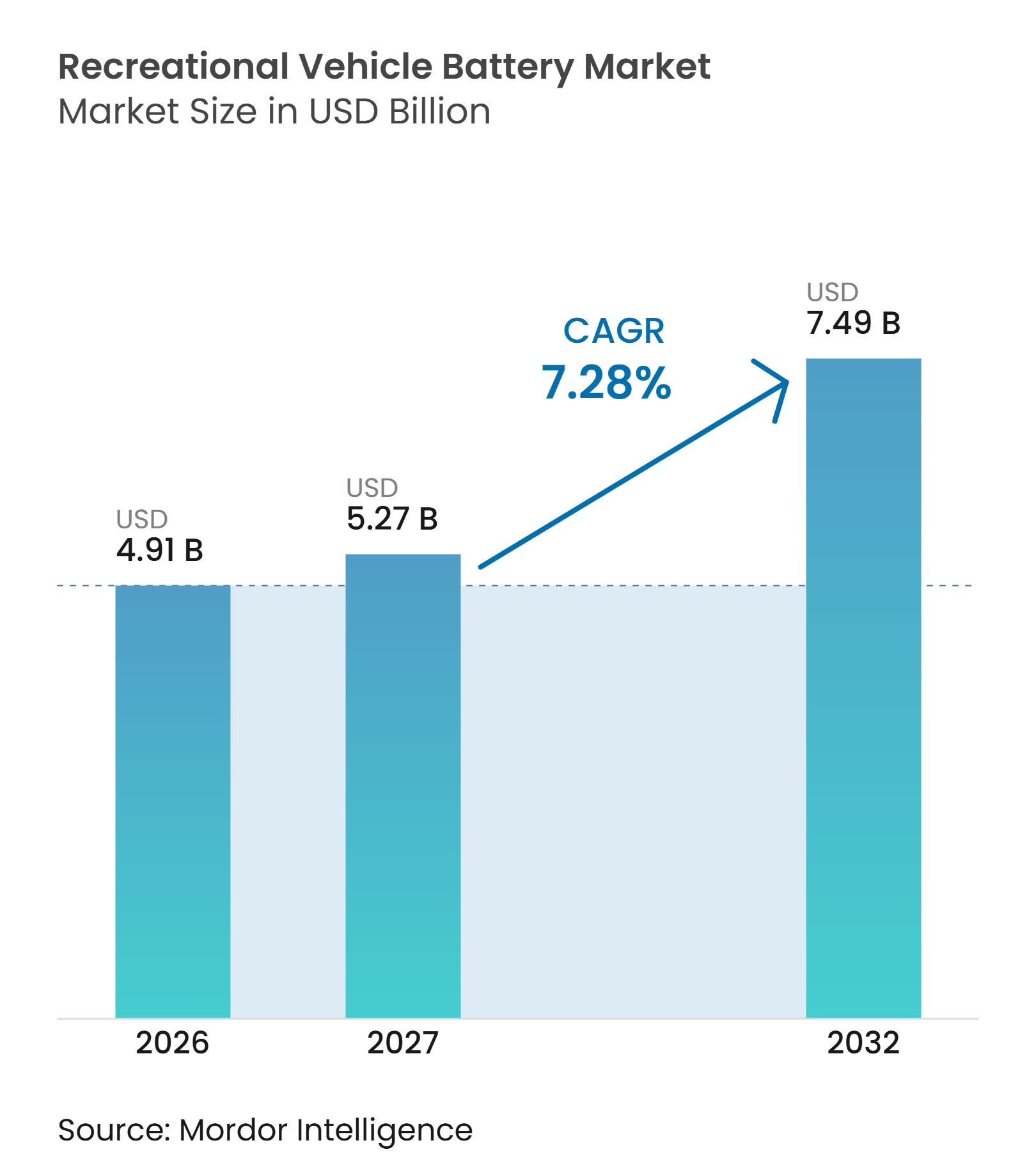
The Recreational Vehicle Battery Market size is expected to increase from USD 4.91 billion in 2026 to USD 5.27 billion in 2027 and reach USD 7.49 billion by 2032, growing at a CAGR of 7.28% over 2027-2032. The Recreational Vehicle Battery Market is supported by a growing RV fleet, longer off-grid trips, and a broader range of vehicle formats. U.S. wholesale RV shipments reached 342,220 units in 2025, and the RV Industry Association (RVIA) expects 349,300 units in 2026 as financing conditions improve.[1] Higher onboard loads are raising the battery capacity required in new vehicles. Original Equipment Manufacturer (OEM) adoption of lithium batteries also moving battery selection into the original vehicle purchase, which reduces the need for a separate aftermarket decision. Lead-acid suppliers retain an advantage in replacement channels, while lithium suppliers are building positions through integrated power systems and OEM programs.
Key Report Takeaways
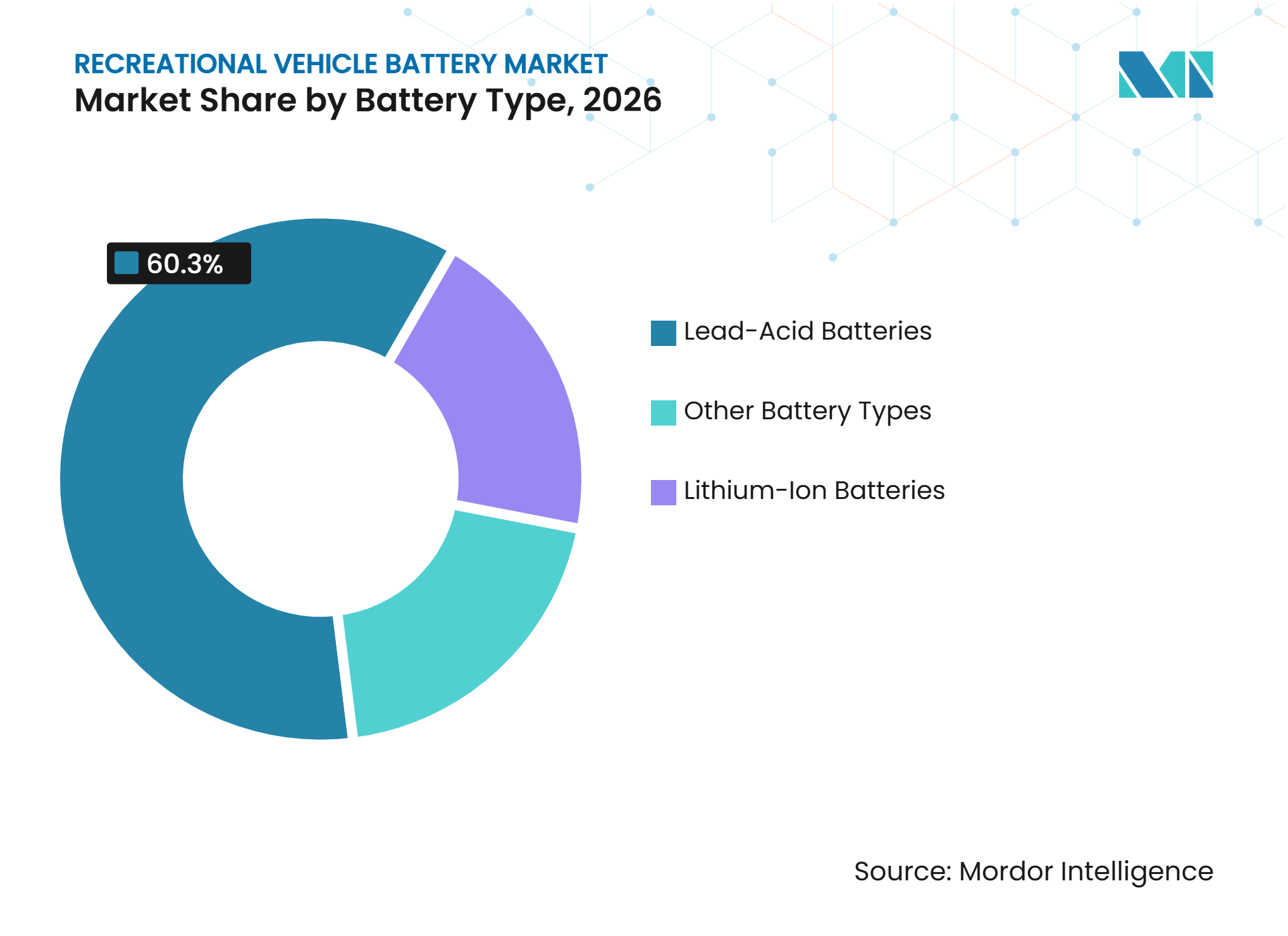
- By battery type, lead-acid batteries held 60.3% of the Recreational Vehicle Battery Market share in 2026, while lithium-ion batteries are forecast to grow at an 11.3% CAGR through 2032.
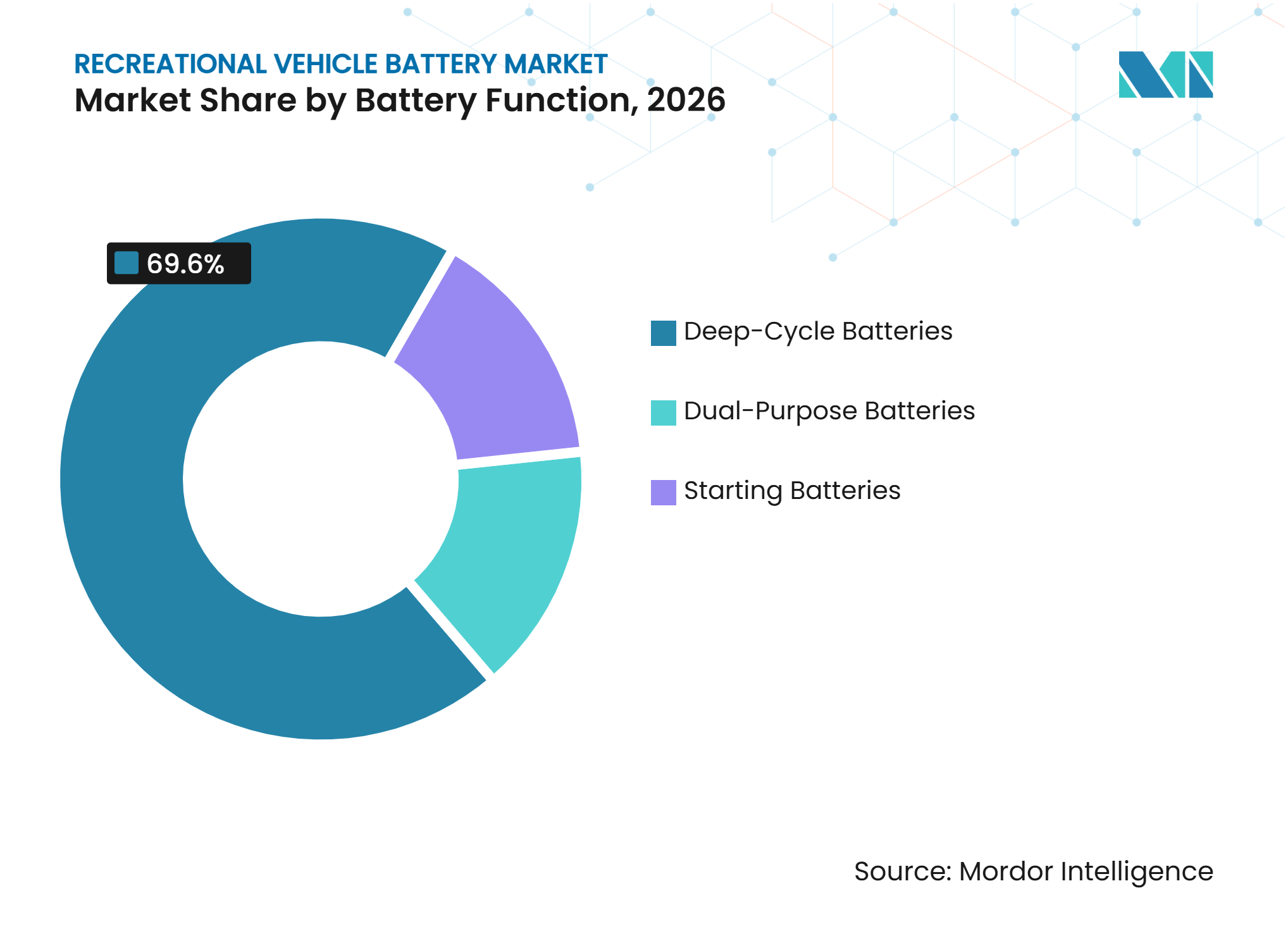
- By battery function, deep-cycle batteries held 69.6% of the Recreational Vehicle Battery Market share in 2026, while dual-purpose batteries are forecast to grow at a 7.9% CAGR through 2032.
- By end user, individual RV owners held 58.4% of demand in 2026, while RV rental and leasing companies are forecast to grow at an 8.1% CAGR through 2032.
- By geography, North America held 58.7% of revenue in 2026, while Asia-Pacific is forecast to grow at an 8.3% CAGR through 2032.
Note: Market numbers in this report are based on Mordor Intelligence's proprietary estimation framework, which combines nine months of actuals with Q4 projections for base year 2026.
Market Trends and Insights
Drivers Impact Analysis of Recreational Vehicle Battery Market*
| Driver | (~) % Impact on CAGR Forecast | Geographic Relevance | Impact Timeline |
|---|---|---|---|
| Rising RV Ownership and Off-Grid Travel | +2.1% | Global, led by North America and Australia | Short term (≤ 2 years) |
| Growth in Lithium-Ion and LiFePO4 Adoption | +2.4% | Global, early gains in North America and Europe | Medium term (2-4 years) |
| Increasing Onboard Electrical Loads | +1.0% | North America and Europe | Short term (≤ 2 years) |
| Solar-Integrated RV Power Systems | +0.9% | North America, Australia, and Europe | Medium term (2-4 years) |
| Dealer and Installer Demand for Integrated Power Packages | +0.6% | North America core, with spillover to Europe | Short term (≤ 2 years) |
| Battery Autonomy Requirements for Smaller, Lightweight RVs | +0.5% | North America and Europe | Medium term (2-4 years) |
| Source: Mordor Intelligence | |||
Rising RV Ownership and Off-Grid Travel
The Recreational Vehicle Battery Market is gaining from higher RV ownership and increased use of vehicles for extended travel. U.S. wholesale shipments reached 342,220 units in 2025. Fifth-wheel shipments increased 21.6%, while Park Model RV shipments rose 9.6% in the same year. These formats use larger battery banks for appliances, climate systems, and slide-out mechanisms. Van camper shipments increased 14.5% year over year in August 2025, bringing more weight-sensitive vehicles into the buyer base.The resulting rise in battery capacity per vehicle supports revenue even when shipment growth is moderate.
Growth in Lithium-Ion and Lithium Iron Phosphate (LiFePO4) Adoption
Lithium-ion adoption is moving from retrofit demand to factory-installed systems in the Recreational Vehicle Battery Market. Dragonfly Energy reported 44% year-over-year OEM revenue growth in the third quarter of 2025. Airstream made Battle Born LiFePO4 batteries standard across its 2026 lineup.[2] The Interstate and Atlas packages provide up to 10.3 kWh of usable energy. Factory fitment places battery cost within the vehicle purchase rather than presenting it as a separate upgrade. Dealer and installer demand for integrated packages further favors suppliers that can provide compatible batteries, controls, and charging equipment.
Increasing Onboard Electrical Loads and Compact RV Requirements
Modern RVs in the Recreational Vehicle Battery Market are supporting a wider set of work and living loads, including residential refrigerators, satellite internet terminals, and induction cooking equipment. BLUETTI released its RVSolar 48V system on September 30, 2025, with capacity that can scale to 122 kWh and support dual air-conditioning units. These demand profiles challenge the practical limits of conventional 12V lead-acid battery banks. Smaller RVs also require power systems that use limited weight and installation space efficiently. This supports dual-purpose and lithium solutions where separate starting and house-battery banks are difficult to install. The Recreational Vehicle Battery Market is therefore moving toward higher-voltage systems in vehicle formats with higher electrical intensity.
Solar-Integrated RV Power Systems
Solar integration is becoming more common in mid-range and premium RV power packages. Renogy introduced its Lithium 2.0 solid-state Lithium Iron Phosphate (LFP) seriesat Caravan Salon Düsseldorf in August 2025. The product line is rated for more than 6,000 cycles and has IP67 protection for rooftop solar applications. LFP batteries can maintain charging current across a broader state-of-charge range, which makes solar storage systems more useful during variable generation conditions. The EU Battery Regulation requires carbon-footprint information and battery passport-related documentation for relevant batteries, increasing the value of traceable system supply chains in Europe.[3] The Recreational Vehicle Battery Market benefits when solar, storage, and charging components are offered as a coordinated package.
Restraints Impact Analysis of Recreational Vehicle Battery Market*
| Restraint | (~) % Impact on CAGR Forecast | Geographic Relevance | Impact Timeline |
|---|---|---|---|
| High Upfront Cost of Lithium-Ion Systems | -1.5% | Global, most acute in Asia-Pacific and South America | Medium term (2-4 years) |
| Charging-System and Vehicle Compatibility Constraints | -0.8% | Global, particularly older fleet retrofits | Short term (≤ 2 years) |
| Cold-Weather Charging Limitations and Storage Behavior | -0.3% | Northern North America and Northern Europe | Long term (≥ 4 years) |
| Limited Qualified RV Battery Installation Capacity | -0.3% | North America and Europe | Short term (≤ 2 years) |
| Source: Mordor Intelligence | |||
High Upfront Cost of Lithium-Ion Systems
The purchase price of LFP systems remains a constraint for buyers who use RVs intermittently. A 200Ah LFP system retails for USD 1,200 to USD 1,800, compared with USD 300 to USD 500 for a comparable Absorbent Glass Mat (AGM) bank. Expion360 disclosed going-concern conditions in its fiscal 2025 annual report, showing the pressure that pricing and margins can place on smaller lithium specialists. The price gap is especially significant where entry-level trailers cost less than USD 15,000. In South America and Southeast Asia, a USD 1,500 battery upgrade can exceed 10% of a base vehicle’s price. Long warranties and high cycle life may improve lifetime value, but do not remove the initial budget constraint.
Charging Compatibility, Cold Weather, and Installation Capacity
Older RV charging equipment was designed around lead-acid absorption and float-voltage profiles. Use of unmodified converters, chargers, or alternator systems with LFP batteries can cause undercharging and reduce cycle life. American Boat and Yacht Council (ABYC) E-13-2025 identifies compatibility and commissioning requirements for lithium battery installations. Cold-weather charging needs and the limited availability of qualified installers add further barriers in northern regions and established retrofit markets. These issues slow aftermarket upgrades, even as factory-installed lithium systems expand. The constraint directs suppliers toward OEM channels where charger selection, commissioning, and warranty requirements can be controlled at the factory.
*Our forecasts treat driver/restraint impacts as directional, not additive. The impact forecasts reflect baseline growth, mix effects, and variable interactions.
Recreational Vehicle Battery Market Segment Analysis
By Battery Type:
Chemistry Transition Reshapes Long-Term Market EconomicsLead-acid batteries accounted for 60.3% of the Recreational Vehicle Battery Market in 2026. Their position reflects the large installed base of older RVs and the lower purchase cost of Absorbent Glass Mat (AGM) and gel products. East Penn Manufacturing produces more than 40 million batteries annually at its 520-acre Pennsylvania facility. In March 2025, the company expanded its Deka Ready Power family with lithium and gel products. This dual approach allows established suppliers to keep lead-acid replacement volume while addressing new demand for lithium. Clarios also introduced VARTA lithium-ion leisure batteries for EMEA markets in September 2025, with six models from 50Ah to 200Ah. Carbon-enhanced AGM and nickel-based products continue to serve specialty military-certified and high-temperature uses. This preserves a defined role for non-lithium chemistry in specialized applications.
Lithium-ion batteries are projected to advance at an 11.3% CAGR through 2032. This portion of the Recreational Vehicle Battery Market size is supported by OEM fitment and demand for longer off-grid operating periods. ISO 23625:2025 defines safety requirements for lithium-ion batteries in small craft, including battery management and thermal-runaway mitigation provisions that are relevant to supplier qualification practices. American Boat and Yacht Council (ABYC) E-13-2025 also establishes installation and commissioning requirements for lithium systems. These requirements favor producers with validated battery management systems and documented installation guidance. Renogy stated that its Lithium 2.0 product uses cells rated for more than 6,000 cycles and an electrolyte designed to be 70% less flammable than conventional LFP. The recreational vehicle battery industry is thus balancing price-sensitive replacement demand with a more tightly specified OEM lithium channel. The chemistry transition is therefore more visible in new vehicles than in legacy retrofit fleets.



By Battery Function:
Deep-Cycle Batteries Remain Central as Dual-Purpose Use ExpandsDeep-cycle batteries held 69.6% of the market by battery function in 2026. This share reflects their role in operating living-space loads during multi-day off-grid stays. Battery Council International reported that North American automotive lead battery demand grew 2.5% through 2025 and accelerated to 2.8% in 2026. Replacement demand therefore remains material, even as lithium use expands. Concorde’s Lifeline AGM range is manufactured to U.S. military and U.S. Coast Guard specifications. The range has self-discharge rates of 1% to 3% per month and exceeds 1,000 cycles at 50% depth of discharge. Starting batteries retain a smaller role because each vehicle has a fixed engine-related need. Their demand is linked to vehicle count rather than expanded living-space power requirements.
Dual-purpose batteries are forecast to grow at a 7.9% CAGR through 2032. The Recreational Vehicle Battery Market size for this function is linked to compact RVs, where separate starting and house banks may be impractical. U.S. towable shipments totaled 306,191 units in 2025. Truck camper shipments increased 25.2%, reinforcing demand from space- and weight-constrained formats. Banner updated its Energy Bull Dual Power battery in 2025 for starting and deep-cycle use in motorhomes and motorboats. The product direction reflects a need for functional flexibility rather than a broad replacement of deep-cycle batteries. The recreational vehicle battery industry continues to require dedicated deep-cycle products in high-capacity motorhomes. Dual-purpose products address a specific installation constraint rather than every RV use case.

By End User:
Individual Owners Anchor Volume While Rental Fleets UpgradeIndividual RV owners represented 58.4% of demand in 2026. Lead-acid replacement cycles generally last 3 to 5 years, while LFP replacements can extend to 8 to 12 years. This repeat purchase pattern rewards brands with strong distribution and dependable availability. Clarios announced a USD 6 billion American Energy Manufacturing Strategy in March 2025. It also announced a planned investment of up to USD 1 billion in a U.S. critical-minerals recovery facility in May 2025. These actions support domestic supply continuity in the replacement channel. Commercial fleet operators and dealerships have a greater incentive to assess maintenance schedules and lifetime ownership costs. Their buying process can give greater weight to operational reliability than an individual replacement purchase.
RV rental and leasing companies are forecast to grow at an 8.1% CAGR through 2032. Their batteries may be turned 4 to 6 times faster than those of private owners because of higher daily use and inconsistent charging practices. This creates a case for LFP systems that reduce mid-rental failures and technician call-outs. Interstate Batteries launched its lithium RV battery lineup in 2025 with a 10-year warranty and IPX-7 protection after more than 4 years of testing. Other end users include campground battery-rental services and institutional recreation programs. Their presence may increase as campgrounds install storage for electrically assisted campers. The Recreational Vehicle Battery Market gains from this channel because fleet use places a higher value on predictable uptime. This makes documented performance and service support material to fleet purchasing decisions.
Geography Analysis
North America
North America accounted for 58.7% of the Recreational Vehicle Battery Market in 2026. The United States remains the region’s main volume center and an important channel for new power-system designs. U.S. RV shipments reached 342,220 units in 2025. RVIA projects 349,300 units in 2026 as inflation and financing conditions improve. Clarios announced USD 6 billion in U.S. manufacturing plans in 2025, pointing to continued confidence in regional replacement demand. Its circular supply strategy is also supported by the acquisition of three Ecobat recycling centers in Germany and Austria. Canada has high per-capita RV ownership, while Mexico is developing as a secondary demand center through domestic tourism and proximity to U.S.-oriented battery assembly.
Asia-Pacific
Asia-Pacific in the Recreational Vehicle Battery Market is projected to grow at an 8.3% CAGR between 2027 and 2032. Australia’s registered RV fleet reached 937,000 vehicles in 2025. Caravan parks generated AUD 3.3 billion in revenue, equivalent to USD 2.2 billion, and imports rose 16% to 23,244 units. China recorded its first year with more than 20,000 self-propelled motorhome sales in 2025. New-energy RV sales in China increased 229% and reached 14.7% penetration among self-propelled units.SAIC Maxus began large-scale motorhome exports to Australia from Liyang in 2025, linking Chinese production with Australia’s import-led market.[4]
Europe, South America, Middle East and Africa
Europe’s Recreational Vehicle Battery Market size is supported by Germany’s large caravaning base, with 19 million residents participating in caravaning and 100,000 new vehicle registrations projected for 2025. The region’s 800,000 to 900,000 registered fleet supports a deep aftermarket. The EU Battery Regulation changes procurement by requiring battery information and circular-economy documentation. South America has developing motorhome demand, particularly around long-distance tourism in Argentina and Brazil. The Middle East and Africa create early demand for high-capacity systems that support air conditioning and connectivity in high-temperature conditions. Those operating conditions favor lithium products with thermal management, while Europe’s compliance factors favor suppliers with transparent recycling and traceability practices.
Competitive Landscape
Market Concentration
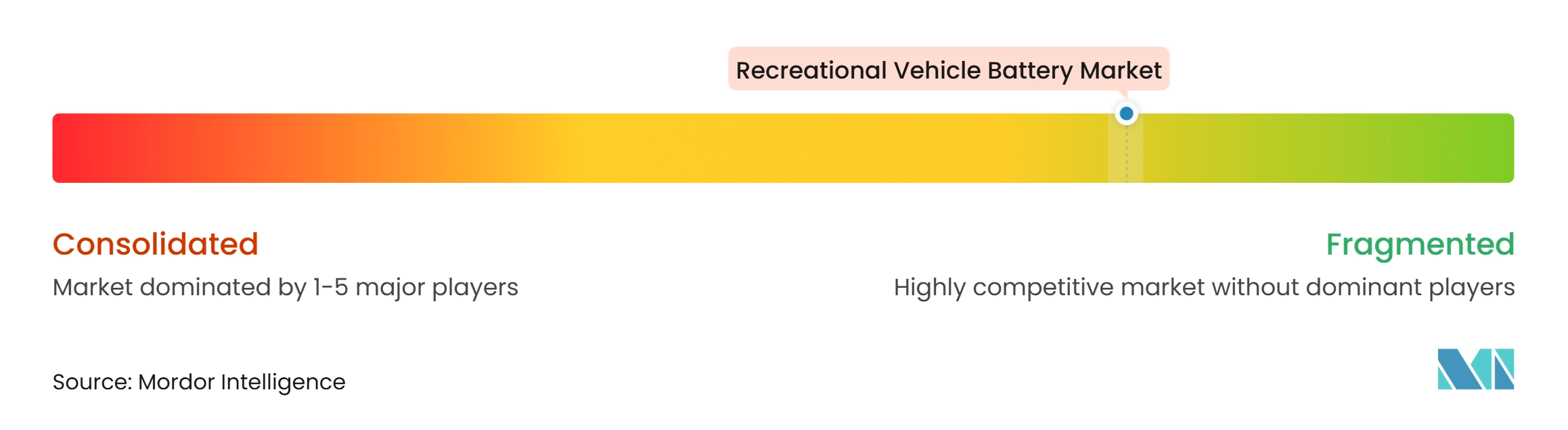
The Recreational Vehicle Battery Market is fragmented. Clarios, East Penn Manufacturing, and GS Yuasa retain strong positions in lead-acid products through scale, recycling, and established replacement distribution. Clarios processes 8,000 spent batteries per hour across its recycling network. In August 2025, Clarios acquired three Ecobat recycling centers in Germany and Austria. This gives incumbent producers greater control over recovered material and supply continuity. Dragonfly Energy, Renogy, and EcoFlow are building positions through LFP integration, solar compatibility, and OEM power packages.
Battery intelligence and vehicle-network integration are becoming clearer areas of differentiation. BLUETTI’s RVSolar system supports RV-C and NMEA 2000 and can scale to 122 kWh. Expion360 offers SmartTalk Bluetooth and CAN Bus-enabled LFP systems. IEC 62619 and UN 38.3 certification requirements increase qualification costs for suppliers seeking OEM programs. Dragonfly Energy received a U.S. patent in July 2025 for a solid-state ionically conducting electrolyte feedstock. This approach could reduce exposure to conventional liquid-electrolyte designs. Leoch International and Fullriver are extending RV-focused configurations into North American and European channels using production scale from automotive and industrial batteries.
East Penn, Interstate Batteries, and Banner illustrate the continued role of established battery brands in the Recreational Vehicle Battery Market transition. East Penn expanded its Deka Ready Power family with lithium and gel variants in March 2025. Interstate entered the lithium RV category with a protected LFP range in 2025. Banner updated its dual-purpose Energy Bull product for motorhome use. The competitive field therefore combines legacy replacement strength with differentiated OEM capability.
Recreational Vehicle Battery Industry Leaders
-
Clarios, LLC
-
East Penn Manufacturing Company, Inc.
-
Exide Technologies, Inc.
-
EnerSys
-
Dragonfly Energy Corp.
- *Disclaimer: Major Players sorted in no particular order
Recreational Vehicle Battery Market Companies Covered in this Report
- Banner GmbH
- Clarios, LLC
- Concorde Battery Corporation
- Crown Battery Manufacturing Company
- Discover Energy Systems Inc.
- Dragonfly Energy Corp.
- East Penn Manufacturing Company, Inc.
- EcoFlow Inc.
- EnerSys
- Exide Technologies, Inc.
- Expion360 Inc.
- Fullriver Battery Manufacturing Co., Ltd.
- GS Yuasa Corporation
- Interstate Battery System of America, Inc.
- Leoch International Technology Limited
- Lithium Hub LLC
- RELiON Battery, LLC
- Renogy
- Trojan Battery Company, LLC
- U.S. Battery Manufacturing Company
Recent Industry Developments in Recreational Vehicle Battery Market
- February 2026: Renogy introduced its Pro S1 semi-solid-state LiFePO4 battery series for recreational vehicles and off-grid energy storage applications. The batteries use approximately 70% less liquid electrolyte than conventional lithium batteries, improving thermal safety and durability. They also offer a lifespan of up to 6,000 cycles while retaining 80% of their capacity.
- September 2025: BLUETTI officially released the RVSolar 48V Power System for global markets following its IFA 2025 debut, with a 30-minute core installation design, RV-C and NMEA 2000 protocol support, and expandable LFP battery capacity up to 122 kWh.
- August 2025: Dragonfly Energy announced that Battle Born LiFePO4 batteries are now standard across Airstream’s entire 2026 model lineup, including Advanced Power System packages for Interstate and Atlas motorized series delivering up to 10.3 kWh of usable energy with cold-weather integrated heating.
- August 2025: Clarios acquired 3 battery recycling centers from Ecobat in Germany and Austria, expanding its closed-loop battery supply chain in EMEA and reinforcing its critical-mineral recovery and circular production capacity.
Global Recreational Vehicle Battery Market Report Scope
A recreational vehicle (RV) battery is an electrical power source used in motorhomes and travel trailers to start the engine or power interior 12-volt DC appliances, lighting, water pumps, and HVAC systems when the vehicle is not connected to shore power or a generator.
The recreational vehicle battery market is segmented into battery type, battery function, end user, and geography. By battery type, the market is segmented into lead-acid batteries, lithium-ion batteries, and other battery types. By battery function, the market is divided into starting batteries, deep-cycle batteries, and dual-purpose batteries. By end user, the market is segmented into individual RV owners, RV rental and leasing companies, commercial RV fleet operators, RV dealerships and service centers, and other end users. The report also covers the market size and forecasts for the global recreational vehicle battery market across 20 countries in key regions. For each segment, the market sizing and forecasts have been provided on the basis of value (USD).
Segmentation Overview
| Lead-Acid Batteries |
| Lithium-Ion Batteries |
| Other Battery Types |
| Starting Batteries |
| Deep-Cycle Batteries |
| Dual-Purpose Batteries |
| Individual RV Owners |
| RV Rental and Leasing Companies |
| Commercial RV Fleet Operators |
| RV Dealerships and Service Centers |
| Other End Users |
| North America | United States |
| Canada | |
| Mexico | |
| Europe | Germany |
| United Kingdom | |
| France | |
| Italy | |
| Spain | |
| Netherlands | |
| Rest of Europe | |
| Asia-Pacific | China |
| India | |
| Japan | |
| South Korea | |
| Australia | |
| Rest of Asia-Pacific | |
| South America | Brazil |
| Argentina | |
| Rest of South America | |
| Middle East and Africa | Saudi Arabia |
| United Arab Emirates | |
| South Africa | |
| Morocco | |
| Rest of Middle East and Africa |
| By Battery Type | Lead-Acid Batteries | |
| Lithium-Ion Batteries | ||
| Other Battery Types | ||
| By Battery Function | Starting Batteries | |
| Deep-Cycle Batteries | ||
| Dual-Purpose Batteries | ||
| By End User | Individual RV Owners | |
| RV Rental and Leasing Companies | ||
| Commercial RV Fleet Operators | ||
| RV Dealerships and Service Centers | ||
| Other End Users | ||
| By Geography | North America | United States |
| Canada | ||
| Mexico | ||
| Europe | Germany | |
| United Kingdom | ||
| France | ||
| Italy | ||
| Spain | ||
| Netherlands | ||
| Rest of Europe | ||
| Asia-Pacific | China | |
| India | ||
| Japan | ||
| South Korea | ||
| Australia | ||
| Rest of Asia-Pacific | ||
| South America | Brazil | |
| Argentina | ||
| Rest of South America | ||
| Middle East and Africa | Saudi Arabia | |
| United Arab Emirates | ||
| South Africa | ||
| Morocco | ||
| Rest of Middle East and Africa | ||
Key Questions Answered in the Report
What is the projected value of the Recreational Vehicle Battery Market by 2032?
The Recreational Vehicle Battery Market is projected to reach USD 7.49 billion by 2032, growing at a 7.28% CAGR from 2027. The forecast reflects growing RV use, higher onboard electrical loads, and wider lithium OEM fitment.
Which battery type leads RV demand?
Lead-acid batteries lead demand with 60.3% share in 2026, supported by the installed base and lower upfront cost. They remain relevant in replacement channels and price-sensitive RV formats.
Which RV battery chemistry is growing fastest?
Lithium-ion batteries are the fastest-growing battery type, with an 11.3% CAGR projected through 2032. OEM-installed power packages and extended off-grid needs are supporting adoption.
Why are lithium batteries used in newer RVs?
They support longer off-grid operation, higher electrical loads, and integrated OEM power systems. They are also suited to higher-voltage architectures where conventional 12V battery banks have practical limits.
Which region has the largest RV battery demand?
North America leads with 58.7% of revenue in 2026, supported by its large RV fleet and replacement infrastructure. U.S. wholesale RV shipments reached 342,220 units in 2025.
What limits lithium battery adoption in RVs?
Higher upfront prices, charging-system compatibility, cold-weather charging needs, and limited qualified installation capacity remain constraints. ABYC E-13-2025 also highlights the importance of compatible installation and commissioning.