
RAN Vendor Selection Benchmarking Market Size and Share
Market Overview
| Study Period | 2020 - 2031 |
|---|---|
| Market Size (2026) | USD 37.54 Billion |
| Market Size (2031) | USD 42.32 Billion |
| Growth Rate (2026 - 2031) | 2.43 % |
| Fastest Growing Market | Asia-Pacific |
| Largest Market | North America |
| Market Concentration | High |
Major Players *Disclaimer: Major Players sorted in no particular order Image © Mordor Intelligence. Reuse requires attribution under CC BY 4.0. | |
RAN Vendor Selection Benchmarking Market Analysis by Mordor Intelligence
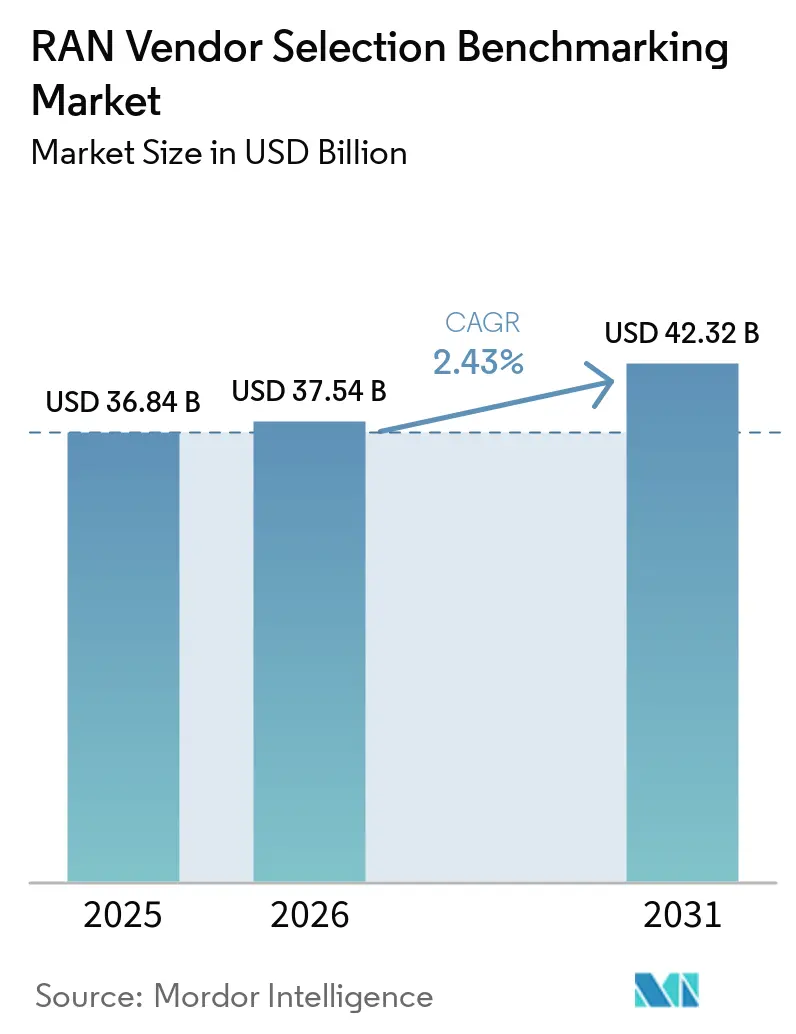
The RAN Vendor Selection Benchmarking Market size is projected to expand from USD 36.84 billion in 2025 to USD 37.54 billion in 2026, and to USD 42.32 billion by 2031, registering a CAGR of 2.43% between 2026 and 2031. The RAN Vendor Selection Benchmarking Market is entering a period of stabilization following the revenue decline observed between 2021 and 2024. Spending is shifting toward software, virtualized network functions, and AI-enabled radio capabilities, even as hardware remains essential for coverage and capacity projects. Operators are giving greater weight to recurring software value, energy performance, and interoperability when reviewing supplier proposals. Growth opportunities are strongest where 5G standalone networks, private wireless systems, and brownfield upgrades require new procurement decisions. The RAN Vendor Selection Benchmarking Market also faces slower capital spending in mature markets, which makes delivery confidence and a practical upgrade path important in vendor selection.
Key Report Takeaways
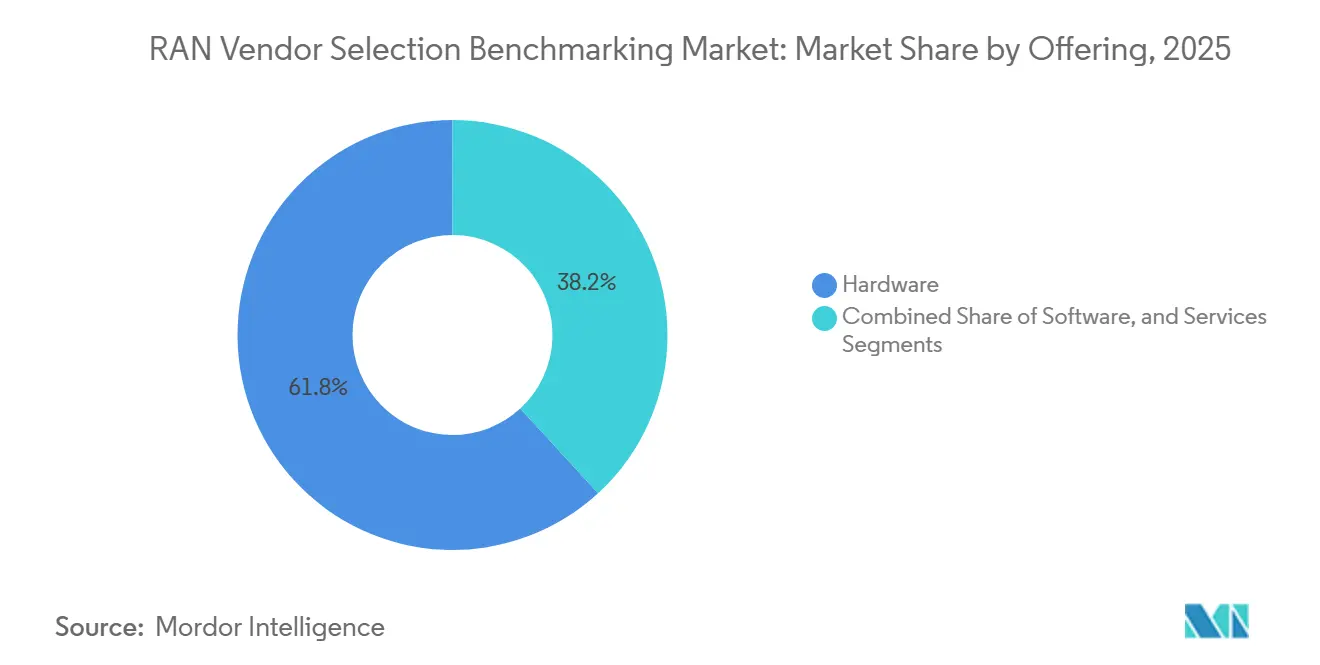
- By offering, hardware held 61.84% of the 2025 RAN Vendor Selection Benchmarking Market mix, while software is expected to expand at a 3.61% CAGR through 2031.
- By RAN architecture, traditional RAN accounted for 72.41% of the RAN Vendor Selection Benchmarking Market share in 2025, while virtualized RAN is projected to grow at a 4.37% CAGR through 2031.
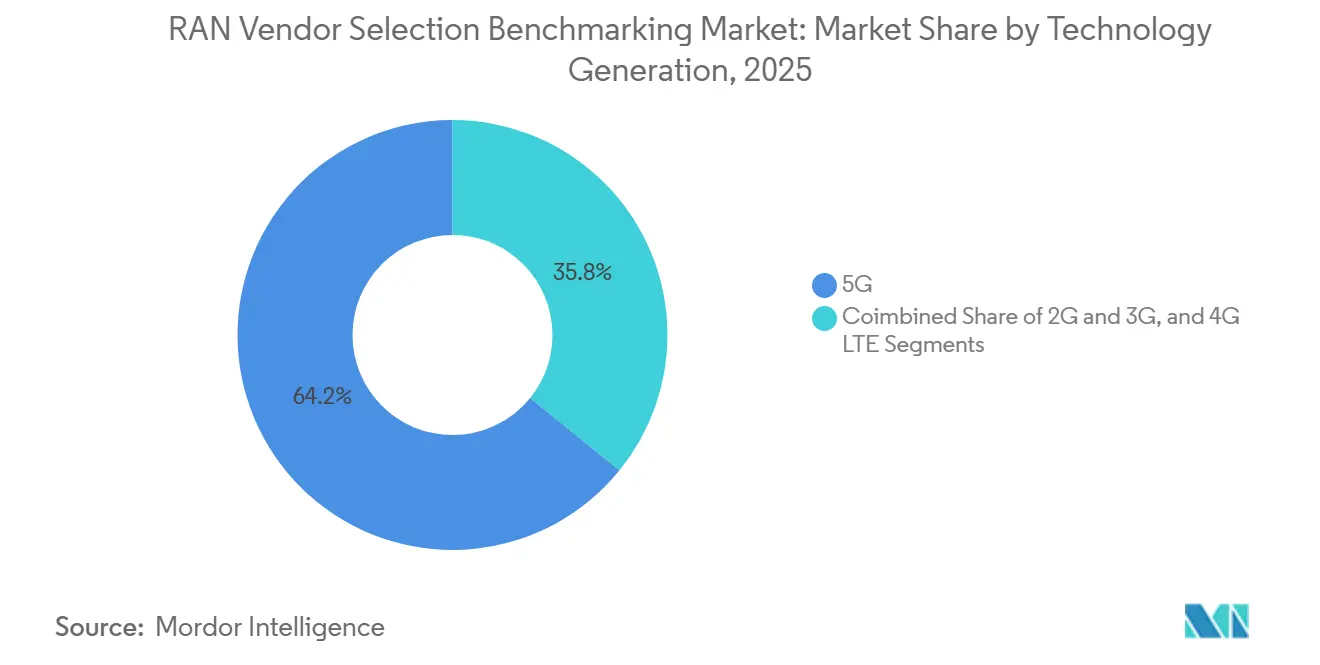
- By technology generation, 5G accounted for 64.16% of the 2025 mix and is expected to grow at a 3.82% CAGR through 2031.
- By component, radio units commanded 48.12% of the 2025 mix, while centralized units are projected to grow at a 4.28% CAGR through 2031.
- By deployment, outdoor networks represented 84.28% of the 2025 base, while indoor deployments are expected to expand at a 3.74% CAGR through 2031.
- By end user, telecom operators held 78.28% of the 2025 segment, while enterprises are projected to record a 4.13% CAGR through 2031.
- By geography, North America held 34.12% of the RAN Vendor Selection Benchmarking Market share in 2025, while Asia-Pacific is expected to grow at a 3.63% CAGR through 2031.
Note: Market size and forecast figures in this report are generated using Mordor Intelligence’s proprietary estimation framework, updated with the latest available data and insights as of January 2026.
Market Trends and Insights
Drivers Impact Analysis of RAN Vendor Selection Benchmarking Market*
| Driver | (~) % Impact on CAGR Forecast | Geographic Relevance | Impact Timeline |
|---|---|---|---|
| 5G Standalone Rollouts in Emerging Regions | +0.7% | Global, concentrated in Asia-Pacific, Middle East and Africa, and South America | Short term (≤ 2 years) |
| Virtualized and Open RAN Adoption | +0.6% | Global, led by North America, Europe, and Japan | Medium term (2-4 years) |
| Private 5G and Industrial Connectivity Requirements | +0.4% | North America, Asia-Pacific core markets, and Western Europe | Medium term (2-4 years) |
| Brownfield Network Modernization and Supplier Diversification | +0.4% | Europe, North America, and Asia-Pacific excluding China | Medium term (2-4 years) |
| AI-RAN Optimization for Capacity and Energy Economics | +0.3% | North America and Europe, with expansion into Asia-Pacific | Long term (≥ 4 years) |
| Open-Interface Compliance Becoming a Procurement Gate | +0.2% | Global, with early adoption in Europe and North America | Medium term (2-4 years) |
| Source: Mordor Intelligence | |||
5G Standalone Rollouts in Emerging Regions
Commercial 5G standalone deployments are creating demand for new radio units, upgraded basebands, and standalone core integration. The Global Mobile Suppliers Association reported 95 operators with commercial 5G standalone services in April 2026.[1] Emerging markets offer suppliers new opportunities as many operators move beyond non-standalone upgrades to full network modernization. These projects often favor vendors that can provide radio, software, integration, and operational support within a single delivery plan. Standalone availability still has to translate into service adoption and enterprise revenue, which keeps operators focused on coverage quality and practical monetization. The RAN Vendor Selection Benchmarking Market therefore benefits when suppliers can link standalone network investment to capacity, automation, and new service requirements.
Virtualized and Open RAN Adoption
Virtualized RAN adoption is changing how operators compare suppliers, as software capabilities now matter alongside radio performance. Open interfaces can broaden technical choice, but operators still seek tested combinations with clear accountability for support. Samsung and Orange Group expanded their vRAN and Open RAN partnership in Europe in 2026, following earlier pilots, indicating that operators are moving from trials to broader deployments.[2] Vodafone had also selected Samsung for virtualized RAN and Open RAN work across European markets. These agreements show that integrated vRAN delivery can be more attractive than a fully disaggregated stack when operators need proven interoperability. The RAN Vendor Selection Benchmarking Market is consequently rewarding suppliers that combine cloud-native functions with clear responsibility for integration and performance.
Private 5G and Industrial Connectivity Requirements
Private 5G is becoming a larger source of demand for radio equipment, software, and managed services. In February 2026, NTT DATA reported that Cargill had deployed its private 5G network across 50 manufacturing and processing sites.[3] The Global Mobile Suppliers Association identified 1,953 organizations in 84 countries operating private LTE or 5G networks as of April 2026, with manufacturing leading identified deployments. Industrial users require dependable coverage, low latency, cybersecurity controls, and local operational support. These requirements make application knowledge and integration skills important parts of vendor evaluation. The RAN Vendor Selection Benchmarking Market gains from enterprise projects, as they create opportunities beyond conventional public macro-network upgrades.
Brownfield Network Modernization and Supplier Diversification
Brownfield replacement programs are sustaining contract activity where existing 4G equipment ages and operators prepare 5G standalone capabilities. European operators are reviewing supplier exposure while also seeking a manageable route from legacy networks to cloud-enabled operations. Nokia secured a significant 5G agreement with VodafoneThree in 2025 as part of the operator's network investment program.[4] Ericsson also secured an SEK 12.5 billion (USD 1.31 billion) partnership in September 2025 to supply much of VodafoneThree's next-generation United Kingdom network. Such projects support multi-year supplier relationships, but operators still assess whether a vendor can operate with existing equipment and meet national security requirements. The RAN Vendor Selection Benchmarking Market benefits when modernization plans combine hardware replacement, software migration, and long-term services.
Restraints Impact Analysis of RAN Vendor Selection Benchmarking Market*
| Restraint | (~) % Impact on CAGR Forecast | Geographic Relevance | Impact Timeline |
|---|---|---|---|
| High Radio Access Network Capital Intensity and Long Payback Periods | -0.5% | Global, most acute in North America and Europe | Medium term (2-4 years) |
| Cybersecurity, Sovereignty, and Supply-Chain Qualification Burden | -0.4% | Global, with regulatory concentration in North America, Europe, and Australia | Medium term (2-4 years) |
| Multi-Vendor Accountability Gaps in Operational Support | -0.2% | Global, concentrated in early Open RAN adopter markets | Medium term (2-4 years) |
| Edge-Site Power and Thermal Constraints | -0.1% | Dense urban markets in Europe and North America | Long term (≥ 4 years) |
| Source: Mordor Intelligence | |||
High Radio Access Network Capital Intensity and Long Payback Periods
Radio access upgrades require substantial upfront investment, while the commercial return can take several years to develop. Operators in mature markets are therefore scrutinizing projects that cannot show a clear capacity, cost, or revenue benefit. Large macro-site upgrades also require work on power, transport, installation, and maintenance, which raises the full cost beyond the radio equipment itself. This favors established suppliers with a record of delivering complex networks at scale. It also extends sales cycles for smaller vendors that must demonstrate reliability before obtaining large contracts. The RAN Vendor Selection Benchmarking Market remains constrained when operators defer broad upgrades and prioritize targeted investments with faster payback.
Cybersecurity, Sovereignty, and Supply-Chain Qualification Burden
Cybersecurity and supply-chain assurance have become central to RAN procurement. The United States Federal Communications Commission maintains its Covered List under the Secure Networks Act, which influences supplier eligibility and operator planning. The European Union Agency for Cybersecurity describes the 5G cybersecurity toolbox as a framework for managing supply-chain and network risks. Open and software-based architectures can increase the number of interfaces and components that operators must test. Research presented through the NDSS Symposium identified security issues in production-grade O-RAN components, reinforcing the need for careful technical validation. These requirements can lengthen approval periods and favor suppliers that have established audit, documentation, and support processes. The RAN Vendor Selection Benchmarking Market is affected when qualification costs reduce the practical number of suppliers that can compete for a project.
*Our forecasts treat driver/restraint impacts as directional, not additive. The impact forecasts reflect baseline growth, mix effects, and variable interactions.
RAN Vendor Selection Benchmarking Market Segment Analysis
By Offering:
Software Layer Gains Share Alongside Hardware DemandHardware held 61.84% of the RAN Vendor Selection Benchmarking Market share in 2025 because macro expansion and Massive MIMO deployments require physical radio and baseband equipment. Radio hardware remains necessary for coverage, capacity, and 5G standalone upgrades. Operators still evaluate hardware suppliers on energy use, footprint, radio performance, and installation requirements. Hardware contracts also commonly include deployment and support services that add to total contract value. The RAN Vendor Selection Benchmarking Market size for hardware is driven by the continued modernization of public networks and the need to replace aging equipment.
Software is projected to grow at a 3.61% CAGR through 2031, the highest rate among offering types. AI-RAN subscriptions, cloud-native management platforms, and rApp-based optimization tools are shifting some spending toward recurring contracts. Ericsson launched its AI in RAN software subscription in June 2026 for use with deployed basebands and radios. Services remain important because migration, integration, and network optimization continue after equipment is installed. Suppliers that can combine software with integration support are better positioned for brownfield transformation programs. This mix gives operators more ways to improve an installed network without replacing every radio unit.

By RAN Architecture:
Traditional RAN Retains the Largest Base While Virtualized RAN AcceleratesTraditional RAN accounted for 72.41% of the RAN Vendor Selection Benchmarking Market share in 2025, reflecting its large installed base across China, mature Asian markets, and the Americas. Integrated systems remain familiar to network operations teams and are often simpler to support. Many operators continue to select traditional architectures where predictable performance and single-vendor accountability are central priorities. Existing site configurations, operational tools, and trained workforces also support the continued use of traditional RAN. The large traditional base means suppliers must maintain their established portfolios even as they invest in newer platforms.
Virtualized RAN is projected to grow at a 4.37% CAGR through 2031, the fastest rate across architecture types. It moves more baseband functions into software that runs on commercial hardware, enabling feature updates and more flexible resource use. Rakuten Symphony completed interoperability testing of Samsung's vRAN and vCore on its cloud-native platform in March 2026. Centralized RAN offers an intermediate option for operators that want pooled processing but are not ready for full virtualization. Procurement teams increasingly review standards conformance, integration capability, and lifecycle support before selecting a virtualized architecture. This transition allows suppliers to compete on software, automation, and cloud operations rather than radio hardware alone.
By Technology Generation:
5G Leads in Share and Growth5G held 64.16% of the 2025 technology generation mix and is projected to expand at a 3.82% CAGR through 2031. This combination reflects continued densification after initial 5G coverage deployments. Operators are adding capacity, improving indoor reach, and preparing standalone capabilities in markets where 5G traffic is increasing. 5G procurement also includes upgrades to radios, basebands, management systems, and transport links. The RAN Vendor Selection Benchmarking Market is shaped by how well suppliers support these connected requirements across the network.
The 2G and 3G base is declining as operators refarm spectrum and reduce the cost of supporting many technology generations. 4G LTE remains relevant where device availability, coverage requirements, or private-network use cases do not yet justify a full 5G rollout. AI-native network software shows how suppliers can improve performance after a 5G network is already live. Vendors that can support several generations while providing a credible 5G modernization path remain important to operators. This need is especially strong in markets where legacy and next-generation networks must operate in parallel.
By Component:
Radio Units Lead While Centralized Units Gain MomentumRadio units commanded 48.12% of the 2025 component mix because every public and private deployment requires radio transmission equipment. Their role spans outdoor macro sites, indoor systems, neutral-host networks, and enterprise locations. Radio-unit selection depends on spectrum support, energy efficiency, size, weight, and compatibility with the rest of the RAN. Nokia launched Doksuri Remote Radio Heads in March 2026 with Open Fronthaul compatibility and claimed 30% better power efficiency than prior generations. The RAN Vendor Selection Benchmarking Market size for radio units remains linked to 5G rollout plans and replacement cycles.
Centralized units are projected to grow at a 4.28% CAGR through 2031 as processing functions are consolidated and cloud-native designs gain use. These units can support shared compute resources and reduce the hardware burden at remote sites. Distributed units remain important in split architectures that need lower-latency processing close to the radio. In February 2026, Rakuten Mobile announced plans to deploy 1Finity Massive MIMO Open RAN radios at scale via the O-RAN open fronthaul interface. Baseband units continue to serve traditional deployments, but their role changes as more network functions become virtualized. Component decisions increasingly require suppliers to demonstrate Open Fronthaul compatibility and tested interoperability.
By Deployment:
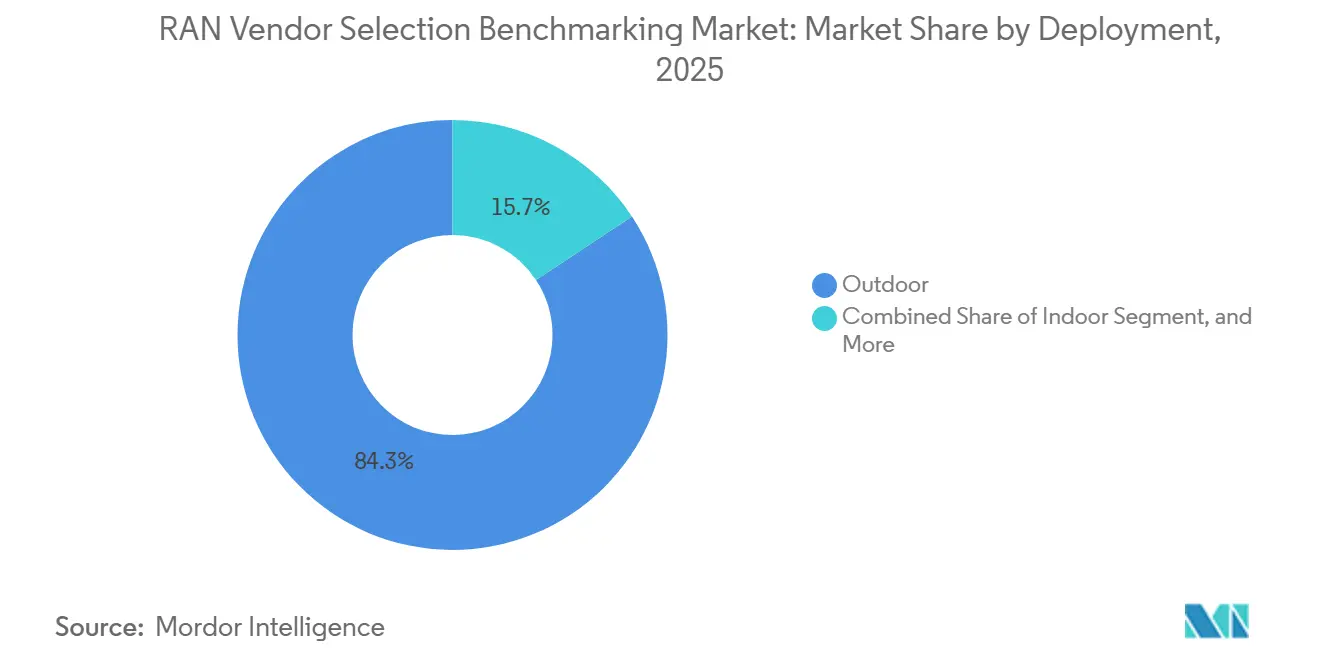
Outdoor Networks Remain Dominant While Indoor Demand ExpandsOutdoor networks accounted for 84.28% of the 2025 deployment base, as macro infrastructure remains the foundation of public mobile coverage. Outdoor sites provide a broad geographic reach and account for a large share of mobile traffic. They require sustained investment in radios, antennas, power systems, and site modernization. Operators often prioritize outdoor work where coverage obligations or capacity requirements are immediate. The RAN Vendor Selection Benchmarking Market share held by outdoor deployments will remain significant as national networks are upgraded.
Indoor deployments are expected to grow at a 3.74% CAGR through 2031 as enterprises, venues, hospitals, airports, and factories seek dependable in-building connectivity. Neutral-host models can reduce the cost of providing service to multiple operators within a single property. The Small Cell Forum reported that enterprise indoor environments are expected to account for 54% of cumulative small-cell deployments from 2024 to 2031. Proptivity completed the first commercial deployment of Ericsson's Host Management Control feature in Oslo in April 2026. The system allows separate operators to connect to shared indoor radio infrastructure. Such arrangements can make indoor coverage more practical where individual operator investment had been a barrier.
By End User:
Telecom Operators Lead While Enterprises Grow FasterTelecom operators accounted for 78.28% of the 2025 end-user segment, as they remain the main buyers of nationwide mobile infrastructure. Their decisions cover large-scale coverage, capacity, spectrum use, energy efficiency, and network availability. Operators also set technical requirements that influence the equipment and software used throughout the RAN Vendor Selection Benchmarking Market. Long-term support, migration planning, and supplier financial strength are important in these procurement processes. Public-network contracts, therefore, remain central to vendor revenue and competitive positioning.
Enterprises are projected to record a 4.13% CAGR through 2031, the fastest rate among end users. Manufacturing, logistics, healthcare, defense, and public-sector users increasingly seek private mobile networks for controlled coverage and predictable performance. Smart cities and public-sector programs also create demand for secure and mission-critical connectivity. Enterprise buyers pay greater attention to site design, integration, local support, and application performance than conventional mobile operators do. Suppliers that can translate network features into operational value will have a stronger position with this growing customer group.
Geography Analysis
North America RAN Vendor Selection Benchmarking Market
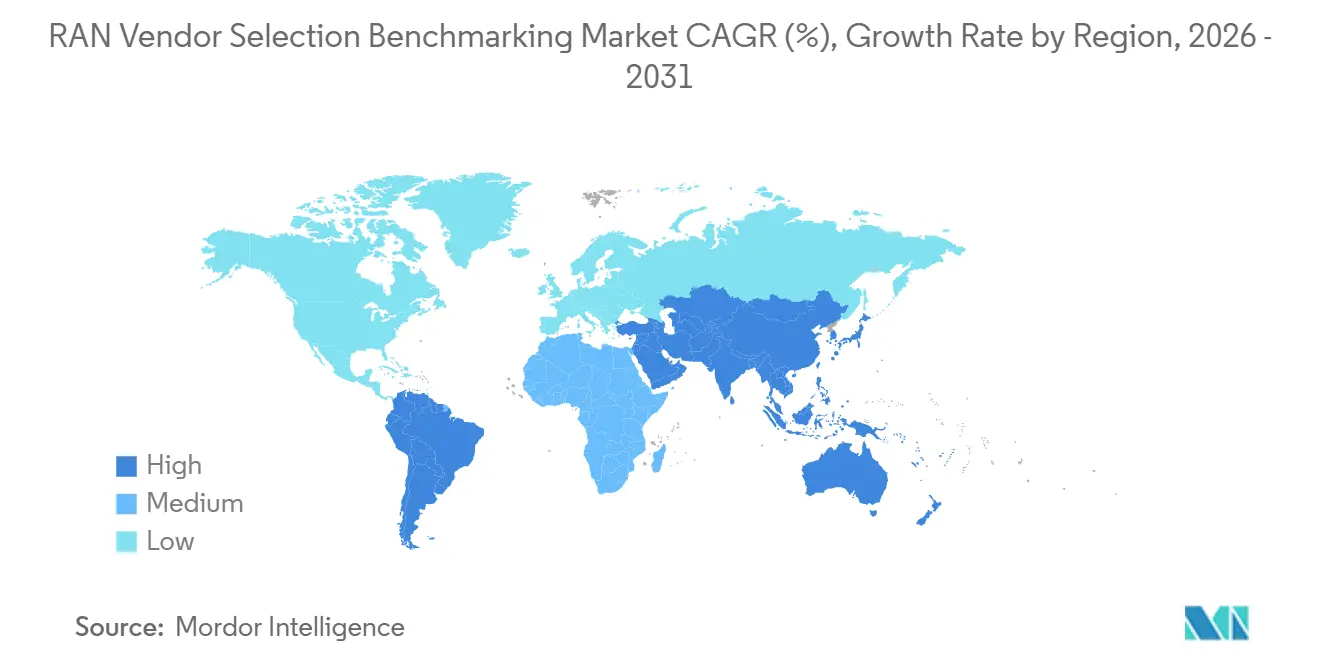
North America held 34.12% of the RAN Vendor Selection Benchmarking Market share in 2025, supported by earlier 5G investment, cloud RAN work, and AI-enabled radio trials. AT&T and Ericsson demonstrated AI-native Link Adaptation on a Cloud RAN stack powered by Intel Xeon 6 SoC in March 2026. The region's activity moderated after the heavy 5G buildout cycle, which makes targeted upgrades more likely than broad nationwide replacement programs. Security rules and the FCC Covered List also shape Supplier selection.
APAC RAN Vendor Selection Benchmarking Market
Asia-Pacific is projected to grow at a 3.63% CAGR through 2031, making it the fastest-growing geographic segment. India, Indonesia, Bangladesh, and Malaysia are in the active stages of 5G investment, while Australia, Japan, and South Korea continue to advance their network capabilities. Rakuten Mobile operates a large open vRAN network in Japan, and its 2026 work with Rakuten Symphony and 1Finity shows continued investment in open and cloud-native designs. China remains an important volume market, but the first phase of its 5G buildout has matured. The RAN Vendor Selection Benchmarking Market has varied opportunities across the region because national investment cycles and supplier preferences differ widely.
EMEA RAN Vendor Selection Benchmarking Market
Europe, the Middle East, and Africa are important locations for replacement projects and new open-architecture deployments. Nokia agreed a 5-year RAN arrangement with Telefónica Germany that includes Cloud RAN and AI-powered management capabilities. Ericsson became Virgin Media O2's primary RAN partner through a 5-year extension in March 2026. Saudi Arabia hosted an O-RAN-neutral-host indoor 4G and 5G small-cell deployment at the King Abdullah Financial District. Africa is still at an earlier stage of standalone deployment, while fixed wireless access is supporting near-term 5G use.
Competitive Landscape
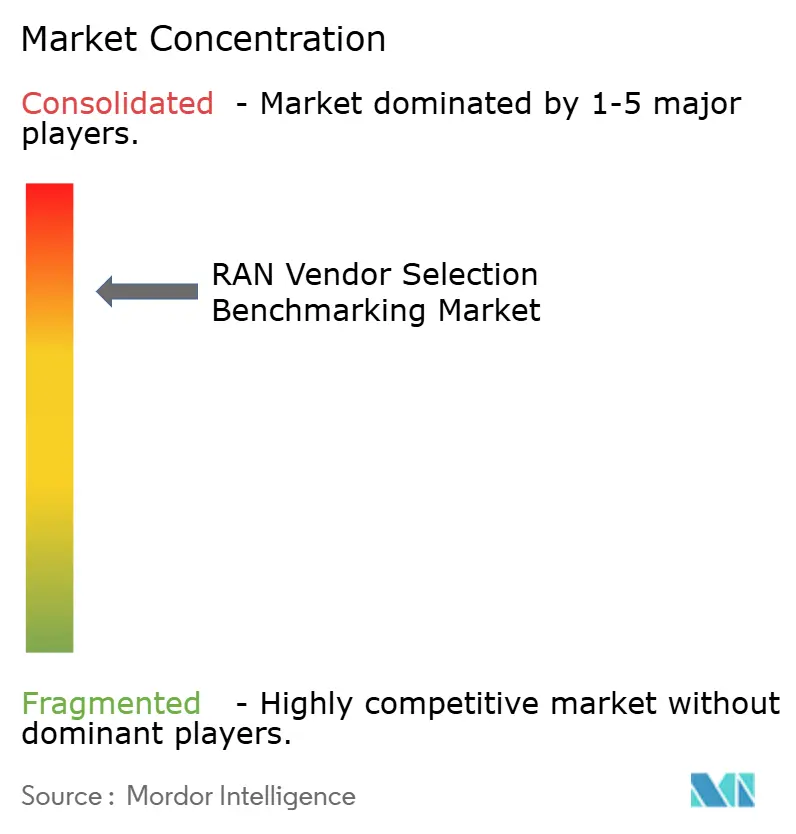
The RAN Vendor Selection Benchmarking Market is concentrated around Huawei, Ericsson, Nokia, ZTE, and Samsung. These suppliers have broad radio portfolios, established customer relationships, and the resources to support long procurement and deployment cycles. The need for global delivery capability, cybersecurity documentation, and lifecycle support reinforces their position. Open interfaces have not removed the importance of proven system integration. Operators compare how well a supplier can combine open standards with accountable end-to-end delivery.
Software and AI-native RAN are becoming important areas of competition. Ericsson launched AI in RAN in June 2026 as a commercial subscription that applies AI models to deployed basebands and radios. In March 2026, Nokia continued its AI-RAN work with customer integrations and functional testing involving BT, Elisa, NTT DOCOMO, and Vodafone Group. Samsung's European agreements with Orange and Vodafone show its focus on virtualized and open RAN programs. These moves indicate that suppliers are trying to add software value to installed hardware.
Smaller vendors are pursuing narrower positions in cloud-native software, small cells, private networks, or specific Open RAN components. Rakuten Symphony's interoperability work with Samsung shows how platform suppliers can participate by validating cloud-native RAN and core combinations. Mavenir's packet core deployment with Rakuten Mobile also reflects ongoing demand for cloud-native network functions. Smaller suppliers face difficult qualification processes, integration demands, and long sales cycles. Vendor partnerships and interoperability testing will remain important ways for these firms to establish credibility.
RAN Vendor Selection Benchmarking Industry Leaders
-
Huawei Technologies Co., Ltd.
-
Telefonaktiebolaget LM Ericsson
-
Nokia Corporation
-
ZTE Corporation
-
Samsung Electronics Co., Ltd.
- *Disclaimer: Major Players sorted in no particular order
RAN Vendor Selection Benchmarking Market Companies Covered in this Report
- Huawei Technologies Co., Ltd.
- Telefonaktiebolaget LM Ericsson (publ)
- Nokia Corporation
- ZTE Corporation
- Samsung Electronics Co., Ltd.
- Fujitsu Limited
- NEC Corporation
- Airspan Networks Holdings LLC
- Mavenir Systems, LLC
- Parallel Wireless, Inc.
- JMA Wireless, Inc.
- Comba Telecom Systems Holdings Limited
- Radisys Corporation
- Rakuten Symphony Singapore Pte. Ltd.
- Baicells Technologies Co., Ltd.
- Sercomm Corporation
- Alpha Networks Inc.
- Dali Wireless, Inc.
- Casa Systems, Inc.
- Airspan Networks Inc.
- 1Finity
- Viavi Solutions
- Wind River Systems
- SynaXG
Recent Industry Developments in RAN Vendor Selection Benchmarking Market
- June 2026: Ericsson launched AI in RAN, a commercial software subscription embedding telco-grade AI models directly into deployed basebands and radios. The solution delivers up to 20% higher downlink throughput, 10% spectral efficiency improvement, and 14% energy savings, targeting operators seeking to monetize existing radio estates through software upgrades without hardware swaps.
- May 2026: T-Mobile and Ericsson moved the AI-native Scheduler with Link Adaptation into large-scale commercial trials across live 5G Advanced traffic in Los Angeles, New York, and Salt Lake City, achieving 10% spectral efficiency improvement and up to 15% downlink throughput increase. T-Mobile targeted full commercial deployment in Q3 2026, establishing one of the earliest AI-native RAN production deployments globally.
- April 2026: Mavenir's Converged Packet Core went live in Rakuten Mobile's nationwide mobile network on Rakuten Cloud Platform, enabling Rakuten Mobile to provide multi-carrier roaming through JAPAN Roaming, a nationwide emergency roaming service in Japan launched on April 1, 2026.
- April 2026: Rakuten Symphony was selected for a grant from Japan's Ministry of Economy, Trade and Industry to accelerate Open RAN and RAN Intelligent Controller deployment across the Global South, targeting large-scale demonstrations in ASEAN and non-ASEAN countries.
Global RAN Vendor Selection Benchmarking Market Report Scope
The RAN vendor selection benchmarking market refers to the analytical and consulting services, along with standardized evaluation frameworks, that telecommunications operators and enterprises use to assess, compare, and select Radio Access Network (RAN) equipment vendors. This market encompasses the benchmarking of hardware, software, and services across various RAN architectures, including traditional, centralized, and virtualized RAN (vRAN), as well as technology generations such as 4G LTE and 5G. The evaluation focuses on critical network components such as radio, distributed, centralized, and baseband units across indoor and outdoor deployments. By providing objective, data-driven insights into vendor performance, total cost of ownership, interoperability, and technological readiness, these benchmarking solutions enable end-users to mitigate procurement risks, optimize network investments, and ensure the deployment of robust, scalable, and future-proof mobile connectivity infrastructure.
The RAN Vendor Selection Benchmarking Market Report is Segmented by Offering (Hardware, Software, and Services), RAN Architecture (Traditional RAN, Centralized RAN, and Virtualized RAN), Technology Generation (2G and 3G, 4G LTE, and 5G), Component (Radio Units, Distributed Units, Centralized Units, Baseband Units, and Others), Deployment (Indoor, Outdoor, and Others), End User (Telecom Operators, Enterprises, Smart Cities and Public Sector, Defense and Security Organizations, and Industrial and Manufacturing Organizations), and Geography (North America, South America, Europe, Asia-Pacific, Middle East, and Africa). The Market Forecasts are Provided in Terms of Value (USD).
Segmentation Overview
| Hardware |
| Software |
| Services |
| Traditional RAN |
| Centralized RAN |
| Virtualized RAN |
| 2G and 3G |
| 4G LTE |
| 5G |
| Radio Units |
| Distributed Units |
| Centralized Units |
| Baseband Units |
| Other Components |
| Indoor |
| Outdoor |
| Other Deployments |
| Telecom Operators |
| Enterprises |
| Smart Cities and Public Sector |
| Defense and Security Organizations |
| Industrial and Manufacturing Organizations |
| North America | United States |
| Canada | |
| Mexico | |
| South America | Brazil |
| Argentina | |
| Chile | |
| Rest of South America | |
| Europe | Germany |
| United Kingdom | |
| France | |
| Italy | |
| Spain | |
| Rest of Europe | |
| Asia-Pacific | China |
| Japan | |
| India | |
| South Korea | |
| Australia | |
| Rest of Asia-Pacific | |
| Middle East | United Arab Emirates |
| Saudi Arabia | |
| Qatar | |
| Rest of Middle East | |
| Africa | South Africa |
| Egypt | |
| Nigeria | |
| Rest of Africa |
| By Offering | Hardware | |
| Software | ||
| Services | ||
| By RAN Architecture | Traditional RAN | |
| Centralized RAN | ||
| Virtualized RAN | ||
| By Technology Generation | 2G and 3G | |
| 4G LTE | ||
| 5G | ||
| By Component | Radio Units | |
| Distributed Units | ||
| Centralized Units | ||
| Baseband Units | ||
| Other Components | ||
| By Deployment | Indoor | |
| Outdoor | ||
| Other Deployments | ||
| By End User | Telecom Operators | |
| Enterprises | ||
| Smart Cities and Public Sector | ||
| Defense and Security Organizations | ||
| Industrial and Manufacturing Organizations | ||
| By Geography | North America | United States |
| Canada | ||
| Mexico | ||
| South America | Brazil | |
| Argentina | ||
| Chile | ||
| Rest of South America | ||
| Europe | Germany | |
| United Kingdom | ||
| France | ||
| Italy | ||
| Spain | ||
| Rest of Europe | ||
| Asia-Pacific | China | |
| Japan | ||
| India | ||
| South Korea | ||
| Australia | ||
| Rest of Asia-Pacific | ||
| Middle East | United Arab Emirates | |
| Saudi Arabia | ||
| Qatar | ||
| Rest of Middle East | ||
| Africa | South Africa | |
| Egypt | ||
| Nigeria | ||
| Rest of Africa | ||
Key Questions Answered in the Report
What is the RAN Vendor Selection Benchmarking Market size?
The RAN Vendor Selection Benchmarking Market is projected to expand from USD 36.84 billion in 2025 and USD 37.54 billion in 2026 to USD 42.32 billion by 2031, at a 2.43% CAGR.
Which RAN offering is growing the fastest?
Software is projected to grow at a 3.61% CAGR through 2031, supported by AI-RAN subscriptions and cloud-native management tools.
Why are operators adopting virtualized RAN?
Virtualized RAN can move baseband functions into software, support flexible updates, and improve the use of compute resources. It is projected to grow at a 4.37% CAGR through 2031.
Which end users are creating new demand for RAN solutions?
Enterprises are projected to grow at a 4.13% CAGR through 2031 as manufacturing, logistics, healthcare, defense, and public-sector users adopt private mobile networks.
Which region is expected to grow the fastest?
Asia-Pacific is expected to record a 3.63% CAGR through 2031, supported by 5G deployment activity in India, Indonesia, Bangladesh, and Malaysia.
What factors matter most in RAN vendor selection?
Operators evaluate radio performance, energy efficiency, security assurance, interoperability, integration capability, lifecycle support, and the ability to modernize existing networks.