
Rakes and Tedders Market Size and Share
Market Overview
| Study Period | 2022 - 2032 |
|---|---|
| Market Size (2027) | USD 2.29 Billion |
| Market Size (2032) | USD 2.86 Billion |
| Growth Rate (2027 - 2032) | 4.55 % |
| Fastest Growing Market | Asia-Pacific |
| Largest Market | Europe |
| Market Concentration | Medium |
Major Players *Disclaimer: Major Players sorted in no particular order Image © Mordor Intelligence. Reuse requires attribution under CC BY 4.0. | |
Rakes and Tedders Market Analysis by Mordor Intelligence
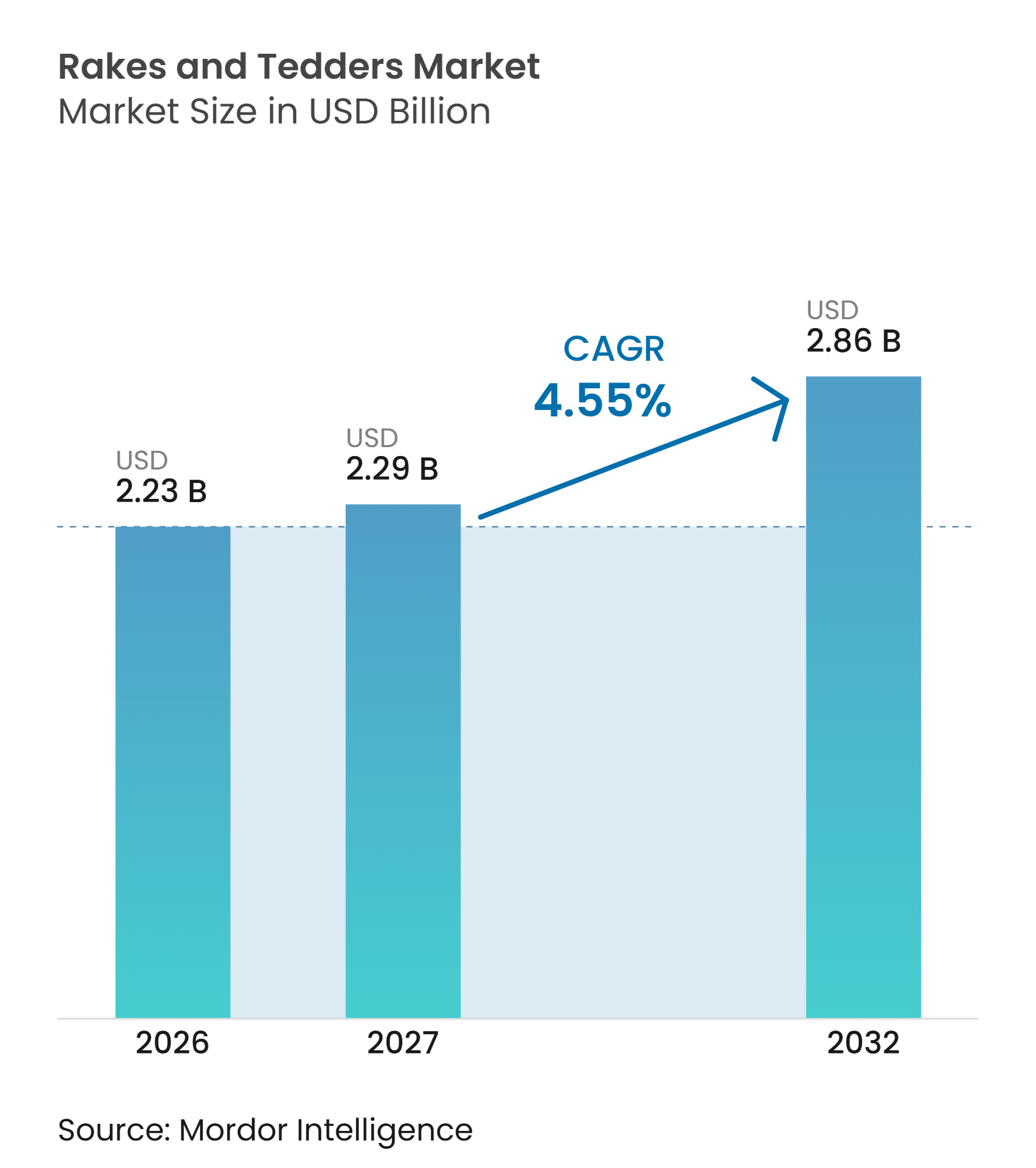
The rakes and tedders market was valued at USD 2.23 billion in 2026 and is projected to grow from USD 2.29 billion in 2027 to USD 2.86 billion by 2032, at a CAGR of 4.55% during the forecast period from 2027 to 2032. Market growth is supported by the need for efficient forage handling, as hay must be spread, dried, and gathered before storage or use in livestock feeding. Rising livestock production and increasing demand for dairy and meat products are supporting investments in forage management equipment. The 2025 Food and Agriculture Organization of the United Nations (FAO) and the Organisation for Economic Co-operation and Development (OECD) report projects global meat, dairy, and egg production to increase by 17% by 2034, alongside a 7% rise in livestock inventories, creating opportunities for mechanized forage handling solutions[1]. Herd expansion across India, Sub-Saharan Africa, and Southeast Asia is anticipated to support demand as producers seek to improve forage management efficiency and address labor constraints. In mature agricultural markets, replacement demand is further supported by the need for higher field capacity, reduced labor requirements, improved forage quality, reliable equipment performance, and compatibility with existing tractor fleets. However, equipment acquisition costs and variations in farm profitability may influence purchasing decisions, particularly among smaller farms and operators with limited capital.
Key Report Takeaways
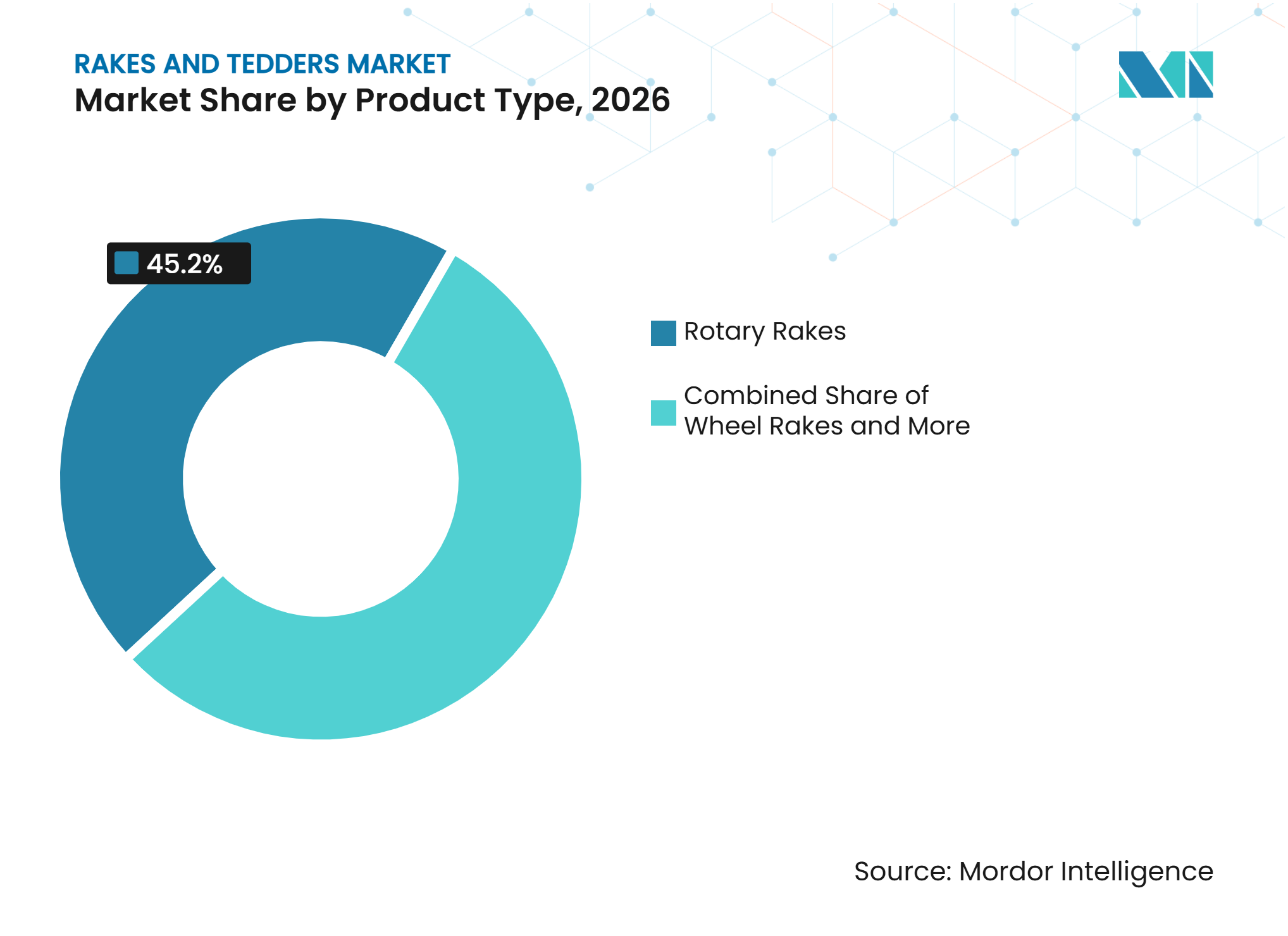
- By product type, rotary rakes were the largest segment and held 45.2% of the rakes and tedders market share in 2026, while they are also the fastest-growing segment and are forecast to expand at a 5.1% CAGR between 2027 and 2032.
- By mounting configuration, mounted machines were the largest segment and held 59.2% of the rakes and tedders market size in 2026, while trailed machines are the fastest-growing segment and are forecast to expand at a 7.8% CAGR between 2027 and 2032.
- By end user, commercial hay producers were the largest segment and held 35.0% of the market share in 2026, while agricultural contractors and custom operators are the fastest-growing segment and are forecast to expand at a 6.0% CAGR between 2027 and 2032.
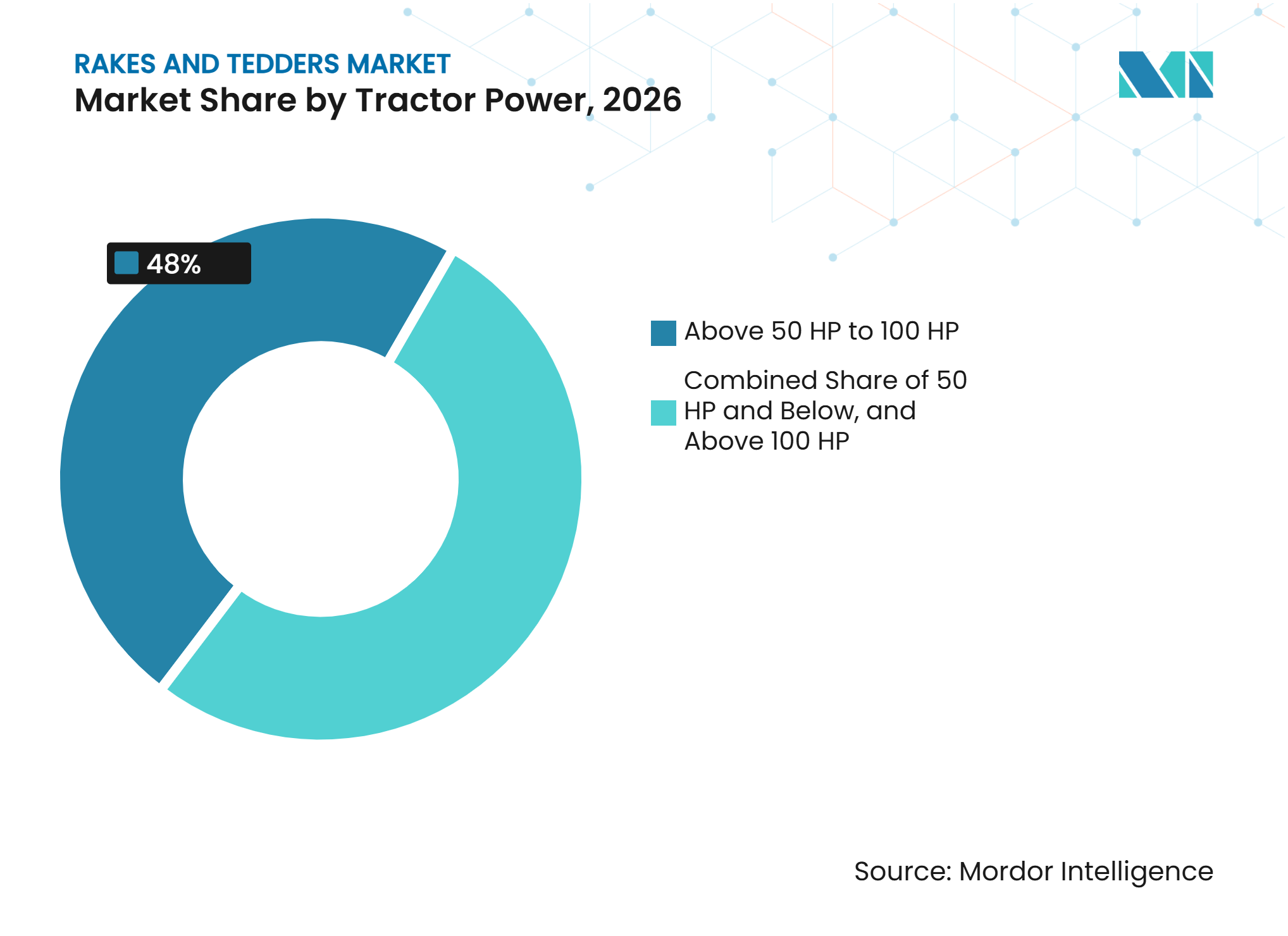
- By tractor power requirement, above 50 horsepower to 100 horsepower (HP) was the largest segment and held 48.0% of the market share in 2026, while above 100 HP is the fastest-growing segment and is forecast to expand at a 5.5% CAGR between 2027 and 2032.
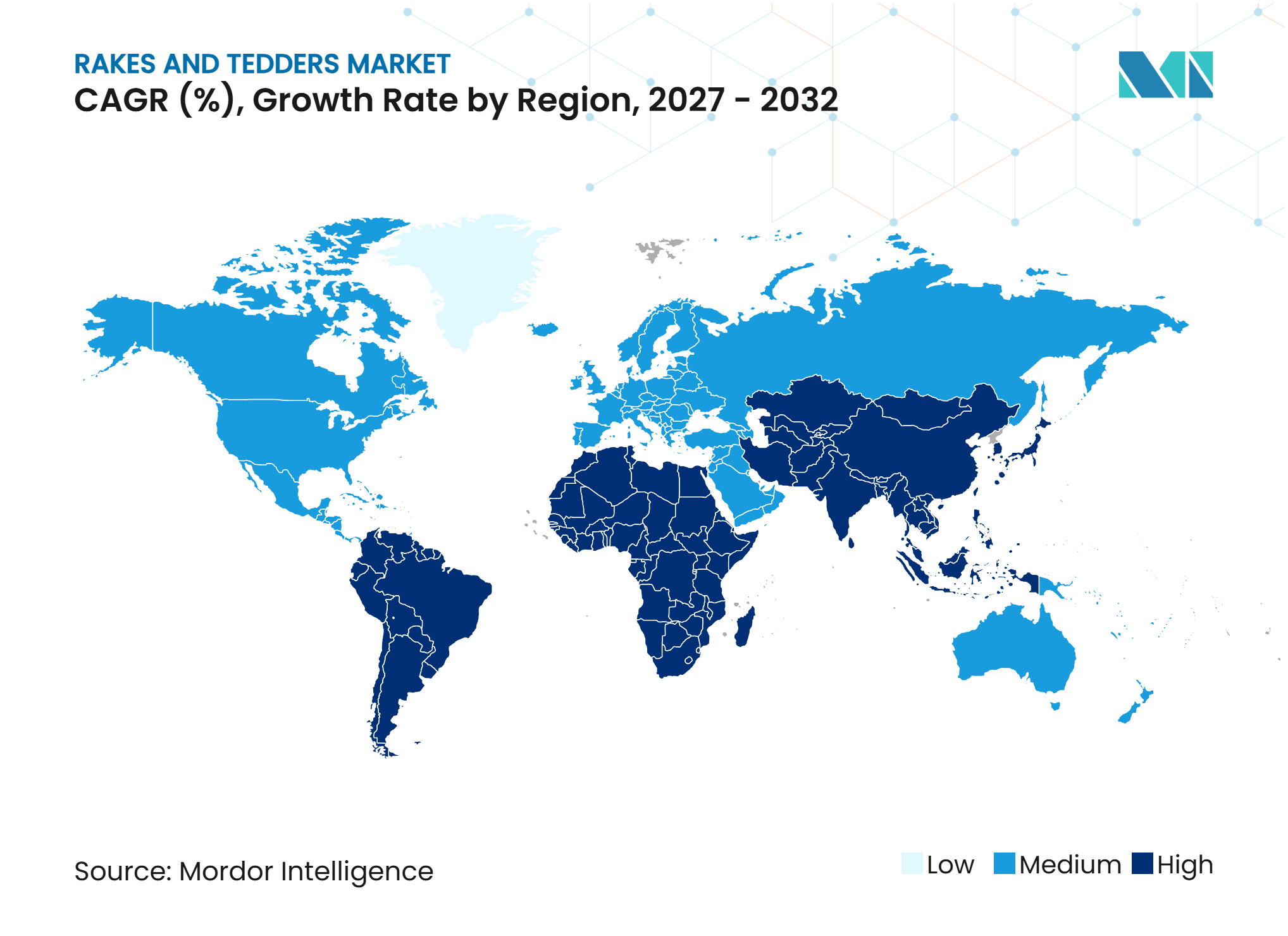
- By geography, Europe was the largest segment and held 46.2% of the market share in 2026, while Asia-Pacific is the fastest-growing segment and is forecast to expand at an 8.3% CAGR between 2027 and 2032.
Note: Market numbers in this report are based on Mordor Intelligence's proprietary estimation framework, which combines nine months of actuals with Q4 projections for base year 2026.
Market Trends and Insights
Drivers Impact Analysis of Rakes and Tedders Market*
| Driver | (~) % Impact on CAGR Forecast | Geographic Relevance | Impact Timeline |
|---|---|---|---|
| Expansion of Livestock and Dairy Production | +1.2% | Global, strongest in Asia-Pacific, Sub-Saharan Africa, and South America | Long term (≥ 4 years) |
| Farm Mechanization and Labor Scarcity | +1% | Global, acute in North America and Europe, and rising in India and China | Medium term (2-4 years) |
| Forage-Quality Preservation and Shorter Drying Windows | +0.8% | North America, Europe, Australia, and Brazil | Medium term (2-4 years) |
| Precision Tedding and Raking for Weather-Risk Management | +0.7% | North America, Germany, France, Australia, and Japan | Medium term (2-4 years) |
| Dealer-Financed Access and Contract-Haying Models | +0.6% | India, China, Brazil, South Africa, and the United States | Short term (≤ 2 years) |
| Modular Rake-Tedder Platforms for Fragmented Fields | +0.4% | India, China, Vietnam, Turkey, and South Africa | Medium term (2-4 years) |
| Source: Mordor Intelligence | |||
Expansion of Livestock and Dairy Production
Expanding livestock and dairy production is supporting demand for the rakes and tedders market by increasing the need for efficient forage preparation and haymaking operations. The Organisation for Economic Co-operation and Development - Food and Agriculture Organization of the United Nations (OECD-FAO) Agricultural Outlook 2025–2034 projects global production of meat, dairy products, and eggs to increase by approximately 17% by 2034, while livestock inventories are anticipated to grow by 7%. The outlook also projects global milk production to increase by 1.8% annually, reaching 1,146 million metric tons by 2034. In Sub-Saharan Africa, the beef cattle herd is projected to expand by 15%[2]. These trends increase the importance of improving feed availability and forage-handling efficiency across livestock systems. Rotary and wheel rakes help consolidate cut forage into windrows for collection, while tedders spread and turn forage to accelerate drying before baling. As commercial dairy farms and livestock operations expand, demand for mechanized haymaking equipment can increase, particularly where labor availability, short weather windows, and the need to preserve forage quality influence harvesting decisions. The rakes and tedders market therefore benefits from both equipment upgrades in established livestock-producing regions and greater mechanization among expanding livestock operations.
Farm Mechanization and Labor Scarcity
Farm mechanization is supporting the rakes and tedders market by reducing manual effort in forage spreading, turning, and windrow formation during haymaking. Labor shortages and rising labor costs can make it difficult for farms and agricultural contractors to complete these operations within narrow weather windows, increasing the value of equipment that improves field productivity per operator. A 2025 randomized study by University of California San Diego researcher Steven Brownstone, conducted in India, found that combining farmer training with access to drum-seeder rentals nearly tripled adoption of the technology and increased farm profits by 6%[3]. It demonstrates how improved access to mechanization can encourage technology adoption and reduce labor-related costs. For haymaking operations, rakes and tedders can help operators cover larger areas more efficiently, while wider working widths and adjustable configurations can improve suitability across different field sizes and forage conditions. As farms and contractors seek to reduce reliance on manual work and complete forage preparation before unfavorable weather, demand for mechanized raking and tedding equipment is likely to strengthen.
Forage-Quality Preservation and Shorter Drying Windows
Forage quality preservation is supporting demand in the rakes and tedders market because moisture management during haymaking influences the nutritional value and storage quality of harvested feed. A review of alfalfa drying technologies published in Applied Sciences in November 2025 identified asynchronous drying of stems and leaves as a major challenge contributing to nutrient loss and uneven forage quality. Tedding helps spread cut forage to increase exposure to air and sunlight, while raking gathers the material into windrows for subsequent baling or chopping. These operations must be managed carefully because insufficient drying can increase the risk of spoilage, whereas excessive handling of leafy crops can cause leaf loss. Consequently, farms and agricultural contractors have an incentive to use equipment that promotes uniform drying while limiting crop damage. This supports demand for adjustable tedders, efficient raking systems, and wider machines that can cover more acreage within short weather windows. Manufacturers that combine field productivity with gentle crop handling can appeal to livestock producers seeking to preserve forage quality and reduce harvesting losses.
Precision Tedding and Raking for Weather-Risk Management
Weather variability and the need for timely forage preparation are encouraging demand for adjustable and precision-enabled rakes and tedders. Haymaking operations depend on suitable drying conditions, making accurate implement control and efficient field coverage important when rainfall can interrupt harvesting schedules. The ISO 11783 standard, commonly known as ISOBUS, establishes a common communication framework for agricultural tractors, implements, sensors, and onboard control systems. In October 2025, KUHN introduced its GA 14231 four-rotor rake with Agricultural Industry Electronics Foundation (AEF) ISOBUS certification, enabling functions such as automatic rotor control and section control to improve field operation. These capabilities can reduce unnecessary implement movement and support more consistent raking patterns. Adjustable working widths, rotor controls, and spreading settings also allow operators to adapt equipment to field boundaries, forage volume, and crop conditions. As farms and contractors seek to make better use of limited drying windows, demand for precision-enabled equipment can increase.
Restraints Impact Analysis of Rakes and Tedders Market*
| Restraint | (~) % Impact on CAGR Forecast | Geographic Relevance | Impact Timeline |
|---|---|---|---|
| High Upfront and Maintenance Costs | -1.1% | India, Brazil, South Africa, Poland, and the United States | Long term (≥ 4 years) |
| Seasonal Utilization and Weather-Dependent Purchasing | -0.7% | Canada, Germany, France, Argentina, and Australia | Short term (≤ 2 years) |
| Tariff Exposure and Volatile Steel and Hydraulic Component Costs | -0.9% | the United States, China, Germany, India, and Brazil | Medium term (2-4 years) |
| Narrow Transport, Storage, and Service-Capacity Constraints | -0.5% | South Africa, Kenya, India, Brazil, and Turkey | Long term (≥ 4 years) |
| Source: Mordor Intelligence | |||
High Upfront and Maintenance Costs
High acquisition and maintenance costs can constrain the adoption of advanced rakes and tedders, particularly among small farms and operators in price-sensitive markets. Wide working widths, multi-rotor configurations, hydraulic folding systems, and ISOBUS-compatible controls can increase equipment prices compared with simpler machinery. Additional expenses for replacement tines, bearings, driveline components, tires, and routine servicing further affect total ownership costs. These expenses can be difficult to justify where annual forage acreage is limited or equipment is used for only a short period each year. Limited access to authorized dealers, trained technicians, and replacement parts in some developing markets can also increase repair costs and extend downtime during weather-sensitive haymaking periods. Agricultural contractors can spread equipment costs across multiple customers, but profitability depends on sufficient seasonal demand and high machine utilization. Consequently, smaller farms may continue using basic equipment or rely on custom-hiring services, limiting adoption of premium rakes and tedders even as mechanization expands across developing regions.
Tariff Exposure and Volatile Steel and Hydraulic Component Costs
Trade-policy uncertainty and fluctuations in raw-material and component costs can constrain profitability and purchasing decisions in the rakes and tedders market. These machines rely on steel frames, rotors, tines, gearboxes, hydraulic systems, and other components whose production or procurement costs can vary with commodity prices, energy expenses, and cross-border trade measures. Tariffs on imported machinery, metals, or components may increase manufacturing and landed costs when applicable, prompting manufacturers to adjust prices or absorb part of the additional expense through lower margins. Smaller manufacturers and import-dependent dealers may have limited flexibility to offset these increases through sourcing changes or economies of scale. Higher equipment prices can also delay replacement purchases, particularly among farms with seasonal cash flows and limited access to financing. In response, manufacturers and dealers may need to strengthen supplier diversification, inventory planning, and pricing strategies. These cost pressures can restrain demand for premium equipment and make market growth more sensitive to changes in farm income, component availability, and trade policy.
*Our forecasts treat driver/restraint impacts as directional, not additive. The impact forecasts reflect baseline growth, mix effects, and variable interactions.
Rakes and Tedders Market Segment Analysis
By Product Type:
Rotary Rakes Combine the Largest Base With the Fastest GrowthRotary rakes held 45.2% of the rakes and tedders market share in 2026, making them the largest product-type segment. Their leading position reflects their versatility across grass, hay, straw, and mixed-forage operations, along with compatibility with different tractor sizes and harvesting systems. Rotary rakes gather cut forage into consistent windrows for subsequent baling or chopping, helping farms and agricultural contractors prepare larger areas efficiently. Their application across different farm sizes and forage production systems supports demand in established haymaking markets. Wheel rakes remain relevant for wide-row hay operations, particularly in North America, while basket and bar rakes serve applications where simple construction and careful crop handling are priorities.
Rotary rakes are also forecast to be the fastest-growing product-type segment, expanding at a CAGR of 5.1% from 2027 to 2032. Growth prospects are supported by manufacturers developing wider working widths, multi-rotor configurations, and precision-control features for higher field productivity. For example, KUHN’s GA 14231 four-rotor rake offers working widths of approximately 9 to 13.7 meters and has received Agricultural Industry Electronics Foundation certification, supporting compatible electronic implement-control functions. Such developments reflect efforts to meet the needs of large farms and contractors while improving operational flexibility. As operators seek to reduce field time and coordinate forage preparation with baling and harvesting schedules, demand for high-capacity rotary rakes is anticipated to increase, although smaller farms will continue to require more compact and cost-effective equipment.



By Mounting Configuration:
Mounted Machines Hold Volume While Trailed Machines Gain MomentumMounted machines held 59.2% of the rakes and tedders market share in 2026, making them the leading mounting-configuration segment. Their position reflects their compatibility with commonly used agricultural tractors, maneuverability in irregular fields, and suitability for farms with limited storage space. Mounted rakes and tedders can offer a practical solution for small and medium-sized farms that need reliable forage-handling equipment without investing in larger trailed systems. In May 2026, KUHN introduced the GA 7631 P mounted twin-rotor rake, featuring a 7.4-meter working width and a transport profile of 2.8 meters. This launch illustrates manufacturers’ efforts to combine field productivity with transport practicality, supporting demand among farms that prioritize versatility and ease of operation.
Trailed machines are forecast to be the fastest-growing mounting-configuration segment, expanding at a CAGR of 7.8% from 2027 to 2032. Their growth prospects are supported by demand from commercial hay producers and agricultural contractors seeking wider working widths, greater field capacity, and efficient operation across large areas. Trailed equipment can help operators cover more acreage during favorable drying conditions, making it attractive for high-volume forage operations. In May 2026, KRONE introduced the Swadro T 1040 Pro pickup rake, with a working width of up to 10.4 meters and a pickup-based design intended for leafy forage crops such as alfalfa and clover. The product highlights efforts to combine high throughput with careful crop handling to reduce leaf loss. As contractor fleets and larger farms prioritize productivity and forage quality, trailed machines are positioned for faster growth, although their adoption depends on available tractor capacity, transport requirements, and operating scale.
By End User:
Commercial Hay Producers Lead While Agricultural Contractors Drive GrowthCommercial hay producers held 35.0% of the rakes and tedders market share in 2026, making them the largest end-user segment. Their leading position reflects large cultivated areas, repeated seasonal haymaking operations, and the need to prepare forage efficiently within weather-dependent harvesting windows. These producers prioritize durable, high-capacity implements that can form consistent windrows, promote uniform drying, and limit leaf loss or soil contamination. Dairy farms represent another important end-user group because forage quality and availability influence livestock nutrition and feed costs. Beef cattle operations and sheep and goat farms also contribute to demand, particularly in regions where expanding herds increase requirements for stored forage and mechanized hay preparation.
Agricultural contractors and custom-hiring operators are forecast to be the fastest-growing end-user segment, expanding at a CAGR of 6.0% from 2027 to 2032. Their growth prospects reflect the need to serve multiple farms during short seasonal harvesting windows while maximizing machinery utilization and controlling operating costs. Wider working widths, durable tines and drivetrains, and efficient field performance are important purchasing considerations for these operators. In August 2025, Vermeer announced new hay equipment for the 2026 season, including three carted wheel rake models designed for commercial hay producers and high-acreage operations. This product expansion illustrates manufacturers’ continued focus on equipment suited to demanding haymaking workloads. As farms increasingly access specialized machinery through contractors rather than purchasing it individually, demand is likely to strengthen for reliable rakes and tedders that can operate across multiple fields and forage conditions.
By Tractor Power Requirement:
Mid-Range Tractors Anchor Demand and High-Power Equipment Expands FasterThe above 50 HP to 100 HP segment accounted for 48.0% of the rakes and tedders market share in 2026, making it the largest tractor power requirement category. Its leading position reflects the widespread use of utility and mid-range tractors across commercial haymaking and forage production systems. This power range supports a broad selection of mounted and semi-mounted implements, including rotary rakes, twin-rotor tedders, and smaller trailed machines, providing flexibility across different farm sizes and field conditions. The 50 HP and below category remains important in smallholder markets, particularly across South and Southeast Asia, where compact mounted equipment offers a more accessible entry point to mechanized forage handling. Together, these power classes serve farms with varying acreage, machinery budgets, and harvesting requirements.
The above 100 HP segment is forecast to be the fastest-growing category, expanding at a CAGR of 5.5% from 2027 to 2032. Growth is supported by agricultural contractors and commercial hay producers investing in wider trailed tedders, high-capacity rotary rakes, and multi-rotor equipment that requires greater tractor power. Higher-powered tractors can operate larger implements and maintain field productivity across extensive acreage, helping operators complete forage preparation within limited weather windows. As professional contract-haying services expand and large farms prioritize operational efficiency, demand for rakes and tedders compatible with tractors above 100 HP is anticipated to increase.

Geography Analysis
Europe held 46.2% of the rakes and tedders market share in 2026, supported by established dairy and livestock industries, mechanized forage production, and well-developed agricultural machinery distribution networks in Germany, France, and Italy. However, investment conditions remain challenging. In October 2026, the European Agricultural Machinery Association (CEMA) reported continued pressure on the grassland machinery sector during the 2025/26 season, reflecting factors such as drought-related forage losses, rising input costs, and geopolitical uncertainty. These conditions may delay equipment replacement and new purchases. The European Union Machinery Regulation 2023/1230, generally applicable from January 20, 2027, will introduce updated machinery safety and conformity requirements, influencing equipment design and compliance. Nevertheless, regional demand will continue to depend primarily on farm profitability, forage production needs, and replacement cycles.
Asia-Pacific is forecast to be the fastest-growing regional market, expanding at a CAGR of 8.3% from 2027 to 2032. Growth prospects are supported by India’s large dairy industry, agricultural mechanization initiatives in India and China, and the need to improve productivity amid rising labor constraints. The OECD-FAO Agricultural Outlook 2025–2034 projects that India and Southeast Asia will account for 39% of global agricultural and fish commodity consumption growth by 2034. The demand for rakes and tedders will depend on the prevalence of forage-based feeding, farm scale, and access to suitable tractors and implements. South America also benefits from livestock production and commercial haymaking in Brazil and Argentina, where agricultural contractors and larger farms can support demand for higher-capacity equipment. Brazil’s imports of haymaking machinery under HS code 843330 provide an additional indicator of regional equipment demand.
North America benefits from established hay production, agricultural contracting, and replacement demand for equipment that improves field productivity and reduces labor requirements. In August 2025, Vermeer announced new hay equipment for the 2026 season, including three carted wheel-rake models designed for commercial hay producers and high-acreage operations. Africa offers longer-term opportunities as livestock production and mechanization initiatives expand, although equipment adoption can be limited by affordability, fragmented farm holdings, and gaps in servicing and spare-parts availability. In the Middle East, demand is linked to livestock production and investment in agricultural and food-security infrastructure, but varies with local forage-production systems and machinery requirements. Across these regions, market growth will depend on farm investment capacity, contractor availability, access to financing, and the suitability of mechanized forage handling for local agricultural practices.
Competitive Landscape
Market Concentration
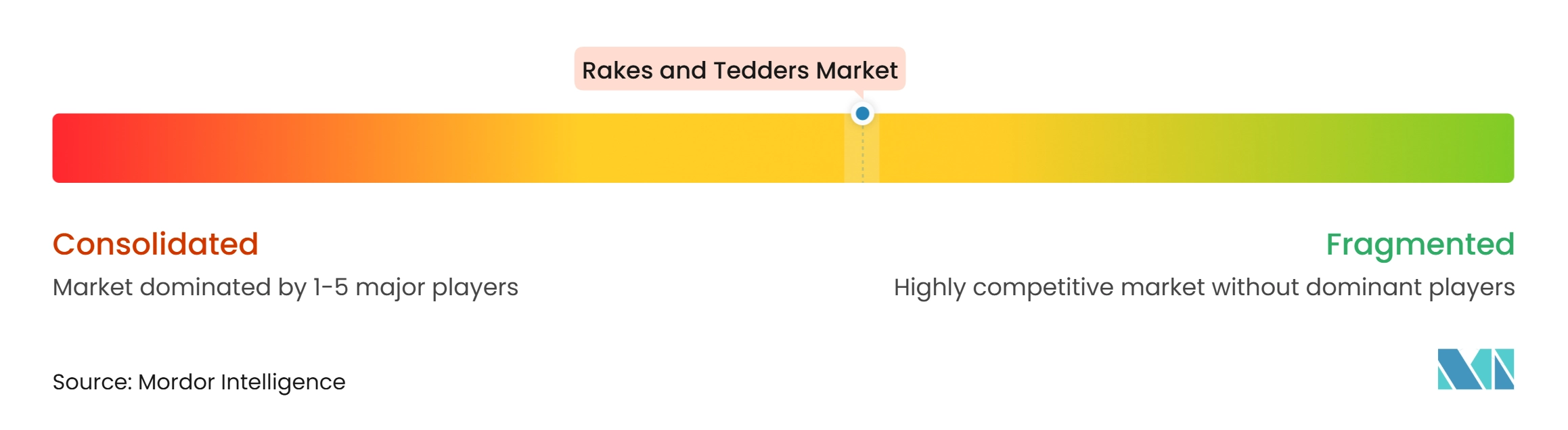
The rakes and tedders market was moderately concentrated in 2026, with KUHN SAS, AGCO GmbH, CLAAS Saulgau GmbH, CNH Industrial N.V., and Maschinenfabrik Bernard KRONE GmbH & Co. KG holding a major share. Competition is shaped by product breadth, dealer networks, after-sales service, equipment durability, and field productivity. Leading players offer mounted and trailed rakes and tedders designed for different farm sizes, tractor power classes, and forage conditions. Regional manufacturers and specialized equipment makers also participate by targeting local agricultural requirements, offering competitive pricing, and developing implements suited to specific field conditions.
Product development remains a key competitive strategy as manufacturers target higher field capacity, precision control, and improved forage quality. KUHN’s GA 14231 four-rotor rake offers a working width of approximately 9 to 13.7 meters and ISOBUS-certified functions, reflecting the focus on high-capacity and electronically controlled forage equipment. In May 2026, KRONE introduced the Swadro T 1040 Pro pickup rake, designed for leafy forage crops such as alfalfa and clover, emphasizing crop handling and reduced leaf loss. These developments illustrate how established players differentiate their portfolios through working width, implement control, and crop-specific designs. Dealer coverage, spare-parts availability, and technical support remain important factors in maintaining relationships with commercial farms and agricultural contractors.
Opportunities remain for manufacturers to develop compact and versatile equipment for smaller or fragmented fields while improving the productivity of larger machines used by commercial producers and contractors. Equipment that supports adjustable working widths, efficient transport, and gentle forage handling can address varied customer requirements. Strojírny Rožmitál’s presentation of a combined tedder-rake at Agritechnica 2025 also illustrates continued product development among regional specialists. While rental and custom-hiring services may help address affordability constraints in some markets, their contribution depends on local contractor networks and seasonal utilization. Overall, competition is anticipated to center on product specialization, operational efficiency, reliable after-sales support, and the ability to serve both established mechanized markets and regions where forage-equipment adoption is developing.
Rakes and Tedders Industry Leaders
-
KUHN SAS (Bucher Industries AG)
-
AGCO GmbH (AGCO Corporation)
-
CLAAS Saulgau GmbH (CLAAS KGaA mbH)
-
CNH Industrial N.V.
-
Maschinenfabrik Bernard KRONE GmbH & Co. KG (Bernard KRONE Holding SE & Co. KG)
- *Disclaimer: Major Players sorted in no particular order
Rakes and Tedders Market Companies Covered in this Report
- CNH Industrial N.V.
- Bernard Krone Holding GmbH and Co. KG
- Krone Gruppe
- AGCO Corporation
- OJSC Gomselmash
- Combine Plant Rostselmash LLC
- Carlos Mainero y Cía. S.A.I.C.F.I.
- Deere & Company
- PÖTTINGER Landtechnik GmbH
- Yanmar Holdings Co., Ltd.
- Lely International N.V.
- MASCHIO GASPARDO S.p.A.
Recent Industry Developments in Rakes and Tedders Market
- August 2026: PÖTTINGER Landtechnik GmbH announced the compact, chassis-free TOP V 6520 C twin-rotor rake. The machine features a pivoting headstock, floating rotor suspension, and mechanically adjustable working width of 5.9–6.5 meters. Its design targets maneuverability, ground following, and forage quality, including on uneven fields
- July 2026: Kverneland introduced the Tactus 2072 and Tactus 2078 double-rotor rakes. The two models feature working widths of 6.4–7.2 meters and 7.0–7.8 meters, respectively. Both incorporate the DUO tine system and TerraLink Plus ground-following technology, targeting consistent raking, reduced soil contamination, and forage handling across different field conditions.
- July 2026: Vicon introduced two double-rotor rakes, ANDEX 725 and ANDEX 785, with working widths of 6.4–7.2 meters and 7.0–7.8 meters, respectively. The machines feature the DUO tine system and TerraLink Plus ground-following technology, with design priorities including clean forage collection, reduced leaf loss, and lower soil contamination.
Global Rakes and Tedders Market Report Scope
The Rakes and Tedders Market is Segmented by Product Type (Rotary Rakes, Wheel Rakes, Basket-Bar Rakes, Parallel-Bar Rakes, and Rotary Tedders), by Mounting Configuration (Mounted, Semi-Mounted, and Trailed), by End User (Commercial Hay Producers, Dairy Farms, Beef Cattle Operations, Sheep and Goat Farms, and Agricultural Contractors and Custom Operators), by Power Requirement (50 HP and Below, Above 50 HP to 100 HP, and Above 100 HP), and by Geography (North America, South America, Europe, Asia-Pacific, Middle East, and Africa). The Market Forecasts are Provided in Terms of Value (USD).
Segmentation Overview
| Rotary Rakes |
| Wheel Rakes |
| Basket-Bar Rakes |
| Parallel-Bar Rakes |
| Rotary Tedders |
| Mounted |
| Semi-Mounted |
| Trailed |
| Commercial Hay Producers |
| Dairy Farms |
| Beef Cattle Operations |
| Sheep and Goat Farms |
| Agricultural Contractors and Custom Operators |
| 50 HP and Below |
| Above 50 HP to 100 HP |
| Above 100 HP |
| North America | United States |
| Canada | |
| Mexico | |
| Rest of North America | |
| South America | Brazil |
| Argentina | |
| Rest of South America | |
| Europe | Germany |
| France | |
| United Kingdom | |
| Italy | |
| Spain | |
| Russia | |
| Rest of Europe | |
| Asia-Pacific | China |
| India | |
| Japan | |
| South Korea | |
| Australia | |
| Vietnam | |
| Rest of Asia-Pacific | |
| Middle East | Turkey |
| Saudi Arabia | |
| United Arab Emirates | |
| Rest of Middle East | |
| Africa | South Africa |
| Egypt | |
| Rest of Africa |
| By Product Type | Rotary Rakes | |
| Wheel Rakes | ||
| Basket-Bar Rakes | ||
| Parallel-Bar Rakes | ||
| Rotary Tedders | ||
| By Mounting Configuration | Mounted | |
| Semi-Mounted | ||
| Trailed | ||
| By End User | Commercial Hay Producers | |
| Dairy Farms | ||
| Beef Cattle Operations | ||
| Sheep and Goat Farms | ||
| Agricultural Contractors and Custom Operators | ||
| By Tractor Power Requirement | 50 HP and Below | |
| Above 50 HP to 100 HP | ||
| Above 100 HP | ||
| By Geography | North America | United States |
| Canada | ||
| Mexico | ||
| Rest of North America | ||
| South America | Brazil | |
| Argentina | ||
| Rest of South America | ||
| Europe | Germany | |
| France | ||
| United Kingdom | ||
| Italy | ||
| Spain | ||
| Russia | ||
| Rest of Europe | ||
| Asia-Pacific | China | |
| India | ||
| Japan | ||
| South Korea | ||
| Australia | ||
| Vietnam | ||
| Rest of Asia-Pacific | ||
| Middle East | Turkey | |
| Saudi Arabia | ||
| United Arab Emirates | ||
| Rest of Middle East | ||
| Africa | South Africa | |
| Egypt | ||
| Rest of Africa | ||
Key Questions Answered in the Report
What is the size of the rakes and tedders market?
The rakes and tedders market was valued at USD 2.23 billion in 2026 and is projected to grow from USD 2.29 billion in 2027 to USD 2.86 billion by 2032, at a CAGR of 4.55% during the forecast period from 2027 to 2032.
Which region leads rakes and tedders sales?
Europe led with 46.2% market share in 2026, supported by mature dairy and livestock operations and established equipment networks. Its replacement demand also supports ongoing purchases of forage machinery across intensive grassland systems and professional contractor fleets.
Which product type has the strongest position?
Rotary rakes held 45.2% share in 2026 and are forecast to expand at a 5.1% CAGR between 2027 and 2032. Their use across multiple forage crops, field conditions, and farm sizes supports this position and keeps them relevant in varied operating environments.
What is driving equipment purchases for forage handling?
Livestock and dairy production growth, labor scarcity, forage-quality needs, and higher contractor demand are the main factors. Buyers also value machines that improve field capacity during limited drying windows and simplify seasonal work planning when weather conditions change quickly.