
Raincoat Products Market Size and Share
Market Overview
| Study Period | 2021 - 2031 |
|---|---|
| Market Size (2026) | USD 4.64 Billion |
| Market Size (2031) | USD 6.16 Billion |
| Growth Rate (2026 - 2031) | 5.85 % |
| Fastest Growing Market | Asia-Pacific |
| Largest Market | Asia-Pacific |
| Market Concentration | Medium |
Major Players *Disclaimer: Major Players sorted in no particular order Image © Mordor Intelligence. Reuse requires attribution under CC BY 4.0. | |
Raincoat Products Market Analysis by Mordor Intelligence
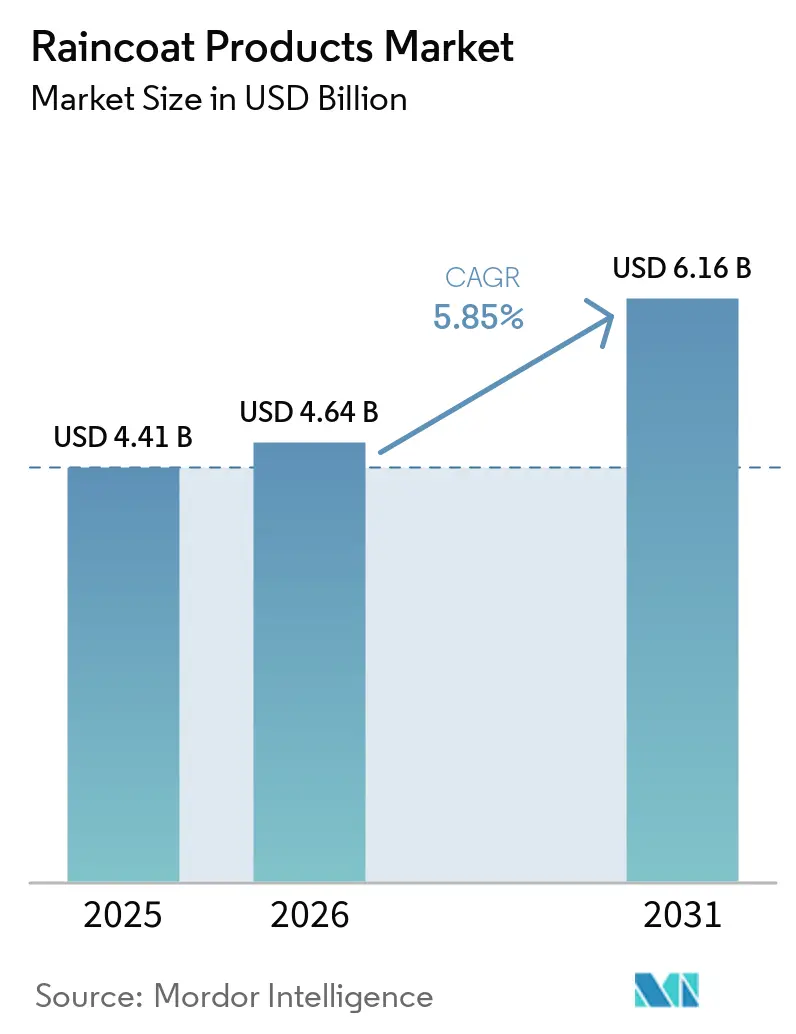
The raincoat products market size was valued at USD 4.41 billion in 2025 and is estimated to grow from USD 4.64 billion in 2026 to reach USD 6.16 billion by 2031, at a CAGR of 5.85% during the forecast period (2026-2031). Demand is broadening as rainwear is used for commuting, outdoor activity, and everyday outerwear rather than only during wet seasons. Changing rainfall patterns and larger outdoor participation bases support replacement purchases and wider product use. Regulatory limits on PFAS are moving product development toward alternative finishes and membrane systems. This raises design and sourcing costs, but it also gives companies a way to differentiate products on performance and compliance. Delivery work, construction activity, and online retail create distinct opportunities that require different prices, product features, and sales approaches.
Key Report Takeaways
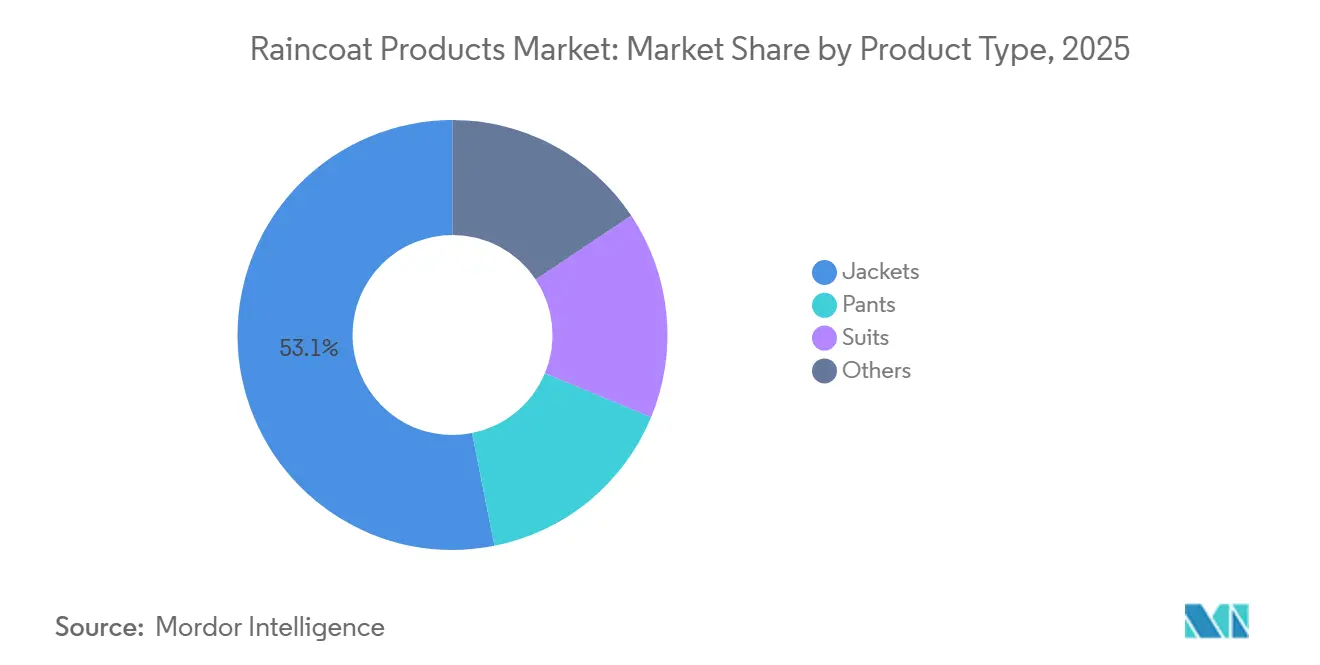
- By product type, jackets held a 53.12% revenue share in 2025, and is estimated to grow at the fastest growing CAGR of 6.34% through 2031.
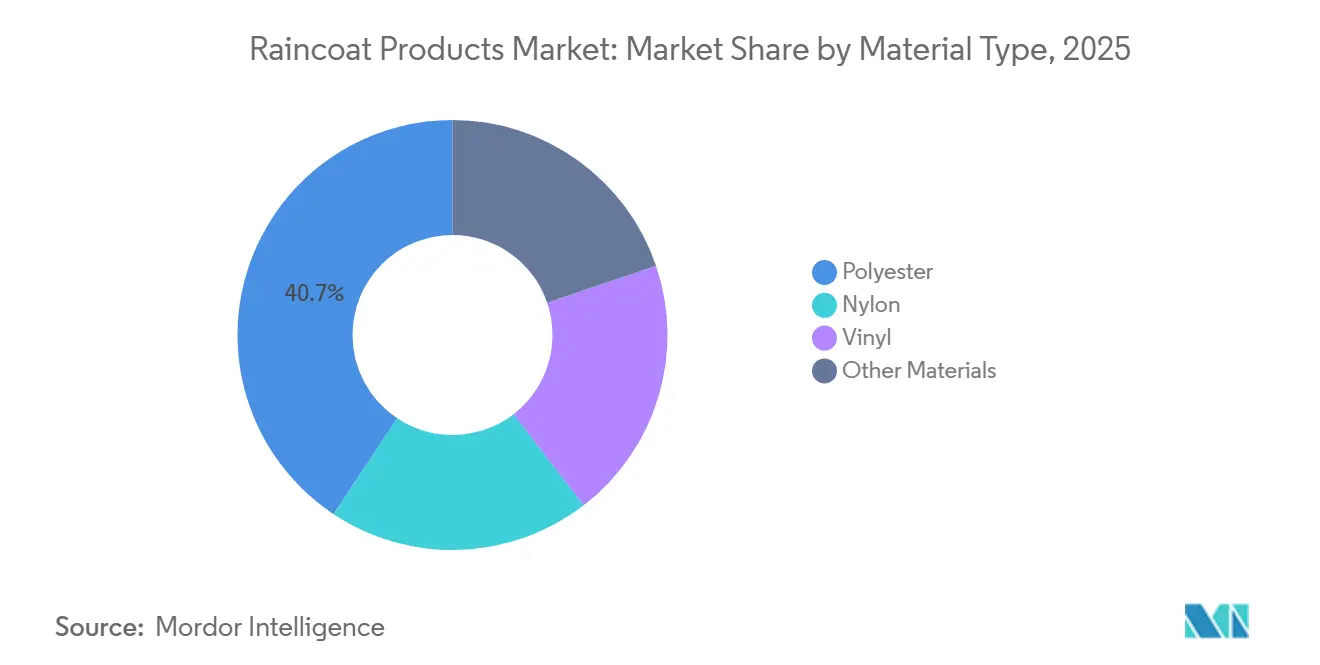
- By material type, polyester held a 40.67% revenue share in 2025, while nylon is expected to grow at a CAGR of 6.65% through 2031.
- By end user, adults segment is forecast to grow at CAGR of 6.89% through 2031, and the segment held the largest share of 70.34% in 2025.
- By distribution channel, offline channels accounted for 65.23% of the raincoat products market size in 2025, while online channels is expected to grow at a CAGR of 7.03% through 2031.
- By geography, Asia Pacific accounted for the largest market share of 38.56% in 2025, and is also expected to grow at the fastest CAGR of 6.36% through 2031.
Note: Market size and forecast figures in this report are generated using Mordor Intelligence’s proprietary estimation framework, updated with the latest available data and insights as of January 2026.
Global Raincoat Products Market Trends and Insights
Drivers Impact Analysis*
| Driver | (~) % Impact on CAGR Forecast | Geographic Relevance | Impact Timeline |
|---|---|---|---|
| Lightweight Waterproof Apparel Demand | +1.5% | Global, with peak in APAC core markets and Western Europe | Medium term (2-4 years) |
| Outdoor Recreation and Weather-Exposed Commuting | +1.2% | North America, Australia, Western Europe | Medium term (2-4 years) |
| Fashion-Functional Raincoat Adoption | +0.8% | Western Europe, East Asia, and North America | Short term (≤ 2 years) |
| E-Commerce and Omnichannel Product Discovery | +0.9% | APAC core markets, North America, and MEA | Short term (≤ 2 years) |
| PFAS-Free and Recycled-Material Innovation | +0.7% | EU, North America, and global export chains | Long term (≥ 4 years) |
| Delivery, Construction, and Field Worker Demand | +0.5% | APAC, South America, and gig-economy hubs | Medium term (2-4 years) |
| Source: Mordor Intelligence | |||
Rising Demand for Lightweight Waterproof Apparel
Consumers increasingly expect rainwear to be lightweight, packable, breathable, and suitable for everyday use. These preferences are shifting the raincoat products market from a category focused on basic weather protection to one driven by comfort and versatility. Two-layer and 2.5-layer constructions eliminate the need for traditional mesh linings and enable lighter garments. Compared with conventional three-layer designs, these constructions can reduce garment weight by 20-30% while maintaining hydrostatic pressure ratings above 10,000 mm. This shift raises the minimum product standards for mainstream brands. Companies that lack differentiated materials or membrane technologies face increasing pressure on margins and product positioning.
Outdoor Recreation and Weather-Exposed Commuting
Outdoor recreation drives demand for durable, packable outerwear in the raincoat products market. In the United States, outdoor participation reached 183.2 million people in 2025, representing 59% of the population aged 6 and older[1]Outdoor Industry Association and Outdoor Foundation, “Outdoor Recreation Participation Reaches Record 183.2 Million Americans,” Outdoor Sports Wire, outdoorsportswire.com . Hiking attracted 63.6 million participants, while camping attracted 42.3 million participants in 2025. Participation among adults aged 65 and older increased from 25.7% in 2016 to 41.6% in 2025. Rainwear enables occasional participants to remain active in wet conditions, despite a decline in average outing frequency. Urban commuters who cycle, use scooters, or rely on public transit also require lightweight protection that is easier to carry than full rain suits.
Fashion-Functional Adoption of Raincoats
The raincoat products market benefits from the growing acceptance of waterproof garments as everyday outerwear. Outdoor-inspired styling has increased the relevance of technical jackets among consumers who value both functionality and fashion. This trend extends raincoat use beyond emergency weather protection and supports more frequent wear.
It also enables brands to develop products that combine simple silhouettes with functional fabrics. Design-led labels and technical outerwear brands can target streetwear audiences while maintaining their presence in performance categories. The growing use of raincoats as primary outerwear may increase consumer emphasis on material quality, fit, and finish.
PFAS-Free and Recycled-Material Innovation
PFAS restrictions are making reformulation a central product-development priority in the raincoat products market. New York prohibits intentionally added PFAS in apparel under ECL §37-0121. Washington State has also adopted restrictions for specified products, including certain apparel categories[2]Washington State Department of Ecology, “WAC 173-337, Safer Products Restrictions and Reporting,” Washington State Department of Ecology, ecology.wa.gov . Alternative finishes may require more frequent care and provide lower oil repellency than legacy chemistries. In response, manufacturers may improve seam construction, use stronger membranes, and adopt more protective face fabrics. Arc'teryx is expected to introduce System 0 in August 2026 and has announced the Sperro SV, which features a GORE-TEX Pro ePE membrane and an ECONYL nylon face fabric.
Restraints Impact Analysis*
| Restraint | (~) % Impact on CAGR Forecast | Geographic Relevance | Impact Timeline |
|---|---|---|---|
| Counterfeit Products in Price-Sensitive Markets | -0.8% | APAC and South America | Short term (≤ 2 years) |
| Performance Trade-Offs in PFAS-Free Coatings | -0.5% | EU, North America, and APAC premium segments | Long term (≥ 4 years) |
| Seasonality and Weather-Dependent Sell-Through | -0.6% | Global, with acute exposure in South Asia and South America | Short term (≤ 2 years) |
| Disposable Poncho Waste and End-of-Life Liability | -0.3% | EU, North America, and South America | Medium term (2-4 years) |
| Source: Mordor Intelligence | |||
Counterfeit Products in Price-Sensitive Markets
Low-cost and counterfeit products constrain branded revenue growth in price-sensitive segments of the raincoat products market. Testing by the Seoul Metropolitan Government found that more than 30% of 35 imported children's products failed to meet safety standards, with three raincoats failing physical safety tests. One product contained formaldehyde at 32.6 times the legal limit. A further Seoul inspection in May 2026 identified phthalate-based plasticizers in children's raincoat zippers at levels 3.6 times above the allowable limit. These products can erode consumer confidence and pressure legitimate brands to reduce prices. Branded suppliers need to strengthen authentication measures, platform enforcement, and consumer education to protect product quality and brand value.
Performance Trade-Offs in PFAS-Free Coatings
The shift away from PFAS-based finishes creates technical constraints for performance-oriented rainwear. Fluorine-free water-repellent finishes can provide water resistance but may offer lower resistance to oils and mechanical abrasion. Users may need to reapply these treatments more frequently to maintain intended product performance. This issue particularly affects workwear and technical products, where durability is critical. Expanded polyethylene membranes provide a potential solution for waterproof and breathable construction without intentionally added PFAS. However, many brands continue to face challenges with outer-fabric finishes, which may slow adoption among buyers with demanding performance requirements.
*Our forecasts treat driver/restraint impacts as directional, not additive. The impact forecasts reflect baseline growth, mix effects, and variable interactions.
Segment Analysis
By Product Type: Jackets Support Broad Use Across Channels
Jackets accounted for 53.12% of the raincoat products market share in 2025, and the segment is expected to grow at the fastest growth rate of 6.34% through 2031. Their leading position reflects widespread use in commuting, hiking, technical activities, and urban wear. A single jacket format can serve multiple end uses, supporting continued investment in design and materials. This versatility also enables brands to apply product innovations across their portfolios.
Jackets remain the primary focus of technical and design investment. Pants and suits address more specialized requirements, including cycling and occupational applications that require more comprehensive coverage. Delivery work can support demand for rain suits, as reliable protection enables riders to continue working in wet conditions. Ponchos face greater sustainability scrutiny than reusable garments. Companies pursuing growth in adjacent product formats must position these offerings against jackets' strong consumer recognition. This product mix continues to shape the raincoat products market.



By Material Type: Nylon Gains Support from Lightweight Construction
Nylon is forecast to expand at a CAGR of 6.65% through 2031, the highest growth rate among material types. Its lightweight and packable properties support demand for performance apparel and fashion-oriented products. Polyester accounted for 40.67% of global material revenue in 2025 and remains widely used due to its accessible cost, established supply base, and predictable manufacturing performance.
Vinyl remains relevant for value-priced and occupational products due to its inherent waterproof properties and low cost. However, it faces increased scrutiny in markets with stringent phthalate and chemical-compliance regulations. Recycled nylon and polyester are gaining traction as brands respond to sourcing and compliance requirements. Arc'teryx uses regenerated ECONYL nylon in the Sperro SV face fabric. Recycled nylon can command a 15-25% premium over virgin alternatives, while supply remains limited outside Europe and Japan. Therefore, material availability remains a key consideration in the raincoat products market.
By End User: Adults Drive Demand Across Urban and Recreational Uses
Adults segment, which recorded the highest market share of 70.34% in 2025, is forecast to grow at a 6.89% CAGR through 2031. This rate exceeds the overall forecast for the raincoat products market. Demand is increasing among adults in APAC cities who place greater value on functional outerwear. Adults aged 25-45 combine performance expectations with interest in everyday style.
Older outdoor participants also create a distinct product need. Participation among U.S. adults aged 65 and older reached 41.6% in 2025. These buyers may value lighter garments, easier layering, and stronger durability. Kids remain a smaller but distinct segment with high safety requirements. Verified product safety can be a differentiator because failures in children's rainwear create recall and reputational risks. These different needs widen the raincoat products market.
By Distribution Channel: Digital Sales Grow Faster While Stores Retain Importance
Offline channels accounted for 65.23% of the raincoat products market size in 2025. Physical stores enable consumers to inspect materials, construction quality, fit, and product performance before purchasing. Specialty outdoor retailers, department stores, and branded stores remain important distribution channels for premium products. Store staff also help customers evaluate technical rainwear products.
Online channels are projected to grow at a CAGR of 7.03% through 2031. Fit algorithms, product videos, and verified reviews are reducing barriers to online purchases. The shift toward direct-to-consumer sales is also influencing the raincoat products market, as it can improve unit margins. However, direct selling can create tensions with wholesale partners. Digital demand signals emerge rapidly, requiring improved inventory visibility and faster responses across channels. This transition is reshaping the raincoat products market.
Geography Analysis
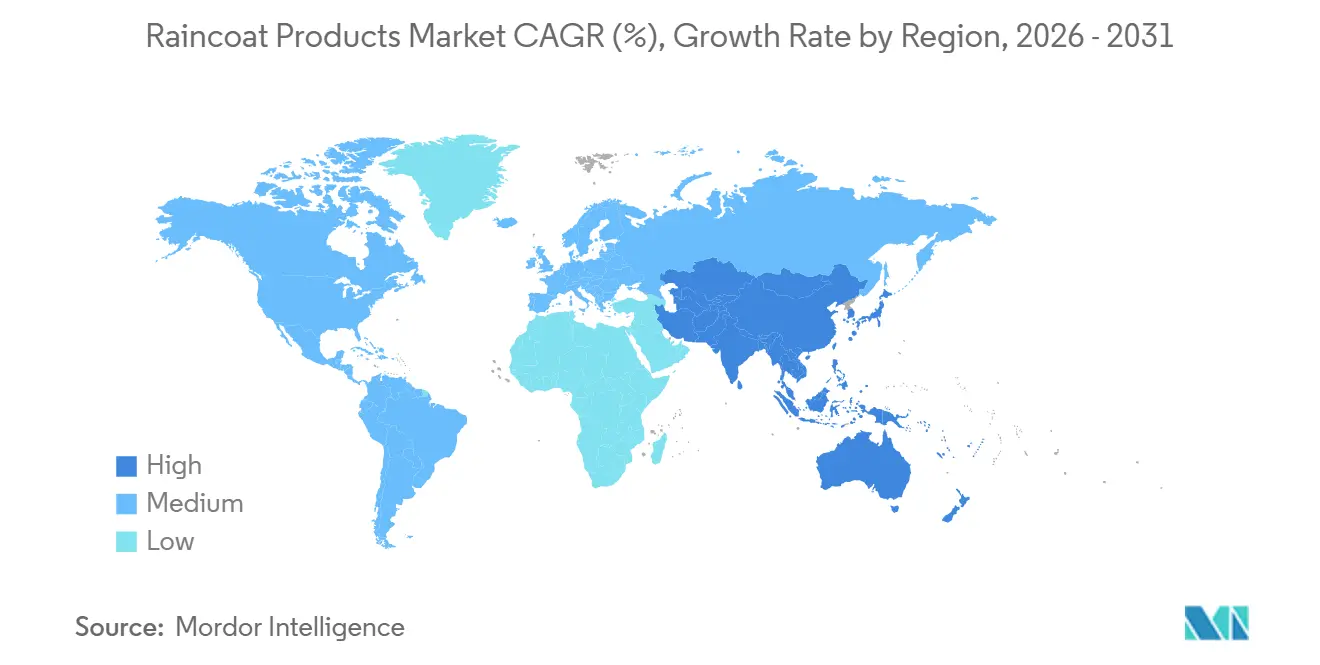
Asia-Pacific accounted for 38.56% of the raincoat products market share in 2025 and is expected to grow at a CAGR of 6.36% through 2031. China serves as a major manufacturing hub and an expanding premium consumer market. India presents a middle-market opportunity, as branded product penetration remains limited relative to its population. Indonesia, the Philippines, and Vietnam generate recurring monsoon-driven demand and continue to expand online retail access. China Compulsory Certification requirements, along with ISO 9001 and ISO 14001 practices, are raising quality expectations among manufacturers and exporters.
North America and Europe represent the second- and third-largest regional revenue pools, respectively. In the United States, 183.2 million people participated in outdoor recreation in 2025, supporting replacement demand for weather-ready outerwear. New York's PFAS-in-apparel law is changing product requirements for suppliers serving the state. Washington State restrictions also influence product decisions for suppliers serving the U.S. market. Nordic countries exhibit high per-capita demand due to climatic conditions, while the United Kingdom, France, Germany, and Italy represent key European value pools.
South America and the Middle East and Africa offer smaller but complementary opportunities for the raincoat products market. Brazil and Argentina experience concentrated wet seasons, maintain large agricultural and construction workforces, and have significant exposure to informal retail channels. Chile offers a more organized retail opportunity across its major urban areas. Construction activity in Gulf countries supports occupational demand for high-visibility waterproof workwear. South Africa and Saudi Arabia are experiencing greater retail formalization and broader physical and online availability of international apparel brands.

Competitive Landscape
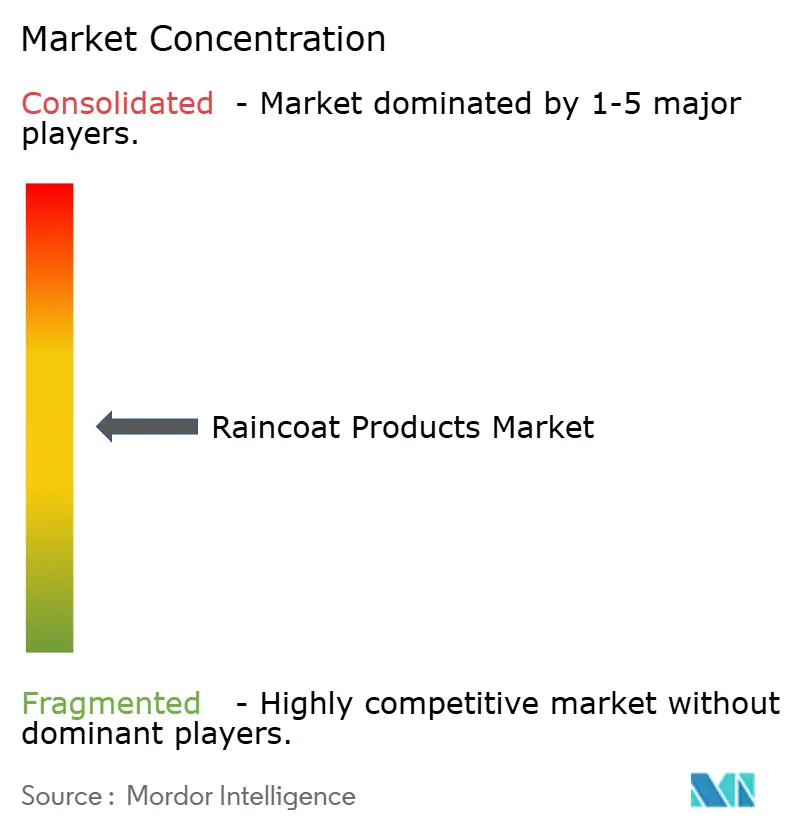
The raincoat products market has a moderately concentrated premium technical segment and a fragmented mid-value segment. Arc'teryx, Columbia Sportswear, Patagonia, The North Face, and Helly Hansen are established technical brands in the premium category. Regional suppliers, design-focused labels, and Decathlon compete more actively in accessible price ranges. Opportunities remain in occupational rainwear, certified children's products, and products designed to address female-specific fit requirements. These segments create distinct growth opportunities within the raincoat products market.
Kontoor Brands is expected to announce an agreement to acquire Helly Hansen in February 2025, combining Helly Hansen's outdoor and workwear portfolio with Kontoor Brands' retail distribution capabilities. Arc'teryx is expected to introduce System 0 in August 2026 as a circular product design framework and launch the Sperro SV. The product is expected to use a GORE-TEX Pro ePE membrane and recyclable ECONYL nylon face fabric. These developments are likely to reshape the raincoat products market through expanded distribution, advanced materials, and circular design initiatives. Smaller brands will need clearly differentiated product offerings or channel strategies to compete with the scale of larger companies.
Companies are increasingly choosing between premium circular products and accessible performance-oriented ranges. AI-supported fit guidance, virtual try-on tools, and material traceability are becoming more relevant in direct digital sales channels. These tools can help brands address fit-related concerns and respond more quickly to changing demand. Design-focused direct-to-consumer labels can establish specialized niches without matching the supply chain scale of larger companies. Competitive performance in the raincoat products market will depend on product credibility, pricing, distribution reach, and compliance with material requirements.
Raincoat Products Industry Leaders
Columbia Sportswear Company
The North Face
Patagonia, Inc.
Arc'teryx
Helly Hansen AS
- *Disclaimer: Major Players sorted in no particular order

Recent Industry Developments
- August 2026: Arc'teryx Equipment introduced System 0™, a circular product design framework, alongside the global launch of the Sperro SV hardshell jacket, priced at USD 1,200, on September 4, 2026. The Sperro SV is the world's first TESTEX Circularity-certified technical outerwear product. It uses a GORE-TEX Pro ePE PFAS-free membrane and a recyclable ECONYL® nylon face fabric. Through Arc'teryx's ReBIRD™ program, the jacket includes three years of unlimited out-of-warranty repairs. Arc'teryx distributes the product through more than 2,300 retail locations worldwide.
- February 2025: Kontoor Brands signed a definitive agreement to acquire Helly Hansen from Canadian Tire Corporation. The transaction is expected to close in the second quarter of 2025. Through the acquisition, Kontoor Brands aims to scale Helly Hansen’s outdoor and workwear rainwear portfolio across broader global retail distribution channels.


Global Raincoat Products Market Report Scope
The raincoat products market comprises waterproof or water-resistant outerwear designed to protect the wearer from rain and wet weather conditions. The market includes products made from materials such as nylon, vinyl, and polyester, available in different designs. Raincoats are used by consumers for daily commuting, outdoor activities, travel, and recreational purposes, as well as by workers in sectors such as construction, transportation, agriculture, logistics, and emergency services.
The raincoat products market is segmented by product type, material type, end user, distribution channel, and geography. By product type, the market is segmented into jackets, pants, suits, and others. By material type, the market is segmented into nylon, vinyl, polyester, and other materials. By end user, the market is segmented into adults and kids. By distribution channel, the market is segmented into offline and online. The report also covers the raincoat products market size and forecasts for the raincoat products market in 15 countries across major regions. For each segment, the market sizing and forecasts have been done on the basis of value (USD).
| Jackets |
| Pants |
| Suits |
| Others |
| Nylon |
| Vinyl |
| Polyester |
| Other Materials |
| Adults |
| Kids |
| Offline |
| Online |
| Asia-Pacific | China |
| India | |
| Japan | |
| South Korea | |
| ASEAN Countries | |
| Rest of Asia-Pacific | |
| North America | United States |
| Canada | |
| Mexico | |
| Europe | Germany |
| United Kingdom | |
| France | |
| Italy | |
| NORDIC Countries | |
| Rest of Europe | |
| South America | Brazil |
| Argentina | |
| Rest of South America | |
| Middle East and Africa | Saudi Arabia |
| South Africa | |
| Rest of Middle East and Africa |
| By Product Type | Jackets | |
| Pants | ||
| Suits | ||
| Others | ||
| By Material Type | Nylon | |
| Vinyl | ||
| Polyester | ||
| Other Materials | ||
| By End User | Adults | |
| Kids | ||
| By Distribution Channel | Offline | |
| Online | ||
| By Geography | Asia-Pacific | China |
| India | ||
| Japan | ||
| South Korea | ||
| ASEAN Countries | ||
| Rest of Asia-Pacific | ||
| North America | United States | |
| Canada | ||
| Mexico | ||
| Europe | Germany | |
| United Kingdom | ||
| France | ||
| Italy | ||
| NORDIC Countries | ||
| Rest of Europe | ||
| South America | Brazil | |
| Argentina | ||
| Rest of South America | ||
| Middle East and Africa | Saudi Arabia | |
| South Africa | ||
| Rest of Middle East and Africa | ||


Key Questions Answered in the Report
What is the forecast for raincoat products through 2031?
The raincoat products market size is projected to rise from USD 4.64 billion in 2026 to USD 6.16 billion by 2031, at a 5.85% CAGR. Demand is supported by commuting, outdoor participation, delivery work, and wider everyday use.
Which product type leads raincoat products sales?
Jackets led product-type revenue with a 53.12% share in 2025 because they serve commuting, outdoor activity, and everyday wear. Their versatility also concentrates material development, technical features, and design investment in this format.
Which raincoat material type is growing fastest?
Nylon is projected to record the highest material-type CAGR at 6.65% through 2031, supported by demand for light and packable garments. Polyester remains important because of its established supply, predictable manufacturing performance, and cost-performance profile.
Which region has the largest raincoat products demand?
Asia-Pacific held 38.56% of global value in 2025 and is forecast to grow at a 6.36% CAGR through 2031. Its demand is supported by monsoon exposure, commuter needs, expanding online access, and manufacturing capacity.
Page last updated on:





