
Radiofrequency Skin Rejuvenation Devices Market Size and Share
Market Overview
| Study Period | 2020 - 2031 |
|---|---|
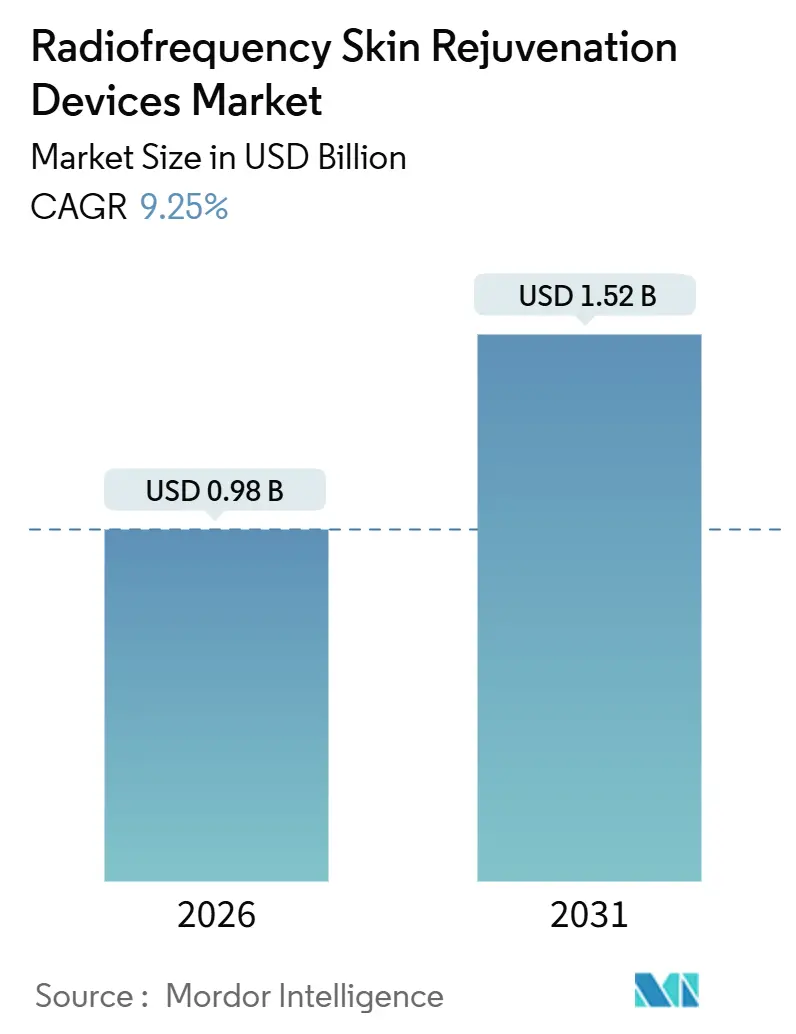
| Market Size (2026) | USD 0.98 Billion |
| Market Size (2031) | USD 1.52 Billion |
| Growth Rate (2026 - 2031) | 9.25 % |
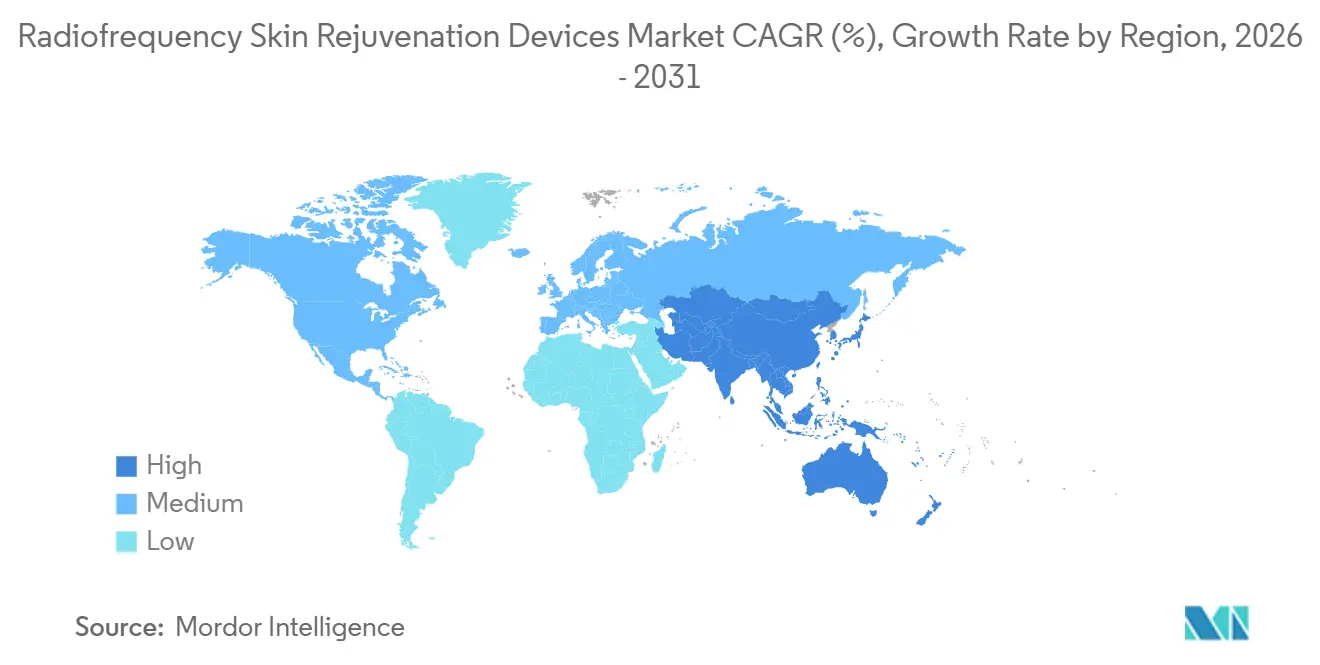
| Fastest Growing Market | Asia Pacific |
| Largest Market | North America |
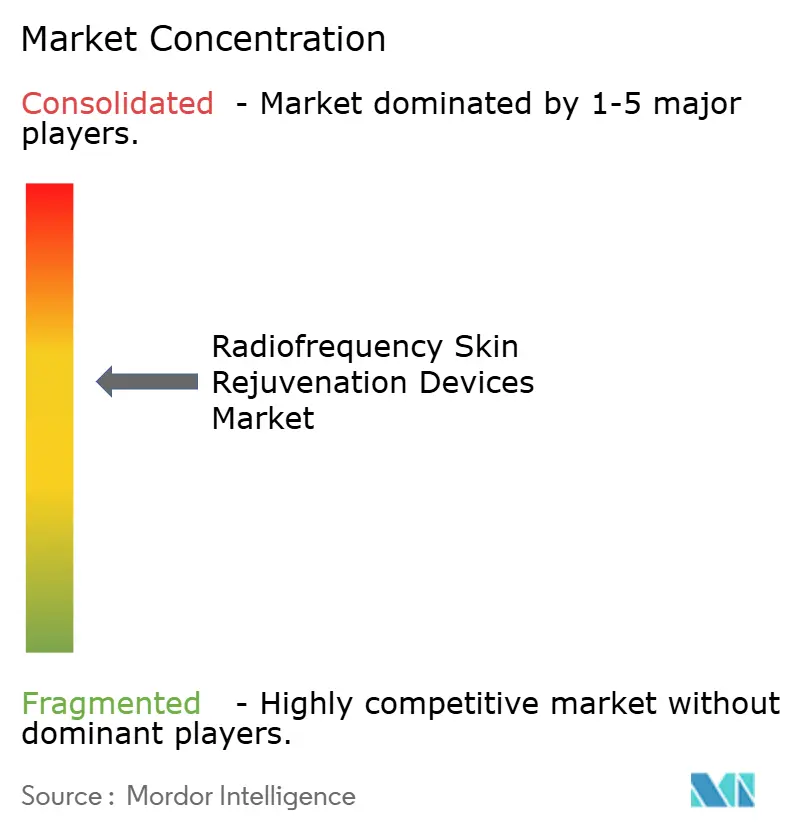
| Market Concentration | Medium |
Major Players *Disclaimer: Major Players sorted in no particular order Image © Mordor Intelligence. Reuse requires attribution under CC BY 4.0. | |
Radiofrequency Skin Rejuvenation Devices Market Analysis by Mordor Intelligence
The Radiofrequency Skin Rejuvenation Devices Market size is estimated at USD 0.98 billion in 2026, and is expected to reach USD 1.52 billion by 2031, at a CAGR of 9.25% during the forecast period (2026-2031).
Persistent demand for minimally invasive procedures, rapid miniaturization of energy platforms, and the rise of hybrid clinic-at-home care models are amplifying growth momentum in the Radiofrequency Skin Rejuvenation Devices market. Fractional microneedling protocols, AI-driven parameter control, and bundled financing programs are narrowing the adoption gap between large hospital centers and single-practitioner medical spas. Meanwhile, home-use devices, cleared for over-the-counter purchase since 2024, are broadening the consumer funnel and reinforcing brand visibility. Competitive dynamics remain fluid, with regional specialists leveraging distributor tie-ups and lower-price portable formats to chip away at incumbent share, while established multinationals focus on multipolar and hybrid platforms that extend treatment menus and device utilization rates.
Key Report Takeaways
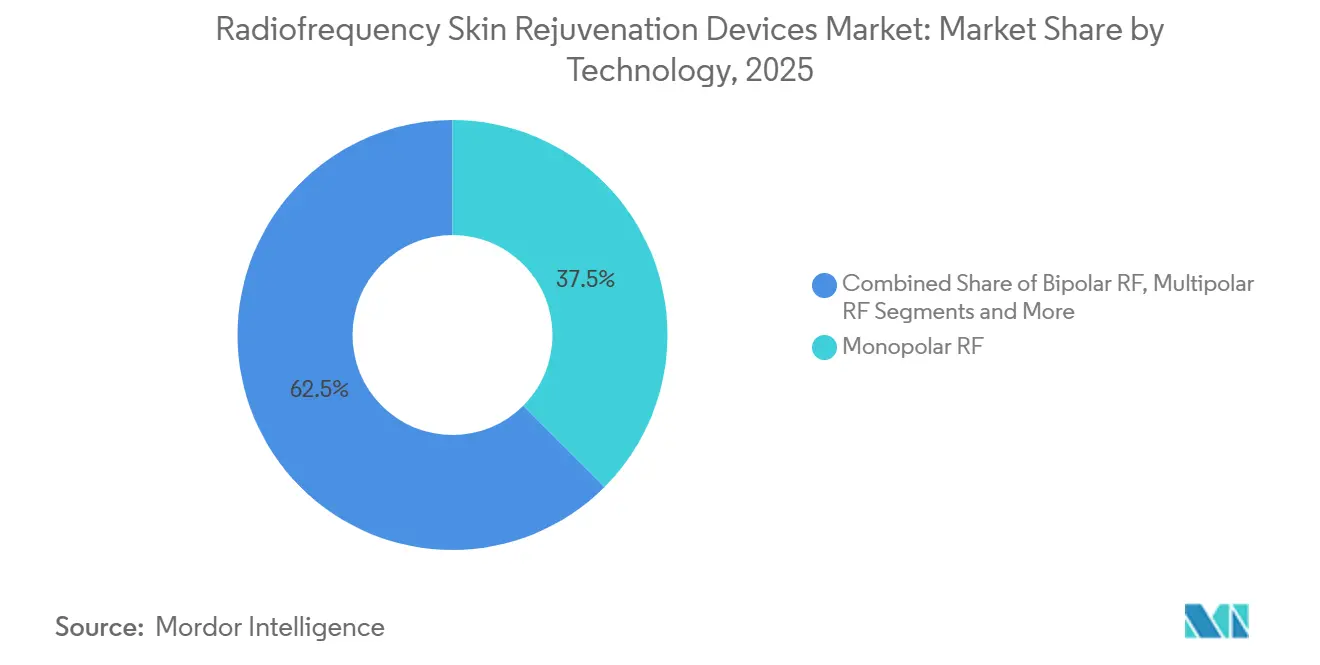
- By technology, monopolar systems led with 37.55% of the Radiofrequency Skin Rejuvenation Devices market share in 2025; fractional RF microneedling is advancing at a 12.25% CAGR to 2031.
- By device format, portable and handheld units held 54.53% of revenue in 2025, while the category is expanding at a 10.85% CAGR through 2031.
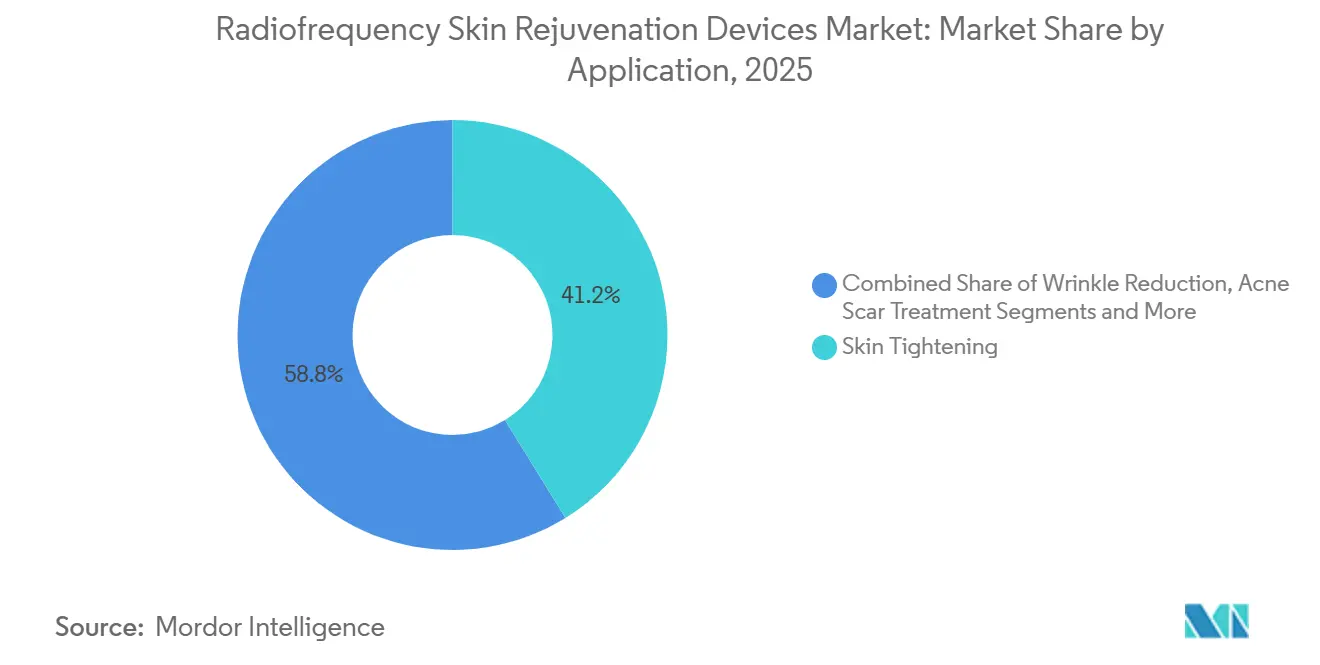
- By application, skin tightening commanded 41.23% of revenue in 2025; acne scar treatment is growing fastest at 11.55% annually to 2031.
- By end user, dermatology clinics accounted for 58.03% of the Radiofrequency Skin Rejuvenation Devices market size in 2025, whereas home-care settings are scaling at an 11.11% CAGR.
- By geography, North America retained 42.25% market share in 2025; Asia-Pacific is forecast to post a 10.21% CAGR to 2031.
Note: Market size and forecast figures in this report are generated using Mordor Intelligence’s proprietary estimation framework, updated with the latest available data and insights as of January 2026.
Market Trends and Insights
Drivers Impact Analysis of Radiofrequency Skin Rejuvenation Devices Market*
| Driver | (~) % Impact on CAGR Forecast | Geographic Relevance | Impact Timeline |
|---|---|---|---|
| Escalating demand for non-invasive aesthetic procedures | +2.8% | Global, with North America and Asia-Pacific leading | Medium term (2-4 years) |
| Aging population & anti-aging consciousness | +2.5% | Europe, North America, Japan, South Korea | Long term (≥4 years) |
| Rapid tech advances (fractional & multipolar RF) | +2.1% | North America, Europe, Asia-Pacific | Short term (≤2 years) |
| AI-guided personalized energy modulation | +1.2% | North America, select Asia-Pacific markets (South Korea, Japan) | Medium term (2-4 years) |
| Post-COVID teledermatology boosts home-use RF uptake | +0.7% | North America, Europe | Short term (≤2 years) |
| Source: Mordor Intelligence | |||
Escalating Demand for Non-Invasive Aesthetic Procedures
Minimally invasive services continue to displace traditional surgery in the Radiofrequency Skin Rejuvenation Devices market. The American Society of Plastic Surgeons recorded 28.2 million procedures in 2024, a 1.5% rise over 2023, with skin resurfacing volume alone climbing 6% to 3.7 million treatments[1]American Society of Plastic Surgeons, “More Than 28 Million Cosmetic Procedures Performed in 2024,” plasticsurgery.org. Patient preference is shifting toward fractional and hybrid RF modalities that shorten downtime while improving texture, motivating medical spas—whose U.S. footprint expanded 18% in 2023—to anchor service menus around RF-based tightening packages. Repeat-visit economics remain strong, with 75% of med-spa clientele returning for additional sessions, reinforcing device utilization and accelerating upgrade cycles.
Aging Population and Anti-Aging Consciousness
Population aging is widening the candidate pool for RF rejuvenation across developed markets. In 2024 the European Union reported 21.6% of citizens aged 65 or older, and projections indicate one-third of Europeans will be senior citizens by 2100. Japan’s elderly cohort reached 29.3% in late 2024, the highest globally. Women constitute the majority of the 60-plus demographic, underpinning sustained demand for collagen-remodeling therapies. Device makers now tune energy densities and pulse durations for mature skin to minimize thermal injury while maintaining efficacy.
Rapid Tech Advances in Fractional and Multipolar RF
Standardized protocols issued in 2024 recommend needle depths of 0.5 mm–7 mm and energies up to 62 mJ per pin, ensuring predictable outcomes across Fitzpatrick I–IV skin types. Multipolar systems that disperse current over four to six electrodes achieve uniform dermal heating at 5 mm–15 mm, supporting cellulite and body-contouring indications. Systematic reviews confirm collagen synthesis benefits persisting beyond 12 months when fractional RF is combined with poly-L-lactic acid fillers.
AI-Guided Personalized Energy Modulation
Emerging platforms embed impedance sensors and machine-learning algorithms that adjust pulse width in real time. EXION, launched in March 2024, modulates output based on live skin feedback, lowering operator variability and adverse-event risk. Clinical validation in 2025 showed 87% predictive accuracy for wrinkle reduction when AI image analysis guided RF-ultrasound protocols, tightening the feedback loop between teledermatology consults and at-home device settings.
Restraints Impact Analysis of Radiofrequency Skin Rejuvenation Devices Market*
| Restraint | (~) % Impact on CAGR Forecast | Geographic Relevance | Impact Timeline |
|---|---|---|---|
| High equipment & treatment costs | -1.5% | Global, acute in emerging markets (India, Brazil, MEA) | Medium term (2-4 years) |
| Stringent regulatory clearance pathways | -0.9% | North America (FDA), Europe (MDR), China (NMPA) | Long term (≥4 years) |
| Counterfeit/low-quality home devices hurt trust | -0.6% | Global, concentrated in e-commerce channels | Short term (≤2 years) |
| Source: Mordor Intelligence | |||
High Equipment and Treatment Costs
Professional trolley systems can exceed USD 50,000, while full treatment courses run USD 3,000–USD 15,000, discouraging uptake among small clinics. Venus Concept saw fiscal-2024 revenue fall 15% as third-party lenders tightened credit, prompting the firm to introduce an in-house “Venus Prime” financing program in January 2024[2]Venus Concept Inc., “Venus Concept Launches Venus Prime,” venusconcept.com. Portable formats, priced 30%–50% lower, are gaining favor as cost-controlled entry points.
Stringent Regulatory Clearance Pathways
The U.S. 510(k) process can take up to 12 months and requires exhaustive IEC 60601 safety testing, while Europe’s Medical Device Regulation demands more clinical evidence, expanding documentation loads. China’s NMPA has likewise extended review cycles post-2024, delaying foreign launches and favoring incumbents with deep regulatory resources.
*Our forecasts treat driver/restraint impacts as directional, not additive. The impact forecasts reflect baseline growth, mix effects, and variable interactions.
Radiofrequency Skin Rejuvenation Devices Market Segment Analysis
By Technology:
Fractional Microneedling Disrupts Monopolar DominanceMonopolar systems held a 37.55% share in 2025, anchoring deep-tissue tightening and body-contouring use cases. Yet fractional microneedling is racing ahead at a 12.25% CAGR as patients prioritize texture refinement over bulk contraction. The Radiofrequency Skin Rejuvenation Devices market size for fractional solutions is expected to more than double by 2031, buoyed by standardized depth-energy protocols and histologically proven neocollagenesis. Fractional platforms such as Morpheus8 deliver 1 MHz energy at selectable depths up to 7 mm, allowing single-pass treatment of scars, laxity, and photoaging with minimal downtime. Bipolar and multipolar configurations remain essential for Fitzpatrick IV-VI skin where superficial heating mitigates pigment risk, and hybrid RF-laser stacks are emerging for comprehensive rejuvenation packages.
Technological progress is shifting competition from sheer power output toward treatment customization. Cooling-integrated microneedle tips, disposable electrode arrays, and dual-frequency modes are now standard in premium systems. Manufacturers are also stacking RF with electroporation or ultrasound to deliver cosmeceutical actives, boosting per-procedure revenue for clinics. Clinical data confirming 75% cellulite improvement when multipolar RF is paired with vacuum massage highlights cross-indication potential.



By Device Format:
Portability Drives Clinical and Home AdoptionPortable and handheld platforms captured 54.53% of revenue in 2025 and are growing at a 10.85% CAGR, fueled by the convergence of clinic efficiency needs and home-care demand. Built-in impedance sensors, preset safety caps, and IoT connectivity elevate these compact units from novelty to revenue workhorse. Clinic-owned handhelds permit rapid room turnover and minimal consumables, while consumer retail units extend brand presence into the household. FOREO’s multi-modal BEAR, priced EUR 429–EUR 1,429, typifies premium at-home positioning backed by Bluetooth-linked tutorials.
Trolley-mounted flagships remain indispensable for high-power body contouring, yet financing constraints and floor-space economics are prompting many practices to lease rather than purchase. Tabletop systems provide an intermediary option, balancing wattage with modest footprint. Industry financing evolution mirrors device miniaturization; subscription models and usage-based payments reduce upfront capital, aligning vendor revenue with real-time utilization.
By Application:
Acne Scar Treatment Outpaces Skin TighteningSkin tightening held 41.23% of 2025 revenue, yet acne scar protocols are registering the highest growth at 11.55% CAGR. The Radiofrequency Skin Rejuvenation Devices market share for acne indications is being propelled by high-resolution before-and-after photography on social platforms and by systematic reviews reporting 75% patient-rated improvement after 3–5 fractional sessions. Patients view scar correction as a tangible, visible payoff versus generalized tightening, driving willingness to commit to multi-session plans.
Wrinkle reduction overlaps with tightening but benefits from bipolar and multipolar precision in periorbital and perioral zones. Cellulite and body contouring applications capitalize on uniform deep-dermal heating, while hyperpigmentation protocols remain adjunctive due to the efficacy of alternative laser therapies. Manufacturers respond by engineering modular handpieces that swap seamlessly between indications, maximizing return on hardware investment.
By End User:
Home-Care Settings Surge as Clinics ConsolidateDermatology clinics accounted for 58.03% of 2025 revenue and continue to dominate high-energy treatments requiring medical oversight. Multi-procedure bundles and loyalty memberships keep repeat rates high and utilization steady. Conversely, the home-care channel is the fastest riser at 11.11% CAGR, underpinned by FDA clearances for over-the-counter devices with automated safety locks. Teledermatology platforms bridge professional guidance and self-administration, allowing physicians to escalate patients to in-office fractional procedures as needed.
Plastic-surgery centers and hospitals employ RF systems in postoperative care to accelerate wound healing and reduce scarring, though their share remains modest. Medical spas, especially those attached to fitness centers or luxury hotels, leverage flexible staffing models to offer extended hours, further expanding consumer touchpoints for the Radiofrequency Skin Rejuvenation Devices market.
Geography Analysis
North America Radiofrequency Skin Rejuvenation Devices Market
North America maintained a 42.25% stake in 2025 on the back of high discretionary health spending, dense clinic networks, and streamlined 510(k) clearances for devices such as Optimas MAX and XERF. The United States performed 3.7 million skin resurfacing procedures in 2024, reflecting 6% growth even as nonsurgical tightening volumes plateaued, a sign that fractional modalities resonate more strongly with consumers. Canada’s Health Canada license for Thermage FLX in April 2025 broadened access to monopolar tech, while Mexico’s medical-tourism hubs are adding bilingual med-spa franchises focused on RF resurfacing.
APAC and Oceania Radiofrequency Skin Rejuvenation Devices Market
Asia-Pacific is the growth pacesetter at 10.21% CAGR, driven by Japan’s 29.3% senior population and South Korea’s 1.17 million inbound aesthetic tourists in 2024. Chinese clinics are seeing a surge in male clientele, expanding market demographics, and Australia’s TGA clearance for Venus Bliss MAX in September 2024 strengthened the device mix in Oceania. Urbanization and social media influence, especially K-beauty trends, continue to accelerate uptake of compact fractional devices.
EMEA and South America Radiofrequency Skin Rejuvenation Devices Market
Europe offers long-term upside as aging deepens; one-fifth of the population was already 65 plus in 2024, projected to hit 32.5% by 2100[3]Eurostat, “Demography of Europe – 2025 Edition,” ec.europa.eu. Near-term growth is moderated by the Medical Device Regulation’s rigorous clinical-evidence mandates and fragmented reimbursement systems. Italy and Germany, with median ages approaching 49 and 46 years, respectively, register the highest per-capita volumes for anti-aging treatments. The Middle East and Africa benefit from premium wellness tourism in Gulf Cooperation Council states, whereas South America contends with import duties and currency instability despite ANVISA’s streamlined pathways in Brazil.

Competitive Landscape
Competition is moderately fragmented. InMode, BTL Aesthetics, Candela, and Venus Concept headline the Radiofrequency Skin Rejuvenation Devices industry, but regional specialists such as Jeisys, Lutronic, and YA-MAN capture localized share with distributor networks and culturally tailored marketing. Capital intensity remains a hurdle—trolley-grade platforms price above USD 50,000—prompting borrowers to seek vendor-backed financing or pay-per-use models. Cutera’s emergence from Chapter 11 in May 2025 following a USD 400 million debt reduction exemplifies sector volatility. Venus Concept’s 2024 revenue slide of 15% spurred the rollout of its in-house Venus Prime financing to stabilize sales.
Strategically, incumbents lean on AI-guided modulation and IoT telemetry to differentiate premium systems, while portfolio breadth enables cross-selling of companion consumables. Private-equity interest remains high: Candela’s USD 1.2 billion acquisition by CD&R in July 2024, and L’Oréal’s 10% Galderma stake in August 2024, underscore confidence in recurring procedure revenue. Patent filings around cooling microneedle tips and disposable electrode arrays highlight a shift toward patient-safety features that resonate with regulators and insurers.
White-space opportunities include integration of RF modalities into post-surgical care pathways and development of ultra-portable form factors for emerging-market clinics constrained by space and budget. Counterfeit deterrence technologies—blockchain tracking, QR-code authentication—also offer differentiation as regulators clamp down on grey-market imports.
Radiofrequency Skin Rejuvenation Devices Industry Leaders
InMode Ltd
BTL Aesthetics
Candela Medical
Venus Concept
Cynosure
- *Disclaimer: Major Players sorted in no particular order
Radiofrequency Skin Rejuvenation Devices Market Companies Covered in this Report
- Alma Lasers
- Bison Medical
- BTL
- Candela Medical
- Cartessa Aesthetics
- Cutera
- Cynosure
- EndyMed Medical
- Fotona
- Hologic
- IBRAMED
- InMode Ltd
- Jeisys Medical
- Lumenis
- Lutronic
- NuFACE
- Pollogen (TriPollar)
- SharpLight Technologies
- Silk'n / Home Skinovations
- Candela Medical
- Venus Concept
- YA-MAN Ltd

Recent Industry Developments in Radiofrequency Skin Rejuvenation Devices Market
- August 2025: Cynosure Lutronic received FDA clearance for its XERF monopolar platform targeting deep dermal tightening.
- April 2025: Health Canada granted a medical device license for Solta Medical’s Thermage FLX, expanding monopolar access across clinics nationwide.


Global Radiofrequency Skin Rejuvenation Devices Market Report Scope
As per the scope of the report, radiofrequency skin rejuvenation devices are medical or cosmetic tools that utilize radiofrequency energy to stimulate collagen production, tighten skin, and improve skin texture and tone.
The radiofrequency skin rejuvenation devices market is segmented by technology into monopolar radio frequency (RF), bipolar radio frequency (RF), multipolar radio frequency (RF), fractional radio frequency microneedling, and hybrid or combination radio frequency. By device format, the market is categorized into trolley-mounted systems, table-top systems, and portable or handheld devices. Based on application, the market includes skin tightening treatments, wrinkle reduction procedures, acne scar treatments, body contouring services, cellulite reduction treatments, and hyper-pigmentation & stretch-mark treatments. By end user, the market is divided into dermatology clinics, medical spas, plastic surgery centers, hospitals & outpatient centers, and home-care settings. Geographically, the market is analyzed across North America, Europe, Asia-Pacific, the Middle East and Africa, and South America. The Market Forecasts are Provided in Terms of Value (USD).
| Monopolar RF |
| Bipolar RF |
| Multipolar RF |
| Fractional RF Microneedling |
| Combination / Hybrid RF |
| Trolley-Mounted Systems |
| Table-Top Systems |
| Portable / Handheld |
| Skin Tightening |
| Wrinkle Reduction |
| Acne Scar Treatment |
| Body Contouring |
| Cellulite Reduction |
| Hyper-pigmentation & Stretch-Marks |
| Dermatology Clinics |
| Medical Spas |
| Plastic Surgery Centers |
| Hospitals & Out-patient Centers |
| Home-care Settings |
| North America | United States |
| Canada | |
| Mexico | |
| Europe | Germany |
| United Kingdom | |
| France | |
| Italy | |
| Spain | |
| Rest of Europe | |
| Asia-Pacific | China |
| India | |
| Japan | |
| Australia | |
| South Korea | |
| Rest of Asia-Pacific | |
| Middle East and Africa | GCC |
| South Africa | |
| Rest of Middle East and Africa | |
| South America | Brazil |
| Argentina | |
| Rest of South America |
| By Technology | Monopolar RF | |
| Bipolar RF | ||
| Multipolar RF | ||
| Fractional RF Microneedling | ||
| Combination / Hybrid RF | ||
| By Device Format | Trolley-Mounted Systems | |
| Table-Top Systems | ||
| Portable / Handheld | ||
| By Application | Skin Tightening | |
| Wrinkle Reduction | ||
| Acne Scar Treatment | ||
| Body Contouring | ||
| Cellulite Reduction | ||
| Hyper-pigmentation & Stretch-Marks | ||
| By End User | Dermatology Clinics | |
| Medical Spas | ||
| Plastic Surgery Centers | ||
| Hospitals & Out-patient Centers | ||
| Home-care Settings | ||
| By Geography | North America | United States |
| Canada | ||
| Mexico | ||
| Europe | Germany | |
| United Kingdom | ||
| France | ||
| Italy | ||
| Spain | ||
| Rest of Europe | ||
| Asia-Pacific | China | |
| India | ||
| Japan | ||
| Australia | ||
| South Korea | ||
| Rest of Asia-Pacific | ||
| Middle East and Africa | GCC | |
| South Africa | ||
| Rest of Middle East and Africa | ||
| South America | Brazil | |
| Argentina | ||
| Rest of South America | ||


Key Questions Answered in the Report
How large is the Radiofrequency Skin Rejuvenation Devices market today?
The Radiofrequency Skin Rejuvenation Devices market size reached USD 0.98 billion in 2026 and is on track to hit USD 1.52 billion by 2031.
Which technology segment is growing the fastest?
Fractional RF microneedling is expanding at a 12.25% CAGR through 2031, the highest among all technology categories.
What region is expected to grow most quickly?
Asia-Pacific is projected to post a 10.21% CAGR, driven by aging demographics and a robust medical-tourism ecosystem.
Are portable devices overtaking trolley systems?
Yes, portable and handheld units already hold 54.53% revenue share and are growing at a 10.85% CAGR thanks to clinic flexibility and home-use adoption.
What is the main barrier to wider adoption?
High equipment costs - often exceeding USD 50,000 for professional units - remain the primary constraint, especially in emerging markets.
How is AI improving treatment outcomes?
AI-driven impedance monitoring and image-based treatment planning are personalizing energy delivery, reducing operator variability, and limiting adverse events.
Page last updated on:





