
Quantum Computing Vertical Applications BFSI Market Size and Share
Market Overview
| Study Period | 2020 - 2031 |
|---|---|
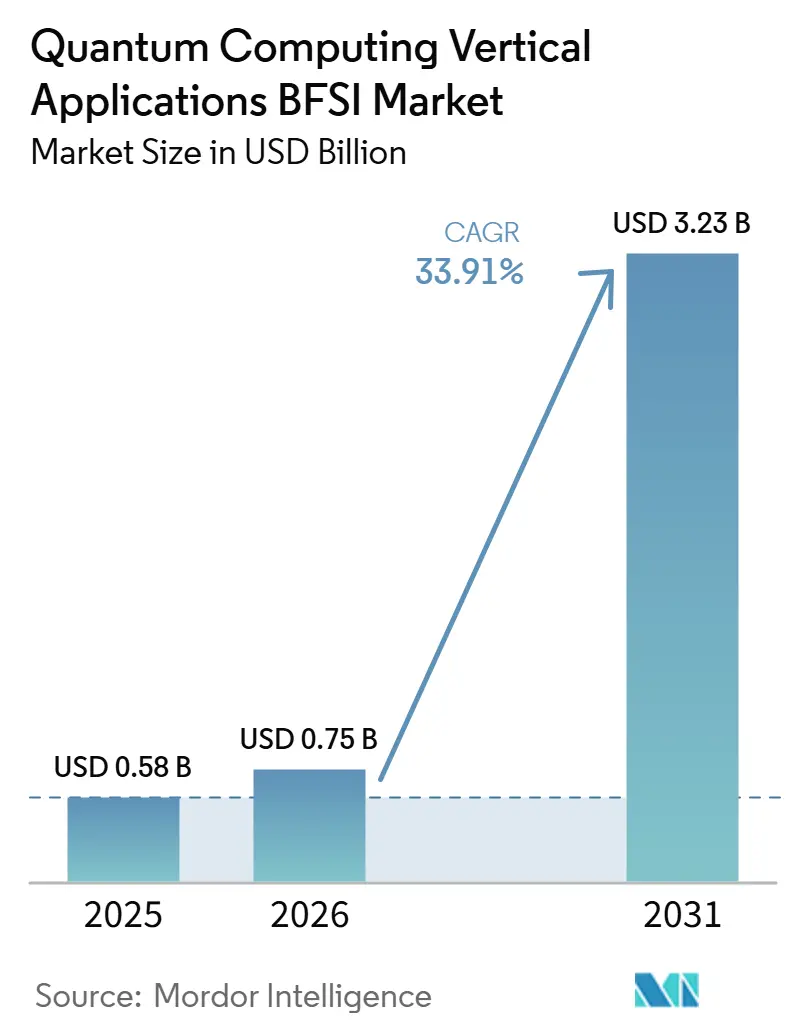
| Market Size (2026) | USD 0.75 Billion |
| Market Size (2031) | USD 3.23 Billion |
| Growth Rate (2026 - 2031) | 33.91 % |
| Fastest Growing Market | Asia-Pacific |
| Largest Market | North America |
| Market Concentration | Low |
Major Players *Disclaimer: Major Players sorted in no particular order Image © Mordor Intelligence. Reuse requires attribution under CC BY 4.0. | |
Quantum Computing Vertical Applications BFSI Market Analysis by Mordor Intelligence
The quantum computing vertical applications BFSI market size was USD 0.58 billion in 2025 and is forecast to reach USD 3.23 billion by 2031 at a CAGR of 33.91% from 2026 to 2031. Growth in the quantum computing vertical applications BFSI market is being shaped by a clear shift toward computation-heavy financial workflows where classical systems face time, scale, and efficiency limits. Financial institutions are also moving faster on quantum readiness because cryptographic transition planning now sits closer to core infrastructure and compliance budgets than it did a year earlier. The commercial structure of the quantum computing vertical applications BFSI market still favors software, orchestration, and integration layers, as production-grade, fault-tolerant hardware is not yet available for routine financial workloads. Hybrid operating models are therefore becoming the practical path to adoption, as they allow institutions to test quantum methods while maintaining classical control, validation, and failover. Competition is tightening as vendors try to secure long-cycle financial accounts early, leaving room for platform providers, integration specialists, and application-focused firms that can shorten the path from pilot work to repeatable enterprise use.
Key Report Takeaways
- By solution, software accounted for 68.42% of the quantum computing vertical applications BFSI market size in 2025, while services are projected to expand at 36.84% CAGR through 2031.
- By deployment, cloud-based delivery accounted for 71.26% of revenue in quantum computing vertical applications BFSI market in 2025, while hybrid deployment is projected to grow at a 35.19% CAGR through 2031.
- According to the quantum-computing paradigm, gate-based systems accounted for 42.31% of revenue in 2025, while hybrid quantum-classical computing is projected to expand at a 38.42% CAGR through 2031.
- By application, risk management and scenario analysis accounted for 21.74% of revenue in 2025, while fraud detection and financial crime prevention are projected to grow at 39.18% CAGR through 2031.
- By end user, banking accounted for 34.82% of revenue in 2025, while FinTech is projected to expand at a 37.63% CAGR through 2031.
- By geography, North America accounted for 36.41% of the quantum computing vertical applications BFSI market share in 2025, while Asia-Pacific is projected to grow at 36.92% CAGR through 2031.
Note: Market size and forecast figures in this report are generated using Mordor Intelligence’s proprietary estimation framework, updated with the latest available data and insights as of January 2026.
Market Trends and Insights
Drivers Impact Analysis of Quantum Computing Vertical Applications BFSI Market*
| Driver | (~) % Impact on CAGR Forecast | Geographic Relevance | Impact Timeline |
|---|---|---|---|
| Surging Demand for Quantum Risk Modeling and Portfolio Optimization | +8.2% | Global, with early gains in North America and Europe | Short term (≤ 2 years) |
| Rising Need for Post-Quantum Cryptography Readiness in Financial Networks | +7.1% | Global, concentrated in North America, Europe, and Asia-Pacific core | Medium term (2-4 years) |
| Growing Bank Adoption of Hybrid Quantum-Classical Workflows | +6.5% | North America and Europe, with spillover to Asia-Pacific | Short term (≤ 2 years) |
| Public-Private Funding for Financial-Grade Quantum Pilots | +5.4% | North America, Europe, Japan, South Korea, and Singapore | Medium term (2-4 years) |
| Quantum-As-A-Service Lowering Entry Barriers for Mid-Tier BFSI Firms | +4.3% | Global, with Asia-Pacific and South America gaining access | Medium term (2-4 years) |
| Regulatory Pressure to Modernize Cryptographic Infrastructure | +3.6% | Europe, North America, and Asia-Pacific | Medium term (2-4 years) |
| Source: Mordor Intelligence | |||
Surging Demand for Quantum Risk Modeling and Portfolio Optimization
Financial institutions continue to face long compute cycles when running large Monte Carlo simulations across multi-factor portfolios, which keeps risk analytics at the forefront of enterprise quantum demand. ESMA stated in May 2026 that quantum Monte Carlo integration offers a theoretical quadratic speedup over classical approaches for financial workloads, which keeps the use case commercially relevant even before full hardware maturity arrives.[1]European Securities and Markets Authority, “Quantum Computing in Financial Markets, Applications, Investments and Prospects,” ESMA, esma.europa.eu Crédit Agricole CIB and Pasqal advanced their partnership in June 2026 with a production roadmap focused on capital markets applications and risk-weighted asset monitoring, which shows that the quantum computing vertical applications BFSI market is moving beyond isolated technical tests in selected institutions. Banks also recognize that better optimization and scenario modeling can influence pricing quality, capital efficiency, and response times within the same operating framework. This creates a practical incentive to build internal algorithm knowledge now, because institutions that learn earlier will be better placed when production-grade systems become more dependable.
Rising Need for Post-Quantum Cryptography Readiness in Financial Networks
Post-quantum cryptography has moved from a research topic to an infrastructure planning issue, as financial institutions now have formal standards and clearer migration guidance. NIST finalized ML-KEM, ML-DSA, and SLH-DSA in August 2024, giving banks and payment operators a concrete baseline for transition work rather than a loose technical target.[2]National Institute of Standards and Technology, “NIST Releases First 3 Finalized Post-Quantum Encryption Standards,” NIST, nist.gov The G7 Cyber Expert Group reinforced this direction in January 2026 with a coordinated roadmap that pointed to 2030-2032 as a critical deadline window for high-priority systems and 2035 as the broader endpoint for migration. The urgency is stronger than it appears because harvest-now-decrypt-later exposure means sensitive financial data captured today can remain vulnerable long before a mature attack capability is deployed. In the quantum computing vertical applications BFSI market, that pressure is pushing security budgets, network reviews, and procurement calendars toward crypto-agile architectures earlier than many institutions had originally planned.[3]G7 Cyber Expert Group, “Statement on Advancing a Coordinated Roadmap for the Transition to Post-Quantum Cryptography in the Financial Sector,” U.S. Department of the Treasury, treasury.gov
Growing Bank Adoption of Hybrid Quantum-Classical Workflows
Hybrid workflows are gaining traction because they allow institutions to test quantum methods without removing the classical controls that financial environments still depend on. In practice, banks can embed quantum components into an existing compute chain while continuing to use classical systems for validation, reconciliation, and operational backups. This lowers execution risk for the quantum computing vertical applications BFSI market because buyers do not need to wait for fault-tolerant hardware before they begin workflow redesign. It also broadens the addressable customer base, since institutions with modest internal quantum capability can still participate through managed platforms and cloud access. Vendors that can combine algorithm work, integration support, and orchestration across both environments are therefore in a stronger position than firms that sell a narrow point solution.
Public-Private Funding for Financial-Grade Quantum Pilots
Public and private funding remain important growth levers because they improve vendor capacity and reduce the initial cost burden for financial users. Pasqal and Crédit Agricole CIB formalized a more detailed production roadmap in June 2026, demonstrating that shared development models can help move the quantum computing vertical applications BFSI market from pilot activity toward industrial application planning.[4]Pasqal, “Crédit Agricole CIB and Pasqal Advance Their Strategic Partnership to Deploy Quantum Computing Applied to Finance,” Pasqal, pasqal.com The G7 roadmap also signaled that post-quantum and quantum-readiness planning is becoming a coordinated priority across major economies, attracting board-level attention and providing longer-term funding visibility. Co-funded or partnership-led pilot structures are especially relevant for mid-tier institutions that lack the scale to build dedicated quantum teams in-house. As more programs follow this structure, adoption is likely to expand across banks, insurers, capital markets firms, and payment operators seeking exposure without taking on full technology risk at the outset.
Restraints Impact Analysis of Quantum Computing Vertical Applications BFSI Market*
| Restraint | (~) % Impact on CAGR Forecast | Geographic Relevance | Impact Timeline |
|---|---|---|---|
| No Fault-Tolerant Quantum Systems for Production Finance Workloads | -4.8% | Global | Long term (≥ 4 years) |
| Model Validation Risk for Quantum-Derived Financial Outputs | -3.2% | North America and Europe | Medium term (2-4 years) |
| Specialized Talent Shortage in Quantum Finance Stack Integration | -2.5% | Global, most acute in Asia-Pacific and South America | Medium term (2-4 years) |
| Long Post-Quantum Cryptography Migration Cycles can Delay Procurement Decisions | -1.8% | Europe and North America | Medium term (2-4 years) |
| Source: Mordor Intelligence | |||
No Fault-Tolerant Quantum Systems for Production Finance Workloads
The biggest near-term brake on the quantum computing vertical applications BFSI market is hardware readiness, not customer awareness. ESMA noted in May 2026 that current quantum hardware capabilities are still limited for real-world, industry-scale financial problems, which keeps most institutions from using quantum outputs in high-stakes production environments. Banks, therefore, continue to treat many quantum results as advisory, experimental, or pre-production material that must be checked against classical methods. Those extra validation steps weaken the speed and efficiency gains that make quantum adoption attractive in the first place. Until error-corrected systems become more practical for financial workloads, a large part of demand will remain tied to pilots, sandboxes, and controlled research engagements rather than scaled deployment.
Model Validation Risk for Quantum-Derived Financial Outputs
Model validation is also a serious constraint because financial institutions must explain, test, and govern every material output that affects pricing, credit, fraud, or capital decisions. Many quantum methods are not yet easy to map into the review structures that banks already use for model risk, governance approval, and supervisory communication. This slows adoption in the quantum computing vertical applications BFSI market, even when technical teams see promise in a use case, because the path to production depends on risk committees and compliance functions as much as it depends on algorithm performance. The issue is sharper for large institutions, since their highest-value use cases tend to sit in the most heavily supervised parts of the business. As a result, firms with the strongest economic case for quantum deployment can also face the longest time to move from experiment to approved operational use.
*Our forecasts treat driver/restraint impacts as directional, not additive. The impact forecasts reflect baseline growth, mix effects, and variable interactions.
Quantum Computing Vertical Applications BFSI Market Segment Analysis
By Solution:
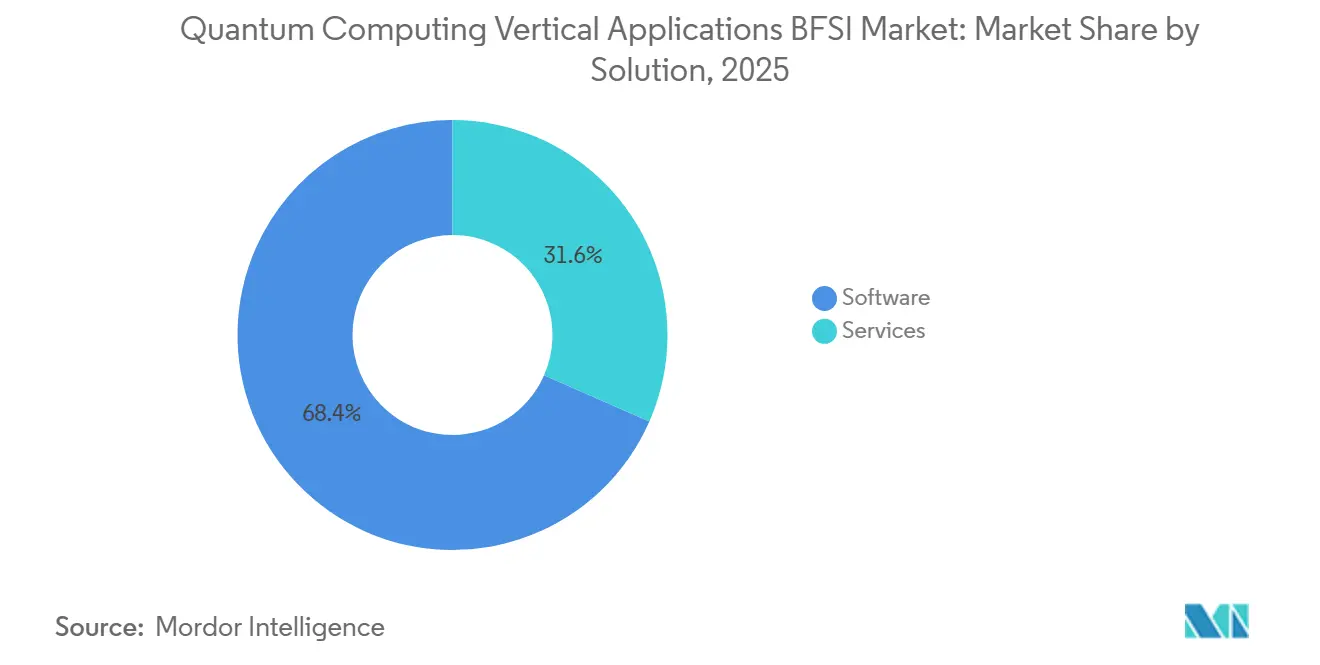
Software Leads Current Spending While Services Build Future ScaleSoftware accounted for 68.42% of revenue in 2025, making it the largest solution segment in the quantum computing vertical applications BFSI market. This lead reflects how most financial institutions access quantum capabilities through development kits, simulation tools, cloud interfaces, and application programming layers rather than through direct hardware ownership. The spending pattern also shows that buyers want usable environments for modeling, testing, and workflow integration before they commit to more specialized infrastructure decisions. Services are projected to expand at a 36.84% CAGR through 2031, indicating rising demand for managed pilots, application tuning, migration work, and implementation support. In the current phase of the quantum computing vertical applications BFSI market, software remains the easiest commercial entry point because it fits more naturally into established enterprise buying patterns.
The second layer of demand is forming around execution support, since institutions need help connecting quantum methods to real business processes rather than isolated demonstrations. Vendors with reusable libraries for valuation, optimization, fraud analytics, and cryptographic transition work can scale more effectively than firms that depend only on bespoke advisory assignments. This is one reason the quantum computing vertical applications BFSI industry is rewarding providers that combine tools, domain knowledge, and integration capabilities in a single offering. Pasqal’s deeper work with Crédit Agricole CIB shows why financial clients value suppliers that can stay engaged from technical exploration into structured delivery planning.


By Deployment:
Cloud-Based Access Holds The Base While Hybrid Models AdvanceCloud-based deployment captured 71.26% of revenue in 2025, which shows that the quantum computing vertical applications BFSI market still depends heavily on remote access models. This structure suits regulated institutions because it limits upfront capital commitments while preserving flexibility for research-stage work. It also reflects the reality that very few firms are prepared to own, operate, and maintain specialized quantum infrastructure on premises. Hybrid deployment is projected to expand at 35.19% CAGR through 2031 as users begin to connect quantum tools more directly with classical analytics, data pipelines, and enterprise controls. The result is a market where access convenience supports current scale, while integration depth shapes future differentiation.
The hybrid model is gaining ground because it better aligns with the operating logic of financial institutions than a pure quantum environment does. Banks and other users can keep sensitive governance steps, validation routines, and failover logic inside classical systems while allowing quantum components to handle selected compute tasks. This lowers organizational friction across the quantum computing vertical applications BFSI market because technical experimentation does not require a full rewrite of existing architecture. On-premises deployment will remain limited to cases where control, sovereignty, or infrastructure policy outweighs cost and flexibility.
By Quantum Computing Paradigm:
Gate-Based Systems Lead While Hybrid Quantum-Classical Setups Grow FaGate-based quantum computing held 42.31% of revenue in 2025, giving it the largest share among paradigms in the quantum computing vertical applications BFSI market. The lead comes from a broader vendor ecosystem, stronger visibility in enterprise programs, and a larger body of financial use-case development focused on optimization, pricing, and fraud analysis. Buyers also see gate-based systems as the most familiar commercial route because several well-known vendors already organize access, tooling, and support around this model. Quantum annealing remains relevant for optimization-heavy tasks, but its narrower use profile limits its broader adoption across BFSI workflows. Hybrid quantum-classical computing is projected to expand at a 38.42% CAGR through 2031, indicating that the fastest momentum is moving toward approaches that blend new methods with proven infrastructure.
That growth pattern says a great deal about what customers value at this stage of adoption. Institutions want practical improvements in workflow performance, but they also want operational continuity and a clear line of accountability back to classical checks and balances. The quantum computing vertical applications BFSI market, therefore, favors paradigms that support progressive adoption rather than all-at-once change. ESMA’s view that current hardware remains limited for industry-scale finance underscores why buyers continue to prefer models that deliver incremental value as hardware maturity improves.
By Application:
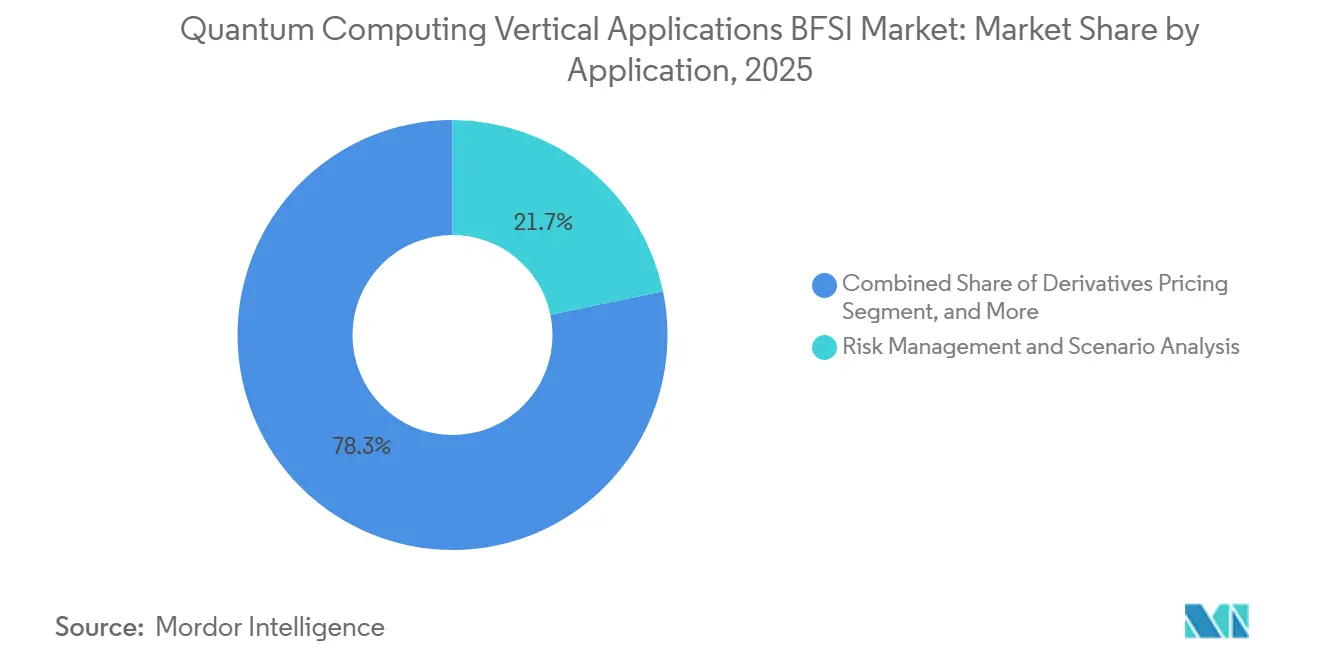
Risk Management Anchors Revenue While Fraud Detection Builds SpeedRisk management and scenario analysis accounted for 21.74% of revenue in 2025, making it the largest application segment in the quantum computing vertical applications BFSI market. This position comes from the long-standing dependence of banks and capital markets firms on Monte Carlo simulation, derivatives valuation, stress testing, and value-at-risk estimation. ESMA noted in May 2026 that quantum Monte Carlo integration offers a theoretical quadratic speedup over classical methods for financial market work, which keeps this application at the center of commercial demand. Risk-related workflows are also easier for large institutions to justify because they connect directly to capital use, pricing accuracy, and time-sensitive decision windows. Other applications, such as portfolio and wealth management, derivatives pricing, credit scoring and loan assessment, algorithmic trading, customer analytics, and cybersecurity, add further depth to the application mix.
Fraud detection and financial crime prevention are projected to grow at 39.18% CAGR through 2031, making it the fastest-moving application in the quantum computing vertical applications BFSI market. The appeal comes from graph-heavy transaction analysis, money mule detection, and anomaly mapping, where network complexity can rise rapidly across large payment flows. This use case is commercially attractive because even small gains in detection quality or false-positive control can carry direct operational and financial value. Cybersecurity and post-quantum cryptography will also remain important because migration timing is being shaped by formal standards and cross-border coordination rather than only by discretionary technology spending.

By End-User:
Banking Holds The Lead While FinTech Adds MomentumBanking accounted for 34.82% of revenue in 2025, making it the largest end-user segment in the quantum computing vertical applications BFSI market. Large banks have the clearest reason to spend because they manage sizable derivative books, broad credit portfolios, extensive fraud exposure, and complex security infrastructure. They also have more room to support internal research, cross-functional governance, and phased testing than many smaller financial firms do. Capital markets and investment firms remain close behind in use cases linked to pricing, trading strategy, and portfolio construction. Insurance carriers and payment providers also matter because actuarial modeling, claims risk, transaction security, and network resilience align well with emerging quantum use cases.
FinTech is projected to expand at a 37.63% CAGR through 2031, making it the fastest-growing end-user segment. The pace reflects architecture and operating speed rather than absolute scale, since many FinTech firms can connect to cloud-based tools without the slower procurement and governance cycles seen in larger incumbents. Standard Chartered’s SC Ventures and Fujitsu announced the roadmap for Qubitra Technologies in January 2026, underscoring how application-layer delivery models are being built to serve financial institutions and hedge funds with quantum-enabled fraud detection and trading tools. The insurance segment will likely continue to grow gradually, especially as scenario complexity and risk correlation make advanced optimization and simulation increasingly valuable over time.
Geography Analysis
The Americas Quantum Computing Vertical Applications BFSI Market
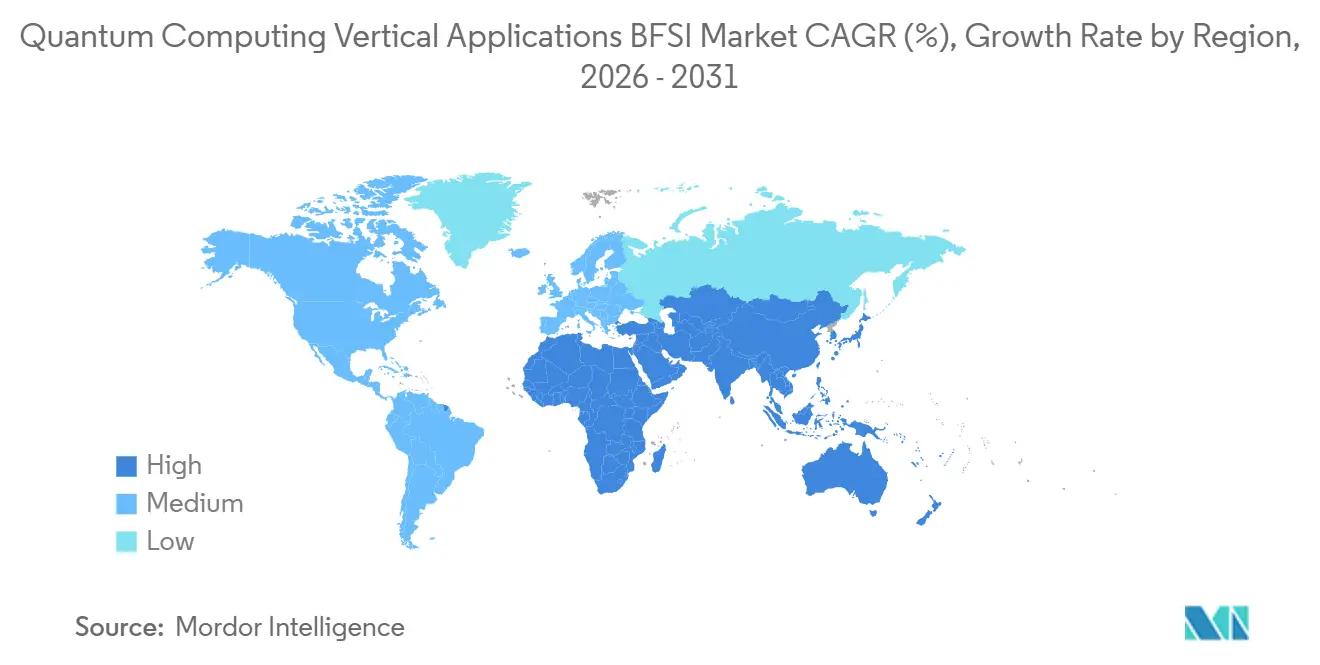
North America accounted for 36.41% of revenue in 2025, giving it the largest regional position in the quantum computing vertical applications BFSI market. The region benefits from a dense concentration of Tier-1 banks, payment operators, capital markets firms, and quantum vendors with established enterprise relationships. The United States also has a clear advantage in cryptographic preparedness, as NIST finalized the first post-quantum cryptography standards in August 2024, providing financial institutions with a formal technical basis for migration planning. That standard-setting role supports earlier procurement activity across security, infrastructure review, and pilot work in the quantum computing vertical applications BFSI market. South America remains much smaller in scale, but the region is still relevant as cloud delivery and service-led adoption lower the barriers for financial firms seeking selective quantum exposure.
Europe Quantum Computing Vertical Applications BFSI Market
Europe forms a substantial secondary demand center in the quantum computing vertical applications BFSI market, with the United Kingdom, Germany, France, and Spain standing out as active markets. ESMA highlighted that DORA and the NIS 2 framework are turning quantum-related cryptographic vulnerability planning into a more structured compliance issue for European financial entities. That matters because regulatory timing gives vendors a clearer demand path than in markets where adoption depends only on voluntary experimentation. Erste Group’s February 2026 integration of entangled quantum key distribution into existing banking fiber infrastructure in Vienna also shows that Europe is testing physical network security use cases, not only software-led pilots.
APAC and MEA Quantum Computing Vertical Applications BFSI Market
Asia-Pacific is projected to expand at 36.92% CAGR through 2031, making it the fastest-growing regional segment in the quantum computing vertical applications BFSI market. Public funding, large national technology programs, institutional research activity, and rising interest from banks and financial infrastructure players are supporting growth. The roadmap for Qubitra Technologies, announced by Fujitsu and SC Ventures in January 2026, shows how the region is building application-led pathways into fraud detection and trading use cases rather than waiting only for hardware maturity. The Middle East and Africa remain smaller in absolute terms, but sovereign programs and financial institutions in the region are beginning to explore derivatives pricing and payments security as early entry points.

Competitive Landscape
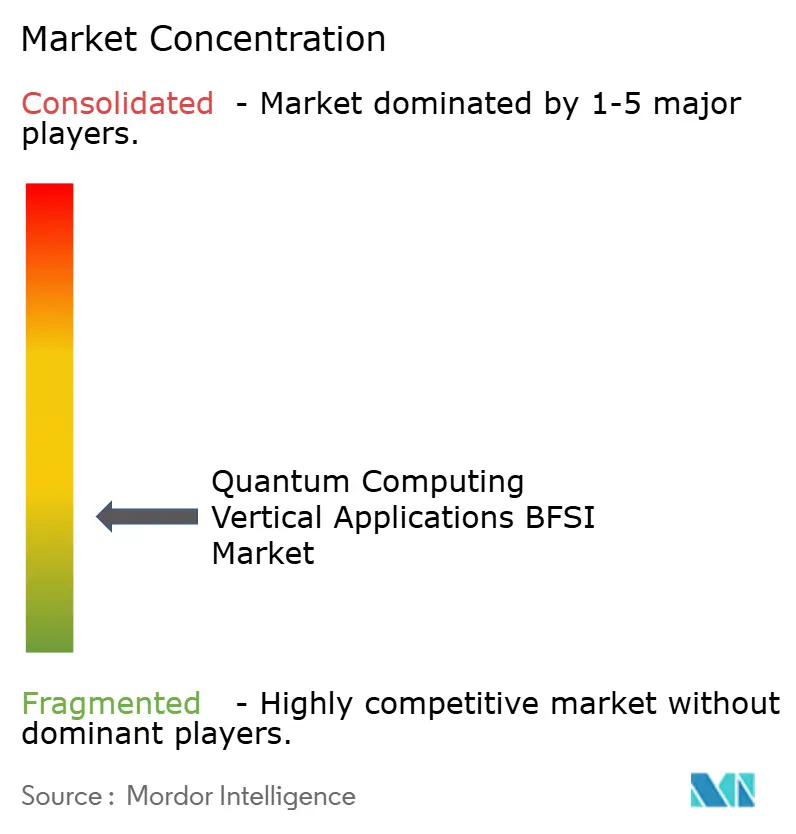
The quantum computing vertical applications BFSI market remains moderately fragmented, with a more concentrated hardware tier and a more dispersed software and services layer. IBM, Quantinuum, IonQ, D-Wave Quantum, Pasqal, Rigetti Computing, and IQM Quantum Computers are visible participants, but they do not compete in the same way across the stack. Some vendors focus on hardware access and platform ecosystems, while others push deeper into workflow design, sector-specific tooling, or security-oriented use cases. This mix keeps the quantum computing vertical applications BFSI market open to both established enterprise vendors and focused specialists that can solve a narrow but valuable problem well. It also means buyers are increasingly evaluating commercial credibility through delivery depth, integration readiness, and governance support rather than solely on hardware claims.
Strategic partnerships are shaping the next phase of competition, as financial institutions seek measurable progress tied to real operational use cases. Pasqal’s expanded June 2026 partnership with Crédit Agricole CIB is a clear example, as it moved beyond general collaboration into a production roadmap for finance applications. IonQ’s February 2025 agreement to acquire a controlling stake in ID Quantique extended its reach into quantum-safe networking and cryptographic security, which is highly relevant to regulated BFSI customers facing migration pressure. Fujitsu and SC Ventures used the Qubitra Technologies roadmap to target the application layer directly, indicating that market competition is moving toward workflow specialization and client-specific delivery.
The white-space opportunity remains strongest among mid-tier institutions that want curated solutions but lack the resources to build large internal quantum teams. In that part of the quantum computing vertical applications BFSI market, vendors that can package access, use-case templates, governance support, and implementation services into a single commercial offer may scale faster than firms that rely solely on raw hardware visibility. The next competitive shift is likely to center on application-layer relevance, security alignment, and the ability to fit quantum methods into existing financial controls. That keeps the market competitive, but it does not yet point to one provider with dominant power across the full stack.
Quantum Computing Vertical Applications BFSI Industry Leaders
International Business Machines Corporation
D-Wave Quantum Inc.
IonQ, Inc
Rigetti Computing, Inc.
Quantinuum Ltd.
- *Disclaimer: Major Players sorted in no particular order
Quantum Computing Vertical Applications BFSI Market Companies Covered in this Report
- International Business Machines Corporation
- D-Wave Quantum Inc.
- IonQ, Inc.
- Rigetti Computing, Inc.
- Quantinuum Ltd.
- Xanadu Quantum Technologies Inc.
- Pasqal SAS
- IQM Quantum Computers Oy
- Oxford Quantum Circuits Ltd.
- Alice and Bob SAS
- Alpine Quantum Technologies GmbH
- QuEra Computing Inc.
- Quantum Computing Inc.
- Infleqtion, Inc.
- SEEQC, Inc.
- Quix Quantum B.V.
- Origin Quantum Computing Technology Co., Ltd.
- Shenzhen SpinQ Technology Co., Ltd.
- Anyon Systems Inc.
- Riverlane Ltd.
- Google LLC
- Cambridge Quantum Computing Ltd.
- Intel Corporation
- Fujitsu Limited
- Honeywell International Inc.

Recent Industry Developments in Quantum Computing Vertical Applications BFSI Market
- June 2026: Pasqal and Crédit Agricole CIB advanced their strategic partnership with a formal production roadmap targeting industrialization of quantum computing applications in capital markets, including risk-weighted asset monitoring, with initial production use cases targeted for 2028. Pasqal, backed by more than USD 300 million in private funding, is concurrently pursuing a Nasdaq listing.
- February 2026: Fujitsu and SC Ventures, Standard Chartered, announced the roadmap for Qubitra Technologies, a United Kingdom-based joint venture building quantum-enabled fraud detection and financial trading applications, with initial customer go-lives at financial institutions and hedge funds targeted for 2026.
- February 2026: Erste Group, zerothird, and A1 successfully integrated an entangled quantum key distribution solution into Erste Group’s existing fiber-optic banking infrastructure in Vienna, completing the first commercial quantum key distribution pilot in a Central European banking network.
- February 2025: IonQ reached a definitive agreement to acquire a controlling stake in ID Quantique, a global leader in quantum-safe networking headquartered in Geneva, alongside a strategic partnership with SK Telecom, extending IonQ’s product reach into quantum-safe cryptography and physical-layer network security relevant to financial institution operators.


Global Quantum Computing Vertical Applications BFSI Market Report Scope
The quantum computing vertical applications BFSI market refers to the specialized ecosystem of software and services that leverage quantum computing principles to solve highly complex computational problems within the banking, financial services, and insurance (BFSI) sector. This market encompasses solutions built on various quantum paradigms, including gate-based quantum computing, quantum annealing, and hybrid quantum-classical computing, delivered via cloud-based, hybrid, or on-premises deployment models. In the BFSI domain, these technologies are used to run advanced applications that are computationally prohibitive for classical computers, such as optimizing massive investment portfolios, performing multivariate risk and scenario analyses, accelerating algorithmic and high-frequency trading, and accurately pricing complex derivatives. Additionally, the market addresses critical industry challenges through enhanced fraud detection, advanced credit scoring, and the implementation of post-quantum cryptography to secure sensitive financial data against future quantum threats. The end-user scope includes traditional banks, insurance companies, capital market firms, fintechs, and digital payment providers aiming to achieve unmatched processing speeds, improved predictive accuracy, and robust security frameworks to gain a competitive edge.
The Quantum Computing Vertical Applications BFSI Market Report is Segmented by Solution (Software and Services), Deployment (Cloud-Based, Hybrid, and On-Premises), Quantum Computing Paradigm (Gate-Based Quantum Computing, Quantum Annealing, and Hybrid Quantum-Classical Computing), Application (Portfolio and Wealth Management, Risk Management and Scenario Analysis, Fraud Detection and Financial Crime Prevention, Algorithmic and High-Frequency Trading, Derivatives Pricing, Credit Scoring and Loan Assessment, Cybersecurity and Post-Quantum Cryptography, Customer Analytics and Personalization, and Other Applications), End-User (Banking, Insurance, Capital Markets and Investment Firms, FinTech, and Payment and Digital Financial Services), and Geography (North America, South America, Europe, Asia-Pacific, and Middle East and Africa). The Market Forecasts are Provided in Terms of Value (USD).
| Software |
| Services |
| Cloud-Based |
| Hybrid |
| On-Premises |
| Gate-Based Quantum Computing |
| Quantum Annealing |
| Hybrid Quantum-Classical Computing |
| Portfolio and Wealth Management |
| Risk Management and Scenario Analysis |
| Fraud Detection and Financial Crime Prevention |
| Algorithmic and High-Frequency Trading |
| Derivatives Pricing |
| Credit Scoring and Loan Assessment |
| Cybersecurity and Post-Quantum Cryptography |
| Customer Analytics and Personalization |
| Other Applications |
| Banking |
| Insurance |
| Capital Markets and Investment Firms |
| FinTech |
| Payment and Digital Financial Services |
| North America | United States | |
| Canada | ||
| Mexico | ||
| South America | Brazil | |
| Argentina | ||
| Rest of South America | ||
| Europe | Germany | |
| United Kingdom | ||
| France | ||
| Russia | ||
| Spain | ||
| Rest of Europe | ||
| Asia-Pacific | China | |
| Japan | ||
| India | ||
| South Korea | ||
| Southeast Asia | ||
| Rest of Asia-Pacific | ||
| Middle East and Africa | Middle East | Saudi Arabia |
| United Arab Emirates | ||
| Turkey | ||
| Rest of Middle East | ||
| Africa | South Africa | |
| Nigeria | ||
| Egypt | ||
| Rest of Africa | ||
| By Solution | Software | ||
| Services | |||
| By Deployment | Cloud-Based | ||
| Hybrid | |||
| On-Premises | |||
| By Quantum Computing Paradigm | Gate-Based Quantum Computing | ||
| Quantum Annealing | |||
| Hybrid Quantum-Classical Computing | |||
| By Application | Portfolio and Wealth Management | ||
| Risk Management and Scenario Analysis | |||
| Fraud Detection and Financial Crime Prevention | |||
| Algorithmic and High-Frequency Trading | |||
| Derivatives Pricing | |||
| Credit Scoring and Loan Assessment | |||
| Cybersecurity and Post-Quantum Cryptography | |||
| Customer Analytics and Personalization | |||
| Other Applications | |||
| By End-User | Banking | ||
| Insurance | |||
| Capital Markets and Investment Firms | |||
| FinTech | |||
| Payment and Digital Financial Services | |||
| By Geography | North America | United States | |
| Canada | |||
| Mexico | |||
| South America | Brazil | ||
| Argentina | |||
| Rest of South America | |||
| Europe | Germany | ||
| United Kingdom | |||
| France | |||
| Russia | |||
| Spain | |||
| Rest of Europe | |||
| Asia-Pacific | China | ||
| Japan | |||
| India | |||
| South Korea | |||
| Southeast Asia | |||
| Rest of Asia-Pacific | |||
| Middle East and Africa | Middle East | Saudi Arabia | |
| United Arab Emirates | |||
| Turkey | |||
| Rest of Middle East | |||
| Africa | South Africa | ||
| Nigeria | |||
| Egypt | |||
| Rest of Africa | |||


Key Questions Answered in the Report
What is the current and forecast value of the quantum computing vertical applications BFSI space?
The market size was USD 0.58 billion in 2025 and is forecast to reach USD 3.23 billion by 2031 at a CAGR of 33.91% from 2026 to 2031.
Which region leads revenue generation in this space?
North America led with 36.41% revenue share in 2025, supported by large financial institutions, vendor proximity, and stronger post-quantum cryptography standard readiness.
Which region is growing the fastest through 2031?
Asia-Pacific is projected to expand at 36.92% CAGR through 2031, helped by public funding, institutional programs, and regional application development activity.
Which application area is expanding the fastest in financial quantum use cases?
Fraud detection and financial crime prevention is projected to grow at 39.18% CAGR through 2031 because graph-heavy transaction analysis and anomaly mapping offer strong commercial value.
Why does software account for the largest share today?
Software held 68.42% of revenue in 2025 because most institutions still access quantum capabilities through tools, interfaces, and simulation environments rather than by owning hardware.
Which end-user group is moving fastest?
FinTech is projected to grow at 37.63% CAGR through 2031 because cloud-native operating models allow faster testing and deployment than larger institutions typically permit.
Page last updated on:


 Your data is secure and never sold or shared.


