
Push Notification Software Market Size and Share
Market Overview
| Study Period | 2020 - 2031 |
|---|---|
| Market Size (2026) | USD 1.83 Billion |
| Market Size (2031) | USD 3.78 Billion |
| Growth Rate (2026 - 2031) | 15.61% CAGR |
| Fastest Growing Market | Asia-Pacific |
| Largest Market | North America |
| Market Concentration | Medium |
Major Players *Disclaimer: Major Players sorted in no particular order Image © Mordor Intelligence. Reuse requires attribution under CC BY 4.0. | |
Push Notification Software Market Analysis by Mordor Intelligence
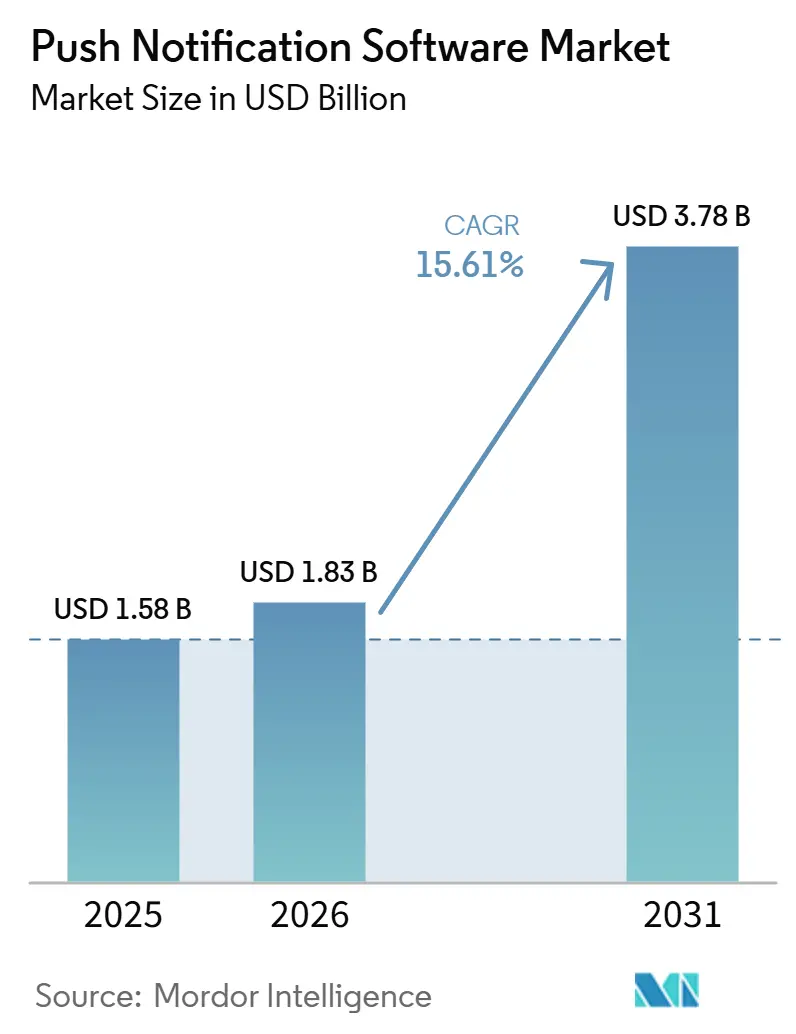
The push notification software market size is projected to expand from USD 1.58 billion in 2025 and USD 1.83 billion in 2026 to USD 3.78 billion by 2031, registering a CAGR of 15.61% between 2026 to 2031. The push notification software market is moving beyond broad campaign delivery toward tools that support retention, event-based messaging, and coordinated customer communication. The decline of third-party tracking identifiers has increased the value of permission-based subscriber data, particularly for brands that need direct and measurable communication channels. Buyers increasingly assess providers on personalization, revenue attribution, opt-out management, and integration with customer relationship management and customer data platforms. Competition is becoming more intense as leading providers add AI-supported campaign management, while specialist vendors retain an opportunity to serve smaller teams that need simple deployment and flexible pricing.
Key Report Takeaways
- By deployment model, cloud-based deployment held 72.63% of the push notification software market share in 2025, while on-premises deployment is projected to expand at a 15.96% CAGR through 2031.
- By enterprise size, large enterprises accounted for 64.38% of the market in 2025, while SMEs are expected to record the highest CAGR of 16.78% through 2031.
- By notification channel, mobile push notifications held 43.12% of revenue in 2025, while web push notifications are projected to grow at a 17.29% CAGR through 2031.
- By end-user industry, retail and e-commerce accounted for 28.41% of revenue in 2025, while healthcare and life sciences is expected to expand at an 18.37% CAGR through 2031.
- By geography, North America held 36.61% of the market in 2025, while Asia-Pacific is projected to advance at a 19.24% CAGR through 2031.
Note: Market size and forecast figures in this report are generated using Mordor Intelligence’s proprietary estimation framework, updated with the latest available data and insights as of January 2026.
Global Push Notification Software Market Trends and Insights
Drivers Impact Analysis*
| DRIVER | (~) % IMPACT ON CAGR FORECAST | GEOGRAPHIC RELEVANCE | IMPACT TIMELINE |
|---|---|---|---|
| Real-Time Mobile and Web Customer Engagement | +4.2% | Global | Short term (≤ 2 years) |
| First-Party Data and Permission-Based Messaging | +2.8% | North America and Europe | Medium term (2-4 years) |
| Lifecycle Automation in SaaS and Commerce Workflows | +2.4% | North America and Asia-Pacific | Medium term (2-4 years) |
| Omnichannel Retention Strategies | +1.9% | Global | Medium term (2-4 years) |
| AI-Assisted Send-Time and Message Personalization | +1.5% | North America and Europe | Short term (≤ 2 years) |
| Mid-Market and Self-Service SMB Adoption | +1.2% | Asia-Pacific and South America | Long term (≥ 4 years) |
| Source: Mordor Intelligence | |||
Rising Need For Real-Time Mobile and Web Customer Engagement
The push notification software market benefits from the growing need for immediate and relevant customer communication across mobile applications and websites. Brands increasingly use event-triggered messages for abandoned carts, inventory availability, price changes, account activity, and other time-sensitive actions. Retailers that use these triggers have reported stronger order recovery than businesses that depend only on scheduled campaign broadcasts. India and Southeast Asian countries continue to offer a wide mobile-first audience for real-time engagement tools, although subscriber scale alone does not guarantee effective communication. Businesses are focusing more closely on retaining existing users because customer reacquisition through paid channels can be expensive. Mature users of the push notification software market have embedded notification delivery into broader retention programs, which makes these platforms more difficult to replace once they are linked to customer data and workflow systems.
Growth of First-Party Data and Permission-Based Messaging
The reduction in third-party tracking options has made push subscriptions a more important source of first-party customer information. A push token can provide an opted-in, device-linked communication route that remains available when browsers refresh or applications update. This capability gives brands a direct way to engage known users without relying entirely on fragmented advertising audiences. OneSignal released OneSignal AI and its Model Context Protocol Server in open beta during July 2026, allowing AI assistants to use behavioral data for audience creation and campaign work. The European Data Protection Board stated that consent under the applicable privacy framework must be freely given, specific, informed, and unambiguous when personal data processing is involved.[1]European Data Protection Board, “Guidelines 2/2023 On Technical Scope Of Art. 5(3) Of ePrivacy Directive,” European Data Protection Board, edpb.europa.eu Providers with consent management, subscriber records, and opt-out controls can therefore have an advantage in enterprise purchasing decisions.
Expansion of Lifecycle Automation in SaaS and Commerce Workflows
The push notification software market is gaining support from businesses that are automating communications around subscription status, product usage, payment events, and customer inactivity. Visual workflow builders allow marketing and growth teams to create complex customer journeys without requiring extensive engineering work. This lowers implementation effort for companies that previously depended on custom notification infrastructure. Braze reported that Cleo Labs recorded fewer unsubscribes, lower email opt-outs, more application opens, and higher push engagement after rebuilding its onboarding program with BrazeAI Operator.[2]Braze, Inc., “Braze Delivers Powerful New Agentic AI Capabilities That Transform How Marketers Build, Personalize, And Deliver Customer Experiences,” Braze, Inc., braze.com Iterable introduced Nova Agent in April 2026 to build campaigns, conduct message checks, run multivariate tests, and support personalization at enterprise scale. For software providers, lifecycle messaging can support feature adoption, renewal discussions, and reactivation efforts more effectively than uniform campaign sends.
Omnichannel Retention Strategies Replacing Single-Channel Campaigns
Enterprise buyers increasingly assess notification platforms on their ability to coordinate push messages with email, SMS, in-app messaging, RCS, and website interactions. The push notification software market is therefore being shaped by systems that can suppress repetitive outreach and select the most suitable channel for each customer event. Providers that connect customer actions across channels can also give clients a clearer view of revenue attribution and campaign outcomes. Attentive introduced integrated push messaging within its SMS, email, and RCS platform at Thread 2026, reflecting the movement toward unified customer communication programs. This shift creates pressure for standalone push vendors because larger platforms can bundle notification features with established engagement products. Vendors with open application programming interfaces and integrations with customer data platforms, data warehouses, and CRM systems are better placed to remain relevant as buyers consolidate tools.
Restraints Impact Analysis*
| RESTRAINT | (~) % IMPACT ON CAGR FORECAST | GEOGRAPHIC RELEVANCE | IMPACT TIMELINE |
|---|---|---|---|
| Notification Fatigue and User Opt-Out Pressure | -2.1% | Global | Short term (≤ 2 years) |
| Consent, Privacy, and Device-Level Permission Controls | -1.7% | Europe and North America | Medium term (2-4 years) |
| Cross-Platform Integration Complexity | -1.2% | Global | Medium term (2-4 years) |
| Commoditization of Core Push Functions | -0.8% | North America and Europe | Long term (≥ 4 years) |
| Source: Mordor Intelligence | |||
Notification Fatigue and User Opt-Out Pressure
Notification fatigue remains a constraint on the push notification software market because poorly timed or repetitive messages can lead users to disable communications. Device-level opt-outs can be difficult to reverse because brands often need a new application install or renewed permission from the user. Retail, media, and other high-volume senders face greater risk when messages are not tailored to customer behavior and preferences. Batch’s 2025 benchmark reviewed 800 billion messages across 1.2 billion visitors and found different permission outcomes across platforms and industry categories. A growing subscriber list does not necessarily translate into long-term platform revenue if businesses do not invest in relevance and frequency management. Predictive suppression tools can help providers identify users with elevated opt-out risk and reduce contact volume before the relationship is lost.
Tightening Consent, Privacy, and Device-Level Permission Controls
Permission requirements can limit subscriber growth, particularly for brands with large iOS audiences that depend on customers accepting multiple prompts. The push notification software market also faces stricter expectations around consent records, data use, and the handling of personal information. The European Data Protection Board’s Guidelines 2/2023 clarified the technical scope of Article 5(3) of the ePrivacy Directive and its connection with terminal equipment access. Research published in the Journal of Intellectual Property, Information Technology and E-Commerce Law discussed the relationship between push notifications, data protection law, and ePrivacy requirements. These requirements favor vendors that have already developed data governance, consent orchestration, and audit capabilities for European customers. Smaller providers may face higher compliance costs when adapting their products for regulated customer environments.
*Our forecasts treat driver/restraint impacts as directional, not additive. The impact forecasts reflect baseline growth, mix effects, and variable interactions.
Segment Analysis
By Deployment Model: Cloud Leads While On-Premises Supports Regulated Users
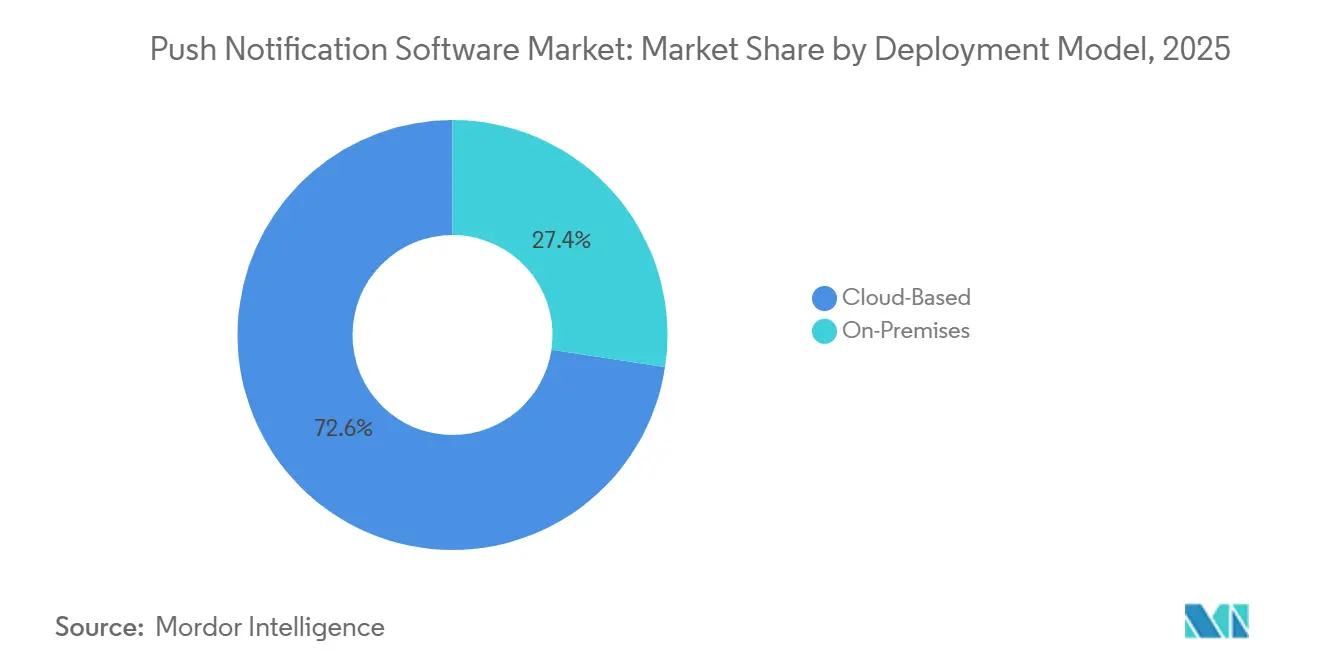
Cloud-based deployment held 72.63% of the push notification software market share in 2025. The segment benefits from automatic software updates, flexible capacity, and pricing models that reduce up-front implementation costs. Cloud delivery also supports the web-based application programming interfaces that are necessary for browser notifications and broader digital engagement programs. Small and mid-sized buyers often favor cloud tools because they can begin with limited technical support and expand usage as their subscriber base grows. Braze added multilingual translation support and workspace-level messaging rate limits in its April 2026 release, showing how cloud platforms can deliver new capabilities across customer accounts. Security certifications such as SOC 2 Type II and ISO 27001 have become important enterprise requirements for cloud providers, raising the entry barrier for smaller vendors.
On-premises deployment is expected to record a 15.96% CAGR through 2031, making it the fastest-growing deployment approach. Financial institutions, government contractors, and healthcare organizations often require stronger control over data location and processing environments. The healthcare and life sciences segment’s 18.37% CAGR is linked in part to demand for private cloud or on-premises environments that support HIPAA requirements in the United States. Braze added European hosting on Google Cloud for BrazeAI Decisioning Studio during April 2026 to address data-residency requirements among European clients. This development illustrates the growing role of hosted private environments that combine cloud delivery with stronger customer controls. Providers that offer flexible deployment without reducing core functionality can serve both cloud-first companies and regulated organizations.


By Enterprise Size: Large Enterprises Lead Revenue While SMEs Gain Access
Large enterprises accounted for 64.38% of the push notification software market share in 2025. These organizations often operate across several business units and connect notification tools with CRM systems, customer data platforms, analytics products, and data warehouses. Such integrations can create operational switching costs because replacing a provider may disrupt established customer journeys and reporting processes. Large buyers also require consent management, audit records, role-based access controls, dedicated infrastructure, and service-level agreements. Healthcare systems, retail chains, and banking, financial services, and insurance institutions place particular importance on delivery reliability and secure handling of data. Providers without certified integrations for systems such as Salesforce, Oracle, SAP, and major customer data platforms may struggle to meet enterprise procurement needs.
The SME segment is projected to grow at a 16.78% CAGR through 2031. Self-service onboarding, freemium plans, and consumption-based pricing have lowered the cost and complexity of adoption for smaller businesses. OneSignal stated that its platform had been adopted by more than 1 million businesses globally and supported messaging across push, email, SMS, RCS, in-app messaging, and Live Activities. The company’s July 2026 AI release was designed to help lean teams create segments, write campaign content, build journeys, and schedule communications with less manual work.[3]OneSignal, Inc., “OneSignal Unveils Autonomous Lifecycle Marketing Vision, Opens OneSignal AI And MCP Server To All Users,” OneSignal, Inc., onesignal.com Providers such as Pushwoosh, PushEngage, and WebEngage use usage-based pricing that allows smaller customers to align spending with subscriber growth. AI-supported automation can further narrow the gap between large-company engagement programs and the resources available to smaller teams.
By Notification Channel: Mobile Push Leads While Web Push Broadens Reach
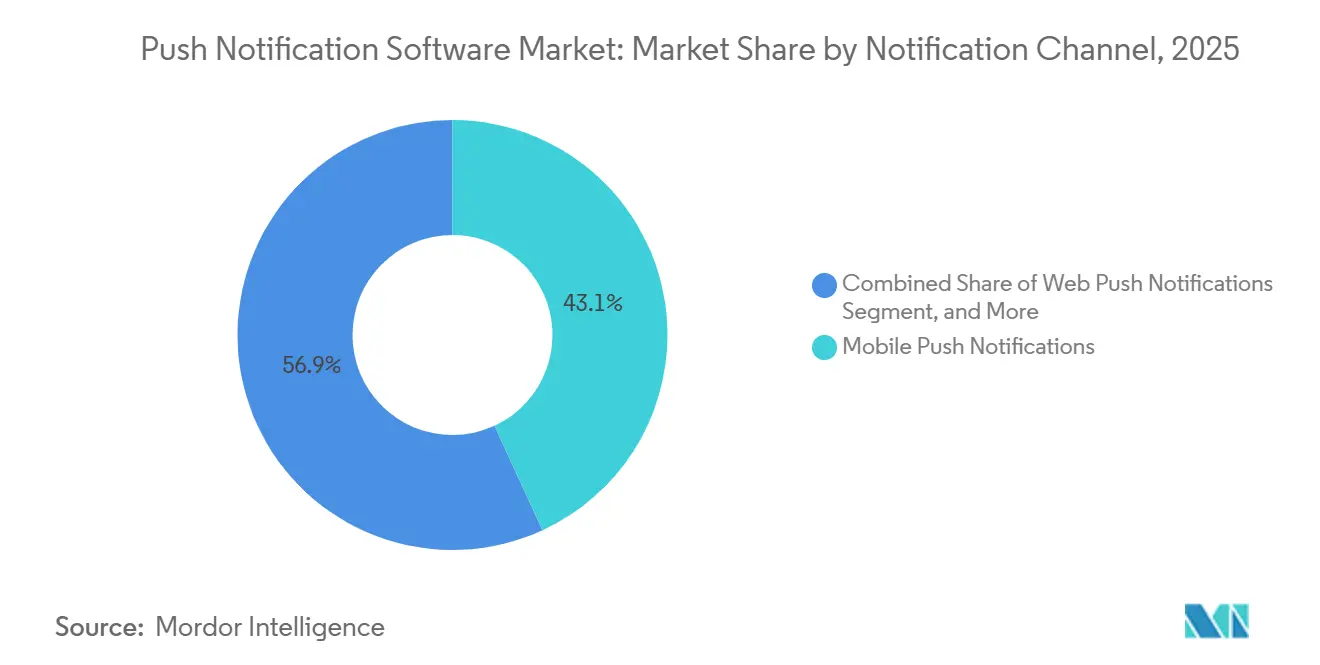
Mobile push notifications accounted for 43.12% of the push notification software market size by channel revenue in 2025. Native iOS and Android infrastructure, established software development kits, and direct application access make mobile notifications the default delivery method for many consumer brands. Mobile applications can also use behavioral signals such as location, usage history, and in-app events to support more relevant communications. Financial services applications use mobile alerts for account activity, payments, investment information, and potential fraud, where immediacy is valuable to the customer. Aurora Mobile’s JPush partnered with Pobo Financial in July 2026 to support low-latency distribution of financial information during high traffic volumes.[4]Aurora Mobile Limited, “Aurora Mobile’s JPush Partners With Pobo Financial To Build A Low-Latency, Highly Reliable Financial Information Distribution Channel,” Aurora Mobile Limited, aurora-mobile.com Desktop push remains useful for business software, news media, and workplace productivity products where users spend extended periods in browser-based environments.
Web push is projected to advance at a 17.29% CAGR through 2031. The channel enables businesses to reconnect with website users without requiring a native application installation. Batch found that 72.8% of web push traffic originated from mobile devices in its 2025 study, indicating that the distinction between web and mobile engagement is becoming less clear. The same study reported an 86.1% web push opt-in rate in the services sector, the highest result among the verticals it tracked. Progressive web applications can extend web push functionality in markets where native app distribution is constrained by limited storage capacity, bandwidth conditions, or customer reluctance to download applications. This makes the channel relevant for digital commerce and service providers across developing mobile markets.

By End-User Industry: Retail Holds Volume While Healthcare Expands Fastest
Retail and e-commerce captured 28.41% of the push notification software market in 2025. The sector uses push messages for abandoned carts, back-in-stock alerts, delivery updates, price changes, and limited-time offers. These communications are most effective when linked to current customer behavior rather than distributed as broad promotional campaigns. Retailers also use notification platforms to coordinate messages across mobile applications, websites, email, and text messaging. Banking, financial services, and insurance companies use similar platforms for transaction alerts, account updates, and investment notifications, although their requirements for reliability and compliance are often stricter. Media, telecommunications, travel, and hospitality companies add demand through content recommendations, service notices, booking updates, and customer support communications.
The healthcare and life sciences industry is expected to grow at an 18.37% CAGR through 2031. Digital health applications, telemedicine services, and remote patient monitoring programs need dependable real-time communication for appointments, care reminders, and patient updates. Healthcare organizations that use personalized reminders can improve attendance and reduce costs associated with missed appointments. HIPAA requires specific controls when systems handle protected health information, which creates demand for vendors able to support Business Associate Agreements and secure data processes. The education sector also uses notification tools for deadlines, examination schedules, course reminders, and personalized learning recommendations. As providers include HIPAA-ready capabilities in enterprise plans, the push notification software market can gain access to a broader group of healthcare customers.
Geography Analysis
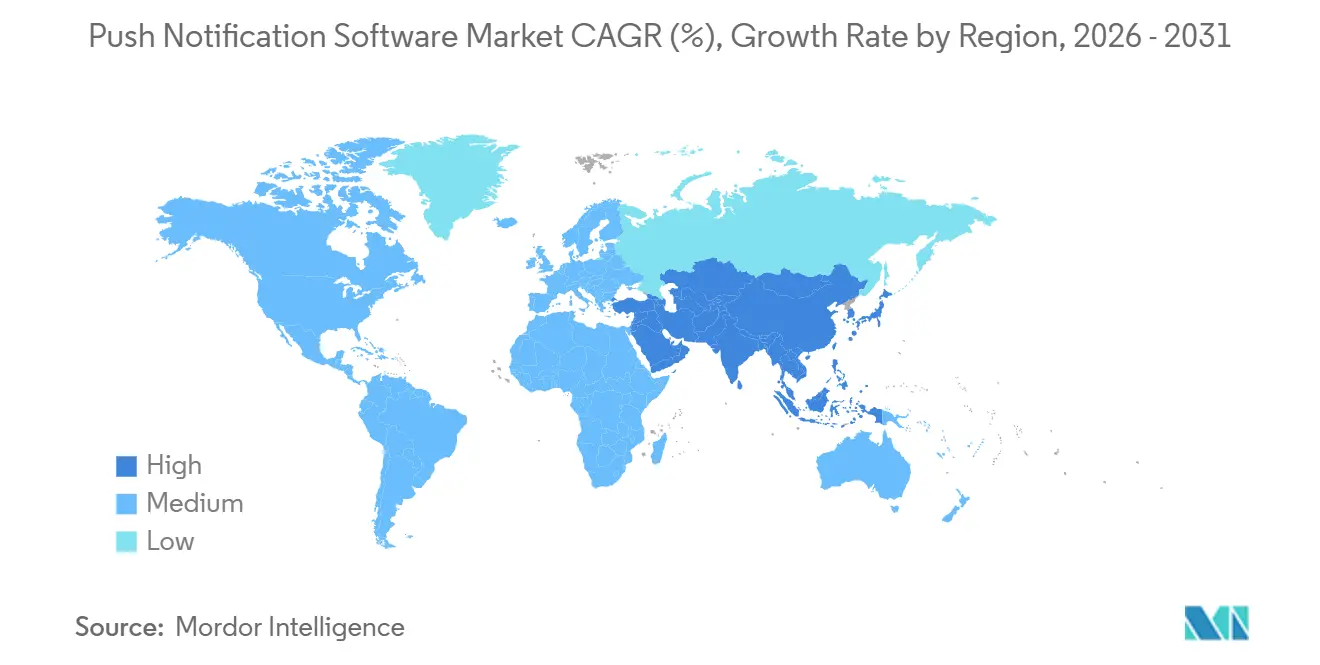
North America held 36.61% of the global push notification software market share in 2025. The region has mature software-as-a-service adoption among retail, banking, financial services, insurance, media, and digital commerce companies. Enterprise deployments often connect deeply with Salesforce, HubSpot, and customer data platforms, making notification systems part of established customer engagement operations. These integrations can increase switching costs and support longer vendor relationships. Europe represented the second-largest regional market, with Germany, the United Kingdom, and France serving as significant enterprise buyer locations. European customers place greater emphasis on consent management, data residency, and audit infrastructure because privacy compliance affects platform selection. The European data protection framework has therefore made governance features an important competitive differentiator for providers serving the region.
Asia-Pacific is expected to grow at a 19.24% CAGR through 2031. Mobile-first commerce in India, China, and Southeast Asia supports demand from fintech, quick commerce, education technology, and digital health applications. Regional providers such as MoEngage, WebEngage, and Netcore Cloud have used their experience in Indian customer engagement programs to expand outside their domestic markets. Aurora Mobile’s JPush deployment with Pobo Financial in July 2026 demonstrated the need for high-availability delivery systems for financial communications in China. Japan and South Korea contribute enterprise demand from gaming, retail, media, and consumer application companies with high smartphone penetration.
South America is an emerging area for the push notification software market, with Brazil and Mexico supporting adoption through fintech and e-commerce growth. Mobile-first internet use makes direct customer engagement especially relevant for businesses seeking cost-effective retention programs. Brazil’s large digital commerce environment is encouraging investment in lifecycle automation and behavior-based communications. The Middle East and Africa remains at an earlier stage of adoption, although financial services digitization in Saudi Arabia and the United Arab Emirates is creating demand among banks, fintech providers, and e-commerce businesses. Nigeria and South Africa are important African markets because improving mobile infrastructure and digital commerce activity are expanding the addressable user base. Providers that support local languages and regional payment integrations may be better positioned as digital infrastructure develops across these regions.

Competitive Landscape
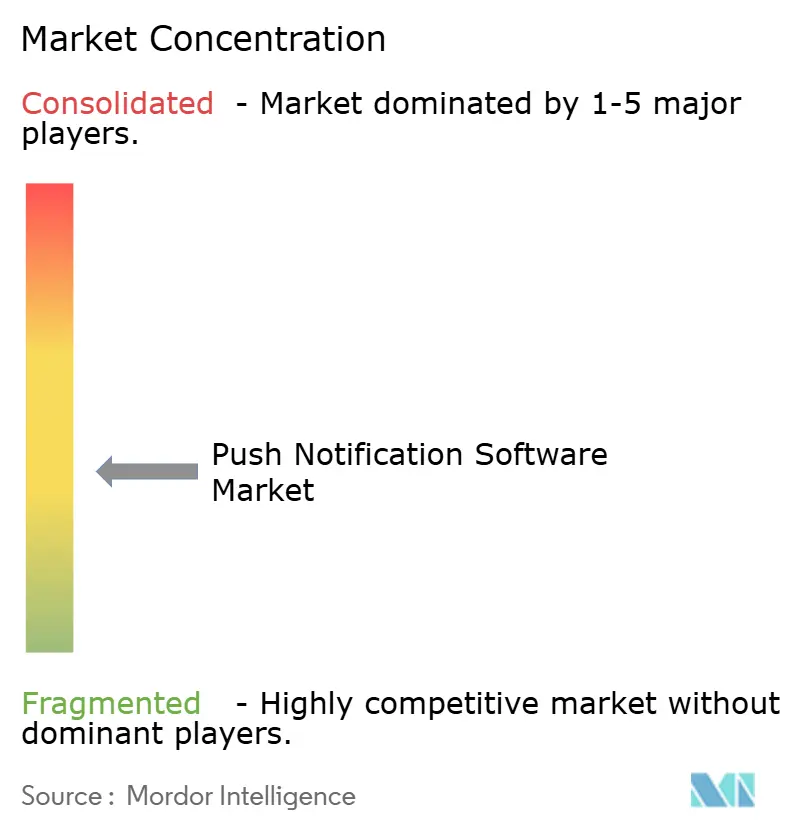
The push notification software market was moderately fragmented in 2026, with no individual provider holding a dominant global revenue position. Pure-play vendors such as OneSignal, Pushwoosh, and PushEngage compete through software development kit coverage, developer usability, and free or low-cost entry plans. Multichannel engagement providers, including Braze, MoEngage, CleverTap, and Iterable, include push delivery within broader customer communication platforms. Salesforce, Adobe, and Oracle participate through marketing cloud and CRM offerings that benefit from established enterprise relationships. CleverTap, Insider, WebEngage, and Netcore Cloud maintain regional relevance in Asia-Pacific and Middle East markets, where North American vendors may have less extensive distribution. This competitive structure gives customers several choices, but it also requires vendors to distinguish themselves through automation, integration, compliance support, and service quality.
AI-supported campaign management became an important area of competition during 2026. MoEngage acquired Aampe in June 2026 to add reinforcement learning capabilities that process more than 200 billion decisioning events each week.[5]MoEngage, Inc., “MoEngage Acquires Aampe To Bring 1:1 Agentic Decisioning To B2C Marketing Teams,” MoEngage, Inc., moengage.com Braze made BrazeAI Operator and BrazeAI Agent Console generally available in April 2026, expanding its tools for campaign creation, personalization, and customer experience management. Iterable launched Nova Agent during the same month with features for automated campaign development, message review, experimentation, and personalization.
Airship released Intelligent Rollouts in May 2026 to identify and distribute better-performing push message variants while campaigns are active. The product reduces the need for manual testing and limits user exposure to weaker message variants. Airship also introduced Scene Action functionality in July 2026, allowing native in-app content such as surveys, registration forms, and video to open from a push message. Competitive opportunities remain in healthcare platforms that support HIPAA requirements, affordable autonomous tools for small businesses, and services designed for low-bandwidth markets with varied device environments. The lowest-priced web push products face the greatest commoditization risk because similar core features are available through several vendors. Providers that add cross-channel orchestration, advanced personalization, and reliable compliance features are more likely to retain enterprise accounts.
Push Notification Software Industry Leaders
OneSignal, Inc.
Airship Group, Inc.
Braze, Inc.
CleverTap
MoEngage, Inc.
- *Disclaimer: Major Players sorted in no particular order

Recent Industry Developments
- July 2026: OneSignal unveiled its Autonomous Lifecycle Marketing vision and released OneSignal AI along with the OneSignal MCP Server in open beta to all account holders. The MCP Server enabled AI assistants, including Claude, ChatGPT, Cursor, and Microsoft Copilot, to operate OneSignal autonomously, executing segmentation, copy drafting, journey building, and campaign scheduling on a customer’s behalf. Customer proof points included Cashea’s 43% increase in first-month activation, letgo’s reactivation of 28,000+ dormant users from a single campaign, and BetterMe’s 22% retention improvement.
- July 2026: Aurora Mobile’s JPush division announced a partnership with Pobo Financial to deploy its intelligent push notification solution across Pobo Financial’s mobile applications. JPush’s self-developed high-availability cluster architecture and intelligent routing algorithms enabled real-time processing of sudden traffic spikes while maintaining low-latency financial information delivery.
- July 2026: Airship added Scene Action functionality for push notifications, enabling native in-app content, including surveys, channel registration forms, and video, to open directly from a push notification tap. The feature was available from iOS SDK 20.9 and Android SDK 20.8.2.
- April 2026: Braze launched BrazeAI Operator and BrazeAI Agent Console as generally available agentic AI tools and introduced Braze Creative Studio with direct integrations to Figma and Canva for design-to-campaign workflows. Braze also added EU hosting on Google Cloud for BrazeAI Decisioning Studio to address GDPR data-residency requirements for European financial services and healthcare clients.


Global Push Notification Software Market Report Scope
The push notification software market comprises platforms and tools that enable businesses to deliver real-time, personalized alerts and messages directly to users across web, mobile, and desktop applications. These solutions help organizations improve customer engagement, strengthen retention strategies, and optimize conversions by automating targeted notifications, integrating with CRM and marketing systems, and providing analytics to measure campaign performance. Market growth is driven by the increasing demand for personalized communication, the expansion of mobile commerce, and the need for privacy-compliant customer engagement tools across industries.
The Push Notification Software Market Report is Segmented by Deployment Mode (Cloud-Based, and On-Premises), Enterprise Size (Large Enterprises, and Small and Medium Enterprises), Notification Channel (Mobile Push Notifications, Web Push Notifications, and Desktop Push Notifications), End-User Industry (Retail and E-Commerce, Banking, Financial Services, and insurance (BFSI), IT and Telecommunication, Media and Entertainment, Travel and Hospitality, Healthcare and Life Sciences, Education, and Other End User Industries), and Geography (North America, South America, Europe, Asia-Pacific, and Middle East and Africa). The Market Forecasts are Provided in Terms of Value (USD).
| Cloud-Based |
| On-Premises |
| Large Enterprises |
| Small and Medium Enterprises |
| Mobile Push Notifications |
| Web Push Notifications |
| Desktop Push Notifications |
| Retail and E-Commerce |
| Banking, Financial Services, and insurance (BFSI) |
| IT and Telecommunication |
| Media and Entertainment |
| Travel and Hospitality |
| Healthcare and Life Sciences |
| Education |
| Other End User Industries |
| North America | United States | |
| Canada | ||
| Mexico | ||
| South America | Brazil | |
| Argentina | ||
| Rest of South America | ||
| Europe | Germany | |
| United Kingdom | ||
| France | ||
| Italy | ||
| Spain | ||
| Russia | ||
| Rest of Europe | ||
| Asia-Pacific | China | |
| Japan | ||
| india | ||
| South Korea | ||
| Australia | ||
| Rest of Asia-Pacific | ||
| Middle East and Africa | Middle East | Turkey |
| Saudi Arabia | ||
| United Arab Emirates | ||
| Rest of Middle East | ||
| Africa | South Africa | |
| Nigeria | ||
| Rest of Africa | ||
| By Deployment Model | Cloud-Based | ||
| On-Premises | |||
| By Enterprise Size | Large Enterprises | ||
| Small and Medium Enterprises | |||
| By Notification Channel | Mobile Push Notifications | ||
| Web Push Notifications | |||
| Desktop Push Notifications | |||
| By End User Industry | Retail and E-Commerce | ||
| Banking, Financial Services, and insurance (BFSI) | |||
| IT and Telecommunication | |||
| Media and Entertainment | |||
| Travel and Hospitality | |||
| Healthcare and Life Sciences | |||
| Education | |||
| Other End User Industries | |||
| By Geography | North America | United States | |
| Canada | |||
| Mexico | |||
| South America | Brazil | ||
| Argentina | |||
| Rest of South America | |||
| Europe | Germany | ||
| United Kingdom | |||
| France | |||
| Italy | |||
| Spain | |||
| Russia | |||
| Rest of Europe | |||
| Asia-Pacific | China | ||
| Japan | |||
| india | |||
| South Korea | |||
| Australia | |||
| Rest of Asia-Pacific | |||
| Middle East and Africa | Middle East | Turkey | |
| Saudi Arabia | |||
| United Arab Emirates | |||
| Rest of Middle East | |||
| Africa | South Africa | ||
| Nigeria | |||
| Rest of Africa | |||


Key Questions Answered in the Report
What is the push notification software market size?
The push notification software market size is projected to expand from USD 1.58 billion in 2025 and USD 1.83 billion in 2026 to USD 3.78 billion by 2031, registering a CAGR of 15.61% between 2026 to 2031.
What is driving demand for push notification platforms?
Demand is supported by real-time customer engagement, first-party data use, lifecycle automation, and coordination of push messages with email, SMS, in-app messaging, and RCS.
Which deployment model leads push notification software adoption?
Cloud-based deployment led with 72.63% of revenue in 2025 because it supports scalable delivery, automatic updates, and lower implementation effort.
Which notification channel is growing fastest?
Web push notifications are expected to grow at a 17.29% CAGR through 2031 because they can engage website users without requiring a native application download.
Which end-user sector is expanding fastest?
Healthcare and life sciences is projected to record an 18.37% CAGR through 2031 as digital health, telemedicine, and remote monitoring services expand.
Which region is expected to grow fastest through 2031?
Asia-Pacific is projected to grow at a 19.24% CAGR, supported by mobile-first commerce and expanding fintech, education technology, and digital health applications.
Page last updated on:






