
Pump Rental Market Size and Share
Market Overview
| Study Period | 2022 - 2032 |
|---|---|
| Market Size (2027) | USD 12.57 Billion |
| Market Size (2032) | USD 16.90 Billion |
| Growth Rate (2027 - 2032) | 6.10 % |
| Fastest Growing Market | Asia-Pacific |
| Largest Market | North America |
| Market Concentration | Medium |
Major Players *Disclaimer: Major Players sorted in no particular order Image © Mordor Intelligence. Reuse requires attribution under CC BY 4.0. | |
Pump Rental Market Analysis by Mordor Intelligence
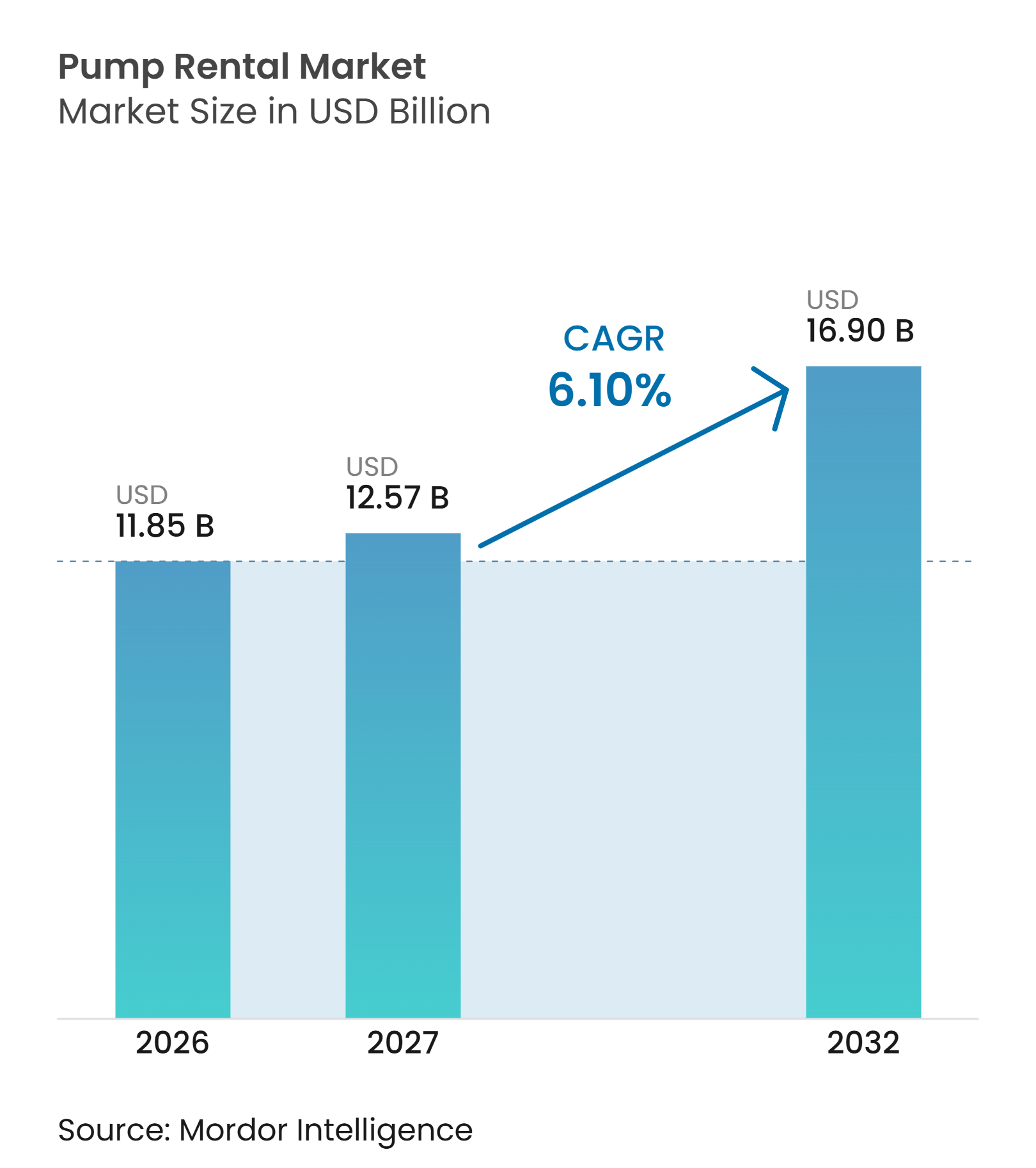
The Pump Rental Market size is expected to increase from USD 11.85 billion in 2026 to USD 12.57 billion in 2027 and reach USD 16.90 billion by 2032, growing at a CAGR of 6.10% over 2027-2032. The pump rental market is supported by customers that need temporary dewatering capacity but prefer to avoid ownership, maintenance liability, and equipment obsolescence risk. Construction, mining, and municipal clients can use rental contracts to align equipment availability with site conditions and project schedules. Water infrastructure rehabilitation creates recurring demand because treatment plants and pipelines often require bypass capacity while work is completed. Larger suppliers are broadening their networks and specialist services, while connected equipment is becoming more important to fleet reliability. The pump rental market also faces a practical limit because rapid deployment depends on local inventory and qualified field technicians.
Key Report Takeaways
- By pump type, centrifugal pumps held 62.7% of the pump rental market share in 2026, while submersible pumps are forecast to grow at a 6.5% CAGR through 2032.
- By end-user industry, construction held 27.5% of revenue in 2026, while water and wastewater utilities are forecast to grow at a 6.4% CAGR through 2032.
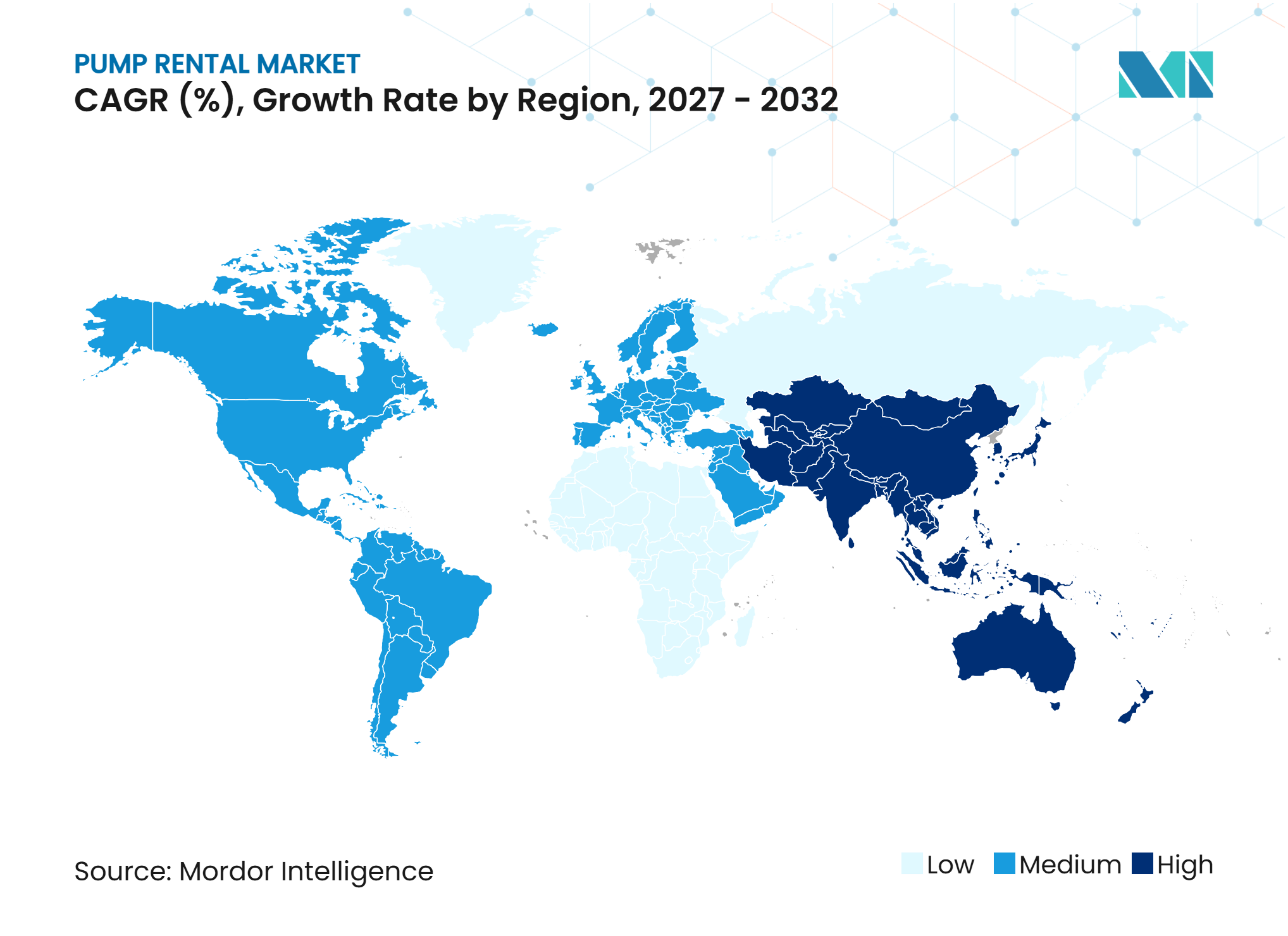
- By geography, North America held 44.9% of revenue in 2026, while Asia-Pacific is forecast to grow at a 7.1% CAGR through 2032.
Note: Market numbers in this report are based on Mordor Intelligence's proprietary estimation framework, which combines nine months of actuals with Q4 projections for base year 2026.
Market Trends and Insights
Drivers Impact Analysis of Pump Rental Market*
| Driver | (~) % Impact on CAGR Forecast | Geographic Relevance | Impact Timeline |
|---|---|---|---|
| Lower Capital Commitment and Flexible Capacity Access | +1.5% | Global | Short term (≤ 2 years) |
| Water and Wastewater Infrastructure Renewal | +1.3% | North America and EU, spill-over to APAC | Medium term (2-4 years) |
| Construction, Mining, and Industrial Dewatering Demand | +1.1% | Global, APAC core | Medium term (2-4 years) |
| Emergency Response and Flood-Resilience Requirements | +0.6% | Global, with APAC and MEA strength | Short term (≤ 2 years) |
| Mine-Water Management Beyond Conventional Dewatering | +0.5% | APAC core, spill-over to MEA and South America | Long term (≥ 4 years) |
| Rental-Fleet Telematics and Predictive Maintenance | +0.3% | Global | Medium term (2-4 years) |
| Source: Mordor Intelligence | |||
Lower Capital Commitment and Flexible Capacity Access
Rental contracts allow project owners to obtain equipment without holding pumps that may sit idle after a project ends. This structure moves maintenance, repair, and replacement responsibilities to the rental provider. It is relevant where project demand is uncertain or short lived, particularly in construction, oil and gas, and utilities. The pump rental market benefits when customers want a defined operating cost instead of a larger upfront purchase. Temporary dewatering work is especially suited to this model because the required flow, head, and duration vary by site. This preference can remain in place even when equipment purchasing conditions improve because the underlying work is project-based.
Water and Wastewater Infrastructure Renewal
Aging water and wastewater assets require bypass pumping when pipes, treatment units, and related infrastructure are rehabilitated. The U.S. Environmental Protection Agency identifies USD 630 billion in wastewater infrastructure needs over 20 years, which supports a long project pipeline for utilities and contractors.[1] The Bipartisan Infrastructure Law provided USD 50 billion through drinking water and clean water state revolving funds, supporting water infrastructure work.[2] Utilities cannot routinely suspend water or treatment services during repair work. They therefore need temporary systems that can maintain flows while permanent assets are unavailable. The pump rental market can gain longer contracts when a provider supplies equipment, design support, and discharge management for these projects.
Construction, Mining, and Industrial Dewatering Demand
Construction holds 27.5% of 2026 revenue, reflecting the continued need to control groundwater during foundations, trenches, transit work, and industrial development. Mining sites need more complex water management as extraction moves deeper and groundwater conditions become less predictable. Underground mine pump systems are safety critical and need reliable power, monitoring, and automatic response arrangements.[3] These conditions favor rental providers that can select equipment for changing site duty conditions and then support it in the field. Industrial projects, including semiconductor plants and data centers, also need dewatering during construction and related site preparation. The pump rental market has room to serve these projects with packages that combine pumps, filtration, hoses, tanks, and field support.
Emergency Response and Flood-Resilience Requirements
Flood response requires equipment that can be mobilized quickly, often before permanent pumping capacity can be expanded. Municipalities and contractors are increasingly using standing rental arrangements to prepare for weather-related disruption. Mine operators also need emergency water controls after heavy precipitation, and the Mine Safety and Health Administration has highlighted impoundment inspection and response planning.[4] These projects can require high-volume pumps, backup systems, tanks, and trained crews at short notice. Suppliers that perform well in an emergency can retain customers for planned water-management work later. This demand can also place pressure on local fleet availability when several events occur at the same time.
Restraints Impact Analysis of Pump Rental Market*
| Restraint | (~) % Impact on CAGR Forecast | Geographic Relevance | Impact Timeline |
|---|---|---|---|
| Fleet Logistics and Short-Notice Equipment Availability | -0.6% | Global, most acute in APAC and MEA | Short term (≤ 2 years) |
| Skilled Technician and Field-Service Capacity Constraints | -0.5% | Global, most acute in APAC and MEA | Long term (≥ 4 years) |
| Site-Specific Hydraulic Design and Changing Duty Conditions | -0.4% | Global | Medium term (2-4 years) |
| Environmental Discharge, Emissions, and Compliance Costs | -0.3% | North America and EU | Medium term (2-4 years) |
| Source: Mordor Intelligence | |||
Fleet Logistics and Short-Notice Equipment Availability
Pump rental depends on bringing the appropriate unit, accessories, and support crew to the site quickly. A local depot network can be difficult to build because it requires capital, transport capacity, and predictable demand. Smaller providers can face inventory constraints when several customers seek the same equipment at once. The issue becomes more acute during major weather events or large infrastructure programs. Specialist equipment centers can support deeper inventory for high-demand pump types and related water-handling equipment. However, the concentration of equipment at a few hubs can increase travel time for work outside core service areas. Providers must decide which assets to distribute across local branches and which assets to retain in specialist locations. The right balance depends on site density, expected demand, equipment transport needs, and the time available for mobilization. Strong logistics planning can reduce idle fleet time while improving the chance that a customer receives the required unit quickly. Concentrated specialist centers can support deeper inventory, but transport time can still affect short-notice jobs.
Skilled Technician and Field-Service Capacity Constraints
Correct pump selection requires knowledge of head curves, soil conditions, discharge rules, and changes in site duty over time. U.S. construction rules require water-removal equipment to be monitored by a competent person when excavation hazards are present. A shortage of qualified technicians can therefore limit the number of complex projects a provider can handle. The constraint is important in rapidly expanding markets where technical training has not kept pace with equipment demand. Poor field commissioning can lead to unreliable performance, compliance concerns, and lower repeat business. This is why fleet expansion without engineering and service capacity may not produce the expected results for the pump rental market.
*Our forecasts treat driver/restraint impacts as directional, not additive. The impact forecasts reflect baseline growth, mix effects, and variable interactions.
Pump Rental Market Segment Analysis
By Pump Type:
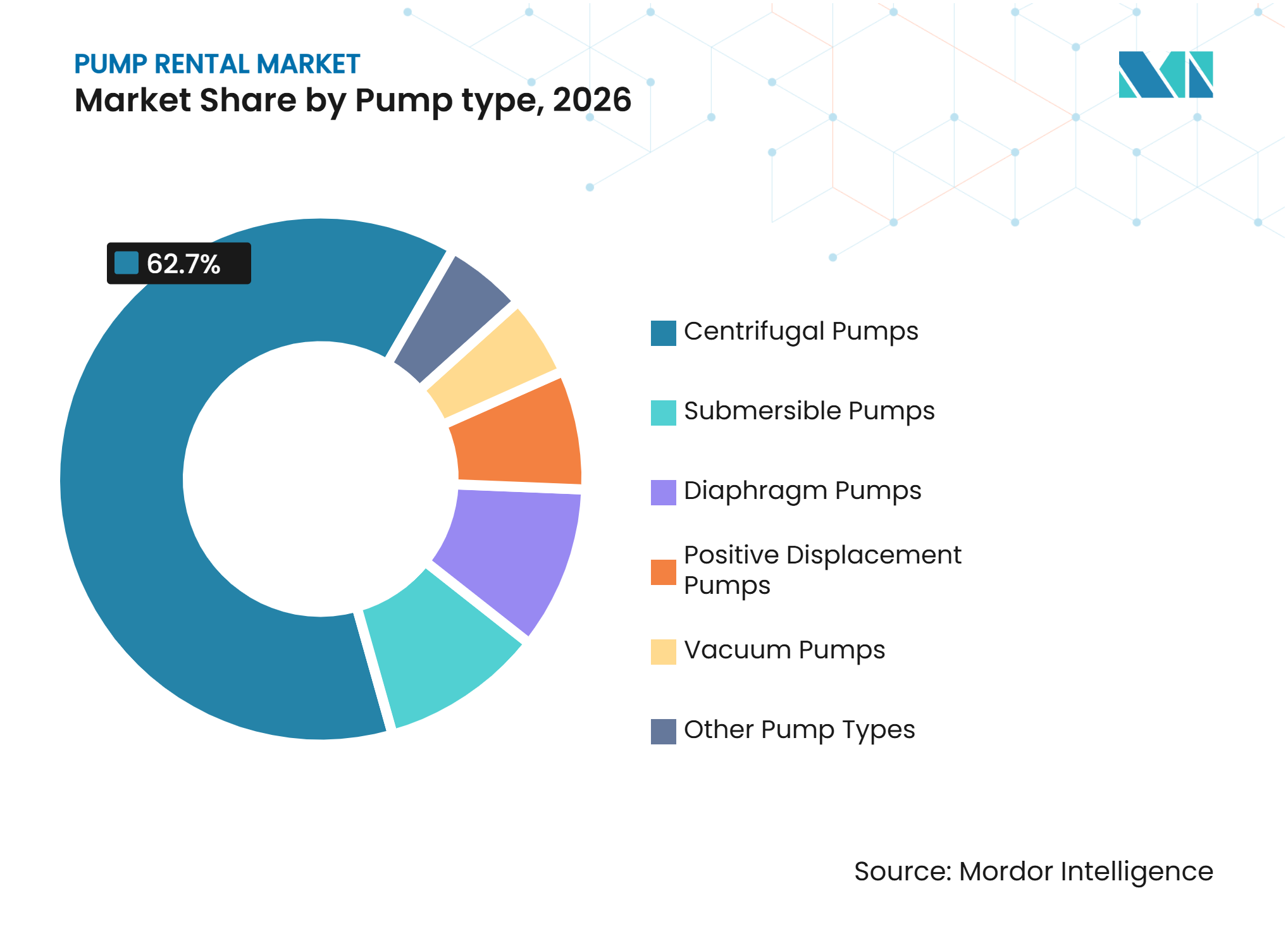
Submersible Growth Reshapes Dewatering ConfigurationsCentrifugal pumps held 62.7% of the pump rental market share in 2026 because they are versatile, straightforward to maintain, and suitable for many dewatering tasks. Self-priming designs can manage clean water and lightly contaminated groundwater across construction, industrial, and municipal work. Their wide operating range makes them a common choice for contractors that need familiar equipment and rapid setup. Centrifugal units also fit well within broader rental packages that include hoses, tanks, filtration, and generators. This scale gives rental fleets a practical base for routine drainage, bypass, and site water-control work.
Submersible pumps are forecast to expand at a 6.5% CAGR through 2032, which is the fastest rate among the stated pump types. Their value rises when pumps must operate at depth or within confined spaces where surface suction arrangements are less practical. Underground mining, tunnels, metro construction, and urban bypass work are important use cases. Electric submersible units can also address urban requirements for lower noise and reduced local exhaust emissions. Positive displacement, diaphragm, vacuum, and axial-flow pumps continue to serve specialized needs, including viscous fluids, corrosive materials, wellpoint systems, and high-volume flood control. The pump rental market needs each of these configurations because water conditions and required flow levels are not uniform across projects. Rental providers can improve project fit by assessing the fluid, solids content, available power, discharge route, and space limitations before selecting a unit. A broader fleet does not remove the need for this assessment, especially where safety or uninterrupted operations are important. The pump rental industry therefore depends on equipment availability as well as the ability to match a pump to the operating conditions.



By End-User Industry:
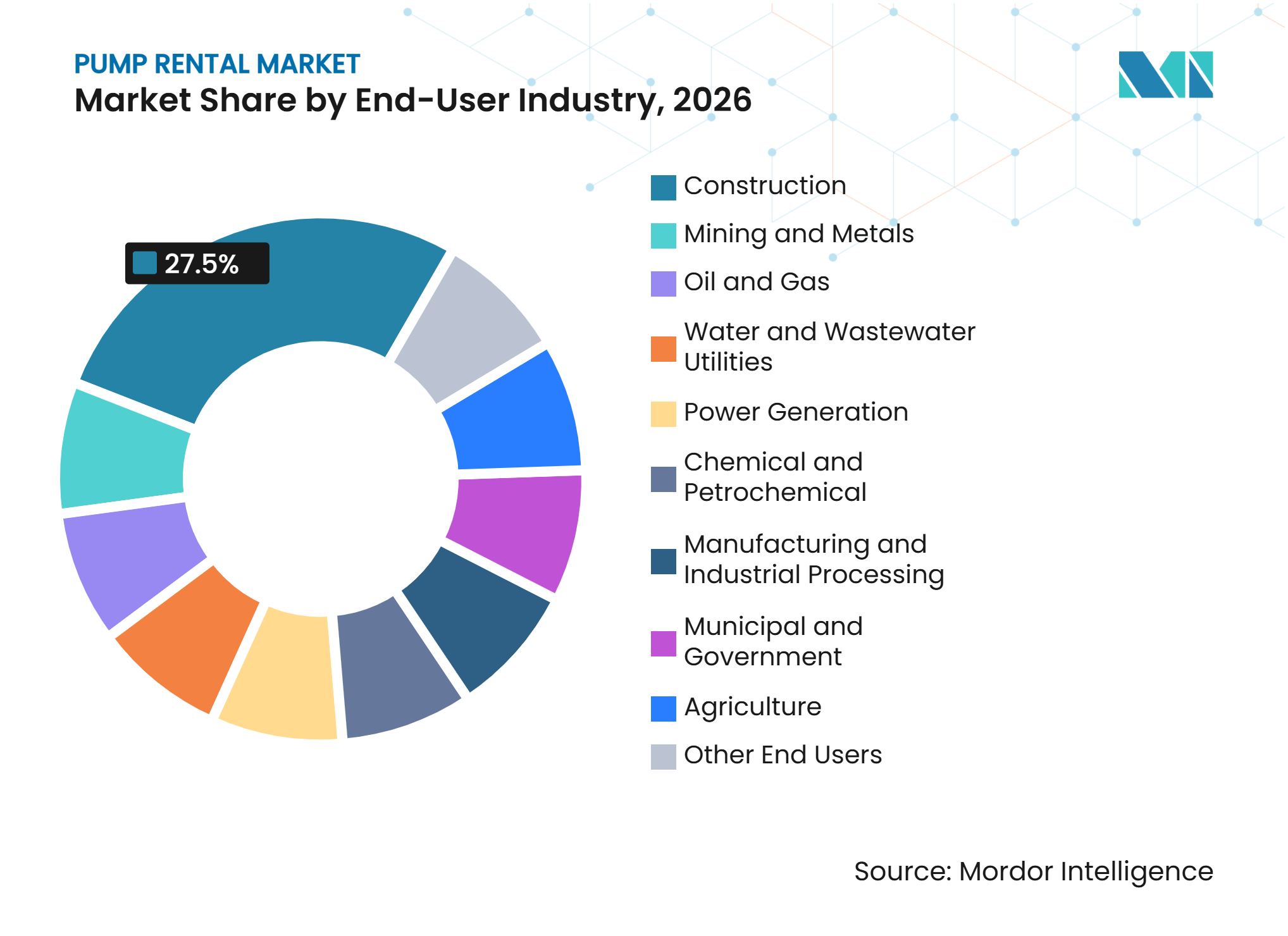
Utilities Support Longer Rental CommitmentsConstruction accounted for 27.5% of the pump rental market size in 2026 and remained the largest end-user segment. Foundation work, trench excavation, civil construction, and industrial site development all need temporary groundwater control. Rental periods in construction are often short to medium in duration, and equipment turnover can be high. This structure suits providers with broad geographic coverage and a wide general fleet. Construction demand is also exposed to weather conditions, project timing, and the availability of local equipment.
Water and wastewater utilities are projected to grow at a 6.4% CAGR through 2032. These customers use bypass systems when treatment plants, pipelines, and associated infrastructure are repaired or upgraded. Such work can continue for months or years, making it attractive to providers that can offer reliable service and monitoring. Xylem described a temporary water-treatment deployment in Chatham-Kent, Ontario, that used diesel and electric dewatering pumps after a treatment facility fire. Mining and metals remain an important source of revenue as deeper extraction increases water-management needs. Oil and gas, power generation, chemical and petrochemical, municipal, manufacturing, and agriculture users create additional demand with different pump, material, and flow requirements. Utility work often requires close coordination because a bypass arrangement must maintain service while permanent infrastructure is offline. This can make field support and monitoring as important as the pump itself. The pump rental industry has an advantage where providers can support planning, installation, adjustment, and removal as one service. Long-duration utility assignments can also help suppliers plan fleet use more effectively than highly variable short construction rentals. The pump rental market remains diversified because these recurring assignments sit alongside project-led and emergency demand.

Geography Analysis
North America: Infrastructure Investment and Rental Scale Support Demand
North America held 44.9% of the pump rental market share in 2026. The region has a mature equipment-rental culture, an established supplier base, and a substantial backlog of water infrastructure work. Federal water funding supports projects that require temporary bypass capacity during rehabilitation. The U.S. Environmental Protection Agency proposed the 2027 Construction General Permit with updated provisions for stormwater discharges from construction sites. These compliance factors can favor providers that help customers plan water handling, monitoring, and documentation. Mining for critical minerals in Canada creates a further use case for specialized dewatering. United Rentals reported USD 16.1 billion in FY2025 total revenue, with Fluid Solutions representing 7% of rental revenue. The scale of diversified platforms can help them cross-sell pumping with other job site services, though specialist firms compete through water-management expertise.
Asia-Pacific: Infrastructure and Mining Drive the Highest Regional Growth
Asia-Pacific is forecast to grow at a 7.1% CAGR through 2032, giving the region the highest stated regional growth rate. Urban development, mining expansion, sanitation projects, and new transport infrastructure create varied demand for temporary pumping. India’s water and infrastructure programs support municipal and construction activity, while Southeast Asian mining needs specialist water control. Local expertise is important because soil conditions, rainfall, groundwater, and site logistics vary widely across the region. In mining, deeper extraction can shift dewatering from a temporary task to an ongoing operating need. The pump rental market can benefit where suppliers combine locally available fleets with engineering support rather than relying on standard equipment alone. Fleet logistics and technician availability remain meaningful constraints in less developed service networks. This creates an opening for operators that invest in regional depots, service training, and remote equipment monitoring. The pump rental market also needs flexible deployment models because the distance between a depot and a remote mining or construction site can affect both response time and cost. Local teams can help customers adjust equipment as water conditions change during a project. Connected fleet tools may improve visibility across a dispersed network, but they do not replace trained people at the site. The pump rental market opportunity in Asia-Pacific is therefore closely tied to the depth of service capability that accompanies equipment expansion.
Europe, South America, and Middle East and Africa: Different Compliance and Project Needs Shape Demand
Europe, South America, and Middle East and Africa represent a mixed set of opportunities for the pump rental market. Europe has industrial demand and water-related compliance obligations, including the regulatory influence of the EU Water Framework Directive. LOXAM reported USD 2.76 billion (EUR 2.47 billion) in FY2025 revenue and plans USD 560 million (EUR 500 million) in fleet capital expenditure for 2026, with attention to Southern Europe and Brazil. Its planned acquisition of a controlling interest in Mills, subject to approval by Brazil’s Conselho Administrativo de Defesa Econômica (CADE), points to continuing interest in Latin American rental capacity. South American demand includes oil and gas activity and urban construction, while local service coverage remains a differentiator. Gulf construction programs create demand for groundwater management and temporary water handling. In Southern Africa, mining remains central to specialized dewatering requirements. Service coverage in these regions is shaped by the distance between customer sites, the ability to deliver equipment safely, and the availability of local field expertise. The different regional patterns mean suppliers need to balance equipment availability with compliance knowledge and local technical support.
Competitive Landscape
Market Concentration
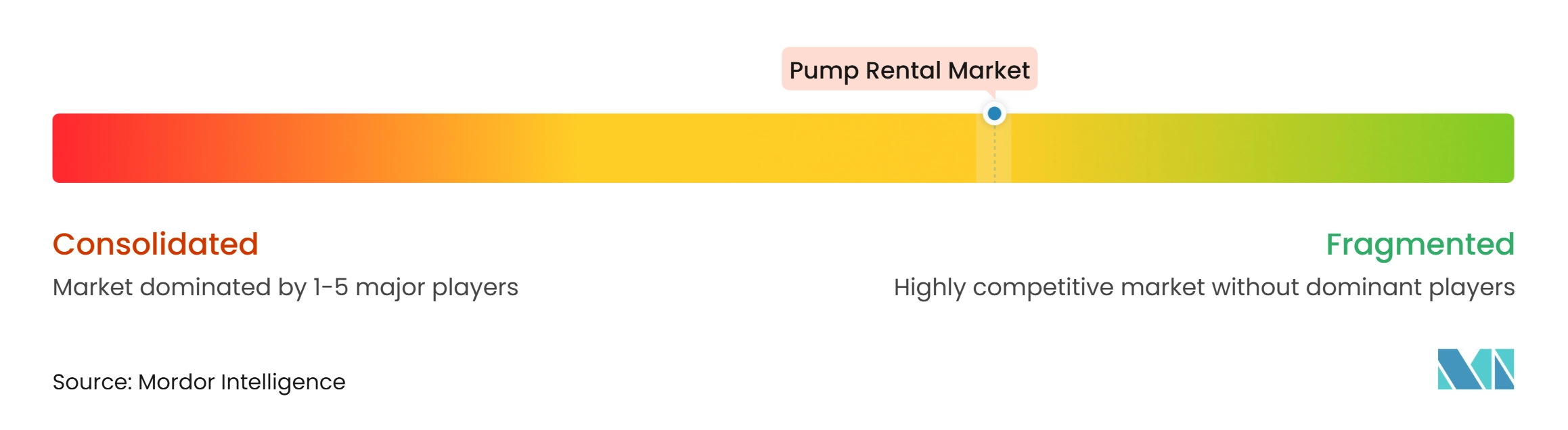
The pump rental market is moderately consolidated and has two broad competitive groups. Diversified rental platforms, including United Rentals, Ashtead Group, Herc Holdings, LOXAM, and Boels Rental, offer pumps as part of wider specialty or general equipment portfolios. Their advantage is the ability to provide pumps, power, filtration, trench safety, and other jobsite requirements through a single supplier relationship. Specialist providers, including Xylem, Workdry companies, and Atlas Copco businesses, focus more directly on dewatering application design, technical support, and water-management equipment. Xylem states that its global dewatering rental fleet includes more than 20,000 products across the Godwin and Flygt portfolios. This combination of scale and specialist capability gives customers a choice between integrated procurement and deep pumping expertise. The diversified model is strongest when a site needs several categories of temporary equipment and wants a single commercial agreement. It can simplify delivery scheduling, invoicing, and coordination across a project. The specialist model is strongest when the work has demanding hydraulic conditions or requires a tailored bypass design. It also matters when a site requires filtration, water treatment, or controls alongside pumping hardware. In the pump rental market, the two approaches can overlap because diversified providers continue to build specialist service lines. Customers may choose a broad platform for routine applications and a specialist team for complex, high-risk, or long-duration jobs. Regional suppliers retain a role where local response time and long-standing client relationships matter more than national fleet scale.
Consolidation has remained an important competitive feature. Herc Holdings completed the acquisition of H&E Equipment Services in June 2025 for USD 5.3 billion, expanding its footprint and adding locations across the United States. Atlas Copco completed the acquisition of National Tank & Equipment in October 2025, establishing a direct U.S. rental platform for pumps and storage solutions. Workdry International also expanded its North American dewatering offer through the acquisition of Atlas Dewatering. These moves show that larger groups seek local fleets, customer access, and technical capabilities at the same time. They can also raise the competitive threshold for regional firms that lack comparable branch coverage or service resources. Acquisition activity can add useful equipment capacity and local operating knowledge without requiring a company to construct a network from the ground up. It can also bring technicians, established customer relationships, and application records into a larger organization. The value of these assets is highest where the acquired business already has credibility in dewatering or water handling. In the pump rental market, transactions also help larger companies respond to customers that prefer wider geographic support. The resulting networks can improve access to equipment across regions, but they still need strong depot planning to avoid thin fleet coverage. Smaller operators can remain relevant by focusing on a narrow set of pump applications, local response, or technical work that a large general fleet may not prioritize.
Technology and compliance can influence supplier selection alongside price and fleet availability. Connected pumps can provide flow, motor, temperature, and fault information that supports maintenance planning and remote operation. Suppliers can use this data to improve asset utilization and reduce avoidable downtime. Customers also value help with discharge monitoring and permit requirements in regulated sites. A provider that can document compliance and deliver reliable field support may face lower customer switching risk. Telematics also gives service teams a clearer view of equipment condition before a fault interrupts work. That can help providers schedule field visits, prepare the necessary parts, and reduce time spent diagnosing a unit on site. The practical benefit is strongest on projects where a pump failure could delay construction activity or interrupt a bypass operation. Rental customers do not need every project to use the same level of connected monitoring. Complex and long-running sites may justify a more complete monitoring package, while small short-duration jobs may prioritize ease of deployment. Compliance support has a similar effect because customers can value documentation when discharge rules or site permits are demanding. The pump rental market therefore rewards companies that combine reliable hardware, responsive service, and credible administrative support rather than relying on fleet size alone. This need changes the basis of competition from simple equipment availability to the dependable execution of a temporary water-management assignment. It also links fleet planning with field service because remote data is most useful when a technician and the right replacement equipment can be dispatched quickly. Equipment that is well maintained and correctly specified can reduce disruption for the contractor or utility. In this setting, providers compete on the consistency of the complete service, from site assessment through mobilization, operation, monitoring, and demobilization. That is particularly relevant where a project has strict discharge conditions or cannot tolerate a loss of pumping capacity.
Pump Rental Industry Leaders
-
United Rentals, Inc.
-
Ashtead Group plc
-
Xylem Inc.
-
Herc Holdings Inc.
-
Rain for Rent
- *Disclaimer: Major Players sorted in no particular order
Pump Rental Market Companies Covered in this Report
- ACTION International Services LLC
- APO Pumps & Compressors
- Ashtead Group plc
- Atlas Copco AB
- Barco Pump
- Boels Rental
- Global Pump Company
- GPM Rentals
- Herc Holdings Inc.
- Holland Pump Company
- Integrated Pump Rental (Pty) Ltd.
- LOXAM Group
- MWI Pumps
- Rain for Rent
- Selwood Limited
- Speedy Hire plc
- Thompson Pump and Manufacturing Company
- United Rentals, Inc.
- Van der Kamp BV
- Xylem Inc.
Recent Industry Developments in Pump Rental Market
- May 2026: LOXAM SAS signed a share purchase agreement to acquire a 50.3% controlling stake in Mills, Brazil's largest equipment rental company with annual net revenue of EUR 315 million in 2025 and a fleet of 16,000 equipment units, implying an equity value of BRL 3.8 billion, subject to approval from Brazil's antitrust authority, CADE.
- March 2026: LOXAM Group announced FY2025 revenues of EUR 2.47 billion and outlined plans for EUR 500 million in fleet CapEx investment in 2026 to accelerate recovery, with strategic focus on Southern Europe and Brazil, following a 4% year-on-year revenue decline driven by subdued European construction markets.
- February 2026: Herc Holdings reported record FY2025 total revenues of USD 4.38 billion, a 23% year-on-year increase, following the integration of H&E Equipment Services, which added 160 locations and significantly expanded the company's ProSolutions pump rental network across North America.
- January 2026: United Rentals reported FY2025 total revenues of USD 16.1 billion, with fluid solutions comprising 7% of rental revenue and the Specialty segment growing at a double-digit rate. The company also announced plans to return USD 2 billion to shareholders in 2026, supported by a new USD 5 billion share repurchase program.
Global Pump Rental Market Report Scope
Pump rental is a service that provides temporary or long-term access to specialized pumping equipment without requiring an outright purchase.
The pump rental market is segmented into pump type, end-use industry, and geography. By pump type, the market is segmented into centrifugal pumps, positive displacement pumps, submersible pumps, diaphragm pumps, vacuum pumps, and other pump types. By end-use industry, the market is divided among construction, mining and metals, oil and gas, water and wastewater utilities, power generation, chemical and petrochemical, manufacturing and industrial processing, municipal and government, agriculture, and other end users. The report also covers the market size and forecasts for the global pump rental market across 26 countries in key regions. For each segment, the market sizing and forecasts have been provided on the basis of value (USD).
Segmentation Overview
| Centrifugal Pumps |
| Positive Displacement Pumps |
| Submersible Pumps |
| Diaphragm Pumps |
| Vacuum Pumps |
| Other Pump Types |
| Construction |
| Mining and Metals |
| Oil and Gas |
| Water and Wastewater Utilities |
| Power Generation |
| Chemical and Petrochemical |
| Manufacturing and Industrial Processing |
| Municipal and Government |
| Agriculture |
| Other End Users |
| North America | United States |
| Canada | |
| Mexico | |
| Europe | Germany |
| France | |
| Italy | |
| Spain | |
| United Kingdom | |
| Poland | |
| Russia | |
| Rest of Europe | |
| Asia-Pacific | China |
| India | |
| Japan | |
| South Korea | |
| Australia | |
| Indonesia | |
| Vietnam | |
| Thailand | |
| Rest of Asia-Pacific | |
| South America | Brazil |
| Argentina | |
| Chile | |
| Rest of South America | |
| Middle East and Africa | Saudi Arabia |
| United Arab Emirates | |
| Egypt | |
| South Africa | |
| Morocco | |
| Rest of Middle East and Africa |
| By Pump Type | Centrifugal Pumps | |
| Positive Displacement Pumps | ||
| Submersible Pumps | ||
| Diaphragm Pumps | ||
| Vacuum Pumps | ||
| Other Pump Types | ||
| By End-User Industry | Construction | |
| Mining and Metals | ||
| Oil and Gas | ||
| Water and Wastewater Utilities | ||
| Power Generation | ||
| Chemical and Petrochemical | ||
| Manufacturing and Industrial Processing | ||
| Municipal and Government | ||
| Agriculture | ||
| Other End Users | ||
| By Geography | North America | United States |
| Canada | ||
| Mexico | ||
| Europe | Germany | |
| France | ||
| Italy | ||
| Spain | ||
| United Kingdom | ||
| Poland | ||
| Russia | ||
| Rest of Europe | ||
| Asia-Pacific | China | |
| India | ||
| Japan | ||
| South Korea | ||
| Australia | ||
| Indonesia | ||
| Vietnam | ||
| Thailand | ||
| Rest of Asia-Pacific | ||
| South America | Brazil | |
| Argentina | ||
| Chile | ||
| Rest of South America | ||
| Middle East and Africa | Saudi Arabia | |
| United Arab Emirates | ||
| Egypt | ||
| South Africa | ||
| Morocco | ||
| Rest of Middle East and Africa | ||
Key Questions Answered in the Report
What is the projected value of the pump rental sector by 2032?
The sector is projected to reach USD 16.90 billion by 2032, growing from USD 11.85 billion in 2026 at a 6.10% CAGR.
Which pump type has the largest rental revenue share?
Centrifugal pumps held 62.7% of revenue in 2026 because they support a wide range of construction, industrial, and municipal dewatering tasks.
Which pump type is expected to grow fastest through 2032?
Submersible pumps are projected to grow at a 6.5% CAGR, supported by underground mining, tunnel construction, and confined-space applications.
Why are water and wastewater utilities increasing demand for rented pumps?
Utilities use bypass pumping during pipeline and treatment plant rehabilitation, and the segment is projected to grow at a 6.4% CAGR through 2032.
Which region has the largest share of pump rental revenue?
North America held 44.9% of revenue in 2026, supported by mature rental networks and water infrastructure rehabilitation.
Which region is forecast to grow fastest in pump rental?
Asia-Pacific is forecast to grow at a 7.1% CAGR through 2032 as infrastructure, mining, and sanitation projects expand.