
Protecting Reagents Market Size and Share
Market Overview
| Study Period | 2021 - 2031 |
|---|---|
| Market Size (2026) | USD 0.75 Billion |
| Market Size (2031) | USD 1.03 Billion |
| Growth Rate (2026 - 2031) | 6.55 % |
| Fastest Growing Market | Asia-Pacific |
| Largest Market | North America |
| Market Concentration | Medium |
Major Players *Disclaimer: Major Players sorted in no particular order Image © Mordor Intelligence. Reuse requires attribution under CC BY 4.0. | |
Protecting Reagents Market Analysis by Mordor Intelligence
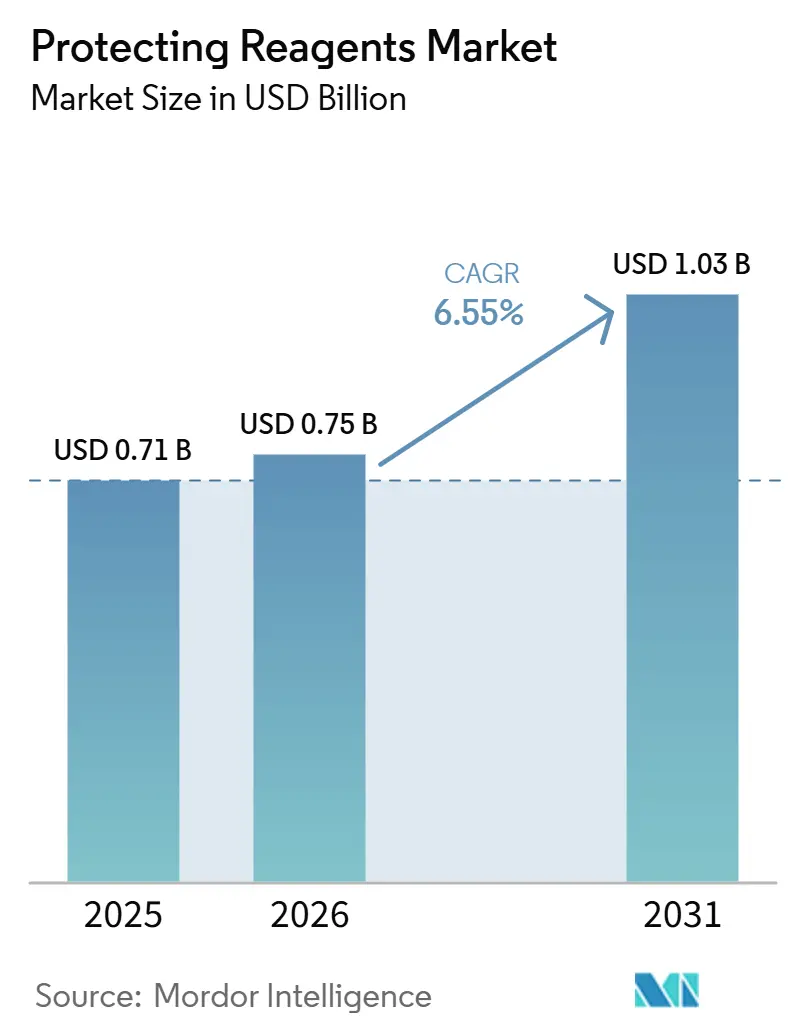
The Protecting Reagents Market size was valued at USD 0.71 billion in 2025 and is estimated to grow from USD 0.75 billion in 2026 to reach USD 1.03 billion by 2031, at a CAGR of 6.55% during the forecast period (2026-2031). The protecting reagents market is supported by the rapid scale-up of peptide manufacturing, where higher Glucagon-Like Peptide-1 (GLP-1) output increases upstream demand for protected amino acid building blocks, coupling agents, and deprotecting solvents in a direct, volume-linked manner. The market is also expanding beyond peptide applications, as antisense oligonucleotides, small interfering RNA (siRNA), and antibody-drug conjugates require distinct protecting group strategies, making end-use demand more diverse across established product classes. Rising large-scale Solid-Phase Peptide Synthesis (SPPS) capacity is pushing buyers toward long-term, validated supply agreements rather than short purchase cycles, especially for 9-Fluorenylmethyloxycarbonyl (Fmoc)-based chemistries used in commercial production, making the market more relationship-driven. The qualified supplier base is narrowing, as current Good Manufacturing Practice (cGMP) expectations, purity demands, and documentation standards favor larger or more specialized manufacturers with strong batch histories and consistent quality systems. The market offers growth opportunities through GMP-grade supply, custom synthesis, liquid-ready formulations, and regulatory-ready product portfolios that align with peptide and oligonucleotide manufacturing requirements.
Key Report Takeaways
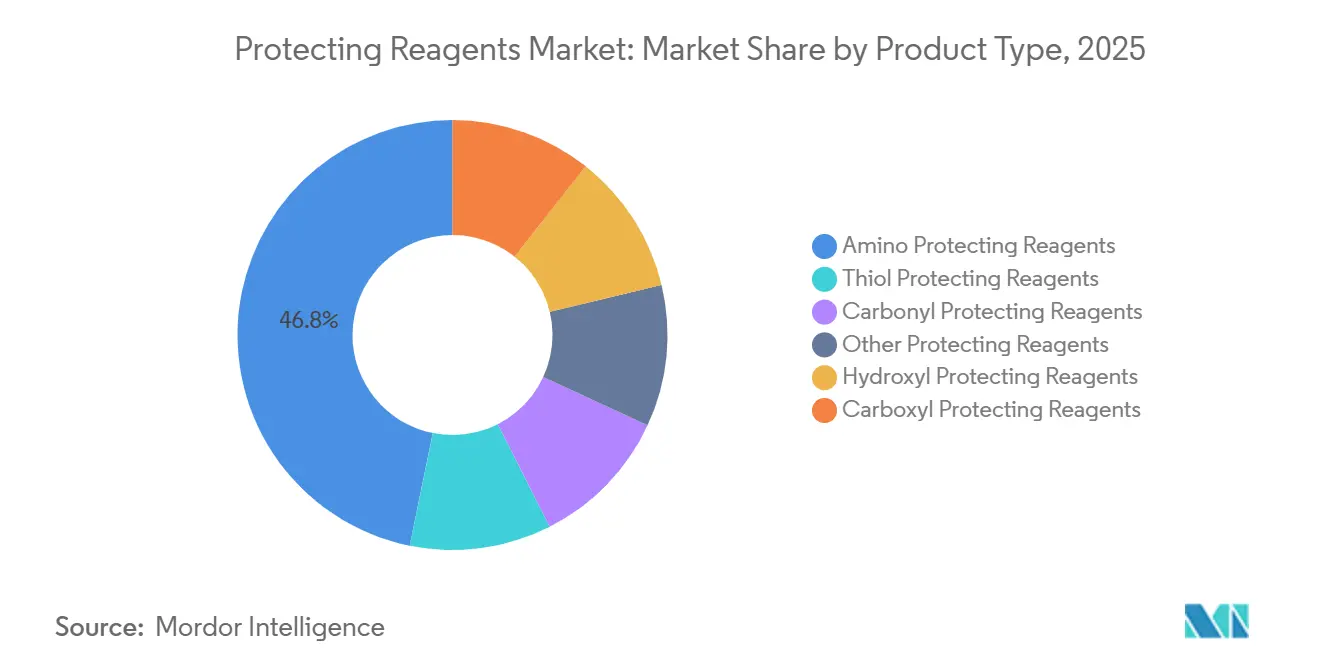
- By product type, Amino Protecting Reagents held 46.82% of the protecting reagents market share in 2025, and the same segment is forecast to expand at an 8.62% CAGR through 2031.
- By physical form, powder accounted for 58.72% of the protecting reagents market size in 2025, while liquid is forecast to expand at a CAGR of 7.05% through 2031.
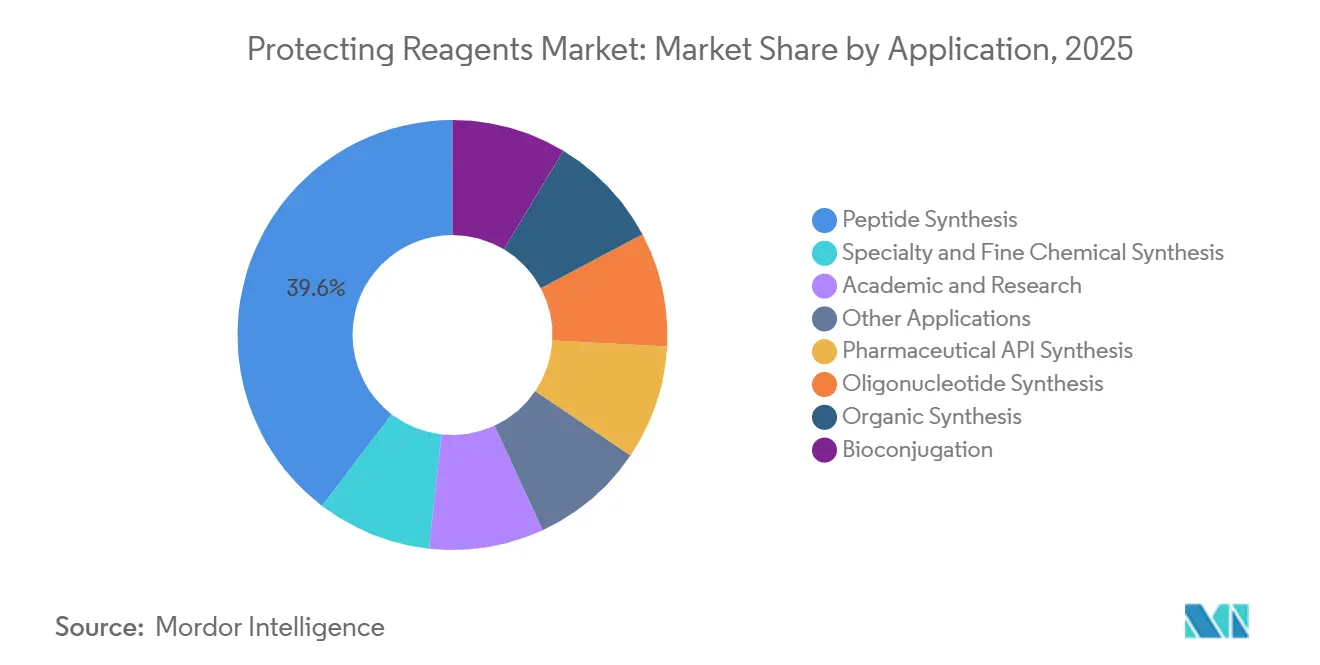
- By application, peptide synthesis accounted for 39.63% of the protecting reagents market size in 2025, while oligonucleotide synthesis is projected to grow at the fastest CAGR of 7.72% through 2031.
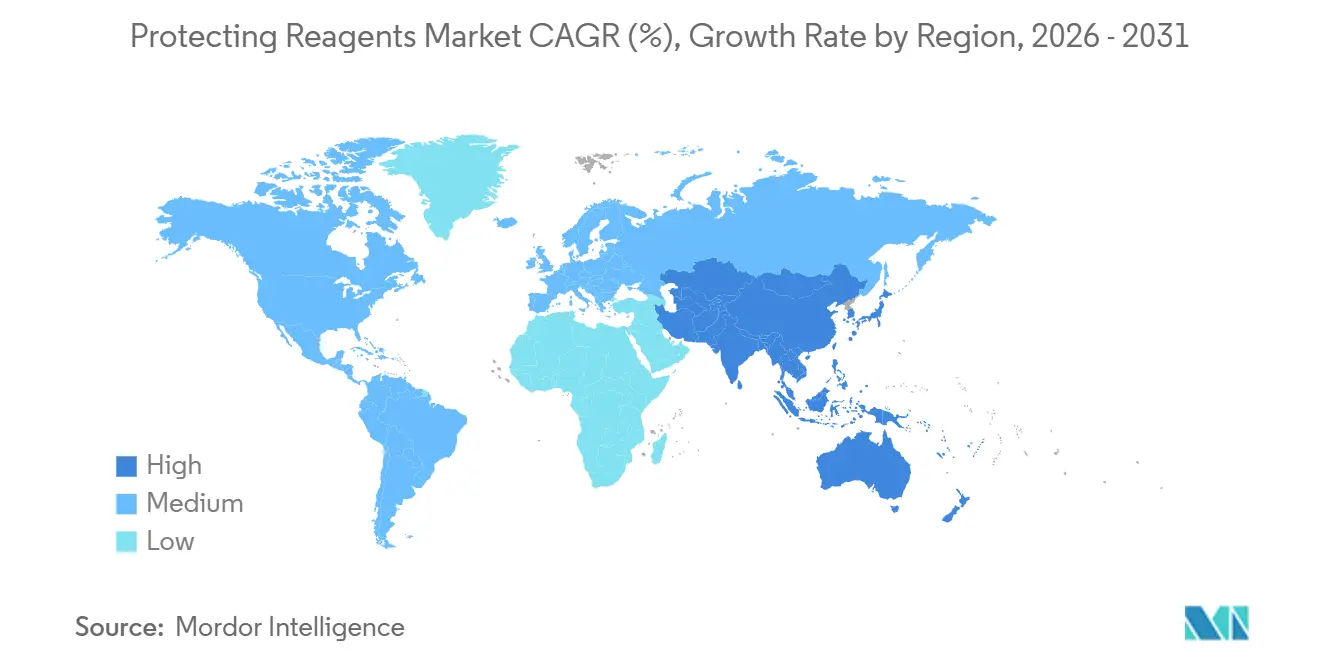
- By geography, North America held 37.41% share in 2025, while Asia-Pacific is forecast to expand at the fastest CAGR of 7.43% through 2031.
Note: Market size and forecast figures in this report are generated using Mordor Intelligence’s proprietary estimation framework, updated with the latest available data and insights as of January 2026.
Market Trends and Insights
Drivers Impact Analysis of Protecting Reagents Market*
| Drivers | (~) % Impact on CAGR Forecast | Geographic Relevance | Impact Timeline |
|---|---|---|---|
| Rising Demand for Peptide-Based Therapeutics and Synthesis | +2.0% | Global, with a concentration in North America and Europe | Short term (≤ 2 years) |
| Increasing Pharmaceutical API Synthesis and Multi-Step Synthesis Workflows | +1.2% | North America, Europe, APAC core | Medium term (2-4 years) |
| Growing Adoption of Solid-Phase Peptide Synthesis | +1.0% | Global | Medium term (2-4 years) |
| Expansion of Contract Development and Manufacturing Organizations | +0.8% | North America and Europe primarily spill over to APAC | Medium term (2-4 years) |
| Increasing Demand for Oligonucleotide Synthesis Reagents | +0.6% | North America, East Asia | Long term (≥ 4 years) |
| Source: Mordor Intelligence | |||
Rising Demand for Peptide-Based Therapeutics and Synthesis
The commercial expansion of GLP-1 receptor agonists has reshaped the protecting reagents market, as procurement has shifted from research-scale purchases to multi-year, high-volume supply planning. Each kilogram of GLP-1 peptide API requires several kilograms of Fmoc-protected amino acid building blocks, meaning reagent demand rises directly with finished peptide output and creates strong demand on validated upstream suppliers. This shift has raised purity expectations across the protecting reagents market, as commercial peptide quality standards limit the role of lower-tier suppliers, even those competing solely on price. The same demand pattern supports broader pharmaceutical API synthesis and other multi-step workflows, since selective protection remains essential when multiple reactive groups must be controlled in sequence during complex manufacturing routes. A 2025 study introduced Fmoc-O-N(CH₃)-Bz as a novel Fmoc introducer that achieved 70% to 93% yields for cyclic amino acids and avoided the Lossen rearrangement observed with conventional Fmoc-OSu reagents, broadening the usable range of amino-protecting chemistry for more demanding peptide structures. This development supports the protecting reagents market by extending amino protection chemistry into non-natural amino acid programs, which are increasingly relevant in newer peptide drug pipelines.
Growing Adoption of Solid-Phase Peptide Synthesis (SPPS)
The protecting reagents market has benefited from the shift toward solid-phase peptide synthesis (SPPS), as this route consumes Fmoc-protected amino acids and side-chain protecting reagents in repeated coupling cycles during each synthesis. Fmoc chemistry has become more established in automated GMP settings because its deprotection conditions are milder, it fits automated synthesizers well, and it avoids the handling of hydrofluoric acid associated with older Boc-based workflows. This operating advantage matters in the protecting reagents market because manufacturers require reagent specifications that remain fixed across batch records, validation packages, and repeated commercial campaigns. Bachem disclosed strong 2025 capital spending, including the commissioning of Building K at Bubendorf, which directly expanded large-scale peptide and oligonucleotide API capacity and depends on reliable supplies of premium protecting reagents. The protecting reagents market also benefits from tighter process discipline, as manufacturers place greater emphasis on well-documented protecting group removal and reproducible synthesis control in regulated environments. As a result, SPPS growth has supported not only higher volumes in the protecting reagents market, but also a stronger preference for suppliers that can combine chemistry depth with dependable GMP execution.
Expansion of Contract Development and Manufacturing Organizations
The protecting reagents market has seen a structural increase from contract development and manufacturing organization (CDMO) expansion, as each new peptide synthesis line or added reactor train raises annual demand for Fmoc, Boc, and side-chain protection chemistries used across commercial and clinical programs. CordenPharma announced a multiyear expansion of its peptide platform across Switzerland and the United States, with a greenfield site near Basel being built to support GLP-1 and non-GLP-1 peptide projects and commercial operations expected to start in the first half of 2028[1]CordenPharma, “CordenPharma Expands Peptide Platform with More Than EUR 500 Million Euro Greenfield Facility Construction Near Basel, Switzerland,” Press Release, cordenpharma.com. This capacity buildout matters for the protecting reagents market because it concentrates purchasing among fewer, larger buyers that require dedicated supply programs, stable lead times, and technical support. Thermo Fisher Scientific announced a USD 2 billion investment commitment across U.S. manufacturing and R&D over four years in April 2025, with pharma services among the areas expected to benefit from the larger footprint. The protecting reagents market has therefore moved away from fragmented small-batch buying and toward validated, relationship-based procurement that favors suppliers with scale and broad compliance readiness. This also links the market more closely to long-cycle pharma manufacturing investment plans rather than short-cycle laboratory spending.
Increasing Demand for Oligonucleotide Synthesis Reagents
The protecting reagents market has also expanded through oligonucleotide synthesis, where DMT groups are used for 5'-hydroxyl protection and cyanoethyl groups for phosphate protection during repeated coupling steps in strand assembly. The growth of antisense oligonucleotides, siRNA therapeutics, and related RNA platforms has created sustained demand for high-purity phosphoramidites and associated protecting groups, adding a second major demand stream beyond peptide chemistry. This is significant for the protecting reagents market because the oligonucleotide segment requires a distinct portfolio, different impurity control, and strong documentation support for GMP submissions. Therapeutic oligonucleotide production imposes strict requirements for purity, batch consistency, and supporting technical documentation, concentrating demand among well-documented manufacturers. The protecting reagents market has also been widened by peptide-oligonucleotide hybrids and GalNAc-conjugated siRNA programs, where coordinated multi-protecting-group strategies are needed across both synthesis domains. This makes oligonucleotide growth a meaningful adjacent opportunity for suppliers that can extend beyond amino acid-based chemistry and support more orthogonal deprotection requirements.
Restraints Impact Analysis of Protecting Reagents Market*
| Restraints | (~) % Impact on CAGR Forecast | Geographic Relevance | Impact Timeline |
|---|---|---|---|
| High Cost of Specialty-Grade GMP Reagents | -0.5% | Global, most acute in emerging APAC markets | Medium term (2-4 years) |
| Multi-Step Synthesis Complexity and Quality Consistency Challenges | -0.3% | Global | Medium term (2-4 years) |
| Stringent Environmental and Chemical Compliance Regulations | -0.2% | EU and North America primarily | Medium term (2-4 years) |
| Source: Mordor Intelligence | |||
High Cost of Specialty-Grade GMP Reagents
The protecting reagents market faces a persistent cost barrier, as current good manufacturing practice (cGMP)-grade products require validated batch testing, impurity profiling, optical purity certification, and stable supply documentation. These requirements materially increase production costs compared to research-grade equivalents, reflecting not only additional documentation but also multi-step synthetic routes and tighter crystallization controls needed to meet pharmaceutical-grade purity and stereochemical standards. This creates a two-tier structure in the protecting reagents market, where GMP-grade supply and lower-purity research-grade supply are not readily interchangeable. Buyers in regulated manufacturing face additional friction because qualifying a new supplier often requires requalification against existing Drug Master Files and process validation packages, which limits switching even under price pressure[2]Iris Biotech GmbH, “Boc Versus Fmoc for Solid Phase Peptide Synthesis,” Iris Biotech, iris-biotech.de. Synthesis complexity further reinforces this barrier, particularly in long-sequence peptide programs where low racemization risk and well-characterized reagents are essential for process consistency. As a result, higher end-use demand does not translate into unrestricted growth across the protecting reagents market, since only a limited number of suppliers can meet the required technical and compliance standards.
Stringent Environmental and Chemical Compliance Regulations
The protecting reagents market is also constrained by tighter chemical compliance requirements in major regulated regions, particularly where halogenated solvents, piperidine, and related processing materials remain part of Fmoc-based workflows. In Europe, compliance requirements increase the documentation burden on specialty chemical producers and can weigh more heavily on smaller companies with narrow product lines. Environmental and chemical obligations add costs, extend qualification timelines, and reduce operational flexibility. The academic push toward greener protection chemistry is ongoing, and a 2024 review discussed deep eutectic solvents as an alternative route for protection reactions with lower environmental impact. However, the protecting reagents market is unlikely to see a material shift in commercial GMP demand patterns from these alternatives until broader industrial adoption is established. Current suppliers, therefore, continue to balance regulatory compliance, process practicality, and customer validation requirements in a market that still relies heavily on established synthesis systems.
*Our forecasts treat driver/restraint impacts as directional, not additive. The impact forecasts reflect baseline growth, mix effects, and variable interactions.
Protecting Reagents Market Segment Analysis
By Product Type:
Amino Reagents Lead as Glucagon-Like Peptide-1 (GLP-1) Synthesis Scales UpAmino Protecting Reagents held a 46.82% share in 2025 and represent the fastest-growing product type in the Protecting Reagents market, with an 8.62% CAGR through 2031. The segment covers Fmoc, Boc, and Cbz chemistries, which remain the core building blocks for SPPS programs serving peptide research, clinical development, and commercial manufacturing. Fmoc reagents have seen wider adoption in automated GMP settings because their deprotection profile is easier to manage at scale, fits automated operations, and avoids the harsher cleavage conditions associated with older Boc and benzyl systems. At the same time, Boc chemistry retains relevance where legacy Drug Master Files or validated commercial processes require continuity, meaning transitions within the Protecting Reagents market are shaped by regulatory constraints as much as by chemistry preference. A 2025 paper on Fmoc-O-N(CH₃)-sulfonyl and acyl reagents reported 70% to 93% yields for cyclic amino acids while avoiding a known side reaction, supporting broader use of amino protection in more demanding drug candidates.
The wider product mix in the Protecting Reagents market remains important because hydroxyl and carboxyl protecting reagents are required in orthogonal schemes where selective deprotection preserves sequence control during multistep synthesis. Thiol protecting reagents are receiving more attention as ADC programs expand, since cysteine-focused conjugation chemistry remains a preferred approach for linker attachment in those products. Carbonyl protecting reagents are less widely used but serve technically demanding applications in aldehyde-functionalized peptides and related bioconjugation or diagnostic work. Merck identified novel modalities, including ADCs, as an important growth driver in its Life Science business, supporting the view that the Protecting Reagents market is expanding beyond standard peptide synthesis into more specialized downstream applications.



By Physical Form:
Powder Chemistry Dominates While Liquid Formats Gain TractionPowder accounted for 58.72% of the Protecting Reagents market in 2025, reflecting the long-established role of dry crystalline amino acid derivatives, which offer strong storage stability and familiar cold-chain handling practices. Powder has remained the preferred form across much of the Protecting Reagents market because point-of-use dissolution allows quality teams to verify material before it enters synthesis, while also avoiding some of the shelf-life challenges associated with moisture-sensitive solutions. This position is supported by established GMP routines that make batch sampling and visual inspection in solid form more straightforward. Powder continues to align well with traditional peptide manufacturing practice, particularly where storage duration, optical purity, and analytical control are priorities. This gives the format a strong installed base, even as newer handling preferences shift some demand toward other forms.
Liquid is the fastest-growing physical form in the Protecting Reagents market, with a 7.05% CAGR through 2031, as automated peptide synthesis platforms increasingly favor pre-formulated, ready-to-pump solutions. Liquid formats reduce manual dissolution steps, lower handling exposure, and support more consistent workflow timing in controlled manufacturing environments. This shift changes where value sits in the Protecting Reagents market, as suppliers offering validated concentrations and instrument-matched formulations can differentiate more clearly than sellers of standard dry powders alone. Other forms, including immobilized reagents and cartridge-style formats, remain smaller but offer opportunities in high-throughput settings where faster setup and lower cross-contamination risk are important.
By Application:
Peptide Synthesis Commands Demand While Oligonucleotide Workflows AcceleratePeptide synthesis accounted for 39.63% of the market in 2025, making it the largest application in the Protecting Reagents market and confirming SPPS as the primary demand channel for Fmoc, Boc, and side-chain protection systems. This position reflects the large installed base of peptide programs across research, clinical supply, and commercial production, particularly as GLP-1 manufacturing continues to absorb significant volumes of protected amino acid inputs. Peptide work anchors the Protecting Reagents market because the synthesis route involves repeated protection and deprotection cycles, keeping consumption closely tied to batch activity and scale. Pharmaceutical API synthesis and organic synthesis remain important adjacent applications, as selective control of amines, alcohols, and thiols is central to complex small-molecule routes. These applications are stable and technically necessary, though they are more mature than the highest-growth channels currently shaping procurement patterns.
Oligonucleotide synthesis is the fastest-growing application in the Protecting Reagents market, with a 7.72% CAGR through 2031, supported by manufacturing growth in antisense, siRNA, and related therapeutic modalities. This segment requires dimethoxytrityl (DMT) and cyanoethyl protection systems rather than amino acid-based peptide chemistry, representing a distinct product adjacency rather than a straightforward extension of existing peptide portfolios. This distinction is relevant because suppliers entering this part of the Protecting Reagents market require a different technical offering, tighter impurity management, and a documentation package suited to therapeutic oligonucleotide production. Bioconjugation is also becoming increasingly relevant, particularly when selective modification supports ADC linker attachment and PEGylation. Academic and research demand remains smaller but serves as an early test bed for new protecting group strategies that can subsequently move into commercial pharmaceutical use.
Geography Analysis
North America Protecting Reagents Market
North America held 37.41% of the protecting reagents market share in 2025, making it the largest regional base for demand. The region benefits from a concentrated pharmaceutical and biotechnology manufacturing network, strong peptide development activity, and a broad set of contract synthesis providers that consume validated reagents at scale. The United States remains central to the protecting reagents market, where Glucagon-Like Peptide-1 (GLP-1) manufacturing demand is especially high, supporting sustained purchasing of Fmoc-grade amino protecting reagents across regulated production lines. In April 2025, Thermo Fisher Scientific announced a USD 2 billion investment commitment across U.S. manufacturing and R&D, tied to its pharmaceutical services expansion in upstream chemistry and supply support.
Europe and APAC Protecting Reagents Market
Europe is the second-largest region in the protecting reagents market, holding a strong position in both reagent manufacturing and peptide contract development and manufacturing organization (CDMO) infrastructure. The region includes several specialized firms with established Good Manufacturing Practice (GMP) capability, supporting both premium product supply and technical development for more demanding protection chemistries. CordenPharma's peptide expansion in Switzerland reflects how European infrastructure has developed for high-volume peptide production, reinforcing demand for consistent, well-documented upstream reagents. Regulatory expectations across Europe also support incumbent suppliers, as compliance requirements raise the threshold for smaller new entrants. Asia-Pacific is forecast to record the fastest regional CAGR at 7.43% through 2031 in the protecting reagents market, driven by the expanding CDMO base in China, the growing pharmaceutical manufacturing platform in India, and continued investment in peptide and oncology capabilities across South Korea.
APAC, South America and Middle East Protecting Reagents Market
China is moving beyond a low-cost role in the protecting reagents market, as specialized clusters are increasingly positioned to supply GMP-grade Fmoc amino acids at scale and improve export competitiveness. Japan continues to drive meaningful demand through its strong peptide synthesis base and technical focus on complex non-natural amino acids, particularly in Fmoc Solid-Phase Peptide Synthesis (Fmoc-SPPS) applications. The Rest of the World remains a smaller segment of the protecting reagents market, with demand centered on research-grade materials rather than large clinical or commercial volumes. Brazil and Saudi Arabia remain markets to watch over the medium term as pharmaceutical manufacturing activity continues to develop.

Competitive Landscape
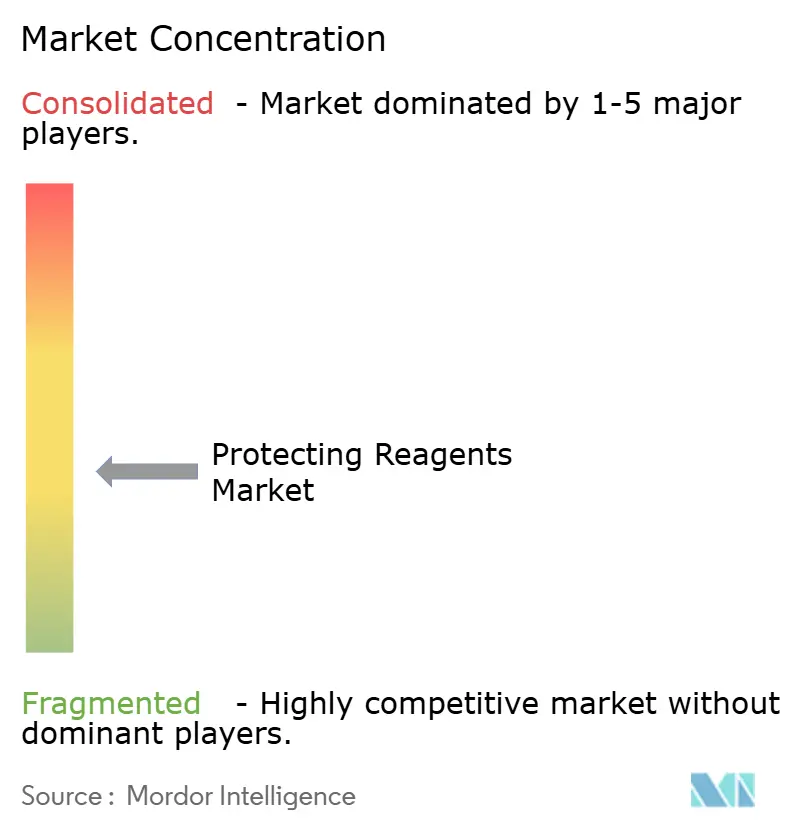
The protecting reagents market is moderately fragmented. Merck KGaA and Thermo Fisher Scientific form the leading global tier through broad portfolios, established logistics, and long-standing relationships with regulated peptide manufacturers. Below that tier, the market includes specialist suppliers such as Iris Biotech, Bachem's Research and Specialties business, GL Biochem, and Suzhou Highfine Biotech, which compete on chemistry depth, optical purity, and responsiveness to custom synthesis rather than broad catalog scale. This creates a layered structure in which large distributors serve high-volume, validated supply needs, while specialists address complex, lower-volume, or less standardized protecting group requirements. Bachem reported 8.8% year-on-year growth in its Research and Specialties business in 2025, indicating that reagent demand remains significant even among companies that are also large peptide active pharmaceutical ingredient (API) manufacturers.
Technology differentiation is becoming more visible in the protecting reagents market as newer protecting group systems, including photocleavable and orthogonal options, address selectivity needs that standard Fmoc-centered workflows do not always meet. This is most relevant in complex peptide, bioconjugate, and hybrid oligonucleotide programs where stepwise control is more difficult and customers are less willing to accept variability. The market also has room for products tailored to continuous-flow platforms, where solvent behavior and stability requirements can differ from conventional batch solid-phase peptide synthesis (SPPS). Bachem inaugurated Building K in April 2026, strengthening vertically linked peptide and oligonucleotide production while supporting internal and external demand for high-purity upstream reagents. Thermo Fisher launched a U.S. investment program in April 2025, expanding the broader manufacturing and service footprint that supports regulated reagent supply and pharma services.
CordenPharma's expansion of its peptide platform across Switzerland and the United States illustrates how customers in the protecting reagents market are preparing for larger peptide output and more durable supplier partnerships. Specialist suppliers from China are gaining ground in research-grade market segments through cost competitiveness and growing technical capabilities. However, their entry into good manufacturing practice (GMP) supply remains challenging, as documentation systems, analytical depth, and multi-year quality investments continue to represent barriers in regulated end uses. This dynamic keeps the market competitive while limiting penetration at the premium end, where validation history is as important as chemical performance.
Protecting Reagents Industry Leaders
Merck KGaA
Thermo Fisher Scientific Inc.
Bachem Inc.
GL Biochem (Shanghai) Ltd.
CordenPharma
- *Disclaimer: Major Players sorted in no particular order
Protecting Reagents Market Companies Covered in this Report
- AAPPTec
- Apollo Scientific Ltd.
- Bachem Inc.
- Biosolve Chimie
- BLD Pharmatech Ltd.
- Carl Roth GmbH + Co. KG
- Chem-Impex International
- CordenPharma
- CS Bio Co.
- Enamine Ltd.
- Fluorochem Ltd.
- FUJIFILM Wako Pure Chemical Corporation
- GL Biochem (Shanghai) Ltd.
- Iris Biotech GmbH
- Merck KGaA
- Suzhou Highfine Biotech Co., Ltd.
- Thermo Fisher Scientific Inc.
- Tokyo Chemical Industry Co., Ltd.
- Toronto Research Chemicals Inc.

Recent Industry Developments in Protecting Reagents Market
- April 2026: Bachem AG inaugurated Building K at its Bubendorf, Switzerland headquarters, a production facility for large-scale peptide and oligonucleotide APIs, cleared by Swissmedic following an inspection at end-2025. Commercial production has been ramping up progressively since April 2026 while the second phase of construction is being completed. The facility significantly increases large-scale solid-phase peptide synthesis (SPPS) capacity and directly lifts demand for high-purity protecting reagents within Bachem's integrated supply chain.
- April 2025: Thermo Fisher Scientific announced a USD 2 billion investment commitment across US manufacturing and R&D over 4 years. The commitment spans 64 US manufacturing facilities across 37 states, with pharma services, encompassing reagent supply, CDMO capacity, and analytical services, identified as a primary beneficiary of the expanded footprint.


Global Protecting Reagents Market Report Scope
Protecting reagents are substances used to temporarily mask specific functional groups. This prevents the groups from undergoing unwanted reactions during multi-step synthesis, allowing chemists to safely modify other parts of the molecule before restoring the original group.
The protecting reagents market is segmented by product type, physical form, application, and geography. By product type, the market is segmented into amino protecting reagents, hydroxyl protecting reagents, carboxyl protecting reagents, thiol protecting reagents, carbonyl protecting reagents, and other protecting reagents. By physical form, the market is segmented into powder, solution, and other forms. By application, the market is segmented into peptide synthesis, pharmaceutical API synthesis, oligonucleotide synthesis, organic synthesis, bioconjugation, specialty and fine chemical synthesis, academic and research, and other applications. The report also covers market size and forecasts for protecting reagents across 11 countries in major regions. The market sizes and forecasts are provided in terms of value (USD).
| Amino Protecting Reagents | Fmoc Reagents |
| Boc Reagents | |
| Cbz (Z) Reagents | |
| Other Amino Protecting Reagents | |
| Hydroxyl Protecting Reagents | |
| Carboxyl Protecting Reagents | |
| Thiol Protecting Reagents | |
| Carbonyl Protecting Reagents | |
| Other Protecting Reagents |
| Powder |
| Liquid |
| Other Forms |
| Peptide Synthesis |
| Pharmaceutical API Synthesis |
| Oligonucleotide Synthesis |
| Organic Synthesis |
| Bioconjugation |
| Specialty and Fine Chemical Synthesis |
| Academic and Research |
| Other Applications |
| Asia-Pacific | China |
| India | |
| Japan | |
| South Korea | |
| Rest of Asia-Pacific | |
| North America | United States |
| Canada | |
| Europe | Germany |
| United Kingdom | |
| France | |
| Italy | |
| Russia | |
| Rest of Europe | |
| Rest of the World | South America |
| Middle-East and Africa |
| By Product Type | Amino Protecting Reagents | Fmoc Reagents |
| Boc Reagents | ||
| Cbz (Z) Reagents | ||
| Other Amino Protecting Reagents | ||
| Hydroxyl Protecting Reagents | ||
| Carboxyl Protecting Reagents | ||
| Thiol Protecting Reagents | ||
| Carbonyl Protecting Reagents | ||
| Other Protecting Reagents | ||
| By Physical Form | Powder | |
| Liquid | ||
| Other Forms | ||
| By Application | Peptide Synthesis | |
| Pharmaceutical API Synthesis | ||
| Oligonucleotide Synthesis | ||
| Organic Synthesis | ||
| Bioconjugation | ||
| Specialty and Fine Chemical Synthesis | ||
| Academic and Research | ||
| Other Applications | ||
| By Geography | Asia-Pacific | China |
| India | ||
| Japan | ||
| South Korea | ||
| Rest of Asia-Pacific | ||
| North America | United States | |
| Canada | ||
| Europe | Germany | |
| United Kingdom | ||
| France | ||
| Italy | ||
| Russia | ||
| Rest of Europe | ||
| Rest of the World | South America | |
| Middle-East and Africa | ||


Key Questions Answered in the Report
What is current market size of Protecting Reagents Market?
The Protecting Reagents Market size was valued at USD 0.71 billion in 2025 and is estimated to grow from USD 0.75 billion in 2026 to reach USD 1.03 billion by 2031, at a CAGR of 6.55% during the forecast period (2026-2031).
What is driving demand for protecting reagents the most right now?
GLP-1 peptide manufacturing is the strongest near-term demand driver because higher peptide API output directly increases consumption of protected amino acid building blocks and related synthesis inputs.
Which product type leads in protecting reagents’ sales?
Amino Protecting Reagents lead with 46.82% share in 2025 and post the fastest product growth at 8.62% CAGR through 2031, reflecting the central role of Fmoc-led chemistry in SPPS.
Why are liquid formulations gaining traction in peptide manufacturing?
Liquid formats are growing faster, at a 7.05% CAGR, as automated synthesis platforms increasingly prefer ready-to-use solutions that reduce manual preparation and enable cleaner, more consistent handling.
Page last updated on:





